OPC applications

TP1 | Atmospheres and Exospheres of Terrestrial Bodies

EPSC2024-231 | ECP | Posters | TP1

Validation of Martian dust storm trajectories in the Mars PCM using observational datasets 

Demetrius Ramette, Ehouarn Millour, Tanguy Bertrand, Antoine Bierjon, and Kerstin Schepanski
Mon, 09 Sep, 14:30–16:00 (CEST) | Poster area Level 2 – Galerie | P1
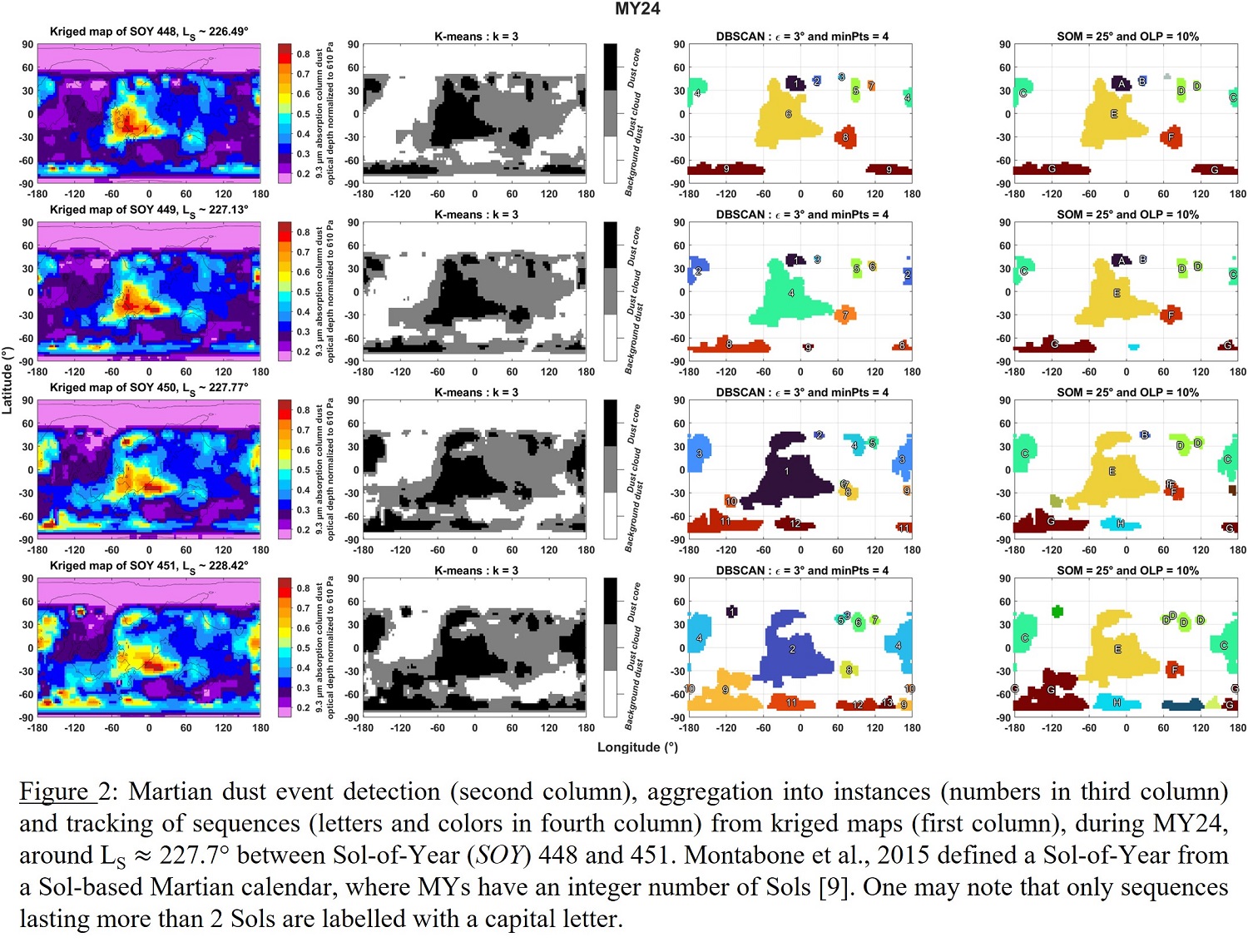
Dust is a key component affecting the radiative budget of the Martian atmosphere. In order to achieve accurate numerical modelling of the Martian weather and climate, it is therefore crucial to understand the dynamics of Martian dust storms throughout their whole life cycle, from the injection to the deposition of dust [1]. However, our understanding of dust storm dynamics is still incomplete and simulations of the Martian dust cycle come with large uncertainties, especially concerning the transport of dust by model winds. The latter are difficult to validate, as in-situ or remote-sensing measurements of winds in the Martian atmosphere are rare or inexistent. How well do dust storm trajectories predicted by a Mars Global Climate Model match observed trajectories?

In this study, we use recently published observations [2, 3] of dust storm trajectories and dust storm simulations by the Mars PCM6 [4], in order to compare the direction and velocity of dust transport of individual dust storms. This will allow to identify strengths and weaknesses of the Mars PCM6 with respect to dust transport.

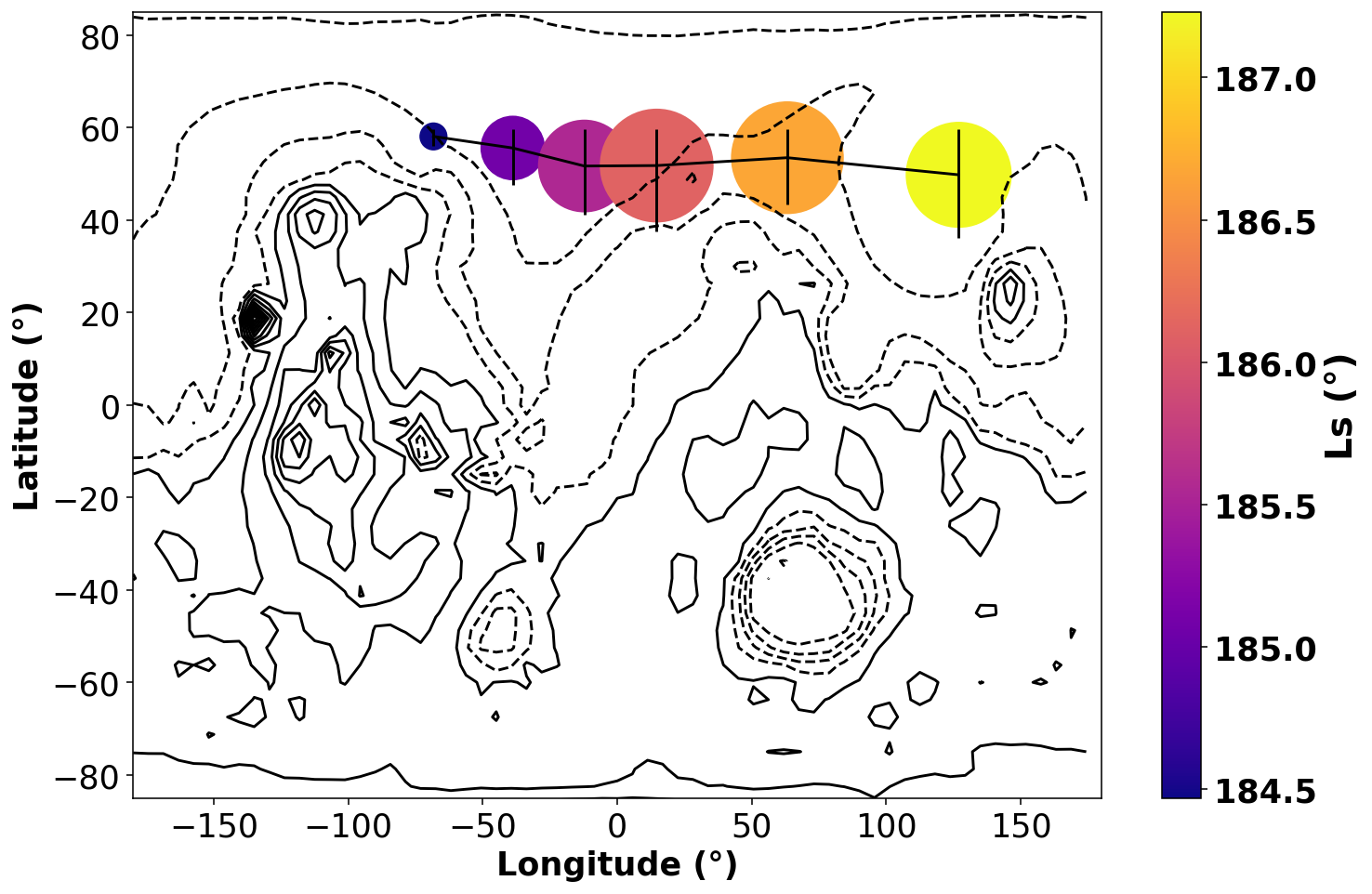
The Mars PCM in its newest version 6 [5, 6] is able to initiate a dust storm with a given dust scenario – based on maps of the observed column dust optical depth from [7] – and then let it freely evolve, following the large scale winds and other relevant physical processes. The Mars Dust Activity Database (MDAD, [2]) and the Mars Dust Storm Sequence Dataset (MDSSD, [3]) contain compilations of observed dust storms, based on high-resolution (0.1° x 0.1°) daily mosaics of wide-angle images from orbital cameras. Fig. 1 shows an exemplary trajectory of a dust storm member from the MDAD.

This new combination of model results and observations may further open opportunities to better understand the dynamics of Martian dust storms, especially concerning emission and deposition processes and, based on that, to improve dust cycle representation in the Mars PCM.

Fig. 1: Plotting of the trajectory of an exemplary dust storm member during Mars Year 24 on a map of Mars, around Ls=185° (here: dust storm member m03_126 from the MDAD [2]). The size of the colored circles scales with the surface area of the dust storm and the color indicates the time of observation (solar longitude Ls, in degrees). The vertical black lines indicate the maximum latitudinal extension of the dust storm. The black broken line connects the individual positions of the dust storm centroid and thus indicates the evolution of its position over time. The contour lines (dashed and solid lines) represent the Martian topography with a line interval of 1500m. Here, we see that the dust storm originates in the Northern Hemisphere west of Acidalia Planitia and ends in Utopia Planitia. In this study, we want to compare these kind of tracks with model simulations.


[1] Kahre, M. A., Murphy, J. R., Newman, C. E., Wilson, R. J., Cantor, B. A., Lemmon, M. T., & Wolff, M. J. (2017). The Mars dust cycle. The atmosphere and climate of Mars, 18, 295.

[2] Battalio, M., & Wang, H. (2021). The Mars Dust Activity Database (MDAD): A comprehensive statistical study of dust storm sequences. Icarus, 354, 114059.

[3] Wang, H., Saidel, M., Richardson, M. I., Toigo, A. D., & Battalio, J. M. (2023). Martian dust storm distribution and annual cycle from Mars daily global map observations. Icarus, 394, 115416.

[4] Forget, F., Hourdin, F., Fournier, R., Hourdin, C., Talagrand, O., Collins, M., Lewis, S.R., Read P.L. & Huot, J. P. (1999). Improved general circulation models of the Martian atmosphere from the surface to above 80 km. Journal of Geophysical Research: Planets, 104(E10), 24155-24175.

[5] Forget, F., Millour, E., Bierjon, A., Delavois, A., Fan, S., Lange, L., Liu, J., Mathe, C., Naar, J., Pierron, T., Vandemeulebrouck, R., Spiga, A., Montabone, L., Chaufray, J.-Y., Lefèvre, F. Määttänen, A., Montmessin, F., Rossi, L., Vals, M., Gonzalez-Galindo, F., Lopez-Valverde, Wolff, M.J., Young, R., Lewis, S.R. & Read, P. L. (2022). Challenges in Mars Climate Modelling with the LMD Mars Global Climate Model, Now Called the Mars “Planetary Climate Model”(PCM). In Seventh international workshop on the Mars atmosphere: Modelling and observations.

[6] Millour, E., Bierjon, A., Forget, F., Spiga, A., Wang, C. and the Mars PCM Team, "Improving the vertical distribution of airborne dust in the Mars PCM", EPSC 2024

[7] Montabone, L., Forget, F., Millour, E., Wilson, R. J., Lewis, S. R., Cantor, B., Kass, D., Kleinböhl, A., Lemmon, L.T., Smith, M.D. & Wolff, M. J. (2015). Eight-year climatology of dust optical depth on Mars. Icarus, 251, 65-95.

How to cite: Ramette, D., Millour, E., Bertrand, T., Bierjon, A., and Schepanski, K.: Validation of Martian dust storm trajectories in the Mars PCM using observational datasets, Europlanet Science Congress 2024, Berlin, Germany, 8–13 Sep 2024, EPSC2024-231, https://doi.org/10.5194/epsc2024-231, 2024.

TP2 | Mars Surface and Interior

EPSC2024-748 | ECP | Posters | TP2 | OPC: evaluations required

Water and Sediment Transport Processes in Jezero Crater 

Anastasiia Ovchinnikova, Ralf Jaumann, Sebastian H. G. Walter, Christoph Gross, Wilhelm Zuschneid, and Frank Postberg
Wed, 11 Sep, 10:30–12:00 (CEST) | Poster area Level 2 – Galerie | P7

Introduction: The current NASA's Mars 2020 mission is exploring the Jezero crater that was once filled with water. Since it is widely acknowledged that access to liquid water is essential for life, studying the fluvial activity in Jezero can aid in the crater’s habitability assessment. We examined ten water-related processes using water and sediment transport models by [3]: 1) the western inlet valley carving, 2) the northern inlet valley carving, 3) crater flooding by only northern inlet, 4) by both northern and western inlets, 5) erosion of the western rim by the western inlet, 6) erosion of the eastern rim due to the outlet, 7) water outflow from the crater, 8) outlet valley carving, 9) western delta deposition, 10) northern delta deposition. The goal of our study was to calculate the minimum timescales for each event and estimate the minimum volume of water provided/released during each event. Relative comparison of timescales and of water amount which we calculated based on new geomorphological observations introduces a deeper understanding of the water history in Jezero.

Data: Measurements of channel sizes, valleys, deltas, eroded rims, and outflowed water volumes were based on Mars 2020 Science Investigation CTX DEM Mosaic [5] and HRSC Mars Chart (HMC) DTM and corresponding orthomosaics [2].

Geomorphological observations: The northern inlet was most likely involved in the crater flooding because it has terraces at the same height as the breaching terraces in the eastern rim (breaching happened in 3 phases, as shown in [7]). The western inlet, in contrast, has no terraces at the breaching heights. This implies that either it was not involved in crater flooding, or its terraces were eroded.

Mapping: Both deltas were mapped using three potential extents: minimum, medium, and maximum. Valleys were mapped based on two morphological features: 1) initial valley, borders of which are not visible on HMC ortho-mosaics and could only be recognized on slope and profile curvature rasters, calculated from HMC DTM; 2) last incision valley, which was mapped on HMC ortho-rectified image mosaic.

Measurements: Dimensions of the channels were derived from longitudinal and cross-sectional profiles on CTX DTM. Water volume to fill the crater before breaching and the amount of sediments, transported from valleys and deposited in deltas were estimated using ArcGIS Tools „Surface Volume“ and „CutFill“.

Methodology: Flow discharge and sediment transport models [3] are used to calculate water and sediment transport timescales under constant bank-full discharge when most of erosion occurs. The models do not include the climate and non-bank-full conditions to constrain minimum timescales. Main input parameters include: Median Grain Size, Channel depth, width and slope, Sediment porosity, Shields criterion for incipient motion, Sediment density, Martian gravity, and Water density. Data from the Perseverance rover [1] were taken for the Median Grain Size estimation. Sediment porosity, Sediment density, and Shields criterion for incipient motion were taken based on previous research [3], [4], [6]. Several scenarios were modeled with varying values of input parameters in the most expectable ranges. Eastern and western rim breechings were modelled both in a catastrophic scenario and in a long-term erosion under constant flow scenario.

Results: A comparison of the timescales of the last incised valleys carving and delta depositions showed that deltas were deposited during the last incision of the corresponding valleys. For the northern delta, the medium extent is the most probable; for the western delta, the maximum extent is the most probable.

Most modelled cases, in both long-term and catastrophic scenarios of the rim breaching, showed that the outlet valley carving lasted longer than the eastern rim erosion. Therefore, Jezero was an open-basin lake after breaching.

The eastern rim erosion and water outflow during breaching showed different results depending on the scenario. In the long-term scenario, the eastern rim erosion lasted longer than the outflow of water which was stored in the crater before breaching. That means, that this amount of water (236 km3) was not enough to carve the breach. In the catastrophic scenario there are overlapping timescales, therefore, the eastern rim breaching, and water outflow could happen simultaneously.

Multiplying the timescales by corresponding discharges allows us to calculate the minimum water volume provided/released during each event. Dividing the minimum water volume by the volume of the crater before breaching (446 km3) shows that the northern inlet as well as the western inlet could alone flood the crater (last column in Table 1).

A comparison of the minimum amount of water discharged after the breach (236 km3) with the amount of water needed to carve the whole outlet valley (1000 – 14800 km3, Table 1) confirms that Jezero must have been an open-basin lake after the breaching.

Table 1. Minimum water volume provided/released during the carving of the valleys. Timescales presented for the total valley carving (initial valley and last incised valley together).


Timescale, Earth years

Discharge, km3/day

Minimum volume of provided/released water, km3

 How many times Jezero could be filled before breaching (basin volume = 446 km3)

Northern Valley Total

70 – 632

~0.2

4600 – 42000

10 – 94

Western Valley Total

505 – 3792

~0.2

33500 – 253000

75 – 567

Outlet Valley Total

1.4 – 21.2

~1.9

1000 – 14800


References:

[1] Farley K., and Stack K. (February 15, 2023). Mars 2020 reports, Volume 2. https://mars.nasa.gov/internal_resources/1656/

[2] Gwinner, K. et al. (2016). The High Resolution Stereo Camera (HRSC) of Mars Express and its approach to science analysis and mapping for Mars and its satellites. Planetary and Space Science, 126, 93–138. https://doi.org/10.1016/j.pss.2016.02.014

[3] Kleinhans, M. G. (2005). Flow discharge and sediment transport models for estimating a minimum timescale of hydrological activity and channel and delta formation on Mars. Journal of Geophysical Research: Planets, 110(12), 1–23. https://doi.org/10.1029/2005JE002521

[4] Kleinhans, M. G., van de Kasteele, H. E., & Hauber, E. (2010). Palaeoflow reconstruction from fan delta morphology on Mars. Earth and Planetary Science Letters, 294(3–4), 378–392. https://doi.org/10.1016/j.epsl.2009.11.025

[5] Malin, M. C. et al. (2007). Context Camera Investigation on board the Mars Reconnaissance Orbiter. Journal of Geophysical Research: Planets, 112(5). https://doi.org/10.1029/2006JE002808

[6] Roda, M. et al. (2014). Catastrophic ice lake collapse in Aram Chaos, Mars. Icarus, 236, 104–121. https://doi.org/10.1016/j.icarus.2014.03.023

[7] Salese, F. et al. (2020). Estimated Minimum Life Span of the Jezero Fluvial Delta (Mars). Astrobiology, 20(8), 977–993. https://doi.org/10.1089/ast.2020.2228

How to cite: Ovchinnikova, A., Jaumann, R., Walter, S. H. G., Gross, C., Zuschneid, W., and Postberg, F.: Water and Sediment Transport Processes in Jezero Crater, Europlanet Science Congress 2024, Berlin, Germany, 8–13 Sep 2024, EPSC2024-748, https://doi.org/10.5194/epsc2024-748, 2024.

EPSC2024-777 | ECP | Posters | TP2

Polyphase Amazonian floods in the Olympica – Jovis Fossae channel system. 

Anita Zambrowska, Daniel Mège, and Sam Poppe
Wed, 11 Sep, 10:30–12:00 (CEST) | Poster area Level 2 – Galerie | P14
  • Centrum Badań Kosmicznych Polskiej Akademii Nauk (CBK PAN), Bartycka 18A, 00-716 Warszawa, Poland
IntroductionIntroductio

Introduction

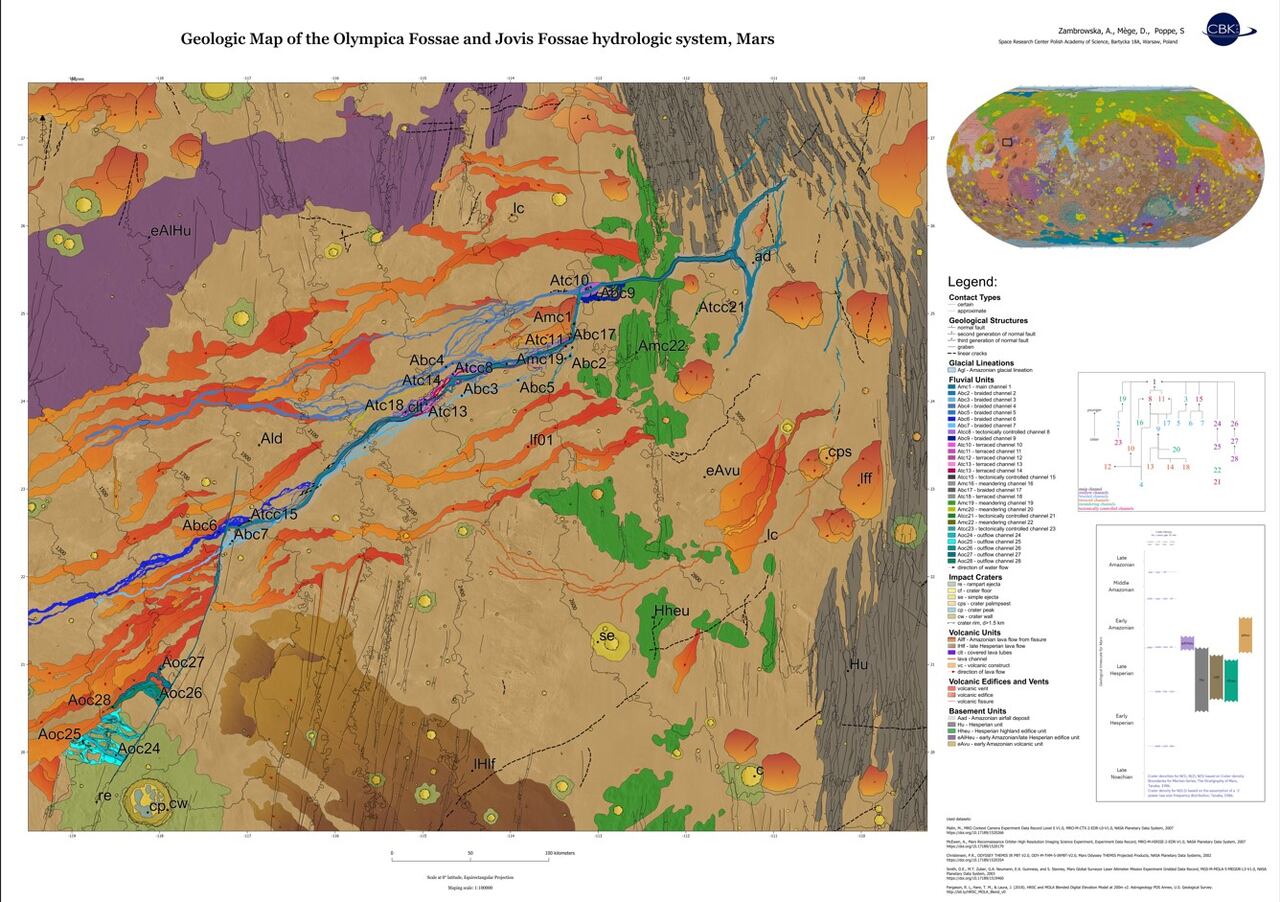
Geomorphological evidence of deglaciation was discovered on Mars at mid-latitudes [1, 2], in response to planetary obliquity changes [3]. Many craters contain evidence of subsurface ice remaining from Late Amazonian deglaciation [4]. Martian climate models predict the presence of ice accumulation in the mid-latitudes, especially on the western flanks of the Tharsis montes [5]. During the Amazonian epochs, the early Tharsis reservoirs were partly withdrawn to the surface, through outflow channels [6]. The largest of them formed between 3.7 and 3 billion years ago. There is evidence, however, that the crustal water reservoir was not exhausted after this time [7][8]. Many channels, including the largest Amazonian system Olympica – Jovis Fossae, formed at the top of the Tharsis bulge in lava flows that may be only a few hundred million years old [9]. To investigate the formation of such channel systems, we present a new geological map of Olympica-Jovis Fossae (Figure 1).

Data and methods

To map morphological and geological features, we used visible imagery from the Mars Reconnaissance Orbiter (MRO) Context Camera (CTX) with a resolution of 6 meters per pixel [10][11] and MRO High-Resolution Imaging Science Experiment (HiRISE) camera with a resolution of 25 cm per pixel [12]. To constrain the intersecting relationships between channels we used the newest DEM topography data (2021 – 2023) from the Mars Express High Resolution Stereo Camera (HRSC) with a resolution of ~20-40 meters per pixel [11][13] and optical imagery data from the ExoMars Trace Gas Orbiter, Colour and Stereo Surface Imaging System (CaSSIS) with a resolution of 4.8 meters per pixel ([14]).

Results

Our new geological map includes fluvial units (Figure 2), volcanic units, volcanic edifices and vents, glacial lineations, regional fracture systems, and impact craters. We identified 28 fluvial units that could be attributed to six classes, based on discriminating geomorphological features. Observed channel morphologies include the main channel (set of troughs and channels extending from the triple junction to Jovis Fossae), braided channels with densely interconnected channels with dendritic and sinuous geometry, terraced channels with eroded floors, step-like landforms, meandering channels, tectonically controlled channels, and outflow channels with streamlined islands. The oldest in the sequence of fluvial channels are terraced channels, representing multiple flooding events, followed by braided channels, meandering channels, outflow channels that originate at

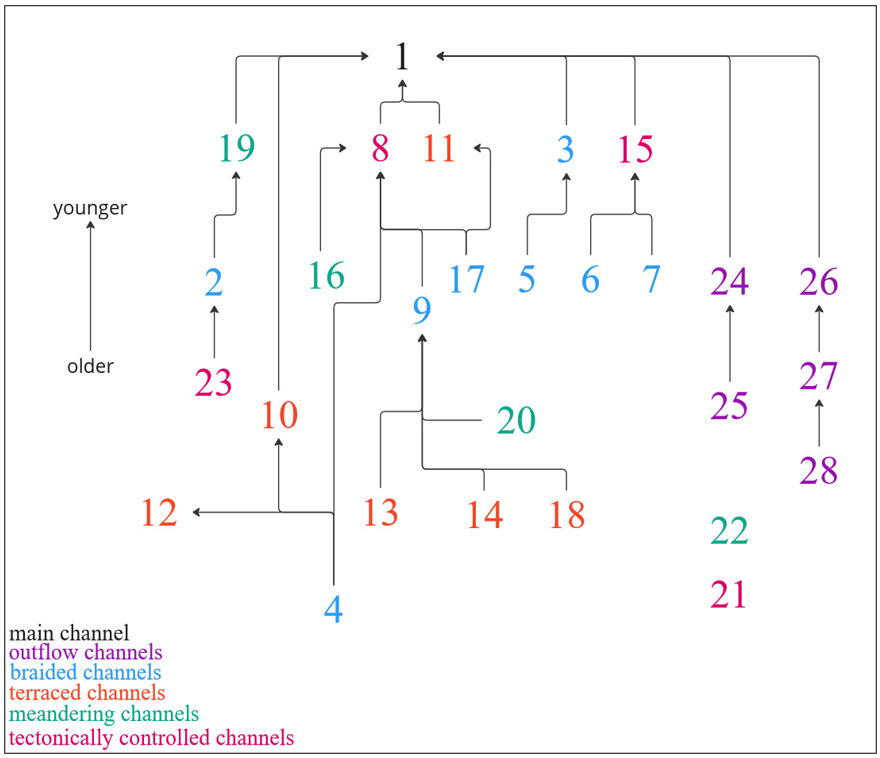
Jovis Fossae system fissures, and tectonically controlled channels (attributed to extensional stress, subsequently developed and filled by water and lava). Investigation of the mapped units and correlation of channel formation reveal at least three bigger flooding events. We determined the relative ages and relationships between fluvial channels from cross-cutting relationships (Figure 3).

Figure 1. Geologic map of the Olympica Fossae and Jovis Fossae hydrologic system.

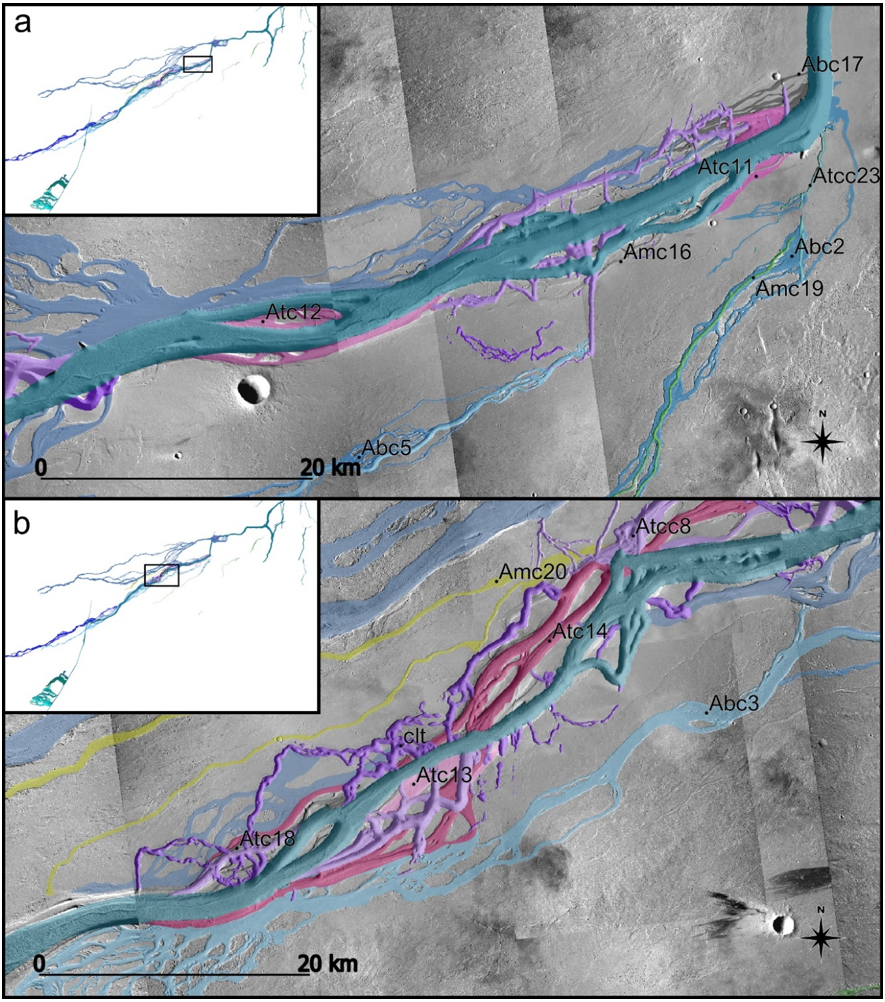
Figure 2. Zoom on two regions of the map. Legend: clt – collapsed lava tube, Atc – Amazonian terraced channel, Amc – Amazonian meandering channel, Abc – Amazonian braided channel, Atcc – Amazonian tectonically controlled channel.

Figure 3. Chart of cross-section relationships between 28 fluvial channels. Arrowheads indicate younger flows.

Discussion and conclusion

We present the first detailed geological map and relative dating of the Olympica Fossae and Jovis Fossae, providing a basis for understanding the recent hydrologic and volcanic activity at the top of the Tharsis dome. Our map includes 28 individual fluvial units, glacial lineations, impact craters, volcanic units, edifices, and vents, as well as geological structures. We found a series of complex cross-cutting relationships between channels. General investigation of the channel’s morphology and their correlation with volcanic edifices reveal that the Olympica Fossae and Jovis Fossae formed by repeated overflows from various fissures related to an intensive period of distributed volcanism. Olympica – Jovis Fossae shares similar fluvial morphology with other outflow channels on Mars. Since our geologic map reveals six types of channels, future detailed morphologic analysis will be crucial to better understand the general conditions for catastrophic groundwater flooding in a volcanic context. Further efforts are needed to identify the chronological succession of deposition and flows and interfaces between floods, lava flows, and airfall deposits, based on crater retention age determination.

References:

[1] Baker, D. M. H., & Head, J. W. (2015). Icarus, 260, 269–288.

[2] Head, J. W., et al. (2006). Geophysical Research Letters, 33(8).

[3] Head, J. W., et al. (2006). Earth and Planetary Science Letters, 241(3-4), 663–671.

[4] Dickson, J.L., et al. (2010). Earth and Planetary Science Letters, 294(3-4), 332–342.

[5] Shean, D. E. (2005). Journal of Geophysical Research, 110(E5).

[6] Cassanelli, J.P., Head, J.W. (2019). Planetary and Space Science 169, 45-69.

[7] Rodriguez, J. A. P., et al. (2015). Icarus, 257, 387–395.

[8] Hiatt, E., et al. (2024). Icarus, 408, 115774

[9] Keske, A.L., et al. (2015). Icarus, 245, 333-347.

[10] Fergason, R. L., et al. (2021). 51st  Lunar Planet. Sci. Conf. Abstract #2020.

[11] Jaumann, R., et al. (2007). Planetary and Space Science, 55(7), 928–952.

[12] McEwen, A. S., et al. (2007). Journal of Geophysical Research, 112(E5), E05S02.

[13] Neukum, G., Jaumann, R. (2004). Eur. Space Agency Spec. Publ., ESA-SP 1240, 17–35.

[14] Thomas, N., et al. (2017). Space Sci Rev 212, 1897–1944.

How to cite: Zambrowska, A., Mège, D., and Poppe, S.: Polyphase Amazonian floods in the Olympica – Jovis Fossae channel system., Europlanet Science Congress 2024, Berlin, Germany, 8–13 Sep 2024, EPSC2024-777, https://doi.org/10.5194/epsc2024-777, 2024.

EPSC2024-1077 | ECP | Posters | TP2

Evolution of fluvial, and possible lacustrine or marine activity in Nilosyrtis, Mars -  A geomorphological & chronostratigraphic analysis. 

Emelie Saar, Cynthia Sassenroth, and Andreas Johnsson
Wed, 11 Sep, 10:30–12:00 (CEST) | Poster area Level 2 – Galerie | P12
 Introduction

Today, Mars’ surface is defined as a cold hyper-arid desert, but geomorphological and geochemical observations have shown that in the past, vast amounts of liquid water were stable at the planet’s surface (Di Achille et al. 2006, Erkeling et al. 2012, Hauber et al. 2009). With the increased coverage of high-resolution remote sensing datasets, investigations of possible remnants of fluvial processes in the Martian landscape have significantly increased during the last couple of decades. The spatiotemporal evolution of hydrological events is however not well understood (Erkeling et al. 2012). In this master thesis study, an impact crater in the region of Nilosyrtis Mensae has been mapped to identify geomorphological evidence that can increase the understanding of the spatiotemporal evolution of landforms at the dichotomy boundary on Mars.

Method & Data

The mapping was made using ArcGIS Pro version 3.1.0. with inspiration taken from the FGDC Digital Cartographic Standard for Geologic Map Symbolization (USGS, 2006) as well as the Italian cartographic standard Geomorphological Map of Italy at 1:50,000 scale by ISPRA (2021). The Context Camera [CTX] mosaic & raw images (5-6 m/px) and High Resolution Imaging Science Experiment [HiRISE] images (0.3-0.25m/px) as well as the THEMIS IR mosaic dataset of 100m/px were used to map surface features. 3D models were used in this study to support interpretations, such as the HRSC DEM product mosaic of 50m/px. By using the MarsSI application (marssi.univ-lyon1.fr) overlapping CTX raw images have been processed for HiRISE & CTX imagery to create DEM products with 12 m/px and 0.5 m/px respectively.

Geological setting

The study crater is 80+ km wide and is located at the dichotomy boundary. The crater lacks primary impact morphology and ejecta. The northeastern wall is completely degraded and opens up towards the northern plains. Moreover, the crater wall is incised by several channels of which two channels connects to adjacent craters of similar size, located east and west of the study area. The crater floor forms a palimpsest landscape of different landforms suggesting a very complex history of sedimentation, exhumation and erosion.   

Result

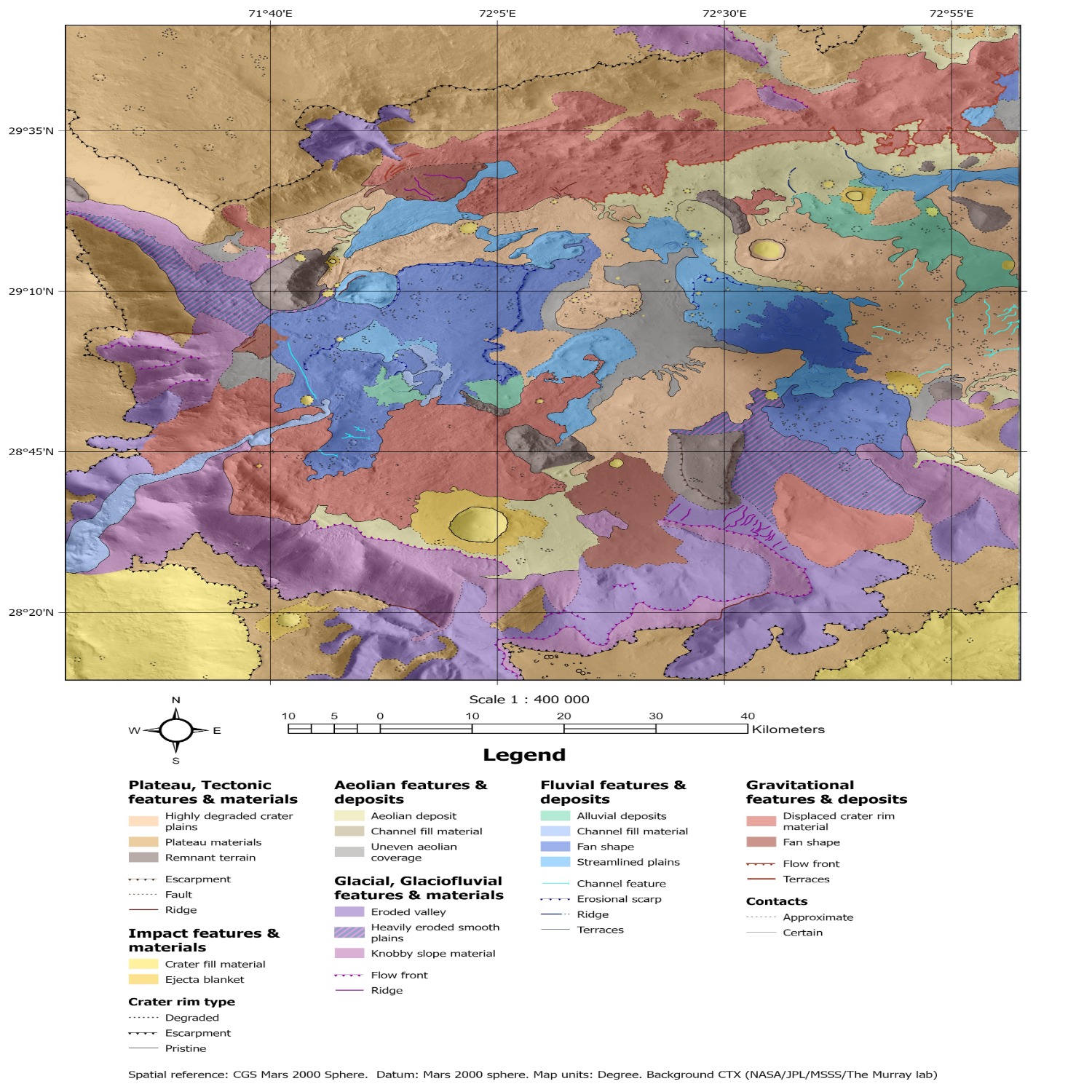
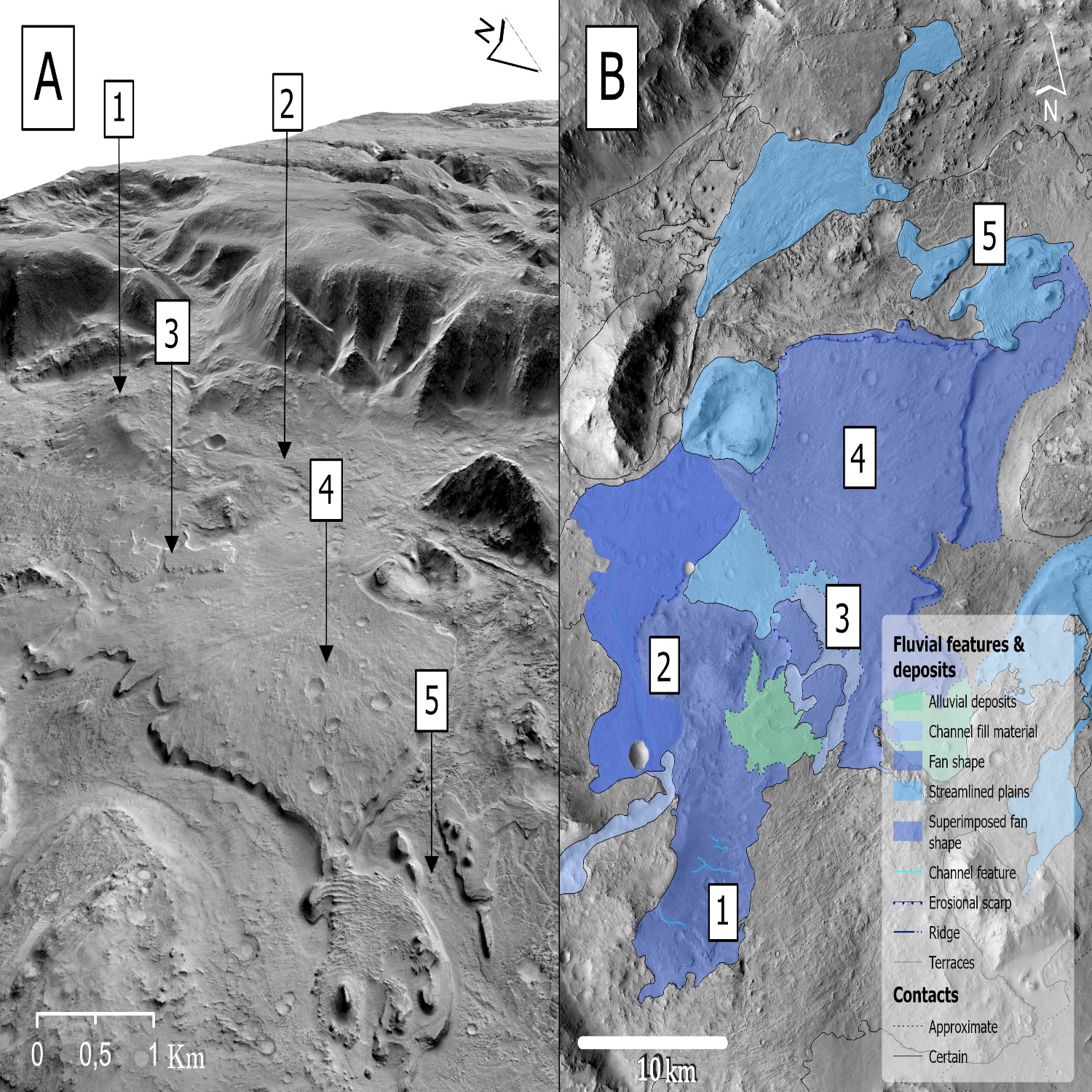
The main result is the geomorphological map produced by this study (Fig.1). Key findings include a set of fan-shaped landforms that partially cover the crater floor. Some fans are associated with valley incisions and one of the larger fans is heavily affected by impact cratering. The fan shapes have a variety in surface texture, morphology, size and stratigraphic positions. Multiple elongated fan shapes combined with streamlined plains, alluvial deposits have been identified at the termination of the southwestern valley inlets (Fig. 2).

Figure 1. A geomorphological map of an impact crater basin in Nilosyrtis Mensae, Mars, at approximate
29°N, 72°E draped over the CTX satellite mosaic (NASA/JPL/MSSS/The Murray lab
Spatial reference: CGS Mars 2000 Sphere. Datum: Mars 2000 sphere. Map units: Degree.

Figure 2. A) 3D view of the valley inlet entering the study crater from the southeast. B) An overview of the mapped units of possible fluvial genesis in the western region of the impact crater basin. Fan shape 1 and 2 are deposited in a close spatial proximity to the channel inlet, while fan shape unit 3 is found further out, divided by a depression of possible alluvial deposition. Fan shape unit 4 covers a large part of the crater floor and does exhibit unique geomorphological features at the top of the streamlined plains marked at 5. Image credit: NASA/JPL/MSSS/The Murray lab.

 Discussion & Conclusion

The diverse classification of landforms and interpreted geneses shows that the studied crater has experienced a long history of degradation, deposition by various processes and erosion since its formation. The superposition between geological units suggests a scenario where fluvial deposition have occurred episodically. Bamberg et. al., (2014) describes the geological history of the floor-fractured crater which is connected to the studied crater by a channel inlet from the northwest. The possible fluvial landforms in the studied crater suggests a close relationship to the hypothesized scenario by Bamberg et al., (2014) of a major fluvial event. Lesser fluvial activity followed, predominantly controlled by conditions in the study crater.  In conclusion, the geomorphology suggests a long and complex history of fluvial events. An impact of possible lacustrine or marine conditions could not be confirmed nor refuted. The framework of the thesis did not allow for more detailed studies using spectral data. Work that includes CRISM may provide further insights into the temporal evolution in the studied crater.   

References

Bamberg et.al., (2014). Floor-Fractured Craters on Mars – Observations and Origin. Planetary and Space Science, 98, 146–162. https://doi.org/10.1016/j.pss.2013.09.017

Di Achille et.al., (2006) Geological evolution of the Tyras Vallis paleolacustrine system, Mars. Journal of Geophysical Research, 111(E4), E04003-N/a.

Erkeling, et.al., (2012). Valleys, paleolakes and possible shorelines at the Libya Montes/Isidis boundary; implications for the hydrologic evolution of Mars. Icarus 219(1), 393-413.

Hargitai, (2019). Planetary Cartography and GIS. Springer.

Hauber, et.al., (2009). Sedimentary deposits in Xanthe Terra: Implications for the ancient climate on Mars. Planetary and Space Science, 57(8), 944-957

ISPRA. (2021). Geomorphological Map of Italy at 1:50,000 scale - Update and additions to the Guidelines of the Geomorphological Map of Italy at 1:50,000 scale and Geomorphological Database (Version 2.0). Volume 13, issue 1 Volume 13, Part I - The CARG Project: changes and additions to the Quaderno n. 4/19944/2022. https://www.isprambiente.gov.it/resolveuid/45c17b95e93f45cda3e1c2fa0f5e06fa

USGS. (2006). FGDC Digital Cartographic Standard for Geologic Map Symbolization (PostScript Implementation. U.S. Geological Survey Techniques and Methods 11-A2. Derived 2023-12-29 from:https://pubs.usgs.gov/tm/2006/11A02/


How to cite: Saar, E., Sassenroth, C., and Johnsson, A.: Evolution of fluvial, and possible lacustrine or marine activity in Nilosyrtis, Mars -  A geomorphological & chronostratigraphic analysis., Europlanet Science Congress 2024, Berlin, Germany, 8–13 Sep 2024, EPSC2024-1077, https://doi.org/10.5194/epsc2024-1077, 2024.

EPSC2024-1115 | Posters | TP2 | OPC: evaluations required

Exploring Polygonal Patterned Grounds in the Hyper-arid Atacama Desert: Insights into Formation Mechanisms and Implications for Martian Analogues 

Josephine Anderson, Christof Sager, Alessandro Airo, Andrea Miedtank, Franziska Schwonke, and Jenny Feige
Wed, 11 Sep, 10:30–12:00 (CEST) | Poster area Level 2 – Galerie | P18

Understanding the formation mechanisms of polygonal patterned grounds in hyper-arid environments like the Atacama Desert is crucial for unraveling their significance as an analogue for extraterrestrial landscapes, notably Mars. Unlike their extensively studied periglacial counterparts, the genesis of hyper-arid polygons requires more detailed exploration, since multiple processes, such as, desiccation [1] (including gypsum dehydration), thermal contraction [2], and haloturbation [3] are currently under debate. Therefore, we excavated a trench in polygonated ground in the Yungay area of the Atacama Desert and systematically collected over 80 soil samples covering an entire polygon, its adjacent sand wedges, and underlying sediments (190 x 190 cm). Sedimentological and geochemical analyses indicate a continuous interplay of atmospheric salt deposition, dissolution, precipitation, and inducing clast heave and shattering, under extreme dry conditions. Our findings emphasize that polygons in the Atacama Desert provide a promising analogue to Martian saline polygons, emphasizing the relevance of terrestrial studies for advancing our understanding of extraterrestrial landscapes.

References:

1 Ewing 2006

² Sager 2021

³ Zineabelidin 2024 (preprint)

How to cite: Anderson, J., Sager, C., Airo, A., Miedtank, A., Schwonke, F., and Feige, J.: Exploring Polygonal Patterned Grounds in the Hyper-arid Atacama Desert: Insights into Formation Mechanisms and Implications for Martian Analogues, Europlanet Science Congress 2024, Berlin, Germany, 8–13 Sep 2024, EPSC2024-1115, https://doi.org/10.5194/epsc2024-1115, 2024.

EPSC2024-1355 | ECP | Posters | TP2 | OPC: evaluations required

Spatiotemporal development of two stepped fans in Xanthe Terra and Terra Sirenum, Mars 

Cynthia Sassenroth, Ernst Hauber, Maria Cristina Salvatore, and Carlo Baroni
Wed, 11 Sep, 10:30–12:00 (CEST) | Poster area Level 2 – Galerie | P9

INTRODUCTION

Deltas on Mars are crucial markers for reconstructing the planet's past climatic and hydrological conditions. The detailed study of Martian deltas, particularly through the interpretation of high-resolution imaging and geomorphological mapping, reveals insights into the environmental changes the planet has undergone. This study investigates stepped-fan deposits on Mars. The research utilized remote sensing techniques and landscape analysis to produce geomorphological maps of two key sites: Picardi crater in Terra Sirenum and Dukhan crater in Xanthe Terra (Fig. 1). These sites showcase extremely well-preserved stepped-fan deposits, possibly have formed during groundwater sapping events in the early Amazonian [1], [2].


Figure 1: A) Location of stepped-fan deposits in Picardi (Terra Sirenum) and Dukhan Crater (Xanthe Terra). B) Stepped-fan in Picardi crater. C) Stepped-fan deposits in Dukhan crater. 


METHODS

We used data from NASA's MRO mission (HiRISE and CTX imagery and DEMs) to produced detailed geomorphological maps of the study sites. The maps were generated using a combination of two geomorphological keys. The planetary symbolization key by the Federal Geographic Data Committee of the United States (U.S.G.S., 2006) lacks the representation of small-scale features like alluvial fans, deltas, and various surface textures observed at the sites. Therefore, a synergistic mapping approach was adopted by also integrating the symbology of the cartographic standard proposed by the Italian Geological Survey and the Italian Association of Physical Geography and Geomorphology (Gruppo Nazionale Geografia Fisica e Geomorfologia CNR, 1986).

RESULTS


Picardi crater showcases an exceptionally well-developed  stepped-fan deposit [3], [4]. A multitude of geomorphological features and deposits, related to impact cratering, paleochannel activity, aeolian erosion and deposition, mass wasting and tectonism, have been identified . Most intriguing are the stepped, fan-shaped deposits in the southeastern part of Picardi crater, which have been further subdivided into individual geomorphic units, each differentiated by their specific morphometrical and sedimentological characteristics, and potential origin. The fan is connected to a small, steep-walled amphitheater-headed channel. Seven distinct fan units, originating from a single amphitheater-headed valley, were deposited radially outward from the apex (Fig. 2). 


Figure 2: Detailed HiRISE images of the Picardi crater fan deposit. A) Fan Unit 1. Wrinkle ridge and smooth, sparsely cratered sediments of Fan Unit 1 distal to the main fan-geological units. B) Fan Unit 5. Finger-like extensions at the topographically low, distal part of the main fan. C) Secondary, isolated fan deposit. D) Upper part of the fan deposits with Fan Units 6 and 7 covering the highly eroded, semicircular Fan Unit 4. North is up in all panels.

Dukhan crater exhibits a diverse array of features, including plains, plateaus, tectonic structures, impact craters, and various depositional features such as fluvial, gravitational, and aeolian deposits (see figure 1c and 3). The stepped-fan deposits in Dukhan crater consist of distinct units with varied characteristics. Fan Unit 1, the most distal, has a wedge-like shape with sparse cratering and large boulders on its flat top. Fan Unit 2 is partially covered by Unit 4 and displays a slightly higher albedo with erosion on its distal side. Fan Unit 3, with a smooth surface and minor disruptions, forms the bulk of the fan. Unit 4, at the uppermost part, features asymmetrical geometry and erosion on its eastern side. The fan is connected to an amphitheater-headed inlet valley, aligned with a wrinkle ridge system on the highland plateau, suggesting underlying structural control. Along the crater walls, multiple channel-like features indicate the presence of alluvial deposits and paleochannels, gradually transitioning from rugged terrain to linear paths with changes in albedo.

Figure 3: Detailed HiRISE images of the Picardi crater deposit. A) Fan Unit 1. Wrinkle ridge and smooth, sparsely cratered sediments of Fan Unit 1 distal to the main fan-geological units. B) Fan Unit 5. Finger-like extensions at the topographically low, distal part of the main fan. C) Secondary, isolated fan deposit. D) Upper part of the fan deposits with Fan Units 6 and 7 covering the highly eroded, semicircular Fan Unit 4. North is up in all panels.

DISCUSSON

The stepped-fan deposits in Picardi crater exhibit a complex evolution, transitioning from deltaic depositional in the lower fan to alluvial dominance in the upper fan. In the middle section Unit 4 (fig. 2d), characteristics of glacial activity were recognised. The formation mechanisms of these units suggest a dynamic interplay of environmental factors, including shifts in climate and hydrological activity as well as glacial activity.

In Dukhan crater, the lowermost unit displays large boulders on its surface with diameters of >1 m and displays a massive sedimentary unit. It likely formed as a result of a landslide, and initiated the formation of the amphitheater-headed channel as a result of groundwater sapping. The upper units, resembling conical, layered deposits, have characteristics of both alluvial fans and deltaic deposits, making their differentiation challenging. While they share similarities with deltaic deposits found in other Martian regions, their lack of typical features suggests an alternative formation process, possibly through alluvial mechanisms driven by groundwater aquifers.


CONCLUSIONS

The study reveals a more complex formation history for Martian stepped-fans than previously recognized. Both Picardi and Dukhan craters show evidence of multiple processes, including deltaic, alluvial, and glacial and mass wasting processes. These findings enhance our understanding of Mars' climatic and hydrological evolution, indicating shifts from water-rich to glacial and arid conditions over time.

REFERENCES

[1]             E. Hauber et al., ‘Asynchronous formation of Hesperian and Amazonian-aged deltas on Mars and implications for climate’, Journal of Geophysical Research: Planets, vol. 118, no. 7, pp. 1529–1544, 2013, doi: 10.1002/jgre.20107.

[2]             E. Hauber et al., ‘Old or not so old: That is the question for deltas and fans in Xanthe Terra, mars’, presented at the Third Conference on Early Mars, 2012.

[3]             E. R. Kraal, M. van Dijk, G. Postma, and M. G. Kleinhans, ‘Martian stepped-delta formation by rapid water release’, Nature, vol. 451, no. 7181, pp. 973–976, Feb. 2008, doi: 10.1038/nature06615.

[4]             G. G. Ori, L. Marinangeli, and A. Baliva, ‘Terraces and Gilbert-type deltas in crater lakes in Ismenius Lacus and Memnonia (Mars)’, Journal of Geophysical Research: Planets, vol. 105, no. E7, pp. 17629–17641, 2000, doi: 10.1029/1999JE001219.

How to cite: Sassenroth, C., Hauber, E., Salvatore, M. C., and Baroni, C.: Spatiotemporal development of two stepped fans in Xanthe Terra and Terra Sirenum, Mars, Europlanet Science Congress 2024, Berlin, Germany, 8–13 Sep 2024, EPSC2024-1355, https://doi.org/10.5194/epsc2024-1355, 2024.

TP3 | Planetary field analogues for Space Research

EPSC2024-124 | ECP | Posters | TP3 | OPC: evaluations required

Rivers' classification: integrating Deep Learning and statistical techniques for terrestrial and extraterrestrial drainage networks analysis 

Mariarca D'Aniello, Maria Raffaella Zampella, Andrea Dosi, Alvi Rownok, Michele Delli Veneri, Adriano Ettari, Stefano Cavuoti, Luca Sannino, Massimo Brescia, Carlo Donadio, and Giuseppe Longo
Tue, 10 Sep, 10:30–12:00 (CEST) | Poster area Level 2 – Galerie | P10

Various approaches have been proposed to describe the geomorphology of drainage networks and the intricate relationships between abiotic/biotic factors and their surrounding environment. There is an intrinsic complexity of the explicit qualification of the morphological variations in response to various types of control factors and the difficulty of expressing the cause-effect links. Traditional methods of drainage network classification are based on the manual extraction of key characteristics, subsequently applied to pattern recognition frameworks. These attitudes, however, have low predictive and uniform ability. For this reason, we present a different approach, based on the data-driven supervised learning by images, extended also to extraterrestrial cases. Using deep learning models, the extraction and classification phases are integrated within a more objective, analytical, and automatic toolkit (Donadio et al., 2021).


Pre - processing of satellite and topographical images through image segmentation methods

Extraterrestrial and terrestrial drainage pattern analysis is a topic of central interest since it allows scientists to understand the hydrogeological and geomorphological past of planets and satellites. Earth, Mars, Venus, and Titan’s patterns have been taken into consideration in this work. The extraction process, necessary to obtain an outline of the river, can be done through image segmentation, considering different mathematical methods whose efficiency varies according to the conditions and properties of the images. The segmentation methods used can reliably identify objects’ contours if in the foreground, separating them from the background. In the context of image processing, this is addressed as Edge Detection.

Two types of images were addressed, respectively, topographic and satellite. In both, an extensive pre-processing phase has been carried out, to reduce background noise with computationally efficient and optimized algorithms. This makes the profiles of the drainage networks stand out from the rest of the image, minimizing the loss of important information and the need for human intervention.

This aims to make the preparatory phase of the images (pre-processing) as self-consistent as possible, to be effectively applied to large volumes of images, allowing the generation of a valid training set for the classification of drainage patterns using self-adaptive methods, based on machine and deep learning paradigms.

In the final work, a good trade-off has been achieved between efficiency and effectiveness of the edge-detection methods. As will be discussed later, the need for an expert’s intervention is extremely limited, in most cases not needed at all.


River Zoo survey and classification based on Deep Learning models

This work introduces an innovative approach to river hydrographic basins classification within the River Zoo Survey project. The main goal is to perform a statistical evaluation of the classification of terrestrial and extraterrestrial drainage networks by human experts to be subsequently used as base of knowledge to train supervised Artificial Intelligence (AI) methods.

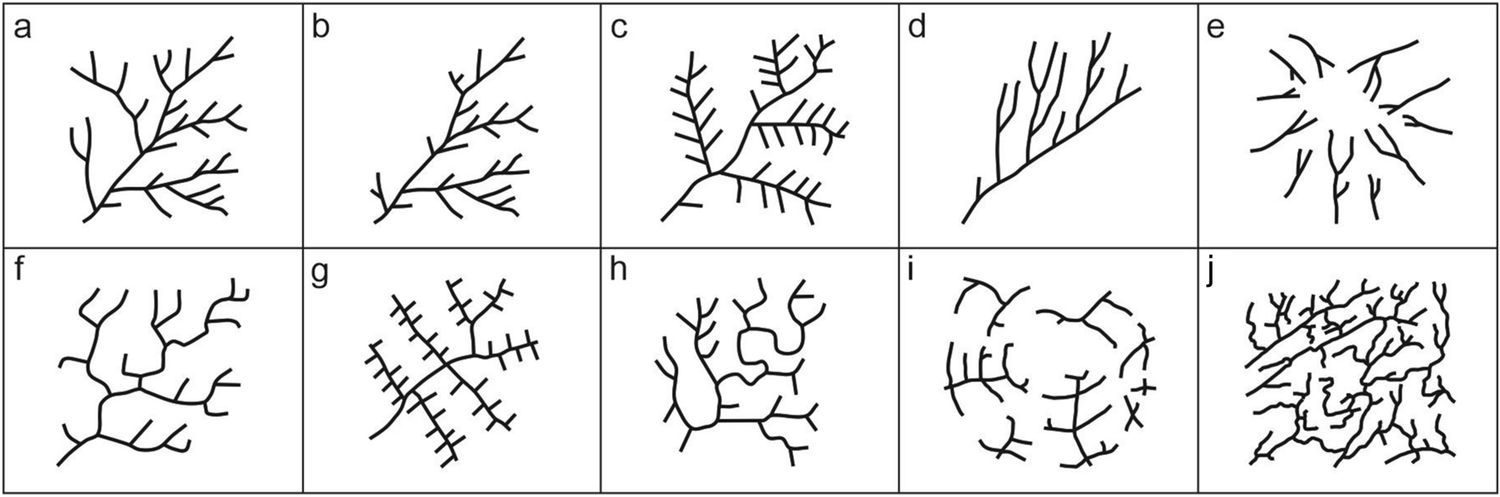
The idea is to analyze the degree of reliability of class assignment to drainage samples, driven domain expert decisions, based on visual inspection of images and the identification of the right pattern type. Through the analysis of Earth, Mars and Titan’s rivers, experts were asked to classify rivers into one of ten distinct patterns, further categorized into two macro-classes: dendritic and non-dendritic.

Figure 1 – Different classes of drainage patterns: a) dendritic; b) sub-dendritic; c) pinnate; d) parallel; e) radial; f) rectangular; g) trellis; h) angular; i) annular; j) contorted. (a)–(c) patterns are related to dendritic forms (D), (d)–(j) to non-dendritic ones (ND).

The purpose of this study is to establish an objective classification system for rivers, improving the understanding of terrestrial and extra-terrestrial rivers drainage networks. Using statistical techniques, the study explores methods to reduce noise in human based classification, thus providing a robust classification system for the automatic processing of river data with a detail much better (10 classes) than the current two class classification systems (dendritic and non-dendritic).

This work focuses on the methodology and objectives of the research, highlighting its interdisciplinary nature and potential contributions to a better comprehension of river morphologies across different planetary bodies.


Classification of drainage patterns using properties of fractals

Machine Learning (ML) models often require a differentiated and big enough training sequence so that they can output a good prediction rule, a predictor, to then use in labeling unseen elements belonging to the testing set. While experts can give their opinions on a given river in relation to the ten classes here considered, it is more of a subjective truth than a ground truth. To minimize the model’s bias, the training sequence should contain data as accurately labeled as possible, thus having a great probability of minimizing the true error.

Introducing fractal geometry, involving self-similar objects with a fixed degree of complexity, often referred to as Hausdorff Dimension (HD). By computing the HD for a given set of rivers, they can be grouped into classes by defining step thresholds determining the belonging to any of the ten categories. The classification can be further refined by considering the Horton-Strahler number, which is a way of establishing a hierarchy between tributaries in a drainage network. This makes it possible to keep track of the branching of rivers, along with their intrinsic fractal complexity.

To compute the HDs, different methods will be used, leveraging the flexibility and the capabilities of the Python programming language. The best algorithm to compute the HD on rivers, Box Counting (BC), will be analyzed, and compared to the experts’ classification, to further comprehend the thought process of a human mind when presented with a classification task involving complex and branched structures.

Results show that fractal analysis is reliable in the context of geomorphology and river patterns, allowing for the creation of a ground truth for the RiverZoo images, and laying the basis for the development of advanced ML algorithms used for classification purposes.

How to cite: D'Aniello, M., Zampella, M. R., Dosi, A., Rownok, A., Delli Veneri, M., Ettari, A., Cavuoti, S., Sannino, L., Brescia, M., Donadio, C., and Longo, G.: Rivers' classification: integrating Deep Learning and statistical techniques for terrestrial and extraterrestrial drainage networks analysis, Europlanet Science Congress 2024, Berlin, Germany, 8–13 Sep 2024, EPSC2024-124, https://doi.org/10.5194/epsc2024-124, 2024.

EPSC2024-695 | ECP | Posters | TP3 | OPC: evaluations required

Mapping of Martian geomorphologies as a contribution to construct the first artificial analog in Colombia 

Laura Romero, Javier Suarez, Oscar Ojeda, Yael Mendez, and Luis Ochoa
Tue, 10 Sep, 10:30–12:00 (CEST) | Poster area Level 2 – Galerie | P2

1. Introduction

The development and validation of specific procedures for scientific activities in planetary analog sites, whether natural or artificial, are key to ensure the success, effectiveness, and safety in future extraterrestrial human exploration missions (Foucher et al. 2021). However, this has been developed in facilities and sites generally inaccessible for the Latin American scientific community and constitutes an obstacle for contributing to the study in analogs.

This work presents the geomorphological assessment of three representative landforms on Mars: a lava flow field at the southwestern base of Olympus Mons (13.18° N, 134.95 W), a lacustrine deposit in a paleolake within an impact crater near Maja Valles (5.33° N, 58.58° W) and the impact crater Catota in Acidalia Planitia (51.65° N, 25.98° W); which were used to test the analogy of morphological simulations of these landforms created in the first artificial Mars analog facility in Latin America, called "Rock Yard" within the Simulated Analog Space Exploration Habitat in Colombia (HAdEES-C).

2. Data

In order to carry out the geomorphological mapping and interpretation, images from the High Resolution Imaging Science Experiment (HiRISE), Mars Reconnaissance Orbiter (MRO) Context Camera (CTX) and the High Resolution Stereo Camera (HRSC) as well as digital terrain models available were collected and processed for each of the Mars’s sites, in addition to basemaps of Mars.

3. Results

3.1. Mapping of landforms

For each of the real sites on Mars, a geomorphological map was made and interpreted.

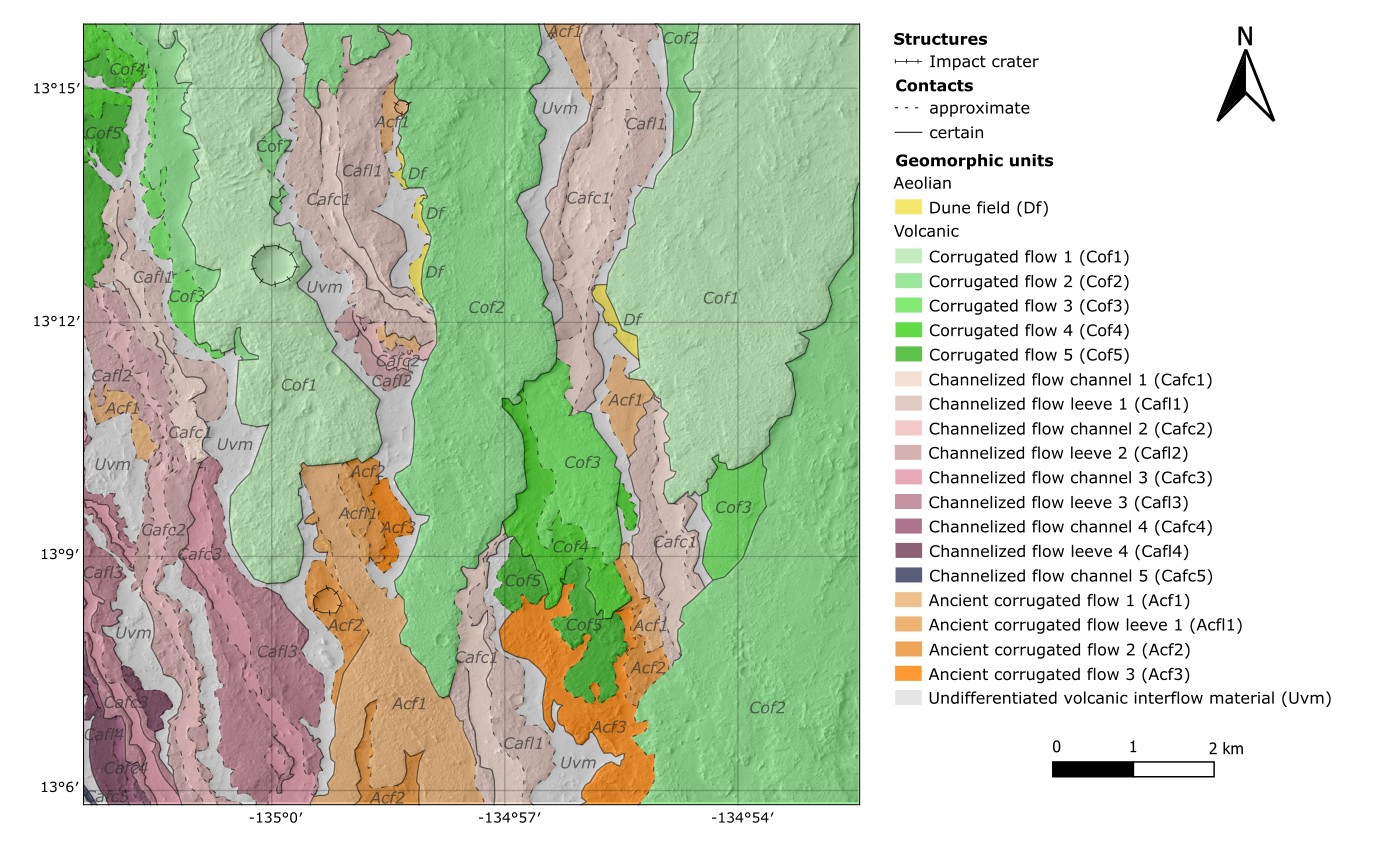
The area in the southernmost part at the base of Olympus Mons forms a flow field in an anastomosing network (Morris & Tanaka, 1995). Flows are broadly divided into three categories according to their morphology and stratigraphy (Peters et al. 2021). Corrugated flows (Cof) are the younger flows characterized for their rough surface texture resembling ‘a’a¯ flows in Hawaii (Hargitai & Kereszturi, 2015). Underlying are the Channelized flows (Caf), numerous and narrower flows with a smooth-textured central channel and rough-textured levees. And Ancient corrugated flows (Acf) are the oldest flows. These define at least three different episodes of volcanic activity with different emplacement styles. Figure 1 shows this map.

The possible paleolake is in a ~37 km complex impact crater and forms a closed-basin lake (Cabrol & Grin, 1999) with a >30 km long incised Inlet valley (Iv) (Goudge et al. 2015) but no outlet valley. It has an inlet continuous delta observed extending over 4 km, where different depositional events were identified based on the overlapping Deltaic slopes (Ds). The basin floor is nearly level given that the lacustrine deposits filled the topographic irregularities, but only resurfacing units are visible: Volcanic mantles (Vm) at east, and dark and finer Eolian deposits (Ed) at west.

The impact crater has a diameter of 1.3 km, is bowl-shaped and its rim is raised. The inner flank shows a Spur-and-gully (Sg) morphology (Watters et al. 2015) in the upper part and talus deposits in the lower part. The outer flank is covered by the preserved ejecta that divides in Continuous ejecta (Ec) and Discontinuous ejecta (Ed).

Figure 1: Geomorphological map of lava flows at the base of Olympus Mons.

3.2. Analogue model constructed

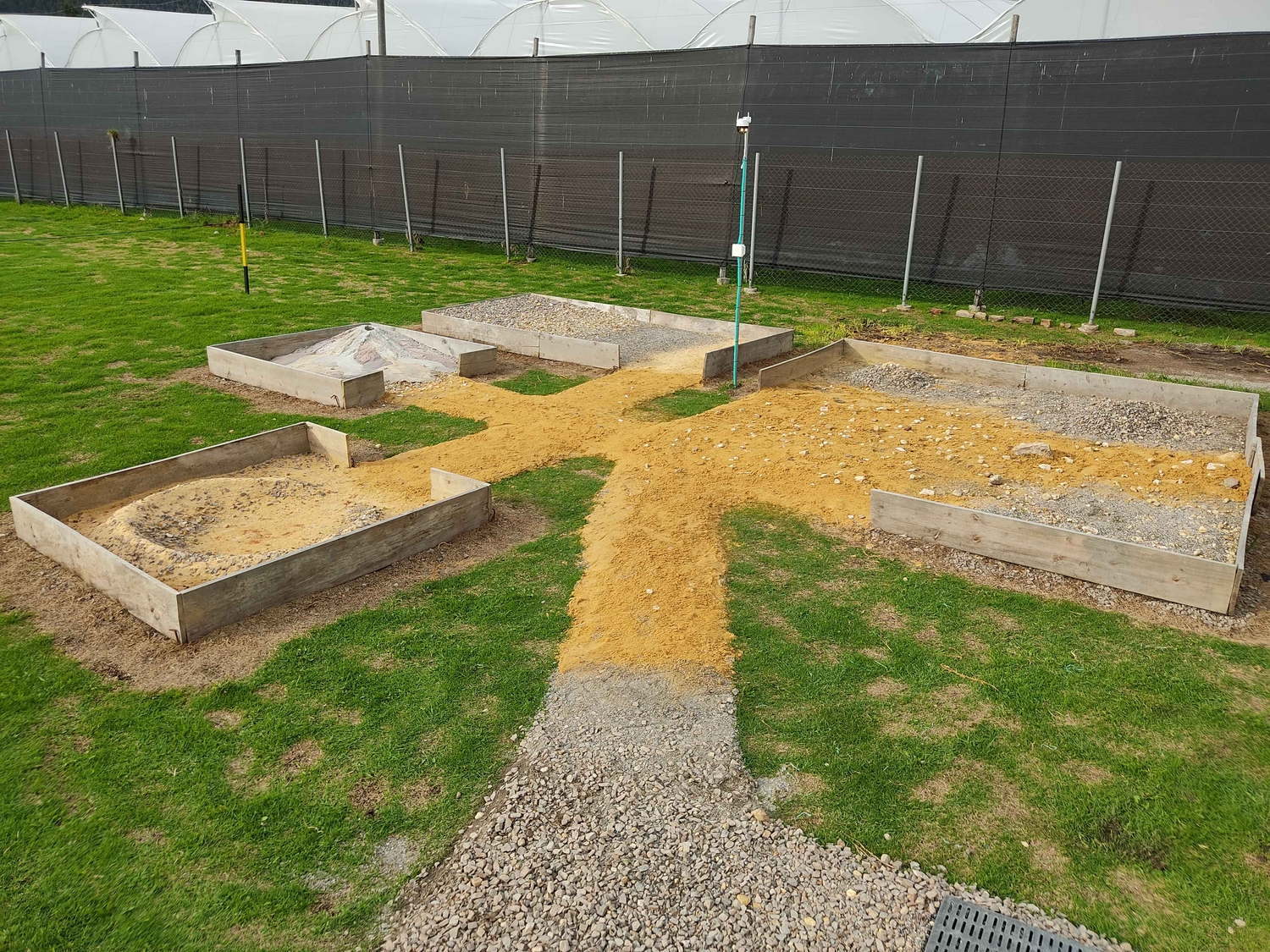
Following a low-cost and open science concept, the Rock Yard was built with two 4 m2, one 8 m2 and 18 m2 interconnected modules, each one with a specific landform made with easily accessible local construction materials to mechanically simulate the Martian soil. The cost did not exceed 400€ and it was built in 8 days. Figure 2 contains a photograph of the complete Rock Yard.

Figure 2: Rock Yard at HAdEES-C.

4. Discussions and conclusions

The recreated landforms represent approximately 44% of the Martian surface compared to the latest defined geological units on Mars defined by Tanaka et al. (2014). Several of the defined geomorphological units can indeed be correlated with the structures present in the simulations of the Rock Yard, and the main differences correspond to inconsistencies due to the scale, and the impossibility to recreate secondary surface processes on Mars that have modified the original landforms. Therefore, the Rock Yard constitutes a characterized facility whose main parameters are controlled with a geomorphologic analogy that is coherent within the limits of the scale of representation and the composition of the materials.

Work is currently underway to expand the area to include simulations of other landforms and generate interactions between them that represent a realistic geological history, to make this space a more rigorous scientific representation of the structures and processes on Mars. In any case, while being a first approximation to the design and construction of these facilities in Colombia, the Rock Yard is already a compact, representative, and accessible geologic analog. One that allows research, outreach, and educational activities that will contribute to the local production of scientific knowledge, and to bring the study of analogues to a wider public.

5. Acknowledgements

This project has received funding from Cydonia Foundation and GMAS and initiated as an undergraduate geology dissertation in the National University of Colombia.

6. References

  • Cabrol, N., & Grin, E. (1999). Distribution, Classification, and Ages of Martian Impact Crater Lakes. Icarus, 142, 160–172.
  • Foucher, F., Hickman-Lewis, K., Hutzler, A., Joy, K. H., Folco, L., Bridges, J. C., Wozniakiewicz, P., Martínez-Frías, J., Debaille, V., Zolensky, …, Westall, F. (2021). Definition and use of functional analogues in planetary exploration. Planetary and Space Science, 197.
  • Goudge, T., Aureli, K., Head, J., Fassett, C., & Mustard, J. (2015). Classification and analysis of candidate impact crater-hosted closed-basin lakes on Mars. Icarus, 260, 346-367.
  • Hargitai, H., & Kereszturi, Á. (2015). Encyclopedia of Planetary Landforms. Springer. doi:10.1007/978-1-4614-3134-3.
  • Morris, E., & Tanaka, K. (1995). Geologic Maps of the Olympus Mons Region of Mars. USGS Astrogeology Science Center.
  • Peters, S. I., Christensen, P. R., & Clarke, A. (2021). Lava Flow Eruption Conditions in the Tharsis Volcanic. Journal of Geophysical Research: Planets, 126.
  • Watters, W., Geiger, L., Fendrock, M., & Gibson, R. (2015). Morphometry of small recent impact craters on Mars: Size and terrain dependence, short-term modification. J. Geophys. Res. Planets, 120, 226–254.

How to cite: Romero, L., Suarez, J., Ojeda, O., Mendez, Y., and Ochoa, L.: Mapping of Martian geomorphologies as a contribution to construct the first artificial analog in Colombia, Europlanet Science Congress 2024, Berlin, Germany, 8–13 Sep 2024, EPSC2024-695, https://doi.org/10.5194/epsc2024-695, 2024.

EPSC2024-914 | ECP | Posters | TP3 | OPC: evaluations required

Towards Low Earth Orbit Exposure Experiments on the ISS -Designing a Simulation Setup for Mars Like Conditions 

Ruben Nitsche, Severin Wipf, Lucas Bourmancé, Adrienne Kish, and Andreas Elsaesser
Tue, 10 Sep, 10:30–12:00 (CEST) | Poster area Level 2 – Galerie | P12
Abstract
In the search for life, Mars is considered to be a major target due to its similarity and relative
proximity to Earth, which makes it accessible for scientific investigation. Considering the past
chemical, geological and physical environment on Mars, the planets surface might have been
habitable to life during the so called Noachian¹. The quest to identify complex organic molecules on
the surface of Mars is an ongoing effort using instruments like SHERLOC onboard the NASA
Perseverance Rover² or the SAM³ and CheMin⁴ instruments onboard the NASA Curiosity Rover.
Other investigations of possible biosignatures on Mars are focusing on the search for chemical
processes exclusive to life. Potential indicators are specific atmospheric gases like Methane or
mineralogical signatures in composition or morphology that indicate past or present presence life.
Recent measurements indicate not only the presence of frozen but also subsurface liquid water on
Mars. Such water could only be stable on the planet in the form of highly concentrated brines.
Halophilic organisms, that are known to survive environments with high salinity, have therefore
become a focus for Astrobiology in the context of Mars⁵.
The atmosphere of Mars mostly consists of CO2 (95%), but oxygen (0.174%) and water vapor (0.03%,
variable) are also present⁶ at an atmospheric pressure of around 6 mbar. The high abundance of CO2
blocks UV radiation below around 200 nm while any UV light at higher wavelengths reaches the
surface of Mars. This is in clear contrast to solar radiation on the surface of Earth where UV light
below around 300 nm is blocked from reaching ground level due to the higher concentration of
oxygen and ozone. Additionally, the absence of magnetic shielding around Mars means that
energetic particle radiation can reach the surface of Mars. The average surface temperature of Mars
is considered to be around −63 ℃, reaching up to 20 ℃ in the equatorial regions and go as low as
−153 ℃ at the poles, with daily variations often exceeding 80 ℃⁷. The surface of Mars is covered in a
fine, unconsolidated regolith mostly originating from eroded volcanic rocks exhibiting a distinct red
color caused by high abundances of iron oxides. Varying amounts of phyllosilicates have been found
indicating the past presence of water⁸. To investigate the photochemistry of possible biosignatures in
a laboratory or space born context it is necessary to reproduce these extreme conditions as
accurately as possible.
A number of radiation exposure experiments under Mars-like conditions in Low Earth Orbit (LEO)
involving organic molecules and other astrobiological samples have been performed or are currently
under development. Considering high costs and limited availability of space born experiments we
have developed a laboratory based Mars simulation setup. Our setup partly reuses concepts of LEO
experiments while adding simulation parameters that are not yet possible to recreate in LEO due to
their technical complexity. Specialized reaction cells have been developed for the NASA O/OREOS
cube satellite experiments⁹. They hold samples, applied as thin films, in a sealed gas volume while
being transparent to irradiation and spectroscopy measurements. These reaction cells are also
planned to be used in the upcoming LEO experiments ExoCube Chem and OREOCube¹⁰ outside the
International Space Station (ISS). The reaction cells consist of a central stainless steel ring, sealed
using indium rings with a sample window on either side The window materials are chosen to allow
both irradiation and transmission spectroscopy from the UV up to the IR range. Using FTIR
spectroscopy, we can show that the reaction cells lose less than 60% of CO2 gas content over a span
of 18 months. The Radiation Background on Mars is complex and can not fully be recreated
accurately. We therefore focus on simulating electromagnetic radiation as found on the surface of
Mars. To do so we use a Xenon Arc lamp that produces a wide spectrum of light similar to solar
radiation. It also produces significant amounts of UV radiation below 300 nm so that it can be used
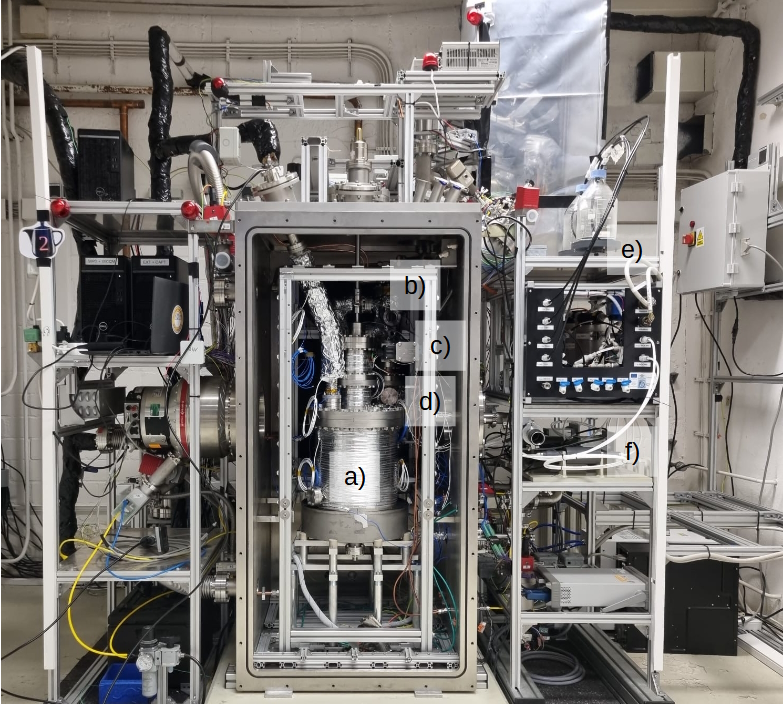
as an adequate radiation source for Mars Simulation. The setup has space for up to 10 reaction cells
placed in a ring for the most uniform irradiation. The irradiance was checked at each sample spot
with a relative variation in irradiance of less than 5%. The custom made sample holder can be cooled
using liquid nitrogen (LN2). An off the shelf solenoid valve is used to control the flow of LN2 while
the temperature is controlled using a PT1000 temperature probe in the same form factor as the
reaction cells. In practice this system can be used to cool samples to temperatures between room
temperatures and about −150 ℃. The custom PID control is not limited to a fixed temperature but
also allows to perform temperature protocols (e.g. diurnal cycles). The variance in temperature from
the setpoint using this temperature control is typically below 1 ℃.
FTIR spectroscopy is performed using the ARCoptix OEM FT-IR module which is also planned to be
used in the ExoCube Chem LEO experiment. For UV-VIS measurements we use an Ocean Insight
Flame-S UV-VIS spectrometer, which is planned to be used in the OREOCube LEO experiment. Both
spectroscopy setups are placed on a xy-stage, measuring individual samples in transmission during
the irradiation. The spectroscopic measurements are fully automated, such that only the exchange of
liquid nitrogen has to be performed manually. The setup will be used in the context of the ExoCube
Halo project to investigate photochemical processes involving halophilic organisms exposed to
extreme Mars like conditions.
Acknowledgements
This work was supported by the Deutsche Forschungsgemeinschaft (DFG, grant number 490702919)
and the Volkswagen Foundation and its Freigeist Program.
References
1 https://doi.org/10.1089/ast.2013.1106
2 https://doi.org/10.1007/s11214-021-00812-z
3 https://doi.org/10.1016/j.pss.2016.06.007.
4 https://doi.org/10.1016/j.chemer.2020.125605.
5 https://doi.org/10.1038/s41550-020-1080-9
6 https://doi.org/10.1016/j.pss.2017.01.014.
7 https://doi.org/10.1029/1999JE001095
8 https://doi.org/10.1016/j.icarus.2018.08.019
9 https://doi.org/10.1016/j.actaastro.2012.09.009.
10 https://ui.adsabs.harvard.edu/abs/2022cosp…44.2758W

How to cite: Nitsche, R., Wipf, S., Bourmancé, L., Kish, A., and Elsaesser, A.: Towards Low Earth Orbit Exposure Experiments on the ISS -Designing a Simulation Setup for Mars Like Conditions, Europlanet Science Congress 2024, Berlin, Germany, 8–13 Sep 2024, EPSC2024-914, https://doi.org/10.5194/epsc2024-914, 2024.

EPSC2024-982 | ECP | Posters | TP3

Charge Distribution of Ejected Particles after Impact Splash on Mars: A Laboratory Approach 

Tim Becker, Florence Chioma Onyeagusi, Jens Teiser, Teresa Jardiel, Marco Peiteado, Olga Munoz, Julia Martikkainen, Juan Carlos Gomez Martin, Jonathan Merrison, and Gerhard Wurm
Tue, 10 Sep, 10:30–12:00 (CEST) | Poster area Level 2 – Galerie | P4

We present laboratory measurements for the charge distribution of dust to sand sized particles that are ejected in small-scale sand grain impacts, simulating saltation bombardement events on the Martian surface. Using a high speed camera, tracking particles within an electric field, we determined charges of individual grains characterizing single grain impacts. While the charge of small particles seems to have random polarity, larger particles show some bias toward positive charges. Such preference could lesd to a charge separation in the free air stream and thus to the establishment of an electric field near the surface, aiding further lifting as e.g. proposed by Renno&Kok 2008* and Holstein-Rathlou et al. 2010**.

*Renno, N. O., & Kok, J. F. 2008, SSRv, 137, 419, doi: 10.1007/s11214-008-9377-5
**Holstein-Rathlou, C., Gunnlaugsson, H. P., Merrison, J. P., et al. 2010, Journal of Geophysical Research: Planets, 115, doi: 10.1029/2009JE003411

How to cite: Becker, T., Onyeagusi, F. C., Teiser, J., Jardiel, T., Peiteado, M., Munoz, O., Martikkainen, J., Gomez Martin, J. C., Merrison, J., and Wurm, G.: Charge Distribution of Ejected Particles after Impact Splash on Mars: A Laboratory Approach, Europlanet Science Congress 2024, Berlin, Germany, 8–13 Sep 2024, EPSC2024-982, https://doi.org/10.5194/epsc2024-982, 2024.

TP4 | Planetary Dynamics: Shape, Gravity, Orbit, Tides, and Rotation from Observations and Models

EPSC2024-952 | ECP | Posters | TP4 | OPC: evaluations required

Satellite gravity-rate observations to uncover Martian plume-lithosphere dynamics 

Riva Alkahal and Bart Root
Wed, 11 Sep, 14:30–16:00 (CEST) | Poster area Level 2 – Galerie | P26

In the past few decades, Mars-oriented orbiters and landers have allowed to unravel valuable knowledge about Mars’ surface and interior. With the InSight mission, seismic waves have indicated the presence of more frequent Marsquakes than assumed before the mission (Banerdt et al. 2020). Moreover, active mantle plume is considered below the Elysium Region (Broquet and Andrews-Hanna, 2023). This raises questions regarding the planet's formation and whether Mars is more geologically active than was considered.

An important milestone in studying the interior of Mars is the recovery of static gravity field models. These models have been accomplished using data from the three recent Mars orbiting missions, namely, Mars Global Surveyor (MGS), Mars Odyssey (ODY), and the Mars Reconnaissance Orbiter (MRO). In addition to the static gravity field, seasonal variations of Mars’ gravity field have been observed, providing information regarding the periodic behavior of the polar ice caps (Konopliv et al. 2016, Genova et al. 2016). However, the secular variation of the gravity field and its link to the solid deformation of the planet has been limited studied.

In general, the estimation of the time variations of the gravity field in the very long wavelength can provide insights into activity of the mantle (Wörner et al. 2023). Le Maistre et al., (2023) have studied the spin rate of Mars and its connection to interior mantle flow or atmospheric changes. By analyzing measurements from the Viking and InSight landers, they estimated a long-term change of the rotation rate of Mars and its moment of inertia.  The obtained rotation rate change, along with the J2 coefficient variation over one Martian year, suggests factors such as atmospheric changes, glacial rebound of the polar ice caps (GIA, Glacial Isostatic Adjustment), or substantial deep mantle flow. Therefore, decoupling atmospheric signal from solid Mars deformations in the gravity signal is essential.  

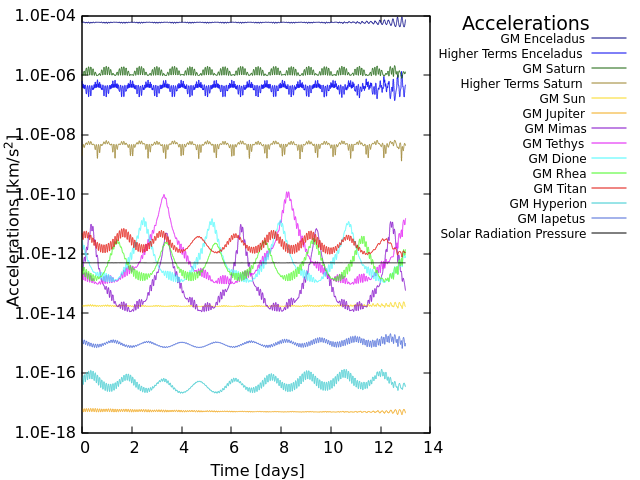
In this study, we focus on a new way of estimating secular variations of the gravity field of Mars from the available tracking data with an open-source orbit estimation tool: TUDAT (TU Delft Astrodynamics Toolbox). First, we review the state-of-the-art literature on studying the plume-lithosphere interaction and model the gravity-rate signal that would come from mantle flow. Then, we perform a sensitivity analysis for decoupling the secular variations from other signals, such as, the atmospheric density variations and ongoing GIA of the polar ice caps. We do this by simulating one-way and two-way Doppler observations of a Mars-orbiting satellite. We include all possible dynamic forces impacting the satellite. Some of these forces are the static and temporal gravity field, the third body gravitation, the solar radiation pressure, the atmospheric drag, and other forces. For the atmospheric drag, we use the Mars-DTM atmosphere density model that models the static, daily, and yearly variations that affect the drag of the satellite (Bruinsma and Lemoine, 2002). We determined the sensitivity of the estimation process for different parameters including: the initial state, the atmospheric drag and the solar radiation coefficients, and the global vs. arc-wise time varying coefficients. Finally, we perform a correlation analysis of these parameters to determine in which estimation scenario we are able to separate the atmospheric signal from the solid Mars gravity changes. This sensitivity analysis will help in decoupling the gravity-rate signal in order to answer the unresolved question about the activity of the Martian interior.

References:

Banerdt, W.B., Smrekar, S.E., Banfield, D. et al. Initial results from the InSight mission on Mars. Nat. Geosci. 13, 183–189 (2020). https://doi.org/10.1038/s41561-020-0544-y

Broquet, A., Andrews-Hanna, J.C. Geophysical evidence for an active mantle plume underneath Elysium Planitia on Mars. Nat Astron 7, 160–169 (2023). https://doi.org/10.1038/s41550-022-01836-3

Bruinsma, S., & Lemoine, F. G. (2002). A preliminary semiempirical thermosphere499
model of mars: Dtm-mars. Journal of Geophysical Research: Planets, 107 (E10). doi: https://doi.org/10.1029/2001JE001508

Genova, A., Goossens, S., Lemoine, F.G., Mazarico, E., Neumann, G.A., Smith, D.E., Zuber, M.T., 2016. Seasonal and static gravity field of Mars from MGS, Mars Odyssey and MRO radio science. Icarus 272, 228–245. http://dx.doi.org/10.1016/j.icarus.2016.02.050

Konopliv, A.S., Park, R.S., Folkner, W.M., 2016. An improved JPL Mars gravity field and orientation from Mars orbiter and lander tracking data. Icarus 274, 253–260. http://dx.doi.org/10.1016/j.icarus.2016.02.052.

Le Maistre, S., Rivoldini, A., Caldiero, A. et al. Spin state and deep interior structure of Mars from InSight radio tracking. Nature 619, 733–737 (2023). https://doi.org/10.1038/s41586-023-06150-0

Wörner, L., Root, B. C., Bouyer, P., Braxmaier, C., Dirkx, D., Encarnação, J., Hauber, E., Hussmann, H., Karatekin, Ö., Koch, A., Kumanchik, L., Migliaccio, F., Reguzzoni, M., Ritter, B., Schilling, M., Schubert, C., Thieulot, C., Klitzing, W. v., & Witasse, O. (2023). MaQuIs—Concept for a Mars Quantum Gravity Mission. Planetary and Space Science, 239, 105800. https://doi.org/10.1016/j.pss.2023.105800

How to cite: Alkahal, R. and Root, B.: Satellite gravity-rate observations to uncover Martian plume-lithosphere dynamics, Europlanet Science Congress 2024, Berlin, Germany, 8–13 Sep 2024, EPSC2024-952, https://doi.org/10.5194/epsc2024-952, 2024.

TP5 | Ionospheres of unmagnetized or weakly magnetized bodies

EPSC2024-34 | Posters | TP5 | OPC: evaluations required

Gravity Wave-Induced Ionospheric Irregularities in the Martian Atmosphere 

Rong Tian, Chunhua Jiang, and Beatriz Sánchez‐Cano
Tue, 10 Sep, 14:30–16:00 (CEST) | Poster area Level 2 – Galerie | P23
For the past few decades, it has demonstrated that gravity waves (GWs) and neutral winds can drive ionospheric irregularities on Earth. Still, as far as we know, the formation of ionospheric irregularity on Mars due to GWs has not been well studied. In this study, we use data from NASA's Mars Atmosphere and Volatile Evolution (MAVEN) mission to show evidence of an irregularity event in the Martian ionosphere, which is potentially seeded by the break of GWs (GWB). The statistical findings indicate that the observed ratio of GWB-related irregularity events varies from ~0.25 to 0.57 in each year, and the overall correlation for 2015 to 2020 is ~0.37. Numerical simulations provide further insight into the processes behind irregularities formation, which employs neutral wind shear as a source of perturbation in the context of the GWB. The simulations yield results fundamentally aligned with the observed characteristics of ionospheric irregularities observed in the 2018 event by considering the wind shear as the disturbance source. This study provides supplementary insights into the perturbation sources involved in shaping irregularities within the Martian ionosphere and presents valuable information about the coupling between the Martian ionosphere and the lower atmosphere.

How to cite: Tian, R., Jiang, C., and Sánchez‐Cano, B.: Gravity Wave-Induced Ionospheric Irregularities in the Martian Atmosphere, Europlanet Science Congress 2024, Berlin, Germany, 8–13 Sep 2024, EPSC2024-34, https://doi.org/10.5194/epsc2024-34, 2024.

EPSC2024-219 | ECP | Posters | TP5

Evolution of the ion dynamics at comet 67P during the escort phase 

Zoe Lewis, Peter Stephenson, Esa Kallio, Marina Galand, and Arnaud Beth
Tue, 10 Sep, 14:30–16:00 (CEST) | Poster area Level 2 – Galerie | P27

Comet 67P/Churyumov-Gerasimenko was escorted by the Rosetta spacecraft through a 2 year section of its 6 year orbit around the Sun. This enabled the observation of a large variation in comet outgassing and the resulting evolution of the plasma environment. The diamagnetic cavity, a region of negligible magnetic field arising from the interaction of the unmagnetised cometary plasma with the solar wind, began to be detected sporadically by the Rosetta Plasma Consortium/ Magnetometer (RPC/MAG) in April 2015 at a heliocentric distance of 1.8 au [1]. The last detections were in February 2016 at 2.4 au. Within this cavity, the flow of cometary ions has been shown to be largely radial [2]; the ions are accelerated above the neutral gas speed by an ambipolar electric field, but many newborn ions still undergo multiple ion-neutral chemical reactions before escaping [3,4]. Outside the diamagnetic cavity boundary, which is itself highly variable, the ion flow is considerably more complex, and the ambipolar electric field plays a more minor role compared to the convective electric field of the solar wind [2].  At large heliocentric distances (>2.5 au), the total plasma density observed from RPC plasma sensors is well explained by a simple flux conservation model that assumes the ions travel radially away from the nucleus at speed close to that of neutrals [5,6]. However, closer to perihelion and once the diamagnetic cavity has formed, such an approach does not hold [7]. We aim to better understand this transition, the driver of ions' acceleration, and the role that the diamagnetic cavity plays.In this study, we explore the varying ion dynamics both in the presence (e.g. during high outgassing activity) and absence (low outgassing activity) of a diamagnetic cavity. Electric and magnetic fields from hybrid simulations of the cometary environment are used to drive a 3D test particle model of the cometary ions for a range of comet activity levels. We model the behaviour of three key ion species, H2O+, H3O+, and NH4+, in order to assess the impact of the ion dynamics on the ionospheric composition and density.

 [1] Goetz et al. MNRAS S 462, S459–S467 (2016)

[2] Koenders et al., Planetary and Space Science, 101-116, 105 (2015)

[3] Lewis et al., MNRAS, 523, 6208–6219 (2023)

[4] Lewis et al 2024, MNRAS, 530, 66–81 (2024)

[5] Galand et al., MNRAS, S331-S351, 462 (2016)

[6] Heritier et al., A&A, 618 (2018)

[7] Vigren et al., ApJ 6, 881(1) (2019)

How to cite: Lewis, Z., Stephenson, P., Kallio, E., Galand, M., and Beth, A.: Evolution of the ion dynamics at comet 67P during the escort phase, Europlanet Science Congress 2024, Berlin, Germany, 8–13 Sep 2024, EPSC2024-219, https://doi.org/10.5194/epsc2024-219, 2024.

EPSC2024-1287 | ECP | Posters | TP5 | OPC: evaluations required

Preliminary Results of the Categorizing and Statistical Survey of Martian Ionospheric Irregularities 

Xin Wan, Jiahao Zhong, Chao Xiong, and Jun Cui
Tue, 10 Sep, 14:30–16:00 (CEST) | Poster area Level 2 – Galerie | P26

A climatological survey of Martian ionospheric plasma density irregularities was conducted by exploring the in-situ measurements of the Mars Atmosphere and Volatile EvolutioN (MAVEN) spacecraft. The irregularities were first classified as enhancement, depletion, and oscillation. By checking the simultaneous magnetic field fluctuation, the irregularities have been classified into two types: with or without magnetic signatures. The classified irregularities exhibit diverse global occurrence patterns, as those with magnetic signatures tend to appear near the periphery of the crustal magnetic anomaly (MA), and those without magnetic signatures prefer to appear either inside of the MA or outside of the MA, depending on the type and solar zenith angle. Under most circumstances, the irregularities have a considerable occurrence rate at altitudes above the ionospheric dynamo height (above 200 km), and the magnetization state of the ions seems irrelevant to their occurrence. In addition, the irregularities do not show dependence on magnetic field geometry, except that the enhancement without magnetic signatures favors the vertical field line, implying its equivalence to the localized bulge (Duru et al., 2006). Other similarities and discrepancies exist in reference to previous studies. We believe this global survey complements previous research and provides crucial research clues for future efforts to clarify the nature of the Martian ionospheric irregularities.

How to cite: Wan, X., Zhong, J., Xiong, C., and Cui, J.: Preliminary Results of the Categorizing and Statistical Survey of Martian Ionospheric Irregularities, Europlanet Science Congress 2024, Berlin, Germany, 8–13 Sep 2024, EPSC2024-1287, https://doi.org/10.5194/epsc2024-1287, 2024.

TP6 | Late accretion and early differentiation of rocky planetary bodies, from planetesimals to super-Earths

EPSC2024-763 | ECP | Posters | TP6

Resolving the origin of lunar high-Ti basalts by petrologic experiments 

Cordula Haupt, Christian J. Renggli, Arno Rohrbach, Jasper Berndt, and Stephan Klemme
Wed, 11 Sep, 10:30–12:00 (CEST) | Poster area Level 2 – Galerie | P35
The origin of the most primitive, picritic lunar basalts, sampled as pyroclastic glass beads in the lunar soils [1,2], remains poorly constrained. Especially the petrogenesis of high-Ti glasses (TiO2 > 6 wt%) seems enigmatic. Three hypotheses have been proposed for the origin of these exotic samples: I) Ascent of a primary, undifferentiated melt from the lunar interior and assimilation of clinopyroxene and ilmenite in the upper section of the not overturned lunar mantle [3]. II) Melting of a hybridized lunar mantle after lunar mantel overturn [4,5]. III) Reaction of sunken low-degree high-density melts of the hybrid magma ocean source with high Mg-cumulates in the deep interior of the lunar mantle and subsequent ascent [5,6,7]. This study re-investigates hypothesis II with the aim to assess whether a one stage melting process of a heterogeneous lunar mantle can cause the compositional variabilities of lunar (high-Ti) picritic glasses. Specifically, the effect of modal mineralogy of different cumulate layers in the hybrid lunar mantle is investigated.

The overturn of the lunar mantle stratification due to Rayleigh-Taylor instabilities will have caused the so-called “Ilmenite-bearing cumulate (IBC)” to sink into the underlying harzburgite lunar mantle [7]. Therefore, an IB cumulate and a harzburgite cumulate appear to be the major components of a hybrid lunar mantle [7]. In this study, the first batch of starting material compositions was mixed similar to [5] using a fixed composition the harzburgite mantle. An IBC was designed by mixing ilmenite, clinopyroxene, and small amounts of plagioclase. These minerals are the basic components of the bulk lunar mantle after cumulate overturn [2]. We investigated how the ilm/cpx ratio within an IBC will affect the melt compositions and melting conditions. A such, we assumed that modal proportions of crystallization were not preserved in the cumulate [e.g., 5,9]. In a second batch of experiments, we slightly adjusted olivine and orthopyroxene ratios in the harzburgite layer. A third component of a hybrid lunar mantle in some of our starting material composition was an urKREEP component [10], which has been proposed to participate in the overturn and melting process [7,11].

To investigate the composition and modal amounts of partial melts from several different starting materials, we conducted high-pressure and high-temperature experiments in an endloaded Piston cylinder apparatus at the University of Münster. Most runs were conducted at a pressure of 1.5 GPa, which corresponds to the lower end of the depth range suggested for the source depth of high-Ti lunar picritic basalts [6]. Run temperatures were varied between 1300 and 1450 °C to investigate the effect of changing melting degree on melt compositions [3]. In order to control fO2 and to minimize Fe-loss in the runs, we used graphite-lined Pt capsules [3,4]. The characterization of experimental runs was conducted by the means of scanning electron microscopy (SEM) and energy dispersive x-ray spectroscopy (EDS). Mineral and melt proportions were determined via mass balance calculations using the major element chemistry of the phases present in each experiment.

All experiments contain glass and forsteritic olivine. Some experiments contain olivine and orthopyroxene. The degree of partial melting (Fmelt) is 0.18–0.75. The experiments that contain both olivine and orthopyroxene were run at lower temperatures (< 1400 °C) and low degrees of partial melting (Fmelt < 0.5). 


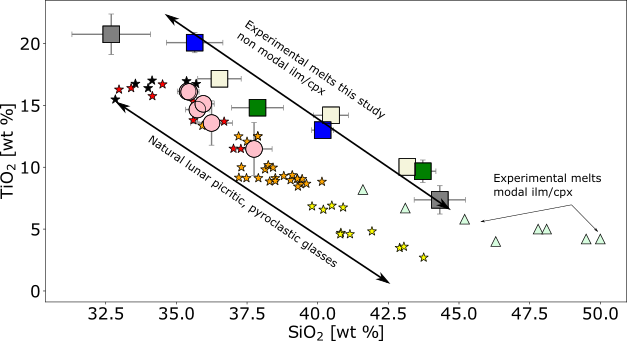
Figure 1: SiO2 vs. TiO2 of lunar Apollo picritic glasses (yellow, orange, red, black – colored accordingly) from [8,9] and our experimental melts (squares and circles). Indivudual symbols correspond to different starting material compositions.Triangles correspond to melting experiments of a hybrid lunar mantle with modal ilm/cpx from fractional crystallization experiments [5] 

Comparing the composition of experimental melts and natural lunar picritic glasses (Fig. 1), it can be stated that the melting of a heterogeneous lunar mantle produced by the overturn of lunar stratification after the solidification of the lunar magma ocean can generate melts in the range similar high-Ti picritic melts. Experimental temperatures and pressures agree with the temperatures and depth of origin predicted by previous experimental studies [3,5]. A partial melting process of a cumulate-bearing mantle, as modeled by our experiments, is shown to be a viable and simple alternative to the currently accepted complex melting model [5,6]. In our experimental setup, a ratio of ilm/cpx of 1/1 or 4/1 in the IBC layer reproduces high-Ti compositions, similar to the picritic lunar basalts. Good matches are achieved in runs with lower temperatures, which correspond to the comparably lower degree of melting.

The most suitable ol/opx is 3/2. We further find that, following the constraints of [12], some plagioclase has to be entrained in the IBC layer, in order to reproduce Al2O3/CaO in the cumulate mantle melting experiments. Additionally, the presence of urKREEP in the cumulates strongly influences Al2O3/CaO, driving it too high in melts originating from cumulates containing that component.

In the light of our experiments, it is possible to shed some new light on the origin of exotic lunar basalt samples, such as the picritic, high-Ti lunar basalts. We explored the feasibility of a simple melting process of a hybrid lunar mantle after overturn. 

[1] Delano (1986) J Geophys Res-Solid 91, B4 201-213 [2] Shearer C. K. and Papike J. J. (1993) Geochim Cosmochim Ac, 57, 19, 4785-4812 [3] Wagner T. P. and Grove T. L. (1997) Geochim Cosmochim Ac, 61, 6, 1315–1327. [4] Krawczynski M. J. and Grove T. L. (2012) Geochim Cosmochim Ac, 79, 1-19. [5] Singletary G. H. and Grove T. L. (2008) Earth Planet Sc Lett, 208, 182–189. [6] Elkins-Tanton L. T., van Orman J. A. et al. (2002) Earth Planet Sc Lett, 196, 239-249. [7] Hess P. C. and Parmentier E. M. (1995) Earth Planet Sc Lett 134, 501-514 [8] Elkins L. T., Fernandes V. A. et al. (2000) Geochim Cosmochim Ac, 64.13, 2339–2350. [9] Brown, S. M., Grove, T. L. (2015). Geochim Cosmochim Ac171, 201-215. [10] Warren, P. H., Wasson, J. T. (1979). Rev Geophys17(1), 73-88. [11] Elardo, S. M., Laneuville, M. et. al (2020). Nat Geosci13(5), 339-343. [12] Charlier, B., Grove, T. L., et al. (2018). Geochim Cosmochim Ac234, 50-69. 

How to cite: Haupt, C., Renggli, C. J., Rohrbach, A., Berndt, J., and Klemme, S.: Resolving the origin of lunar high-Ti basalts by petrologic experiments, Europlanet Science Congress 2024, Berlin, Germany, 8–13 Sep 2024, EPSC2024-763, https://doi.org/10.5194/epsc2024-763, 2024.

EPSC2024-1006 | ECP | Posters | TP6 | OPC: evaluations required

1D Modeling of the Magma Ocean Stage of Rocky Planets  

Meiye Wu and Lena Noack
Wed, 11 Sep, 10:30–12:00 (CEST) | Poster area Level 2 – Galerie | P31

To better understand the evolution of rocky planet interiors and their redox transformations, we are developing a comprehensive 1D mineralogical and geochemical interior model. This model is designed to simulate the initial conditions and subsequent evolution of rocky planet interiors in the magma ocean stage.

This project creates a 1D grid-based compressible interior-structure model with a magma ocean thermal evolution and solidification model, building upon existing codes and models [1]. Differing from previous magma ocean models, this 1D model incorporates the evolution of core differentiation and couples it with a magma ocean model. We also further enhance previous models by incorporating depth-dependent thermodynamic properties and implementing high-temperature and high-pressure melt Equations of State (EOS). We are developing a composition-dependent melting temperature formulation that aligns with low-pressure melting temperature laws. For the high-pressure environments of planetary interiors, we apply the extended Lindemann-Stacy melting law [2]. Moreover, the early planet accretion stage is considered in this model and different accretion scenarios are investigated.

Our approach is expected to provide thermal and chemical profiles from planet formation till the end of the magma ocean stage. Our results will help determine the efficiency of core formation under different redox states and planetary conditions during the magma ocean stage. In the future, the results of this model could also be used as inputs for 2D convection simulations or planetary atmospheric models.


References

  • [1]  L. Noack, D. Höning, A. Rivoldini, C. Heistracher, N. Zimov, B. Journaux, H. Lammer, T. Van Hoolst, and J.H. Bredehöft. Water-rich planets: How habitable is a water layer deeper than on Earth? Icarus, 277:215–236, 2016.

  • [2]  V. Stamenković, D. Breuer, and T. Spohn. Thermal and transport properties of mantle rock at high pressure: Applications to super-earths. Icarus, 216(2):572– 596, 2011.

How to cite: Wu, M. and Noack, L.: 1D Modeling of the Magma Ocean Stage of Rocky Planets , Europlanet Science Congress 2024, Berlin, Germany, 8–13 Sep 2024, EPSC2024-1006, https://doi.org/10.5194/epsc2024-1006, 2024.

TP7 | Planetary volcanism, tectonics, and seismicity

EPSC2024-650 | ECP | Posters | TP7 | OPC: evaluations required

Effects of magmatic styles on the thermal evolution of planetary interiors 

Carianna Herrera, Ana-Catalina Plesa, Julia Maia, and Doris Breuer
Wed, 11 Sep, 10:30–12:00 (CEST) | Poster area Level 2 – Galerie | P44
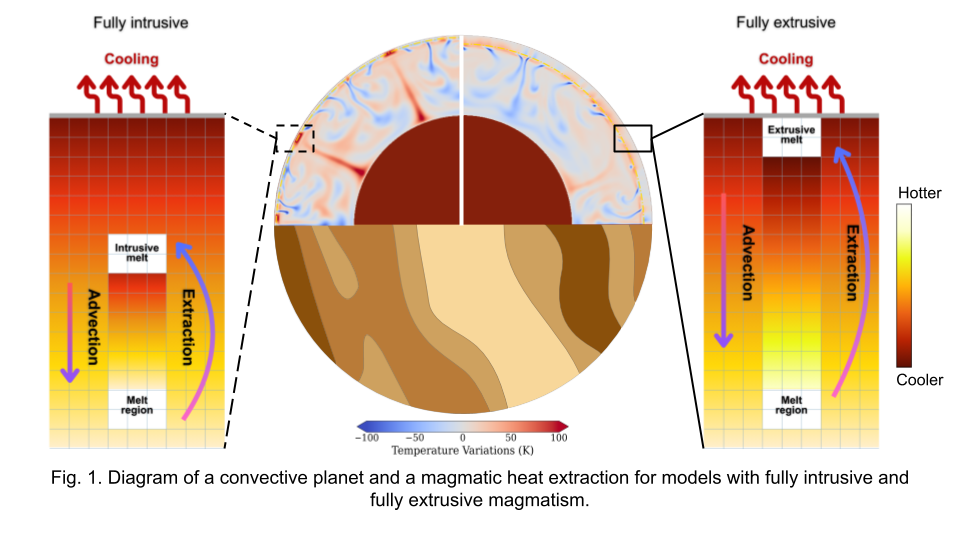
ABSTRACT

Previous studies have suggested that extrusive magmatism efficiently cools planetary interiors but the contribution by intrusive magmatism has been little investigated so far. We study the effects of the magmatic style (i.e., intrusive vs. extrusive magmatism) on the thermal evolution of Mercury-, Venus-, Moon-, and Mars-like bodies. Our results suggest that different magmatic styles strongly affect the thermal evolution of planets, where for instance intrusive magmatism allows for thinner lids, cooler melts and more melt production. In addition, for large and/or highly magmatically active planets such as Venus, an intrusive magmatism allows for more efficient cooling of the interior.

INTRODUCTION

Volcanic activity has been evidenced on planetary bodies across the inner solar system [1]. Mercury's volcanic surface expressions are extrusive volcanic vents, pyroclastic deposits, lava flow margins, etc.; and studies have analyzed their history in terms of the effect of the planetary cooling who led to the global contraction [2,3]. Venus surface is dominated by volcanoes, flow fields, volcanic vents, and coronae, among other features [4]. Recent analysis of radar data collected by the Magellan mission suggests that there could be volcanic activity still ongoing on Venus [5].

Volcanism has also shaped the lunar surface, leading to the formation of a variety of volcanic landforms such as lunar maria, lava flows, domes, cones, etc., features that were confirmed after a series of lunar exploration missions and even directly studied thanks to the return of samples from the lunar surface [6,7]. The extensive volcanic products on Mars account a large variety of explosive [8] and sedimentary volcanism [9], and recent studies presented geophysical evidence for active volcanic processes in the Elysium Planitia region [10,11].

These volcanic features are witnesses of magmatic processes that these bodies have experienced, but the amount of intrusive vs. extrusive melt that was produced during the thermal history is difficult to constrain. Extrusive magmatism has been suggested to allow more efficiently cooling of planetary interiors, but the role of intrusive magmatism on the thermal evolution has been little investigated.

In this study, we analyze the effect of the magmatic style (i.e. ‘fully intrusive’ vs. ‘fully extrusive’ magmatism end-members) by modelling the thermal evolution of Mercury, Venus, Moon, and Mars-like bodies. Our aim is to understand the effect of different magmatic styles for different planetary interiors rather than the particular evolution of the inner solar system bodies.

METHODS

We use the mantle convection code GAIA in a 2D spherical annulus geometry [12, 13]. Our models employ a temperature- and pressure-dependent viscosity that follows an Arrhenius law for diffusion creep [14, 15]. The strong temperature-dependence of the viscosity leads to the formation of a stagnant lid (an immobile layer) at the top of the convecting mantle, due to the cold temperature conditions. The thermal conductivity and thermal expansivity in our models are pressure- and temperature-dependent and we use parametrizations derived from ab-initio calculations and laboratory experiments [16]. We assume a homogeneous distribution of the heat sources and account for the decay in time of radioactive elements (i.e. 238U, 235U, 232Th, and 40K) and consider that the core cools with time.

Melting occurs when the mantle temperature exceeds the melting temperature. To keep the models as best as possible comparable with each other, we use the same melting curve parametrization as derived for the Earth’s interior [17]. We compute partial melting and consider two scenarios, i.e., fully intrusive and fully extrusive magmatism (Fig. 1). For all bodies, the depth of magmatic intrusions is set at 50 km depth. For scenarios where partial melting occurs deeper than the density crossover at ~11GPa [18], the melt is not buoyant enough to rise towards the surface and it is thus not considered in our models.

RESULTS

For all studied bodies, the convection pattern is characterized by stronger mantle plumes and more vigorous mantle flow for the fully intrusive cases than for the fully extrusive cases (Fig. 2). Additionally, the intrusive melt depth seems to control the stagnant lid growth with thinner lids for cases with magmatic intrusions.

While the global average temperature of the entire silicate part is higher for Mercury, Mars, and the Moon in the intrusive scenario compared to extrusive models, for Venus the opposite is the case (Fig. 3a). We explain this by Venus’s smaller lid-to-mantle thickness ratio and high melt production rate compared to Mercury, Mars, and the Moon. Normalized to their silicate mantles, the intrusive magmatism models produce more melt than the extrusive cases (Fig. 3d).

The mechanical lid depth of the intrusive cases is always shallower through time (Fig. 3b), diverging from the extrusive cases up to hundreds of kilometers. This is explained by higher thermal gradients and thus warmer lithospheres in the intrusive cases.

Mercury cools very quickly compared to the other planets and stops producing melt after the first half of its evolution (Fig. 3c). After that moment, the differences between the two scenarios are nearly identical. For all bodies, the intrusive magmatism cases melt at shallower depths with cooler melts during their evolution.

SUMMARY       

Throughout the evolution of all studied bodies, the fully intrusive cases present thinner mechanical lids, cooler melt temperatures, more melt production, and shallower melting depths than the extrusive cases. Our results suggest that large and/or highly magmatically active planets such as Venus efficiently cool their interior through intrusive magmatism, while keeping at the same time a warm and thin lithosphere.

REFERENCES

[1] Byrne et al., Nat.Astron, 2020; [2] Thomas & Rothery, Elements, 2019; [3] Wright et al., J. Volcanol., 2021; [4] Ghail et al., Space Science Reviews, 2024; [5] Herrick & Hensley, Science, 2023; [6] Head, Rev Geophys., 1976; [7] Zhao et al, Space: Science & Technology, 2023; [8] Brož et al., J. Volcano., 2021; [9] Brož et al., Earth Surf. Dynam., 2023; [10] Broquet & Andrews-Hanna, Nat.Astron., 2023; [11] Stähler et al. Nat.Astron., 2022, [12] Hüttig et al., PEPI, 2013; [13] Fleury et al., Geochem.Geophys., 2024; [14] Karato et al., JGR, 1986; [15] Karato & Wu, 1993; [16] Tosi et al., PEPI, 2013; [17] Stixrude et al., EPSL, 2009; [18] Ohtani et al., Chem. Geol., 1995.

How to cite: Herrera, C., Plesa, A.-C., Maia, J., and Breuer, D.: Effects of magmatic styles on the thermal evolution of planetary interiors, Europlanet Science Congress 2024, Berlin, Germany, 8–13 Sep 2024, EPSC2024-650, https://doi.org/10.5194/epsc2024-650, 2024.

EPSC2024-1106 | ECP | Posters | TP7

Tectonic influence of multi-ring basins: The case of Mercury’s Discovery Quadrangle and the Andal-Coleridge basin. 

Antonio Sepe, Luigi Ferranti, Valentina Galluzzi, Gene Walter Schmidt, Salvatore Buoninfante, and Pasquale Palumbo
Wed, 11 Sep, 10:30–12:00 (CEST) | Poster area Level 2 – Galerie | P47

Introduction
Mercury’s Discovery quadrangle is located at southern mid-latitudes in a heavily cratered region roughly antipodal to Caloris Basin [1]. The quadrangle hosts a probable pre-Tolstojan multi-ring impact basin named Andal-Coleridge, surrounded by a three- to five-ring system [2,3].
Here we present a high-resolution structural map of the quadrangle that will contribute to the 1:3M quadrangle geological map series in preparation for the BepiColombo mission [4]. In addition, we carried out a structural analysis in order to study the structural framework of the quadrangle, validate and ascertain the existence of the Andal-Coleridge basin and investigate its influence on the tectonic evolution of this region.

Data and methods
We produced a high-resolution structural map of the quadrangle utilizing MESSENGER end-of-mission products [5]. Structure strikes were then plotted in rose diagrams to recognize preferential trends at the regional scale. We also investigated the structural relationships between three main scarps (Discovery, Adventure and Resolution Rupes – DAR) –including another scarp (here named Discovery-2) that seems to be the westward continuation of the Discovery Rupes (Discovery-1)– by making several profiles across them and measuring their throw. Furthermore, to validate and ascertain the presence of the Andal–Coleridge basin, we employed gravimetric data and estimated the related stress field via beta-analysis. 

Map and trend of structural features
Our structural map (Fig.1) reveals ∼500 segments of contractional structures –including lobate scarps, high-relief ridges and wrinkle ridges– mainly arranged in a circular pattern at the approximate centre of the quadrangle, encircling both a broad topographic low and a mascon, similar to Caloris Basin [6], although identified only in the Bouguer anomaly map of [7]. Strike directions of the segments within rose diagrams generally show a uniform distribution of bins –together with a NW-SE preferential trend– suggesting an impact-related nature for most structures [8].

Figure 1 Structural map of the Discovery quadrangle overlayed to the Digital Elevation Model of [9] (left) and the Bouguer Anomaly Map of [7] (right). The red dashed line approximately delimits the topographic low and the mascon respectively.

Beta-Analysis
Following the work done for Mercury and Mars by [2] and [10], we estimated the stress field related to concentric structures via beta-analysis. This approach reveals a bimodal distribution consisting of a primary "bull's-eye" distribution, whose centre represents the point from which the causative stress field for faults spread, and a secondary, much less dense, distribution (Fig.2). Discovery Rupes aligns concentrically with the primary distribution, while Adventure and Resolution Rupes exhibits concentric alignment with the secondary distribution roughly coincident with another probable impact basin, informally named b78 [11], where another smaller mascon is present.

Figure 2 (left) The stress field resulting from beta-analysis in stereographic projection centred at quadrangle’s centre. (right) The hypothesised location and extent of Andal-Coleridge and b78 basins from [11].

Throw-Height Analysis
For each profile the scarp height was measured and then plotted against its position on the fault trace, corresponding to the fault length, resulting in a throw profile (Fig.3). The analysis of the throw profiles provide evidence that the three structures represent the morphological expression of two different faults, the Discovery fault and the Adventure-Resolution fault [2], grown hard-linking several segments together. These two faults also appear to be kinematically soft-linked, since the cumulative throw falls approximately at the centre of the system, consistent with terrestrial fault growth patterns [12]. Additionally, Discovery Rupes shows evidence of reactivation within Rameau crater, suggesting a process of fault-trace erosion and its subsequent re-emergence possibly due to Mercury's global contraction. Adopting previous dating of Rameau crater and Discovery Rupes [14,15], we derived a preliminary chronology for Discovery Rupes evolution and found a peak in throw-rate during the Tolstojan period, with declining activity towards the Mansurian period which is possibly continuing to the present [15].

Figure 3 (up) The DAR system and the 40 profiles used to produce the throw-height plot (down). Each peak on the plot represents a fault segment.

Conclusions and future work
The present work reveals a complex structural framework within Mercury’s Discovery quadrangle. The concentric alignment of structures to both a topographic low and a mascon together with the general uniform distribution shown in rose diagrams strongly supports the existence of the Andal-Coleridge basin. The concentricity of Discovery Rupes to the primary distribution identified through beta-analysis emphasizes its connection to the basin. In contrast, Adventure and Resolution Rupes display concentric alignment with the smaller b78 impact basin. This observation implies that these two scarps originated from two distinct impacts and were reactivated by Mercury's global contraction as a linked fault system. The Andal-Coleridge basin likely introduced mechanical discontinuities in the crust, influencing the localization and orientation of faults [2]. These weaker zones were eventually exploited during the subsequent global contraction. Indeed, the throw-height analysis shows signs of reactivation where Discovery Rupes cuts Rameau crater, suggesting a peak in throw-rate during the Tolstojan period.
We aim at improving the structural map of the quadrangle to better understand the NW-SE-trending structures’ behaviour and better investigate the fault reactivation. This study may also represent a contribution for evaluating the rate of global contraction and its magnitude throughout Mercury’s evolution.

Acknowledgements
We gratefully acknowledge funding from the Italian Space Agency (ASI) under ASI-INAF agreement 2017-47-H1.

References
[1] Trask and Dzurisin (1984). USGS, IMAP 1658. [2] Watters et al. (2001). Plan. and Sp. Sci., 49(14-15), 1523-1530. [3] Spudis and Strobell (1984). LPSC, 814-815. [4] Galluzzi et al. (2019). JGR: Planets, 124(10), 2543-2562. [5] Denevi et al. (2017). Sp. Sci. Rev., 214(1). [6] Smith et al. (2012). Science, 336. [7] Buoninfante et al. (2023). Sci. Rep., 13, 19854. [8] Delbo et al. (2019). LPI Contrib. No. 2189. [9] Becker et al. (2016). LPSC Contrib. No. 1903. [10] Wise et al. (1979). Icarus, 38, 456-472. [11] Orgel et al. (2020). JGR: Planets, 125(8). [12] Kim and Sanderson (2005). Earth-Sci. Rev., 68(3-4), 317-334. [13] Kinczyk et al. (2020). Icarus, 341, 113637. [14] Clark et al. (2024). LPSC Contrib. No. 3040. [15] Tosi et al. (2013). JGR: Planets, 118(12), 2474-2487.


How to cite: Sepe, A., Ferranti, L., Galluzzi, V., Schmidt, G. W., Buoninfante, S., and Palumbo, P.: Tectonic influence of multi-ring basins: The case of Mercury’s Discovery Quadrangle and the Andal-Coleridge basin., Europlanet Science Congress 2024, Berlin, Germany, 8–13 Sep 2024, EPSC2024-1106, https://doi.org/10.5194/epsc2024-1106, 2024.

TP9 | Impact Processes in the Solar System

EPSC2024-372 | ECP | Posters | TP9 | OPC: evaluations required

Evaluation of large craters and basins for lunar production functions 

Astrid Oetting, Wajiha Iqbal, Thomas Heyer, Nico Schmedemann, James Head, Gregory Michael, Harald Hiesinger, and Carolyn van der Bogert
Thu, 12 Sep, 14:30–16:00 (CEST) | Poster area Level 2 – Galerie | P9

Introduction: Large craters and basins that are present on the lunar surface are remants of its early impact history. The relative ages of geological surfaces can be determined with crater size-frequency distribution (CSFD) measurements using a production function (PF), since the impact record on the lunar surface is related to time. Widely used PFs were developed by Neukum (1983) and Neukum et al. (2001) [1,2] and are valid for crater diameters between 0.01–300 km. However, to understand the earlier history of the Moon, when larger impacts were more abundant, an extension of the valid crater diameter range to larger diameters would be beneficial. It could provide input for understanding the number of impactor populations [e.g., 1-4] and the stability of the impact rate on the Moon [e.g., 1,2,5,6]. However, the precise determination of the main basin rim diameter, especially for multi-ring basins, is challenging due to their complex and degraded morphology.


Method: The diameters of large craters and basins were measured based on topographic (~100 m/pixel) and gravity data. We used the Lunar Reconnaissance Orbiter (LRO) Wide Angle Camera (WAC) image mosaic [7], LRO Lunar Orbiter Laser Altimeter Digital Elevation Model (LOLA DEM) [8], and the WAC DEM color-shaded relief map [9,10]. In addition, the following geophysical data were used: Gravity Recovery and Interior Laboratory (GRAIL) [11] data, a crustal thickness map (Crustal Thickness – Model 1) [12], and a Bouguer anomaly map [11].

In order to have a consistent measurement of the main basin rim diameter, we follow the approach of Neumann et al. (2015) [13]. They [13] compared the Bouguer anomaly, which reflects changes in the subsurface and/or crustal thickness, with well-preserved basin structures. They suggest that double the diameter of the Bouguer anomaly is consistent with the main or reference rim for multi-ring basins.

The ArcGIS CraterTools add-in [14] was used to perform the CSFD measurements, which were then further analyzed with Craterstats2 [15]. The count area is the entire Moon, but due to significant differences between mare and highlands areas, we subdivide the count area "Entire Moon" into "Highlands" and "Mare".


Results & Discussion: We identified 311 craters and basins with diameters between 100-1250 km over the entire Moon. We do not include the South Pole Aitken (SPA) basin as it is unclear which topographic ring is its reference rim and it is assumed to have formed in an even earlier era of lunar basins [16]. The CSFD measurements (Figure 1) of the entire Moon and the highlands are consistent up to diameters of 250 km. However, while the highlands distribution progresses relatively smoothly towards large basin diameters, the CSFD of the entire Moon shows a "step" between 400-700 km. The CSFD of the mare areas is significantly different from the two other areas. Craters <200 km are less abundant than on the other two areas, and craters and basins >250 km are more abundant. The CSFD measurements for the entire Moon and the lunar highlands are better represented by the PF of [2] using the valid crater diameter range of 100-300 km. The mare areas could not be fitted with either PF.

Figure 1: Cumulative CSFD plots for large craters and basins compared with existing PFs (black and blue curves) (a) [1] and (b) [2] in the valid crater diameter range of 100-300 km. The gray line represents the equilibrium function of [17].


The significant difference between the CSFDs on highlands and mare areas may result from:

(1) lava flooding [18,19], causing an incomplete identification of basins on the mare areas

(2) asymmetries in cratering rate, e.g. due to the rotation and inclination of the Moon [20,21]

(3) larger basin diameters resultant on the lunar nearside due to a different subsurface temperature and crustal thickness [16]


Conclusion: The CSFD measurements indicate that large craters and basins are still in production and, therefore, an extension of PFs for craters and basins from 300-1250 km could be possible. This extented crater diameter range would allow to draw conclusions about the number of impactor populations and the stability of the impact rate in the early lunar history. However, the influence of resurfacing processes on mare units compared to the highlands is not yet entirely understood and a more detailed analysis of the mare regions is necessary.

Acknowledgments: This Project is funded by the Deutsche Forschungsgemeinschaft (DFG, German Research Foundation) – Project-ID 263649064 – TRR 170.

References: [1] Neukum G. (1983) Habil. Thesis LMU, Munich. [2] Neukum G. et al. (2001) Space Sci. Rev., 96, 55. [3] Strom R.G. et al. (2005) Science, 309(5742), 1847-1850. [4] Head J.W. et al. (2010) Science, 329(5998), 1504-1507. [5] Guinness E.A. and Arvidson R.E. (1977) Proc. Lunar Sci Conf., 8, 3475-3494. [6] Bottke W.F. et al. (2005) Icarus, 179(1), 63-94. [7] Robinson M.S. et al. (2010) Space Sci. Rev. 150, 81-124. [8] Smith D.E. et al. (2010) Space Sci. Rev., 150, 209-241. [9] Scholten F. et al. (2012) JGR, 117(E12). [10] Smith D.E. et al. (2010) GRL, 37(18). [11] Zuber M.T. et al. (2013) Science, 339(6120), 668-671. [12] Wieczorek M.A. et al. (2013) Science, 339, 671-675. [13] Neumann G.A. et al. (2015) Sci. Adv., 1(9), e1500852. [14] Kneissl T. et al. (2011) PSS, 59(11-12), 1243-1254. [15] Michael G. et al. (2016) Icarus, 277, 279-285. [16] Miljković K. et al. (2013) Science, 342(6159), 724-726. [17] Hartmann W.K. (1984) Icarus, 60(1), 56-74. [18] Evans A.J. (2016) Geophys. Res. Lett., 43, 2445-2455. [19] Evans A.J. (2018) JGR, 123, 1596-1617. [20] Wiesel W. (1973) Icarus, 15(3), 373-383. [21] Le Feuvre M. and Wieczorek M.A. (2011) Icarus, 214(1), 1-20.

How to cite: Oetting, A., Iqbal, W., Heyer, T., Schmedemann, N., Head, J., Michael, G., Hiesinger, H., and van der Bogert, C.: Evaluation of large craters and basins for lunar production functions, Europlanet Science Congress 2024, Berlin, Germany, 8–13 Sep 2024, EPSC2024-372, https://doi.org/10.5194/epsc2024-372, 2024.

EPSC2024-437 | ECP | Posters | TP9 | OPC: evaluations required

Efficacy of classical and spectroscopic techniques for strain quantification in weakly shocked rocks: Results from experimentally impacted Taunus quartzite 

Rajit Das, Amar Agarwal, Arun Ojha, Thomas Kenkmann, and Michael Poelchau
Thu, 12 Sep, 14:30–16:00 (CEST) | Poster area Level 2 – Galerie | P13

Traditional strain estimation techniques, such as the Fry and the Rf/Phi method, have been extensively used in tectonically deformed rocks [1]. However, their applicability in impact rocks has not been explored yet. An essential difference between tectonic and impact cratering-led deformation is that the former causes strain rates in the order of 10-15-10-6 s-1 [2], while the latter leads to a much higher strain rate, ~10-2-106 s-1 [3]. Furthermore, peak pressures in tectonic deformation are in the order of hundreds of megapascals [4], whereas, in the case of naturally shocked rocks, the shock pressures are in the range of gigapascals [5].

To address this, an impact cratering experiment was carried out on a quartzite block to investigate the efficacy of these traditional and spectroscopic tools in determining strain in weakly shocked rocks (Fig. 1). A basalt projectile of diameter 6.18mm was accelerated to a velocity of ~5km/s and impacted a quartzite block, Taunus quartzite from Germany.

The block was sawed through the crater centre. Twelve cores were recovered from the target surface and the sawed (sub-) surface each. Each cylinder was bisected in half to produce 24 specimens, each from the target and subsurface. Specimens 5.1 to 5.24 were from the target surface, whereas the subsurface specimens were labelled 6.1 to 6.24. Specimens 5.1 to 5.12 and 6.1 to 6.12 were from the top half of the cylindrical core obtained from the target surface and subsurface, respectively. Similarly, 5.13 to 5.24 and 6.13 to 6.24 were from the lower half of the cylindrical core obtained from the target surface and the subsurface, respectively.

Figure 1: Photographs of the Taunus quartzite block (edge length 20 cm) (A) before and (B) after the impact experiment. The block was split into several pieces after the experiment. The top/target surface is marked with “Top” and “X” inside a green circle. Note the different orientations of the block in the two images.

Strain analysis was carried out using three methods: (1) Fry, (2) Rf/Phi, and (3) X-ray Diffractometry (XRD) in the impacted Taunus quartzite. These results were then compared to simulated strains in the transient stage from hydrocode modelling (Fig. 2). Radial fractures were observed on the target surface but not in the subsurface in the thin section images (Fig. 3). Results demonstrably suggest that the strain measured using the three methods is similar to the results from the hydrocode simulations. Furthermore, these techniques are sensitive enough to capture strain imparted at shock pressures as low as 0.23 GPa (obtained from hydrocode modelling) at the transient crater stage (at 25 µs post impact).

Figure 2: Results from hydrocode simulation. (A-B) show pressure and density distribution, and (C-D) show damage and total plastic strain at 0 ms and 25 ms. Simulation is run till the end of the transient cratering stage and before the arrival of the reflected wave from the free surface.

Figure 3: Thin section images from the experiment. The arrows indicate the direction of the point of impact. (A) Sample T01 is on the target surface and closest to the point of impact, (B) sample S01 is on the subsurface and just below the point of impact, whereas (C) sample S24 is the point farthest away from the point of impact. Note the radial tensile fractures in the target surface in (A) (parallel to the arrow indicating the direction of the impact point) and their absence in the subsurface (B and C).

However, caution is advised while using Fry and Rf/Phi methods, as grain fracturing and pulverisation may affect the grain centre distribution and grain shape, thus leading to anomalous results. The use of the lattice technique, XRD, can be investigated further to understand the accuracy and efficacy in low-strain conditions. 

Acknowledgements:

We thank the Dept. of Earth Sciences at the Indian Institute of Technology-Kanpur for microscopy and XRD facilities. The authors are also grateful to Dr. Auriol Rae for his input and help on the hydrocode simulation. We are also thankful to Dr. Gaurav Joshi for his suggestions. Yashwant Singh helped in the Fry analysis.

References:

[1] Joshi, G., et al. (2017). Microstructures and strain variation: Evidence of multiple splays in the North Almora Thrust Zone, Kumaun Lesser Himalaya, Uttarakhand, India. Tectonophysics 694, 239–248.

[2] Pfiffner, O. A., et al. (1982). Constraints on geological strain rates: Arguments from finite strain states of naturally deformed rocks, J. Geophys. Res., 87(B1), 311–321.

[3] Ramesh, K. T. (2008). High Rates and Impact Experiments. In: Sharpe, W. (eds) Springer Handbook of Experimental Solid Mechanics. Springer Handbooks. Springer, Boston, MA.

[4] Vaughan-Hammon, J. D., et al. (2021). Alpine peak pressure and tectono-metamorphic history of the Monte Rosa nappe: evidence from the cirque du Véraz, upper Ayas valley, Italy. Swiss J Geosci 114, 20.

[5] Engelhardt, W. V., et al. (1969). Shock induced planar deformation structures in quartz from the Ries crater, Germany. Contr. Mineral. and Petrol. 20, 203–234 (1969).

How to cite: Das, R., Agarwal, A., Ojha, A., Kenkmann, T., and Poelchau, M.: Efficacy of classical and spectroscopic techniques for strain quantification in weakly shocked rocks: Results from experimentally impacted Taunus quartzite, Europlanet Science Congress 2024, Berlin, Germany, 8–13 Sep 2024, EPSC2024-437, https://doi.org/10.5194/epsc2024-437, 2024.

EPSC2024-560 | ECP | Posters | TP9 | OPC: evaluations required

Modelling Lunar Impact Flashes from Molten Ejecta 

Paige Rice, Robert Luther, and Kai Wünnemann
Thu, 12 Sep, 14:30–16:00 (CEST) | Poster area Level 2 – Galerie | P6

Introduction:

Lunar impact flashes have been observed from Earth since 1999 [1]. To date, over 600 impact flashes have been detected by individuals as well as multiple observation campaigns [2], including the NASA Lunar Impact Monitoring Program, the MIDAS project, and the NELIOTA project. The record of flashes has been analysed statistically to estimate the current near-Earth meteorite flux and size distribution [3], though the results of such estimates rely on some assumptions about the relationship between the radiative energy of the flashes and impactor velocity and kinetic energy.

Luminous efficiency, the fraction of impactor kinetic energy that is transformed into light emission during the impact process, is a poorly constrained value. Common estimates range over three orders of magnitude, from 10-2 to 10-4 [4]. Recent modelling work produced a detailed model of the radiant process in the impact debris cloud and fit well to the observed flash using calculated impactor properties [5]. Their work builds on previous studies considering the physics of the radiant process, indicating that vaporized material in the instant of impact cannot provide enough thermal radiance to account for impact flash magnitude, and most of the light from impact flashes is created by thermal radiance of droplets of melted ejecta [1]. However, they did not fit their model to the observed diameter and depth of an associated crater.

Method:
We seek to improve the constraints on luminous efficiency by modelling simplified analogues of observed impact flashes with known associated craters. Here, we use the iSALE-Dellen shock physics code [6,7,8] to model the 17 March 2013 lunar impact flash and crater [Fig. 1], adjusting the impact parameters to best replicate the known factors of the impact and match the resultant crater size. Target porosity, modelled by the ε-α-porosity compaction model [8,9], is set at a homogeneous 42% and a vertical impact in a 2D cylindrical model is used for computational efficiency. We use the Drucker-Prager strength model and the ANEOS equation of state to model the lunar regolith. Then, we determine the volume of melted ejecta produced in each impact as a proxy for radiance, and vary velocity-mass balance and target porosity parameters to study the effect on ejected melt volume. Crater data permitting, we will also study additional, recently identified flash-crater pairs [10,11,12].


Figure 1: Crater identified with 17 March 2013 impact flash. a: before, b: after. [13]


Results:

We show some preliminary results of our first study models in the plot below. Peak pressure on target material is plotted (in Pa x1e10). Material above the black curve is ejected as the model proceeds. All material is shown in position at t=0. The resolution of this model (10 CPPR) is not sufficient for a detailed analysis of peak pressure and melt volume; 40 CPPR resolution will yield a better result, reducing uncertainty to <10% [14]. Critical shock pressure for melt production in regolith at 42% porosity is estimated at no higher than 24 GPa [14]. Our preliminary model shows only a small sliver of overlap between melt volume and ejecta volume, much lower than the 20-30% of melt ejected in [15], suggesting a low luminous efficiency in this impact.

Figure 2: Peak pressure on target material for modelled 17 March 2013 impact. Material above the black curve is ejected. Material above 24 GPa peak pressure is assumed melted.


Conclusion:

Further study of the details of thermal radiance of the ejected melt will be left to a future study, enabling a connection from impact parameters to luminous efficiency via melt volume. This work could also be expanded through use of 3D models with realistic replication of the estimated impact angles of known impact flash craters, as well as more detailed, layered target rock properties.


References

[1] Yanagisawa, Masahisa et al. (2002), Icarus 159 (1), pp. 31–38. DOI: 10.1006/icar.2002.6931.

[2] Sheward, D. et al. (2024), MNRAS 529 (4), pp. 3828–3837. DOI: 10.1093/mnras/stad2707.

[3] Avdellidou, Chrysa et al. (2021), Planetary and Space Science 200, p. 105201. DOI: 10.1016/j.pss.2021.105201.

[4] Ortiz, J. L. et al. (2000), Nature 405 (6789), pp. 921–923. DOI: 10.1038/35016015.

[5] King, Patrick K. et al. (2022), 16th Hypervelocity Impact Symposium. DOI: 10.1115/HVIS2022-28.

[6] Amsden, A. et al. (1980), LANL, LA8095:101.

[7] Collins, G.S. et al. (2004), Meteoritics & Planetary Science 39:217–231. DOI: 10.1111/j.1945-5100.2004.tb00337.x.

[8] Wünnemann, K. et al. (2006), Icarus 180, pp. 514-527. DOI: 10.1016/j.icarus.2005.10.013.

[9] Collins, G. et al. (2011), Int. J. Imp. Eng., 38:434-439. DOI: 10.1016/j.ijimpeng.2010.10.013,

[10] Sheward, Daniel et al. (2021), Europlanet Science Congress 2021. DOI: 10.5194/epsc2021-590.

[11] Sheward, D. et al. (2022), MNRAS 514 (3), pp. 4320–4328. DOI: 10.1093/mnras/stac1495.

[12] Sheward, Daniel et al. (2024), EGU General Assembly 2024, Abstract EGU24-1216. DOI: 10.5194/egusphere-egu24-1216.

[13] Robinson, Mark S. et al. (2015), Icarus 252, pp. 229–235. DOI: 10.1016/j.icarus.2015.01.019.

[14] Liu, T. et al. (2022), JGR Planets 127 (8), Article e2022JE007264, e2022JE007264. DOI: 10.1029/2022JE007264.

[15] Luther, R. et al. (2017), 48th Annual Lunar and Planetary Science Conference (1964), p. 3012. Bibcode: 2017LPI....48.3012L.

How to cite: Rice, P., Luther, R., and Wünnemann, K.: Modelling Lunar Impact Flashes from Molten Ejecta, Europlanet Science Congress 2024, Berlin, Germany, 8–13 Sep 2024, EPSC2024-560, https://doi.org/10.5194/epsc2024-560, 2024.

EPSC2024-956 | ECP | Posters | TP9 | OPC: evaluations required

From Debris to Resource: Simulating High-Velocity Impacts of Space Debris on the Moon 

Nick Langer, Robert Luther, Kai Wünnemann, Frank Koch, and Stefan Linke
Thu, 12 Sep, 14:30–16:00 (CEST) | Poster area Level 2 – Galerie | P7

1. Introduction

The quantity of space debris—defunct human-made objects in orbit—continues to increase, including old satellites, spent rocket stages, and fragments resulting from disintegration, erosion, and collisions. Space debris poses a significant risk for space travel and satellite operations, as even small pieces, traveling at high velocities, can cause substantial damage or destruction upon colliding with satellites or spacecraft. This growing accumulation increases the risk of collisions, poten tially triggering a cascade effect known as the Kessler Syndrome, which could render certain orbits unusable for future satellites.

Despite the impending threat to space infrastructure, measures to mitigate space debris are insufficiently implemented, primarily due to high associated costs. Furthermore, existing regulations are often more akin to recommendations than mandatory directives. A solution with potential economic benefit is to collect larger objects (e.g. a Ariane 5 upper stage in the geostationary transfer orbit), and to transport this material to the lunar surface, where the metal can be used in future projects [1]. To facilitate recycling, the debris is planned to impact the Moon at velocities ranging from 0.5 − 3.0 km/s. Upon impact, the debris would break down, and the resulting fragments would be collected by moon rovers. In this study, we analyze the effect of impact velocity and target parameters on the fate of the projectile and the resulting crater, using numerical simulations.


2. Methods

In this study, we apply iSALE-2D shock physics code [2-4] to simulate the impact of an Ariane 5 ESC-A upper stage (4540 kg, 5.4 m in diameter, 4.711 m in height [5]) onto lunar regolith at velocities from 0.5 − 3 km/s. A realistic representation with thin walls is computationally expensive as it requires a large model resolution. Here, we consider four representations of the projectile: We represent the Ariane upper stage as 1) a small homogeneous cylinder with the density of aluminum alloy 2219 (ρ=2840 kg/m³), 2) a porous cylinder of the same mass, and a correct volume of the projectile, using the epsilon-alpha porosity compaction model [4], 3) a homogeneous cylinder of the same mass and volume but instead of using the porosity model, we modify the density specified in the equation of state, and 4) a hollow cylinder with resolved walls and end caps. We use a grid spacing of 0.2 and a resolution of 14 cells per projectile radius in vertical and horizontal direction.

The projectile and target are simulated by a Tillotson equations of state [6]. It is designed for high-velocity impact computations and hence capable of handling the relevant pressure ranges for this study. A granular behavior is assumed for the regolith target. Therefore the Drucker-Prager strength model with the strength Y=min(Y0p,Ym) is used, where Y0 is the cohesion (yield strength at zero pressure), μ is the coefficient of internal friction for material, Ym is the limiting strength at high pressure and p is pressure. The parameters for the regolith are taken from [7], including porosity model parameters. We apply the Von Mises strength model for the aluminum of the upper stage: Y=Y0. For the porous projectile representation, we derive an elastic threshold based on the Youngs modulus and the yield strength as: ε=315 MPa / 73 GPa=0.004. Both values for this equation are taken from [8].


3. Results

Here, we show results generated using a porous projectile. We observe, as expected, that with increasing kinetic energy, the radius and depth of the crater increase as well (Figure 1). For the slowest impact of 0.5 km/s, the crater grows to ∼ 18 m in diameter, while it reaches ∼ 32 m for an impact at 3 km/s. The faster impact also generates a more heterogeneous pressure distribution (Figure 2).

We find that in the case of the slower impact, the resulting crater is relatively shallow (Figure 2 top panel), with a depth-diameter ratio of 0.17, while it reaches 0.25 for the fastest impact (Figure 2 bottom panel).


Figure 1: Simulated crater radii and depths from the instant of impact until 4 seconds after impact.


(2a) Impact velocity vimpact = 0.5 km/s .


(2b) Impact velocity vimpact = 3.0 km/s .
Figure 2: Crater snapshot at 4 seconds after impact. The pressure and density are plotted on the left and right halves, respectively.


4. Discussion & Conclusion

The plotted depth in Figure 1 (lower panel) occasionally deviates from the final value, which is likely due to numerical artefacts or residual material close to the symmetry axis. An adjustment of the analysis procedure can reduce this noise.

The study investigates lunar surface recycling of space debris, specifically through the high-velocity impact simulation of an Ariane 5 upper stage on lunar regolith. The method's potential in repurposing space debris for lunar construction is promising, contributing to sustainable lunar exploration efforts. However, anomalies in pressure distribution and crater rim identification suggest simulation refinement.


References

[1] F. Koch. 8th European Conference on Space Debris, 8(1), 2021.
[2] A.A. Amsden, H.M. Ruppel, and C.W. Hirt. Technical Report LA-8095, 5176006, June 1980.
[3] G.S. Collins, H.J. Melosh, and B.A. Ivanov. Meteoritics & Planetary Science, 39(2):217–231, February 2004.
[4] K. Wünnemann, G.S. Collins, and H.J. Melosh. Icarus, 180(2):514–527, February 2006.
[5] R.Lagier et al. User’s Manual, (1), 2021.
[6] J. H. Tillotson. Technical report, July 1962.
[7] R. Luther et al. The Planetary Science Journal, 3(10):227, October 2022.
[8] C.Y. Ho, J.M. Holt, and H. Mindlin. Number Bd. 2. Cindas/Purdue Univ., 1997.

How to cite: Langer, N., Luther, R., Wünnemann, K., Koch, F., and Linke, S.: From Debris to Resource: Simulating High-Velocity Impacts of Space Debris on the Moon, Europlanet Science Congress 2024, Berlin, Germany, 8–13 Sep 2024, EPSC2024-956, https://doi.org/10.5194/epsc2024-956, 2024.

EPSC2024-1111 | ECP | Posters | TP9 | OPC: evaluations required

Quantifying the effect of asteroid structure on hypervelocity impact outcomes with the Material Point Method 

Xiaoran Yan, Wenhan Zhou, Yan Liu, Patrick Michel, and Junfeng Li
Thu, 12 Sep, 14:30–16:00 (CEST) | Poster area Level 2 – Galerie | P8

Introduction Recent advancements in computational power and model sophistication have revolutionized the study of hypervelocity impacts on asteroids, enabling the exploration of broader parameter spaces and more intricate asteroid structures [1, 2]. The outcome of such collisions, including crater formation and catastrophic disruption, is intricately linked to the internal structure of asteroids. However, the nature of this relationship remains an open question, necessitating further investigation. The Material Point Method (MPM), renowned for its ability to accurately track interfaces and resolve contact problems, emerges as a powerful tool for numerical simulations in this context [3]. By harnessing the capabilities of MPM, we aim to shed light on the correlation between an asteroid's structural composition and its response to hypervelocity impacts, ultimately contributing to a deeper understanding of the underlying physical processes.

Method Developed from the particle-in-cell numerical method, the Material Point Method (MPM) combines Eulerian and Lagrangian descriptions, making it well-suited for handling boundary conditions and interface problems. By utilizing a dynamic background grid that only creates nodes with mapped material points for efficient computation, we further implement a contact algorithm in our MPM framework that could accurately calculate the real contact and friction force on each interface, and novelly extend the contact correction from two-object to multi-object scenarios.

When the contact algorithm is activated, if a background grid node is shared by multiple objects, separate node information will be created for each object, along with the associated material point indices, as illustrated in Fig. 1. The execution of contact correction is triggered by assessing both the distance between objects and their relative motion based on non-penetration constraints. It is implemented by applying contact forces to eliminate penetration and enforce suitable friction conditions. Multi-body contact is resolved by solving a linear system of equations for the unknown contact forces between each pair of interacting objects. This algorithmic enhancement bolsters the capability of our MPM code to precisely simulate hypervelocity impacts on asteroids with intricate internal structures.

Simulation and Discussion In this study, we conduct numerical simulations of artificial hypervelocity impacts on asteroids to quantitatively investigate the distinct dynamic responses of rubble-pile asteroids compared to monolithic, homogeneous ones. We employ material parameters of typical basaltic rocks in our simulations [4]. The impact scenarios and results for rubble-pile asteroids are illustrated in Fig. 2. Considering the crucial role of the catastrophic disruption threshold in understanding the evolutionary history of small celestial bodies and designing asteroid impact defense missions, as well as the availability of numerical values for specific asteroid sizes from previous research [5], we aim to quantify the influence of porosity and internal interfaces on impact disruption mechanisms by calculating the catastrophic disruption threshold for rubble-pile asteroids with various configurations.

Our simulation results demonstrate the significant impedance effect of internal interfaces on shock wave propagation, leading to a substantially higher catastrophic disruption threshold for rubble-pile asteroids compared to monolithic asteroids of the same strength. This finding suggests that the presence of a rubble-pile structure enhances the resistance of asteroids to catastrophic disruption, which has important implications for understanding their fragmentation and reassembly processes throughout their evolutionary history.

Furthermore, the quantitative analysis of the catastrophic disruption threshold for different rubble-pile configurations provides valuable insights into the role of porosity and internal structure in the impact response of asteroids. These findings contribute to the development of more accurate models for asteroid evolution and can inform the design of future asteroid impact defense strategies. Additionally, the results of this study have the potential to facilitate the calibration of asteroid ages based on their structural properties and impact history, enhancing our understanding of the chronology of asteroids in the solar system.

Acknowledgment X.Y. and J.L. acknowledge support from the National Natural Science Foundation of China under Grant 12372047. X.Y. acknowledges support from the National Natural Science Foundation of China under Grant 62227901. P.M. acknowledges support from the French space agency CNES and from the French National Centre for Scientific Research (CNRS) through the exploratory research program of the Mission for Transversal and Interdisciplinary Initiatives.

References [1] Raducan, S. D. et al. (2024). PSJ. 5(3). [2] Jutzi, M. et al. (2022) Nat. Commun. 13(1), 7134. [3] Yan, X. et al. (2023) ACM Conference. [4] Jutzi, M. (2015) P&SS. 107(1), 3–9. [5] Benz, W. et al. (1999) Icar. 142, 5–20.

How to cite: Yan, X., Zhou, W., Liu, Y., Michel, P., and Li, J.: Quantifying the effect of asteroid structure on hypervelocity impact outcomes with the Material Point Method, Europlanet Science Congress 2024, Berlin, Germany, 8–13 Sep 2024, EPSC2024-1111, https://doi.org/10.5194/epsc2024-1111, 2024.

TP10 | Exploring Mercury and its environment

EPSC2024-247 | ECP | Posters | TP10 | OPC: evaluations required

Shape and Albedo from Shading with Planetary Flyby Images of Mercury and the Moon 

Isabel Krüll, Kay Wohlfarth, Moritz Tenthoff, Christian Wöhler, Valentina Galluzzi, Jack Wright, Johannes Benkhoff, and Joe Zender
Thu, 12 Sep, 10:30–12:00 (CEST) | Poster area Level 2 – Galerie | P26

Introduction
Surface reconstruction of planetary bodies such as the Moon and Mercury is crucial for geomorphological analysis, reflectance normalization, thermal modeling, rover landing site planning, and outreach activities. Stereo algorithms and Shape-and-Albedo-from-Shading (SAfS) are well-established methods for planetary 3D reconstruction. The current state-of-the-art combines both methods. SAfS refines the surface slopes of a stereo digital elevation model (DEM) and typically yields 3D models at image resolution [1,2,3,4,5,6]. This approach is generally well-validated for scientifically calibrated instruments that observe the planetary body under favorable conditions. However, the limits of SAfS still need to be explored. This work applied the SAfS algorithm to planetary flyby images acquired with uncalibrated off-the-shelf cameras. We qualitatively and quantitatively assessed the algorithm's performance and found the method robust even under these challenging conditions.

Methods
We considered two images: First, a flyby image of Mercury (Figure 1, left), which was obtained with a monitoring camera during BepiColombo’s third flyby, and second, a flyby image of the Moon captured by a GoPro during the Artemis I mission (Figure 1, right). In both cases, off-the-shelf cameras without a proper radiometric calibration routine were used instead of scientific instruments. Therefore, it was necessary to calibrate the images before applying the SAfS algorithm. For calibration, we estimated a reflectance image of the region of interest with Hapke parameters from [7] to establish a relationship between the digital number output of the camera and the physical radiances. The resulting Mercury flyby DEM was evaluated qualitatively, compared to MDIS WAC images [8]. The lunar flyby DEM was compared to the SLDEM2015 (60-100 m/pixel) [9], which serves as a ground truth. 

Figure 1. Left: Flyby image from the BepiColombo mission [10]. Right: Flyby image from the Artemis I mission [11].


Results
Figure 2 shows the color-coded SAfS DEM for the BepiColombo image. We found that the algorithm successfully reconstructed the surface in the center of the image but struggled with the more extremely illuminated sections at the edges. It is obvious that the algorithm reconstructed some details that are not visible in the input DEM and hence improved the resolution. Figure 3 compares a grey-scale representation of the SAfS DEM with MDIS WAC image EW0251718878F. Small craters in Izquierdo (the crater in the right half of the marked section), a few kilometers in diameter, become especially visible. Figure 4 shows the marked section in more detail. Due to the lack of high-resolution ground truth, a detailed algorithm evaluation was not possible for this image.

Figure 2. Color-coded presentation of the reconstructed SAfS DEM from the BepiColombo image.


Figure 3. Left: grey scale reconstructed SAfS DEM from the BepiColombo image. Right: wide-angle camera (WAC) image from MDIS [8]. The marked image section was evaluated in more detail (Fig. 4).


Figure 4. Comparison of WAC image, input DEM, BepiColombo (BC) image and SAfS DEM. Below the images are the height and slope of the profile (red dashed line).


However, the ground truth evaluation with the Artemis I image gives a quantitative measure under comparable conditions. Figure 5 shows the color-coded SAfS DEM of a region of interest (ROI) reconstructed from the flyby image. The results for the Artemis I image for all ROIs were of high quality. Figure 6 shows the elevation profile indicated by the dashed line in Figure 5. The algorithm refines the low-frequency initial DEM (dashed line), yielding a SAfS DEM (red line), which closely resembles the ground truth DEM (black line).  The vertical RMSE between the reconstructed DEM and the ground truth is 523 m, lower than the pixel size of approximately 1500 m. However, there were inaccuracies near the ROIs’ edges, and a preferred direction aligned with the illumination direction became visible.

Figure 5. Color-coded presentation of the reconstructed SAfS DEM from the Artemis image. The black dashed line marks the profile that was analyzed in detail (see Fig. 6).


Figure 6. Height profile of a selected terrain profile (see black dashed line in Fig. 5). Red line: DEM generated with the SAfS algorithm. Black line: Ground truth DEM. Dashed line: Initial DEM (input for the SAfS algorithm).


Conclusion
In conclusion, it is possible to obtain sharp results by applying our SAfS framework to flyby images. Both results show that, despite the challenging conditions, the SAfS algorithm could reconstruct the surface up to image resolution and increase the level of detail of the input DEM. The quality differences between the two images can mainly be attributed to the (spatial) resolution of the original images and the oblique illumination direction. Usually, the image center is distortion-free, and the illumination geometry is best suited for SAfS. We found that the surface reconstruction at the edge of the image is also possible, but the quality decreases significantly. All in all, our flyby-derived DEMs are accurate, and a previous version has been used for ESA outreach activities, similar to [12]:
https://www.esa.int/Science_Exploration/Space_Science/BepiColombo/BepiColombo_s_third_Mercury_flyby_the_movie


References
[1] A. Grumpe, F. Belkhir, C. Wöhler. Advances in Space Research, 53(12):1735–1767, 2014.
[2] C. Jiang, S. Douté, B. Luo, L. Zhang, P&RS,130, 2017 
[3] O. Alexandrov, R. Beyer. Earth and Space Science, 5, 2018
[4] B.  Wu, W. C.  Liu, A. Grumpe, C. Wöhler. P&RS, 140, 2018
[5] M. Tenthoff, K. Wohlfarth, C. Wöhler. Remote Sensing, 12(23), 2020.
[6] M. Hess, M. Tenthoff, K. Wohlfarth, and C. Wöhler. Journal of Imaging, 8(6), 2022.
[7] J. Warell, Icarus, 167, 2,2004
[8] Hawkins, S. Edward, et al. Space Science Reviews 131 (2007): 247-338.
[9] M.K. Barker, E. Mazarico, G.A. Neumann, M.T. Zuber, J. Haruyama, D.E. Smith, Icarus, 273, 2016.
[10] ESA. Planetary science archive.2023.
https://archives.esac.esa.int/psa/#!Image%20View/MCAM=instrument, accessed 10th May 2024
[11] NASA. flickr, 2022,
https://www.flickr.com/photos/nasa2explore/52547180935/in/album-72177720303788800/, accessed 10th May 2024
[12] K. Wohlfarth, M. Tenthoff, J. Wright, V. Galluzzi, C. Wöhler, H. Hiesinger, J. Helbert, J. Zender, J. Beckhoff. MExAG Annual Meeting, 02.2023

How to cite: Krüll, I., Wohlfarth, K., Tenthoff, M., Wöhler, C., Galluzzi, V., Wright, J., Benkhoff, J., and Zender, J.: Shape and Albedo from Shading with Planetary Flyby Images of Mercury and the Moon, Europlanet Science Congress 2024, Berlin, Germany, 8–13 Sep 2024, EPSC2024-247, https://doi.org/10.5194/epsc2024-247, 2024.

EPSC2024-646 | ECP | Posters | TP10 | OPC: evaluations required

Spectral properties of pyroclastic deposits on Mercury over space and time 

Mireia Leon Dasi, Sebastien Besse, Lauren M. Jozwiak, Erica R. Jawin, and Alain Doressoundiram
Thu, 12 Sep, 10:30–12:00 (CEST) | Poster area Level 2 – Galerie | P34

Explosive volcanic activity on Mercury extended after the end of the widespread effusive volcanism era (Jozwiak et al., 2018). Understanding the precise timing of explosive eruptions has significant implications for the volatile content and thermal evolution of the planet. However, the age of individual pyroclastic deposits remains largely debated and is difficult to assess using crater counting (e.g. Luchitta and Schmitt, 1974). An individual analysis of a selection of faculae has highlighted the spectral diversity across and within deposits (Barraud et al., 2021, Besse et al., 2020). In this work, we constrain the link between the variability in spectral properties across deposits and deposit age. Additionally, we explore the spatial variability in spectral properties inside deposits, and the relationship of this variability to the timing of eruptions inside individual faculae. A combination of morphologic analyses based on MESSENGER/MDIS images and spectral data from MESSENGER/MASCS is analyzed to this end, utilizing a deep learning approach.

We analyze the relationship between the morphological degradation of the vents (physical depressions) and the spectral changes in the associated deposits (faculae). This study shows a correlation between the deposit spectra and vent degradation, characterized by a rapid initial darkening of the deposit and spectral flattening over time, followed by stabilization. The deposits with heavily degraded vents reach the properties of the local background terrain, rendering old deposits spectrally undetectable. To explain these temporal variations in spectral properties, we propose three potential processes: space weathering, mixing with the underlying terrain, and changes in erupted pyroclast size. Space weathering acts “fast”: spectral changes induced by nanophase iron accumulation produced by space weathering on the Moon saturate after ~1 Ga (Tai Udovicic et al., 2021). If a similar mechanism is responsible for most of the spectral modifications observed over time, then a large part of explosive eruptions detected on Mercury could be significantly younger than previously expected.

To explore the relative timing of vents within the same facula, we examine the variability of spectral properties inside the deposits. Using outlines defining the vent profile and the deposit extent defined by Leon-Dasi et al. (2023), we extract the evolution of spectral properties in the direction locally perpendicular to the vent. Using these data, we study (1) the rate of change of spectral properties, (2) the symmetry of the deposit, and (3) the contribution of each vent to the spectral variability. This analysis benefits from leveraging the deep learning-based data reduction performed by Leon-Dasi et al. (2023), which results in a set of latent dimensions integrating spatial and spectral information. Using such latent dimension has proven to highlight the pyroclastic deposits and reduce the spatial noise more effectively than using single MASCS-derived spectral parameters. From a preliminary analysis, we find a trend between the rate of change of the spectral variations across the deposits and the deposit age. Older deposits appear to present slower-changing spectral properties, which is consistent with deposit erasure over time through various space weathering processes. Within multi-vent faculae, we find spatial variations in the association between spectral signatures and different vents—this implies that eruptions within a single facula were separated in time. Overall, this research provides further insight into Mercury’s volcanic history and the processes that have shaped its surface over time.

How to cite: Leon Dasi, M., Besse, S., Jozwiak, L. M., Jawin, E. R., and Doressoundiram, A.: Spectral properties of pyroclastic deposits on Mercury over space and time, Europlanet Science Congress 2024, Berlin, Germany, 8–13 Sep 2024, EPSC2024-646, https://doi.org/10.5194/epsc2024-646, 2024.

EPSC2024-757 | ECP | Posters | TP10 | OPC: evaluations required

Linewidth Measurements of Mercury's Alkali Exosphere 

Patrick Lierle, Carl Schmidt, and Emma Lovett
Thu, 12 Sep, 10:30–12:00 (CEST) | Poster area Level 2 – Galerie | P17

Sunlight can shape elements in Mercury’s thin atmosphere into an escaping cometlike tail. Solar photons are absorbed from one direction—the Sun—and scatter isotropically, imparting a net momentum in the anti-sunward direction. This change in momentum is a force that is strongest on atoms that efficiently interact with sunlight, that is, atoms with strong resonance scattering like sodium and potassium. Sunlight is intense at Mercury, and this creates a long sodium tail that extends more than 1000 planetary radii, making it one of the largest structures in our solar system [1].

Precision radial velocity spectrometers are common tools in the exoplanet community that can offer resolved linewidth measurements of Mercury’s exosphere. Here we present observations of the sodium and potassium exosphere from two such instruments. With R~150,000 resolving power and fast tip-tilt image stabilization, the Extreme Precision Spectrometer (EXPRES) at the 4.3m Lowell Discovery Telescope is ideally suited for measuring line broadening in planetary gases [2][3][4]. Over several nights across April 2023, we sampled from 0 to 4 planetary radii along the cometlike tail with EXPRES. Data were obtained surrounding maximum radiation pressure (TAA = 56–80°) and at a 90° phase angle, where Mercury’s tail is oriented perpendicular to the line of sight. Our downtail pointing from 2023 April 10 is illustrated in Figure 1. In addition to probing the exotail, we also acquired spectra on disk to look for small-scale variations in linewidths. In March 2024, we completed a follow-up campaign with the Keck Planet Finder (KPF) spectrometer on the Keck I telescope, once again sampling several planetary radii downtail and more intentionally targeting on-disk regions of interest (cusps, subsolar point, poles, etc.). This run spanned a different season at Mercury (TAA = 20–40°) with the planet still near 90° phase angle. Results from EXPRES are discussed herein and early results from the follow-up KPF campaign will be presented in-person at EPSC2024.

In order to quantify measured linewidths, we derive effective temperatures. While the collisionless exosphere is not inherently thermal, effective temperature estimates are nonetheless a useful energy metric. We obtain these estimates by convolving forward models of the Doppler-broadened hyperfine structure of the sodium and potassium D lines with the instrumental line spread functions of EXPRES and KPF. These convolved models are fit to the solar-subtracted spectra and best-fit temperatures are extracted via a least-squares algorithm. Pointing is determined by matching spectra to slit-viewer images. As verification of this method, we measure sodium gas above the low-latitude dayside limb to be approximately 1200K, consistent with estimates derived from MESSENGER scale heights [5].

We find that both sodium and potassium line profiles exhibit steep growth with downtail distance until their effective temperatures level off near 8000 and 10,000 K, respectively, around 3 planetary radii. We interpret this to be the furthest extent of gravitationally bound gas, where atomic trajectories reach apex and return toward the surface. Beyond 3 radii, the escaping gas populations show a constant effective temperature with distance. Figure 2 shows sodium D1 and D2 profiles from 2023 April 10. As we point downtail, the gravitationally trapped cold population forming the core of the lines is depleted, causing broadening and producing the nonthermal profiles seen past 1.5 radii. The asymmetry in these sodium profiles is consistent across nights and appears to indicate more particles are moving away from us than toward us along the line of sight. Figure 3 plots the leveling off of effective temperature at two TAAs. At maximum radiation pressure, the effective temperature of the distant tail approaches 8000 K, as compared to 5000 K during a lower g-value season. This is expected, as radiation pressure accelerates particles to higher velocities during the peak g-value season. The potassium exosphere is less extended than sodium at only ~700 K above the dayside limb, but both species exhibit significant escape during peak radiation pressure.

Results from on-disk measurements with EXPRES show that sodium above the low-latitude dayside limb is approximately 1200 K, while gas at high latitudes is 100-200 K more energetic. Despite bright enhancements near the magnetic cusps, linewidths here show no evidence for an ion-sputtered component with energies predicted by theory or laboratory time of flight experiments. KPF measurements will help further constrain the contribution of a hot sputtered component. A cold population with enhancement at the cusps may suggest a plasma-stimulated low-energy exospheric source such photon or electron stimulated desorption.  

Figure 1: EXPRES pointing on 2023 April 10 with triangles representing the spectrometer aperture. We sampled the southern lobe of the tail from 0 to 4 radii downtail.

Figure 2: EXPRES line profiles of sodium D1 and D2 at increasing downtail distance from Mercury. Spectra are color-coded to match pointing locations in Figure 1. Data are overlaid with thermal forward models in grey, illustrating how, as linewidths grow, they also become increasingly nonthermal. Best fit temperatures are given in grey. Downtail distances are zeroed at the nightside limb. Temperatures increase from ~1200K on disk to above 7000K past 3 Mercury radii downtail.

Figure 3: Sodium best-fit temperatures to EXPRES data as a function of downtail distance for two true anomaly angles. Temperature levels off just before 3 Mercury radii downtail for both, though effective temperatures far downtail are much higher for TAA=56°.

References:

[1] Baumgardner, J., Wilson, J., & Mendillo, M, 2008, GRL, 35(3), L03201.

[2] Petersburg R. R., Joel Ong J. M., Zhao L. L. et al. 2020 AJ 159 187.

[3] Jurgenson C., Fischer D., McCracken T. et al. 2016 Proc. SPIE 9908 99086T.

[4] Brewer J. M., Fischer D. A., Blackman R. T. et al. 2020 AJ 160 67.

[5] Cassidy, T. A., Merkel, A. W., Burger, M. H., et al., 2015, Icarus, 248.

How to cite: Lierle, P., Schmidt, C., and Lovett, E.: Linewidth Measurements of Mercury's Alkali Exosphere, Europlanet Science Congress 2024, Berlin, Germany, 8–13 Sep 2024, EPSC2024-757, https://doi.org/10.5194/epsc2024-757, 2024.

EPSC2024-828 | Posters | TP10

Preliminary temperature analysis of the Region of Interest using MERTIS onboard BepiColombo for the upcoming Mercury's 5th Flyby. 

Nimisha Verma, Joern Helbert, Aurelie Van den Neucker, Mario D'Amore, Solmaz Adeli, Giulia Alemanno, Oceane Barraud, Alessandro Maturilli, Karin Bauch, and Harald Hiesinger
Thu, 12 Sep, 10:30–12:00 (CEST) | Poster area Level 2 – Galerie | P37

Introduction:

The MErcury Radiometer and Thermal infrared Imaging Spectrometer (MERTIS) is an Infrared spectrometer (TIS) and radiometer (TIR) instrument onboard the BepiColombo spacecraft. It is part of the Mercury Planetary Orbiter payload with a spectral wavelength of 7-14 μm and a resolution of 90 nm. The radiometric wavelength of MERTIS is 7-40 μm (Hiesinger et al., 2008). Currently, the MERTIS team is preparing for the upcoming 5th flyby of Mercury by BepiColombo on the 2nd of December, 2024 during which the instrument will observe the Hermean surface to characterize the spectral emission, and map the surface mineralogy and temperature variation of the planet. The observation will be performed using the space view of the instrument.

Figure 1: MERTIS Instrument (ESA, 2024)

Region of Interest:

The currently planned Region of Interest (ROI) expands between 51.54° & -53.18° latitude and -97.17° & -143.30° longitude. It encompasses the Beethoven basin and craters like Michelangelo, Durer and Vieira da Silva. The altitude in the region ranges from 2841 m to -4453.5 m with a maximum slope of around 30°.

Figure 2: Left: Digital Elevation model of the ROI. Right: Slope (in degree) of the ROI.

Methodology:

Due to proximity to the Sun, the surface of Mercury undergoes a large temperature variation while also showcasing difference in regional temperature identified as hot and cold regions. Various factors influence the temperature on Mercury’s surface like the density of impact craters, topography, surface morphology, distance to the sun, density of the material etc. In preparation for the flyby, a preliminary temperature analysis of the ROI is conducted using python language and equations from the Vasavada model.

The surface temperature of Mercury is mainly dependent on three parameters – the radiation received from the sun, the radiative loss of heat and the thermal conduction of the surface and sub-surface (Bauch et al., 2021; Yan et al., 2005). Solar irradiance on the surface of Mercury varies depending on the distance from the sun and the longitude of observation (Yan et al., 2005). During the flyby, mercury will almost be at its closest to the sun with an average distance of 46,959,173 km for the observation period between longitude -97° and -143°. The incidence angle for the period of observation ranges from 81° to 83°. It has been observed that the energy received at longitude 90° and 270° is almost half of the energy received at 0° and 180° during perihelion (Yan et al., 2005). Taking into consideration the above information, the solar irradiance is calculated based on the incidence angle of the sun, the distance and the surface albedo.

The radiative heat loss from the planet during daytime is defined by the upper boundary condition and the lower boundary condition. The upper boundary condition is the calculation of the radiative heat at the surface while the lower boundary is for the sub-surface radiation. For simplifying the process, we do not consider the sub-surface conditions of the planet. Hence, the lower boundary condition is ignored.

In order to calculate the thermal conductivity, we consider the ratio of two parameters – contact conductivity which refers to the ability of two material to conduct heat or electricity through the point of contact and conduction by radiation into a medium. Aubrite is one of the materials considered for the calculation of the thermal conductivity due to its characteristic proximity to the planet Mercury (Keil, 2010).

The results generated from these calculations will be used to develop a temperature map for the ROI. This map will be used along with the emissivity spectral measurement from Planetary Spectroscopy Laboratories (PSL) of the German Aerospace Center (DLR), to better understand the temperature ranges in ROI and characterize the surface mineralogy for the upcoming BepiColombo flyby.

References:

Bauch, K.E., Hiesinger, H., Greenhagen, B.T., Helbert, J., 2021. Estimation of surface temperatures on Mercury in preparation of the MERTIS experiment onboard BepiColombo - ScienceDirect. Icarus 354. https://doi.org/10.1016/j.icarus.2020.114083

Hiesinger, H., Helbert, J., MERTIS Co-I Team, 2008. The Mercury Radiometer and Thermal Infrared Spectrometer (MERTIS) for the BepiColombo mission - ScienceDirect. Planetary and Space Science 58, 144–165. https://doi.org/10.1016/j.pss.2008.09.019

Keil, K., 2010. Enstatite achondrite meteorites (aubrites) and the histories of their asteroidal parent bodies. Geochemistry 70, 295–317. https://doi.org/10.1016/j.chemer.2010.02.002

Yan, N., Chassefière, E., Leblanc, F., Sarkissian, A., 2005. Thermal model of Mercury’s surface and subsurface: Impact of subsurface physical heterogeneities on the surface temperature - ScienceDirect. Advances in Space Research 38, 583–588. https://doi.org/10.1016/j.asr.2005.11.010

How to cite: Verma, N., Helbert, J., Van den Neucker, A., D'Amore, M., Adeli, S., Alemanno, G., Barraud, O., Maturilli, A., Bauch, K., and Hiesinger, H.: Preliminary temperature analysis of the Region of Interest using MERTIS onboard BepiColombo for the upcoming Mercury's 5th Flyby., Europlanet Science Congress 2024, Berlin, Germany, 8–13 Sep 2024, EPSC2024-828, https://doi.org/10.5194/epsc2024-828, 2024.

EPSC2024-1011 | ECP | Posters | TP10 | OPC: evaluations required

Mineralogy of the mantles in sub- Earths and exo- Mercuries 

Camilla Cioria, Giuseppe Mitri, James Alexander Denis Connolly, Jean-Philippe Perrillat, and Fabrizio Saracino
Thu, 12 Sep, 10:30–12:00 (CEST) | Poster area Level 2 – Galerie | P15

The mantle mineralogy of large exoplanets (e.g. super- Earths, planetary bodies having masses between 1-10 ME) has been widely investigated (Duffy et al., 2015).

However, the minerals constituting the mantle of Mercury-sized objects (here referred to as exo-Mercuries) and sub-Earths (planetary bodies having masses ranging from 1 MM < 1ME, respectively 1 Mercury-mass and 1 Earth-mass), orbiting closer to their stars, are still underexplored.  This modeling work has focused on describing stable mineral associations in those mantles equilibrated under low values of oxygen fugacity (fO2). Such reducing conditions are not uncommon in stellar systems, as evidenced by various materials in the solar system, ranging from undifferentiated ones (carbonaceous chondrites belonging to the CH and CB groups) to enstatite chondrites, to already differentiated materials like aubrites, and even entire planets like Mercury.

Assuming Mercury as a proxy, we employed the open-source software Perple_X (Connolly, 1990) to characterize the mineral assemblages forming the mantle of these reduced planetary bodies.

The thermodynamic approach here adopted offers the advantage of allowing the investigation of those planetary interiors otherwise not explorable. Moreover, the employed thermodynamic inputs were extrapolated from known precursor materials, which share several properties with exoplanets under examination. This methodology has already been discussed in literature (Néri et al., 2020; Cioria and Mitri, 2022), ensuring the validity of this approach. Bulk silicate compositions of aubrite and CH, CB, EN chondrites, have been used as thermodynamic inputs in our simulations. Calculations were conducted within the pressure and temperature ranges suggested for the mantle of Mercury: 1200 K -1700 K and 3 GPa -5 GPa (Tosi et al., 2013).

 We found that orthopyroxene, clinopyroxene, olivine, and accessory minerals constitute the mantles of Mercury and reduced exoplanets. These results indicate that the initial bulk compositions have a first-order constraint on the resulting mantle mineralogy; more specifically, the initial abundance of SiO2 determines the chemical equilibrium shift between pyroxene and olivine, respectively constituting the dominant phases at high and low silica content. The predicted mantle mineralogy, dominated by pyroxenes, is consistent with that outlined by Putirka and Rarick, (2019) and Putirka and Xu, (2021).

The differences with Earth’s mantle mineralogy are significant, necessitating a new and more appropriate classification of these rocks, as already suggested in Putirka and Rarick, (2019).

This outcome holds significant implications for the thermochemical evolution and geodynamics of reduced mantles, also exerting a  substantial influence on the properties of the related  crusts and cores.

Future investigations on Mercury, conducted by the ESA BepiColombo mission, could shed new light on the possible mineralogy of its mantle, helping to further detail the minerals stable in those exoplanets formed in similar geochemical contexts.

Acknowledgments

G.M. and C.C. acknowledge support from the Italian Space Agency (2017-40-H.1-2020).

References

Cioria, C., & Mitri, G. (2022). Model of the mineralogy of the deep interior of Triton. Icarus, 388, 115234.

Connolly, J. A. D. (1990). Multivariable phase diagrams; an algorithm based on generalized thermodynamics. American Journal of Science, 290(6), 666- 718. https://doi.org/10.2475/ajs.290.6.6661315

Duffy, T., Madhusudhan, N., and Lee, K.K.M. (2015) Mineralogy of super-Earth planets. Treatise on Geophysics, 2nd Ed., 2, 149-178.1333

Néri, A., Guyot, F., Reynard, B., & Sotin, C. (2020). A carbonaceous chondrite and cometary origin for icy moons of Jupiter and Saturn. Earth and Planetary Science Letters, 530, 115920.

Putirka, K. D., & Rarick, J. C. (2019). The composition and mineralogy of rocky exoplanets: A survey of > 4000 stars from the Hypatia Catalog. American Mineralogist: Journal of Earth and Planetary Materials, 104(6), 817-829. https://doi.org/10.2138/am-2019-67871593

Putirka, K. D., & Xu, S. (2021). Polluted white dwarfs reveal exotic mantle rock types on  exoplanets in our solar neighborhood. Nature Communications, 12(1), 6168.1595

Tosi, N., Grott, M., Plesa, A. C., & Breuer, D. (2013). Thermochemical evolution of Mercury's interior. Journal of Geophysical Research: Planets, 118(12), 2474-2487.  https://doi.org/10.1002/jgre.201681688


How to cite: Cioria, C., Mitri, G., Connolly, J. A. D., Perrillat, J.-P., and Saracino, F.: Mineralogy of the mantles in sub- Earths and exo- Mercuries, Europlanet Science Congress 2024, Berlin, Germany, 8–13 Sep 2024, EPSC2024-1011, https://doi.org/10.5194/epsc2024-1011, 2024.

TP11 | Unveiling Venus from atmosphere to core

EPSC2024-836 | ECP | Posters | TP11

Analysis of lava flow features on Venus for radar sounder simulations 

Lisa Molaro and Lorenzo Bruzzone
Thu, 12 Sep, 10:30–12:00 (CEST) | Poster area Level 2 – Galerie | P41

Introduction

Previous missions to Venus depicted an environment dominated by volcanic landforms and hostile atmospheric conditions. The surface was imaged by the Magellan mission, and compositional information were extracted from the Venera, VEGA and Venus Express missions. However, these data show low resolution and uncertain geologic correlation. To improve our knowledge, new missions towards Venus are planned, like ESA’s EnVision. EnVision will study the surface and subsurface of Venus and its relationship with the atmosphere with various instruments, among which a subsurface radar sounder (SRS). SRS will operate at a central frequency of 9 MHz with a bandwidth of 5 MHz, penetrating for few hundred meters through the subsurface, with a vertical resolution of about 20 m [1]. One of SRS targets are lava flow features. This work analyses the existing literature related to lava flow features on Venus, to extract morphometric and compositional information to improve the SRS performance prediction through simulations based on geological analogues. This approach exploits existing radargrams in geologically analogous terrains to produce realistic simulations of the investigated target, using parameters related to the composition and morphometry of the target [2].

Lava flows properties and distribution

Several classifications for Venus flows are based on morphology and radar backscatter (Figure 1). These morphologies are then compared to terrestrial common effusive features: pahoehoe, a'a, and blocky. Pahoehoe interpretation prevails based on Magellan radar backscatter of Venus flows, panoramas of the Venera landing sites and comparison with terrestrial lava flows, with values of rms slopes at Magellan SAR resolution of 75 m ranging from 2.5° to 8° [3]. Estimates of flow thicknesses from Magellan altimetric data and stratigraphic relationships span from 10-30 m to 400 m [4]. The extension of flows ranges from tens up to thousands kilometres.

Figure 1: Classifications of lava flow features (elaboration from [5], [6], [7], [8]).

The composition of lava flows inferred by previous missions and morphological observations suggest a predominantly mafic composition, mostly tholeiitic and alkali basalts (Table 1) [9]. Predicted values of porosity are lower for Venus than Earth, varying from 0.05 to 0.75 (bubble volume fraction). More exotic compositions for channels are considered, such as carbonatite or sulphur, and more evolved compositions are possible. Emissivity measurements of Venus flows range from 0.7 to 0.9, consistent with basaltic samples [3].  

Table 1: Characteristics of Venera and VEGA landing sites from [9].

Landing site

(Lat°, Long°)

Geochemistry

Inferred porosity

Venera 8

(-10.70, 335.24)

Very high K, Th, U

-

Venera 9

(31.01, 291.64)

Low K, U; high Th

-

Venera 10

(15.42, 291.51)

Low K, U, Th

1–7%

Venera 13

(-7.55, 303.69)

High K basalt

50–53 %

Venera 14

(13.05, 310.19)

Tholeiitic basalt

60–62 % (top layer)/ 50–53 % (below)

VEGA 1

(8.10, 175.85)

Low K, U, Th

-

VEGA 2

(-7.14, 177.67)

Tholeiitic basalt; low K, U, Th

13%


Lava flows are associated with volcanic edifices, rift zones and coronae. There is a concentration of these features in the Beta-Atla-Themis Regios and in Sedna Planitia (Figure 2) [6]. Comparing the probable composition of lava flows to that of their terrestrial analogues, geodynamic contexts for tholeiitic and alkali basalts would be consistent with Earth analogues like NMORB, islands arcs and hot spots, with melting occurring in the shallow mantle or at much greater depth. Carbonatite volcanism occurs on Earth in intraplate regions, on hotspots, associated with orogenic activity or plate separation, and is mantle-derived [8].


Figure 2: Map of Venus with major volcanic environments (elaboration from [10], [11]).

Conclusions

The analysis of the literature on lava flows on Venus is useful for both fine-tuning the expected performance of SRS on these features and defining scenarios to be accurately simulated. Considering lava flows compositional and morphological parameters, SRS is expected to be able to detect changes between flows based on composition, porosity, surface roughness and thus to provide a new stratigraphic perspective of Venus history. 

References

[1]           L. Bruzzone et al., ‘Envision Mission to Venus: Subsurface Radar Sounding’, in IGARSS 2020 - 2020 IEEE International Geoscience and Remote Sensing Symposium, Sep. 2020, pp. 5960–5963. doi: 10.1109/IGARSS39084.2020.9324279.

[2]           S. Thakur and L. Bruzzone, ‘An Approach to the Simulation of Radar Sounder Radargrams Based on Geological Analogs’, IEEE Trans. Geosci. Remote Sens., vol. 57, no. 8, pp. 5266–5284, Aug. 2019, doi: 10.1109/TGRS.2019.2898027.

[3]           B. A. Campbell and D. B. Campbell, ‘Analysis of volcanic surface morphology on Venus from comparison of Arecibo, Magellan, and terrestrial airborne radar data’, J. Geophys. Res. Planets, vol. 97, no. E10, pp. 16293–16314, Oct. 1992, doi: 10.1029/92JE01558.

[4]           K. M. Roberts et al., ‘Mylitta Fluctus, Venus: Rift-related, centralized volcanism and the emplacement of large-volume flow units’, J. Geophys. Res. Planets, vol. 97, no. E10, pp. 15991–16015, 1992, doi: 10.1029/92JE01245.

[5]           M. G. Lancaster et al., ‘Great Lava Flow Fields on Venus’, Icarus, vol. 118, no. 1, pp. 69–86, Nov. 1995, doi: 10.1006/icar.1995.1178.

[6]           J. W. Head et al., ‘Venus volcanism: Classification of volcanic features and structures, associations, and global distribution from Magellan data’, J. Geophys. Res. Planets, vol. 97, no. E8, pp. 13153–13197, 1992, doi: https://doi.org/10.1029/92JE01273.

[7]           E. Stofan, ‘Development of Large Volcanoes on Venus: Constraints from Sif, Gula, and Kunapipi Montes’, Icarus, vol. 152, no. 1, pp. 75–95, Jul. 2001, doi: 10.1006/icar.2001.6633.

[8]           V. R. Baker et al., ‘Channels and valleys on Venus: Preliminary analysis of Magellan data’, J. Geophys. Res. Planets, vol. 97, no. E8, pp. 13421–13444, 1992, doi: https://doi.org/10.1029/92JE00927.

[9]           A. Abdrakhimov and A. Basilevsky, ‘Geology of the Venera and Vega Landing-Site Regions’, Sol. Syst. Res., vol. 36, pp. 136–159, Jan. 2002, doi: 10.1023/A:1015222316518.

[10]         R. M. Hahn and P. K. Byrne, ‘A Morphological and Spatial Analysis of Volcanoes on Venus’, J. Geophys. Res. Planets, vol. 128, no. 4, p. e2023JE007753, 2023, doi: https://doi.org/10.1029/2023JE007753.

[11]         E. R. Stofan et al., ‘Preliminary analysis of an expanded corona database for Venus’, Geophys. Res. Lett., vol. 28, no. 22, pp. 4267–4270, 2001, doi: https://doi.org/10.1029/2001GL013307.

How to cite: Molaro, L. and Bruzzone, L.: Analysis of lava flow features on Venus for radar sounder simulations, Europlanet Science Congress 2024, Berlin, Germany, 8–13 Sep 2024, EPSC2024-836, https://doi.org/10.5194/epsc2024-836, 2024.

EPSC2024-1042 | ECP | Posters | TP11

Searching for a near-surface particulate layer using near-IR spacecraft observations 

Shubham Kulkarni, Patrick Irwin, and Colin Wilson
Thu, 12 Sep, 14:30–16:00 (CEST) | Poster area Level 2 – Galerie | P63

The Venera 13 probe recorded spectrophotometric data of Venus’s atmosphere from 62 km down to the surface. While the main dataset was lost, a part of it was reconstructed using the originally published graphic material [1]. The reconstructed downward radiance profiles indicate the presence of a possible near-surface particulate layer (NSPL) in the atmosphere. By fitting these Venera 13 radiance data, NEMESIS [2], a radiative transfer and retrieval tool, is used to retrieve the parameters of the particles forming the NSPL, such as size, abundance, and refractive index. The retrieved layer could have an aeolian or volcanic origin, or it could be formed by volatile transport from the surface. Considering the possible formation mechanisms, it is likely that the NSPL exhibits some form of spatiotemporal variability. On nightside of Venus, it is possible to probe the surface and deep atmosphere (surface up to 15 km altitude) in several near-IR thermal emission windows within the wavelength range of 0.78 to 1.18 μm. Thus, if optical thickness variations of the NSPL exist, then it could be possible to detect them using repeated spacecraft observation in near-IR windows. The instruments EnVision/VenSpec-M and VERITAS/VEM will perform such observations using several surface-observing spectral windows [3, 4]. Motivated by these upcoming missions, simulations are performed to study the effect of the NSPL on near-IR spacecraft observations.

NEMESIS is used to perform simulations of the nightside thermal emission while introducing an assumed variability in the above retrieved NSPL. The sensitivity of the simulated thermal emission spectra to an assumed variability of the NSPL is inspected. However, the main cloud deck (MCD) also shows high variability and affects the surface thermal emission. Thus, the spacecraft observations are simulated by also introducing the variability of MCD in simulations. These simulated spacecraft observations are then corrected for MCD optical thickness variations by following the methodology given by [5] to correct the Venus Express/VIRTIS-M-IR observations. The detectability of the NSPL after correcting the observations for MCD variations is then investigated.


References: 

[1] Ignatiev, N. I., Moroz, V. I., Moshkin, B. E., Ekonomov, A. P., Gnedykh, V. I., Grigor’ev, A. V., and Khatuntsev, I. V. Cosmic Research 35(1), 1–14 (1997).

[2] Irwin, P. G., Teanby, N. A., de Kok, R., Fletcher, L. N., Howett, C. J., Tsang, C. C., Wilson, C. F., Calcutt, S. B., Nixon, C. A., and Parrish, P. D. Journal of Quantitative Spectroscopy and Radiative Transfer 109(6), 1136–1150 (2008).

[3] Helbert, J., Vandaele, A. C., Marcq, E., Robert, S., Ryan, C., Guignan, G., Rosas-Ortiz, Y. M., Neefs E., Thomas, I. R., Arnold, G., Peter, G., Widemann, T., and Lara, L. M., In Infrared Remote Sensing and Instrumentation XXVII, 1112804, SPIE, (2019).

[4] Helbert, J., Pertenaïs, M., Walter, I., Peter, G., Säuberlich, T., Cacovean, A., Maturilli, A., Alemanno, G., Zender, B., Arcos Carrasco, C., and others. In Infrared Remote Sensing and Instrumentation XXX, 1223302, SPIE, (2022).

[5] Mueller, N. T., Smrekar, S. E., and Tsang, C. C. Icarus 335(August 2019), 113400 (2020).

How to cite: Kulkarni, S., Irwin, P., and Wilson, C.: Searching for a near-surface particulate layer using near-IR spacecraft observations, Europlanet Science Congress 2024, Berlin, Germany, 8–13 Sep 2024, EPSC2024-1042, https://doi.org/10.5194/epsc2024-1042, 2024.

EPSC2024-1078 | ECP | Posters | TP11 | OPC: evaluations required

Radiative Transfer Modelling of Venus – A comparison of line databases 

Ankita Das, Nils Mueller, Franz Schreier, David Kappel, John Lee Grenfell, Heike Rauer, and Jörn Helbert
Thu, 12 Sep, 14:30–16:00 (CEST) | Poster area Level 2 – Galerie | P64

Introduction:

The Venusian atmosphere is a fascinating object of interest to planetary scientists. Obtaining in-situ data from Venus’ atmosphere and surface is however challenging. Radiative transfer (RT) modelling is an essential tool to understand planetary atmospheres. In a nutshell, radiative transfer codes model absorption, emission, and scattering of light by various components present in the atmosphere and surface. Accurate modelling of the atmosphere is also essential for decoding surface information from remote sensing data collected by probes. In the coming decade, several missions to Venus are planned that aim to image Venus thermal emission in the NIR spectral windows [1]. In order to process the data from these missions once they are available, radiative transfer modelling of the Venusian atmosphere is a necessary first step. One important aspect of the model is absorption by gases. Modelled absorption cross-sections are governed by the line list chosen for the model. These line lists are provided for wavelength ranges over which absorption occurs. The high-resolution transmission molecular absorption database (HITRAN) is a frequently used line database in radiative transfer modelling [2]. Several Venus atmospheric studies [3], however, have relied on the database of [4] for CO2 lines, referred to as “Hot CO2” from here on. This database is structurally similar to high-temperature molecular spectroscopic database (HITEMP) [5]. Fortunately, due to advances in exoplanetary sciences, newer line databases have been developed for high temperature atmospheres which are yet to be applied to Venusian atmospheric studies. In this work we compare absorption cross sections generated by using different line databases for relevant species present in the Venusian atmosphere: HITRAN 2020, HITEMP 2010, Hot CO2, and ExoMol [2,4,5,6]. Additional comparisons are made between radiance spectra generated by radiative transfer methods using different line lists with measured spectra in the NIR wavelength range.

SPICAV dataset from Venus Express:

The NIR wavelength range of 0.8 – 1.2 micron contains spectral windows where Venus’ surface thermal emission radiation is detectable from space, paving the way for surface studies in these bands [4]. Hence, the NIR region of Venus’ spectra is of particular importance. The Spectroscopy for the Investigation of the Characteristics of the Atmosphere of Venus (SPICAV) suite on board Venus Express made observations of Venus’ nightside in the spectral range of 0.65–1.7 um. The data used in our analysis is detailed in [7].

Materials and Methods:

The following computational tools have been utilized in this work: PYthon for Computational ATmospheric Spectroscopy (Py4CATS) [8] and Planetary Spectrum Generator (PSG) [9]. Both Py4CATS and PSG are equipped to read various line lists to produce radiance spectra from calculated absorption coefficients for a specified atmospheric profile. PSG is an online multi-purpose tool capable of computing radiance and transmission for planets and exoplanets with preconfigured settings. Py4CATS implements several scripts for radiative transfer calculations which can be executed from a Python interpreter or from a console. PSG includes a module capable of modelling scattering in the Venusian clouds while Py4CATS has to be combined with additional tools to do so, e.g. [10].

Preliminary results:

In the Venusian atmosphere, absorption features are majorly dominated by CO2 and H2O lines. Thus, we start by comparing absorption cross sections for CO2 computed by Py4CATS for the following line databases: HITRAN 2020, HITEMP 2010, and Hot CO2. From figure 1, one can note that HITEMP 2010 has missing lines in the 8500 – 9000 cm-1 wavenumber region and that absorption cross sections produced from HITRAN 2020 are much closer to those of Hot CO2. This work aims to further explore implications on radiative transfer modelling using recently updated line databases such as HITRAN 2020 and ExoMol.

Figure 1: Comparison of line databases in NIR region generated using Py4CATS, computed for575 K and 2x10⁶ Pa

To decide which database is best suited it is necessary to compare modelled top of atmosphere radiances to observed spectra. We use the PSG to model nadir radiances of the default Venus atmosphere profile and modules (i.e. Lambertian surface with emissivity 0.8, absorption by gases, Rayleigh scattering, multiple scattering at cloud droplets with cloud optical thickness 15). Figure 2 shows that there are noticeable differences in the radiance spectrum generated by the PSG [9] upon using HITRAN 2020 line database and the ExoMol line database.

Fig 2: Radiance spectra generated by PSG (HITRAN 2020 and ExoMol) compared to SPICAV IR data.

It can be noted from figure 2 that radiances generated using HITRAN 2020 database to have a better agreement with SPICAV data than those generated using ExoMol database. It is likely that further modifications to the line shapes and continuum absorption similar to those that are used in other Venus studies will have to be introduced [3, 11].

Conclusions:

The HITRAN 2020 line list is closer to the often used ‘’Hot CO2’’ line list than previous versions of HITRAN. Line databases such as ExoMol which are intended for high temperature atmospheres may improve radiative transfer models for Venus, although our initial comparison does not show an improvement over HITRAN. Overall our investigations have shown HITRAN 2020 to be more promising for Venus RT studies than HITEMP 2010 and ExoMol. This work aims to further explore applying these new databases to radiative transfer models and compare generated spectra to measured data.

References:

[1] Allen D. A. et al. (1984) Nature, 307, 222–224

[2] Gordon I. E. et al. (2022) J. Quant. Spectrosc. Radiat. Transfer, 277, 107949

[3] Bézard B. et al. (2011) Icarus, 216(1), 173–83

[4] Pollack J. B. et al. (1993) Icarus, 103, 1–42

[5] Rothman L. S. et al. (2010) J. Quant. Spectrosc. & Radiat. Transfer, 111(12-13), 2139–2150

[6] Tennyson J. et al. (2016) J. Mol. Spectrosc., 327, 73 – 94

[7] Korablev O. et al. (2006) J. Geophys. Res. 111(E9)

[8] Schreier F. et al. (2019) Atmosphere, 10(5), 262

[9] Villanueva G. L. et al. (2018) J. Quant. Spectrosc. & Radiat. Transfer, 217, 86 – 104

[10] Efremenko D. et al. (2023) Environmental Sciences Proceedings , 29(1), 20

[11] Kappel D. et al. (2016) Icarus 265, 42–62

How to cite: Das, A., Mueller, N., Schreier, F., Kappel, D., Grenfell, J. L., Rauer, H., and Helbert, J.: Radiative Transfer Modelling of Venus – A comparison of line databases, Europlanet Science Congress 2024, Berlin, Germany, 8–13 Sep 2024, EPSC2024-1078, https://doi.org/10.5194/epsc2024-1078, 2024.

EPSC2024-1152 | ECP | Posters | TP11

Remote Sensing Investigation of Recent Volcanic Activity on Reykjanes Peninsula, Iceland, as an Analog for Venus 

Akin Domac, Solmaz Adeli, Thomas Kenkmann, Gabriele Arnold, and Jörn Helbert
Thu, 12 Sep, 10:30–12:00 (CEST) | Poster area Level 2 – Galerie | P46

Abstract: Venus and Earth share key similarities yet differ fundamentally. It is uncertain how Venus's evolution diverged from Earth's and if its past was significantly different from its present state. Despite the interest in Venus since the dawn of planetary missions, orbiters could only use radar waves to observe the surface due to its dense and opaque atmosphere. Subsequent research revealed that Venus's atmosphere permits the transmission of electromagnetic waves emitted from its hot surface through six spectral bands centered at 0.86 μm, 0.91 μm, 0.99 μm, 1.02 μm, 1.11 μm and 1.18 μm within five atmospheric windows [1]. Advances in near-infrared imagers and laboratory measurements of the emissivity of rocks have spurred a new era of Venus exploration. In June 2021, two orbiters were announced as part of a fleet of Venus missions: NASA’s VERITAS and ESA’s EnVision. Both orbiters will be equipped with emissivity mappers designed and built by the German Aerospace Center (DLR) and aim to use these six bands to map the surface globally: Venus Emissivity Mapper (VEM) and VenSpec-M, respectively. [2, 3].

Here, we inquire into the potential of near-infrared remote sensing observations to investigate recent or active volcanic activity by employing machine learning methods for classifying surface units and change detection in preparation for future Venus missions.

Iceland serves as a primary analog for Venus in addressing the research questions of this study. This is because Iceland has a young, mostly vegetation-free surface that is formed by ongoing volcanic activity. Reykjanes Peninsula has been experiencing frequent fissure eruptions for the last 4 years. Two of these eruptions, known as the 2021 and 2022 Fagradalsfjall eruptions, resulted in the formation of a 5.01 km2 flow field called Fagradalshraun [4, 5, 6]. The study investigated the Reykjanes Peninsula, focusing on Fagradalshraun, using near-infrared bands in the spectral range of VEM of pre- and post-eruption Sentinel-2A datasets. The imagery dataset was selected based on three essential criteria that were satisfied by ESA’s Sentinel-2 constellation: Open public access, spectral bands within the range of VEM, and temporal coverage of the eruptions.

Supervised classification with the Support Vector Machines method and unsupervised classification with the K-means clustering method were performed to distinguish between geological units based on their age differences. In addition, the contributions of the Texture Analysis and the Principal Components Analysis methods for improving the classification results were tested. Then, the Normalized Difference of Time Series method was used for change detection. The results showed that despite employing a limited number of spectral bands as VEM and VenSpec-M will provide, both classification methods could distinguish between fresh basalt, weathered basalt, and aeolian cover. The accuracy of the classification methods improved with the inclusion of texture measures. Additionally, it was observed that the highest accuracy in unsupervised classification was achieved through the utilization of Principal Component Analysis. Finally, it was seen that the Normalized Difference of Time Series method detected the Fagradalshraun with an accuracy of 95%.

The results presented here underscore the capability of VEM and VenSpec-M, especially in detecting potentially active or recently active volcanism on Venus. In addition, they emphasize the contribution of studying the terrestrial analogs to enhancing the science return from future Venus missions.

References: [1] Helbert, J., et al. (2016). SPIE. [2] Helbert, J., et al. (2020). SPIE. [3] Widemann, T., et al. (2023). Space Science Reviews. [4] Adeli, S., et al. (2023). LPSC. [5] Adeli, S., et al. (2024) LPSC. [6] Pedersen, G., et al. (2022). Geophysical Research Letters.

How to cite: Domac, A., Adeli, S., Kenkmann, T., Arnold, G., and Helbert, J.: Remote Sensing Investigation of Recent Volcanic Activity on Reykjanes Peninsula, Iceland, as an Analog for Venus, Europlanet Science Congress 2024, Berlin, Germany, 8–13 Sep 2024, EPSC2024-1152, https://doi.org/10.5194/epsc2024-1152, 2024.

TP12 | Lunar Science and Exploration Open Session

EPSC2024-87 | ECP | Posters | TP12 | OPC: evaluations required

In-situ extraction and purification of water on the moon – the LUWEX project 

Noria Brecher, Christopher Kreuzig, Gerwin Meier, Christian Schuckart, and Jürgen Blum
Tue, 10 Sep, 14:30–16:00 (CEST) | Poster area Level 2 – Galerie | P30

For the future of sustainable space exploration, In-Situ Resource Utilization (ISRU) plays a key role. Thus, the investigation and development of new technologies focusing on utilizing local resources is crucial to cost-effective robotic and human space missions with less logistical effort. Water does not only serve as consumable for astronauts and plants but also as rocket propellant by electrolysing it into hydrogen and oxygen.

Therefore, the LUWEX (Validation of Lunar Water Extraction and Purification Technologies for In-Situ Propellant and Consumables Production) project aims to develop and validate a technology demonstrator for the extraction of water from icy-lunar-regolith simulant, the following purification and quality monitoring. Several experiments with different mixing ratios and material compositions will be conducted. The Technology Readiness Level (TRL) is increased for the whole process chain from TRL 2 and 3 to TRL 4 based on the planned experiments. The extraction, capturing and liquefaction subsystems are placed inside the thermal-vacuum chamber (TVAC) of the Comet Physics Laboratory (CoPhyLab) at TU Braunschweig, detailed in Kreuzig et al. 2021, to simulate the relevant lunar environment. The TVAC, including the extraction, capturing and liquefaction subsystems inside it, is shown in Fig.1. This image also shows the purification and quality monitoring subsystems placed on the tray on the right side of the chamber. Two liquid nitrogen cooling systems are utilized to cool the TVAC to an ambient temperature of around 100 K. The working pressure inside the TVAC is around 10-5 mbar. To realize the control of all subsystems inside the TVAC, a complex valve system, including 20 electric-pneumatic valves, is installed around it. Further, an electric-pneumatic slider is mounted between the capturing and liquefaction subsystems inside the TVAC (see Fig.1c). This is necessary as a cold trap consisting of two 3D-printed, actively cooled copper-cones is utilized to capture water vapour extracted from the regolith by heating with the liquefaction chamber mounted below it. Once water ice has deposited onto the cold trap, it is heated to release the ice into the liquefaction chamber. There, the ice is liquefied by heating the liquefaction chamber. To liquefy the ice, the pressure inside the liquefaction subsystem needs to increase to the vapour saturation pressure of water. The chamber is, therefore, separated from the cold trap utilizing the above-mentioned slider.

Besides providing an artificial lunar environment, the CoPhyLab is responsible for the production of icy simulant. Therefore, granular water ice with a mean grain size of 2.4 microns, which is produced with the ice machine outlined in Kreuzig et al. 2021, is mixed with lunar Highland simulant by Lunex Technologies. To prevent any thermal evolution of the water ice, the mixing is performed by adding liquid nitrogen to the materials. In the resulting mixture, the water ice particles are expected to be evenly distributed in the regolith. During the water ice production, impurities such as CO2 or methanol can be added.

The experiments with the LUWEX system will be performed in Summer 2024, and the first results will be presented in September. Firstly, an experiment run with an icy-lunar-regolith sample with around 50% water ice in mass is planned to characterize and test the sample preparation, infilling and the extraction, capturing and liquefaction subsystems. Then, icy-regolith samples with 5%, 10% and 15% water ice in mass will be realised, and the complete process chain, including purification and water quality monitoring, will be tested.

More information on the LUWEX project is available at https://luwex.space.

Figure 1: The CoPhyLab TVAC with the extraction (a), capturing (b) and liquefaction (d) subsystems mounted inside. A slider is installed between the capturing subsystem and the liquefaction (c). On the right side of the TVAC, the purification subsystem is placed with two storage tanks (e). Below the purification sits the quality monitoring subsystem (f). Image credit: Luca Kiewiet

References:

Kreuzig, C. et al. (2021). “The CoPhyLab comet-simulation chamber”. Review of Scientific Instruments 92.11, S.115102.

How to cite: Brecher, N., Kreuzig, C., Meier, G., Schuckart, C., and Blum, J.: In-situ extraction and purification of water on the moon – the LUWEX project, Europlanet Science Congress 2024, Berlin, Germany, 8–13 Sep 2024, EPSC2024-87, https://doi.org/10.5194/epsc2024-87, 2024.

EPSC2024-196 | Posters | TP12

Astronaut experiences on the slopes along Apollo EVAs 

Wajiha Iqbal, James W. Head, Carolyn H. van der Bogert, Thomas Frueh, Megan Henriksen, Valentin Bickel, David Kring, Harald Hiesinger, David R. Scott, and Thomas Heyer
Tue, 10 Sep, 14:30–16:00 (CEST) | Poster area Level 2 – Galerie | P45

Introduction: The topography of a landing region is a critical factor in the operational safety and planning of human extravehicular activities (EVAs). Consequently, digital terrain models (DTMs) and derived slope maps are employed to impose constraints on proposed EVA paths with minimal slopes and elevation discrepancies. It is clear that there are technical constraints associated with the use and operation of equipment and tools, such as suits and instrument carts, and astronaut walking trafficibility. While these constraints have been improved over the years, it is also important to consider the observational, physiological, and psychological experiences and constraints of astronauts when planning successful EVAs. This study examined Apollo astronaut reports as well as audio and video recordings to ascertain the experience and performance of the astronauts in relation to the topography and slopes encountered during their EVAs.

Data and Methods: We conducted an analysis of the elevations and slopes along the traverses of the Apollo landing sites, utilizing the Lunar Reconnaissance Orbiter (LRO) Narrow Angle Camera (NAC) derived Digital Terrain Model (DTM) with a 2-m pixel resolution and the related slope map with a 6-m baseline [1,2] (Fig. 1). We extracted topographic profiles of each Apollo landing site traverse in ArcGIS Pro and imported them into Matlab for evaluation. The profiles are simplified and vertically exaggerated by a factor of two (Fig. 1).


Furthermore, we examined NASA's extensive archive of Apollo mission journals, images (Fig. 2) and video libraries [3], from which we extracted discussions among the astronauts about their experiences dealing with challenging terrain.

Distance Perception: The Apollo astronauts reported difficulty perceiving the distance and size of objects [3]. In addition, incorrect estimates of size and distance have been reported by travelers on Earth, which are attributed to “the absence of objects of comparison” [4]. Astronauts' perceptions are highly influenced by lighting conditions. In conditions with low sun angles, which are prevalent during landing due to the lunar morning landing time, shadows appear longer (Fig. 2) and the terrain appears more rugged. [5].

 Slopes Perception: The Center of Lunar Science and Exploration report [6] classifies slopes with inclinations of less than 25° as highly accessible. However, more detailed, quantitative data on the performance of Apollo and Lunokhod provides specific guidelines for use under both Earth-based and lunar conditions [7]. The perception of slope steepness can also be affected by lighting conditions, with boulders on slopes casting particularly long shadows which exaggerate the actual steepness of the slopes. During the Apollo 16 mission, the astronauts standing on the North Ray crater rim (Fig. 2) were unable to see the crater floor. Consequently, they perceived the slope of the wall to be approximately 60°. However, this was in fact less than 30° [3] (Fig. 1).

The lunar surface is characterised by a soft regolith, which presents a challenge for walking on uphill slopes. However, the Moon's gravity is ~1/6th of the Earth, which reduces the risk of astronauts sliding downhill [3]. In their own accounts, astronauts have noted that they relied on their center of gravity while walking downhill [3]. Additionally, Apollo astronauts frequently reported the challenge of traversing slopes due to the limited mobility afforded by carrying their tools and samples. This restriction in movement resulted in a longer time needed to complete a traverse [3]. The lunar roving vehicle was introduced to the Apollo 15, 16, and 17 missions to facilitate the exploration of greater distances and steeper slopes by the astronauts.

Future Missions Planning: The 13 Artemis landing sites were selected on ridges and large crater rims at the South Pole in well-illuminated areas with good Earth visibility, and with potential access to the presumably volatile-rich permanently shadowed regions (PSRs) [7]. However, the landing sites are situated in more complex geological terrains, which may necessitate a greater duration of time at individual stations for the completion of tasks. The astronauts climbed up to 150 m during the Apollo missions and walked on slopes of <15°. In contrast, the Artemis landing sites have elevation differences of ~3400 m. The Apollo astronauts traversed near-equatorial regions on relatively smooth surfaces, but perceived them as rough at low sun angles. Near the South Pole, this effect can be more extreme, limiting visibility and mobility during EVA exploration. It is of the utmost importance to prioritize safety measures [6] and to learn from past successful missions in order to optimize success.

 [1] Scholten F., et. al. (2012). J. Geophy. Res. Planet 117 (E12), 2156–2202.

[2] Henriksen M. R., et. al. (2017). Icarus 283, 122–137.

[3] Jones E. M., Glover K. (2017). Apollo lunar surface journal. NASA.

[4] Darwin, C, (1835) ch. XV, p 347, ISBN-13 : 978-1787377424

[5] van der Bogert, C. H., et. al. (2022). LPSC 53., # 1347.

[6] Kring, D. A., Durda, D. (2012). LPI. #1694.

[7] Basilevsky, A.T., et al. (2019). Solar System Research, 53, 383-398.

[8] McKay, D.S., et al. (1991). Lunar sourcebook, 285-356.


How to cite: Iqbal, W., Head, J. W., van der Bogert, C. H., Frueh, T., Henriksen, M., Bickel, V., Kring, D., Hiesinger, H., Scott, D. R., and Heyer, T.: Astronaut experiences on the slopes along Apollo EVAs, Europlanet Science Congress 2024, Berlin, Germany, 8–13 Sep 2024, EPSC2024-196, https://doi.org/10.5194/epsc2024-196, 2024.

EPSC2024-299 | ECP | Posters | TP12

A Reverse Monte Carlo Method to Investigate the Topography Interaction with the Lunar Exosphere 

Alexander Smolka, Carlos Saenz Reguero, and Philipp Reiss
Tue, 10 Sep, 14:30–16:00 (CEST) | Poster area Level 2 – Galerie | P32
Introduction
Many Monte Carlo-based models of exospheres of our solar system have been developed in the past, for example, by Hodges et al. (1973), Crider et al. (2002), Grava et al. (2014), Hurley et al. (2017), Killen et al. (2019), Kegerreis (2020), Schörghofer et al. (2021), and Smolka et al. (2023). Their main setup includes tracking individual particles from a defined source of the exosphere to the eventual loss of the particles in a forward manner. Due to the size of the particle trajectories through the exosphere, which can span over more than half the Moon’s circumference, the simulations must geometrically include the entire Moon. While this is an excellent tool for investigating global effects and overarching exospheric dynamics, its accuracy on a significantly smaller scale is lower. The smaller the region of interest and, thus, the relevant domain, the less likely it is for any particles of the global simulation to travel through this volume, which negatively impacts the resolution of the output.
 
There are several such scenarios where a traditional Monte Carlo simulation of an exosphere is not ideally suited for the problem, including investigating local and regional topography and its influence on the exosphere. To tackle this problem, we are implementing a reverse Monte Carlo (RMC) method into existing exosphere simulation frameworks, where, instead of tracking a particle from its source to its loss, the simulation starts the particle inside the relevant domain and evaluates the likelihood of this assumption by backtracking its trajectory. This ensures that every simulated particle contributes to the investigation of the region of interest, which greatly reduces the computational effort and increases the resolution of the output. While this method is already used in other applications like the radiative transfer in exospheres (Gratiy et al., 2010), it has not yet been applied to particle tracking in exosphere models. The following section describes the numerical model and its internal mathematical structure.
 
Numerical Model
The main problem of reverse tracking particle trajectories in exosphere models is the unknown kinetic energy of the particle. A backwards trajectory leads from the known landing position, x1, to the unknown starting position, x0. Generally, the shape of the trajectory, including the angular and speed distribution of the launch velocity, is based on the processes that lead to the release of the particle at x0. Since this information is inaccessible a priori, the reverse model must include a probabilistic approach to the particle’s kinetic energy with a weighing factor that is calculated posteriorly.
 
Mathematically speaking, let the particle start its reverse journey at x1, where it draws a landing velocity vector v1 based on a velocity distribution V1 with probability density p1. The reverse trajectory uses the vector −v1 as its starting velocity and backtracks the particle to its actual launch position x0, where it lands with a velocity of −v0. Based on the conditions and processes occurring at x0, the probability density p0 for drawing v0 from V0 can be calculated.
 
Using Bayes’ theorem with the events A that the particle launched at x0 and B that the trajectory in question occurred, p(B) = p1 is the evidence of the trajectory and p(BA) = p0 is the conditional probability of the trajectory given that a particle was launched at x0, leaving only the prior probability p(A) of a particle being launched at x0 to be determined. Together, one can evaluate the weight w of the reverse trajectory as
If multiple hops of a particle are tracked using the RMC method, each i-th trajectory gets assigned its respective weight wi, where the prior probability of launch p(A)i is equal to the weight of the next reverse trajectory, wi+1. Thus, the i-th weight can be recursively calculated as
with a total of N trajectories and an initial launching probability of p(A)N.
 
The principle is shown in Fig. 1, where from an initial position x1, a particle is tracked backwards using the RMC method. The drawn velocities and probabilities are shown in blue. This process can be repeated for multiple hops of the particle until it leaves the computational domain or has come from a known source with a known probability distribution. While p0 and p1 can be directly calculated based on the underlying process, for example, using Maxwellian velocity distributions for thermally desorbed exospheric particles, the prior probability p(A)N has to be estimated either based the conditions at the first x0 outside of the computational domain. A first-order approximation would assume that p(A)N is linearly dependent on the particle number density at x0.
 
Model Scenarios
The main scenario investigated is the interaction of the lunar exosphere with local topography. First, to validate the numerical method, the model is tested with a perfectly flat surface, and the results are compared with the global results of an exosphere simulation. We use Helium particles to further reduce the complexity of the entire model and compare the results with our global model (Smolka et al., 2023). The next step will include a simplified crater geometry where, based on the crater sizes (depth and diameter), we will investigate the exosphere dynamics above and landing probabilities inside the crater. The latter will shed light on whether particles have a preferred landing position inside the crater, which could be used for further studies of permanently shadowed regions and, in extension, the accumulation of volatile species within.
 
Additionally, the method will be used to study the interaction of instruments like mass spectrometers with the lunar exosphere. Particles can be launched from the instrument and tracked backwards to evaluate the likelihood of reaching the instrument. This can be used to optimize the instrument’s position and orientation and estimate the expected particle flux and the required measurement time.
 
Bibliography
  • Crider et al. (2002). Advances in Space Research
  • Gratiy et al. (2010). Icarus
  • Grava et al. (2014). Icarus
  • Hodges et al. (1973). Fourth Lunar Science Conference
  • Hurley et al. (2017). Icarus
  • Kegerreis (2020). Springer Theses Ser.
  • Killen et al. (2019). Icarus
  • Schörghofer et al. (2021). Space Science Reviews
  • Smolka et al. (2023). Icarus

How to cite: Smolka, A., Saenz Reguero, C., and Reiss, P.: A Reverse Monte Carlo Method to Investigate the Topography Interaction with the Lunar Exosphere, Europlanet Science Congress 2024, Berlin, Germany, 8–13 Sep 2024, EPSC2024-299, https://doi.org/10.5194/epsc2024-299, 2024.

EPSC2024-1070 | ECP | Posters | TP12 | OPC: evaluations required

Simulating the 6.5 days surface Artemis 3 mission with a first woman and man: EMMPOL20 4Artemis3 EuroMoonMarsPoland May 2024 Analog Astronaut Campaign
(withdrawn after no-show)

Clara Laforet, Matthew Harvey, Bernard Foing, Agata Kołodziejczyk, and Molly Balfe
Tue, 10 Sep, 14:30–16:00 (CEST) | Poster area Level 2 – Galerie | P46

TP14 | Mars Science and Exploration

EPSC2024-877 | ECP | Posters | TP14 | OPC: evaluations required

Study of Mars mesosphere longitudinal temperature variations from NOMAD-SO onboard ESA’s TGO. 

Loïc Trompet, Lori Neary, Ian Thomas, Shohei Aoki, Frank Daerden, Justin Erwin, Arnaud Mahieux, Séverine Robert, Miguel Ángel López-Valverde, Giuliano Liuzzi, Geronimo Villanueva, Adrián Brines, Giancarlo Bellucci, Manish Patel, and Ann Carine Vandaele
Wed, 11 Sep, 10:30–12:00 (CEST) | Poster area Level 2 – Galerie | P60

NOMAD [1] is one of the four instruments on board ESA’s Trace Gas Orbiter and consists of three channels: SO, LNO, and UVIS. The SO channel is dedicated to solar occultation measurements and thus probes the Martian terminator. SO is an infrared spectrometer (2.3-4.3 µm) composed of an echelle grating with an acousto-optic tunable filter for the selection of the diffraction orders. SO has been regularly scanning the atmosphere of Mars from the troposphere to the upper thermosphere since the beginning of the science operations of the Trace Gas Orbiter on April 21, 2018. One diffraction order is ~25 cm-1, and six diffraction orders are scanned at each occultation. The spectral resolution is ~0.15 cm-1, and the signal-to-noise ratio is ~2500. The field of view varies between 1.6 km and 1.85 km, and the vertical sampling varies between 0.1 km and 1 km depending on the beta-angle of TGO. The vertical resolution of the profiles is ~2.5 km. Recently, in 2024, SO started to scan 12 diffraction orders per occultation, dividing the vertical sampling by two but improving the coverage of several species. The resulting vertical resolution is then reduced to a maximum of 50 %. The instrument function of SO was described in ref. [2].

The retrieval of CO2 density and temperature was described in ref. [3]. The radiative transfer computations are performed with the ASIMUT software [4]. The regularisation of the profiles is carefully fine-tuned with an iterated Tikhonov method [3, 5]. This fine-tuning of the regularisation helps to better constrain some variabilities in the profiles that are, for instance, produced by tides and gravity waves. The regularisation does not add any a priori information to the retrieved profiles.

The diffraction order 132 (2966 to 2930 cm-1) is used to infer the CO2 density and temperature in the troposphere (altitudes below ~50 km), while the CO2 density and temperature are inferred in the mesosphere (~50 to ~100 km) from diffraction orders 148 (3326 – 3353 cm-1) and 149 (3348 – 3375 cm-1). Previously, the retrievals in the mesosphere were done only with order 148 (3138 measurements from 2018 to 2023) for the thermosphere, but diffraction order 149 (2880 measurements from 2018 to 2023) is now added to the retrieval pipeline. Diffraction order 148 is sensitive to CO2 density but weekly sensitive to temperature, while diffraction order 149 is highly sensitive to temperature in addition to CO2 density. Diffraction order 165 (3708 – 3738 cm-1) is used to retrieve CO2 density and temperature in the upper thermosphere (140 – 190 km). The lower bounds of the diffraction orders are due to the saturation of the lines[3]. Nevertheless, a full profile combining GEM-Mars [6, 7] and the retrieved profiles from the diffraction orders 132 and 148 (altitudes below 100 km) is provided for the retrievals of other species whose lines are dependent on temperature.

We analysed the longitudinal variations of temperature for some profiles with very close solar longitude, local solar time, and latitude around 60°. Only non-migrating tides (non-synchronous with the relative position of the Sun) can be analysed as the set of profiles corresponds to tight ranges in local times: either 0 h, 9 h, or 15 h. The local times close to 0 h cover the Northern hemisphere in the first half year and the Southern hemisphere in the second half year. The local times close to 9 h and 15 h cover the Southern hemisphere in the first half year and the Northern hemisphere in the second half year. Some preliminary results concerning four sets of profiles in Martian year 35 where longitudinal variations could be inferred were presented in [8]. This analysis was now extended to more than fifty of those sets of profiles from Martian years 34 to 37. Amongst the results, we found an important wavenumber-1 structure at 9 h around LS 60° and 110° in the Southern hemisphere with very similar amplitude and phase for Martian years 35 to 37. Still, we found no structure higher than 1% of the background temperature at 15 h around LS 85° in the Southern hemisphere.

Comparisons to simulations from a GCM [6, 7] show some large differences in the amplitude of longitudinal variations in the mesosphere, especially closer to aphelion in the Southern hemisphere, showing that the dynamical processes occurring at that time might still need to be better constrained. Comparisons to the results of measurements from other instruments are ongoing to confirm those results obtained with SO.

How to cite: Trompet, L., Neary, L., Thomas, I., Aoki, S., Daerden, F., Erwin, J., Mahieux, A., Robert, S., López-Valverde, M. Á., Liuzzi, G., Villanueva, G., Brines, A., Bellucci, G., Patel, M., and Vandaele, A. C.: Study of Mars mesosphere longitudinal temperature variations from NOMAD-SO onboard ESA’s TGO., Europlanet Science Congress 2024, Berlin, Germany, 8–13 Sep 2024, EPSC2024-877, https://doi.org/10.5194/epsc2024-877, 2024.

EPSC2024-1334 | ECP | Posters | TP14

Spatio-Temporal Detection, Aggregation and Tracking of Martian Large-Scale Dust Events 

Timoté Lombard and Luca Montabone
Wed, 11 Sep, 10:30–12:00 (CEST) | Poster area Level 2 – Galerie | P67

Introduction: Martian dust storms play a crucial role in the red planet's climate and weather patterns, affecting both atmosphere and surface conditions over various time scales [1]. Orbital data help track these storms, which pose challenges for spacecraft operations and energy production [2], [3], [4] and [5]. Although monitoring is precursor, accurate forecasting is essential for future Mars exploration [6]. Supervised machine learning (SML) has already been used for automatic detection of Martian dust storms from visible images [7], [8]. However, we are not aware of SML and/or unsupervised machine learning (UML) being utilized for this application with other data sources.

Data: Montabone et al. (2015) have already identified a certain degree of interannual repeatability of large-scale dust storms from zonal mean of column dust optical depth normalized to the reference 610 Pa pressure level (CDOD@610) [9]. A novel approach relying exclusively on UML (see Figure 1) has been developed to detect, aggregate and track Martian large-scale dust events both in space and time (ST-DATMADE), from the publicly-available, multiannual (from Martian Year (MY) 24 to 36) CDOD@610 dataset described in Montabone et al. (2015, 2020) [9], [10]. Large-scale dust events are characterized by surface areas ≥1.6×10⁶ km2 and last more than two Martian days [2]. Normalized CDOD is used to remove topographic features (plains, volcanoes etc.) which affect the distribution of dust within the column. The dataset contains gridded observation maps and kriged maps from CDOD satellite retrievals. Being spatially interpolated, regularly kriged maps (see Figure 2, 1st column) are more relevant to use for SML application compared to irregularly gridded maps.

Detection: Detection of dust events involves the identification of spatio-temporal anomalies in CDOD maps. A dust event is defined as a temporal series of dust episodes characterized by foreground dust anomalies. A foreground dust anomaly refers to a significant increase in CDOD observed during a given Sol (Martian day), regardless of spatial dimension, relative to the background dust level. Background dust refers to the typical or baseline level of diffused dust present in the Martian atmosphere. Therefore, to facilitate the recognition of these anomalies, a “background/foreground” segmentation is initially performed to enhance subsequent data partitioning (see Figure 1). The CDOD data distribution is adjusted by mapping the lowest data associated with background dust into a threshold value, , calculated as follows:

The low dust loading season (LDLS) is a multiannual period between LS (Solar Longitude) = 10° and LS = 140° where there is almost no large-scale dust injection [11]. Here, the LDLS background, , is defined as the 95th percentile () of CDOD during LDLS between MY24 and MY36. It represents the multi-annual atmospheric background during the “clear” season. Additionally, the daily background, , is defined as the 33rd percentile () of CDOD at a given Sol and MY. It considers that the background dust may evolve as dust events may increase the surrounding dust opacity.

Furthermore, the adjusted dataset distribution is extremely and positively skewed, in such case an inverse transform may help to reduce the skewness, making the distribution more symmetrical and evenly distributed, particularly when addressing extreme dust events, [12]. This brings extreme values closer to average values. Within an episode of foreground dust anomaly, distinct features are identified as dust core and dust cloud. A dust core is a value-based partition where atmospheric dust injection is likely. A dust cloud is a value-based partition where atmospheric dust diffusion is likely. Grouping between background dust, dust cloud and dust core is realized through CDOD values partitioning in k=3 partitions using a widely-known UML algorithm: k-means [13]. See Figure 1 and Figure 2, 2nd column.

Aggregation: Density-Based Spatial Clustering of Applications with Noise (DBSCAN) algorithm ([14]) is used for spatial clustering of the partition with the highest CDOD values (i.e. dust core). A dust instance is an individual, isolated spatial-based cluster within the dust core partition, produced by DBSCAN (see Figure 1 and Figure 2, 3rd column).

Tracking: A series of space-coherent and time-continuous dust instances is organized into a dust sequence. To track instances from one Sol to another (Sol-to-Sol) the pairwise centroid distances of consecutive Sols is compared to a “sphere of membership” (SOM). As well as the percentage of overlapping (OLP) of instances from consecutive Sols. Thereby, it is possible to track dust event instances Sol-to-Sol and to deduce whether they form sequences (see Figure 1 and Figure 2, 4th column).

Catalog: Previous section of tracking provides Sol-to-Sol cluster assignments (instances organized in sequences) allowing to build a catalog of dust event instances tagged with an “id” with format: MY.._Sol_..._1,2,3 etc. Space-consistent and time-continuous instances are labelled with a sequence “id” as: MY.._A,B,C, etc. (see Table 1).

Statistics: This catalog will allow a comprehensive analysis of large-scale dust events based on CDOD data. In particular, their spatio-temporal distribution through trajectories, region of origination, LS of origination etc. as well as intensity distribution through area and CDOD statistical features (mean, median etc.).

Acknowledgments: The authors would like to acknowledge the use of the publicly available dataset on the LMD webpage: http://www-mars.lmd.jussieu.fr/mars/dust_climatology/index.html and the NASA PDS webpage:

https://pdsatmospheres.nmsu.edu/data_and_services/atmospheres_data/MARS/montabone.html.

References:

[1]  L. Montabone and F. Forget, 2018, http://hdl.handle.net/2346/74226

[2]  B. A. Cantor et al., 2001, https://doi.org/10.1029/2000JE001310

[3]  H. Wang and M. I. Richardson, 2015, https://doi.org/10.1016/j.icarus.2013.10.033

[4]  M. Battalio and H. Wang, 2021, https://doi.org/10.1016/j.icarus.2020.114059

[5]  C. Gebhardt et al., 2022,

https://www-mars.lmd.jussieu.fr/paris2022/abstracts/poster_Gebhardt_Claus.pdf

[6]  L. Montabone et al., 2022,

https://www-mars.lmd.jussieu.fr/paris2022/abstracts/oral_Montabone_Luca.pdf

[7]  R. Alshehhi and C. Gebhardt, 2022, https://doi.org/10.1186/s40645-021-00464-1

[8]  K. Ogohara and R. Gichu, 2022, https://doi.org/10.1016/j.cageo.2022.105043

[9]  L. Montabone et al., 2015, https://doi.org/10.1016/j.icarus.2014.12.034

[10] L. Montabone et al., 2020, https://doi.org/10.1029/2019JE006111

[11] F. Forget and L. Montabone, 2017, http://hdl.handle.net/2346/72982

[12] B. G. Tabachnick and L. S. Fidell, Using Multivariate Statistics. Pearson Education, 2013.

[13] S. Lloyd, 1982, https://doi.org/10.1109/TIT.1982.1056489

[14] M. Ester et al., 1996, https://www2.cs.uh.edu/~ceick/7363/Papers/dbscan.pdf 

How to cite: Lombard, T. and Montabone, L.: Spatio-Temporal Detection, Aggregation and Tracking of Martian Large-Scale Dust Events, Europlanet Science Congress 2024, Berlin, Germany, 8–13 Sep 2024, EPSC2024-1334, https://doi.org/10.5194/epsc2024-1334, 2024.

OPS1 | Broadening our understanding of Jupiter’s icy moons and their environment

EPSC2024-17 | Posters | OPS1 | OPC: evaluations required

Global morphology of ENA emissions from the atmosphere-magnetosphere interactions at Europa and Callisto 

C. Michael Haynes, Tyler Tippens, Peter Addison, Lucas Liuzzo, Andrew R. Poppe, and Sven Simon
Mon, 09 Sep, 10:30–12:00 (CEST) | Poster area Level 2 – Galerie | P23
We analyze the emission of energetic neutral atom (ENA) flux from charge exchange between Jovian magnetospheric ions and the atmospheres of Callisto and Europa. For this purpose, we combine the draped electromagnetic fields from a hybrid plasma model with a particle tracing tool for the energetic ions. We determine the ENA flux through a spherical detector that encompasses the entirety of each moon's atmosphere, thereby capturing the complete physics imprinted in these emission patterns. In order to constrain the modifications to the ENA emissions that arise from the periodic change of the ambient plasma conditions, we calculate the emission morphology at multiple positions during a Jovian synodic rotation. To isolate the influence of field line draping, we compare to the emission patterns in uniform fields. Our major results are:

(a) At Europa and Callisto, the majority of detectable ENA emissions are concentrated into a band normal to the Jovian magnetospheric field. (b) The fraction of observable ENA flux that contributes to this band depends on the number of complete gyrations that the parent ions can complete within the moon's atmosphere. (c) Field line draping partially deflects impinging parent ions around both moons, thereby attenuating the ENA flux and driving significant morphological changes to the emission patterns. (d) The band of elevated ENA flux contains a local maximum and a local minimum in intensity, on opposite sides of each moon. At Europa, detectable ENA emissions are maximized slightly west of the ramside apex. At Callisto, they maximize near the Jupiter-facing apex.

How to cite: Haynes, C. M., Tippens, T., Addison, P., Liuzzo, L., R. Poppe, A., and Simon, S.: Global morphology of ENA emissions from the atmosphere-magnetosphere interactions at Europa and Callisto, Europlanet Science Congress 2024, Berlin, Germany, 8–13 Sep 2024, EPSC2024-17, https://doi.org/10.5194/epsc2024-17, 2024.

EPSC2024-75 | ECP | Posters | OPS1 | OPC: evaluations required

Non-thermal atmospheric escape of sulfur and oxygen on Io driven by photochemistry and atmospheric sputtering 

Xu Huang, Hao Gu, and Jun Cui
Mon, 09 Sep, 14:30–16:00 (CEST) | Poster area Level 2 – Galerie | P31

Introduction

Io, the innermost of Jupiter’s four Galilean satellites, processes a unique SO2-dominated atmosphere comprising sulfides, oxides (such as SO, S, O2, and O), and other minor alkali and chlorine compounds [1]. In general, three mechanisms are responsible for the generation of an atmosphere on Io, including active volcanism, frost sublimation, and surface sputtering, of which the former two are more important [2]. Both the active volcanism arising from Jupiter's powerful tidal forces and the SO2 frost sublimation from Io's surface release large amounts of gases to replenish the tenuous atmosphere of Io, triggering a rich and complicated photochemical network, which may be a significant source of photochemical escape on Io [3-4]. Meanwhile, Io suffers from intense ion bombardment from Jupiter’s magnetosphere [5]. This constant atmospheric erosion by energetic ion precipitation, referred to as atmospheric sputtering, also serves as an important mechanism of Io’s atmospheric escape.

Aims

With the aid of constantly accumulated understandings of Io’s space environment and atmospheric photochemistry, as well as the updated laboratory measurements [6], we evaluate the non-thermal escape of sulfur and oxygen on Io driven by both photochemistry and atmospheric sputtering [7]. A comprehensive review of the atmospheric escape process on Io is also provided.

Methods

The sputtering yield and escape probability are introduced to evaluate the escape intensity driven by the above two mechanisms. A one-dimensional Test Particle Monte Carlo (TPMC) Monte Carlo model is constructed to track the energy degradation of incident energetic ions and atmospheric recoils from which the sputtering yields and escape probabilities of different atmospheric species are determined. Different plasma populations (S++ and O+) and atmospheric conditions are compared, including high-density volcanic and low-density quiet atmospheric states, in which various chemical channels (photodissociation, neutral-neutral, ion-neutral, and dissociative recombination reactions) are considered. The background atmosphere and ionosphere are adapted from previous photochemical models of [3] and [4].

Results and Conclusions

Our calculations suggest a total escape rate of 3×1029 atom s−1 driven by atmospheric sputtering on Io, and SO2 is the dominant sputtered species. The photochemical escape rates are (1.1−2.0) × 1027 s−1 for total O and (1.5−6.7) × 1026 s−1 for total S, occurring mainly in the atomic form. Further investigations reveal that (1) S++ is the most efficient species for atmospheric sputtering on Io and sputtering yields increase substantially with increasing incident ion mass, energy, and incidence angle; (2) The photochemical escape rates vary extensively with the atmospheric conditions, especially in terms of the intensity of volcanic eruption, resulting in the chemical escape rate increases by up to a factor of five. Photochemistry is the most chemical escape channel. (3) By comparing multiple escape mechanisms including thermal escape (Jeans escape) and non-thermal escape, we conclude that atmospheric sputtering is the dominant mechanism driving atmosphere escape at Io. Photochemical escape outweighs Jeans escape for both atomic O and S for the quiet atmosphere scenario, while for the volcanic scenario, it is likely important for atomic S only.


Reference:

[1] Giono, G., & Roth, L. (2021). Io's SO2 atmosphere from HST Lyman-α images: 1997 to 2018. Icarus, 359, 114212.

[2] de Pater, I., Goldstein, D., & Lellouch, E. (2023). The Plumes and Atmosphere of Io. Io: A New View of Jupiter’s Moon, 233-290.

[3] Summers, M. E., & Strobel, D. F. (1996). Photochemistry and vertical transport in Io's atmosphere and ionosphere. Icarus, 120(2), 290-316.

[4] Moses, J. I., Zolotov, M. Y., & Fegley Jr, B. (2002). Photochemistry of a volcanically driven atmosphere on Io: Sulfur and oxygen species from a Pele-type eruption. Icarus, 156(1), 76-106.

[5] Crary, F. J., & Bagenal, F. (1997). Coupling the plasma interaction at Io to Jupiter. Geophysical Research Letters, 24(17), 2135-2138.

[6] Bagenal, F., & Dols, V. (2020). The space environment of Io and Europa. Journal of Geophysical Research: Space Physics, 125(5), e2019JA027485.

[7] Huang, X., Gu, H., Cui, J., Sun, M., & Ni, Y. (2023). Non-Thermal Escape of Sulfur and Oxygen on Io Driven by Photochemistry. Journal of Geophysical Research: Planets, 128(9), e2023JE007811.

How to cite: Huang, X., Gu, H., and Cui, J.: Non-thermal atmospheric escape of sulfur and oxygen on Io driven by photochemistry and atmospheric sputtering, Europlanet Science Congress 2024, Berlin, Germany, 8–13 Sep 2024, EPSC2024-75, https://doi.org/10.5194/epsc2024-75, 2024.

EPSC2024-323 | ECP | Posters | OPS1 | OPC: evaluations required

Exploring Europa and Ganymede's Internal Structure: A Statistical Perspective  

Terézia Košíková and Marie Běhounková
Mon, 09 Sep, 14:30–16:00 (CEST) | Poster area Level 2 – Galerie | P28

Introduction 

Past missions, such as Galileo, Cassini and Juno, have significantly advanced our understanding of icy moons. Through their measurements, these missions unveiled the presence of subsurface water reservoirs. Building on these discoveries, upcoming missions, JUICE and Europa Clipper, hold the potential to further enhance our understanding of the hydrospheres by delivering new and improved data, including tidal deformation measurements (Cappuccio et al., 2020; Cappuccio et al., 2022; Mazarico et al., 2023).  

Our study aims to characterize the hydrospheres of Europa and Ganymede. Europa, a smaller satellite, possesses a less extensive hydrosphere, where internal pressures are not expected to reach the levels required for the formation of high-pressure ice phases. In contrast, Ganymede, a larger and differentiated satellite, is known to harbour high-pressure ice phases within its hydrosphere. To evaluate these differences, we employed a combination of known thermodynamic properties (Choukroun and Grasset, 2010; Mcdougall and Barker., 2011; Journaux et al., 2020) alongside satellites’ parameters to assess their plausible internal structures. Additionally, we include anticipated Love number measurements from upcoming missions such as JUICE and Europa Clipper into our statistical analysis, aiming to enhance our understanding of the moons' structural characteristics. 

Model 

We employed the PlanetProfile (Styczinski et al., 2023; Vance et al., 2018) to analyse the internal structure, evaluating 1D models of structure based on fundamental planetary properties such as mass (M), moment of inertia (MOI), and radius (R). 
Additionally, we coupled the PlanetProfile with the Markov chain Monte Carlo (MCMC, Foreman-Mackey et al., 2013) method to assess the statistical properties of the interior structure.  Furthermore, to obtain Love numbers, necessary for determining tidal deformation, we will use own library, based on Sabadini and Vermeersen (2004).   

Results 

Europa 

We assume that Europa is fully differentiated into the hydrosphere, mantle, and core to assess the structure. We analyzed the internal structure of two different oceanic compositions: Seawater and a solution containing MgSO4 salt. For Seawater, our statistical analysis includes variables such as M, R, and MOI assuming normal distribution and the temperature at the interface Ih-ocean interface, Tb, between 249K and 272.5K, assuming uniform distribution. For MgSO4 solution, salinity was incorporated as an additional variable, constrained within the range of 1-10 wt%, assuming uniform distribution. 

The results for Seawater is depicted in Figure 1. For MgSO4 solution, findings are presented in Figure 2. As expected, our observations confirm the composition of Europa's hydrosphere consists of Ih ice and ocean.   In the case of Seawater, despite assuming a uniform distribution of Tb, the actual distribution appears to be non-uniform, likely due to the absence of a corresponding model for the given parameters (R, M, MOI, Tb). However, Figure 2 illustrates that the introduction of salinity allows for lower values of Tb. 

Ganymede  

To model internal structure of Ganymede, we used same procedure as in the case of Europe. We also assumed that Ganymede is fully differentiated. However, the hydrosphere is further divided into layers of Ih ice, liquid ocean and layers of high-pressure ice phases. 

In the case of Ganymede, we only worked with the composition of the MgSO4 salt ocean, whose salinity ranged within the same values as in the case of Europa.  The results for Ganymede with MgSO4 solution are presented in Figure 3. By comparing with Figure 2, we observe a greater thickness of the ocean, as was expected. 

Summary 

We modelled the internal structure of the icy moons Europa and Ganymede, for the cases of Seawater composition for Europa, and MgSO4 solution for both Europa and Ganymede. The PlanetProfile was used and modified by implementing Markov chains, using Emcee library. Europa's hydrosphere is composed of a layer of Ih ice and ocean, and the hydrosphere of Ganymede is composed of layers of Ih ice, ocean, and high-pressure phases of ice, which agrees with theoretical assumptions. Furthermore, we integrate anticipated Love number measurements to reduce the uncertainty in the determination of the internal structure. 

Acknowledgement 

This study received funding from project SVV 260709. 

References 

Cappuccio et al. (2020). Ganymede's gravity, tides and rotational state from JUICE's 3 GM experiment simulation. Planetary and Space Science. 187. 104902. 10.1016/j.pss.2020.104902. 

Cappuccio et al. (2022). Callisto and Europa Gravity Measurements from JUICE 3GM Experiment Simulation. Planet. Sci. J. 3 199. 10.3847/PSJ/ac83c4 

Choukroun, Grasset. (2010). Thermodynamic data and modeling of the water and ammonia-water phase diagrams up to 2.2 GPa for planetary geophysics. The Journal of chemical physics. 133. 144502. 10.1063/1.3487520. 

Foreman-Mackey et al. (2013) emcee: The MCMC Hammer, Publications of the Astronomical Society of the Pacific 125(925), p. 306. https://doi.org/10.1086/670067 

Foreman-Mackey (2016). corner.py: Scatterplot matrices in Python. The Journal of Open Source Software, 1(2), 24. doi: 10.21105/joss.00024 

Gomez Casajus et al. (2021). Updated Europa gravity field and interior structure from a reanalysis of Galileo tracking data. Icarus 358, 114187. https://doi.org/10.1016/j.icarus.2020.114187. 

Journaux et al. (2020). Holistic approach for studying planetary hydrospheres: Gibbs representation of ices thermodynamics, elasticity, and the water phase diagram to 2,300 MPa. Journal of Geophysical Research: Planets, 125, e2019JE006176. https://doi.org/10.1029/2019JE006176 

Mazarico et al. The Europa Clipper Gravity and Radio Science Investigation. Space Sci Rev 219, 30 (2023). https://doi.org/10.1007/s11214-023-00972-0 

McDougall and Barker (2011). Getting started with TEOS-10 and the Gibbs seawater (GSW) oceanographic toolbox. SCOR/IAPSO WG, 127, 1–28. 

Sabadini and Vermeersen (2004). Global Dynamics of the Earth: Applications of Normal Mode Relaxation Theory to Solid-Earth Geophysics. Kluwer Academic Publishers. 

Schubert et al., Interior composition, structure and dynamics of the Galilean satellites, in Jupiter. The Planet, Satellites and Magnetosphere, vol. 1, 2004, pp. 281–306. 

Styczinski et al. (2023). PlanetProfile: Self-consistent interior structure modeling for ocean worlds and rocky dwarf planets in Python. Earth and Space Science, 10, e2022EA002748. https://doi.org/10.1029/2022EA002748 

Vance et al. (2018). Geophysical investigations of habitability in ice-covered ocean worlds. Journal of Geophysical Research: Planets Planets, 123, 180–205. https://doi.org/10.1002/2017JE005341 


How to cite: Košíková, T. and Běhounková, M.: Exploring Europa and Ganymede's Internal Structure: A Statistical Perspective , Europlanet Science Congress 2024, Berlin, Germany, 8–13 Sep 2024, EPSC2024-323, https://doi.org/10.5194/epsc2024-323, 2024.

EPSC2024-933 | ECP | Posters | OPS1 | OPC: evaluations required

Strike-slip tectonics as a precursor to crustal spreading in Anshar Sulcus, Ganymede: Implications for grooved terrain formation 

Mafalda Ianiri, Giuseppe Mitri, Davide Sulcanese, Gianluca Chiarolanza, and Camilla Cioria
Mon, 09 Sep, 14:30–16:00 (CEST) | Poster area Level 2 – Galerie | P35

Introduction

The formation of grooved terrains on the icy surface of Ganymede is still debated and it could involve extensive rifting [1, 2] or spreading [3], strike-slip tectonics [4, 5], and minor cryovolcanic resurfacing [6].

To investigate the origin and evolution of the grooved terrains, we performed a geomorphological and structural analysis of Anshar Sulcus, a grooved terrain located in the anti-Jovian hemisphere within the dark terrain of Marius Regio. In addition, we conducted a topographical analysis producing a Digital Elevation Model (DEM) of this region. We selected Anshar Sulcus because it is a terminal portion of a grooved system, and it was imaged at high resolution by the Galileo SSI. These two aspects helped us to perform a palinspastic reconstruction of the area surrounding the sulcus and, consequently, a reconstruction of the different stages of formation of this sulcus.


Methods

The geological map was produced based on SSI Galileo images having a spatial resolution of about 152 m/px, at 1:500000 scale, using the differences in tones, textures and patterns and DEM. To import these images to the Geographic Information System (GIS), we calibrated, filtered and geo-referenced them through the Integrated Software for Imagers and Spectrometers (ISIS4) [7]. The DEM was produced using the “shape-from-shading” tool (SfS) provided by the NASA Ames Stereo Pipeline tool suite [8], maintaining the same spatial resolution as the images.


Results

Our geological map (Fig. 1) shows that most of the study area is covered by the dark cratered unit (dc) and consists of a heavily cratered surface with several patches of hummocky material and a pervasive fracturing that we have divided into three main sets. The light grooved unit (lg) consists of a prominent lane that crosscuts the dc characterized by sets of sub-parallel linear grooves.  Additionally, topographic profiles traced perpendicular to the sulcus, revealed that the elevation of the grooved terrain increases towards its central part.

From a morphological observation, we identified well preserved rims of cut craters and fractures along the boundary between the lg and dc. These structures interrupt at the boundary with lg, and this allowed us to reconstruct the possible original position of these structures before the formation of the light unit.

Starting from the westernmost crater along the northern boundary of the dc region (Fig. 2a, 2b), we observed morphological coherence and continuity between the fractures within the crater and the set of fractures in the southern region (set a), suggesting a right lateral displacement of about 15 km. Proceeding to east along the boundaries of the two dc regions, we noted the occurrence of two rims of a possible crater (Fig. 2c, 2d) characterized by a lateral displacement of about 13 km. Moreover, in support of morphological evidence, the topographic profiles traced within the analysed structures show a consistency between the elevations of their southern and northern portions (Figs. 3 and 4).


Discussion

Through a combination of structural and topographic analyses, we have found evidence that the formation of Anshar Sulcus grooved terrain was a result of spreading and upwelling of new material. This is supported by the presence of well-preserved structures along the boundaries between dc and lg, and by the higher topographic elevation at the centre of the sulcus, which rules out the possibility of rifting as the cause of its formation.

Our reconstruction shows that the first tectonic event was a right-lateral movement in the NW-SE direction (Fig. 5b) that divided the dark terrain of Marius Regio into two distinct regions with conservative margins. The second tectonic stage (Fig. 5c) presents the beginning of the spreading event that caused the separation of the two regions previously formed as consequence of the strike-slip event, corresponding to the formation of light grooved unit. The right lateral strike-slip tectonics continued during the spreading stage, so the separation of the two regions occurred with a transtensional movement toward a WSW- ENE direction.

Furthermore, we have compiled a chronostratigraphic chart (Fig. 6) that identifies three stratigraphic phases for the formation of Anshar Sulcus and surrounding area. The first phase is characterized by the formation of the dark unit due to contamination of the icy shell by impactors. The second phase is characterized by the formation of the three sets of fractures and by the start of the strike-slip event that produced the division of the dark terrain of Marius Regio. Finally, the third phase is characterized by the formation of the lg unit through crustal spreading. The formation of the grooves inside the light unit occurred relatively quickly, due to the brittle faulting and tilting of the new crust during the extension event that have formed the light unit, explaining the absence of deformed or displaced craters inside the sulcus.


Conclusions

Our analysis reveals a two-stage tectonic genesis of Anshar Sulcus, with a first strike-slip stage dividing the dark terrain of Marius Regio into two distinct regions, and a second stage characterized by the formation of the grooved terrain of Anshar Sulcus through crustal spreading and upwelling of new, uncontaminated material, with the simultaneous formation of grooves within it due to brittle fracturing.


Acknowledgements

M.I. and G.M. acknowledge support from the Italian Space Agency (2023-6- HH.0).


References

[1] Collins et al. (1998b)  Icarus, 135, 345–359.

[2] Prockter et al. (2002) J. Geophys. Res.: Planet. 105, 22519-22540.

[3] Pizzi et al. (2017) Icarus, 288, 148-159.

[4] Pappalardo et al. (1998) Icarus, 135, 276-302.

[5] Cameron et al. (2018) Icarus, 315, 92-114.

[6] Showman et al. (2004) Icarus, 172, 625-640.

[7] Houck and Denicola (2000) ADASS IX, 216, 591.

[8] Beyer et al. (2018) Earth and Space Sci. 5(9), 537–548.

How to cite: Ianiri, M., Mitri, G., Sulcanese, D., Chiarolanza, G., and Cioria, C.: Strike-slip tectonics as a precursor to crustal spreading in Anshar Sulcus, Ganymede: Implications for grooved terrain formation, Europlanet Science Congress 2024, Berlin, Germany, 8–13 Sep 2024, EPSC2024-933, https://doi.org/10.5194/epsc2024-933, 2024.

EPSC2024-1021 | ECP | Posters | OPS1 | OPC: evaluations required

Rayleigh-Bénard convection in the subsurface ocean of Ganymede.  

Silvia Pagnoscin, Antonello Provenzale, Jost Von Hardenberg, and John Robert Brucato
Mon, 09 Sep, 14:30–16:00 (CEST) | Poster area Level 2 – Galerie | P26

Introduction: Jupiter's icy moon Ganymede is widely known not only for its large dimensions, overcoming those of Mercury, but rather for its possible subsurface ocean that could be the greatest liquid water reservoir of the entire Solar System covering about the 50% of the whole satellite. The presence of liquid water is one of the main necessary conditions for life as we know making Ganymede one of the main targets for Solar System exploration [1,2]. The ocean that seems to be more than 100 km deep is confined by two ice layers with the upper one made by ice I and the lower one made by high pressure ice V or VI. In addition, Ganymede owes several characteristics such as a magnetic field, a complex internal structure, and a geologically interesting surface that make the satellite a primary target for the geosciences. It is thus important to investigate the possible geophysical and fluid dynamical processes ongoing in Ganymede’s putative ocean, such as convective motions that can lead to interactions between different interior layers and ocean mixing.

Methods:  Icy moons’ oceans such that of Ganymede are known to be heated from below facilitating convection that could transport enough heat to melt the upper ice layer. In this perspective, we explored the (expectedly turbulent) convective dynamics of a portion of the hidden ocean. We considered a Newtonian fluid layer, set in a 3D box with thickness D and horizontal sides 2πD, subject to Rayleigh-Bénard convection. Periodic boundary conditions are used on the vertical boundaries at x=0, 2πD, and y=0,2πD while boundary conditions on temperature, salinity, and velocity on the horizontal boundaries are set with proper equations according to the case study. Gravity is aligned with the vertical direction, and it points opposite to the z axis. The model includes rotation that can be set at any direction in the y-z plane. The fluid density is a function of temperature and salinity; here we first use the Boussinesq approximation so that density becomes independent of pressure, and subsequently we consider a situation where the unperturbed state is compressible while density perturbations are kept incompressible. Once the theoretical model has been defined, simulations are carried out using RBSolve [3,4], a 3D Navier-Stokes Fortran code in the Boussinesq approximation.

Aims:  This study will lead to a better understanding of planetary geophysics and comparative oceanography. In addition, investigating subsurface ocean circulation and its effects on the upper and lower layers of ice will lead us to astrobiological constraints on how a possible Ganymede’s environment could work.

References:

  • [1] Vance S. D. et al. (2014).  Ganymede’s internal structure including thermodynamics of magnesium sulfate oceans in contact with ice. Planetary and Space Science, Vol. 96, Iss. 06. https://doi.org/10.1016/j.pss.2014.03.011
  • [2] Vance S. D. et al. (2018). Geophysical investigations of habitability in ice-covered ocean worlds. J. Geophys. Res. Planets 123, 180–205. https://doi.org/10.1002/2017JE005341 
  • [3] Von Hardenberg J. (2008). Large-scale patterns in Rayleigh–Bénard convection, Physics Letters A, Vol. 372, Iss. 13. https://doi.org/10.1016/j.physleta.2007.10.099 
  • [4] Novi L. et al. (2019). Rapidly rotating Rayleigh-Bénard convection with a tilted axis, Physical Review Vol 99, Iss. 5. https://link.aps.org/doi/10.1103/PhysRevE.99.053116


How to cite: Pagnoscin, S., Provenzale, A., Von Hardenberg, J., and Brucato, J. R.: Rayleigh-Bénard convection in the subsurface ocean of Ganymede. , Europlanet Science Congress 2024, Berlin, Germany, 8–13 Sep 2024, EPSC2024-1021, https://doi.org/10.5194/epsc2024-1021, 2024.

EPSC2024-1100 | ECP | Posters | OPS1 | OPC: evaluations required

Hiding in Plain Sight: Searching for Evidence of Subduction on Europa's Icy Shell 

Hyunseong Kim, Antoniette Grima, and Luke Daly
Mon, 09 Sep, 14:30–16:00 (CEST) | Poster area Level 2 – Galerie | P36

Satellite images from Voyager 1/2 and Galileo indicate that the Jovian moon Europa has a geologically young surface (40-90 Myr) and might host active tectonics within its icy shell. Previous work has interpreted many of the surface features on Europa as evidence of extensional deformation. However, outside the relatively smooth and asymmetric subsumption bands, evidence of compressional topography is very limited. This suggests that compression induced topographic uplift on Europa must be either; a) very diffuse, potentially due to the elastic properties of the ice, b) undetectable in current satellite images due to photoclinometry and resolution limitations, or c) some of the ice mass must subduct below the surface. To investigate this hypothesis, we first calculate the total volume of new ice that is generated at extension bands and rifts for a first order approximation of the expected amount of compressional uplift, assuming icy shell mass conservation and considering isostatic balance. Using the finite element code ASPECT, we will then run visco- elastic-plastic numerical models of subduction to investigate whether any ‘missing’ topographic signal can result from the subduction of ice and its associated (diffuse) compressional deformation at subsumption bands. Our results have the potential to unravel the mystery of Europa’s topography and provide new insights into the tectonics of icy planetary bodies.

How to cite: Kim, H., Grima, A., and Daly, L.: Hiding in Plain Sight: Searching for Evidence of Subduction on Europa's Icy Shell, Europlanet Science Congress 2024, Berlin, Germany, 8–13 Sep 2024, EPSC2024-1100, https://doi.org/10.5194/epsc2024-1100, 2024.

OPS2 | Jupiter and Giant Planet Systems: Juno Results

EPSC2024-496 | ECP | Posters | OPS2 | OPC: evaluations required

A long-term study of the Jovian equatorial atmosphere at the upper troposphere-lower stratosphere from HST observations in the 890-nm methane absorption band 

Mikel Sanchez Arregui, Arrate Antuñano, Ricardo Hueso, and Agustin Sanchez-Lavega
Tue, 10 Sep, 10:30–12:00 (CEST) | Poster area Level 2 – Galerie | P52

Despite the obvious differences among Jupiter, Saturn and Earth, there are some remarkably similar phenomena occurring on all three planets. One of them is the observed equatorial stratospheric oscillation of temperatures and zonal winds that on Earth is called the Quasi-Biennial Oscillation (QBO) and that was discovered on wind fields measured from meteorological balloons [1]. On Jupiter, a similar phenomenon was discovered in 1991 from observations of a cycle of temperatures in the equatorial stratosphere that oscillated with a periodicity of about 4 years [2], and was named the quasi-quadrennial oscillation due to its similarity with the QBO. This phenomenon was later shown to be irregularly affected by the development of large convective outbreaks outside the Equator changing the cadence of the regular cycle modifying the period of the oscillation from 3.9 to 5.7 years [3]. In Saturn, a similar oscillation of equatorial temperatures in the stratosphere was discovered with Cassini data [4-5] and was accompanied by the presence of an elevated narrow equatorial jet traced in the motions of the upper atmosphere equatorial hazes [6]. The Jupiter Equatorial Stratospheric Oscillation (JESO) represents an oscillation of temperatures that propagates downwards in time at pressure levels of 0.1-40 mbar and is confined between the North and South Equatorial Belts. Temperatures oscillate from having a local maximum at the equator and local minimum at ±14º latitude to the opposite situation. Because of the thermal wind relation, changes in temperatures should produce changes in stratospheric winds, but because this occurs at the equator, where Coriolis forces becomes negligible, the exact relation between meridional gradients of temperature and vertical wind shears requires the use of modified thermal wind equations that are untested with observational data [7]. Numerical modelling of JESO, and comparisons with Earth meteorology, suggest that gravity waves produced from convection at the troposphere are likely the major contributors to generating the JESO [8-9]. Recently, an intense narrow equatorial jet at stratospheric levels (200-50 mbar), close but below those most affected by the JESO changes in temperatures, has been discovered in analysis of James Webb Space Telescope (JWST) images [10] (data from July 2022 obtained as part of the Early Release Science Program 1373). This jet mimics the behaviour of the elevated equatorial narrow jet in Saturn [5]. The new jovian jet is confined at ±3º of the equator and it could represent a deep counterpart of the JESO phenomena, thus being a key part of the relation between the troposphere and stratosphere.

The lack of further JWST observations equivalent to those obtained in 2022, and the suspected temporal variability of the stratospheric jet, directed our interest to observations obtained by the Hubble Space Telescope (HST) at the strong methane absorption band at 890 nm (filter FQ889N), which are sensitive to the upper aerosols in the atmosphere at levels of around 200-300 mbar below those observed with the JWST. HST images of Jupiter at this wavelength have remained mostly unused in the past to measure winds in the planet due to the lower contrast of the images and the lower image quality than in filters sensitive to deeper levels in the troposphere. We have analysed HST images in this wavelength between 2015 and 2022 to retrieve zonal winds in the equatorial region and study potential variabilities in zonal jets, optical opacities and hazes altitudes. In this talk, we will present a thorough survey of zonal winds and clouds opacity and altitude results together with a close comparison with JWST data in 2022 and the published studies of the thermal aspects of the JESO [e.g. 11] that will enable us to understand in more detail the troposphere-stratosphere connection.


References: [1] Baldwin, Gray, Dunkerton et al., The quasi-biennial oscillation. Reviews of Geophysics , 39, 179-229 (2001). [2] Leovy, C., Friedson, A. & Orton, G. The quasiquadrennial oscillation of Jupiter's equatorial stratosphere. Nature 354, 380–382 (1991). [3] Antuñano, A., Cosentino, R.G., Fletcher, L.N. et al. Fluctuations in Jupiter’s equatorial stratospheric oscillation. Nat Astron 5, 71–77 (2021). [4] Fouchet, Guerlet, Strobel et al. An equatorial oscillation in Saturn’s middle atmosphere, Nature, 452, 200-202 (2008). [5] García-Melendo et al. A strong high altitude narrow jet at Saturn’s equator. Geophys. Res. Lett., 37, L22204 (2010). [6] Guerlet et al., Evolution of the equatorial oscillation in Saturn’s stratosphere between 2005 and 2010 from Cassini/CIRS data analysis. Geophys. Res. Lett. 38, L09201 (2011). [7] Marcus, Tollefson, Wong and de Pater. An equatorial thermal wind equation: Applications to Jupiter, Icarus, 324, 198-223 (2019). [8] Cosentino, R. G., Morales-Juberías, R., Greathouse, T., Orton, G., Johnson, P., Fletcher, L. N., & Simon, A. (2017). New observations and modeling of Jupiter's quasi-quadrennial oscillation. Journal of Geophysical Research: Planets, 122, 2719–2744. [9] Cosentino, Greathouse, Simon et al. The Effects of Waves on the Meridional Thermal Structure of Jupiter’s Stratosphere. The Planetary Science Journal. 1. 63 (2020). [10] Hueso, R., Sánchez-Lavega, A., Fouchet, T. et al. An intense narrow equatorial jet in Jupiter’s lower stratosphere observed by JWST. Nat Astron 7, 1454–1462 (2023). [11] Giles, Greathouse, Cosentino et al. Vertically-resolved observations of Jupiter’s quasi-quadriennial oscillation from 2012 to 2019. Icarus, 350,113905 (2020).

How to cite: Sanchez Arregui, M., Antuñano, A., Hueso, R., and Sanchez-Lavega, A.: A long-term study of the Jovian equatorial atmosphere at the upper troposphere-lower stratosphere from HST observations in the 890-nm methane absorption band, Europlanet Science Congress 2024, Berlin, Germany, 8–13 Sep 2024, EPSC2024-496, https://doi.org/10.5194/epsc2024-496, 2024.

EPSC2024-669 | ECP | Posters | OPS2 | OPC: evaluations required

Latitudinal Variation in Internal Heat Flux in Jupiter's Atmosphere: Effect on Weather Layer Dynamics 

Xinmiao Hu and Peter Read
Tue, 10 Sep, 10:30–12:00 (CEST) | Poster area Level 2 – Galerie | P53

Conventional weather layer General Circulation Models (GCMs) typically simulate over a height range extending only a short distance beneath the water cloud base, constrained by computational resources. Due to the limited knowledge about the environment at depth, the conditions specified at the bottom boundary of the domain are usually greatly simplified. Consequently, the influence of deeper atmospheric dynamics on cloud-level phenomena remains poorly understood. Recent observations from the Juno mission have provided new insights into the complex conditions prevailing within Jupiter's deep atmosphere. Given these advances, it is timely to re-evaluate the simple assumptions regarding the deep atmosphere currently employed in weather layer GCMs.
In this study, we challenge the conventional approach by introducing latitudinal variations in internal heat flux into a GCM of Jupiter’s atmosphere. Our model incorporates a heat flux profile that decreases from the equator to the poles, with additional complexities such as belt-and-zone contrast and hemispheric asymmetry. Preliminary results show significant deviations in weather layer atmospheric dynamics when compared to constant flux models, particularly in the equatorial regions. We discuss the underlying mechanisms driving these differences, providing insights into the coupling between Jupiter's visible weather layer and its obscured deeper layers. This work represents a step towards developing a more comprehensive GCM for Jupiter, which could also enhance our understanding of other giant planets, by incorporating more realistic conditions at the bottom boundary.

How to cite: Hu, X. and Read, P.: Latitudinal Variation in Internal Heat Flux in Jupiter's Atmosphere: Effect on Weather Layer Dynamics, Europlanet Science Congress 2024, Berlin, Germany, 8–13 Sep 2024, EPSC2024-669, https://doi.org/10.5194/epsc2024-669, 2024.

OPS4 | The Mysterious Saturn System

EPSC2024-347 | ECP | Posters | OPS4 | OPC: evaluations required

Pick-up ion distributions in the inner and middle Saturnian Magnetosphere 

Cristian Radulescu, Andrew Coates, Sven Simon, and Geraint Jones
Wed, 11 Sep, 14:30–16:00 (CEST) | Poster area Level 2 – Galerie | P69

Based on the entire dataset collected by the Cassini Plasma Spectrometer, we provide a comprehensive picture of the pitch angle and velocity distributions of pick-up ions (PUIs) in Saturn’s inner and middle magnetosphere. We investigate the dependence of these distributions on Saturnian Local Time and magnetic latitude. We also search for correlations to the signatures of ion cyclotron waves observed by the Cassini magnetometer. Our survey reveals that ion pitch angle distributions have a pancake shape and their full width increases monotonically with magnetic latitude. This increase in angular width is anti-correlated with the observed amplitudes of ion cyclotron waves that are generated during the thermalization of the PUI distribution. We find no evidence of the observed, non-monotonic change of wave amplitudes with magnetic latitude mapping into the width of the pitch angle distributions. This suggests that only a small fraction of the energy deposited into the waves is transferred back to the ions to broaden the distribution. A possible reason for this is wave damping by the Maxwellian core of the distribution, formed by ions that have already been incorporated into the sub-corotating flow. In addition, wave propagation away from the magnetospheric field direction could reduce the efficiency of the energy transfer. When moving away from Saturn’s magnetic equatorial plane, the observed half-width of the velocity distributions does not evolve appreciably with latitude and L shell value. This behavior changes only outside the orbit of Rhea where the observed velocity distributions begin to broaden due to elevated plasma temperatures.

How to cite: Radulescu, C., Coates, A., Simon, S., and Jones, G.: Pick-up ion distributions in the inner and middle Saturnian Magnetosphere, Europlanet Science Congress 2024, Berlin, Germany, 8–13 Sep 2024, EPSC2024-347, https://doi.org/10.5194/epsc2024-347, 2024.

OPS5 | Exploration of Titan

EPSC2024-226 | Posters | OPS5 | OPC: evaluations required

On the evolution of the primordial hydrosphere of Titan 

Alizée Amsler Moulanier, Olivier Mousis, Alexis Bouquet, Ngan H. D. Trinh, and Kathleen E. Mandt
Tue, 10 Sep, 14:30–16:00 (CEST) | Poster area Level 2 – Galerie | P69

Titan is the only moon of the solar system harboring a thick N2-rich atmosphere, as well as a subsurface global ocean covered by an ice crust. To explore the origins and evolution of Titan’s present hydrosphere volatile inventory, it is necessary to retrace the influence of the moons’ formation scenarios on this inventory. To do so, we need to explore the post-accretion processes that could impact the distribution of volatiles in the hydrosphere. Especially, we investigate the evolution of the early “open-ocean” phase of Titan, which took place shortly after accretion before the ice crust formation.

Our work focuses on modelling the ocean-atmosphere equilibrium which took place over this period, coupled to a statistical clathrate formation model (fig1). Hence, we compute the vapor-liquid equilibrium between the early atmosphere and ocean, as well as the chemical equilibria happening within the ocean, following the approach described by Marounina et al. (2018) [1], to investigate the primitive hydrosphere of Titan. This approach is coupled to a statistical thermodynamic model introduced in Mousis et al (2013) [2], to assess how clathrates formation impact the early atmosphere and the liquid phase’s composition throughout time. By exploring different building blocks composition and how they affect the primordial hydrosphere composition, we highlight the consequence of the ratio of dissolved CO2 and NH3 on the distribution of partial pressures in the primordial atmosphere of Titan as well as the composition and buoyancy of clathrate hydrates formed in the ocean.

Fig1: Model loop scheme. At each time step, the thermodynamical equilibrium between the primordial atmosphere and ocean is computed. If the conditions to form clathrate hydrates are met, the composition of the liquid phase is updated, and the equilibrium recalculated.

Our coupled model allows for an assessment of the impact of the initial distribution of volatiles on the thermodynamic equilibrium between the early moon’s atmosphere and ocean, with or without clathrate formation throughout time. Based on a range of volatile distributions brought by the accreted material of cometary origins, different formation scenarios of Titan’s primordial hydrosphere are then investigated. Such a model highlights the influence of aqueous species’ chemistry on volatile’s dissolution in the ocean, especially CO2 and NH3, and how clathrate hydrate formation can further impact this distribution.This model will be further improved considering geochemical exchanges taking place between the moon’s rocky core and ocean.


References:

[1] N. Marounina, O. Grasset, G. Tobie, and S. Carpy, “Role of the global water ocean on the evolution of Titan’s primitive atmosphere,” Icarus, vol. 310, pp. 127–139, Aug. 2018.

[2] O. Mousis, A. Lakhlifi, S. Picaud, M. Pasek, and E. Chassefière, “On the Abundances of Noble and Biologically Relevant Gases in Lake Vostok, Antarctica,” Astrobiology, vol. 13, pp. 380–390, Apr. 2013

How to cite: Amsler Moulanier, A., Mousis, O., Bouquet, A., Trinh, N. H. D., and Mandt, K. E.: On the evolution of the primordial hydrosphere of Titan, Europlanet Science Congress 2024, Berlin, Germany, 8–13 Sep 2024, EPSC2024-226, https://doi.org/10.5194/epsc2024-226, 2024.

EPSC2024-428 | ECP | Posters | OPS5 | OPC: evaluations required

Seasonal variation of Titan’s stratospheric tilt 

Lucy Wright, Nicholas A. Teanby, Patrick G. J. Irwin, Conor A. Nixon, and Joshua S. Ford
Tue, 10 Sep, 14:30–16:00 (CEST) | Poster area Level 2 – Galerie | P65

Titan’s entire stratosphere is in superrotation and rotates about an axis offset by approximately 4o from its solid-body rotation axis [1]. However, the mechanism causing this offset is not yet understood. The tilted axis has been determined previously through temperature retrievals [1, 2], composition retrievals [3, 4], and by analysis of images of stratospheric haze [5, 6, 7] and polar clouds [8]. We independently determine the magnitude and direction of the stratospheric tilt from temperature and composition maps at a higher spatial resolution compared to previous studies. This is achieved by inverting mid-infrared spectra (580—1500 cm-1) acquired by Cassini’s Composite Infrared Spectrometer (CIRS) [9-11] and using the NEMESIS [12] radiative transfer and retrieval tool.

We use observations acquired at low-spectral resolution (SR, FWHM ~ 14.5 cm-1) with nadir viewing geometry. These observations offer excellent spatial and temporal coverage throughout the Cassini mission (Figure 1) and typically have the best horizontal spatial resolution and lowest noise per spectrum of any of the CIRS observations. While spectral features in these data are often blended and subtle, previous studies have demonstrated accurate modelling using NEMESIS [12] with a correlated-k forward model [13].

In addition to determining an average stratospheric tilt, we investigate the seasonal evolution of the tilted axis over almost half a Titan year (2004—2017). This takes advantage of the excellent temporal coverage of the underused CIRS low-SR dataset. The seasonal evolution of the tilt is not well known and has only been determined for the full Cassini mission through Titan’s stratospheric haze annuli [14]. However, these annuli are observed at higher altitudes than the region probed by our retrievals, which are sensitive to approximately 1 mbar. Moreover, the haze annuli can become unclear around 2012—2015 as Titan’s mean meridional overturning circulation reverses. Our study should provide a more reliable estimate for the tilt during this period, and a powerful independent comparison to [14] over the full Cassini mission. Quantifying Titan’s stratospheric tilt axis, and its potential seasonal evolution, yields valuable insight into the dynamics responsible for the offset and the mechanisms that drive superrotating atmospheres in general.

Figure 1      Mission coverage of the observations used. We use low-spectral resolution nadir spectra acquired by Cassini’s CIRS instrument. The acquisition date of each observation sequence is indicated by colour.

References: [1] Achterberg et al., 2008b [2] Achterberg et al., 2011 [3] Teanby et al., 2010 [4] Sharkey et al., 2020 [5] Roman et al., 2009 [6] Kutsop et al., 2022 [7] Vashist et al., 2023 [8] West et al., 2016 [9] Flasar et al., 2004 [10] Jennings et al., 2017, [11] Nixon et al., 2019 [12] Irwin et al., 2008 [13] Wright et al., 2024 [14] Kutsop et al., 2022.

How to cite: Wright, L., Teanby, N. A., Irwin, P. G. J., Nixon, C. A., and Ford, J. S.: Seasonal variation of Titan’s stratospheric tilt, Europlanet Science Congress 2024, Berlin, Germany, 8–13 Sep 2024, EPSC2024-428, https://doi.org/10.5194/epsc2024-428, 2024.

OPS7 | Aerosols and clouds in planetary atmospheres

EPSC2024-294 | ECP | Posters | OPS7 | OPC: evaluations required

Study of the incidence of gamma radiation on a simulated atmosphere of Titan: An experimental approach 

Rodrigo Zamudio Ramírez, José de la Rosa, Jorge Cruz, Benjamín Leal, and Paola Molina
Mon, 09 Sep, 10:30–12:00 (CEST) | Poster area Level 2 – Galerie | P41

Introduction

Titan, with a radius of 2,575 km is the second largest satellite of the Solar System, and the largest satellite of Saturn. Titan is the most Earth-like body in the Solar System, because has a moist climate with an active weather cycle (involving methane and perhaps ethane), a stable surface liquids, and a thick atmosphere [1] mainly composed of nitrogen and methane, in which they are carried various physical and chemical processes due to the energy sources that act on it, therefore its study will help us understand organic chemistry of planetary atmospheres [2,3].

The photochemistry in Titan’s atmosphere begins with the dissociation and ionization of the main atmospheric components by external energy sources such as Solar UV, Saturn's magnetosphere, solar wind and galactic cosmic rays. The identity and characteristics of this energy sources is important because, among other things, this determines the influences in the chemistry of the entire atmosphere and the surface of the satellite [2,3].

Based on this, in this work we experimentally study the possible effect that the incidence of cosmic rays would have on the chemistry of Titan's atmosphere. To emulated this process, Titan's simulated atmosphere was subjected to different doses of gamma radiation. Preliminary results show that gamma radiation forms saturated, linear and branched hydrocarbons (ethane, propane, butane and isobutane, etc); however, the presence of nitriles and aerosols has not been identified.


Materials and methods

The simulated atmosphere of Titan (10% methane in nitrogen) is prepared using a gas mixer (Linde FM-4660). The two gases used are from the Linde brand and with a high degree of purity; for nitrogen, the purity was 99.998%, while that of methane was 99.97%. Subsequently, the gas mixture is introduced into a Pyrex glass reactor with a capacity of 1 L, reaching a pressure of 1000 mbar with the help of a Schlenk line (Fig. 1).


Figure 1. Gas mixing and Schlenk line for the simulation of planetary atmospheres. Credit: [4]


To emulate the process of cosmic ray incidence, the simulated Titan’s atmosphere was subjected to different doses of gamma radiation (from a minimum dose of 12.5 kGy to a maximum dose of 300 kGy), which is generated by cobalt 60Co sources at the Irradiation Unit of the Institute of Nuclear Sciences of the UNAM (Fig. 2). For each irradiation dose, five replicates were carried out.

Figure 2. Irradiation of the simulated atmosphere of Titan.


After the irradiation, the compounds generated are separated, identified and quantified using an instrumental technique, comprising a gas chromatograph (GC) (Agilent Technologies 7890A) coupled to a mass spectrometer (MS) (Agilent Technologies 5975C) (Fig. 3). Each analysis began at 50°C with a five minutes isotherm, then there was a temperature ramp of 10 °C per minute until reaching a final temperature of 240 °C, maintaining these conditions until the end of the analysis time, which was 30 minutes.

Figure 3. Coupled Gas Chromatography and Mass Spectrometry System.


Results and discussion

Results show that gamma radiation forms linear and branched saturated hydrocarbons have been identified (ethane, propane, isobutane and butane) (Fig. 4 & Table 1), without the presence of aerosols. The first hydrocarbons to appear is ethane, from the lowest dose of 12.5 kGy, then propane appears at 75 kGy and finally isobutane and butane at 100 kGy. From this irradiation dose, the four compounds are present, increasing their abundances.


 Figure 4. Chromatogram of the simulated atmosphere of Titan after irradiating at 300 kGy.


Table 1. Production of compounds by gamma radiation     


After the identification of the main hydrocarbons generated, the formation rates were determined for each compound and with the flow of cosmic ray energy received by Titan's atmosphere (9.0 x 10⁻³ erg cm-2 sec-1) [5], the formation rate of these compounds per year was preliminarily calculated due to the incidence of cosmic rays ((Fig. 5 & Table 2)).

}

Figure 5. Abundance curve of compounds generated by gamma radiation. The lack of data between irradiation doses of 100 - 250 kGy is because at the time of writing this work, those samples have not yet been analyzed.


Table 2. Preliminary production rate of compounds by gamma radiation.


 Conclusion.

Gamma radiation favors the formation of linear, saturated and branched hydrocarbons, but not unsaturated, aromatic, nitrile hydrocarbons or aerosols. In addition, the main hydrocarbon formed by this energy source is ethane, followed by propane, isobutane and finally butane.

These preliminary results are relevant to understanding the possible dynamics and chemistry that would take place in the lower part of Titan's atmosphere, since this zone is where cosmic rays would have the greatest effect.


References.

[1] Mitchell, J. L., & Lora, J. M. (2016). The Climate of Titan. Annual Review of Earth and Planetary Sciences, 44(Volume 44, 2016), 353–380. https://doi.org/10.1146/ANNUREV-EARTH-060115-012428/CITE/REFWORKS.

[2] Sagan, C., Thompson, W. R., & Khare, B. N. (1992). Titan: a laboratory for prebiological organic chemistry. Accounts of Chemical Research, 25(7), 286–292. https://doi.org/10.1021/AR00019A003.

[3] Lavvas, P., Galand, M., Yelle, R. V., Heays, A. N., Lewis, B. R., Lewis, G. R., & Coates, A. (2011). Energy deposition and primary chemical products in Titan’s upper atmosphere. Icarus, 213(1), 233-251.

[4] de la Rosa, J. G. (2001). Estudio de irradiaciones tipo relámpago en una atmósfera simulada de Titán. [Tesis de Maestría, Universidad Nacional Autónoma de México].

[5] Sagan, C., & Thompson, W. R. (1984). Production and condensation of organic gases in the atmosphere of Titan. Icarus, 59(2), 133-161.

How to cite: Zamudio Ramírez, R., de la Rosa, J., Cruz, J., Leal, B., and Molina, P.: Study of the incidence of gamma radiation on a simulated atmosphere of Titan: An experimental approach, Europlanet Science Congress 2024, Berlin, Germany, 8–13 Sep 2024, EPSC2024-294, https://doi.org/10.5194/epsc2024-294, 2024.

EPSC2024-429 | Posters | OPS7 | OPC: evaluations required

One-dimensional Microphysics Model of Venusian Clouds from 40 to 100 km: Impact of the Middle-atmosphere Eddy Transport and SOIR Temperature Profile on the Cloud Structure 

Hiroki Karyu, Takeshi Kuroda, Takeshi Imamura, Naoki Terada, Ann Carine Vandaele, Arnaud Mahieux, and Sébastien Viscardy
Mon, 09 Sep, 10:30–12:00 (CEST) | Poster area Level 2 – Galerie | P37

Venus is globally covered by thick hydrated sulfuric acid (H2SO4) aerosols, which play a pivotal role in the Venusian atmospheric system. The condensation and evaporation processes affect the abundance of H2SO4 vapor and H2O vapor and the chemistry related to these species. Additionally, the aerosol distribution serves as a key indicator for atmospheric dynamics. Thus, studying aerosol processes is vital for understanding various atmospheric phenomena.

The Solar Occultation in the Infrared (SOIR) instrument aboard the Venus Express (VEx) spacecraft measured the mesospheric aerosol and gas vertical profiles closely linked to these condensation and evaporation processes. These observations showed that the upper haze layers can reach altitudes up to 100 km, with the water vapor concentration increasing with altitude. However, the dynamics that maintain these aerosol layers at such altitudes and the interactions between aerosols and gases remain poorly understood.

To investigate these interactions, we developed a one-dimensional cloud microphysics model that simulates the distribution of H2SO4 vapor, H2O vapor, and H2SO4-H2O aerosols from 40 to 100 km (Karyu et al. 2024). To examine how gases and aerosols are transported, we conducted case studies with four distinct patterns of eddy diffusion coefficients between altitudes of 60–70 km and 85–100 km. In addition, we performed an additional case study using a temperature profile obtained by VEx/SOIR (Mahieux et al. 2015, 2023) to examine the impact of the temperature on the gas species and aerosol distributions.

We found that the high eddy diffusion coefficients derived by Mahieux et al. (2021) significantly enhance the model's ability to replicate the observed distribution of upper haze. This indicates that efficient eddy transport is critical to defining the microphysical properties of the haze layer. Variations in these coefficients also influenced the vertical distribution of water vapor, affecting its overall presence within and above the cloud layers. The H2SO4 VMR in the upper haze layer is also highly sensitive to the eddy diffusion coefficient above 85 km, ranging from ~5 pptv to ~0.5 ppbv. However, the simulated values are orders of magnitude lower than the observational upper limit suggested by Sandor et al. (2012). Finally, the present study identifies the best-fit eddy diffusion coefficients as ∼360 m2 s−1 above 85 km and ∼2 m2 s−1 between 60 and 70 km.

Moreover, the temperature profile, especially when updated with the recent SOIR data, has a marked effect on the modeled concentrations of H2O and H2SO4 vapors. Higher temperatures in the SOIR profile resulted in greater saturation vapor pressures, leading to the evaporation of upper haze particles and increased vapor concentrations. As a result, the H2O VMR profile aligns well with SOIR observations. This underlines the critical role of aerosol evaporation in the transport of H2O vapor in the Venusian mesosphere.


Karyu, H., Kuroda, T., Imamura, T., et al. 2024, PSJ, 5, 57

Mahieux, A., Vandaele, A. C., Bougher, S. W., et al. 2015, P&SS, 113, 309

Mahieux, A., Yelle, R. V., Yoshida, N., et al. 2021, Icar, 361, 114388

Mahieux, A., Robert, S., Piccialli, A., et al. 2023, Icar, 405, 115713

Sandor, B. J., Clancy, R. T., & Moriarty-Schieven, G. 2012, Icar, 217, 839

How to cite: Karyu, H., Kuroda, T., Imamura, T., Terada, N., Vandaele, A. C., Mahieux, A., and Viscardy, S.: One-dimensional Microphysics Model of Venusian Clouds from 40 to 100 km: Impact of the Middle-atmosphere Eddy Transport and SOIR Temperature Profile on the Cloud Structure, Europlanet Science Congress 2024, Berlin, Germany, 8–13 Sep 2024, EPSC2024-429, https://doi.org/10.5194/epsc2024-429, 2024.

MITM1 | Planetary Missions, Instrumentations, and mission concepts: new opportunities for planetary exploration

EPSC2024-707 | ECP | Posters | MITM1

Numerical analysis of polar orbits for future Enceladus missions 

Taruna Parihar, Hauke Hussmann, Kai Wickhusen, Gabriel Caritá, Alexander Stark, Jürgen Oberst, Andreas Benedikter, Eduardo Rodrigues Silva Filho, and Jalal Matar
Mon, 09 Sep, 14:30–16:00 (CEST) | Poster area Level 2 – Galerie | P54

Introduction

Saturn's moon Enceladus gained limelight with the discovery by the Cassini spacecraft of the plumes of ejected gas and ice particles from pronounced linear structures in its South Pole region called “Tiger Stripes". The small (504 km diameter) satellite is believed to have a porous rocky core and an ice shell, separated by a global subsurface saltwater ocean. The tidal heating potentially aids in driving chemical reactions in the moon’s interior which makes it a very promising candidate where the right conditions for life formation may exist. This makes Enceladus a prime target for a future mission. Due to strong gravitational perturbations caused by Saturn, the higher gravitational moments of Enceladus and additional perturbations by the other moons of Saturn, the dynamic environment for artificial satellites around Enceladus is extremely complex. As a consequence, the search for natural stable orbits is far from trivial. A polar orbit is desirable to further investigate the Tiger Stripes region, and for mapping of the global subsurface ocean. 

Methodology

To calculate the spacecraft trajectories around Enceladus, all the relevant forces that are acting on the spacecraft are taken into account.  We have used a numerical integrator which solves the general equation of motion of the spacecraft. Fig.1 depicts all the relevant perturbations, caused by the Sun, Jupiter, Saturn and its other moons, the higher degrees and order of Enceladus’ and Saturn’s gravity field and solar radiation pressure, which are taken into consideration. The drag experienced due to the plumes is considered negligible (Benedikter et al., 2022).

pastedGraphic.png

Fig.1. All the relevant accelerations experienced by the spacecraft in orbit around Enceladus at an altitude of 100 km from the surface.

Orbit Life Time Maps

We searched for suitable orbits in the inertial space by varying orbital parameters such as semi-major axis (350 to 450 km), inclination (40° to 120°), argument of periapsis and longitude of ascending node.  The results are presented in the form of orbit life time maps. Fig.2 shows the orbit life time when we vary  semi-major axis and inclination with respect to each other. 

pastedGraphic_1.png

Fig.2 Orbit Life Time Map: The colour map shows the total life time of various orbits when Semi-Major Axis (320-420 km) and Inclination (77.5°-81.5°) are varied with respect to each other. The grid size of the map is 100 x 100.

Conclusions

Moderately inclined orbits (inclination between 45° and 60°) covering the equatorial and mid-latitude regions of Enceladus were found to be stable from several months up to years. In contrast, the more useful polar mapping orbits were found to be extremely unstable due to the so-called “Kozai mechanism”, due to which a spacecraft would impact the moon’s surface within a few days.

However, an example of a highly inclined orbit was found with inclination of approximately 79°, which had an orbital life time of approximately 13 days. A longer mission in this orbit would require correction maneuvers every few days. This would provide coverage of the tiger stripes region and allow for a global characterization of the ocean.

Orbit Control Strategy 

We also determined the delta-v that would be necessary to maintain such an orbit over a mission of several months. This is a preliminary strategy which uses along-track manoeuvres only, i.e., accelerating or decelerating the spacecraft, to maximise the life time of the orbit. The budgets are assessed for an example reference semi-stable orbit solution  and various correction manoeuvre frequencies, e.g., every 1, 2, and 4 days. 

Also, special attention was paid to satellite formation flying in this orbit to maintain a stable baseline for a distributed radar sounder system (across-track formation of multiple satellites).

References

  • Benedikter, A., et al. (2022) Acta Astronautica.
  • Hussmann, H., et al. (2012) Planetary and Space Science.
  • Ley, W., et al. (2009). Handbook of space technology.
  • Enceladus, https://science.nasa.gov/saturn/moons/enceladus/

How to cite: Parihar, T., Hussmann, H., Wickhusen, K., Caritá, G., Stark, A., Oberst, J., Benedikter, A., Rodrigues Silva Filho, E., and Matar, J.: Numerical analysis of polar orbits for future Enceladus missions, Europlanet Science Congress 2024, Berlin, Germany, 8–13 Sep 2024, EPSC2024-707, https://doi.org/10.5194/epsc2024-707, 2024.

EPSC2024-881 | ECP | Posters | MITM1 | OPC: evaluations required

CHirality Analyzer In-Situ (CHAIS) - A Novel Approach to Planetary Surface Characterisation 

Mariya Krasteva, John Carter, Fabrice Madec, Zalpha Challita, Vassilissa Vinogradoff, Louis d'Hendecourt, Olivier Groussin, and Rosario Brunetto
Mon, 09 Sep, 14:30–16:00 (CEST) | Poster area Level 2 – Galerie | P60

The exploration of planetary surfaces is fundamental to our understanding of planetary evolution, habitability, and the origin of life. The chemical composition is typically amongst the main scientific goals of planetary exploration missions. Current orbital space instruments for probing chemical composition of planetary surfaces such as VIRTIS on Rosetta and NIRS3 on Hayabusa-II rely on classical infrared spectroscopy to measure minerals and organic matter.  However, spectrometers for space exploration are more limited in resolution and bandwidth due to constraints in mass, size, power consumption, thermal stability, and space-graded material availability than what can be achieved in a laboratory environment with prepared samples. Beyond these engineering constraints, classical spectroscopy is also intrinsically limited in measuring chemical bonds and not the molecular structure of a given compound. 

Alternatively, mass spectrometers such as COSAC on the Philae lander [5], SAM on the Curiosity rover [3], and MOMA on the Exomars rover [1] can deliver outstanding sensitivity, but at the expense of payload mass, instrument complexity, and the destruction of the sample during measurement. As a result of these constraints, these instruments are primarily suited for a select few mission profiles, notably flagships or large-class mission architectures. Furthermore, COSAC, SAM, and MOMA are currently the only space instruments capable of measuring chirality - the proportion of left vs right handed enantiomers in a sample. While studying these enantiomeric ratios provides key data in the context of prebiotic chemistry and understanding the emergence of homochirality on Earth, these instruments can only make a handful of measurements of this kind over their lifetime. Additionally to the limited number of uses of the chiral columns in the gas-chromatographs (GC), this technique is suitable for volatile compounds excluding chiral targets of interest such as amino acids.

In response to these limitations, we present a novel approach to planetary surface spectroscopy, leveraging polarization as an additional observable to complement traditional spectroscopic techniques and mass spectroscopy chirality measurements. Introducing the Chirality Analyzer In-Situ (CHAIS), a near-infrared optical bench (1.5 - 4.0 um) specifically designed to measure Vibrational Circular Dichroism (VCD) for planetary exploration—a technique well-established in terrestrial chemistry and pharmaceutical laboratories. The objective of CHAIS is to validate this approach through measurements in a true-to-life configuration using planetary analogs, with the aim of assessing the sensitivity thresholds necessary for the development of a space-optimized version of the instrument. By analyzing linear and circular polarization signatures as a function of wavelength, CHAIS is anticipated to enable the non-destructive characterisation of the typically featureless felsic primordial crust minerals present on planetary bodies like the Moon and Mars. The addition of polarimetry to CHAIS not only enhances the capability to discern certain molecular structures while measuring chirality, but also takes advantage of the instrument's relative simplicity and the absence of required sample preparation, enabling a higher number of measurements.

Beyond composition analysis, CHAIS, as the name suggests, is built to measure chirality. Our approach would allow for the measurement of enantiomeric excess and homochirality (100\% enantiomeric excess) which paves the way towards a robust biosignature detection tool. Additionally, other existing spectropolarimeters, such as TreePol [4] and LSDpol [2], operate in the visible spectrum using different methodologies, yet similarly demonstrate the use of optics for detecting chirality and biosignatures. Ultimately, this integration of polarimetry into classical infrared spectroscopy will enable the non-destructive characterisation of a wide variety of planetary surfaces and the development of a new type of space instrument optimized for exploring and understanding the origin and formation of biotic matter. 

Racemic abiotic samples like plastic films as well as Mars analogs such as gypsum have been measured in transmission as part of the first test cases to validate the bench. Preliminary spectroscopy data is shown in Figure 1. In this work we present initial findings with CHAIS including first light results, first spectroscopy and spectro-polarimetry data from a variety of biotic and abiotic samples, as well as the next steps towards a point-and-shoot space instrument of adequate sensitivity to characterise the chemical composition and chirality of surface minerals.

Acknowledgments
This research is co-funded by the Centre National d’ ́Etudes Spatiales (CNES) and the Aix-Marseille Origines Institute
through the A*MIDEX Program.


References

[1] Fred Goesmann et al. “The Mars Organic Molecule Analyzer (MOMA) instrument: characterization of
organic material in martian sediments”. In: Astrobiology 17.6-7 (2017), pp. 655–685.
[2] Christoph U Keller et al. “Design of the life signature detection polarimeter LSDpol”. In: Space Telescopes
and Instrumentation 2020: Optical, Infrared, and Millimeter Wave. Vol. 11443. International Society for
Optics and Photonics. 2020, 114433R.
[3] Paul R Mahaffy et al. “The sample analysis at Mars investigation and instrument suite”. In: Space Science
Reviews 170 (2012), pp. 401–478.
[4] CH Lucas Patty et al. “Circular spectropolarimetric sensing of chiral photosystems in decaying leaves”.
In: Journal of Quantitative Spectroscopy and Radiative Transfer 189 (2017), pp. 303–311.
[5] Stephan Ulamec, Fred Goesmann, and Uwe Meierhenrich. “Philae Landing on Comet 67P/Churyumov-
Gerasimenko–Planned Chirality Measurements and Ideas for the Future”. In: (2018)

How to cite: Krasteva, M., Carter, J., Madec, F., Challita, Z., Vinogradoff, V., d'Hendecourt, L., Groussin, O., and Brunetto, R.: CHirality Analyzer In-Situ (CHAIS) - A Novel Approach to Planetary Surface Characterisation, Europlanet Science Congress 2024, Berlin, Germany, 8–13 Sep 2024, EPSC2024-881, https://doi.org/10.5194/epsc2024-881, 2024.

MITM3 | Artificial Intelligence and Machine Learning in Planetary Science

EPSC2024-318 | ECP | Posters | MITM3 | OPC: evaluations required

Artificial intelligence at the service of space astrometry: a new way to explore the solar system 

Giulio Quaglia, Valery Lainey, and Guillaume Tochon
Tue, 10 Sep, 10:30–12:00 (CEST) | Poster area Level 1 – Intermezzo | I1

Advancements in artificial intelligence (AI) have opened new horizons for space exploration, particularly in the domain of astrometry. This research investigates the integration of AI techniques, specifically deep neural networks, with space astrometry using the Cassini-Huygens images database. The primary objective is to train a neural network for the detection and classification of astronomical sources, in particular stars, satellites and cosmic rays, in order to process them for a better understanding of our solar system, performing an analysis on the spatial and temporal variation of cosmic rays and moreover to a wider investigation on the characteristics of the Saturn system.

The methodology employed involves a multi-step process. Firstly, known stars and satellites' positions are located in the images using ARAGO (IMCCE), a software package designed for the astrometric measurement of natural satellite positions in images taken using the ISS of the Cassini spacecraft, resulting in more than 13,000 images (8bit, 1024x1024, exposure duration <= 1 s) correctly calibrated. Consequently a personalised detection system, using classical image processing techniques such as mathematical morphology, is applied to identify all the bright sources within the images, subsequently forming a labeled database for every image including source positions, bounding boxes and corresponding classes—divided in stars, satellites, cosmic rays. 

The database is used to train a YOLOv5 [1] architecture, customised for small object detection, enabling the accurate identification and classification of sources within Cassini images. Due to the different characteristics of the images in the dataset, having a robust detection algorithm is challenging, considering that there is not a ground truth of the signal. It is therefore very hard to detect every source on the images. In order to minimize this issue, every image is divided in four sub-images with a small overlap between them, leading to two main benefits: firstly there is a more constant background on the sub-images allowing an easier background estimation that leads to an easier detection of sources and secondly smaller images are preferable for YOLO training, being optimised for images of size ~ 640x640.  

After those targeted modification the overall precision of the network is ~ 90%. 

The attained outcome is satisfactory for the moment in the context of characterizing cosmic rays’ behavior and in particularl their interaction with Saturn's magnetosphere. Preliminary findings suggest a direct relationship between cosmic rays occurrence and distance from Saturn, with a peak observed in the area outside the magnetosphere’s edge, followed by a decline in cosmic ray incidence with increasing distance from the outer edge of the magnetosphere. Significantly heightened cosmic ray levels has been noted within Saturn's closest proximity (3-8 Rs apart), potentially linked to Enceladus’ plasma emissions [2]. Indeed at Saturn, neutral atoms dominate over the plasma population in the inner magnetosphere, and local source/loss process dominate over radial transport out to 8 RS .

In conclusion, the fusion of artificial intelligence and space astrometry, as demonstrated in this study, introduces a promising paradigm for the exploration of the universe and in particular our solar system. 

[1] ‘You Only Look Once: Unified, Real-Time Object Detection’:  https://arxiv.org/abs/1506.02640

[2] Bagenal, F. (2011) Flow of mass and energy in the magnetospheres of Jupiter and Saturn

How to cite: Quaglia, G., Lainey, V., and Tochon, G.: Artificial intelligence at the service of space astrometry: a new way to explore the solar system, Europlanet Science Congress 2024, Berlin, Germany, 8–13 Sep 2024, EPSC2024-318, https://doi.org/10.5194/epsc2024-318, 2024.

EPSC2024-780 | Posters | MITM3 | OPC: evaluations required

ChemCam rock classification using explainable AI 

Ana Lomashvili, Kristin Rammelkamp, Olivier Gasnault, Protim Bhattacharjee, Elise Clavé, Christoph H. Egerland, and Susanne Schroeder
Tue, 10 Sep, 10:30–12:00 (CEST) | Poster area Level 1 – Intermezzo | I8

Since 2012, NASA’s Curiosity rover has been looking for evidence of previous habitability on Mars [1,2]. For this purpose, the rover is equipped with a variety of scientific instruments. One of them is ChemCam (Chemistry and Camera), which consists of two parts: LIBS (Laser Induced Breakdown Spectrometer) and RMI (Remote Micro Imager). LIBS provides information on the elemental composition of targets and RMI takes context images [3]. More than 4000 targets have been measured by ChemCam since it landed [4]. One of the common questions asked when analyzing ChemCam targets is when similar targets were observed. The size of the data makes manual labeling tedious, and automating the process would reduce the human workload. In this work, we will explore machine learning methods to improve the classification process of RMI images in terms of rock texture.

 In previous works, we used unsupervised classification, k-means clustering, to derive potential labels for the images [5]. We came down to nine classes: smooth, low nodular, high nodular, fractured, veins, layered, pebbles, soil, and drill shown in Fig 1. We labeled 100 images per class and used transfer learning, an already pretrained model VGG16, to make the size of the training set sufficient for convolutional neural networks [6]. The experiments showed us that more than one label applies to most ChemCam targets. This led us to multilabel classification.  Although we added labels to the targets and fine-tuned models, we were not able to reach more than 80% accuracy. The model kept confusing labels, and one approach to investigate potential reasons is to employ Explainable Artificial Intelligence (XAI) methods to understand what was learned by the model. There are various methods to visualize learned patterns of each layer in deep neural networks. In order to address the so-called “black box”, we employed Guided Backpropagation [6]. The technique is a combination of backpropagation and the deconvolutional network. By setting negative gradients to zero it highlights the most activated pixels by each layer. An example of using guided backpropagation on the 10th layer of VGG16 is illustrated in Fig 2. This method allowed us to understand which textural features were learned by the model and which needed more refining.

Additionally, XAI methods are able to estimate the importance of features in the training set. Some characteristics of the image may not influence the decision-making process of the model and can be a source of extra information making the model complex and heavy. Considering the limited capacity of resources of onboard computing in in-situ missions, making models lighter is one of the priorities. Shapley values from game theory evaluates the contribution of each feature in the model that can be translated into feature importance [7]. In this work, we evaluate the feature importance of our dataset in terms of model accuracy and remove unnecessary weight from the model.

Overall, we explore multilabel classification of ChemCam targets based on their textures captured by RMIs . The automatization of labeling allows efficient interpretation of rocks and identification of regions with similar targets. We apply XAI methods such as guided backpropagation to improve the accuracy of the classification by visualizing the learned patterns. Additionally, by estimating feature importance using Shapley values, we make the model lighter for potential in-situ operation.  

Figure 1 Representative images of the clusters and corresponding labels.

Figure 2 On the left ChemCam target "Rooibank" sol 1266, displaying veins. On the right Guided backpropagation is applied to the target, highlighting veins learned by the 10th layer of VGG16.

Refs:

[1] J. P. Grotzinger, J. Crisp, A. R. Vasavada, and R. P Anderson. Mars Science Laboratory Mission and Science Investigation. Space Sci Rev, 2012.

[2] A. R. Vasavada. Mission Overview and Scientific Contributions from the Mars Science Laboratory Curiosity Rover After Eight Years of Surface Operations. Space Sci Rev, 2022.

[3] R. C. Wiens, S. Maurice, B. Barraclough, M. Saccoccio, and W. C. Barkley. The ChemCam Instrument Suite on the Mars Science Laboratory (MSL) Rover: Body Unit and Combined System Tests. Space Sci Rev, 2012

[4] O. Gasnault et al. Exploring the sulfate-bearing unit: Recent ChemCam results at Gale crater, Mars. EPSC, 2024.

[5] A. Lomashvili et al. Rock classification via transfer learning in the scope of ChemCam RMI image data. LPSC, 2023.

[6] J. T. Springenberg, A. Dosovitskiy, T. Brox, and M. Riedmiller. Striving for Simplicity: The All Convolutional Net. ICLR 2015.

[7] S. Lundberg and S. I. Lee. A Unified Approach to Interpreting Model Predictions. NIPS 2017.

How to cite: Lomashvili, A., Rammelkamp, K., Gasnault, O., Bhattacharjee, P., Clavé, E., Egerland, C. H., and Schroeder, S.: ChemCam rock classification using explainable AI, Europlanet Science Congress 2024, Berlin, Germany, 8–13 Sep 2024, EPSC2024-780, https://doi.org/10.5194/epsc2024-780, 2024.

EPSC2024-934 | ECP | Posters | MITM3 | OPC: evaluations required

Unsupervised classification of Mercury’s surface to aid the reconstruction of explorative geological maps. 

Natalia Amanda Vergara Sassarini, Cristina Re, Riccardo La Grassa, Adriano Tullo, Lorenzo Spina, and Gabriele Cremonese
Tue, 10 Sep, 10:30–12:00 (CEST) | Poster area Level 1 – Intermezzo | I6

Abstract

This work aims to create the first set of global classification maps of Mercury’ surface that consider both spectral and morpho-stratigraphic properties using unsupervised learning techniques. This represents an ambitious and promising approach for facilitating the generation of comprehensive geological maps.

The efficacy of the clustering framework will be assessed within a well-documented quadrangle of Mercury (H05). Then, following a review of the obtained performance metrics, the approach will be scaled to map the entire surface. The resultant global map will not only complement existing mapped terrains but also serve as an unparalleled tool for unveiling the geological features of regions that remain unexplored, providing an unprecedented tool for planetary geologists.

1. Introduction

The mapping of planetary surfaces represents a fundamental activity in planetary science, offering invaluable insights into the formation history, surface processes, and compositional variations of celestial bodies. Furthermore, accurate and detailed mapping are crucial for tasks ranging from identifying potential landing sites to planning future exploration missions. However, the creation of such maps requires the specialized knowledge of expert planetary scientists and constitutes a time-intensive and highly complex task. In addition, often these maps rely solely on a geomorphology‐led approach overlooking meaningful details about composition (i.e., multispectral data) and physical properties of the defined units, with spectral information usually supplementing rather than informing geomorphological data.

This work aims to create the first set of global, explorative classification maps of Mercury’ surface which incorporate both spectral and morpho-stratigraphic properties using unsupervised learning clustering techniques, representing an ambitious and promising approach for facilitating the generation of comprehensive geological maps.

This classification will facilitate geological interpretation and enhance the mapping of the planet's unexplored regions, while enriching the understanding of already surveyed regions. Such advancements are essential for unraveling the complexities of Mercury's surface, contributing significantly to our understanding of the planet in anticipation of the new wave of data expected from SIMBIO-SYS [1] data on the BepiColombo's mission [2]

2.Methods

The global classification started analyzing Hokusai quadrangle’s DTM [3] and the 8-color map [4]. From this dataset, a suite of derivative maps such as ruggedness, albedo, slope, band ratios and fuse maps will be produced. These maps are designed to highlight those specific terrain/spectral features which are usually used by planetary scientists for constructing geological maps of planetary surfaces. These maps will go through a preliminary phase cleaning and filtering and will be then normalized to organize the data into a coherent framework. After this pre-processing step, produced maps will be classified using 4 different clustering algorithms: k-means, Gaussian Mixture Models, DBSCAN and OPTICS. Clustering performance will initially be evaluated using a set of unsupervised metrics and, given the prior knowledge of the ground truth (e.g., mapped H05), by a set of external metrics. Upon selecting the optimal clustering approach, the resulting classified maps will be compared with existing morpho-stratigraphic and spectral unit maps to determine potential correspondences between the classified and independently defined geological or spectral units. Through this approach, we aim to reconstruct composite units that encapsulate both geological and spectral characteristics, thereby enriching the interpretive value of the clustering results. Finally, the best clustering algorithm will be applied to the entire surface of Mercury to create an explorative map representing morpho-stratigraphic and/or spectral units.

3.Preliminary results 

 Figure 1 illustrates the preliminary results of initial tests obtained by applying a GMM to a derived raw map of ruggedness (Terrain Ruggedness Index, TRI). The area depicted in the figure, illustrates the NE portion of the H05 quadrangle, and highlights the Rustavelli crater area. Figure 1A shows the available geological map of the zone [5], while figure 1B shows the clustering results from the derived TRI map. The raw TRI map was first normalized using the Z-score method and was classified using GMM. The outputs from this classification evidenced the presence of a “noise” cluster containing background values, that were removed from the classification. Cleaned clustering outputs show 4 different classes (see bottom box for legend) that visually highlight three main types of geomorphological features: (i) Class 1 (Figure 1 C) emphasizes smooth planes and crater floor material; (ii) Class 2 (Figure 1 D) reveals degraded to heavily degraded crater materials as well as crater rims; (iii) Class 3 (Figure 1 E) indistinguishably indicates well-preserved crater material as well as intercrater planes; iv) Class 4 3 (Figure 1 F) detects mainly crater’s rim shapes.

fileStorageProxy.php.png

Figure 1. Preliminary clustering results with GMM applied to a TRI map of the NE section of  H05 quadrangle, displaying Rustavelli crater. A. Geological map of Rustavelli crater area; B. Map of the clustering outputs showing 4 clusters; C-to-F. Maps of the identified clusters. The bottom box shows the legends for the GMM clustering (upper box) and the simplified geological units (bottom box).

Despite the absence of a performance evaluation step, the preliminary outputs already suggest the great potential of unsupervised methods to recognize geological-related features with a considerable precision. The presented outputs, together with a variety of derived maps, will be tested with different clustering algorithms and will be then evaluated by unsupervised and external metrics to evaluate quantitively the performance of the clustering algorithms.

In a near future, we hope that these exploratory maps will provide planetary geologists with an unprecedented tool for (1) refining the maps of explored terrains and (2) pioneering the mapping of new, unstudied territories by utilizing enhanced data integrating both spectral and geological information.

Acknowledgements: The study has been supported by the Italian Space Agency (ASI-INAF agreement no. 2020-17-HH.0).

References

[1] Cremonese et al. (2020). SIMBIO‐SYS: Scientific cameras and spectrometer for the BepiColombo mission. Space Science Reviews, 216(75), 75; [2] Benkhoff et al. (2021). BepiColombo-mission overview and science goals. Space Science Reviews, 217(8), 90; [3] Becker et al. (2016). First global digital elevation model of Mercury. 47th Lunar and Planetary Science Conference, Houston, TX; [4] Zambon et al. (2022). Spectral units analysis of quadrangle H05‐Hokusai on Mercury. Journal of Geophysical Research: Planets, 127(3), e2021JE006918; [5] Wright et al. (2019). Geology of the Hokusai quadrangle (H05), Mercury. Journal of Maps, 15(2), 509–520.

How to cite: Vergara Sassarini, N. A., Re, C., La Grassa, R., Tullo, A., Spina, L., and Cremonese, G.: Unsupervised classification of Mercury’s surface to aid the reconstruction of explorative geological maps., Europlanet Science Congress 2024, Berlin, Germany, 8–13 Sep 2024, EPSC2024-934, https://doi.org/10.5194/epsc2024-934, 2024.

MITM5 | In-situ planetary measurements

EPSC2024-936 | ECP | Posters | MITM5

Electrochemical impedance spectroscopy analysis of a SiO2 submicron-particles-based relative humidity sensor for planetary research applications 

Michelle Cedeño, Abel Palomas, Xavier Manyosa, Ana Coloma, Manuel Domínguez-Pumar, and Sandra Bermejo
Fri, 13 Sep, 14:30–16:00 (CEST) | Poster area Level 1 – Intermezzo | I24

Purpose

This work presents the development and analysis of a SiO2 composite ionic liquid gel polymer electrolyte (SiO2-CILGPE)-based capacitor in air and carbon dioxide (CO2) atmospheres. The effectiveness of the proposed layer as a humidity-sensitive layer has been demonstrated in [1]. Its use as a humidity sensing layer not only stands out among other alternatives due to its sensing performance, but also because of its cost-effectiveness, scalability, and non-toxicity. In this realm, this study exhibits a brief comparison of the impedance characteristics of the proposed device under air and CO2 conditions, aiming to examine a first insight into the impact of CO2 onits electrical behaviour to evaluate its potential use as a relative humidity sensor for planetary research applications, such the ones carried out in Mars for habitability studies.


Methodology

Figure 1 illustrates the fabrication process of the SiO2 CILGPE. The fabrication starts by dissolving the host polymers (HPs) in deionised water at 70 ºC. Then, a blend of CH₃COONH₄ and 1-Butyl-3-methylimidazolium bromide is incorporated and stirred at 70 ºC. Afterwards, SiO₂ nanoparticles are embedded in the resultant ILGPE using an ultrasound bath until a homogenous mixture is achieved. Finally, the resulting electrolyte is deposited onto the active electrode area using drop-casting and subsequently cured, forming a layer with a thickness of around 600 μm and length and width of 0.4 mm and 1mm, respectively.

The humidity sensing performance of the SiO2 CILGPE-based capacitor was evaluated using the electrochemical impedance spectroscopy (EIS) technique under different humidity conditions at atmospheric pressure. The impedimetric response has been obtained using the impedance module values, while the capacitance response has been calculated using Equation 1:


                                                                                C = -𝑍′′/( 2𝜋 𝑓𝑍2)          (Eq. 1)


Where 𝑍 and 𝑍′′ are the module and imaginary part of the impedance, respectively.

Furthermore, EIS measurements under air and CO2 conditions at different pressures have been carried out and compared to evaluate its behaviour under a CO2 atmosphere. This evaluation starts with air evacuation until a partial vacuum, reducing the concentration of air. This first part of the process provides information about the impact of pressure variations on the electrical behaviour of the SiO2 CILGPE-based capacitor under air conditions. Once 0.1 mbar is reached, CO2 is injected in a controlled and gradual manner. This second step stimulates an increase in the internal pressure of the chamber and allows a preliminary analysis of how the quantity of CO2 can impact the impedimetric characteristics of the device. This methodology enables the characterisation of the SiO2-CILGPE-based capacitor under different conditions of pressure and gas composition, thereby providing initial insights into how the presence of different gases affects its performance. The exhibited EIS measurements can be fitted using the equivalent circuit (EC) displayed in Figure 4. The analysis of EIS data from ECs could allow a first insight into the understanding of the impact of CO2 on the sensing mechanism and performance of the SiO2 CILGPE-based capacitor.


Results

Figure 2 illustrates the obtained Z and capacitance humidity sensing responses. As can be noticed, the SiO2 CILGPE-based capacitor reveals changes in two parameters, increasing its reliability compared to other relative humidity sensors in the literature and offering more information that could facilitate the calibration process.

Following the analysis of the EIS data, Figure 3 compares the obtained impedance module, phase, and capacitance spectra under air and CO2 atmospheres. It is noticeable that the curves of the three parameters of the SiO2 CILGPE-based capacitor exhibit the same trend under the presence of both gases, thereby suggesting the SiO2 CILGPE layer could work similarly under air and CO2.

Nevertheless, the characterised parameters reveal opposite shifts in response to pressure variations. Firstly, under an air atmosphere, it can be noticed that a reduction in the pressure implies an increase in the impedance module and a decrease in the capacitance. This behaviour could be ascribed to a reduction of the water vapour molecules since reducing the pressure inside the measurement chamber also implies a reduction in the partial pressure of all gases, including water vapour [2]. Reducing the water molecules promotes a decrease in the number of charge carriers within the humidity-sensitive layer and, hence, an increase in the impedance and a decrease in the capacitance. Conversely, under a CO2 atmosphere, the SiO2 CILGPE-based capacitor depicts an increase in the impedance module values and a reduction in the capacitance when increasing the pressure. This finding might be attributed to the injection of CO2 into the vacuumed chamber. One possible explanation for such phenomena is that introducing CO2 into the chamber increases the pressure, thereby could reduce the water vapour concentration relative to the total gas, promoting a decrease in the relative humidity. Consequently, the obtained impedance spectra suggest that the SiO2 CILGPE-based capacitor could possess the same response to relative humidity variations under the presence of air and CO2. Further research should focus on investigating and analysing the impact of CO2 presence under different relative humidity levels.


Conclusions

EIS measurements show that, under air and CO2 conditions, the SiO2 CILGPE-based capacitor exhibits similar impedance, phase, and capacitance curve trends, thereby suggesting the SiO2 CILGPE layer could operate following similar electrical behaviours under CO2. Additionally, this comparison shows that a reduction in the relative humidity could imply the same response under air and CO2 atmospheres. Therefore, it might suggest that CO2 does not alter the dominant sensing mechanism.

Consequently, this work provides first insights into the possible potential of a non-toxic, cost-effective alternative based on a SiO2 CILGPE as a sensing layer for humidity sensing in CO2 atmospheres.

Acknowledgements

This work has been supported by the projects TED2021-131552B-C22 and PID2021-126719OB-C42.

References

  • [1]  Cedeño Mata, M.; Orpella, A.; Dominguez-Pumar, M.; Bermejo, S. Boosting the Sensitivity and Hysteresis of a Gel Polymer Electrolyte by Embedding SiO2 Nanoparticles and PVP for Humidity Applications. Gels 2024, 10, 50, doi:10.3390/gels10010050.
  • [2] McIntosh, D. H. and A. S. Thom, Essentials of Meteorology, 1978, Wykeham Publications.


How to cite: Cedeño, M., Palomas, A., Manyosa, X., Coloma, A., Domínguez-Pumar, M., and Bermejo, S.: Electrochemical impedance spectroscopy analysis of a SiO2 submicron-particles-based relative humidity sensor for planetary research applications, Europlanet Science Congress 2024, Berlin, Germany, 8–13 Sep 2024, EPSC2024-936, https://doi.org/10.5194/epsc2024-936, 2024.

MITM6 | Laboratory experiments in support of ground observations and space missions (sample return, analogs, analytical workflow etc.).

EPSC2024-232 | Posters | MITM6 | OPC: evaluations required

Evolution of Laser-Induced Plasmas for In-Situ Analysis on Planetary Bodies 

Fabian Seel, Susanne Schröder, Elise Clavé, Enrico Dietz, Sven Frohmann, Peder Bagge Hansen, Kristin Rammelkamp, and Heinz-Wilhelm Hübers
Thu, 12 Sep, 14:30–16:00 (CEST) | Poster area Level 1 – Intermezzo | I9

Introduction:  When the MSL rover Curiosity landed on Mars in 2012, it successfully demonstrated the use of Laser-Induced Breakdown Spectroscopy (LIBS) for in-situ geochemical investigations of planetary bodies for the first time [1]. Since then, the importance of LIBS for Solar System exploration has only grown, with several subsequent missions employing LIBS systems as part of their sensor
suite [2, 3]. LIBS measurements are performed by focusing a pulsed laser beam on the surface of a sample to generate a local plasma. The emission of this plasma is then analyzed to investigate the sample composition. Since the lifetime, size and emission of the laser-induced plasma depend strongly on experimental parameters [4, 5], LIBS instruments for in-situ analysis of planetary bodies have to be designed for specific environments to generate high-quality data. Important parameters include the ambient atmosphere, the laser irradiance and the sample lithology

Here, we present measurements of the plasma emission at different atmospheric conditions and laser irradiances for four samples with different lithologies to aid in the development of new LIBS instruments for in-situ geochemical research of planetary bodies.

Experimental Setup:  To investigate the lifetime, size and emission of laser-induced plasmas, we use a plasma imaging system that employs a gated ICCD sensor to achieve a temporal resolution of down to 2 ns. The ICCD is most sensitive between about 300 nm and 900 nm. The plasma is generated by a 1064 nm Nd:YAG laser with a pulse duration of 8.1 ns and a spot diameter of about 40 µm.

Figure 1: Overview of the experimental setup.

Different atmospheric conditions can be simulated using a vacuum chamber in which the plasma is ignited, see Fig. 1. In this study, we focus on atmospheric conditions on Earth, Mars and airless planetary bodies such as the Moon.

Methodology: For all investigated samples, measurements were performed at terrestrial, Martian and airless conditions. The laser pulse energy was varied between 11.86 mJ, 8.75 mJ and 6.56 mJ, which corresponds to average irradiances of about 1300 MW/mm², 990 MW/mm² and 750 MW/mm². Four samples with different lithologies were investigated: LMS1 (pressed pellet), LHS1 (pressed pellet), soapstone (talc) and basalt (cut rock). For this abstract, we limit the discussion to data from the basalt sample.

Each plasma image was recorded from a single laser shot with ICCD gate times between 2 ns and 200 ns. All images were pre-processed by subtracting a dark image, applying a uniform filter to reduce the noise level and removing residual constant offsets. The total plasma emission was calculated as the sum over each image. To account for the different ICCD gate times, the total emission of each image was normalized with the gate time. The lifetime of the plasma was computed as the time that covers 90 % of the total detected plasma emission. The full width at half maximum sizes  of the plasmas were calculated as the largest horizontal distance between points that show half of the maximum plasma emission of the image.

Results:  Fig. 2 shows the expansion of the plasma plume from the basalt sample at the three investigated
atmospheric conditions for a laser energy of 8.75 mJ. All plasma images are normalized to their respective maximum. At 100 ns after plasma ignition, two plasma plumes are visible for the measurement performed at terrestrial conditions. This secondary breakdown is likely initiated on residual ejecta from the ablation process.

Figure 2:Time series of plasma images at the three investigated atmospheric conditions. Each plasma image is normalized to its respective maximum signal. Note the different time scales.

Overall, a change in the extent of the plasma and its dynamics is visible between different atmospheric conditions. The plasma’s lifetime is longest at terrestrial atmospheric conditions and shortest at airless conditions. At terrestrial conditions, the plasma is most confined. It is larger at Martian atmospheric conditions and at airless conditions, the plasma extends freely into the vacuum, which leads to a small and bright plasma core close to the sample surface.

Figure 3: Comparison of the development of the total emitted plasma radiation, the plasma’s horizontal  and the plasma lifetime.. Note the different scales of the y-axes.

In Fig. 3, the total emission of the plasma is compared for the three atmospheric conditions and laser energies. Fainter colors represent lower laser energy. The data is normalized to the strongest emission at terrestrial conditions. The vertical lines represent the computed plasma lifetime. On the secondary y-axis, the  is plotted. At terrestrial atmospheric conditions, the plasma is brightest at 10 ns after plasma ignition. The plasma reaches its maximum horizontal extend of about 1.3 mm around 3 µs after ignition. 90 % of the emission are contained within the first 2.5 µs. For Martian conditions, the peak emission occurs after about 20 ns and is about 20 % of the peak emission at terrestrial conditions. The plasma lifetime is reduced to about 1.5 µs and its maximum extend of about 3 mm is reached around 500 ns after ignition. Finally, for airless conditions the peak plasma emission is reduced to about 7% of the peak emission at terrestrial conditions with a lifetime of about 80 ns. The plasma reaches its maximum extent of about 2 mm after around 40 ns.

Conclusion:  The presented data show the different behaviors of plasmas ignited at different atmospheric conditions. The maximum extent varies between about 1.3 mm for terrestrial conditions, 3 mm for Martian conditions and 2 mm for airless conditions. The plasma is brightest at Terrestrial atmospheric conditions. At Martian and airless conditions, the plasma’s peak emission is about 20% and 7% of that at terrestrial conditions, respectively. Part of this work was first presented at the 55th LPSC conference [6].

References: [1] Maurice, S. et al. (2016) J. Anal. At. Spectrom., 31(4), 863-889. [2] Maurice, S. et al. (2021) Space Sci. Rev., 217, 1-108. [3] Wan, X. (2021) At. Spectrosc., 42(6), 294-298. [4] Singh, J. P. and Thakur, S. N. (Eds.). (2020). Laser-induced breakdown spectroscopy. Elsevier. [5] Lasue, J. et al. (2012) J. Geophys. Res. Planets, 117, (E1). [6] Seel, F. et al. (2024) 55th LPSC, 1418.

How to cite: Seel, F., Schröder, S., Clavé, E., Dietz, E., Frohmann, S., Hansen, P. B., Rammelkamp, K., and Hübers, H.-W.: Evolution of Laser-Induced Plasmas for In-Situ Analysis on Planetary Bodies, Europlanet Science Congress 2024, Berlin, Germany, 8–13 Sep 2024, EPSC2024-232, https://doi.org/10.5194/epsc2024-232, 2024.

EPSC2024-867 | ECP | Posters | MITM6

Laboratory hyperspectral analysis of icy mixtures with Martian Simulants 

Nicole Costa, Alessandro Bonetto, Patrizia Ferretti, Bruno Casarotto, Matteo Massironi, Pascal Bohleber, and Francesca Altieri
Thu, 12 Sep, 14:30–16:00 (CEST) | Poster area Level 1 – Intermezzo | I4

Introduction:

The layers of the Martian North Polar Layered Deposits (NPLD) are composed mainly of water ice and variable content of lithic inclusions probably because of astronomical parameters and thus climate variations. These variations are the causes of compositional and physical differences among polar layers [1], that could be detected by instruments onboard spacecraft. An example could be the Compact Reconnaissance Imaging Spectrometer for Mars (CRISM) onboard the NASA Mars Reconnaissance Orbiter (MRO). CRISM instrument is a spectrometer to study the composition of the whole Mars surface [2]. It works in a spectral range from 400 to 4000 nm, with a spectral sampling of 6.55 nm/channel and a spatial resolution of 18.4 m/px. Spectra acquired on the polar deposits can be compared with laboratory icy analogs. Therefore, in this work, we tried to retrieve the composition and the amount of dust included in the layers of the upper part of the North Polar Layered Deposits (NPLD).


Martian Simulants:

We analyzed Martian simulants that were commercially available in order to characterize deeply their compositions before any analysis:

  • Mars Global High-Fidelity Martian Dirt Simulant (MGS-1): average composition of Mars [3];
  • Mojave Mars Simulant (MMS-1): composition regolith of Phoenix landing site [4];
  • Enhanced Mars Simulant (MMS-2): evolution of MMS-1 [4].

The chemical characterization was done using the Inductively Coupled Plasma Mass Spectroscopy, the mineralogical analysis was performed by X-ray diffraction (and SEM-EBS only for MGS-1 coarse grains) and the grainsize was studied through the Laser Diffraction Particle Size Analyzer. We used the finest grains (0-32 µm) of the simulant MGS-1 because it has spectral behavior similar to the atmospheric dust that could be entrapped in the polar layers [5].


Icy slabs:

We mixed a specific quantity of MGS-1 with deionized water to recreate the composition of the polar layers (e.g., see [6]). We froze the mixture at -80°C like the summer temperature at the Martian North Pole [7] or instantaneously in liquid nitrogen. The resulting icy slab was extremely narrow to avoid the precipitation and thus the separation between simulant and water ice. They have been acquired in the VNIR-SWIR range by hyperspectral imaging cameras. We tested the spectral variation with:

  • variation in dust/ice ratio;
  • increase of temperature;
  • different freezing times and methods.


Laboratory set-up:

The accommodation stage of the Headwall Photonics Nano Hyperspec VNIR camera and the Micro Hyperspec SWIR camera was adapted to allow the hyperspectral acquisition of icy mixtures (Figure 1). The icy samples were placed over a cold holder, whose temperature was controlled by a thermocouple. We worked in nitrogen atmosphere to avoid the formation of condensation over the sample.

Figure 1. Hyperspectral camera and its modified stage to acquire spectra of icy slabs.


Preliminary results:

The 400-1000 nm spectra of the icy slabs are characterized by absorption bands of the iron contained in the simulant. These absorption bands increase their depth increasing the amount of dust in the mixture. The 1000-2500 nm spectra are characterized by absorption bands of the water ice, that become deeper with the decrease of dust content [7] (Figure 2). The temperature causes a general shift of the spectrum upwards [8].

Figure 2. Spectra in the range from 400 to 2500 nm of mixtures with different concentrations of MGS-1.


Conclusions:

The laboratory set-up presented in this work is easy to build and the procedure is easy to replicate. All preliminary results are comparable with what is found in literature. Instead of ice grains, we have produced and analyzed icy slabs that could contain more than 30% dust. Moreover, icy slabs could be similar to polar layers instead of a simple mixture of powder and snow.

We plan to perform more detailed spectral analysis of icy mixtures eventually using other instruments (e.g., see [9]).


References:

[1] Byrne S. (2009) Annu. Rev. Earth. Planet. Sci., 37(1), 535-560, https://www.annualreviews.org/doi/pdf/10.1146/annurev.earth.031208.100101.

[2] Viviano-Beck C. E. et al. (2014) J. Geophys. Res., 119(6), 1403-1431, https://doi.org/10.1002/2014JE004627.

[3] Cannon K. M. et al. (2019) Icarus., 317, 470–478,  https://doi.org/10.1016/j.icarus.2018.08.019.

[4] Peters et al. (2008) Icarus, 197, 470–479, https://doi.org/10.1016/j.icarus.2008.05.004.

[5] Costa et al. (2024) Data in Brief, submitted.

[6] Smith I. B. (2019) Geophys. Res. Lett., 48(15), https://doi.org/10.1029/2021GL093618.

[7] Horne D. et Smith M. D. (2009) Icarus 200(1), 118-128, https://doi.org/10.1016/j.icarus.2008.11.007.

[8] Yoldi Z. Et al. (2021) Icarus, 358, https://doi.org/10.1016/j.icarus.2020.114169.

[9] Brissaud O. et al. (2004) Appl. Opt. 43(9), 1926-1937, https://doi.org/10.1364/AO.43.001926.

How to cite: Costa, N., Bonetto, A., Ferretti, P., Casarotto, B., Massironi, M., Bohleber, P., and Altieri, F.: Laboratory hyperspectral analysis of icy mixtures with Martian Simulants, Europlanet Science Congress 2024, Berlin, Germany, 8–13 Sep 2024, EPSC2024-867, https://doi.org/10.5194/epsc2024-867, 2024.

EPSC2024-1299 | ECP | Posters | MITM6 | OPC: evaluations required

Dimensionality reduction on MIR spectra of powdered silicate glasses as analogues for volcanic ashes 

Marco Baroni, Alessandro Pisello, Maurizio Petrelli, and Diego Perugini
Thu, 12 Sep, 14:30–16:00 (CEST) | Poster area Level 1 – Intermezzo | I14

Rationale 
Silicate glasses are significant components of volcanic products, but spectral libraries typically provide references of crystalline materials rather than amorphous ones, even if blurred/featureless spectra are observed on planetary terrains. Thus, the Petro-Volcanology Research Group (PVRG) started an investigation of the spectral response of silicate glasses developing a database, to distribute spectral data applying the FAIR (Findable, Accessible, Interoperable, Reusable) principles ​[1]​. We have analyzed these spectra using PCA and, in particular, we focused on MIR range, in which information about silicates’ arrangement in the material is detectable ​[2].

Fig. 1: a) TAS diagram of all products. Circles:sub-alkaline , triangles:  alkaline. b) spectra of the entire dataset 

Methodology
The investigated datasets consist of MIR spectra of 20 powdered silicate glasses (<36 µm grain size) whose composition that varies greatly within TAS diagram (Fig. 1a). Spectra of silicate glasses within this range present various features, as described in [2] and depicted in Figure 1b: we can observe Christian feature (local negative at ca. 7-8 µm, hereon CF), Reststrahlen Band peak (local maximum at ca. 9-10 µm, hereon RBpeak) and transparency feature (local maximum at ca. 11.5 µm, hereon TF). CF and RBpeak depend on the chemical-structural properties of the material, whereas TF depends on the granulometry of the investigated product and it is particularly prominent for ultra-fine powders.  

Fig. 2: The columns contain the process summary results for each dataset, see main text for explanation.

Steps of data analyses are shown in Figure 2 and are as follows:

I) Starting datasets 

For the principal component analysis, we considered four different starting datasets: spectra were considered between 8.17 µm, which is the highest CF among the set, and 12 µm (Full dataset in Fig. 2) and between ca 8.17 µm and 10.5 µm (Cut dataset in Fig. 2) this distinction was made to observe the influence of TF for such parameterization. Both datasets were investigated as raw spectra and as smoothed spectra  (30 points adjacent averaging technique)

II) Normalization 

Each dataset was normalized from 0 (lowest reflectance) to 1 (highest reflectance) through the formula Snorm=[S-min(S)]/[max(S)-min(S)]. This decision was taken after several try-and-fail approaches which revealed that this simple normalization leads to promising results.

III) PCA Loadings 

Regarding the full dataset, PC1 is in general in anticorrelation with the normalized reflectance values, while the PC2 is divided into a first part of the spectra that is in anticorrelation with the PC score (up to ~10.5 µm) and a second part of the spectra that correlates positively with the score (from ~10.5 to 12 µm). 
Regarding the cut dataset, the general shape of the loadings is similar to the one of the full dataset: PC1 is in general anticorrelation with the score except RBpeak, and PC2 is in general anticorrelation up to ~10.1 µm and then the correlation factor starts to grow. 

  • PCA score plots 

On the full dataset the smoothing has the effect to better distinguish samples with PC1 < 0 and to map the rhyolitic samples to have similar PC1 scores, while leaving the PC2 scores almost unaffected. On the contrary, for the cut dataset the smoothing seems to affect the PC2 scores more than the PC1’s: the basaltic samples are mapped closer together after the smoothing and also the rhyolitic ones possess closer PC2 scores. On the other hand, the main difference between the cut and full datasets (either smoothed or not) seems to lay in the better distribution of samples for the cut one, having the basalt samples more separated from the rest and the rhyolitic samples nearer to each other, as well as a general better distribution of all the other samples in between. 

Conclusions and perspectives 

Firstly, it is important to assess that for each dataset the total variance explained by the PCA is significantly greater than 90 %, with the notable exception of the full non-smooth dataset that is just above it. Therefore, we assess the efficiency of the model at representing the data, especially regarding the cut and smoothed dataset that reaches up to ~97% of the total explained variance. 
Secondly in general it is important to notice how the SiO2 content trend is well reflected by the PC1 scores, especially in the case of the cut and smooth dataset, for which it is clearly visible (see figure 2, row 4, image 4). Always regarding this specific case, the PC2 seems to be, at least partially, in anticorrelation with respect to the Na2O+K2O content, with basalts that have the highest PC2 values, thus giving promising preliminary results. 

References
1. Pisello A., EPSC 2022, doi.org/10.5194/epsc2022-539
2. Pisello A., Icarus 2022, 388, 115222, doi:10.1016/J.ICARUS.2022.115222. 

How to cite: Baroni, M., Pisello, A., Petrelli, M., and Perugini, D.: Dimensionality reduction on MIR spectra of powdered silicate glasses as analogues for volcanic ashes, Europlanet Science Congress 2024, Berlin, Germany, 8–13 Sep 2024, EPSC2024-1299, https://doi.org/10.5194/epsc2024-1299, 2024.

MITM8 | Future and current instruments to detect and characterise extrasolar planets and their environment

EPSC2024-620 | ECP | Posters | MITM8

EXODUS: A mission to explore exoplanet evolution through understanding atmospheric escape 

Citlali Bruce Rosete, Mireia Leon Dasi, Marius Anger, Paula Benitez Sesmilo, Mark R. Boyd, Frederik Dall'Omo, Simone Filomeno, Jan-Vincent Harre, Kim Angelique Kahle, Isabel Pitz, and Vito Saggese
Thu, 12 Sep, 10:30–12:00 (CEST) | Poster area Level 1 – Intermezzo | I22

EXODUS is a proposed mission to study the largely unexplored range of sub-Neptune to Jupiter-sized exoplanets with orbital periods longer than 100 days. The focus of the mission lies in the detection of these planets and characterisation of atmospheric escape to constrain their evolutionary pathways. Further, the activity of the host star is monitored in the ultra-violet (UV) wavelengths to distinguish between two mechanisms of atmospheric escape: UV-driven mass loss and core-powered mass loss. The proposed mission design consists of a space telescope which requires a Lissajous orbit around L2. The primary instrument consists of an Integral Field Unit (IFU) optimised for direct imaging of exoplanetary systems in the near-infrared (NIR) domain. Simultaneous monitoring of the parent star is conducted via photometric observations of the H_alpha emission. The correlation between atmospheric escape and stellar activity is studied to determine the responsible mechanism.

Science objectives

Understanding the variety of system architectures and formation histories of planetary systems remains a major challenge. Current detection methods are strongly biased towards short-period bodies, leaving a gap in the exoplanet population demographics. A mission capable of detecting and characterising exoplanets with orbital periods longer than 100 days would address these biases and add to the population demographic. Measurements of exoplanet properties have established the existence of a bimodal distribution of planetary radii, creating the so-called radius valley. This radius valley is thought to stem from planetary size evolution produced by atmospheric escape, a mass-loss phenomenon that can be core-driven or UV-driven. This process can be detected via observations of the He triplet at 1083 nm in reflected light. The EXODUS mission aims to answer the following science questions:

  • How does atmospheric escape shape the evolution of long orbital period exoplanets?
  • What proportion of the exoplanet population do exoplanets with long orbital periods represent?
  • How does the Solar System architecture compare to that of exoplanetary systems?

Payload

To answer these questions, EXODUS aims at observing a core sample of 2000 exoplanets. The payload includes two telescopes, one for NIR observations of the planet and the other for UV monitoring of stellar activity. The NIR observations are conducted with a 2.4 m diameter telescope in a Cassegrain configuration. The main target observations are performed with the MARY instrument, consisting of a high contrast coronograph and an integral field unit (IFU) equipped with a NIR detector. The configuration allows to obtain a contrast of 1E-9. The IFU is used to obtain spatially resolved full-frame spectra of the exoplanets in the 1000-2000 nm range with a 1nm spectral resolution. A secondary instrument (VISVIS) composed of three detectors is used for the fine guidance system and for monitoring of the host star with an H_alpha filter. The UV monitoring of the star is performed with a smaller secondary Cassegrain telescope, featuring a 9.3 cm primary mirror. A UV photometer measures the flux of the parent star to correlate stellar activity with atmospheric escape.

Spacecraft design

The spacecraft design is driven by the strict thermal requirement imposed by the instrument temperature constraints and the pointing requirements to achieve the desired observation contrast. The spacecraft design assesses these requirements.

To fulfill the thermal requirements, a segmented design with hot and cold sections is chosen. The spacecraft comprises four main modules: (1) the payload module with the primary mirror on top, separated by a thermally isolating structure from (2) the service module, (3) the secondary mirror’s support fixed to the payload module, and (4) the sunshield support, which protects the instruments from solar radiation.

The communication subsystem consists of a combination of a High Gain antenna system devised for science downlink and a Low Gain antenna system for telemetry and telecommand, though both are available for either operation in case of emergency, at the expense of a longer downlink time for the Low Gain system. The power subsystem design is based on three main components: solar panels for power generation, batteries for power storage, and a Power Control and Distribution Unit (PCDU) for power management throughout the spacecraft. The propulsion subsystem consists of bipropellant thrusters which use the same fuel as the Attitude Determination and Control System (ADCS). A design for the tank and fluid supply system is proposed such that either hydrazine or LMP, a green propellant that is currently being researched, can be used.

The ADCS subsystem design is driven by the required pointing accuracy of the coronagraph and the reaction wheel desaturation needed in between science measurements. For the fine pointing of the instrument, a system consisting of a Fine Steering Mirror, a Fine Guidance Sensor (FGS), which is the VISVIS instrument, and a FGS Control Unit is used. For the rough pointing and stabilisation of the spacecraft, eight mono-propellant thrusters and four reaction wheels are connected via a control unit to a system with six sun sensors, a gyroscope and two star-trackers.

The thermal control subsystem design is driven by the required temperature of the payload to avoid thermal noise in the detector. The primary objective of the sunshield is to maintain the payload operating environment at the required temperature, while avoiding an active cooling system for the payload. This reduces the complexity and enhances the reliability of the thermal system. To this end, a seven-layered sunshield was designed to reduce the temperature to the level required by the instrument at the innermost layer. To manage overall heat rejection on the spacecraft, surface coatings such as black paint and aluminized kapton are applied. Meanwhile, targeted heating and dissipation is provided with heaters, radiators, insulators and thermal couplings throughout the spacecraft.

How to cite: Bruce Rosete, C., Leon Dasi, M., Anger, M., Benitez Sesmilo, P., Boyd, M. R., Dall'Omo, F., Filomeno, S., Harre, J.-V., Kahle, K. A., Pitz, I., and Saggese, V.: EXODUS: A mission to explore exoplanet evolution through understanding atmospheric escape, Europlanet Science Congress 2024, Berlin, Germany, 8–13 Sep 2024, EPSC2024-620, https://doi.org/10.5194/epsc2024-620, 2024.

EPSC2024-1202 | ECP | Posters | MITM8 | OPC: evaluations required

Designing new Stellar Activity Metrics for use with Exoplanet Transmission Spectra Obtained with both Current and Future Missions 

Alexandra Thompson, Arianna Saba, Kai Hou Yip, Sushuang Ma, Angelos Tsiaras, Ahmed Al-Refaie, and Giovanna Tinetti
Thu, 12 Sep, 10:30–12:00 (CEST) | Poster area Level 1 – Intermezzo | I24

All exoplanet host stars are unique and have the capacity to exhibit stellar activity in the form of spots and faculae to differing extents and in a highly temporally variable way. It is therefore reasonable to expect that we are seeing, and will continue to see widespread stellar contamination of differing degrees throughout both current and future observations of exoplanets in transmission. Furthermore, as this contamination is potentially varying on an epoch-to-epoch basis, using a one-size-fits-all analytical approach is unwise and implausible even for a single exoplanetary system. 

For transmission spectra obtained with both current and future instruments, the majority of the information pertaining to the extent of stellar contamination is contained within the shortest wavelength datapoints in the optical regime. As such, good coverage in both the optical and the infrared is essential for conducting accurate combined star-planet retrieval analyses. Unfortunately from the stellar-perspective, the optical regime is usually less prioritised by instrumentation with respect to the infrared, where the bulk of the planetary information lies. As such the optical region tends to have a lower resolution and the datapoints themselves frequently have larger error bars leading a retrieval to assign a lower priority to them during the fitting process. Conducting retrievals on the optical data alone is also not suggested as they require the planetary information contained within the infrared to act as an anchor point in order to perform optimally. Stellar contamination is capable of introducing significant biases in the retrieved planetary parameters if not corrected for so it is paramount that we fully understand the extent of stellar contamination within our observations. In order to achieve this, we need to leverage the information content of the shortest wavelengths to the fullest extent alongside that of the infrared, both so that we can perform complete star-planet analyses of current observations with JWST and in preparation for future exoplanet-dedicated missions e.g. Twinkle and Ariel that will open up the possibility for population studies on an unprecedented scale. 

With this rationale in mind, we introduce two new, complementary metrics, the Stellar Activity Distance (SAD) metric and the Stellar Activity Temporal (SAT) metric which are designed to indicate the extent of stellar contamination at the time of observation in a highly interpretable way. These metrics are intended to aid in the assessment of different retrieval models, alongside existing model comparison tools e.g. the Bayes Factor and activity indicators e.g. log(R′ HK), the uses of which are already well-cemented within the literature, to give a bigger picture context of the host stars stellar activity level, both during an individual observation and over subsequent visits. 

Briefly, the SAD is a chi-squared inspired, goodness-of-fit metric that focuses solely on wavelengths bluewards of 1µm. At first order the SAD seeks to determine whether any slopes in the optical data can be sufficiently reproduced by a Rayleigh scattering slope from atmospheric hazes alone, or whether or not an additional departure from Rayleigh scattering due to stellar contamination is required. This departure can be either in the form of strengthening the positive bluewards slope as is expected for a spot-dominated activity regime or nullifying/reversing the slope in the case of a faculae-dominated regime. The SAD complements the Bayes Factor as although both tools are founded on a similar ideology, they differ in that the SAD focuses solely on the fit in the optical regime, whereas the Bayes Factor indicates which model is preferred by the entire observed spectrum. In contrast, the SAT is designed to assess the repeatability, or lack thereof, of observations from subsequent visits to the same exoplanetary system. As such the SAT requires that the system has been observed at at least two different epochs with the same instrument. By taking the pairwise differences between each datapoint and computing the average we can quantify the differences between multiple observations both in ppm, or as a percentage difference with respect to the planets weighted average transit depth in the IR allowing for comparability between systems. The use of both of these metrics for WASP-6b, a planet orbiting a well-known active host star, are shown in Fig. 1 below.

Figure 1. Left – The Stellar Activity Distance metric (SAD) calculation for a single dataset combining visits with HST STIS grisms G430L and G750L for WASP-6b. The best fit retrieved spectra for two retrieval instances are plotted with the retrieval model accounting for stellar contamination shown in orange and the retrieval model neglecting this shown in cyan. The SAD is calculated as the average distance of the baseline model from the observation divided by the average distance of the stellar contamination model and here shows a strong preference for the inclusion of stellar activity for these observations of WASP-6b. Right – The Stellar Activity Temporal metric (SAT) calculated for the same planet for two G430L visits taken at different epochs. The two observations, shown in purple and cyan, appear to increasingly diverge as a function of decreasing wavelength. The orange dashed line represents the weighted average transit depth for WASP-6b calculated from the HST WFC3 observation in the IR. Adapted from Saba et al. (2024)


In this presentation I will introduce these metrics and show their application to both current observations with HST STIS (Saba et al. 2024) and future observations with Ariel, where they will enable us to extract as much information about the host star and its activity level from the optical FGS photometers as possible. I hope to demonstrate that, alongside other traditional activity indicators, these metrics may be used to give us a better understanding of which exoplanetary systems require follow-up observations through large, ground-based, stellar-focused surveys in order to adequately characterise the host star before we can accurately include their planets within our studies of comparative exoplanetology

REFERENCES
Saba, A., Thompson, A., Hou Yip, K., et al. 2024, arXiv:2404.15505. doi:10.48550/arXiv.2404.15505

How to cite: Thompson, A., Saba, A., Yip, K. H., Ma, S., Tsiaras, A., Al-Refaie, A., and Tinetti, G.: Designing new Stellar Activity Metrics for use with Exoplanet Transmission Spectra Obtained with both Current and Future Missions, Europlanet Science Congress 2024, Berlin, Germany, 8–13 Sep 2024, EPSC2024-1202, https://doi.org/10.5194/epsc2024-1202, 2024.

SB2 | Beyond the Surveys: Observations, Modelling and Follow-up of Asteroids from Ground

EPSC2024-188 | ECP | Posters | SB2 | OPC: evaluations required

Analysis of photocentre offset from Gaia astrometry on selected asteroids and planetary satellites 

Ziyu Liu, Przemyslaw Bartczak, Daniel Hestroffer, Dagmara Oszkiewicz, Josselin Desmars, Pedro David, Valery Lainey, Agnieszka Kryszczyńska, and Karolina Dziadura
Mon, 09 Sep, 14:30–16:00 (CEST) | Poster area Level 1 – Intermezzo | I3

The Gaia space mission provides highly precise astrometric data  about 160,000 solar system objects. Because the object is extended and Gaia observes at a non-zero solar phase angle, the measurement is subject to a photocentre-barycentre shift effect. In other words, astrometry records the centre of the illuminated part (photocentre) of the celestial body instead of the actual centre of mass. This displacement is determined by the surface properties, size, spin and shape of the target [1]. The effect can be shown by statistically significant residuals after the fitting of heliocentric or planetocentric orbits using Gaia astrometric data. The typical magnitude of the offsets for the largest bodies (with diameters > 100km) is of a few mill-arcseconds, larger than the Gaia precision. 


In this work, we used two approaches to correct the effect. The first is to assume that the body is a sphere and use an analytical formula to estimate the offset [2], which is a valid approximation for dwarf planets or planetary satellites. Secondly, we directly used the simulated displacement from a complex shape model by reconstructing the Gaia-object-Sun geometry at the observation epoch. This is done by using an updated spin and shape topographic model derived from photometric data (including Gaia DR3 photometry) using the Sage method [3,4]. 


In the presentation, we will show the effect of the photocentre correction using both methods on a selection of large asteroids and Jovian satellites. 


[1] L. Lindegren, “Meridian observations of planets with a photoelectric multislit micrometer.,”, vol. 57, no. 1-2, pp. 55–72, May 1977

[2] D. Hestroffer, “Photocentre displacement of minor planets: analysis of HIPPARCOS astrometry,”, vol. 336, pp. 776–781, Aug. 1998.

[3] P. Bartczak and G. Dudziński, “Shaping asteroid models using genetic evolution (SAGE),”, vol. 473, no. 4, pp. 5050–5065, Feb. 2018. doi: 10.1093/mnras/stx2535. arXiv: 1904.08940 [astro-ph.EP].

[4] P. Bartczak et al, “Synergy between SAGE and SHAPE algorithms for modelling the physical parameters of asteroids,”  in European Planetary Science Congress, Sep. 2024, EPSC2024.

How to cite: Liu, Z., Bartczak, P., Hestroffer, D., Oszkiewicz, D., Desmars, J., David, P., Lainey, V., Kryszczyńska, A., and Dziadura, K.: Analysis of photocentre offset from Gaia astrometry on selected asteroids and planetary satellites, Europlanet Science Congress 2024, Berlin, Germany, 8–13 Sep 2024, EPSC2024-188, https://doi.org/10.5194/epsc2024-188, 2024.

EPSC2024-640 | ECP | Posters | SB2 | OPC: evaluations required

AsteroiDB: The Asteroid Legacy Archive of the Canary Islands Observatories 

Miguel R. Alarcon, Javier Licandro, and Miquel Serra-Ricart
Mon, 09 Sep, 14:30–16:00 (CEST) | Poster area Level 1 – Intermezzo | I15

The growing volume of astronomical data produced by telescopic facilities presents significant challenges and extraordinary opportunities for the scientific community. Specifically, the Canary Islands Observatories generate approximately 1 petabyte of raw images annually from nearly thirty telescope installations, both public and private. These images are released into the public domain after a standard proprietary period of one year, enabling a variety of targeted research initiatives. In this communication, we introduce AsteroiDB, a dynamic and comprehensive catalog of asteroid photometry in the visible spectral range, compiled from archival images taken by various telescopes and instruments at the Canary Islands Observatories. To facilitate this, we have developed a series of innovative, open-source algorithms optimized for CUDA-based graphics processing units (GPUs). These kernel-based algorithms are designed to enhance the efficiency and speed of processing, calibration, and detection of point objects, and to accurately determine their astrometry and photometry. A brief introduction to the key aspects of these algorithms will be provided, followed by a demonstration of their performance across various GPU models.

The archive from the TTT1 and TTT2 telescopes, located at the Teide Observatory, has been processed to date. These are privately funded 80-cm telescopes that employ two distinct instruments: a CCD camera iKon936-L BEX2-DD (g+r, ugriz filters) with a field of view (FOV) of 17.3 x 17.3 arcmin, and a CMOS camera QHY411 (g+r, gri filters) with an FOV of 39 x 52 arcmin. Since March 2023, a total of 7,500 hours of observation have been conducted, resulting in the processing of 320,000 images (400 TB of data). This has yielded 950,000 photometric data points from 12,000 unique solar system objects, with 1,500 of these objects observed more than 100 times.

This communication presents preliminary results of the photometry, including data from additional telescopes such as the forthcoming Transient Survey Telescope (TST), a 1-meter wide-field telescope scheduled to begin operation in May 2024, and the prototype of ATLAS-Teide, the fifth node of the asteroid impact early warning system ATLAS, which will be installed at the Teide Observatory by the end of 2024. Furthermore, we will present research that has already made use of this data–e.g. Popescu et al. (2023) or de la Fuente Marcos et al. (2024), see Fig. 1. Additionally, we will discuss new investigations that are currently underway. Furthermore, the AsteroiDB User Interface will be introduced, which allows for dynamic access to the database, the addition of new datasets from other photometric catalogs, and the retrieval of detailed information on rotation periods or phase curves, among other features. Future prospects include integrating all other telescopes at the Canary Islands Observatories equipped with imaging instruments into the catalog and conducting specific studies on solar system science, with a particular focus on the Near Earth Asteroid population.


Figure 1. Phased light curve of 2023 FY3 derived from photometric measurements obtained by the TTT1 and TTT2 telescopes. The object was at mV = 18.4 at the moment of the observation, continuous exposures of 6.5-sec were taken using the sCMOS camera QHY411. The rotation period and amplitude of the curve are shown at the upper left. Reproduced from de la Fuente Marcos et al. (2024).


References

Marcel M. Popescu, O. Văduvescu, J. de León, C. de la Fuente Marcos, R. de la Fuente Marcos, M. O. Stănescu, M. R. Alarcon, M. Serra Ricart, J. Licandro, D. Berteşteanu, M. Predatu, L. Curelaru, F. Barwell, K. Jhass, C. Boldea, A. Aznar Macías, L. Hudin and B. A. Dumitru. Discovery and physical characterization as the first response to a potential asteroid collision: The case of 2023 DZ2. A&A, 676 (2023) A126. https://doi.org/10.1051/0004-6361/202346751.

de la Fuente Marcos, C.  de la Fuente Marcos, J.  de León, M. R.  Alarcon, J.  Licandro, M. Serra-Ricart, D. García-Álvarez, A. Cabrera-Lavers. When the horseshoe fits: Characterizing 2023 FY3 with the 10.4 m Gran Telescopio Canarias and the Two-meter Twin Telescope. A&A 681 A4 (2024). https://doi.org/10.1051/0004-6361/202347663.


How to cite: R. Alarcon, M., Licandro, J., and Serra-Ricart, M.: AsteroiDB: The Asteroid Legacy Archive of the Canary Islands Observatories, Europlanet Science Congress 2024, Berlin, Germany, 8–13 Sep 2024, EPSC2024-640, https://doi.org/10.5194/epsc2024-640, 2024.

EPSC2024-1143 | ECP | Posters | SB2

Thermophysical Modeling and Parameter Estimation for 3375 Asteroids  

Hanjie Tan and Josef Durech
Mon, 09 Sep, 14:30–16:00 (CEST) | Poster area Level 1 – Intermezzo | I12

Thermophysical modeling has emerged as a powerful tool for investigating the physical properties of asteroids. In this study, we applied thermophysical models (TPMs) to a dataset of 3375 asteroids, with half of these objects being modeled for the first time. By combining optical and infrared observations with advanced numerical techniques, we aimed to refine the physical parameters of these asteroids and explore potential correlations between their thermal inertia, albedo, and other characteristics.

To address the complexities of asteroid thermophysical models, we employed the convex inversion thermophysical model (CITPM) to simultaneously optimize all relevant physical parameters of the asteroids, taking into account uncertainties in the shape models and rotation states [1]. Furthermore, we tackled the challenges posed by the extensive observational data by incorporating dense optical light curves, sparse light curves from various surveys, and thermal infrared data from WISE, AKARI, and IRAS. By integrating shape models derived from light curve inversion with multi-wavelength observational data, we aimed to provide a more comprehensive characterization of the thermal properties of these asteroids.

Our methodology involved the use of the bootstrap method to optimize the observational data and the implementation of various input conditions for crater aperture and coverage on each asteroid's surface [2]. We explored the solutions under 81 different asteroid surface roughness input conditions to ensure the robustness of our results. The plausible range of physical parameter solutions was determined by evaluating the chi-squared values of the asteroid light curve fits.

While the TPM method may not provide highly precise physical parameters, it offers a relatively efficient means to obtain reasonable estimates of these values. This comprehensive analysis not only expands our understanding of the thermophysical properties of a large number of asteroids but also lays the foundation for investigating correlations between these properties and various asteroid characteristics [3].

The derived parameters were then analyzed to explore correlations with asteroid taxonomic classes, orbital properties, and other relevant characteristics. This extensive thermophysical modeling significantly expands our knowledge of asteroid physical properties and provides valuable insights into the processes that shaped our cosmic neighborhood.


References:

[1] Ďurech, J. et al. (2017). A&A. 604, A27.

[2] Ďurech, J. and Tan, H. (2023). TherMoPS4.

[3] Hanuš, J. et al. (2018). Icar. 309, 297-337.


How to cite: Tan, H. and Durech, J.: Thermophysical Modeling and Parameter Estimation for 3375 Asteroids , Europlanet Science Congress 2024, Berlin, Germany, 8–13 Sep 2024, EPSC2024-1143, https://doi.org/10.5194/epsc2024-1143, 2024.

SB3 | Small Body Surfaces: Windows into Geological Space and Time

EPSC2024-566 | ECP | Posters | SB3

Predicting the surface exposure time of asteroids using the space weathering features in reflectance spectra: small data machine learning. 

Lakshika Palamakumbure, David Korda, and Tomas Kohout
Wed, 11 Sep, 14:30–16:00 (CEST) | Poster area Level 1 – Intermezzo | I7

The surfaces of airless planetary bodies exposed to the interplanetary environment experience space weathering (SW). Over time, the SW process distorts certain reflectance spectral features such as spectral slope, albedo, or absorption band depths and widths. Extensive laboratory experiments studied the evolution of these spectral parameters under simulated SW conditions. However, despite these efforts, the precise relationship between SW duration and the alteration of reflectance spectra remains not fully understood. Various experiments give different, often non-linear evolution rates (Loeffler et al. 2009, Vernazza et al. 2009, Hapke et al. 2001). This research aims to develop and apply machine-learning models to estimate the surface exposure time of S-type asteroids as a function of space weathering agents and dose.

The primary source of the training spectral data are published empirical space weathering simulations. We gathered 200 spectra from publications and mineral and meteorite databases: Re-Lab, and C-TAPE. This included materials such as olivine (85), pyroxene (47), mixtures of olivine and pyroxene (9), as well as chondritic meteorites (59). These materials reflect the composition often found in S-type asteroids. Then we calculated the exposure time at 1 AU for the reflectance spectra based on the laboratory simulation conditions (Sasaki et al. 2002, Schwenn 2000). The exposure time of the dataset ranges from fresh material to 109 years. In this study, we developed a Convolutional Neural Network (CNN) model (model 1) and two models using the ensemble learning technique. The ensemble learning technique combines the results of several models to improve the overall model prediction (Phyo et al. 2022). In the first ensemble model (model 2), we combined four decision tree algorithms: Gradient Boosting Tree Regressor (GBT), Decision Tree Regressor (DT), Extra Tree Regressor (ET), and K-neighbors Tree Regressor (KNT). In the second ensemble model (model 3), we combined a CNN with GBT, DT, ET, and KNT. Then we trained and evaluated these models using the stratified K-fold cross-validation method to assess the performance and generalization ability of a predictive model. The models were fed with reflectance spectra and SW conditions as independent variables, while exposure time was predicted as the dependent variable.

Figure 1 illustrates a comparative analysis of actual values versus predicted values from the three models, with the standard deviation across 10 iterations. Notably, as we progress from model 1 to model 3, there is a noticeable enhancement in prediction accuracy, coupled with a reduction in standard deviation. In Figure 2, it is observed that 68% of the predicted values from model 1 estimate time with accuracy better than 2.5 times. However, with the utilization of ensemble model 2 and ensemble model 3, this metric sees a notable improvement, reaching 77% and 80% accuracy respectively. The combination of the CNN model with decision tree algorithms not only reduces absolute error but also improves standard deviation, thus increasing the reliability of predictions. Consequently, the ensembled model, featuring CNN in combination with decision tree algorithms, yields more dependable prediction compared to a standalone CNN model. The constraint of a small dataset size limits the CNN model's capacity to assemble and extrapolate the relationship between SW and surface exposure time from irradiated samples. Conversely, decision tree-based algorithms have shown better performance under such circumstances. It is worth noting that various tree-based algorithms exhibit varying degrees of proficiency across different segments of the dataset. However, their combination notably enhances the overall performance of the model. Furthermore, the combination of the CNN model with the tree-based ensemble model yields further improvements in results. The next step of this work would be to apply this model to asteroid spectra to determine their exposure time.

Hapke, B. 2001 DOI 10.1029/2000JE001338

Loeffler et al. 2009 DOI 10.1029/2008JE003249

Phyo et al. 2022 DOI 10.3390/sym14010160

Sasaki et al. 2002 DOI 10.1016/S0273-1177(02)00012-1

Schwenn, R. 2000 DOI 10.1201/9781003220435

Vernazza et al. 2009 DOI 10.1038/nature07956


How to cite: Palamakumbure, L., Korda, D., and Kohout, T.: Predicting the surface exposure time of asteroids using the space weathering features in reflectance spectra: small data machine learning., Europlanet Science Congress 2024, Berlin, Germany, 8–13 Sep 2024, EPSC2024-566, https://doi.org/10.5194/epsc2024-566, 2024.

EPSC2024-617 | ECP | Posters | SB3 | OPC: evaluations required

Radiance Morphological Mapping for Small Body Surface Investigations 

Aditya Savio Paul
Wed, 11 Sep, 14:30–16:00 (CEST) | Poster area Level 1 – Intermezzo | I4

Performing geological investigations for small body surface bodies require a holistic understanding of their environments including the activities that relate to their dynamic behavior. Planetary bodies in the likes of asteroids, comets and other small solar system bodies are expected to host environments which are quite erratic in nature. The occurrence of various geological features like craters and boulders are resultant of such erratic activities including rubble disintegrations, inherent force effects due to rotations on varied axes, impacts from surrounding bodies including micro-meteorites, eminent cosmic dust interactions, as well as surface and sub-surface activities.

Fig 01. Schematic of target representation in volumetric and spatial views

It is these erratic activities that have propelled planetary sciences to advance techniques and methods to explore, navigate and investigate the processes occurring on these bodies. Missions relating to flybys and in-orbit exploration are therefore envisaged to better understand these bodies, as compared to remote observations. However, owing to the surface activities and orbital behavior, it is a challenge to plan missions to these bodies. A solution to this is developing scenarios that represent the morphologies of the target bodies. This provides an intuition regarding their structure and dynamics which brings enhanced cognition towards understanding the activities that may have led to the formation of such features. Probing the environments of small body surfaces requires models that can be spatially represented. These models can be synthesized with spatial observations that can be represented in the radiance and volumetric domains to develop coherent models of the target bodies.
In order to study these bodies and concurrent activities in their vicinity, it is essential that these scenarios are developed (with a sense of photorealism) that provide the intuition about the possible states of the target body that the spacecraft encountered during different mission phases or develop cognition for future spacecraft missions to yet-to-be-explored bodies in space.

This work leverages generative radiance fields to reconstruct varied geo-morphological representations of the surfaces of the target body allowing to render multi-angle views as insights to the surface features and morphology. This approach presents us the opportunity to visualize different geo-morphological views to pursue investigations on surface formations like craters ad boulders. The method synthesizes the scene descriptions as a continuous volumetric scene capturing the surface irradiance reflected off the bodies. Building on this information, we can generate varied states and directional views of the surface features.

Fig 02: Volumetric model reconstructed with spatially represented surface features

Deploying a neural network-based approach the scene representation adopts a fully-connected network using spatial location, and the viewing angles to output the volumetric extent and view-dependent emitted radiance. The neural model is trained over spatially obtained images and subsequent solar phase angles to produce iteratively-progressive minimum-loss environments delineating the surface features. For a holistic understanding, mission-relevant spacecraft trajectories are sampled that perform proximity fly-bys and in-orbit maneuvers capturing the simulated target body from spatially-optimal sampled positions. The neural output is optimized based on varied solar flux incidence angles that effectively illuminate the target body to produce representative surface geometry and geo-appearances. The generation models aid in developing a geomorphic map of the surface features like mounds, boulders and craters.
The research is pursued in two directions – Firstly, performing optimally-spatially renders within a physics-informed space simulation environment (as a requisite of multi-view synthesis) and secondly, obtaining observational data of proxy targets in the space analog within the Space Mission Simulation Centre located in the premises of Tartu Observatory, University of Tartu, Estonia.

Fig 03. Small Body target imaged at Tartu Observatory Facility

The simulations are designed over trajectory solutions to produce a sequence of images representing various orbital maneuvers, as a-priori information, to capture the object of interest from spatially-varied location and orientation. The analog environment at Tartu Observatory serves as a proxy for real-world spatial settings, allowing for controlled experimentation and detailed examination of various surface phenomena. Through a series
of defined trajectories in the form of flybys and proximity, images of the proxy-targets are samples. The targets are illuminated using varied pseudo-solar angles representing the solar illumination. Multiple data gathering campaigns produce images acquired that are used to train the neural network model for producing photo-realistic scene representations. The proposed key investigation surface features include factors influencing the formation and evolution of surface features and shedding light on fundamental geological processes such as weathering, erosion, and deposition. These scenes can produce educated representations of the environments that spacecrafts and satellites might encounter when they visit these pristine worlds.

The scenes help us to understand specific morphology and physical entrails of the target bodies that affect the dynamics of these bodies. The scene representations also help to model inherent forces like the gravitational influence, solar radiation pressure, Yarkowsky’s effect and their extent exerted by these bodies. Moreover, the representations also aid in producing models for endogenous activities like rubble and dust particulates in close vicinity of these bodies.

Fig 04. Feautre recognition for surface ridges

Fig 05. Feautre recognition for surface craters and impacts

In a broader perspective, the scene representations serve as initial understandings of the morphological features of the target body which helps in the design, planning, control and analysis of potential space missions. This helps us to characterize them better and eventually results in a high-scientific yield. The research has the potential to contribute to in-orbit mapping procedures where various orbits of exploration can be assimilated towards generating high fidelity environment maps. Moreover, endeavors with planetary defense also have parallel insights with scene representations and scenario development, especially in capturing transient event flybys in the case of Oumuamua or the impact and aftermath of endeavors like the DART and HERA mission objectives.

How to cite: Paul, A. S.: Radiance Morphological Mapping for Small Body Surface Investigations, Europlanet Science Congress 2024, Berlin, Germany, 8–13 Sep 2024, EPSC2024-617, https://doi.org/10.5194/epsc2024-617, 2024.

SB6 | Surface and interiors of small bodies, meteorite parent bodies, and icy moons: thermal properties, evolution, and structure

EPSC2024-467 | ECP | Posters | SB6

Exploring Enceladus: Internal Structure Models and Moment of Inertia  

Delaram Darivasi, Jürgen Oberst, and Wladimir Neumann
Mon, 09 Sep, 10:30–12:00 (CEST) | Poster area Level 1 – Intermezzo | I17

Introduction

Enceladus, Saturn's sixth-largest moon, with a radius of 252.0±0.2 km [1] was observed by NASA’s Cassini spacecraft in 2005. During its close flybys, Cassini’s imaging science subsystem captured images revealing a region of intense geological activity near Enceladus´ South Pole [2] where it was found to be the source of fine icy particles that form Saturn’s E ring [3]. This suggests the existence of a subsurface water ocean [2].

Enceladus´ density of 1608±5 kg/m³ and its icy surface [2] indicates an ice-rich bulk composition. Additionally, the moment of inertia (MOI) coefficient, ranging from 0.33-0.34 with a confidence level linked to the 2σ range, suggests a differentiated body [4] with a rocky core beneath an H2O mantle [5].

Our current investigation focuses on exploring various internal structures for Enceladus and their corresponding MOI coefficients to determine which internal structure aligns most closely with the MOI coefficient obtained from gravity field data.

Methodology

Several researchers have explored Enceladus's thermal and internal structure. This study builds upon the work of Neumann and Kruse [5], which examined the thermal evolution and differentiation of Enceladus heated by radionuclides and tidal dissipation.

The Neumann-Kruse model incorporates wet olivine, dry olivine, and antigorite for the core's rock rheology. This results in a differentiated Enceladus structure with a core radius of ≈185–205 km, a porous core layer of ≈2–80 km, a subsurface ocean of ≈10–27 km, and an ice-rock crust layer of ≈30–40 km.

Additionally, we adjusted Neumann-Kruse models to incorporate the subduction of an undifferentiated ice-rock crust and the settling of its rock fraction atop the core. This resulted in changes in crust density and an enlarged core radius. Various suggested crust densities were examined: 850 kg/m³ [1], 918 kg/m³, and 925 kg/m³ [6,7].

We calculated MOI for each of the Neumann-Kruse models and the adjusted models derived in this study using equation (1), where ρ(r) represents the density as a function of the radial coordinate r, and θ and φ denote the polar and azimuth angles, respectively:

(1)

The MOI coefficient is computed using:

MOI Coe Eq(2) 

where M represents Enceladus' total mass, and R is its radius.

Results

Figure 1 shows the MOI coefficients calculated for differentiated Neumann-Kruse models and adjusted models for a differentiated crust with a crust density of 850 kg/m³ [1], 918 kg/m³, and 925 kg/m³ [6,7] for both dry and wet olivine core rheologies.

The results show that models without crust subduction have the lowest agreement with the derived MOI from the gravity field by [4]. However, when accounting for undifferentiated crust subduction resulting in an icy crust with a density of 925 kg/m³, most models align within the accepted range of MOI coefficients. Additionally, our findings suggest that models with a higher crust density require a higher core density, while those with a lower crust density should have a lower core density to fall within the accepted range of MOI coefficients.

Figure 1: Results for the moment of inertia coefficient.

Figure 1: Results for the moment of inertia coefficient."D" and "W" denote dry and wet olivine core rheologies. "NK" signifies a crust density of 1609 kg/m³ from Neumann-Kruse models, while subscripts "850," "918," and "925" represent crust densities of 850 kg/m³, 918 kg/m³, and 925 kg/m³, respectively. The colorbar displays core densities ranging from 2150-2633 kg/m³. The solid green line marks a MOI coefficient range of 0.33-0.34, matching the 2σ range confidence level, while the red line represents a range of 0.333-0.338, matching the 1σ range confidence level [4].

When examining the radius of the outer porous core under the condition that the MOI falls within the range of 0.33-0.34 [4], the thickness of this outer porous core varies depending on the type of olivine core rheology. For dry olivine, the outer porous core's thickness ranges from ≈3-73 km, with ≈60% of models under 10 km thick and ≈80% below 20 km. Conversely, for wet olivine, the range is ≈2-80 km, ≈50% of models show a porous outer core under 10 km thick, while ≈65% are below 20 km.

Conclusions

Our study builds upon the differentiated internal structure models proposed by [5], initially based on a rock-ice crust model. We further refined these models by incorporating a differentiated crust with varying densities. Our analysis indicates that most models, with a crust density of 925 kg/m³, align with the MOI range of 0.333-0.338 [4]. This trend persists regardless of whether the core rheology is dry or wet olivine. As expected, lower crust densities result in lower average MOI coefficients. Overall, approximately 54% of the models fall within the accepted 2σ range of MOI, suggesting their compatibility with observed gravity data.

Acknowledgment

This work was supported by the Berlin University Alliance (BUA), by the Deutsche Forschungsgemeinschaft (DFG), and by the International Space Science Institute (ISSI) in Bern and Beijing, through ISSI/ISSI-BJ International Team project “Timing and Processes of Planetesimal Formation and Evolution”. 

References

[1] P.C. Thomas. et al., Icarus 264, 37 (2016).

[2] C.C. Porco. et al., Science 311, 1393 (2006).

[3] F. Spahn. et al., Science 311, 1416 (2006).

[4] L. Iess. et al., Science 344, 78 (2014).

[5] W. Neumann and A. Kruse, The Astrophysical Journal 882, 47 (2019).

[6] W.B. McKinnon, Geophysical Research Letters 42, 2137 (2015).

[7] D.J. Hemingway and T. Mittal, Icarus 332, 111 (2019).

How to cite: Darivasi, D., Oberst, J., and Neumann, W.: Exploring Enceladus: Internal Structure Models and Moment of Inertia , Europlanet Science Congress 2024, Berlin, Germany, 8–13 Sep 2024, EPSC2024-467, https://doi.org/10.5194/epsc2024-467, 2024.

EPSC2024-499 | ECP | Posters | SB6 | OPC: evaluations required

Experimental results from the CoPhyLab -Detection of the influences of surface structureson particle ejection in comet-simulationexperiments 

Calvin Knoop, Christopher Kreuzig, Gerwin Meier, Johanna Noria Brecher, Christian Schuckart, Maximilian Timpe, and Jürgen Blum
Mon, 09 Sep, 10:30–12:00 (CEST) | Poster area Level 1 – Intermezzo | I24

Cometary activity is not yet fully understood. One goal is to determine the
locations on a comet more likely to be active. This work focuses on how surface
structures influence cometary activity. Therefore, laboratory experiments were
conducted to examine different surface structures. To simulate the most simple
version of a comet, the samples were made out of granular water ice. Different
structures were embedded into the samples. Three structures were chosen for
the experiment to simulate some possible structures to find on a surface. A nar-
row but deep hole, a cliff with a 45° angle and an even square imitating a crack
are realized.
The prepared samples then were inserted into an actively cooled vacuum cham-
ber. At a pressure of about 1 · 105mbar the samples were illuminated with
a halogen lamp which simulates the Sun. Exposed to a radiation of around 2
solar constants, the samples show the first signs of activity. The whole process
is filmed with a camera. Every video is about 20 minutes long. In the end, all
the recorded images are stacked and color coded to visualize the most active
regions of the sample. In Fig. 1, the results of an experiment with a cliff are
presented. The upper plot shows the accumulated brightness of the particles
over the position on the sample. The peaks mark the most active areas. The
color coded trajectories of the particles are visualized in the middle plot. The
lower plot indicates the location and shape of the realized structure.
The required intensity of radiation to show activity is lowered by structuring
the samples as observed in the experiments. A reason for that might be less
bound material on the edges of the structures. Another reason could be that
structured surfaces can produce up to 61 % higher sublimation rates than flat
surfaces as results from simulations ( Höfner, 2021).

Further, structured samples feature areas with directed jets. This might be due
to directed gas flow carrying the particles in a certain direction. Since the struc-
tures were embedded into the sample and the camera is observing the sample
parallel to the surface, there is no information about the activity inside the
structures. This setup only observes particles leaving the surface of the sample.
Improving the setup to investigate the structure’s inside will be part of future
work.

Figure 1: (center) Color coded trajectories of ejected particles from a sample
after 20 minutes of illumination with an artificial sun. (bottom) Schematics of
the position of the structure inside of the sample. (top) Accumulated brightness
of each column of the particle trajectories. The two peaks at 3.5 mm and 5 mm
are not related to the measurements but result from pixel errors.


Figure 2: Sample holder filled with micro-granular water ice. Inserted into
the sample holder is a bridge with a stamp used to create the embedded struc-
ture. The left side of the stamp is located in the middle of the sample holder to
compare the flat and structured parts of the sample.


How to cite: Knoop, C., Kreuzig, C., Meier, G., Brecher, J. N., Schuckart, C., Timpe, M., and Blum, J.: Experimental results from the CoPhyLab -Detection of the influences of surface structureson particle ejection in comet-simulationexperiments, Europlanet Science Congress 2024, Berlin, Germany, 8–13 Sep 2024, EPSC2024-499, https://doi.org/10.5194/epsc2024-499, 2024.

EPSC2024-557 | ECP | Posters | SB6 | OPC: evaluations required

A numerical method to determine bulk thermal conductivity of randomly packed particle beds 

Bhuvan Agrawal, Matthias Grott, Jörg Kollenberg, Jens Biele, Bastian Gundlach, Jürgen Blum, Ansgar Greshake, and Hirdy Miyamoto
Mon, 09 Sep, 10:30–12:00 (CEST) | Poster area Level 1 – Intermezzo | I26

Introduction: The Hayabusa2 mission [1] investigated the near-Earth asteroid (162173) Ryugu by remote sensing and in-situ measurements. A comprehensive analysis of the asteroid’s thermophysical properties [2] revealed a discrepancy between results obtained at the asteroid and measurements performed on the returned samples. While it has been proposed that the low thermal conductivities observed in-situ would be caused by the high porosity of boulders in the Ryugu [3], it has been hypothesized that thermal properties may be scale dependent [4]. The latter, for example, be caused by thermal fatigue induced cracks as a result of diurnal temperature forcing.

Fig. 1: Results of simulating heat flow through beds of monodisperse particles driven by a temperature gradient between two plates. (a) Temperature distribution within a particle bed in simple cubic packing, where color represents particle temperatures going from red (hot) to blue (cold). (b) Same as (a), but for a random packing of particles. (c) Thermal conductivity as a function of contact radius normalized to particle radius for a suite of particle beds in simple cubic packing with particle diameters between 0.5 mm (pink) to 5 mm (green). (d) Same as (c), but a random packing of particles.


Modeling: We aim to investigate the thermophysical properties of carbonaceous material using numerical simulations. To this end, we simulate heat transfer in a particle bed where individual particles are connected through sintering bonds at the particle necks [4]. We use the open source software LIGGGHTS®-PUBLIC package [5] which implements the discrete element method to calculate interactions between particles. Fig. 1 shows two such particle beds, with 1a showing a simple cubic packing of particles, while 1b represents a randomly packed bed of particles. The beds are subjected to temperature boundary conditions on the left and right side of the computational domain, while keeping the other boundaries adiabatic.

Once the simulation reaches a quasistatic state, we determine the flux through the bed by evaluating flow through particle layers perpendicular to the temperature gradient. Layers are spaced equally through the bed between hot and cold boundaries. We use the particles which intersect (or touch) the planes to determine the heat flux through them. For each layer m and particle i, heat flow into the particle (and thus into the plane) is determined by summing up all the heat flow contributions from neighboring particles j, considering only the net influx of heat (in thermal equilibrium, the total flow through layer is zero). Assuming particle thermal conductivity kp as well as contact radii rc between particles to be constant, heat flow  into a particle is given by

Qm,i = Σj max(Tm,j - Tm,i, 0)·((kp,i·kp,j)/(kp,i+kp,j))·rc

(1)


where Tm,i is the temperature of particle i. The term on the right-hand side corresponds to the thermal conductance between particles  and  in the units of [W/K]. Heat flow Qm into layer  is then given by summing all contributions from particles in that layer

Qm = Σi Qm,i

(2)


and average flow through the entire packing (of m layers) is then given by

Q =(Σi Qi )/m

(3)


Bulk thermal conductivity kbulk of the particle bed can now be calculated using Fourier’s law given by the area A of the bounding plates, their separation Δz, and the temperature gradient ΔT between them:

kbulk = (Q/A)·(Δz/ΔT)

(4)


This approach accounts for the statistical variation of heat flow inside the randomly packed particle bed and we have run benchmark tests using a simple cubic packing as well as randomly packed particle bed varying particle radius Rp and radius of contacts rc.

Results: Fig. 1 shows the results of calculating heat transport through particle beds in a simple cubic packing (fig. 1c) and through randomly packed beds (fig. 1d). Thermal conductivities have been determined as delineated and the results have been compared to an analytical model that parameterizes the particle contacts in terms of particle bed porosity and the average particle coordination number [6]. Assuming smooth particles of radius Rp, and thermal conductivity kp, the bulk thermal conductivity kbulk,m of the particle bed is given by [6]

kbulk,m = (4/π2)·kp ·(1-φ)C·(rc/Rp)

(5)


where φ and C are porosity and average coordination number for the particle bed, respectively. For the benchmark, particles have been assumed to be monodisperse to facilitate the comparison, but the method is readily extended to arbitrary grain-size distribution.

Fig. 1c shows thermal conductivity as a function of normalized contact radius for particle sizes between 2 and 10 mm assuming a simple cubic packing. Results of the numerical simulations are in excellent agreement with the analytic model and bulk thermal conductivity is a function of normalized contact radius only, as would be expected from Eq. (5). Results for the random packing are shown in Fig. 1d, and we observe a slight deviation from the model which remains to be investigated in further detail.

Outlook: Having established a method to calculate bulk thermal conductivity in randomly packed particle beds, we will now continue to study the influence of porosity on bulk thermal conductivity. To this end, we will use the sphere placer algorithm developed by [7] to generate particle beds with predefined porosities. The algorithm employs random ballistic deposition of particles and is able to achieve packing porosities between 42% and 85%. As the particle beds thus generated are not in mechanical equilibrium, we will introduce predefined bonds between particles or use cohesion between particles to stabilize the beds. Bulk thermal conductivity of the packing can then be determined as a function of porosity to further investigate the relationship between sample porosity and its thermal conductivity.

 References: [1] S. Watanabe et al. Space Science Reviews 208, 1 (2017), p. 3–16. [2] K. Otto et al. Earth, Planets and Space 75, 1 (2023), p. 51. [3] M. Grott et al. Nature Astronomy, 3, 971-976 (2019). [4] B. Agrawal et al. LPSC 2024 Abstract No. 1471. [5] C. Kloss et al. Progress in Computational Fluid Dynamics, An Int. J. 12, 2/3 (2012). [6] N. Sakatani et al. AIP Advances 7, 015310 (2017). [7] L. Klar et al. Granular Matter 26, 59 (2024)

How to cite: Agrawal, B., Grott, M., Kollenberg, J., Biele, J., Gundlach, B., Blum, J., Greshake, A., and Miyamoto, H.: A numerical method to determine bulk thermal conductivity of randomly packed particle beds, Europlanet Science Congress 2024, Berlin, Germany, 8–13 Sep 2024, EPSC2024-557, https://doi.org/10.5194/epsc2024-557, 2024.

EPSC2024-614 | ECP | Posters | SB6 | OPC: evaluations required

Asteroid (2) Pallas: a trip from the limbs profiles to the interior 

Julie Vermersch, Michaël Marsset, Nicolas Rambaux, and Bruno Sicardy
Mon, 09 Sep, 10:30–12:00 (CEST) | Poster area Level 1 – Intermezzo | I18

1. Introduction

The asteroid (2) Pallas is the largest main-belt object not yet visited by a spacecraft. Its surface geology and internal structure remain poorly constrained. However, by means of adaptive-optics-fed ground-based instrumentation, its three-dimensional shape is now fairly well known with a spatial resolution of about 20km (Fétick et al. 2019). High-angular-resolution observations of Pallas’s north and south poles (Fig. 1, a) south, b) north), provided by ESO/VLT/SPHERE, have been analysed by Marsset et al. (2020). Additionally, in 2023, new adaptive-optics images have been performed under an equator-on geometry (Fig. 1, c)), allowing for a revision of its polar axis and, thus, of its volume and bulk density. 

Fig. 1 Deconvolved images of the asteroid (2) Pallas (ESO/VLT/SPHERE) with different observation geometries: a) south pole, b) north pole and c) equator.  


2. Method

Based on these two observation sets and the reconstructed shape model, the global shape and topography of Pallas can be described with a spherical harmonics decomposition (e.g. Rambaux et al. 2022). This description allows us to differentiate large spatial structures related to the equilibrium figures (small degree terms) from smaller local structures (high degree terms) that arise due to collisional history. 


3. Probation of shape model

The extraction of Pallas limbs, acquired over three different epochs, and their projection on the topographic map highlight their homogenous spatial distribution, almost covering the full surface (Fig. 2). The fine match between the topographic features along the limbs and on the projected shape model reveals the accuracy of the model. In order to assess a confidence interval on the shape measurements, we computed residuals between observed limbs and reconstructed ones in spherical harmonics. Furthermore, to estimate the global shape of Pallas, we used its Digital Terrain Model (Jorda et al. 2016). From the estimation of the degree 2 of the DTM spherical harmonic decomposition, we determined the degree limit of the influence of higher degrees.

Fig. 2 Projection of the observed limbs profiles on topographic surface map, obtained from shape model. 


4. Discussion

This shape study will be continued with the determination of an internal structure, exploring a differentiated interior. The important craterisation of the surface, reported by Marsset et al. (2020), will lead to a geological analysis of the crust rheology (Asphaug et al. 1996, Fu et al. 2014, Johnson et al 1973), probing its density, strength and viscosity. Relaxation times needed to reach a near zero shear stress state will be discussed.


References: 

Asphaug, E., Moore, J. M., Morrison, D., Benz, W., Nolan, M. C., & Sullivan, R. J. (1996). Mechanical and geological effects of impact cratering on Ida. Icarus, 120(1), 158-184.

Fétick, R. J., Jorda, L., Vernazza, P., Marsset, M., Drouard, A., Fusco, T., ... & Yang, B. (2019). Closing the gap between Earth-based and interplanetary mission observations: Vesta seen by VLT/SPHERE. Astronomy & Astrophysics, 623, A6.

Fu, R. R., Hager, B. H., Ermakov, A. I., & Zuber, M. T. (2014). Efficient early global relaxation of asteroid Vesta. Icarus, 240, 133-145.

Johnson, T. V., & McGetchin, T. R. (1973). Topography on satellite surfaces and the shape of asteroids. Icarus, 18(4), 612-620.

Jorda, L., Gaskell, R., Capanna, C., Hviid, S., Lamy, P., Ďurech, J., ... & Wenzel, K. P. (2016). The global shape, density and rotation of Comet 67P/Churyumov-Gerasimenko from preperihelion Rosetta/OSIRIS observations. Icarus, 277, 257-278.

Marsset, M., Brož, M., Vernazza, P., Drouard, A., Castillo-Rogez, J., Hanuš, J., ... & Yang, B. (2020). The violent collisional history of aqueously evolved (2) Pallas. Nature Astronomy, 4(6), 569-576.

Rambaux, N., Lainey, V., Cooper, N., Auzemery, L., & Zhang, Q. F. (2022). Spherical harmonic decomposition and interpretation of the shapes of the small Saturnian inner moons. Astronomy & Astrophysics, 667, A78.

How to cite: Vermersch, J., Marsset, M., Rambaux, N., and Sicardy, B.: Asteroid (2) Pallas: a trip from the limbs profiles to the interior, Europlanet Science Congress 2024, Berlin, Germany, 8–13 Sep 2024, EPSC2024-614, https://doi.org/10.5194/epsc2024-614, 2024.

SB12 | Centaurs and Trans-Neptunian objects

EPSC2024-472 | ECP | Posters | SB12 | OPC: evaluations required

 Analysis of a double star occultation by TNO (470316) 2007 OC10 

José María Gómez-Limón Gallardo, Rodrigo Leiva, José Luis Ortiz, Nicolás Morales, Mike Kretlow, Yücel Kilic, Pablo Santos-Sanz, Álvaro Álvarez-Candal, Estela Fernández-Valenzuela, Juan Luis Rizos, Flavia Luane Rommel, René Duffard, and Mónica Vara-Lubiano and the Observers of the 2022-08-22 event
Tue, 10 Sep, 14:30–16:00 (CEST) | Poster area Level 1 – Intermezzo | I22

Transneptunian objects (TNOs) are some of the most pristine objects in the Solar System. These remnants from the protoplanetary disk of planetesimals have been barely altered since the formation of the Solar System. Hence, they are ideal to test formation and evolutionary models. The technique of stellar occultations consists on observing the flux drop of a star as an object passes in front of it. If several observers at different locations on Earth observe the event, the projected bidimensional shape at the moment of the occultation can be reconstructed with spatial resolution only matched by that of in-situ space missions. Therefore, stellar occultations represent an excellent oportunity to probe the shape distribution in the transneptunian region. This is of great interest since three-dimensional shapes provide insight into internal structure, composition and densities [1].

In case of an occultation of a double star, stellar occultations also enable us to resolve the double star and determine individual magnitudes with unparalleled precision. However, the analysis of (unresolved) double star occultations can be challenging. Complex correlations might arise between the relative positions of the stars and the shape parameters. Moreover, if there is a considerable apparent brightness difference and photometry is low in SNR, it is difficult to distinguish between the detection of the dim star being occulted (possitive detection) and no occultation (negative detection). A Bayesian approach is optimal in such cases [2], since no a priori assumptions need to be made about the positive or negative nature of the light curve. Each flux value from each site is considered as an individual data point to be compared against the predicted value by the model for some parameter values. In addition, this method enables us to better understand possible correlations between parameters. Such a methodology has recently been used in published occultation analysis with satisfactory results [3, 4].

(470316) 2007 OC10 is a scattered disk object, i.e. an object that is being currently scattered by Neptune, resulting in high orbital eccentricity and inclination. I will present the preliminary results from an occultation by this TNO recorded on the 2022-08-22. The observed flux drop from different locations is consistent with an occultation of double star. We modeled the possible relative positions and magnitude difference between both stars and the projected shape of 2007 OC10 (assuming an elliptical limb) with a Bayesian approach. Preliminary analysis of the data yields a star separation of ~ 60 mas and magnitude difference of ~ 1.2 mag. The fit to the projected shape enabled us to derive an albedo of ~15 % and an area equivalent radius of ~ 150 km. There are only two published TNO occultation of a double star, by 2014 WC510 [4] and by 2003 VS2 (in which case only the bright star was considered in the analysis) [5].

I would like to acknowledge the effort of all the observers of the occultation event.

References: [1] Rambaux, Baguet, Chambat et al. 2017, ApJL, 850.1-pg L9; [2] Leiva 2022, 16th EPSC2022-669; [3] Strauss, Leiva, Keller et al. 2021, PSJ, 2.1-pg 22; [4] Leiva, Buie, Keller et al. 2019, Planet. Sci. J., 1.2-pg 48; [5] Benedetti-Rossi, Santos-Sanz, Ortiz et al. 2019, AJ, 158.4-pg. 159

How to cite: Gómez-Limón Gallardo, J. M., Leiva, R., Ortiz, J. L., Morales, N., Kretlow, M., Kilic, Y., Santos-Sanz, P., Álvarez-Candal, Á., Fernández-Valenzuela, E., Rizos, J. L., Rommel, F. L., Duffard, R., and Vara-Lubiano, M. and the Observers of the 2022-08-22 event:  Analysis of a double star occultation by TNO (470316) 2007 OC10, Europlanet Science Congress 2024, Berlin, Germany, 8–13 Sep 2024, EPSC2024-472, https://doi.org/10.5194/epsc2024-472, 2024.

SB13 | Icy Ocean Worlds, Comets and Asteroids in the Laboratory

EPSC2024-973 | ECP | Posters | SB13

Growing a putative inhabitant of Enceladus’ ocean surface 

Marie Dannenmann, Mirandah Ackley, David Burr, Karen Olsson-Francis, and Frank Postberg
Thu, 12 Sep, 10:30–12:00 (CEST) | Poster area Level 1 – Intermezzo | I35

Saturn’s icy moon Enceladus is a prime target in the search for extraterrestrial life in our Solar System. Its subsurface ocean fulfils essential criteria for life as we know it on Earth: liquid water [1], organic chemistry [2, 3] and a potential energy source from hydrothermal activity induced by tidal heating [4, 5]. At its south pole, ice grains form from the ocean and are ejected through cracks in the ice shell, transporting the ocean water to space where it can be detected by flyby missions [6, 7].

The Cosmic Dust Analyzer (CDA) [8], an impact ionization mass spectrometer onboard the Cassini-Huygens spacecraft, analyzed the composition of single ejected ice grains, providing insights into the composition of the moderately salty and alkaline ocean [4, 6, 7]. Interpretation of CDA data was aided by complementary analogue experiments with a Laser Induced Liquid Beam Ion Desorption Mass Spectrometer (LILBID-MS) that simulates impact ionization with laser desorption [9]. The LILBID technique can also predict the mass spectral appearance of bacterial biosignatures in ice grains detected by future impact ionization mass spectrometers [10, 11]. However, past experiments have not considered the influence of ambient environmental conditions on the growth of putative extraterrestrial cells and the biosignatures they produce.

To be enclosed in ice grains, cells have to be present at the ocean surface [2]. Thus, they either need to grow in proximity to the ice-ocean interface or be transported upwards from deeper habitats. Here, we investigate the first scenario of viable cells at the ocean surface, represented by Rhodonellum psychrophilum, an alkaliphilic psychrophile, as a model organism.

At its surface, the ocean is likely stratified by a thin salt-depleted layer with NaCl concentrations of 0.05 M [6, 12] and pH 9-11 [7, 13, 14]. This lies within the range of the optimal growth conditions for R. psychrophilum: 0 – 0.1 M NaCl and pH 10 [15]. Water temperatures reach the freezing point at the ice-ocean interface, ca. -0.1 °C for an aqueous 0.05 M NaCl solution, and increase by approximately 2 °C over the stratified layer [12]. Although optimal growth of R. psychrophilum occurs at 5 °C, it can sustain temperatures down to 0 °C [15]. As a strictly aerobic chemoheterotroph, it would rely on transport of radiolytic oxygen from the irradiated icy surface [16] and organic carbon from hydrothermal sites at the ocean floor [2, 3].

We first grew R. psychrophilum at 6 °C in its optimal growth medium (R2-A medium [15]) adjusted to pH 10 with Na2CO3 to demonstrate its suitability as a representative of putative alkaliphilic cells in Enceladus’ ocean. In ongoing experiments, we now aim to set up the culture in an Enceladus ocean water simulant based on CDA data and existing models of the ocean that consists of the following inorganic compounds: 0.05 M NaCl, 0.01 M KCl, up to 0.1 M Na2CO3 (variable for pH adjustment), 0.002 M Na3PO4, 0.001 M SiO2, and 0.001 M NH3 [4, 6, 7, 13, 14, 17, 18, 19]. Organic carbon, sulfur and additional nitrogen sources will first be supplied by the addition of R2-A medium but finally substituted by organic compounds detected in the ocean [2, 3, 18]. We will incubate R. psychrophilum in the dark at 6 °C to obtain optimal biomass yield [15] and at 0 °C to simulate growth in surface waters. Finally, the cells will be analyzed by LILBID-MS to predict their mass spectral appearance in ejected ice grains.

Cultivating bacteria in simulated Enceladus ocean water will illustrate its potential for supporting life and yield biosignatures reflective of authentic environmental settings, increasing the predictive power of biosignature detection experiments.


[1] Thomas, P. C. et al. (2016). lcarus, 264, 37-47.

[2] Postberg, F. et al. (2018). Nature, 558(7711), 564-568.

[3] Khawaja, N. et al. (2019). MNRAS, 489(4), 5231-5243.

[4] Hsu, H.-W. et al. (2015). Nature, 519(7542), 207- 210.

[5] Waite, J. H. et al. (2017). Science, 356(6334), 155-159.

[6] Postberg, F. et al. (2009). Nature, 459(7250), 1098-1101.

[7] Postberg, F. et al. (2011). Nature, 474(7353), 620-622.

[8] Srama, R., et al. (2004). Space Sci. Rev. 114, 465–518.

[9] Klenner, F. et al. (2019). Rapid Commun. Mass Spectrom., 33(22), 1751-1760.

[10] Dannenmann, M. et al. (2023). Astrobiology, 23(1), 60-75.

[11] Klenner, F. et al. (2024). Sci. Adv., 10(12), eadl0849.

[12] Bouffard, M., et al. (2023). [preprint] https://doi.org/10.21203/rs.3.rs-2398898/v1

[13] Glein, C. R. et al. (2018). In Enceladus and the Icy Moons of Saturn, Schenk P. M. et al. (eds). University of Arizona Press, Tucson, AZ, p. 39.

[14] Postberg, F. et al. (2023). Nature 618, 489-493.

[15] Schmidt, M. et al. (2006). INT J SYST EVOL MICR, 56(12), 2887-2892.

[16] Ray, C. et al. (2021). Icarus, 364, 114248.

[17] Postberg et al. (2021). In AGU Fall Meeting Abstracts, Vol. 2021, pp. P32A-05.

[18] Peter, J. S. et al. (2024). Nat. Astron., 8(2), 164-173.

[19] Fifer, L. M. et al. (2022). Planet. Sci. J., 3(8), 191.

How to cite: Dannenmann, M., Ackley, M., Burr, D., Olsson-Francis, K., and Postberg, F.: Growing a putative inhabitant of Enceladus’ ocean surface, Europlanet Science Congress 2024, Berlin, Germany, 8–13 Sep 2024, EPSC2024-973, https://doi.org/10.5194/epsc2024-973, 2024.

EPSC2024-1081 | Posters | SB13 | OPC: evaluations required

Detecting cellular biosignatures from single salt-rich ice grains emitted from Enceladus or Europa 

Mirandah Ackley, Marie Dannenmann, Maryse Napoleoni, Fabian Klenner, Janine Bönigk, Karen Olsson-Francis, and Frank Postberg
Thu, 12 Sep, 10:30–12:00 (CEST) | Poster area Level 1 – Intermezzo | I36

Icy moons with a liquid subsurface ocean, such as Europa7 and Enceladus16, are prime candidates in the search for extraterrestrial life. For future spaceflight missions, the identification of biosignatures with onboard mass spectrometers (MS) will be essential. NASA and ESA’s Cassini-Huygens spacecraft, which passed nearby to Enceladus and sampled ice grains from the icy moon’s cryovolcanic plume using low resolution impact ionization mass spectrometry, has already identified a variety of organic material originating from the moon’s subsurface ocean6,11. In upcoming missions, such as NASA’s Europa Clipper, the use of higher resolution mass spectrometers will be crucial for clearer identification of organic compounds5,13.

The Planetary Sciences group at Freie Universität Berlin is specialized in simulating mass spectra obtained from ice grains in space by a Laser Induced Liquid Beam Ion Desorption Mass Spectrometer (LILBID-MS)17. Such experiments have proven capable of accurately identifying and quantifying biomolecules in a water-ice matrix, such as amino acids, peptides, sugars, and fatty acids from within cells4, while distinguishing between molecular patterns with biotic or abiotic origins8. They have also demonstrated how to identify cell material from within a single pure-water ice grain emitted from Enceladus or Europa9. However, there are still gaps in our knowledge of to what extent salts affect the spectrometric fingerprints of biosignatures.

Such salt concentrations are highly relevant for the ocean and surface of icy moons, where potential biosignatures might be found in water or ice with salinity levels similar to or greater than that of Earth’s oceans. On Enceladus, the ocean contains salt concentrations ranging from 0.07 - 0.3 M NaCl, dependent on depth and ocean layer2,12. On Europa, the abundance and composition of salts in the ocean is not well defined, but existing estimates suggest that the ocean is dominated by NaCl and MgSO4 3. Previous research indicates that the total hydrosphere of Europa contains ∼0.6 M of total dissolved salts14, ranging from 0.01 M MgSO4 and NaCl in less salty ocean waters10 to 2.4 M in mantle pore fluids or localized hyper-saline regions15. Biosignatures entrained in ice grains originating from these regions of Europa or Enceladus would contain far higher salinity levels than have previously been studied, and these levels of salinity are known to interfere with the visibility of organics in mass spectral data1,8, 18, 19

This research project studies how salinity levels and various types of salts comparable to those found on the icy moons may affect mass spectral biosignature readings. To achieve this, the psychrophilic extremophile Sphingopyxis alaskensis is submerged in water-based solutions with salt concentrations similar to that of Enceladus and Europa. The mass spectra of the cells are then measured using MS laboratory instruments to determine what biosignatures might be detectable in single salt-rich ice grains that contain cell material.  

Understanding how salts affect the way cell material is presented in mass spectral data is conducive to  the identification of organic biosignatures in future spaceflight missions, such as Europa Clipper. This research project will help to strengthen our understanding of biosignature detection, enhancing the capability of spaceborne instruments to detect the presence or absence of biosignatures with high confidence.


  • (1) Annesley, T. M., 2003, Clinical Chemistry, vol. 49, pp. 1041–1044, https://doi.org/10.1373/49.7.1041. 
  • (2) Bouffard, M. et al., 2023, (preprint) https://doi.org/10.21203/rs.3.rs-2398898/v1. 
  • (3) Carlson, R. W. et al., 2009, Europa, 283.
  • (4) Dannenmann, M. et al. 2023., Astrobiology, 23(1), 60-75.
  • (5) Kempf, S., 2024, https://doi.org/10.5194/egusphere-egu24-17570. 
  • (6) Khawaja, N. et al., 2019, Monthly Notices of the Royal Astronomical Society, vol. 489, no. 4, pp. 5231–5243, https://doi.org/10.1093/mnras/stz2280. 
  • (7) Kivelson, M. G. et al., 2000, Science, vol. 289, no. 5483, pp. 1340–1343, https://doi.org/10.1126/science.289.5483.1340. 
  • (8) Klenner, F. et al., 2020, Astrobiology, vol. 20, no. 10, pp. 1168–1184, https://doi.org/10.1089/ast.2019.2188. 
  • (9) Klenner, F. Janine Bönigk, et al., 2024, Science Advances, vol. 10, no. 12, https://doi.org/10.1126/sciadv.adl0849.
  • (10) Melwani Daswani, M. et al., 2021, Geophysical Research Letters, vol. 48, no. 18, https://doi.org/10.1029/2021gl094143. 
  • (11) Postberg, F. et al., 2018, Nature, vol. 558, no. 7711, pp. 564–568, https://doi.org/10.1038/s41586-018-0246-4. 
  • (12) Postberg, F. et al.,  2009, Nature, 459(7250), 1098-1101.
  • (13) Reh, K. et al., 2016 IEEE Aerospace Conference, 2016, https://doi.org/10.1109/aero.2016.7500813. 
  • (14) Spiers, E. M., Schmidt, B. E., 2023, vol. 128, no. 11, https://doi.org/10.1029/2023je008028. 
  • (15) Stephens, D. W., 1990, (Utah, USA), 1847–1987. Hydrobiologia, 197(1), 139–146, https://doi.org/10.1007/BF00026946.
  • (16) Thomas, P.C. et al., 2016, Icarus, vol. 264, pp. 37–47, https://doi.org/10.1016/j.icarus.2015.08.037.
  • (17) Klenner, F. et al., 2019, Rapid Communications in Mass Spectrometry, vol. 33, no. 22,, pp. 1751–1760, https://doi.org/10.1002/rcm.8518.
  • (18) Napoleoni, M. et al., 2023, ACS Earth and Space Chemistry, 7(9), 1675-1693.
  • (19) Napoleoni, M. et al., 2023, ACS Earth and Space Chemistry, 7(4), 735-752.

How to cite: Ackley, M., Dannenmann, M., Napoleoni, M., Klenner, F., Bönigk, J., Olsson-Francis, K., and Postberg, F.: Detecting cellular biosignatures from single salt-rich ice grains emitted from Enceladus or Europa, Europlanet Science Congress 2024, Berlin, Germany, 8–13 Sep 2024, EPSC2024-1081, https://doi.org/10.5194/epsc2024-1081, 2024.

EPSC2024-1314 | ECP | Posters | SB13

Measuring Exsolution Rates of Gases in a Laboratory Analog for Enceladus Plume Formation 

Lucas Fifer, Jonathan D. Toner, Kendall Ford, Benjamin Mousseau, Fabian Klenner, and David C. Catling
Thu, 12 Sep, 10:30–12:00 (CEST) | Poster area Level 1 – Intermezzo | I38

Introduction:  Enceladus’s erupting plume likely originates from a subsurface ocean, and thus represents an avenue for revealing the ocean composition. The plume composition was measured by two mass spectrometers on Cassini during flythroughs of the plume. These measurements currently provide our best means of estimating Enceladus’s ocean chemistry and the moon’s potential to host life. The Cosmic Dust Analyzer (CDA; Srama et al. 2004) measured the composition of ice grains in the plume and Saturn’s E ring, finding a variety salts (including biologically useful phosphate) and organic molecules that could be hydrothermal, primordial, or possibly biological in origin (e.g., Postberg et al. 2018, 2023; Khawaja et al. 2019). The Ion and Neutral Mass Spectrometer (INMS; Waite et al. 2006) analyzed the gases in the plume and detected CO2, NH3, H2, CH4 and HCN, which suggests conditions in the ocean are likely favorable for chemotrophy (e.g., methanogenesis) and possibly prebiotic chemistry (e.g., Waite et al. 2017, Peter et al. 2023).

Motivation: However, the relative abundances of key molecules in the plume may be quite different in the ocean due to fractionating processes during eruption (Fifer et al. 2022). The effects of fractionation are important when considering how the plume gas represents (or misrepresents) the abundances of gases in the ocean. For instance, condensation of water vapor onto the icy walls of the tiger stripe fissures can cause gases like CO2 to have much higher abundances (relative to water) in the plume than in the ocean (Glein et al. 2015; Glein & Waite 2020; Fifer et al. 2022). In a competing fractionation, the differential exsolution of gases from Enceladus’s ocean will tend to enrich water vapor in the plume relative to other gases (Fifer et al. 2022). While CDA in situ measurements suggest that the ocean’s pH is ~8.5 – 10.5 (e.g., Postberg et al. 2009, Postberg et al. 2023), studies to account for fractionation and estimate ocean gas content and pH from the plume measurements have produced a wide range of possible ocean compositions, with pH ~6–13 (e.g., Marion et al. 2012; Glein et al. 2015). Thus, quantifying fractionation in the plume gas during eruption can better determine the ocean composition.

Here, we used laboratory experiments to constrain a key fractionation process: the exsolution of gases at the liquid-gas interface.

Methods:  In a stainless steel vessel at 0°C, we added pure water or saline solutions and degassed them under vacuum. We then introduced a single gas (e.g., CO2) and allowed it to dissolve to equilibrium. We monitored the headspace pressure and partially evacuated the headspace gas, driving gas exsolution in an analogous process to how the plumes may form from a water-filled fissure on Enceladus. We can calculate a mass transfer coefficient associated with exsolution by monitoring the increasing headspace pressure during exsolution and deriving the concentration remaining in solution. We also used a stir bar to investigate the effects of stirring or mixing on exsolution.

Results:  We find a positive linear correlation between stir rate and mass transfer coefficient for CO2 (Figure 1) consistent with previous experiments investigating gas transfer in water (Nishimura et al. 1991). Notably, our mass transfer coefficients are comparable to those derived for ocean-atmosphere exchange on Earth (Broecker & Peng 1982). In trials using a 0.2 NaCl solution, we found a reduction in the mass transfer coefficient of CO2 by ~25% compared to pure water, which is larger than in previous studies (~10%) for CO2 diffusion in NaCl solutions (Zhang et al. 2015).

Figure 1: Mass transfer coefficient for CO2 exsolution from pure water as a function of stir rate in solution.

Conclusions: We find that the mass transfer coefficient of CO2 strongly depends on the rate of stirring. For Enceladus’s plume formation, this means that an observed flux of erupting gas could originate from either a well-mixed ocean with low gas concentrations or a poorly-mixed ocean with higher gas concentrations. Therefore, it is important to quantify the degree of mixing in the surface ocean where the plume gas is likely sourced.


References:

Broecker, W.S., and Peng, T.H.. 1982. Tracers in the Sea. Palisades, NY: Lamont-Doherty Geological Observatory of Columbia University. https://doi.org/10.1016/0016-7037(83)90075-3.

Fifer, L.M. et al. 2022. The Planetary Science Journal 3 (8): 191. https://doi.org/10.3847/PSJ/ac7a9f.

Glein, C.R. et al. 2015. Geochimica et Cosmochimica Acta 162: 202–19. https://doi.org/10.1016/j.gca.2015.04.017.

Glein, C.R. and Waite J.H. 2020. Geophysical Research Letters 47 (3): 1689–99. https://doi.org/10.1029/2019GL085885.

Khawaja, N. et al. 2019. Monthly Notices of the Royal Astronomical Society 489 (4): 5231–43. https://doi.org/10.1093/mnras/stz2280.

Marion, G. M. et al. 2012. Icarus 220 (2): 932–46. https://doi.org/10.1016/j.icarus.2012.06.016.

Nishimura, N., S Kitaura, A Mimura, and Y Takahara. 1991. Journal of Fermentation and Bioengineering 72 (4): 280–84.

Peter, J.S. et al. 2023. Nature Astronomy, December. https://doi.org/10.1038/s41550-023-02160-0.

Postberg, F. et al. 2009. Nature 459 (7250): 1098–1101. https://doi.org/10.1038/nature08046.

Postberg, F. et al. 2018. Nature 558 (7711): 564–68. https://doi.org/10.1038/s41586-018-0246-4.

Postberg, F. et al. 2023. Nature 618 (7965): 489–93. https://doi.org/10.1038/s41586-023-05987-9.

Waite, J. H. et al. 2006. Science 1419 (2006): 1419–22. https://doi.org/10.1126/science.1121290.

Waite, J. H. et al. 2017. Science 356 (6334): 155–59. https://doi.org/10.1126/science.aai8703.

Srama, R., et al. 2004. Space Science Reviews 114 (1–4): 465–518. https://doi.org/10.1007/s11214-004-1435-z.

Zhang, W. 2015. Journal of CO2 Utilization 11: 49–53. https://doi.org/10.1016/j.jcou.2014.12.009.

How to cite: Fifer, L., Toner, J. D., Ford, K., Mousseau, B., Klenner, F., and Catling, D. C.: Measuring Exsolution Rates of Gases in a Laboratory Analog for Enceladus Plume Formation, Europlanet Science Congress 2024, Berlin, Germany, 8–13 Sep 2024, EPSC2024-1314, https://doi.org/10.5194/epsc2024-1314, 2024.

EXOA1 | Towards a better understanding of planets' and planetary systems' diversity

EPSC2024-649 | ECP | Posters | EXOA1 | OPC: evaluations required

Reflectance and Emission Modelling of Airless Exoplanets 

Moritz Tenthoff, Kay Wohlfarth, Christian Wöhler, Sebastian Zieba, and Laura Kreidberg
Mon, 09 Sep, 14:30–16:00 (CEST) | Poster area Level 1 – Intermezzo | I38

Introduction
Rocky airless bodies in the solar system, e.g., Mercury, the Moon, and many asteroids, host a rough silicate regolith layer. The roughness of the surfaces influences the reflectance and emission phase curves of these bodies.  At small phase angles, the “opposition effect” increases the reflected radiation and “thermal beaming” leads to higher emitted radiation compared to smooth surfaces (see Figure 1). At higher phase angles, surface roughness leads to “shadowing”, the measured thermal emission is smaller than predicted by the equilibrium model for a smooth surface. The rocky exoplanets LHS 3844 b [1], GJ 1252 b [2], TRAPPIST-1 b [3], and TRAPPIST-1 c [4] are roughly Earth-sized (see Figure 2), likely have no atmospheres, and their surfaces largely remain mysterious. We previously developed and validated a thermal roughness model for airless solar system bodies (the Moon and Mercury) [5]. In this work, we adapt our model to airless exoplanets and analyze how surface roughness and albedo affect the infrared phase curves. The resulting model can then impose constraints on the surface structure of the exoplanets. We will use this approach to analyze upcoming phase curve measurements of LHS 3844 b in the James Webb Space Telescope (JWST) General Observer Program, cycle 2, ID 4008 [6].

Figure 1. The Moon's emission phase curve demonstrates the thermal beaming effect. Adopted from [6].

Figure 2. Radii, temperatures, and stellar distances of the exoplanets studied in this work compared to Mercury, Earth, and the Moon. The radii are not to scale to the distances. The color denotes the dayside surface temperature. 

Figure 3. Comparison of the different host star radii and surface temperatures.

Methods
We model the reflectance component of the radiation with the Hapke model [7] and fix all parameters except for the spectral single-scattering albedo. We derive two sets of albedo values from lunar satellite and returned sample data. The “mare” set models a darker surface and represents a more basaltic composition. The “highland” set resembles a comparatively brighter surface and more feldspathic composition. We use the thermal roughness model from [5] for the emission component, which is mainly controlled by the albedo and the roughness parameter (average roughness angle). We simulate disk-resolved radiances of the planets for different phase angles and integrate them over the disk to retrieve the phase curves. We focus on the wavelength region of the JWST NIRSpec G395H/F290LP disperser/filter combination (2.7 μm-5.2 μm).  

Results
Figure 4 shows the reflectance and emission phase curves for LHS 3844 b for different roughness angles and albedos. The reflected component is smaller than the emitted component in the infrared wavelength region but not negligible. The thermal beaming and shadowing effects are clearly visible. The opposition effect is most likely not detectable due to the occultation of the planet during the secondary eclipse. The simulations of all four exoplanets show that the albedo influences the amplitude of the phase curve, and the surface roughness alters the shape of the phase curve. Figure 5 shows that the two parameters appear interchangeable at small phase angles (close to the secondary eclipse). However, considering the entire phase curve allows albedo and surface roughness to be separated. Figure 6 shows the combined phase curves for the other three exoplanets. The phase curve of GJ 1252 b is like that of LHS 3844 b and the parameter influences can likely be separated. TRAPPIST-1 b and TRAPPIST-1 c have much lower relative flux densities, which makes parameter retrieval difficult.

Figure 4. Reflectance and emission phase curves for LHS 3844 b. The upper row corresponds to the shorter wavelength region of NIRSpec, and the lower row corresponds to the longer wavelength region. The columns represent the two albedo sets.

Figure 5. Combined reflectance and emission phase curves for LHS 3844 b for different surface roughness angles and albedos. 

Figure 6. Combined phase curves for GJ 1252, TRAPPIST-1 b and TRAPPIST-1 c.

Conclusion
The surface roughness and albedo effects are detectable and most likely separable for LHS 3844 b and GJ 1252 b with NIRSpec on JWST. This would allow the retrieval of one or both parameters from phase curve measurements, which can provide information about the nature of extrasolar planetary surfaces. Additional albedo constraints can further improve the retrieval scheme. Due to extensive space weathering, the closely orbiting exoplanets likely have a low albedo, similar to Mercury or the maria of the Moon. The two planets of the TRAPPIST-1 system are less suited for characterization with NIRSpec. Still, MIRI measurements might enable the parameter retrieval. 

References
[1] Kreidberg, L., Koll, D.D.B., Morley, C. et al. Nature 573, 87–90 (2019).
[2] Ian J. M. Crossfield et al 2022 ApJL 937 L17
[3] Greene, T.P., Bell, T.J., Ducrot, E. et al. Nature 618, 39–42 (2023).
[4] Zieba, S., Kreidberg, L., Ducrot, E. et al. Nature 620, 746–749 (2023). 
[5] Wohlfarth, K., Wöhler, C., Hiesinger, H., Helbert, J. A&A 674 A69 (2023)
[6] S. Zieba, L. Kreidberg, R. Hu, C. Morley, K. Wohlfarth, M. Tenthoff, and C. Wöhler. JWST Proposal 4008. https://www.stsci.edu/jwst/science-execution/program-information?id=4008. (2023)
[7] Bruce Hapke. Journal of Geophysical Research: Solid Earth, 86(B4):3039–3054, (1981)

How to cite: Tenthoff, M., Wohlfarth, K., Wöhler, C., Zieba, S., and Kreidberg, L.: Reflectance and Emission Modelling of Airless Exoplanets, Europlanet Science Congress 2024, Berlin, Germany, 8–13 Sep 2024, EPSC2024-649, https://doi.org/10.5194/epsc2024-649, 2024.

EPSC2024-908 | ECP | Posters | EXOA1 | OPC: evaluations required

Confirmation of the long-period Exoplanet TOI-4409 b 

Patricio Reller and the UCL / ESA / Université Côte d’Azur / Max-Planck-Institut für Astronomie / Millennium Institute for Astrophysics & other groups
Mon, 09 Sep, 14:30–16:00 (CEST) | Poster area Level 1 – Intermezzo | I36

Introduction

The detection and confirmation of long-period transiting planets present significant challenges due to the infrequency of their transits. Such planets are crucial for enhancing our understanding of exoplanet formation and evolutionary dynamics. TOI-4409 b, initially identified by TESS, represents a prototypical case for studying these phenomena.

This study aims to confirm and further characterise TOI-4409 b, a long-period planetary candidate. Utilising a combination of photometric and radial velocity (RV) data, the research focuses on verifying the planet's existence and describing its orbital and physical properties.

Method

The comprehensive analysis incorporated photometric data from TESS, ASTEP, CHAT, and OMES lightcurves, along with RV measurements from HARPS, FEROS, and PFS. In total, the study analysed eight lightcurves from TESS, four from ASTEP, one from CHAT, and three from OMES. RV data spanned from 2018 to 2023, as shown in Figure 1, offering a longitudinal perspective essential for detecting and confirming the planetary signals of TOI-4409 b.

The TESS spacecraft provided the initial detection of TOI-4409 b through its wide-field, high-precision photometry, which is particularly adept at identifying transiting exoplanets. Subsequent observations by the ASTEP telescope, strategically located in Antarctica, leveraged the prolonged periods of darkness and stable atmospheric conditions to observe additional transits. This was critical for capturing the infrequent transits of TOI-4409 b. Lightcurves from CHAT and OMES telescopes further supplemented these observations, enhancing the data's robustness through additional transit captures and minimising gaps in the observational data.

Radial velocity data were obtained using three high-precision spectrometers: HARPS, FEROS, and PFS. These instruments are renowned for their sensitivity in detecting the subtle stellar wobbles induced by orbiting planets, which are crucial for confirming the planetary nature of transit signals. The combined RV dataset enabled a comprehensive analysis of the star's motion, aiding in the verification of TOI-4409 b and suggesting the presence of additional planetary bodies through observed anomalies in the RV signals.

Results

The integrated analysis confirmed TOI-4409 b as an exoplanet with a planetary radius of 7.28±0.20 Earth radii, orbiting a low-mass main sequence star with an effective temperature of approximately 4945±10 K and a stellar radius of 0.720±0.018 solar radii. The orbital period of TOI-4409 b was determined to be 92.4±0.8 days. Two of the processed light curves are shown in Figure 2.

Consistent transit signals across multiple datasets, combined with observed Transit Timing Variations (TTVs), reinforced the candidate’s robustness. These TTVs (showcased in Figure 3), in conjunction with the radial velocity data, suggested the gravitational influence of a second planet in a 20-day orbit around the same star.

The integration of diverse observational methods and data from multiple instruments was pivotal in confirming the planetary status of TOI-4409 b. This approach not only facilitated a thorough characterisation of the planet but also underscored the potential complexities of its orbital dynamics, hinted at by the TTV and RV analyses.

The evidence for a second planet, suggested by anomalies in TTV measurements, points to a potentially rich multi-planetary system, warranting further investigation. This discovery highlights the importance of multi-modal and multi-instrumental data analysis in the field of exoplanet research, where single-method approaches may not suffice due to the complex nature of planetary systems and the limitations of individual observational techniques.

Conclusion

The successful confirmation of TOI-4409 b as a long-period exoplanet and the indication of a secondary nearby planet demonstrates the critical role of global cooperation and technological integration in exoplanetary science. The unique capabilities of the Antarctica-based ASTEP telescope, combined with the extensive data provided by TESS, CHAT, OMES, HARPS, FEROS, and PFS, exemplify how diverse observational assets can come together to enhance our understanding of the universe.

Continued monitoring and future investigations into the TOI-4409 system are essential. They will not only confirm the characteristics and existence of the second suggested planet but will also provide deeper insights into the dynamics and potential habitability of planets in long-period orbits. This study sets a precedent for future research into similar exoplanetary systems, using refined methods and international collaboration to further our understanding of planetary formation and evolution.


Figure 1: All unique photometric observation midtimes, spanning the years 2018 to 2023. This distribution of dates enabled a robust TTV analysis.


Figure 2: TESS (left) lightcurve and ASTEP (right) model fit result, showcasing the transiting nature and the TTV of the signals analysed. All 16 light curves were fitted using the same method.

Figure 3: All the unique transit midtimes of our observations (in BJD - 2458000), alongside their calculated Transit Timing Variations.

How to cite: Reller, P. and the UCL / ESA / Université Côte d’Azur / Max-Planck-Institut für Astronomie / Millennium Institute for Astrophysics & other groups: Confirmation of the long-period Exoplanet TOI-4409 b, Europlanet Science Congress 2024, Berlin, Germany, 8–13 Sep 2024, EPSC2024-908, https://doi.org/10.5194/epsc2024-908, 2024.

EXOA2 | Characterizing the diversity of exoplanetary atmospheres

EPSC2024-627 | ECP | Posters | EXOA2

First results of the SPACE Program: The surprisingly featureless spectrum of hot sub-Neptune HD 86226c 

Kim Angelique Kahle, Laura Kreidberg, Paul Mollière, and Jonathan Brande and the SPACE team
Wed, 11 Sep, 14:30–16:00 (CEST) | Poster area Level 1 – Intermezzo | I10

The abundant class of sub-Neptunes is a bridge between the well-studied gas giants and the mostly unexplored Earth-size planets. The Solar System lacks such a planet, reinforcing the importance of examining sub-Neptunes around other stars. To date, only a few sub-Neptune atmospheres have been successfully characterized, many of which have muted spectral features. Whether this is caused by high mean molecular weight atmospheres, high altitude aerosols, or a different mechanism is still unknown.

The Sub-neptune Planetary Atmosphere Characterization Experiment (SPACE) is a Hubble Space Telescope (HST) Multi-Cycle Treasury Program that aims to explore the physics and chemistry causing these muted features. It combines WFC3 near-infrared transmission spectroscopy and STIS ultraviolet stellar characterization for eight sub-Neptune systems. The targets span a physically motivated grid of planet radius (2 – 3.5 R) and equilibrium temperature (400-1300 K) designed to reveal how sub-Neptune atmospheres are shaped by metal enrichment, disequilibrium chemistry, and aerosols (see Figure 1).

Figure 1: SPACE target systems superimposed on the grayscale density distribution of sub-Neptune exoplanets.


Transit spectroscopy of HD 86226c

Here, we present the first results for the hot sub-Neptune HD 86226c, a 2.2 R planet on a four-day orbit around its G-type host star. Its proximity to the star heats the planet to high equilibrium temperatures of 1300 K, making it an interesting target that is likely to be free of methane-based photochemical hazes.

Transit spectroscopy takes time-series observations of the star-planet system while the planet passes in front of its host star, blocking a wavelength-dependent fraction of the starlight. To date, seven transits of HD 86226c have been observed with WFC3, and two more are scheduled for observation in May 2024.

For the seven observed transits, we extracted the spectrum with the dedicated data reduction pipeline PACMAN (Zieba & Kreidberg 2022). The light curve from the time series observations was fitted to a transit model, where we corrected the observed flux for systematic deviations caused by the telescope. In addition to the usual telescope systematics, we find that decorrelating the flux from the spectrum position on the detector significantly improves the precision of the light curve. As shown in Figure 2, we divided the spectra into 11 wavelength bins for which the transit models were fitted individually. For these bins, the average root mean square flux deviation from the model is 110 parts per million (ppm).


Figure 2: Spectral light curves of HD 86226c obtained by combining the seven observed transits. The orbital phase is set such that it is zero during transit mid-time. The flux is measured relative to the out-of-transit stellar flux. Individual light curves are displayed offset by 0.002. The central wavelengths of the respective bins are shown by colored numbers in micrometers. Different markers represent data from different transits.


Spectrum analysis

The measured transit depth (Rplanet/Rstar)2 is shown as a function of wavelength in Figure 3. The spectrum agrees well with a constant transit depth of 405 ppm and does not show prominent spectral features. The spectrum was compared to forward models from the radiative transfer code petitRADTRANS (Mollière et al. 2019) for planetary atmospheres. Based on the observed spectrum, a cloud-free solar composition atmosphere is ruled out. The data are consistent with a hydrogen-dominated atmosphere with a cloud layer above 10-3 bar, or a cloud-free atmosphere with a metallicity well above 100 times the solar value. A pure water atmosphere is also consistent with the spectrum.


Figure 3: Transmission spectrum of HD 86226c obtained with the HST WFC3 instrument. The colored spectra show forward models of the planet's atmosphere from petitRADTRANS.


Implications

The featureless near-infrared transmission spectrum of HD 86226c implies that the hot sub-Neptune does not follow the trend of Neptune-sized objects identified by Brande et al. (2024), who predict an increasing feature size for planets with equilibrium temperatures over 700K (see Figure 4). While the high temperatures on this planet disfavor the formation of methane-based hazes, it is possible that the presence of silicate clouds mutes the spectral features. Alternatively, the flat spectrum can also be explained by a possible high metallicity of the atmosphere of the planet.

We demonstrate that hot sub-Neptunes do not guarantee the presence of large features in their spectra. To understand the composition of their atmospheres, it will be important to observe these targets with high-sensitivity instruments such as the James Webb Space Telescope. Following up with observations of a larger sample of sub-Neptunes will be a key strategy for characterizing the physical processes in the atmospheres of these small planets.


Figure 4: Spectral feature amplitude, AH, as a function of equilibrium Temperature, Teq, for the (sub-) Neptune sample analyzed by Brande et al. (2024, black) and of HD 86226c (red). Colored shaded regions show the feature amplitudes predicted by the models of Morley et al. (2015) for different cloud parametrizations.


References:

  • Zieba & Kreidberg 2022, JOSS, 7, 4838
  • Mollière, et al. 2019, A&A, 627, A67
  • Brande, et al. 2024, ApJ, 961, L23
  • Morley, C. V., et al. 2015, ApJ, 815, 110

How to cite: Kahle, K. A., Kreidberg, L., Mollière, P., and Brande, J. and the SPACE team: First results of the SPACE Program: The surprisingly featureless spectrum of hot sub-Neptune HD 86226c, Europlanet Science Congress 2024, Berlin, Germany, 8–13 Sep 2024, EPSC2024-627, https://doi.org/10.5194/epsc2024-627, 2024.

EPSC2024-1102 | ECP | Posters | EXOA2

Convective mixing in giant planets: When does the atmospheric composition represent the planetary bulk composition? 

Henrik Knierim and Ravit Helled
Wed, 11 Sep, 14:30–16:00 (CEST) | Poster area Level 1 – Intermezzo | I12

The advent of more accurate atmospheric abundance measurements opens a new window into giant planet characterization.  Linking atmospheric measurements to the bulk planetary composition and the planetary origin is a key objective in planetary science. Typically, the observed atmospheric abundances are interpreted using rather simplified evolution and internal structure models. These models assume either a core+envelope or a homogeneous interior. However, we now know from the Solar System that the internal structure of giant planets is more complex. In addition, formation models clearly indicate that composition gradients are expected to form in the deep interior. 

In this talk, we will present results from evolution simulations that account for composition gradients and convective mixing during the planetary evolution. For the planetary evolution, we use the Modules for Experiments in Stellar Astrophysics (MESA) code with state-of-the-art equations of state (EoS) for hydrogen, helium, water, and rock. Based on mixing length theory, we improved the treatment of convective boundaries in MESA to allow a comprehensive investigation of the long-term evolution of convective mixing in giant planets.

We consider a range of planetary masses (0.3-2 MJ), initial entropies (8-11 kb/mu) and heavy-element profiles. We will highlight trends of convection and dependencies between different planetary parameters, such as primordial entropy, composition profile and planetary mass. In addition, we test the influence of using different EoSs and the consideration of stellar irradiation. We find that convective mixing is most efficient at early times (the first 107 years of evolution) and that primordial composition gradients can be eroded. 

The efficiency of convection is primarily driven by the underlying entropy profile. If the primordial entropy is sufficiently low, convective mixing can be inhibited and composition gradients can persist over evolutionary timescales. Moreover, since the primordial entropy increases with planetary mass, more massive planets will mix more effectively. Furthermore, we show that the EoS used plays a crucial role for the long-term evolution with primordial composition gradients: heavier elements are harder to mix and therefore lead to more stable configurations, also differences in the EoS of hydrogen and helium can alter the outcome, underlining the importance of using accurate EoSs. 

Finally, we present a new analytical model that predicts convective mixing under the existence of composition (and entropy) gradients. We show that in most cases our analytical model reproduces well the results from the numerical simulations. It disentangles the key factors for convective mixing and allows to estimate the fraction of atmospheric-to-bulk metallicity without needing to model the evolution numerically.

Overall, we show that in several cases, the atmospheric composition can differ widely from the planetary bulk composition, with the exact outcome depending on the details. Our findings are critical for the interpretation of atmospheric abundance measurements and linking them to the planetary bulk composition and formation history.

How to cite: Knierim, H. and Helled, R.: Convective mixing in giant planets: When does the atmospheric composition represent the planetary bulk composition?, Europlanet Science Congress 2024, Berlin, Germany, 8–13 Sep 2024, EPSC2024-1102, https://doi.org/10.5194/epsc2024-1102, 2024.

EXOA3 | Molecular complexity in space: from the interstellar medium to the Solar System

EPSC2024-1035 | ECP | Posters | EXOA3 | OPC: evaluations required

Unveiling the Si+ chemistry in the Interstellar Medium: an ionic reaction pathway to SiS 

Matteo Michielan, Luca Mancini, Daniela Ascenzi, Fernando Pirani, Gabriella Di Genova, Nadia Balucani, Marzio Rosi, and Cecilia Ceccarelli
Wed, 11 Sep, 10:30–12:00 (CEST) | Poster area Level 1 – Intermezzo | I15

Silicon is one of the most abundant elements in the universe, and it is predominantly stored in the cores of dust grains, meteoroids, and meteorites in the form of silicates and carbides. When intense shocks occur, besides being released in the interstellar medium (ISM) as gaseous SiO and its isotopologues, silicon can be set free in its elemental form, ready to further react [e.g., 1, 2]. Relevant to this study, SiS has been detected in few astronomical environments: the interstellar shocked regions of L1157-B1, associated with an outflow driven by a low-mass protostar, and of the massive star-forming regions Sgr B2, and Orion KL, in addition to the envelopes of C-rich evolved stars [e.g., 3, 4]. Whilst the aspects related to the formation and destruction of SiO have been deeply investigated, those regarding SiS have not been clarified yet. The current available databases involving molecular kinetics (e.g. KIDA1, UMIST2), indeed report a single reaction pathway representing the SiS formation (HSiS+ + e- → H + SiS), leaving a plethora of potential channels to be investigated. Regarding the formation of SiS starting from Si+ via the HSiS+/SiSH+ ionic channel, many aspects are not fully clarified, and existing data in the literature is uncertain or missing. SiSH+ could be formed starting from Si+ through the reaction with OCS (to give SiS+ + CO) and subsequently with H2. However, the SiS+ + H2 → H + SiSH+ reaction seems unlikely [5]. H2S, which is detected also in shocked regions along with SiS [6], could also react with Si+ leading to HSiS+/SiSH+. Such a reaction pathway is not reported in KIDA or UMIST databases, despite H2S is expected to be released from the grains in the shocked regions where also SiS is detected. The formation of SiS from HSiS+/SiSH+ occurs through a proton transfer reaction towards an acceptor (e.g. NH3). In the present work, we aim to investigate the chemistry behind the Si+ + H2S reaction as a relevant ionic pathway to the formation of SiS and to generate new information available for the current reaction networks. To do so, we report both experimental and theoretical results, i.e. the rate constant, the absolute reactive cross section, and the branching ratios for the investigated ion-molecule reaction. The experiments were performed by using a Guide Ion Beam Mass Spectrometer (GIB-MS) with an O1-Q1-O2-Q2 configuration. The ions are generated in the source by electron impact ionization and then cooled and guided through the first octupole (O1) and quadrupole (Q1) to the collision cell, a second octopole (O2), where the neutral gas is injected and the reaction occurs. The products are then mass-filtered through the second quadrupole (Q2) and finally detected. The observables retrieved from this experiment are the branching ratios for the several reaction channels, the absolute reactive cross section for the investigated chemical reaction, and its trend as a function of the collision energy. The theoretical investigation was carried out combining high level ab initio calculations and statistical analysis. In details, electronic structure calculations on the doublet potential energy surface (PES) were performed at the coupled-cluster (CCSD(T)) level of theory, for both geometry optimization and harmonic vibrational frequencies calculations. On the basis of the derived PES, a kinetic investigation was performed adopting a combination of Capture theory and Rice-Ramsperger-Kassel-Marcus (RRKM) theory, in order to derive branching fractions and channel specific rate constants. For the Si+ + H2S system, the observed reaction channels were the formation of SiSH+ + H and SiS+ + H2. The SiSH+ formation channel is observed to be the main one, in agreement with the theoretical results. Between the two possible SiSH+/HSiS+isomers, SiSH+ is the only one expected to form due to the endothermicity of the channel bringing to HSiS+.

References

[1] Bachiller, R. et al. (1998), “A molecular jet from SSV13B near HH7-11”, A&A 339, L49

[2] Codella, C. et al. (1999), “Low and high velocity SiO emission around young stellar objects” A&A, vol. 343, p. 585

[3] Podio, L. et al. (2017), “Silicon-bearing molecules in the shock L1157-B1: first detection of SiS around a Sun-like protostar” Mon. Not. R. Astron. Soc. Lett., vol. 470, no. 1, pp. L16–L20

[4] Zyuris. (1988), “SiS in Orion-KL: Evidence for outflow chemistry”, Astrophys. J., vol. 324, p. 544

[5] Wlodek, S. et al. (1989) “Gas-phase oxidation and sulphidation of Si+(2P), SiO+ and SiS+” J. Chem. Soc., Faraday Trans. 2, vol. 85, no. 10, pp. 1643–1654

[6] Codella C. et al. (2003) “Shocked gas around CepA: evidence from multiple outflows from H2S and SO2 observations”, M.N.R.A.S, 341 707

[7] Accolla, M. et al. (2021), “Silicon and Hydrogen Chemistry under Laboratory Conditions Mimicking the Atmosphere of Evolved Stars,” Astrophys. J., vol. 906, no. 1, p. 44

1 https://kida.astrochem-tools.org

2 https://umistdatabase.uk/database

How to cite: Michielan, M., Mancini, L., Ascenzi, D., Pirani, F., Di Genova, G., Balucani, N., Rosi, M., and Ceccarelli, C.: Unveiling the Si+ chemistry in the Interstellar Medium: an ionic reaction pathway to SiS, Europlanet Science Congress 2024, Berlin, Germany, 8–13 Sep 2024, EPSC2024-1035, https://doi.org/10.5194/epsc2024-1035, 2024.

EXOA4 | Astrobiology and Origins

EPSC2024-12 | ECP | Posters | EXOA4

A novel metric for assessing planetary surface habitability 

Hannah Woodward, Andrew Rushby, and Nathan Mayne
Wed, 11 Sep, 10:30–12:00 (CEST) | Poster area Level 1 – Intermezzo | I24

Planetary surface habitability has so far been, in the main, considered in its entirety. The increasing popularity of 3-D modelling studies of (exo)planetary climate has highlighted the need for a new measure of surface habitability. Combining the observed thermal limits of Earth-based life with surface water fluxes, we introduce such a measure which can be calculated from the climatological outputs from general circulation model simulations. In particular, we pay attention to not only the bounds of macroscopic complex life, but additionally the thermal limits of microbial and extremophilic life which have been vital to the generation of Earth's own biosignatures. This new metric is validated on Earth, using ERA5 reanalysis data to predict the distribution of surface habitability which is then compared to the observed habitability created from satellite-derived data of photosynthetic life. Additionally, the validation against observed habitability is repeated for a selection of popular metrics of surface habitability, allowing for the first time a comparison of metric performance with respect to Earth-based surface life.

How to cite: Woodward, H., Rushby, A., and Mayne, N.: A novel metric for assessing planetary surface habitability, Europlanet Science Congress 2024, Berlin, Germany, 8–13 Sep 2024, EPSC2024-12, https://doi.org/10.5194/epsc2024-12, 2024.

EPSC2024-469 | ECP | Posters | EXOA4

Estimating detectability of phosphine in the Venusian atmosphere using spectral modeling 

Varuna Deopersad
Wed, 11 Sep, 10:30–12:00 (CEST) | Poster area Level 1 – Intermezzo | I21

This study aims to determine if phosphine is detectable in the atmosphere of Venus and at what spectral wavelengths this may be possible. Phosphine is considered a biosignature, and its presence may imply the existence of life on Venus. The quantity of phosphine present in the atmosphere of Venus is a controversial subject and has been investigated using various in situ and Earth-based measuring devices. Due to disagreement in past research concerning detected concentrations of phosphine, further research into the possible detectability of phosphine on Venus is warranted. In this project, version 19 of the PHOENIX spectra modeling software is used to create synthetic spectra of the Venusian atmosphere. Physical parameters (temperature stratification, pressure stratification, atomic lines, molecular lines, continuum cross-section and irradiation) of the Venusian atmosphere and its environment are input into the model. The concentration of phosphine is manipulated and the synthetic spectral output produced is observed. In a synthetic atmosphere with 20 ppb of phosphine the chemical can be detected at ~1.123x10⁷ Å(~266.94 GHz), which agrees with empirical telescopic observations. Phosphine may also be detected at ~1.134x10⁷ Å (~264.35 GHz) and ~ 1.367x10⁷ Å (~219.25 GHz). The latter will potentially provide the strongest signal and can be investigated further by telescopes assuming that there are not many sources of noise at this wavelength.

How to cite: Deopersad, V.: Estimating detectability of phosphine in the Venusian atmosphere using spectral modeling, Europlanet Science Congress 2024, Berlin, Germany, 8–13 Sep 2024, EPSC2024-469, https://doi.org/10.5194/epsc2024-469, 2024.

EPSC2024-1150 | ECP | Posters | EXOA4 | OPC: evaluations required

Survival of microorganisms in Europa-relevant brines and conditions
(withdrawn after no-show)

Alvaro del Moral, Mark G. Fox-Powell, and Karen Olsson-Francis
Wed, 11 Sep, 10:30–12:00 (CEST) | Poster area Level 1 – Intermezzo | I19

EXOA5 | Mineral surfaces in the origin and detection of Life on Earth and beyond

EPSC2024-253 | ECP | Posters | EXOA5 | OPC: evaluations required

Pellet-grown chemical gardens in horizontal planar confined geometry : Diffusion-controlled growth and osmotic fracture 

Mingchuan Zheng, Silvana S. S. Cardoso, Herbert E. Huppert, Julyan H. E. Cartwright, and Alexander F. Routh
Thu, 12 Sep, 10:30–12:00 (CEST) | Poster area Level 2 – Galerie | P75

Chemical gardens refer to a class of plant-like self-assembling inorganic precipitate structures whose growth is driven by osmosis. They are thought to be related to hydrothermal vents and the origin of life. In this work, we have investigated the dynamical behaviour of chemical gardens grown in a horizontal Hele-Shaw cell from cobalt and manganese chloride with aqueous sodium silicate. It is found that the growth of the chemical gardens is well-described by a diffusion-controlled model. In reproducible time scales, the chemical gardens exhibit explosive fracture, which we attribute to osmosis-induced pressurisation. This is similar to osmotic lysis found in biological cells.

How to cite: Zheng, M., Cardoso, S. S. S., Huppert, H. E., Cartwright, J. H. E., and Routh, A. F.: Pellet-grown chemical gardens in horizontal planar confined geometry : Diffusion-controlled growth and osmotic fracture, Europlanet Science Congress 2024, Berlin, Germany, 8–13 Sep 2024, EPSC2024-253, https://doi.org/10.5194/epsc2024-253, 2024.

EXOA6 | Planetary Atmospheres: a key to the evolution of planets

EPSC2024-209 | Posters | EXOA6 | OPC: evaluations required

Atmospheric compositional variations due to changes in mantle redox state  

Caroline Brachmann, Lena Noack, Frank Sohl, and Fabrice Gaillard
Tue, 10 Sep, 10:30–12:00 (CEST) | Poster area Level 1 – Intermezzo | I33

Rocky exoplanets' internal constitution is inferred indirectly through their atmospheric composition. Confidence in this inference necessitates coupling interior and atmospheric models. In the past, various atmospheric redistribution models were developed to determine the composition of exoplanetary atmospheres by varying element abundance, temperature and pressure (Woitke et al., 2021).

However, these models neglect that present-day atmospheres were formed via volcanic degassing and, consequently, element abundances are limited by thermodynamic processes accompanying magma ascent and volatile release. Here we combine volcanic outgassing with an atmospheric chemistry model to simulate the evolution of C-H-O-N-S atmospheres in thermal equilibrium below 600 K. These volatiles can be stored in significant amounts in basaltic magmas and are the most commonly degassed species.

Our model calculates possible atmospheric compositions by varying oxygen fugacity, melt and surface temperature, and volatile abundances, considering phase solubility, atmospheric processes (e.g., water condensation, hydrogen escape), the change in redox conditions caused by volcanic activity and the influence of existing atmospheres on further degassing.

Our findings indicate that the prevailing atmospheric type below 600 K typically consists of CO2, N2, CH4, and, depending on temperature, H2O. Moreover, we illustrate that evolving atmospheric pressure and composition hinge significantly on the oxygen fugacity of the melt due to its impact on gas speciation and solubility. Reduced conditions yield atmospheres dominated by H2, NH3, CH4, and H2O, with exceedingly low atmospheric pressures. In contrast, oxidized conditions result in atmospheres comprising H2O, CO2, N2, and limited CH4, accompanied by high atmospheric pressures. Sulfur gases emerge predominantly at higher surface temperatures, manifesting as S2 or H2S under low mantle redox states and as SO2 under high mantle redox states. Notably, O2 is not generated abiotically, as sufficient carbon or hydrogen remains available to form H2O, CO, or CO2. Therefore, the formation of O2-dominated atmospheres would require excessive photodissociation of H2O or CO2 (Chang et al., 2021), a phenomenon likely common on planets orbiting M-dwarf stars.

In addition to highlighting the indirect inference of rocky exoplanets' internal constitution through their atmospheric composition, we demonstrate that reduced magmas can oxidize via H2 and CO degassing, whereas oxidized magmas may undergo reduction through SO2 degassing. Furthermore, we conclude that the depth of the magma source region and the planetary size significantly influence atmospheric compositions due to the varying pressure dependence of degassed species' solubilities.

How to cite: Brachmann, C., Noack, L., Sohl, F., and Gaillard, F.: Atmospheric compositional variations due to changes in mantle redox state , Europlanet Science Congress 2024, Berlin, Germany, 8–13 Sep 2024, EPSC2024-209, https://doi.org/10.5194/epsc2024-209, 2024.

EPSC2024-1014 | ECP | Posters | EXOA6 | OPC: evaluations required

Aerosol Climatology on Mars as Observed by NOMAD UVIS/SO on ExoMars TGO 

zachary flimon, Justin Erwin, Severine Robert, Lori Neary, Arianna Piccialli, Loic Trompet, Yannick Willame, Frank Daerden, Sophie Bauduin, Michael Wolff, Ian Thomas, Bojan Ristic, Giancarlo Bellucci, Manish Patel, Cedric Depiesse, Ann-Carine Vandaele, Jon P Mason, José juan Lopez-Moreno, and Filip Vanhellemont
Tue, 10 Sep, 10:30–12:00 (CEST) | Poster area Level 1 – Intermezzo | I31

Aerosols are an important part of the Martian atmosphere. They are composed of dust, H2O ice, and CO2 ice. Dust is the main aerosol and has a significant contribution to the radiative transfer budget, as it absorbs solar radiation, leading to local heating of the atmosphere. Dust is confined to lower altitudes during the aphelion season and can reach higher altitudes during the perihelion, especially during dust storms that frequently arise on Mars during this period. The seasonal behavior of the dust will lead to temperature variations in the atmosphere that are important, especially for modelers. Ice clouds are more present during the aphelion when the temperature is colder and follow a seasonal pattern. Different types of clouds can be found throughout the year and contrary to dust, they reflect sunlight and locally cool the atmosphere.

The thermal and dynamical structure of the atmosphere, as well as the distribution of chemical species are sensitive to the aerosol’s abundance and size.

The NOMAD (“Nadir and Occultation for MArs Discovery”) spectrometer suite onboard the ExoMars Trace Gas Orbiter (TGO) is composed of three spectrometers. In this work, we will use the UVIS and SO channels in occultation mode. Both channels are respectively in the UV-Visible (200-650 nm) and infrared (2.3-4.3 µm).

We first developed a methodology to compute extinction and particle sizes with the UVIS channel. The climatology produced allowed us to study aerosols along different seasons and latitudes between the second half of Martian Year (MY) 34 up to the end of MY 36 (figure 1).

Using only the spectral range of UVIS in occultation, dust, H2O ice, and CO2 ice cannot be differentiated because the three aerosols have similar extinction features. To model the extinction cross-section, we assume spherical symmetry and use a Mie scattering code (Bohren, et al., 1998). We use the commonly used log-normal size distribution with the parameterization of (Hansen, et al., 1974).

We show that with UVIS it is possible to distinguish size between 0.1 to 0.8 µm with confidence. When the particles are larger, it is not possible to retrieve the precise size, as the spectra does not possess any absorption bands.

With the addition of the infrared channel, NOMAD SO, we can broaden the sensitivity with respect to particle size and can retrieve the composition of the aerosols. H2O ice, CO2 ice, and dust possess different signatures in the IR (figure 2) and it is possible to differentiate them with confidence. The combination of both UVIS and SO greatly improves the retrieval of particle size as it allows us to have more sensitivity for larger particles.

Several works have already published climatologies of aerosols with NOMAD.   Liuzzi et al., (2019) study water ice cloud and dust particles with the SO channel during MY34 and the beginning of Martian year 35.They were able to discriminate the aerosols and study the presence and evolution of water ice clouds during dust storms. Stolzenbach et al., (2023) also made a similar study , also using SO,  from MY 34 to MY 35. Both works were able to study in detail the size distribution during dust events.

Streeter et al (2022), used the UVIS channel to produce a climatology of aerosols between MY34 to the end of MY35. They derived extinction vertical profiles but not the size of the particles. Using a model, they were also able to study the presence of water ice clouds and dust in the atmosphere.

By the combination of previous work’s results, and the methodology developed for the UVIS channel, we aim to create a new climatology covering from MY34 to the end of MY 36. This new data set will use information contained in the UV and IR channels allowing us to have greater constraints on size and composition of the aerosols. We will be able to study in detail the evolution and occurrence of detached layers during several seasons and latitudes.


Figure 1: Extinction vertical profiles with the UVIS channel as a function of LS for the northern ([30°,70°] Lat, Top panel), equatorial ([-30°,30°] Lat, Middle panel), and southern latitude ([-70°,-30°] Lat, Bottom panel) regions for Martian Years 34, 35, and 36. The extinction is taken as the average between 320 and 360 nm. Shaded regions denote periods where there are no observations due to orbital geometry, while the white regions are where the spectrum is rejected. Both sunset and sunrise occultations are averaged in this figure.

Figure 2: Example of SO extinction spectra (in red) showing the absorption due to water ice (in orange) with other aerosols here for comparison.

How to cite: flimon, Z., Erwin, J., Robert, S., Neary, L., Piccialli, A., Trompet, L., Willame, Y., Daerden, F., Bauduin, S., Wolff, M., Thomas, I., Ristic, B., Bellucci, G., Patel, M., Depiesse, C., Vandaele, A.-C., Mason, J. P., Lopez-Moreno, J. J., and Vanhellemont, F.: Aerosol Climatology on Mars as Observed by NOMAD UVIS/SO on ExoMars TGO, Europlanet Science Congress 2024, Berlin, Germany, 8–13 Sep 2024, EPSC2024-1014, https://doi.org/10.5194/epsc2024-1014, 2024.

EXOA8 | Exoplanet characterization of (super-)Earths and sub-Neptunes

EPSC2024-1017 | ECP | Posters | EXOA8 | OPC: evaluations required

The influence of external factors on surface regimes of terrestrial planets 

Oliver Henke-Seemann and Lena Noack
Fri, 13 Sep, 14:30–16:00 (CEST) | Poster area Level 2 – Galerie | P46

Convective mantle flow in terrestrial planets is governed by a temperature- and pressure-
dependent rheology. This results in a stagnant-lid regime observed on most terrestrial planets.
Plastic deformation can lead to breaking of the strong upper lithosphere, which resembles plate
tectonics on Earth. With Venus being the most Earth-like planet we can closely study, identifying
the factors that led to the apparent absence of plate tectonics on Venus is vital in understanding
the evolution of rocky exoplanets in general.

In order to determine the likelihood of plate tectonics, we investigate the influence of internal and
external planetary factors, mainly surface temperature and yield stress. We employ a viscoplastic
rheology in a 2D-spherical annulus geometry. The models are evaluated by computing common
diagnostic values used to recognize plate-like surface deformation. The goal of this study is to
identify key planetary factors for the occurrence or absence of plate tectonics.

How to cite: Henke-Seemann, O. and Noack, L.: The influence of external factors on surface regimes of terrestrial planets, Europlanet Science Congress 2024, Berlin, Germany, 8–13 Sep 2024, EPSC2024-1017, https://doi.org/10.5194/epsc2024-1017, 2024.

EPSC2024-1088 | ECP | Posters | EXOA8 | OPC: evaluations required

Advancing Exoplanet Transit Characterization through Machine Learning
(withdrawn after no-show)

Fatemeh Fazel
Fri, 13 Sep, 14:30–16:00 (CEST) | Poster area Level 2 – Galerie | P44
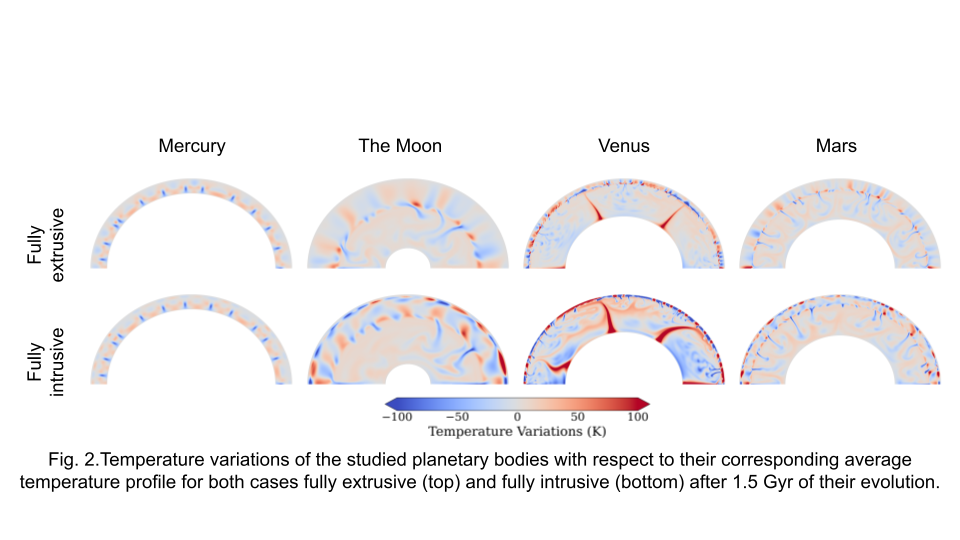
EPSC2024-1154 | ECP | Posters | EXOA8 | OPC: evaluations required

Compositional variations within the TRAPPIST-1 planets 

Alexander Thamm, Alexander Balduin, Ludmila Carone, and Lena Noack
Fri, 13 Sep, 14:30–16:00 (CEST) | Poster area Level 2 – Galerie | P47
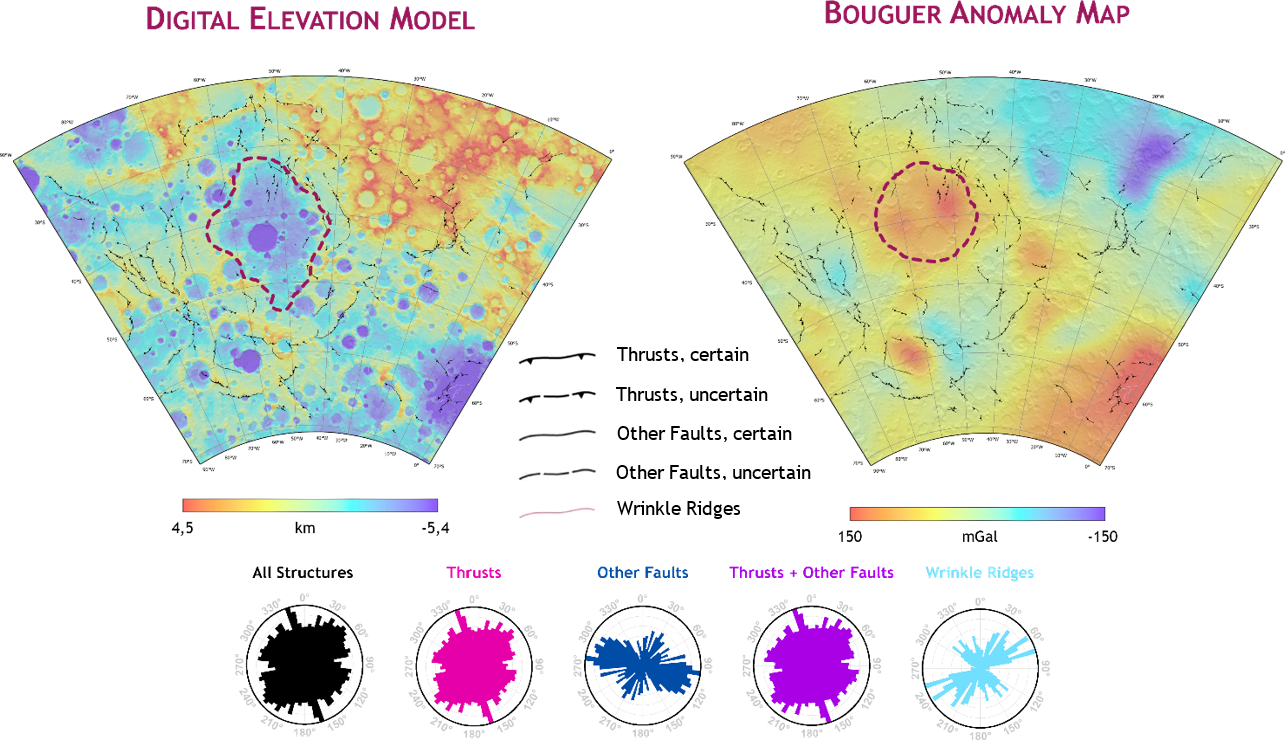
Since stars and their planetary accretion disks are formed by the collapse of the same interstellar dust cloud, the composition of a star can be used as a first estimate for the upper limit of the composition of the accretion disk. However, the stellar composition of TRAPPIST-1 has not yet been determined. We therefore derive elemental abundances for the main planet-forming elements from the stellar metallicity using large-scale astronomical surveys (GALAH and Hypatia). 
 
We then apply a stoichiometric model extended from Bitsch & Battistini (2020) to obtain a first-order estimate on the compositional variation of planetary building material depending on the local temperature within an accretion disk. In this approach, the gas within the accretion disk is assumed to have achieved the state of chemical equilibrium before condensation, with the complete set of molecules preexisting in the gas. Consequently, the relative abundance of molecules can be calculated
stochiometrically and based on their condensation temperature (Lodders 2003).
 
We assume a fixed temperature profile within the accretion disk and do not consider planet migration to obtain a first prediction of compositional variability within the TRAPPIST-1 accretion disk. Our predicted composition of the planetary building blocks of the seven planets in the system is shown in Fig. 1. We obtain three different compositional clusters including dominantly dry (b,c,d), water-rich (e,f) and water- and ammonium-rich building blocks. 
 
We then apply our interior-structure model (Noack et al. 2016) employing look-up tables created with Perple_X (Connolly 2009) for thermodynamic properties of the silicate mantles. We apply an Earth-like mantle iron number of 0.1 (i.e. a magnesium number of 0.9) for the silicate mantle, which leads to a predicted core-mass fraction of 25% for the three inner-most planets (Carone et al. in review). This core-mass fraction leads to planet radii matching the observed values from Agol et al. (2021) for all thre planets, which suggests, that our compositional model is able to correctly predict the planetary composition of the TRAPPIST-1 planets and that their composition was not strongly altered during accretion (by e.g. impact erosion). 
 
For the outer planets of the system, the appearance of volatiles adds a degeneracy to our interior structure, since melting processes during planet accretion implies volatile losses. The final planetary composition is therefore expected to be considerably less volatile-rich than predicted here for the planetary building blocks. Assuming the same mantle-core composition as for the three inner-most planets, our model suggests that the outer planets should have a maximum water fraction below 20 wt-% to match their observed radii, which is in accordance with earlier studies, even though here we apply our TRAPPIST-1 adapted compositional model instead of an Earth-like mineralogy. 
 

How to cite: Thamm, A., Balduin, A., Carone, L., and Noack, L.: Compositional variations within the TRAPPIST-1 planets, Europlanet Science Congress 2024, Berlin, Germany, 8–13 Sep 2024, EPSC2024-1154, https://doi.org/10.5194/epsc2024-1154, 2024.

EXOA12 | Protoplanetary disks and planetesimal formation

EPSC2024-953 | Posters | EXOA12 | OPC: evaluations required

Comparative analysis of a binary system HD 135344 with a protoplanetary disk 

Kertu Metsoja, Mihkel Kama, Colin Folsom, and Anna Aret
Fri, 13 Sep, 10:30–12:00 (CEST) | Poster area Level 2 – Galerie | P52

The chemical composition of two binary stars, HD 135344A and HD 135344B, is compared, from which conclusions can be drawn about the protoplanetary disk around the star HD 135344B. Since binary stars are form from the same gas and dust cloud, their chemical composition is thought to be similar. To study the protoplanetary disk around the secondary star we have to characterize the host star and the primary star for a comparative analysis. The HD 135344B disk is one of the least known transition disks, which has asymmetrical properties in scattered light and heat radiation. Photometric images of near-infrared scattered light shows two big spiral arms and an internal dust-free cavity.

Spectral observations are used to determine the physical parameters and chemical composition of stars, which are matched to synthetic model spectra. The synthetic or model spectrum is found by the Zeeman spectrum sythesis code, which is written in the programming language Fortran. 

In our presentation, we will present our conclusions regarding the chemical composition of the HD 135344B disk based on the comparative analysis of the binary system’s chemical composition.

How to cite: Metsoja, K., Kama, M., Folsom, C., and Aret, A.: Comparative analysis of a binary system HD 135344 with a protoplanetary disk, Europlanet Science Congress 2024, Berlin, Germany, 8–13 Sep 2024, EPSC2024-953, https://doi.org/10.5194/epsc2024-953, 2024.

EPSC2024-1112 | Posters | EXOA12 | OPC: evaluations required

Planet-disk interactions in the AB Aurigae system: revisiting the hypothetical vortex 

Thomas Collin-Dufresne, Emmanuel Di Folco, and Arnaud Pierens
Fri, 13 Sep, 10:30–12:00 (CEST) | Poster area Level 2 – Galerie | P56
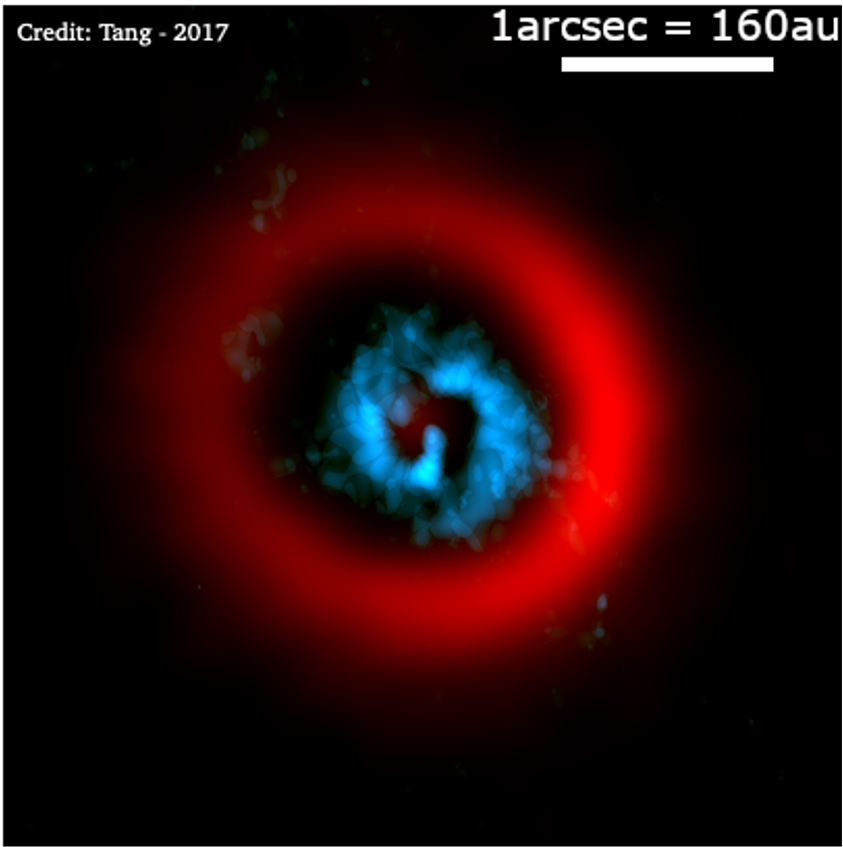
I] Context

Structures and asymmetries detected in protoplanetary disks offer an exciting means to characterize the orbital and physical properties of embedded proto-planets, which are suspected to sculpt some of the observed features. A dozen of young disks have been reported to harbor crescent-shaped dust rings at millimeter wavelengths, with compact or more extended brightness features which could be interpreted as dust traps within vortex structures. 

Among these remarkable systems, AB Aurigae is one of very few nearby, young stars, where disk asymmetries and compelling evidence of protoplanets have been concurrently found. This includes the presence of two prominent spiral arms seen in emission from the gas and small dust grains revealed by ALMA and SPHERE within the broad 120au cavity (Tang+2017, Fig.1). In addition, bright spots spread between 30au and 100au were reported with VLT/SPHERE and Subaru/CHARIS, which are debated  sites of giant planet formation (Boccaletti+2020, Currie+2022, Zhou+2023, Fig.2). Beyond the cavity, a broad dust ring displays a large asymmetric brightness that was interpreted as a possible decaying vortex (Fuente+2017). Confirming the planetary nature of the suspected candidates is however a challenging task, and we propose to investigate the putative planet characteristics through the modeling of planet-induced structures in the disk.


Fig 1: radio-millimetric ALMA observation of the asymmetric dust ring (red) and the CO gas spirals (blue) of the circumstellar disk around AB Aurigae


Fig 2: SCExAO/CHARIS image combined with ALMA submillimetre imaging

II] Methods and Setup

We focus here on the large scale crescent shape of the dust continuum emission in the outer ring. We revisit the hypothesis of the existence of a vortex generated by a massive planet orbiting in the cavity, and we further explore how the dust distribution can inform us on the characteristics of the assumed, embedded planet(s).

For this purpose, we have performed a large set of 2D hydrodynamical simulations with the FARGO-3D code in multi-fluid mode. We used a gaseous fluid with a low viscosity  (alpha=1e-4), interacting with a 0.1mm grain-fluid. We introduced a single planet of variable mass within an equilibrium disk in the isothermal approximation, and we explored a large range of orbital properties and planetary masses based on the existing observational constraints. Vortex structures are naturally produced when the Rossby-wave instability develops at the edge of the cavity (Fig.3). We selected the simulation runs where planet-disk interactions resulted in rings located at the observed radial distance of the outer ring, and capable of trapping the dust grains in expected azimuthal structures. Based on FARGO3D dust surface density maps, radiative transfer simulations with the RADMC3D code were performed to simulate the ALMA continuum map. We finally compare the azimuthal extent and contrast ratio of the simulated ring to constrain the possible parameter space for the planet’s characteristics. 


III] Results

A large set of planetary configurations appear consistent with the observed morphological characteristics of the dust crescent (radial location, contrast and azimuthal width). We explored for the first time the case of eccentric planets in this system, and we find that the dust continuum maps can still be reproduced with giant planet orbital eccentricities as large as e=0.6. We illustrate the degeneracy in the semi-major axis-eccentricity domain in Fig. 4, where we also report the planetary mass range compatible with the dust ring morphology (from 2 to 15Mjup depending on the orbit properties). This diagram extends the canonical case of a 2Mjup circular planet located at the outer edge of the cavity proposed and studied in Fuente+2017. In this framework, this study suggests that any independent, direct constraint on the planet semi-major axis and eccentricity can thus provide an estimate for the protoplanet dynamical mass, based on the modeling of the planet-induced structures.


Besides, we note that the large azimuthal extent of the grain distribution within the ring (FWHM>90deg) and its low contrast ratio can only be reproduced when the gas vortex has started to dissipate and thus when the trapped grains are released from their initial compact configuration. The grains then concentrate at the outer edge of the cavity, in the pressure gradient maximum, and rapidly form an azimuthally uniform, symmetrical ring (Fig.5). We discuss how the short timescale of the vortex dissipation restricts the likelihood to observe this short transient phase, when the ring’s morphology matches the observed asymmetry. We also discuss alternative scenarios, including the impact of a slow planet growth-phase (following Hammer+2019), to extend the lifetime of the observed dust crescent.


Fig 3 : The presence of the planet creates in the gas fluid an extremum in the Liso function at the edge of the cavity, forming anticyclonic gas vortices that can trap dust. Liso = cs^2 * Sigma_gas / (nabla ^ v_gas). The color gradient represents the density of dust particles (log scale). Contour lines correspond to an incrementation of 1.25e-6 of Liso. The dust is trapped at the extremum of Liso


Fig 4: Evolution of dust FWHM as a function of planet orbital time

Fig 5: simulated image at λ=0.9mm based on the FARGO3D density map at the time of the vortex dissipation (face-on view). The azimuthal extent and the contrast ratio of the mm ring emission can be reproduced with an embedded eccentric planet in the cavity. 


Fig 6: Each circle on the graph represents a simulated planetary system, characterized by its semi-major axis (x-axis), eccentricity (y-axis) and planetary mass (number/circle size). Connected points correspond to simulations with the same semi-major axis-eccentricity couple but different planetary masses. Green points correspond to the cases reproducing the asymmetrical ring around AB Aurigae.


How to cite: Collin-Dufresne, T., Di Folco, E., and Pierens, A.: Planet-disk interactions in the AB Aurigae system: revisiting the hypothetical vortex, Europlanet Science Congress 2024, Berlin, Germany, 8–13 Sep 2024, EPSC2024-1112, https://doi.org/10.5194/epsc2024-1112, 2024.

EPSC2024-1204 | ECP | Posters | EXOA12 | OPC: evaluations required

Radiation hydrodynamics of protoplanetary disks with frequency-dependent dust opacities 

Stanley Baronett, Yan-Fei Jiang, Philip Armitage, and Zhaohuan Zhu
Fri, 13 Sep, 10:30–12:00 (CEST) | Poster area Level 2 – Galerie | P53

In protoplanetary disks of gas and dust, sub-micron interstellar grains must grow at least 13 orders of magnitude in size to become terrestrial planets. The frequency-dependent opacities of these silicate grains to pre-main-sequence stellar radiation affect the thermodynamic structure of the disk, which itself influences the various stages of planet formation and migration. With a reduced overall opacity skewed toward shorter wavelengths, the tenuous disk atmosphere heats up as dust preferentially absorbs ultraviolet rays from the young star, while settled grains make the disk midplane optically thick and cooler. Conventional disk and planet formation models, however, use simplified assumptions about the thermodynamic structure, including vertically isothermal temperature profiles, Planck- or Rosseland-mean dust opacities, and flux-limited-diffusion approximations to radiation transport valid only in optically thick regions. Thus, further development of more detailed and self-consistent disk profiles using multifrequency radiation hydrodynamics is warranted. We use the Athena++ finite-volume hydrodynamics code, extended with multigroup radiation transport, to develop and analyze new stellar-irradiated disk models that include the frequency-dependent opacities of silicate dust grains. As the radiation module neither assumes a diffusion-dominated limit nor treats the radiation field as another fluid, our models can better capture the full dynamic range in disk optical depths.

How to cite: Baronett, S., Jiang, Y.-F., Armitage, P., and Zhu, Z.: Radiation hydrodynamics of protoplanetary disks with frequency-dependent dust opacities, Europlanet Science Congress 2024, Berlin, Germany, 8–13 Sep 2024, EPSC2024-1204, https://doi.org/10.5194/epsc2024-1204, 2024.