OPC applications

TP0 | General Session of TP

EPSC-DPS2025-1808 | Posters | TP0 | OPC: evaluations required

Consequences of imperfect accretion in the early giant planet instabilitymodel 

Emily Elizondo and Seth Jacobson
Thu, 11 Sep, 18:00–19:30 (EEST)   Finlandia Hall foyer | F4

Terrestrial planet formation in the solar system describes the growth of the innermost planets, including Earth. There are two competing accretion mechanisms that may be important for building these planets. The pebble accretion theory proposes rapid (<10 Myr) growth through the accretion of cm-sized objects (pebbles). If Earth grew mostly from pebbles, then this hypothesis requires a Moon-forming impact characterized as late, high angular momentum, and between nearly equal-size bodies. Alternatively, the pairwise accretion theory proposes a much longer Earth formation timescale (10–100 Myr) during which Earth is built through a series of collisions between lunar- to Mars-sized bodies. This hypothesis is consistent with the canonical Mars-sized Moon-forming impactor. The runaway growth that produces the planetary embryos in the pairwise accretion theory could have been produced by pebble accretion, so certainly, both processes could have occurred during the formation of the terrestrial planets. Thus, many hybrid scenarios combining the two theories can be imagined. Therefore, it is necessary to understand how much of a role each accretion mechanism played in the formation of the terrestrial planets.


This challenge can be approached by examining the history of impact debris production, transport, and storage in the main asteroid belt. Impact debris production occurs for all large impacts even relatively small ones such as those that produce the lunar and Martian meteorites, but ejecta creation is particularly voluminous during giant impacts. Indeed, at least one giant impact occurred in all terrestrial planet formation scenarios. Therefore, an investigation into the consequences of these impacts based on their frequency and strength can be conducted. For all giant impacts that occur, debris is generated, but what happens to this debris has not been considered. Spectroscopic studies of meteorites and asteroids have connected a rare set of differentiated asteroids to giant impact debris, which may make up as much as a few percent the mass of the asteroid belt. Thus, we hypothesize that some fraction of debris produced by giant impacts could currently reside in the asteroid belt. Quantifying the mass of potential debris currently in the asteroid belt provides an observational constraint on the total mass of debris produced during terrestrial planet formation.


In this study, we incorporate imperfect accretion into one of the leading pairwise accretion scenarios, the early instability scenario, allowing for various collision types and debris generation. The astrophysical N-body integrator SyMBA is used to track and quantify the total mass of debris that resides in the asteroid belt. After numerically evolving each simulated systems for 100 Myr, we reproduced terrestrial planet analogues similar to other simulations of the early giant planet instability scenario, and our results also agree that an orbital instability occurring between 1 and 10 Myr work best for reproducing terrestrial planet analogues. Like past work, we found that including imperfect accretion had a relatively small effect on the final accreted planets, however unlike most past work, we now focus on what happened to the debris from these impact events.


Every simulation of terrestrial planet formation possessed giant impacts which produced debris. These debris particles were scattered onto many different orbits including trajectories that intersected the Sun and other planets. Some were even ejected from the solar system. At the end of the 100 Myr simulation, we assessed which particles were on stable orbits in the asteroid belt. We found that 52 (32%) of simulations produced a significant overabundance of debris on stable orbits in the main asteroid belt while the remaining 110 (68%) simulations produce no debris on stable orbits in the asteroid belt. Of the simulations that had debris in the asteroid belt, ~95% had a total mass of debris that was greater than the current mass of the asteroid belt, as shown in Fig. 1. Some simulations produced as much as about 46 times more mass in debris than there is mass in the asteroid belt. The strong dichotomy between those simulations that produced a lot of debris in the asteroid belt and those that produced very little is likely due to a resolution issue. The debris particles used were each between about 4 – 0.85 times an asteroid belt mass, so these simulations struggled to resolve instances where perhaps only a small amount of debris ended up in the asteroid belt. 

Figure 1. The total mass of debris in the asteroid belt (2.2-3.5 AU) at the end of the 100 Myr simulation as a function of the total mass of debris generated throughout the entire simulation. The mass of the debris is normalized by the current mass of the asteroid belt, where 1 defines the current mass of the asteroid belt (red dashed line). The dark blue, pink, grey, and light blue points represent runs where an orbital instability was triggered at 1 Myr, 5 Myr, 10 Myr, and 50 Myr respectively. Only the simulations that generated debris in the asteroid belt are shown here.


How to cite: Elizondo, E. and Jacobson, S.: Consequences of imperfect accretion in the early giant planet instabilitymodel, EPSC-DPS Joint Meeting 2025, Helsinki, Finland, 7–13 Sep 2025, EPSC-DPS2025-1808, https://doi.org/10.5194/epsc-dps2025-1808, 2025.

TP1 | Mars Surface and Interior

EPSC-DPS2025-105 | ECP | Posters | TP1 | OPC: evaluations required

Dielectric Properties of Magnesium and Calcium Perchlorate Solutions: Implications for Subglacial Liquid Water on Mars  

Gabriele Turchetti
Thu, 11 Sep, 18:00–19:30 (EEST)   Finlandia Hall foyer | F6

Dielectric Properties of Magnesium and Calcium Perchlorate Solutions: Implications for Subglacial Liquid Water on Mars 

Gabriele Turchetti1, Barbara Cosciotti1, Sebastian Emanuel Lauro1, Elisabetta Mattei1, Elena Pettinelli1 

1 Mathematics and Physics Dept., Roma Tre University 

*Corresponding author: Gabriele.turchetti@uniroma3.it

Introduction The presence of perchlorates on Mars has been a significant focus of planetary exploration and astrobiology research due to the implications for both potential habitability and geological history of the planet. Calcium perchlorate Ca(ClO₄)₂ and magnesium perchlorate Mg(ClO₄)₂, have been detected through various missions highlighting their widespread presence across the planet [1][2]. The ability of perchlorates to lower the freezing point of water could allow the existence of liquid water solutions under Martian surface. An interesting site is the subglacial liquid water body detected by the Mars Advanced Radar for Subsurface and Ionosphere Sounding (MARSIS [3]) [4][5]. The analysis of perchlorates properties is fundamental to assess the physical-chemical conditions that allow the water to remain liquid in Martian subsurface. This work aims to measure electromagnetic properties of Magnesium and Calcium perchlorates solutions to understand the characteristics of possible stable brines in the Martian subsurface and to explain the conditions of the subglacial lake detected by MARSIS. The general behaviour of a water solution is explained by the eutectic diagram (fig.1 [6]). Key parameters are the eutectic concentration Ce and the eutectic temperature Te. At the eutectic temperature water solutions with eutectic concentration of perchlorates remain liquid even below the freezing point of water. Between the eutectic temperature and the freezing point of pure water, a solution with a lower concentration than the eutectic is in a mixture of ice and brine (mush). Below the eutectic temperature all the solution is frozen. Eutectic parameters change with the salt, then different salts low differently the freezing point of water.   


Figure1: Eutectic diagram [5]. 

Methods  We measured the complex dielectric permittivity ε (eq.1) in the temperature range 195K-290K to include the eutectic temperatures of Calcium and Magnesium perchlorates (respectively 198K [7] and 216K [8]) in a radar sounder frequency spectrum (1MHz - 100MHz). At radar frequencies the expected real part ε' of an ice solid solution is around 3.1 and that of liquid water solutions is 80 or above, for the mushy mixture we expected an intermediate value. We computed also the conductivity σ (eq.2) and the apparent permittivity εa (eq.3), indicative of the reflection coefficient Γ12 of an interface between two media with two different permittivity ε1, ε2 [9]. To reproduce MARSIS data consistent with the subglacial water body it should be larger than 30 [4]. 

Sample preparation  The samples are prepared by mixing double distilled water with granular perchlorates and pouring the solution into a measurement cell with a coaxial cage transmission line inside. The cell is placed in an ultra-freezer at the temperature of 193K with a pt100 sensor inserted in the sample to monitor the temperature. After some days, we take out the sample (fig.2) and measure the electromagnetic properties using a Vector Network Analyzer (VNA) increasing the temperature from 195K to the room temperature of 292K. The VNA measures scattering parameters, and the complex permittivity is estimated by applying the Nicholson-Ross-Weir algorithm [10][11]. Further details can be found in [12]. 


Figure 2: Mushy sample just taken out from the ultra-freezer. 

Results  We performed measurements with different setups changing the cell length, the concentration, the time inside the ultra-freezer. Fig.3 and 4 show the trends of ε′ and σ with temperature, measured at 4MHz (working frequency of MARSIS), of 5wt% and 10wt% solutions of Mg(ClO₄)₂ and Ca(ClO₄)₂ inside the 150mm cell, after 4 days in the ultra-freezer. The general trend is similar with lower values of both parameters for the lower concentration. The Mg(ClO₄)₂ 10wt% solution did not freeze completely, even below the Te; its ε′ is coherent with a mush. The solution 5wt% froze. Due to its lower Te, Ca(ClO₄)₂ samples did not freeze completely even at lower concentrations. Approaching 273K samples are almost melted and both parameters rise to expected values. For Ca(ClO₄)₂ the εa (fig.5) reaches the critical value to reproduce MARSIS data at 205K. 

Figure3: ε' and  σ of 2 measurements of different concentration of Mg(ClO₄)₂ solutions. 

Figure4: ε' and  σ of different measurements of Ca(ClO₄)₂ solutions. 


Figure5: εa of Ca(ClO₄)₂ solutions for different measurements. The black dashed line is the critical value of 30 to reproduce MARSIS data, the red dashed line represents the eutectic.

Conclusions  These results are important for the comprehension of the stability of perchlorates mushy solutions beneath Martian surface and give information about the possible composition of the subglacial lake detected by MARSIS. Further measurements with other concentrations and perchlorates mixtures will allow a complete understanding of the possible habitability of these environments.

References:

[1] Quinn, R., et al. (2013) Astrobiology, 13(6), 515-520. 

[2] Bravenec, A. and Catling, D. (2023) Acs Earth and Space Chemistry, 7(7), 1433-1445.  

[3] Picardi, Gand, et al. ISBN 92-9092-556-6, 2004, p. 51-69 1240 (2004): 51-69. 

[4] Orosei, Roberto, et al. (2018) Science 361.6401 490-493. 

[5] Lauro, S., et al. (2021) Nature Astronomy 5.1: 63-70. 

[6] Parkinson, J., et al. JCP: X 5 (2020): 100043. 

[7] Rivera-Valentín, Edgard G., et al. Nature astronomy 4.8 (2020): 756-761. 

[8] Stillman D. E. and Grimm R. E. (2011) JGR. 116. 

[9] Mattei, Elisabetta, et al. EPSL 579 (2022): 117370. 

[10] Nicolson, A. M., and G. F. Ross. IEEE 19.4 (1970): 377-382. 

[11] Weir, William B. IEEE 62.1 (1974): 33-36. 

[12] Brin, Alessandro, et al. Icarus 374 (2022): 114800. 

How to cite: Turchetti, G.: Dielectric Properties of Magnesium and Calcium Perchlorate Solutions: Implications for Subglacial Liquid Water on Mars , EPSC-DPS Joint Meeting 2025, Helsinki, Finland, 7–13 Sep 2025, EPSC-DPS2025-105, https://doi.org/10.5194/epsc-dps2025-105, 2025.

EPSC-DPS2025-398 | ECP | Posters | TP1

Preliminary analysis of aeolian bedforms present in the Eberswalde preserved delta, Mars 

Alessandra Piscopo, Monica Pondrelli, Lucia Marinangeli, and Barbara Cavalazzi
Thu, 11 Sep, 18:00–19:30 (EEST)   Finlandia Hall foyer | F13
Keywords:

Eberswalde crater, aeolian bedforms, atmospheric circulation, environmental changes.

  • Introduction and objectives

The Eberswalde crater (Fig. 1) (Malin and Edgett, 2003), located at 33° W–24° S, lies to the north-northeast of Holden crater, near a proposed fluvial network connecting Argyre crater to Ares Vallis (e.g., Grant and Parker, 2002). The crater contains a paleolacustrine system (e.g., Pondrelli et al., 2008; Mangold, 2011). The crater's relative age is determined by the extent of Holden crater's ejecta blanket, indicating that Eberswalde formed during the Early to Late Hesperian period (Irwin and Grant, 2011).

Wind erosion and reworking of fluvio-lacustrine deposits has been effective in originating aeolian bedforms.

The objective of this study is to map these bedforms to describe the stratigraphy of aeolian deposits to infer possible changes in wind circulation which would reflect changes in atmospheric circulation, and in turn climate changes on recent Mars.

  • Data and methods

The study utilized co-registered and orthorectified HiRISE on board MRO (McEwen et al.,2007) orthoimages and DEMs, processed using Integrated Software for Imagers and Spectrometers, ISIS (Laura et al., 2023) and NASA Ames Stereo Pipeline, ASP (Beyer Ross et al., 2018).

Background images were sourced from Context Camera (CTX) mosaics downloaded at https://murray-lab.caltech.edu/CTX/V01/tiles/. The obtained images were then integrated in a GIS system.

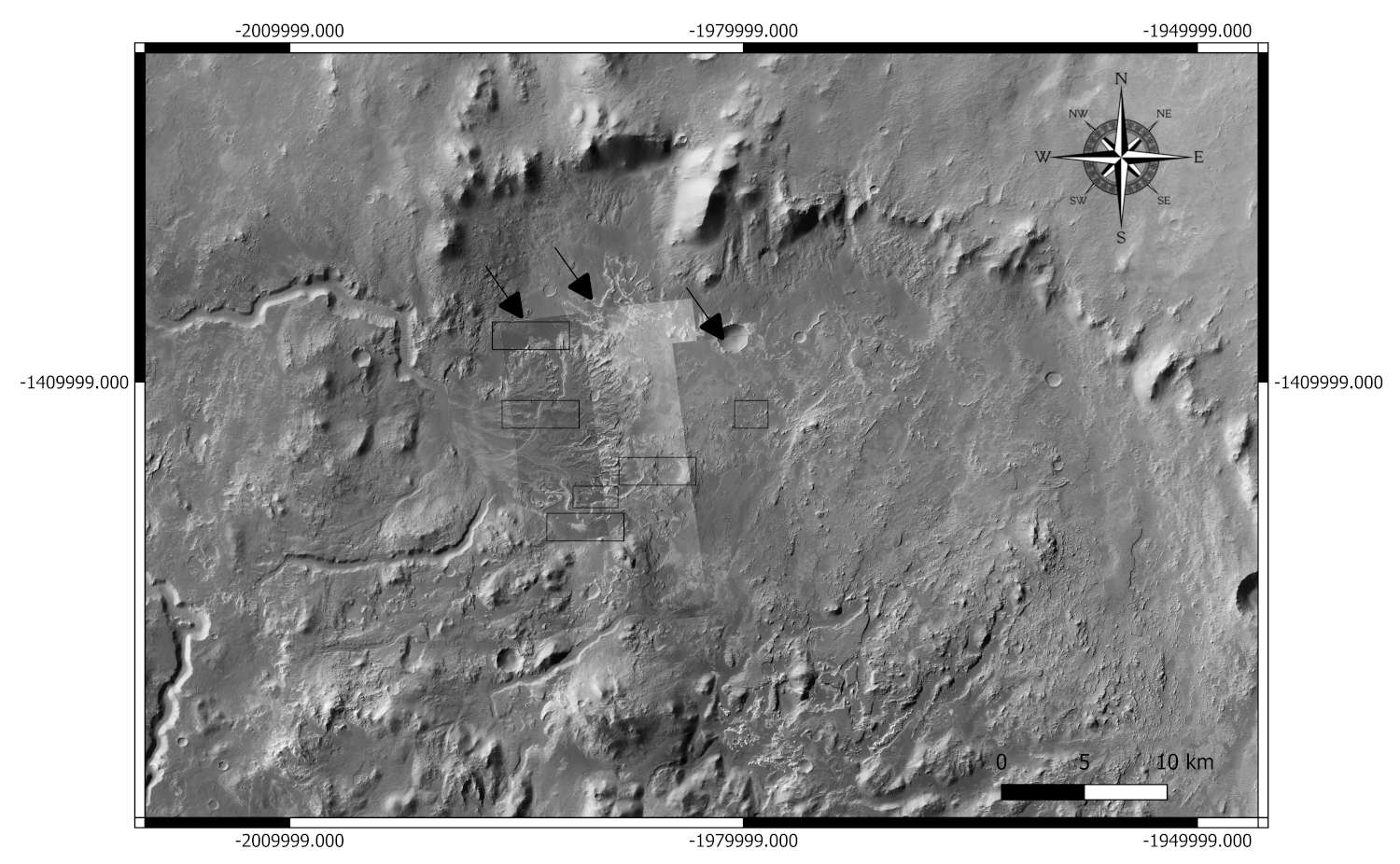
Figure 1. Study area. Black arrows indicate the DEMs used; black rectangles indicate the different areas analyzed. Background CTX mosaic.

  • Preliminary results

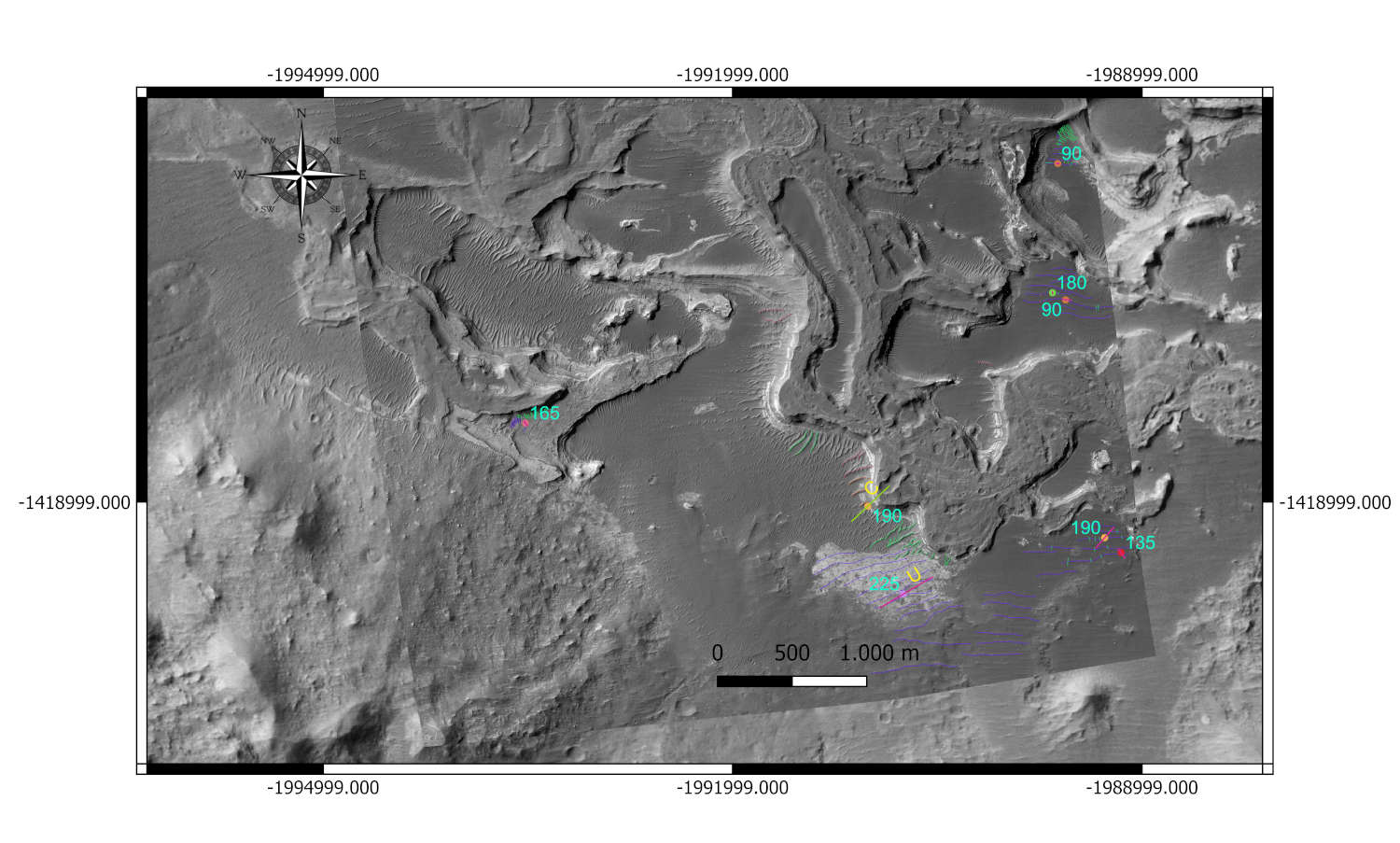
Some specific exemplary areas where to perform a detailed mapping were selected (fig.1, black rectangles). The aeolian bedforms observed were categorized based on their morphology and stratigraphy.

Following Silvestro et al., (2020) classification, dunes, spaced approximately 260 meters apart, with heights of 1-6 meters, and megaripples, with heights of 1-2 meters and spaced 30-40 meters, were mapped.

The bedforms identified include both star and barchan dunes. The crest length of the bedforms was also measured. The wind orientation and sometimes the wind direction could be inferred (fig.2-4), providing insights into the wind dynamics at the time of their formation. At places older bedforms from an earlier wind generation coexists with recent bedforms from a later generation (fig. 3).In some cases, the more recent bedforms overlapped or truncated the older bedforms. 

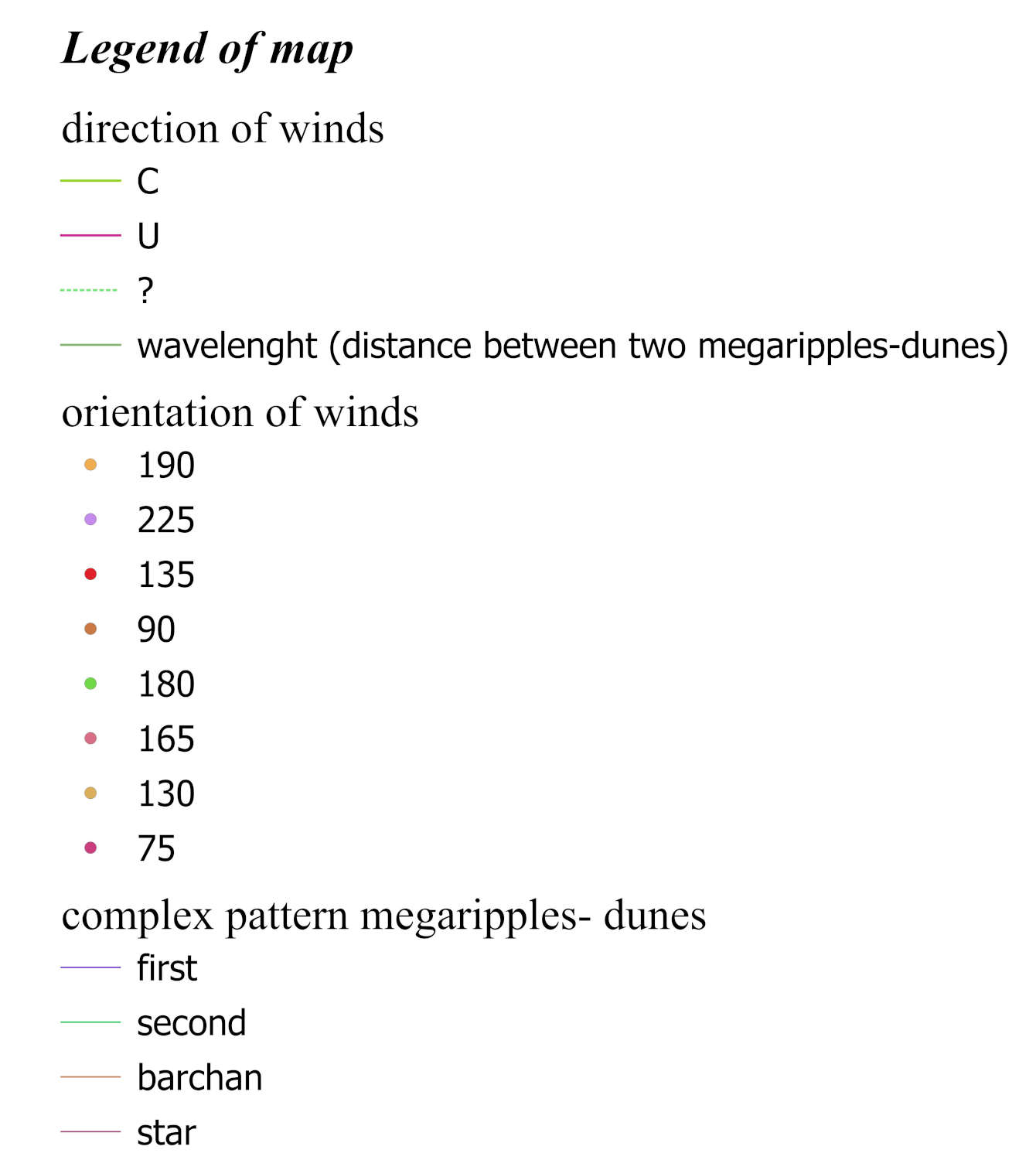
Figure 2. Overview showing principal parameters across multiple areas, C= certain, U=uncertain,?= indefinite. Numerical values in degrees (°). (HiRISE DEM + CTX).
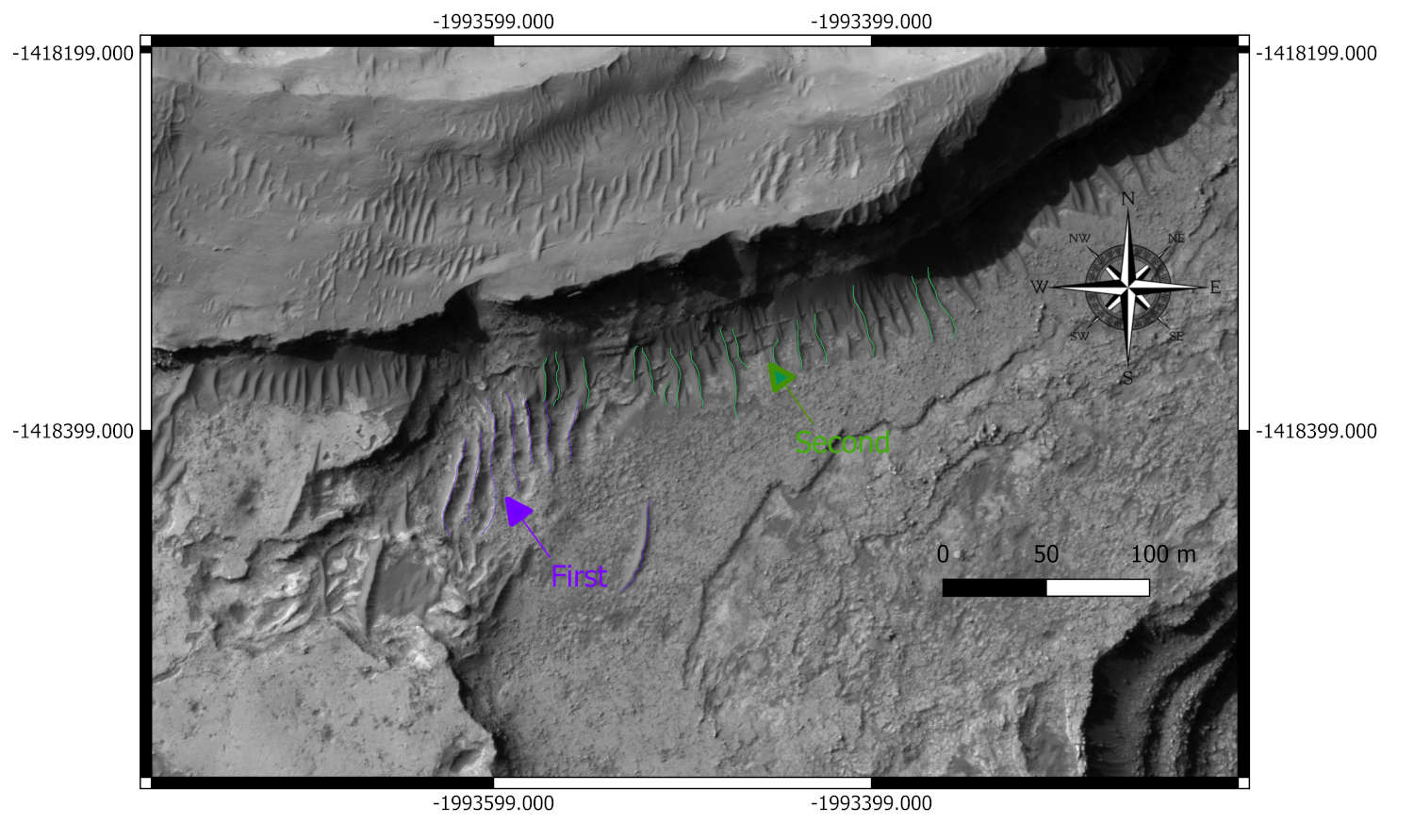
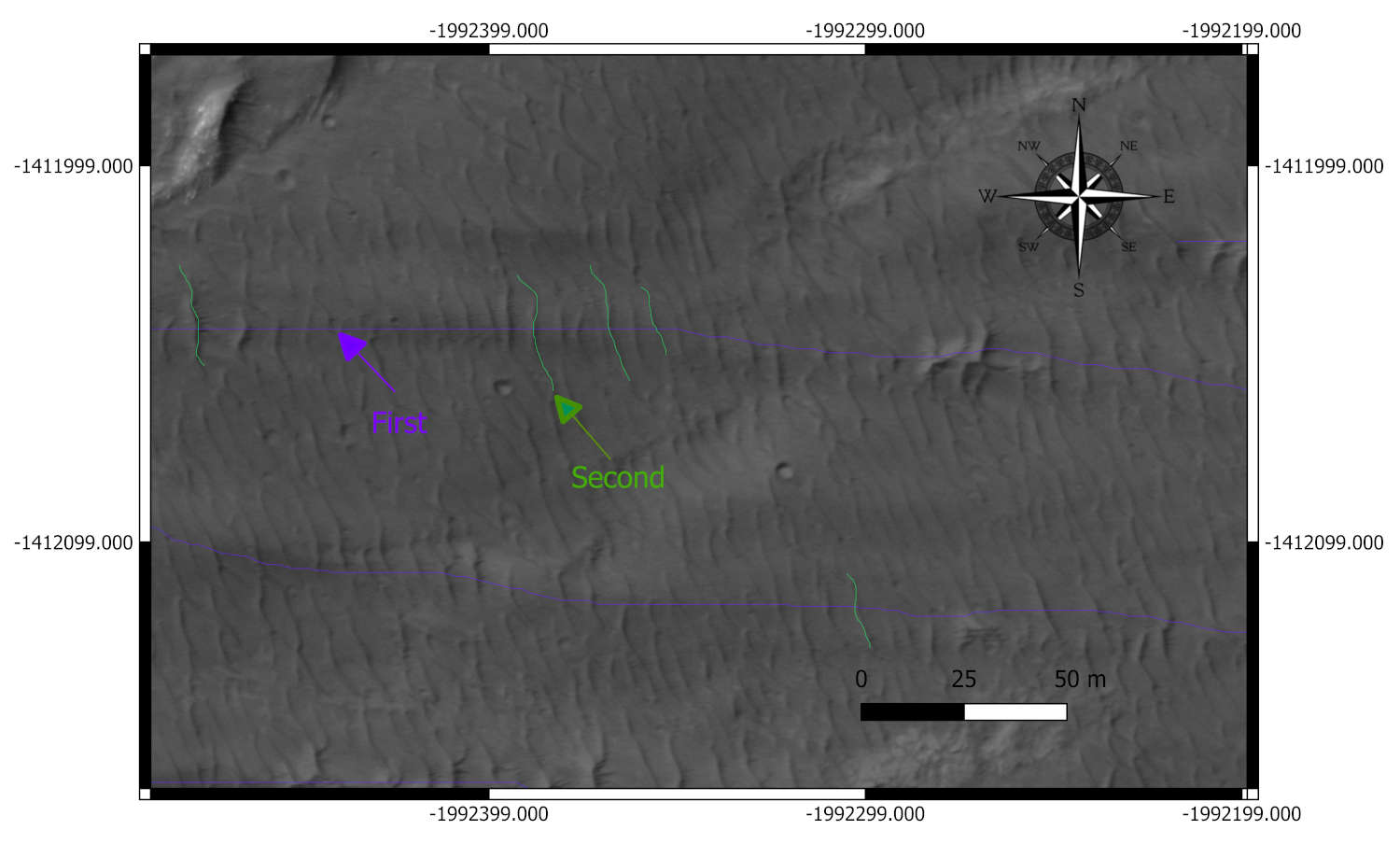
Figure 3. The coexistence of first bedforms and second. HiRISE DEM.
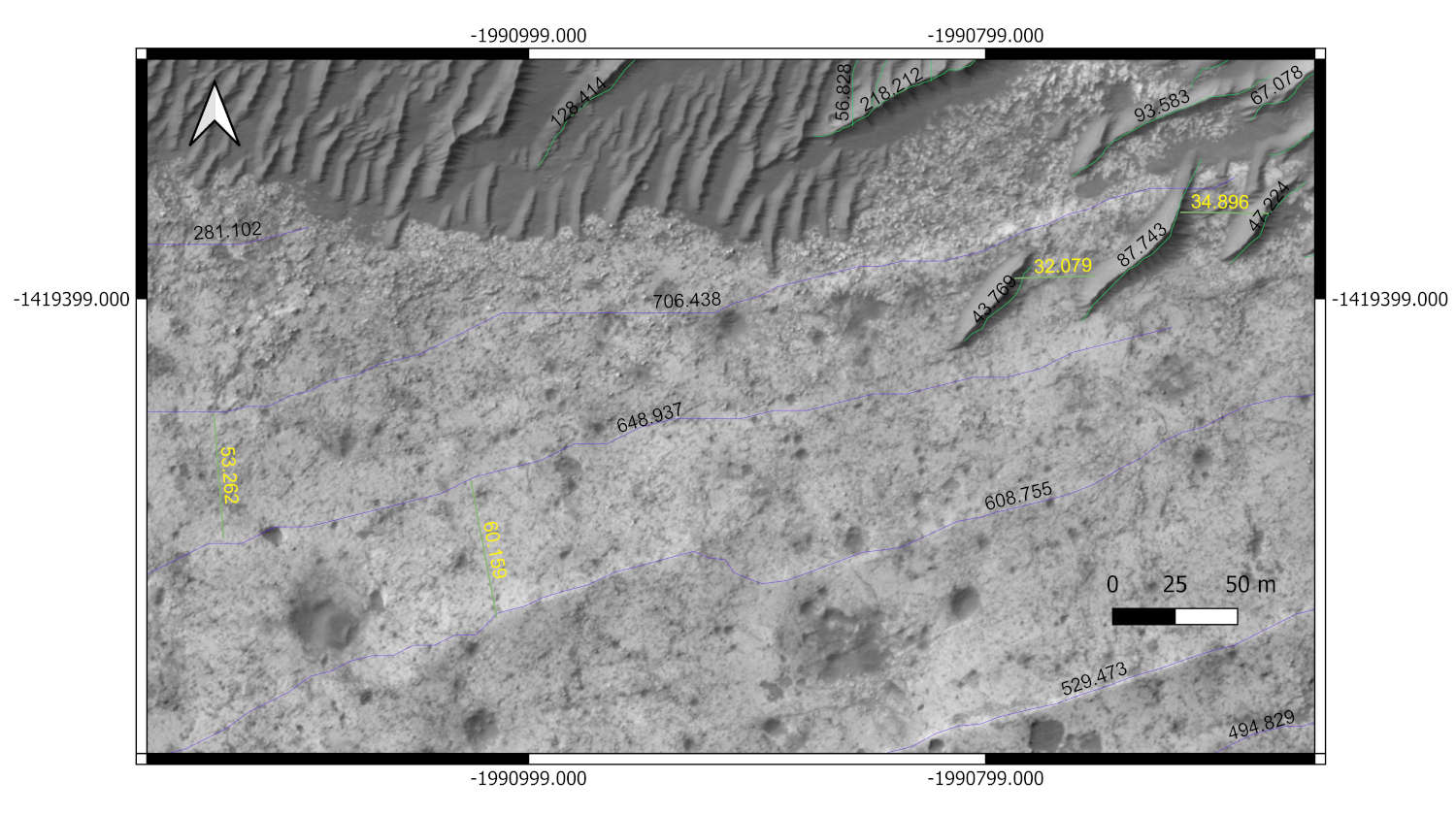
 

Figure 4. Detailed view with measured crest lengths (black) and wavelengths (yellow). HiRISE DEM.

  • Discussion and future work

The presence of a stratigraphic sequence of bedform deposits indicating different wind generations in the Eberswalde crater suggests a complex history of aeolian activity. The occurrence of least two distinct wind regimes, indicated by bedforms different generations, reflects depositional events driven by varying wind patterns.

The presence of star dunes suggests a dynamic environment with high wind variability, where bedforms elongate along the wind flow and display multiple orientations (Courrech du Pont et al. 2024).

Barchan dunes were also observed, with heights of about 3-4 meters, and their wavelengths varied. Longer wavelengths were associated with the older dunes generation, while shorter wavelengths corresponded to megaripples or recent dunes. It is possible that the changes in spacing indicate shifts in sediment availability.

Ongoing work will include mapping of all the Eberswalde basin in order to realize a stratigraphic column of the aeolian deposits.

Then the wind direction will be inferred for each bedform, taking into account the influence of topography, to ultimately understand wind direction changes through time. Moreover, crater size–frequency analysis will be attempted to try and date the mapped bedforms.

This will refine timing estimates for wind regimes and will constrain the changes in wind circulation pattern and their potential significance for a climatic change.

Acknowledgements

We acknowledge financial support under the National Recovery and Resilience Plan (NRRP), Mission 4, Component 2, Investment 1.1, Call for tender No. 104 published on 2.2.2022 by the Italian Ministry of University and Research (MUR), funded by the European Union – NextGenerationEU– Project Title Tanezrouft salt flat deposits (Sahara Desert): a priority target for a Mars Sample Return mission – CUP D53D23002600006 - Grant Assignment Decree No. 962 adopted on 30/06/2023 by the Italian Ministry of Ministry of University and Research (MUR).

This study was carried out within the Space It Up project funded by the Italian Space Agency, ASI, and the Ministry of University and Research, MUR, under contract n. 2024-5-E.0 - CUP n. I53D24000060005.

REFERENCES

Beyer Ross A. et al (2018) “The Ames Stereo Pipeline: NASA's open source software for deriving and processing terrain data”. Earth and Space Science, 5.

Courrech du Pont, S. et al. (2024) “Complementary classifications of aeolian dunes based on morphology, dynamics, and fluid mechanics” Earth-Science Reviews 255 (2024) 104772.

Grant, J. A. and Parker, T. J. (2002) “Drainage evolution in the Margaritifer Sinus region, Mars” Journal of Geophysical Research 107, 5066 doi:10.1029/2001JE001678.

Irwin, R. P. III, and Grant, J. A. (2011) “Geologic map of MTM -15027, -20027, -25027 and -25032 quadrangles, Margaritifer Terra region of Mars, scale 1:500,000” U.S. Geol. Surv. Sci. Invest. Map.

Laura, J. et al. (2023) “Integrated Software for Imagers and Spectrometers (7.2.0_RC1)”. Zenodo. https://doi.org/10.5281/zenodo.7644616.

Malin, M. C. and Edgett, K. S. (2003) “Evidence for Persistent Flow and Aqueous Sedimentation on Early Mars” Science 302, 1931-1934. doi:10.1126/science.1090544.

Mangold, N. (2011) “Post-early Mars fluvial landforms on mid-latitude impact ejecta” Lunar and Planetary Science XXXXII, p. 1370.

Mcwen, A.S. et al. (2007) “Mars Reconnaissance Orbiter’s High Resolution Imaging Science Experiment (HiRISE)” Journal of Geophysical Research 112, doi:10.1029/2005JE002605. E05S02.

Pondrelli, M. et al. (2008) "Evolution and depositional environments of the Eberswalde fan delta, Mars" Icarus 197, 429-451.

Rice M.S. et al. (2005) “A detailed geologic characterization of Eberswalde crater, Mars” The International Journal of Mars Science and Exploration MARS 1, 1-13, 2005; doi:10.1555/mars.2005.1.0.

Silvestro, S. et al (2020) “Megaripple Migration on Mars” Journal of Geophysical Research: Planets doi:10.1029/2020JE006446.

How to cite: Piscopo, A., Pondrelli, M., Marinangeli, L., and Cavalazzi, B.: Preliminary analysis of aeolian bedforms present in the Eberswalde preserved delta, Mars, EPSC-DPS Joint Meeting 2025, Helsinki, Finland, 7–13 Sep 2025, EPSC-DPS2025-398, https://doi.org/10.5194/epsc-dps2025-398, 2025.

EPSC-DPS2025-1469 | Posters | TP1 | OPC: evaluations required

Controlled DTM and orthoimages mosaics from ExoMars TGO CaSSIS stereo-pairs 

Adriano Tullo, Cristina Re, Silvia Bertoli, Emanuele Simioni, Riccardo La Grassa, Gabriele Cremonese, and Nicolas Thomas
Thu, 11 Sep, 18:00–19:30 (EEST)   Finlandia Hall foyer | F26
Introduction

The Colour and Stereo Surface Imaging System (CaSSIS) is an advanced stereo camera developed for the ExoMars Trace Gas Orbiter mission, which has been orbiting Mars since April 2018. The CaSSIS camera can produce detailed 3D maps and capture images in four distinct color bands, providing essential data for analyzing the Martian surface and its composition [1].

An innovative telescope rotation system creates a convergence angle of approximately 22° between the images of the stereo pairs, making CaSSIS's stereo configuration possible. Operating from a circular orbit approximately 400 km above the Martian surface, CaSSIS's average ground resolution is 4.5 m per pixel, resulting in digital terrain models (DTMs) with a resolution of about 13.5 m per pixel [2].

CaSSIS has captured over 50,000 images, covering more than 8% of Mars' surface, including over 2,250 stereo-pairs. The planning of CaSSIS observations, which is guided by requests from the scientific community and the team, has focused on acquiring multiple images in areas of particular scientific interest. This has recently allowed for the acquisition of partially overlapping stereo pairs, enabling a more in-depth and comprehensive analysis of these regions.

The work outlines the new methods for creating CaSSIS mosaics of DTMs and orthophoto and their application in various areas of Mars.


Methods

The 3DPD software, developed by the INAF OAPd team [2,3], serves as the foundation for generating Digital Terrain Models (DTMs) and orthorectified images. It is also the official tool for creating CaSSIS DTMs. Since the establishment of the framework, the software has been continuously updated to enhance the performance and quality of stereo data product generation. As a result, over 450 DTMs and orthoimages have been produced and are available in the OAPD-hosted repository (https://cassis.oapd.inaf.it/archive/) and soon in the ASI Space Science Data Center repository (SSDC).

The developed pipeline enables the generation of stereo products from radiometrically calibrated CaSSIS frames by following several processing steps. Recent pre-processing improvements include a Bundle Block Adjustment phase and geometric corrections necessary for mosaicking the framelets, which help resolve misalignments that could otherwise lead to step artifacts and projection errors. The stereogrammetric processing of 3DPD, detailed by [3], is based on a two-step approach: a preliminary rough, feature-based step followed by an advanced multiscale refinement (dense-matching) step. According to [2], this process achieves a vertical accuracy of up to 8 meters, while the best horizontal accuracy is estimated at up to 13.5 meters per pixel, corresponding to  CaSSIS DTM GSD (Ground Sample Distance) (3 pixel on ground). The resulting point cloud (PC), which has a heterogeneous density due to perspective viewing, is then interpolated onto a regular grid of height values within a reference coordinate system. To enhance geographical projection and absolute elevation, the point cloud is co-registered with the global MOLA-HRSC DTM [4]. This improves the accuracy to a standard deviation generally below 50 meters when compared to MOLA, effectively correcting any residual tilting. The point cloud is then interpolated, and the two original panchromatic images are orthorectified. The co-registration with MOLA simplifies the mosaicking of adjacent DTMs, as their georeferencing often requires minimal or no mutual corrections. These can typically be addressed through simple horizontal and vertical rigid translations. The seamless mosaicking process is based on the "feathering" approach, in which the overlapping areas are averaged using a weighted average that considers the inverse of the distance from the image edges and, in this implementation, from null pixels.


Region of interests

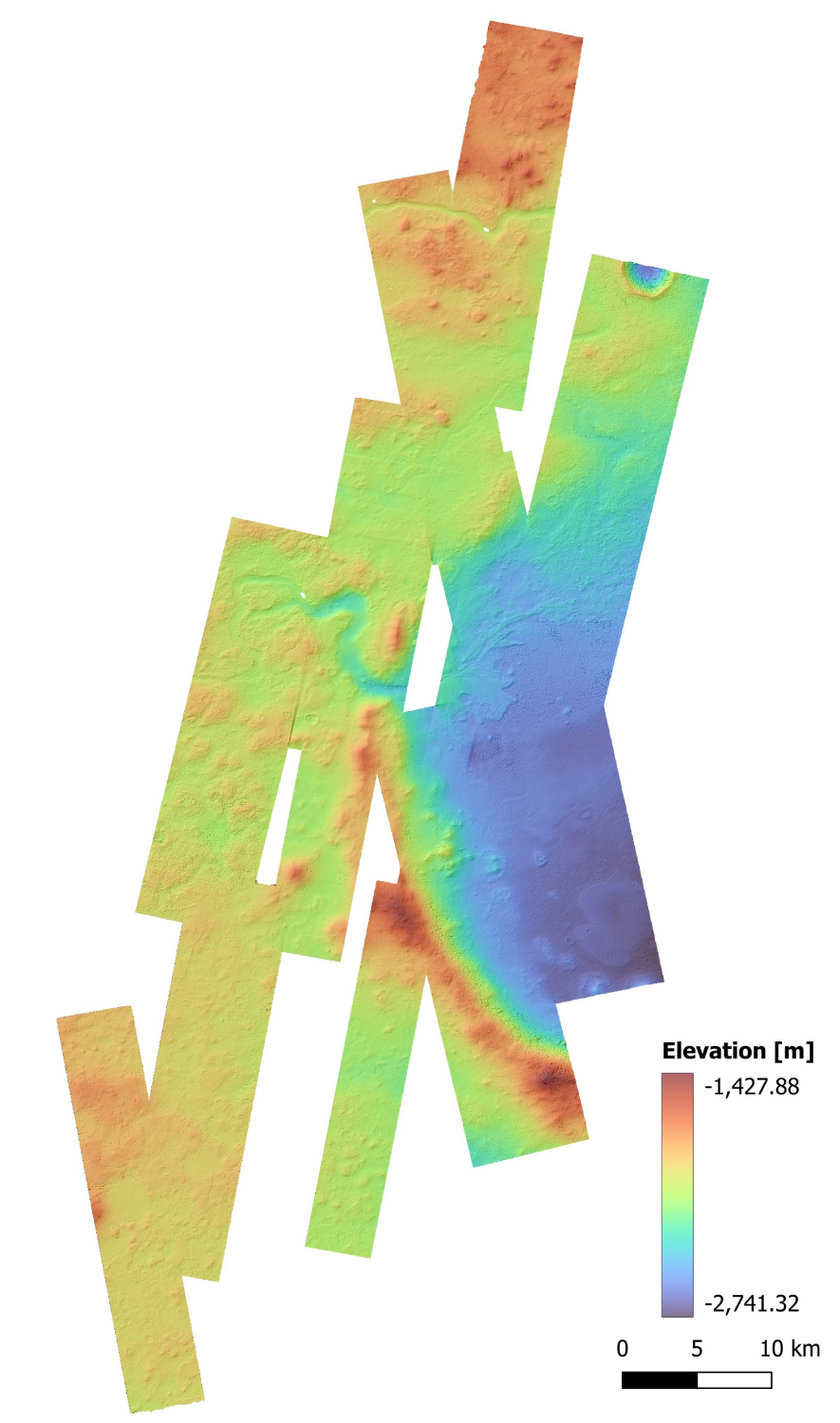
The number of areas potentially interested by multiple contiguous stereo pairs of CaSSIS is constantly being updated. Six areas have been selected for the initial assessment of the potential of CaSSIS DTM mosaics. Two of these are of particular interest for landing site studies: the north-western area of the Jezero crater (Fig. X), the location of NASA Mars 2020 surface mission [5], and Oxia Planum in Arabia Terra, chosen as the landing site for the second ESA ExoMars mission [6], currently postponed to 2028. The areas are currently interested by 14 and 13 contiguous DTMs, respectively.

The other mosaic areas include various geological contexts in different regions of Mars: southern Isidis Planitia, well-preserved craters in Utopia and Daedalia Planitiae, and peri-glacial features in the Northern Plains.

In addition to being applied in targeted geological studies, the preliminary mosaics will be evaluated globally using lower-resolution data (HRSC and MOLA) and locally using high-resolution HiRISE DTMs to verify vertical accuracy and georeferencing precision.

Fig, 1 Mosaic of CaSSIS DTMs at 13.5 m/px of the northwestern part of Jezero Crater. The data is derived from the composition of 14 different DTMs. The display shows the elevation in transparency on a hillshade map.


Acknowledgement

This work has been developed under the ASI-INAF agreement n. 2024-40-HH.0


References

[1] Thomas, N. et al., 2017. Space Sci. Rev., 212, 1897–1944. https://doi.org/10.1007/s11214-017-0421-1

[2] Re, C. et al., 2022. Planet. Space Sci., 219, 105515. https://doi.org/10.1016/j.pss.2022.105515

[3] Simioni, E. et al., 2021. Planet. Space Sci., 198, 105165. https://doi.org/10.1016/j.pss.2021.105165

[4] Fergason, R.L. et al., 2018. USGS Astrogeology PDS Annex.

[5] Williford, K.H. et al., 2018. In: Grotzinger, J.-P. & Webster, C.R. (Eds.), From Habitability to Life on Mars, Elsevier, pp. 275–308.

[6] Quantin-Nataf, C. et al., 2021. Astrobiology, 21(3), 345–366. https://doi.org/10.1089/ast.2020.2244

How to cite: Tullo, A., Re, C., Bertoli, S., Simioni, E., La Grassa, R., Cremonese, G., and Thomas, N.: Controlled DTM and orthoimages mosaics from ExoMars TGO CaSSIS stereo-pairs, EPSC-DPS Joint Meeting 2025, Helsinki, Finland, 7–13 Sep 2025, EPSC-DPS2025-1469, https://doi.org/10.5194/epsc-dps2025-1469, 2025.

TP2 | Atmospheres and Exospheres of Terrestrial Bodies

EPSC-DPS2025-551 | ECP | Posters | TP2

Investigating the Reactivity of Excited State Sulfur Dioxide in the Atmosphere of Venus 

Robert Skog, Theo Kurtén, and Benjamin Frandsen
Tue, 09 Sep, 18:00–19:30 (EEST)   Finlandia Hall foyer | F2

Sulfur dioxide (SO2) is an important part of the chemical processes occurring in the Venusian atmosphere, such as being responsible for the formation of sulfuric acid clouds.[1] As a part of the atmospheric sulfur cycle on Venus, SO2 is also a key player in the formation of other sulfur-containing species, some of which could possibly explain the enigmatic absorption feature seen between 320-400 nm in the atmosphere.[2]

Recently published computational and experimental work showed that SO2 can abstract hydrogens from water and hydrocarbons.[3,4] However, the ground state of SO2 is not reactive in this way; instead, SO2 must be electronically excited for these reactions to occur. This opens a world of new and exciting bimolecular photochemistry, especially in the context of the atmosphere on Venus.

In this work we investigate the bimolecular reactions of electronically excited SO2 with other species found in the atmosphere of Venus. Our results provide reaction rate constants, ready to be implemented into the different atmospheric models, which are currently missing photo-excited SO2 bimolecular chemistry.


[1] D.V. Titov ei al., Space Sci. Rev., 2018, 214, 126. DOI: 10.1007/s11214-018-0552-z
[2] E. Marcq et al., Icarus, 2020, 355, 113368. DOI: 10.1016/j.icarus.2019.07.002.
[3] J.A. Kroll et al., J. Phys. Chem. A, 2018, 122(18), 4465-4469. DOI: 10.1021/acs.jpca.8b03524
[4] J.A. Kroll et al., J. Phys. Chem. A, 2018, 122(39), 7782-7789. DOI: 10.1021/acs.jpca.8b04643

How to cite: Skog, R., Kurtén, T., and Frandsen, B.: Investigating the Reactivity of Excited State Sulfur Dioxide in the Atmosphere of Venus, EPSC-DPS Joint Meeting 2025, Helsinki, Finland, 7–13 Sep 2025, EPSC-DPS2025-551, https://doi.org/10.5194/epsc-dps2025-551, 2025.

EPSC-DPS2025-755 | ECP | Posters | TP2 | OPC: evaluations required

Exploring the variability of the meteoric metal layers in the Venusian atmosphere  

Bianca Ceragioli, John Plane, Daniel Marsh, Wuhu Feng, Joanna Egan, Juan Diego Carrillo-Sánchez, Diego Janches, and Apostolos Christou
Tue, 09 Sep, 18:00–19:30 (EEST)   Finlandia Hall foyer | F12

Cosmic dust injects around 28 ± 16 tons per day of material in the atmosphere of Earth; this dust ablates between 80 and 105 km, generating neutral and ionized metal layers. These layers have been detected by space-based spectroscopy, as well as ground-based lidar observations and rocket-borne mass spectrometry. The same cosmic dust is estimated to deliver 31 ± 18 t d−1 of material in the atmosphere of Venus [Carrillo-Sanchez et al., 2020], which should ablate and form metal layers between 105 and 120 km. However, these layers have not yet been observed on Venus.  

In this study, we model the latitudinal and diurnal variability of the metal layers (Na, Mg, Fe and Si) on Venus, and we analyse the probability of their spectroscopic detection. For this investigation, we used the Venus Planetary Climate (PCM) Model; the metals are injected in the upper atmosphere of Venus through an orbitally varying Meteoric Input Function (MIF) under development for Venus with detailed neural and ion-molecule atmospheric chemistry for Fe, Mg, Na and Si. The model is run for over one Venus year.  

This work indicates there is pronounced diurnal variability in the metal layers on Venus. Our analysis shows neutral metal layers peak in concentration on the night side, with a maximum before the morning terminator – where the metals have had the longest time to accumulate. The latitudinal variability in the metal column density is highly correlated with the circulation on Venus, governed by strong meridional and zonal winds. The metal layers peak at different altitudes, resulting in varying latitudinal concentrations depending on the metal analysed. For example, Mg peaks 10 kg higher than Fe and tends to concentrate in the northern hemisphere, while Fe tends to concentrate in the southern hemisphere; this is caused by varying wind direction and speed at different altitudes. 

In conclusion, our study suggests the metal layers are present and potentially observable in the atmosphere of Venus. In particular, we focus on the Na layer as it should be detectable from a terrestrial telescope observing solar-pumped resonance fluorescence at 589 nm; Na should produce a particularly strong signal at the morning terminator in the northern hemisphere, due to the variability highlighted above. We outline a VLT ESO proposal we submitted with the aim of detecting sodium on the morning terminator on Venus, along with any available preliminary results.   

Finally, we emphasize the importance of detecting metal layers in the CO2-rich atmosphere of Venus, in contrast with the O2–rich atmosphere of the Earth. Knowledge of the metal layers on Venus is a helpful tool to probe the atmosphere of Venus exoplanet analogues, which appear to be abundant in the universe. In general, the distribution and behaviour of meteoric sodium in exoplanetary atmospheres is a field worth exploring, as indicated by the growing detections of Na in the atmospheres of Hot Jupiters and Hot Neptunes. 

How to cite: Ceragioli, B., Plane, J., Marsh, D., Feng, W., Egan, J., Carrillo-Sánchez, J. D., Janches, D., and Christou, A.: Exploring the variability of the meteoric metal layers in the Venusian atmosphere , EPSC-DPS Joint Meeting 2025, Helsinki, Finland, 7–13 Sep 2025, EPSC-DPS2025-755, https://doi.org/10.5194/epsc-dps2025-755, 2025.

EPSC-DPS2025-794 | ECP | Posters | TP2 | OPC: evaluations required

Investigating Martian Meteoric Metal Variability Through the Intercomparison of MAVEN/NGIMS Deep Dip Data and PCM-Mars Simulations. 

Caitlin Gough, Daniel Marsh, John Plane, Wuhu Feng, Andrew Poppe, Juan Diego Carrillo-Sánchez, Diego Janches, Francisco González-Galindo, Jean-Yves Chaufray, and Francois Forget
Tue, 09 Sep, 18:00–19:30 (EEST)   Finlandia Hall foyer | F11

In 2014, NASA’s Mars Atmosphere and Volatile Evolution (MAVEN) satellite made the first direct atmospheric measurements of planetary meteoric metals beyond Earth. A persistent layer of Mg+ was observed at ~90 km via the remote sensing of the Mg+ dayglow emission at 280 nm using MAVEN’s Imaging Ultraviolet Spectrograph (IUVS). This was first reported by Crismani et al. (2017) and the observed variability of the Mg+ layer was investigated by Crismani et al. (2023). Metallic species are injected into the Martian upper atmosphere via meteoric ablation, where the constituents of interplanetary dust particles (IDPs) are heated by thermal collisions and injected as metallic vapours. Ablation starts to occur at altitudes where the pressure is ~1 μbar and so the altitude of the Mg+ layer exhibits seasonal variability due to changes in the aerobraking altitude. On Mars the atmospheric density varies significantly over the Martian year due to the sublimation and deposition of CO2 at the polar caps.


The MAVEN mission has included nine ‘Deep Dip’ campaigns in which the altitude of the spacecraft was lowered from its nominal altitude range of 150-500 km to include altitudes as low as 125 km. The timing and locations of these week-long campaigns were designed such that measurements could be made over a variety of local times, longitudes, latitudes, and solar longitudes. These Deep Dip campaigns offer the unique opportunity to make in situ measurements of meteoric metal species using the Neutral Gas and Ion Mass Spectrometer (NGIMS) instrument. NGIMS has measured a variety of meteoric metal ions including Mg+, Fe+, and Na+. This study investigates the diurnal, seasonal, and latitudinal variability of these metallic species through an intercomparison of NGIMS Deep Dip data and Laboratoire de Météorologie Dynamique (LMD) Mars Planetary Climate Model (PCM) simulations. The PCM-Mars is a 3D numerical model which simulates the Martian atmosphere from the surface to the exobase modelling temperatures, dust, winds, and photochemistry, as well as neutral and ion-molecule chemical reactions.  The Leeds Chemical Ablation Model (CABMOD) of Vondrak et al. (2008) and the Meteoric Input Function (MIF) of Carrillo-Sanchez et al. (2022) have been used to simulate the injection of these metallic vapours and a full chemistry scheme of Mg, Fe, and Na reactions has been incorporated into the PCM-Mars.


Examination of the NGIMS data has shown anomalous metallic isotopic ratio values, highlighting how it is important to be cautious when analysing this data. To ensure reliable profiles are extracted from the Deep Dip dataset, this work implements a data filter which identifies orbits in which the expected isotopic ratios are observed. Generally, metals with higher atomic masses and orbits during night-time hours provide more reliable data. This intercomparison of NGIMS Deep Dip data and PCM-Mars simulations with metal chemistry is integral to constraining global models and understanding the forces driving variability in the metal layers of the Martian upper atmosphere.


References:

Crismani, M.M.J., Schneider, N.M., Plane, J.M.C., Evans, J.S., Jain, S.K., Chaffin, M.S., Carrillo-Sánchez, J. D., Deighan, J.I., Yelle, R.V., Stewart, A.I.F., McClintock, W., Clarke, J., Holsclaw, G.M., Stiepen, A., Montmessin, F., and Jakosky, B.M. Detection of a persistent meteoric metal layer in the Martian atmosphere, Nat. Geosci., 10(6): 401-405, doi:10.1038/ngeo2958, 2017.

Crismani, M.M.J., Tyo, R.M., Schneider, N.M., Plane, J.M.C., Feng, W., Carrillo-Sánchez, J. D., Villanueva, G.L., Jain, S., Deighan, J., and Curry, S. Martian Meteoric Mg+: Atmospheric Distribution and Variability From MAVEN/IUVS, J. Geophys. Res. - Planets, 128(1): e2022JE007315, doi:10.1029/2022JE007315, 2023.

Vondrak, T., Plane, J. M. C., Broadley, S., and Janches, D. A chemical model of meteoric ablation, Atmos. Chem. Phys., 8(23): 7015–7031, doi:10.5194/acp-8-7015-2008, 2008.

Carrillo-Sánchez, J. D., Janches, D., Plane, J.M.C., Pokorný, P., Sarantos, M., Crismani, M.M.J., Feng, W., and Marsh, D.R. A Modeling Study of the Seasonal, Latitudinal, and Temporal Distribution of the Meteoroid Mass Input at Mars: Constraining the Deposition of Meteoric Ablated Metals in the Upper Atmosphere, Planet. Sci. J., 3(10), art. no. 239, doi:10.3847/PSJ/ac8540, 2022.

How to cite: Gough, C., Marsh, D., Plane, J., Feng, W., Poppe, A., Carrillo-Sánchez, J. D., Janches, D., González-Galindo, F., Chaufray, J.-Y., and Forget, F.: Investigating Martian Meteoric Metal Variability Through the Intercomparison of MAVEN/NGIMS Deep Dip Data and PCM-Mars Simulations., EPSC-DPS Joint Meeting 2025, Helsinki, Finland, 7–13 Sep 2025, EPSC-DPS2025-794, https://doi.org/10.5194/epsc-dps2025-794, 2025.

EPSC-DPS2025-1332 | ECP | Posters | TP2

Impact of water supply from interplanetary dust particles on the vertical D/H ratio profile of the Martian atmosphere 

Akinori Hasebe, Naoki Terada, Tatsuya Yoshida, Yuki Nakamura, Shungo Koyaa, and Hiroki Karyu
Tue, 09 Sep, 18:00–19:30 (EEST)   Finlandia Hall foyer | F15

                 The atmospheric D/H ratio on Mars is enhanced by ~5 times the value on Earth, suggesting that large amounts of water have escaped into space. Additionally, water supply processes into the atmosphere, like ablation of interplanetary dust particles (IDPs) and volcanic outgassing, are considered important to satisfy the current isotopic composition. IDPs, containing water as hydrous minerals with a relatively low D/H ratio, ablate at high altitudes and supply water into the upper atmosphere. Nevertheless, the effect of IDP ablation on the isotopic composition of planetary water is poorly understood.

               In this study, we use a 1-D atmospheric photochemical model of the Martian atmosphere (Nakamura et al., 2023) coupled with a numerical model of decomposition and dehydration of IDPs (Micca Longo et al., 2025) to clarify the effect of water supply from IDPs on the vertical D/H ratio profile. We assume a CI chondrite-like composition containing ~1 wt% of hydrogen as interlayer water or phyllosilicates -OH bonds with the same isotopic ratio as the VSMOW value. The water injection flux is given as  for the nominal model, scaled from the observed flux by the Long Duration Exposure Facility on the Earth (Love and Brownlee, 1993) to that on Mars. The vertical injection profile is given by our simple dust ablation model.

              Our results show that the water supply from IDPs significantly changes the HDO/H2O ratio in the upper atmosphere, while other species show little isotopic change. The  value decreases by ~400‰ above 100 km for the nominal model, which corresponds to a ~7% decrease in the HDO/H2O ratio. The HDO/H2O ratio change in the Martian upper atmosphere is caused by the high injection flux of water from IDPs compared to photochemical reaction rates and upward transport rate of hydrogen. The isotopic ratios of OH and H show little change even though they are the primary products of H2O photodissociation. This is because the lifetimes of OH and OD are so short that the isotopic change does not spread into the upper atmosphere. In addition, the background atmospheric densities of H and D are several orders of magnitude higher than those of H2O and HDO, high enough to make the isotopic change caused by the water supply from IDPs negligible.

                 We further investigate the sensitivity of the atmospheric isotopic profiles to parameters such as the temporal variations in the dust influx and the D/H ratio of IDPs. The sensitivity test for temporal variations in the dust influx reveals that the isotopic change overcomes the local time variation in the dust influx and persists for several days. This suggests that the water supply from IDPs changes the HDO/H2O ratio in the Martian upper atmosphere regardless of its local time and longitude. The sensitivity test for the D/H ratio of IDPs is investigated considering the experimental results that the D/H ratio of the dust particles is enriched by hydrogen implantation by the solar wind (Jiang et al., 2024), which will also be presented.

How to cite: Hasebe, A., Terada, N., Yoshida, T., Nakamura, Y., Koyaa, S., and Karyu, H.: Impact of water supply from interplanetary dust particles on the vertical D/H ratio profile of the Martian atmosphere, EPSC-DPS Joint Meeting 2025, Helsinki, Finland, 7–13 Sep 2025, EPSC-DPS2025-1332, https://doi.org/10.5194/epsc-dps2025-1332, 2025.

TP3 | Impact processes in the Solar System

EPSC-DPS2025-729 | ECP | Posters | TP3 | OPC: evaluations required

Analysis of terraced craters in Arcadia Planitia 

Maddalena Faletti, Gabriele Cremonese, Elena Martellato, Adriano Tullo, Silvia Bertoli, Giovanni Munaretto, Francesco Marzari, and Angelo Zinzi
Mon, 08 Sep, 18:00–19:30 (EEST)   Finlandia Hall foyer | F8
Water ice plays a fundamental role in the geological history of Mars, making the planet a primary target for supporting human activities and the search for life. Its distribution is a key constraint for the interpretation of the paleo-martian climate, while the amount of sub-surface ice (in terms of pore filling towards excess ice) provides essential information about deposition processes [1] [2].
Although surface water ice is easy to observe, detecting and studying underground ice is much more challenging. In this context, impact craters become a valuable tool for investigating deeper surface layers. Their morphology reflects the mechanical properties of the target material and can reveal variations in density, strength, water content, porosity, and composition.
Craters formed in ice-rich substrates tend to exhibit lower depth/diameter (d/D) ratios than those formed in dry regolith. This feature is attributed to the different resistance between ice and rock, as well as post-formative processes such as viscous relaxation and slumping [3]. A lower d/D ratio is particularly evident in small craters, which are more sensitive to the local properties of the substrate [6].
In addition, recent numerical modelling studies [5] showed that the formation of double terraces in craters of Arcadia Planitia can be explained by the presence of relatively pure ice layers with different cohesion and porosity. These observations suggest a possible ice stratification and offer new perspectives on the past Martian climate.

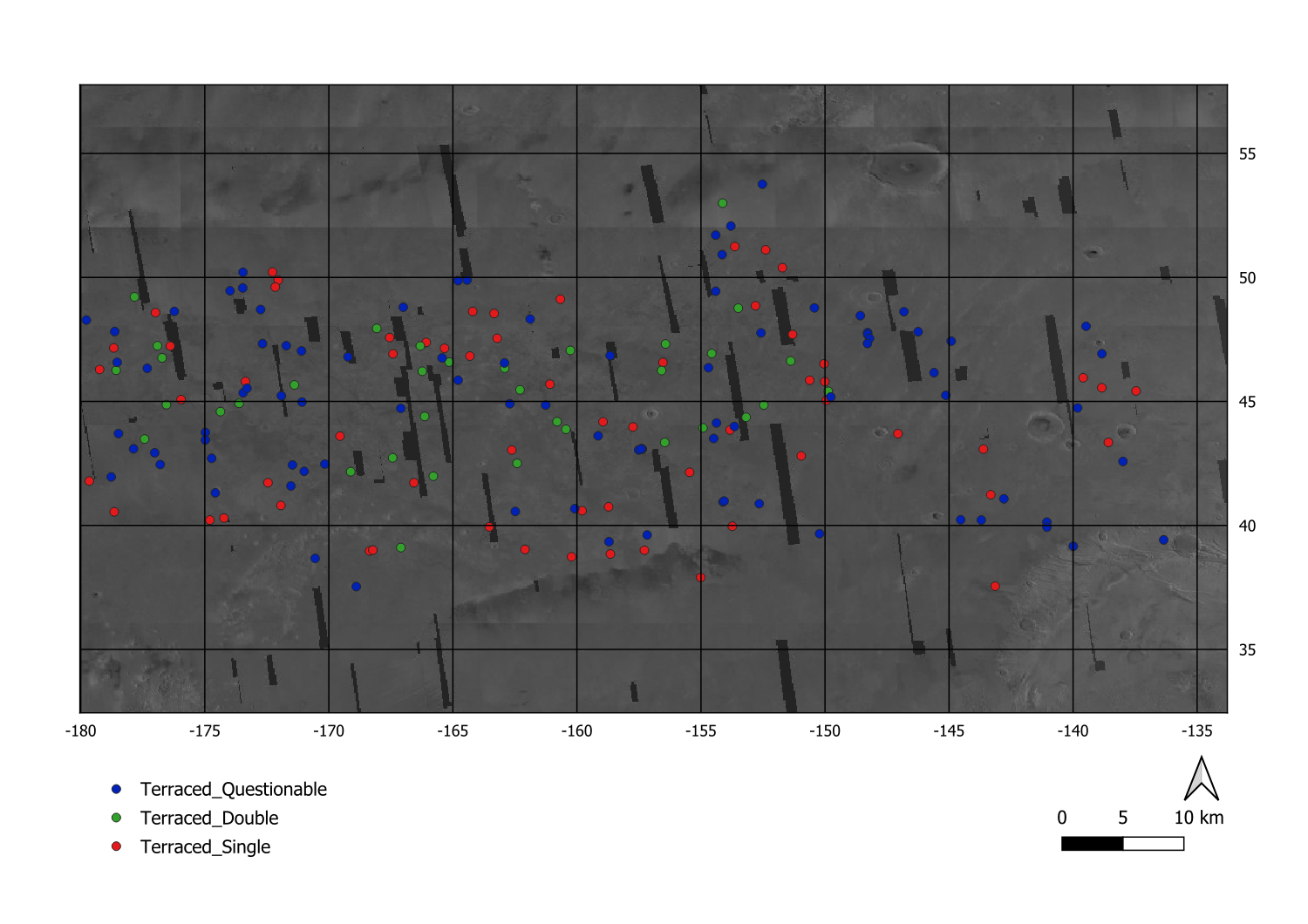
The goal of this study is to extend the analysis of the terraced craters catalog published by Bramson et al. [2], focused on the area of Arcadia Planitia (Figure 1). The database includes 187 craters, with diameters ranging from 125 meters to 2 kilometers. Among these, 62 have a single well-defined terrace, 35 show two distinct terraces, while the remaining 90 were classified as uncertain due to the presence of poorly distinguishable or difficult to interpret terraced morphologies.

Figure 1: Spatial distribution of terraced craters in Arcadia Planitia.

The analysis was carried out using the open-source QGIS software, integrated with custom Python scripts. Based on the previous work [2], a detailed morphometric analysis was conducted using 14 high-resolution Digital Terrain Models (DTMs) from the HiRISE archive [4]. Among these, 10 had already been used in the original study, while 4 were added in the present work. Using the QGIS "Profile Tool", the elevation profiles of craters were analyzed, allowing the measurement of the depth of terraces, dip, and slope between different levels. The results obtained confirm and extend what has already been reported in the literature [2].
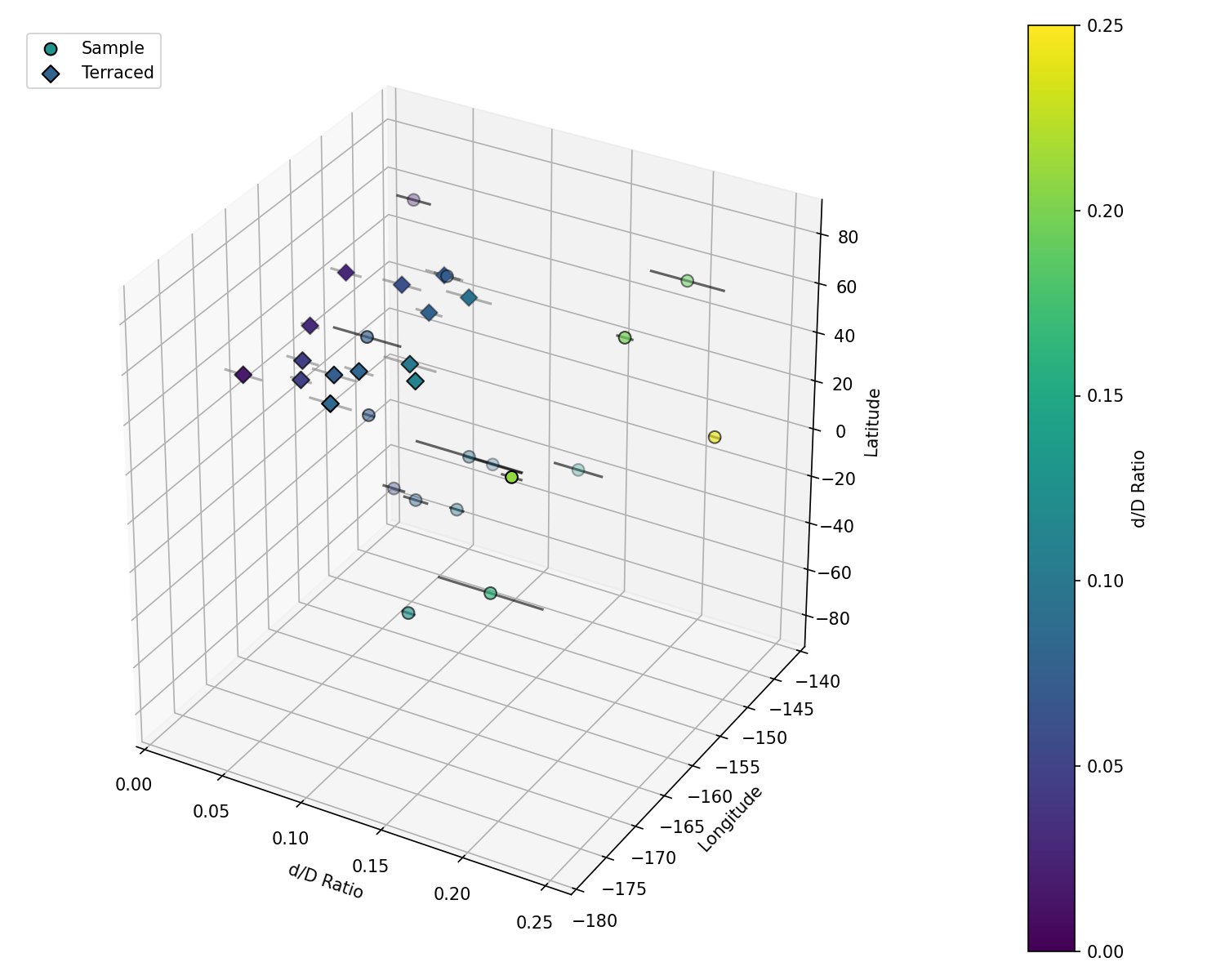
In a second step, an additional analysis was carried out, in which 20 radial profiles were extracted from each HiRISE DTM to calculate the crater d/D ratio and its associated uncertainties. The craters analyzed are located in the region of Arcadia Planitia, between longitudes 180°E and 225°E. For comparative purposes, a sample of 16 simple craters in the same longitudinal band was selected. The results were displayed in a three-dimensional plot d/D versus longitude and latitude (Figure 2).

Figure 2: Three-dimensional distribution of the crater dataset as a function of d/D ratio, longitude, and latitude. Circles represent simple craters, rhombuses terraced ones. Marker color shows the d/D ratio, as indicated by the colorbar. Horizontal lines show d/D measurement error bars.

Referring to this plot, the analysis of the d/D ratio shows systematically lower values in terraced craters (rhombuses) than simple ones (circles), supporting the hypothesis that the presence of ice in the substrate reduces the resistance of the target material at the time of impact. The different gradients and
elevation variations observed within the terraces could provide further indications on the mechanical and stratigraphic properties of the subsurface, supporting the hypothesis of stratified deposits of relatively pure ice in Arcadia Planitia.

In conclusion, the results obtained seem to confirm that the presence of ice in the subsoil at the moment of impact may cause the formation of shallower craters, characterized by lower d/D ratios than those developed in ice-free substrates. Furthermore, the internal morphology of craters, in particular the presence, number and arrangement of terraces, shows a significant variability, potentially related to the stratified structure and composition of the subsoil.
It is currently planned to generate additional terraced crater DTMs located in the same area, using stereoscopic pairs of HiRISE images available from the public archive. In parallel, new DTMs will be produced using stereo pairs acquired from the CaSSIS imaging system [7]. Expanding the dataset will enable further refinement of the analysis and help verify the robustness of the results obtained so far.


Acknowledgments
This work has been developed under the ASI-INAF agreement n. 2024-40-HH.0


References
[1] Ali M Bramson, Shane Byrne, Nathaniel E Putzig, Sarah Sutton, Jeffrey J Plaut, T Charles Brothers, and John W Holt. Widespread excess ice in arcadia planitia, mars. Geophysical Research Letters, 42(16):6566–6574, 2015.
[2] AM Bramson, Shane Byrne, and J Bapst. Preservation of midlatitude ice sheets on mars. Journal of Geophysical Research: Planets, 122(11):2250–2266, 2017.
[3] B. S. Douglass and J. F. Bell III. Using impact crater depth/diameter ratios to search for evidence of subsurface ice on mars, 2025. 56th LPSC.
[4] HiRISE Team. Dtm map browser, 2025. University of Arizona, Lunar and Planetary Laboratory.
[5] E Martellato, AM Bramson, G Cremonese, A Lucchetti, F Marzari, M Massironi, C Re, and S Byrne. Martian ice revealed by modeling of simple terraced crater formation. Journal of Geophysical Research: Planets, 125(10):e2019JE006108, 2020.
[6] Stuart J Robbins and Brian M Hynek. A new global database of mars impact craters≥ 1 km: 2.global crater properties and regional variations of the simple-to-complex transition diameter. Journal of Geophysical Research: Planets, 117(E6), 2012.
[7] N Thomas, G Cremonese, R Ziethe, M Gerber, M Brndli, G Bruno, M Erismann, L Gambicorti, T Gerber, K Ghose, et al. snd markiewicz. W., Massironi, M., McEwen, A., Okubo, C., Tornabene, L., Wajer, P., and Wray, J, page 18971944, 2017.

How to cite: Faletti, M., Cremonese, G., Martellato, E., Tullo, A., Bertoli, S., Munaretto, G., Marzari, F., and Zinzi, A.: Analysis of terraced craters in Arcadia Planitia, EPSC-DPS Joint Meeting 2025, Helsinki, Finland, 7–13 Sep 2025, EPSC-DPS2025-729, https://doi.org/10.5194/epsc-dps2025-729, 2025.

EPSC-DPS2025-1580 | ECP | Posters | TP3

Experimental ice:silicate craters and their application to Mars 

Jack Ethan Finch, Penny Wozniakiewicz, Jon Tandy, Mark Burchell, Elliot Sefton-Nash, Luke Alesbrook, Detlef Koschny, Chrysa Avdellidou, and Vassilia Spathis
Mon, 08 Sep, 18:00–19:30 (EEST)   Finlandia Hall foyer | F7

Background:

The morphology of impact craters has been used to study the surface and near-surface properties of many bodies throughout the Solar System. Comparative planetological methods have then furthered this to infer specific parameters regarding the sub-surface of planetary targets through comparison of morphological features across both Solar System bodies and to laboratory-scale craters [1,2]. Being ubiquitous throughout the outer Solar System, ice:silicate mixtures have received a high level of interest within laboratory-scale impact studies, with the primary focus being on ice-dominated mixtures (silicate content of <50 wt.%) thought to be present on comets and outer Solar System moons, e.g. [3,4].

The results of these experiments (along with a comparison to outer Solar System morphological features) have then been used to infer the properties of ice bearing bodies across the inner Solar System, in particular Ceres [5,6] and Mars [2,7,8]. Observations, however, have estimated the near-surface ice quantity for these bodies to be far below 50 wt.% [6], placing them well within the silicate-dominated range for ice:silicate mixtures rather than the ice-dominated regime studied by previous experiments. Consequently, this presents a potential source of error in the interpretation of Martian craters due to the misuse of applied assumptions to understand the morphology of craters. The work presented here aims to study the cratering process for silicate-dominated Martian simulant and kiln-dried sand mixtures, thereby better constraining the influence of ice on cratering processes in such inner Solar System targets.

Methodology:


Impacted targets were formed of ice:silicate mixtures containing either a 50 wt.% or 80 wt.% silicate content. Targets (Figure 1) were constructed from a mixture of crushed ice with either JSC Mars-1 Martian simulant (Figure 2) [9] or a typical commercial kiln-dried sand (KDS) (Figure 3) for 50 wt.% targets only. Constructed targets measured 20 cm in diameter and 9 cm in depth. Once frozen, targets were impacted by 1.5 mm spherical copper projectiles over the velocity range of 2-5 km/s using the light-gas gun at the University of Kent impact laboratory [10]. Following the impact, depth profiles of the crater were taken across each target in orthogonal directions allowing measurement of depth and diameter. Profiles across the crater additionally provided a means for morphological comparisons to be made between the silicate types (JSC Mars-1 and KDS) and ice quantities (50 wt.% and 80 wt.%).

Figure 1: Example pre-impact JSC Mars-1 target mounted to the Kent light-gas gun. The target diameter was 20 cm.

Results and Discussion:


Crater parameters (e.g. depth, diameter, etc.) were analysed versus the energy of the impactor, allowing comparisons to be made for varying projectile materials. The results show that variations in crater parameters were seen when altering both the quantity of ice and the type of silicate within the target. Analysis of the two silicate materials themselves shows that they possess highly different morphologies, with the JSC Mars-1 having much more irregular (in both size and shape) grains when compared to the KDS (Figures 2 and 3). This variation is thought to be the likely cause for the observed variation in crater diameter due to the induced changes in internal friction and responses to shock processing. A variation in crater depth was only seen, however, between targets of differing ice quantities. This indicates that the crater depth was somewhat influenced by the target properties, but that changes were less pronounced than for the crater diameter.

Figure 2: Optical microscopy image of the JSC Mars-1 simulant.

Figure 3: Optical microscopy image of the Kiln-dried sand.

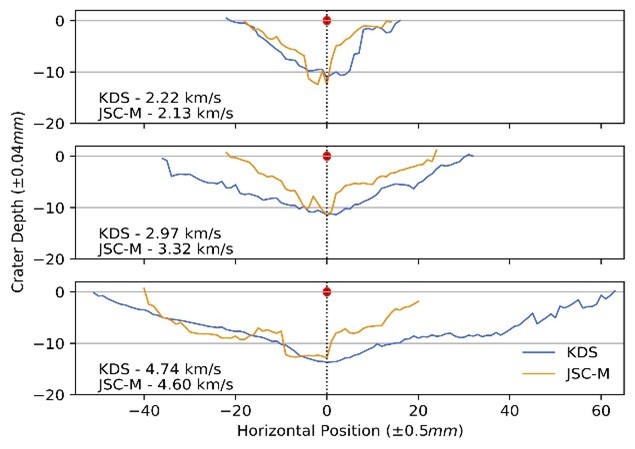
Analysis of the interior crater morphology shows further differences between both silicate types and the ice quantity. Figure 4 compares craters morphologies for targets containing a different silicate type when impacted at various speeds. All targets contained the same 50:50 wt.% ice:silicate ratio. As the impact speed increases, variations in the morphology become substantially more pronounced. The same trend is seen when considering craters formed in targets of a differing silicate quantity.

Figure 4: Comparisons at varying impact speeds between craters formed in JSC Mars-1 and standard sand targets containing a 50 wt.% quantity of silicate material.

Conclusions:

Overall, whilst past investigations have shown that crater parameters change with increasing silicate quantity within a target, the results of this investigation show that initial trends assumed from previous studies may not hold as the silicate quantity increases above the 50 wt.% limit. Hence, the continuing investigation of these processes is likely to further understanding of processes occurring on the Martian surface.

References:

[1] C.M. Ernst, et al., J. Geophys. Res. Planets 123, 2628 (2018).

[2] N.G. Barlow, et al., Meteorit. Planet. Sci. 52, 1371 (2017).

[3] D. Koschny, E. Grun, Icarus 154, 391 (2001).

[4] K. Hiraoka, et al., Adv. in Space Res. 39, 392 (2007)

[5] P. Schenk, et al., Icarus 320, 159 (2019).

[6] H.G. Sizemore, et al., J. Geophys. Res. Planets 124, 1650 (2019).

[7] G. de Villers, et al., Meteorit. Planet. Sci. 54, 947 (2010).

[8] P.J. Mouginis-Mark, Meteorit Planet. Sci. 50, 51 (2015).

[9] C.C. Allen, et al., EOS Trans. AGU 79, 405 (1998).

[10] R. Hibbert, et al., Procedia Enginering 204, 208 (2017).


How to cite: Finch, J. E., Wozniakiewicz, P., Tandy, J., Burchell, M., Sefton-Nash, E., Alesbrook, L., Koschny, D., Avdellidou, C., and Spathis, V.: Experimental ice:silicate craters and their application to Mars, EPSC-DPS Joint Meeting 2025, Helsinki, Finland, 7–13 Sep 2025, EPSC-DPS2025-1580, https://doi.org/10.5194/epsc-dps2025-1580, 2025.

TP4 | Exploring Venus: Unveiling Mysteries of Earth’s Twin from Core to Atmosphere

EPSC-DPS2025-148 | Posters | TP4 | OPC: evaluations required

Investigating the Origin of Venus’ Clouds Using a Cloud Microphysics Model 

Hiroki Karyu, Takeshi Kuroda, Arnaud Mahieux, Sébastien Viscardy, Anni Määttänen, Naoki Terada, Séverine Robert, Ann Carine Vandaele, and Michel Crucifix
Mon, 08 Sep, 18:00–19:30 (EEST)   Finlandia Hall foyer | F28

Sulfuric acid clouds on Venus play a pivotal role in atmospheric radiation, chemistry, and material transport. Therefore, understanding the mechanisms underlying cloud formation on Venus is essential for gaining a better insight into the planet’s climate and atmospheric processes. Cloud formation on Venus begins with the nucleation process, which provides cloud condensation nuclei (CCN) necessary for subsequent condensational growth. Elemental sulfur is frequently assumed to be the primary CCN substance, as its vapor can be readily produced through photochemical reactions and solidifies upon condensation. Meteoric dust has been proposed as CCN as well and cloud droplets could also form by homogeneous nucleation.

Cloud microphysics models are effective tools for exploring the mechanisms of cloud formation and have been widely applied in studies of Venus. Previous modeling studies that assumed elemental sulfur as CCN have successfully reproduced observed cloud structures [1,2,3,4]. However, these studies have typically simplified the CCN production process by directly injecting particles with predefined sizes ranging from 0.01 to 0.1 µm, rather than explicitly calculating the CCN production rate based on nucleation theory. In addition, the elemental sulfur CCN are also provided from the lower model boundary at ~40 km altitude in the previous studies, despite uncertainties about the stability of elemental sulfur as a solid phase at these altitudes. Consequently, the fundamental initial step of cloud formation on Venus remains poorly understood.

In this study, we perform 1D cloud microphysics simulations incorporating elemental sulfur vapor and its nucleation process to investigate the origin of Venus’ clouds.  A cloud microphysics model used here is the Simulator of Particle Evolution, Composition, and Kinetics (SPECK) [5]. SPECK accurately calculates condensation processes and is particularly suitable for aerosols with diverse compositions. Thus, it effectively simulates particle evolution from nucleation through condensation and coagulation, tracking interactions among particles with different composition. Our model includes three condensable vapor species: sulfuric acid, water, and elemental sulfur (S8). The homogeneous nucleation of sulfuric acid occurs via binary nucleation with water [6], while the nucleation of S8 is computed using a classical homogeneous nucleation theory. The size bins of the model range from 1 nm to 30 µm, and homogeneously nucleated particles are introduced into the smallest bin size of 1 nm. The model also considers the heterogeneous nucleation of sulfuric acid and water on the formed elemental sulfur particles. The vertical model domain spans altitudes from 40 km to 100 km, encompassing the entire cloud structure from the lower clouds to the upper haze. In addition to homogeneously nucleated particles, our model incorporates meteoric smoke particles (MSPs) as CCN with a radius of 1 nm. MSPs, assumed to consist of olivine, are introduced at the top of the model domain since the production of MSP is expected to occur around 115 km [7]. A parameter study is conducted with respect to the meteoric dust ablation flux ranging from 1 t d-1 to 1000 t d-1.

Figure 1. (a) Homogeneous nucleation rate of sulfuric acid and water (blue solid line) and S8 (red-dashed line). (b) Heterogeneous nucleation rate of sulfuric acid onto S8 particles.


Our results indicate that different nucleation processes dominate at different altitudes. Specifically, homogeneous nucleation of elemental sulfur prevails below 70 km altitude, whereas homogeneous nucleation of sulfuric acid dominates above 80 km (Figure 1a). The S8 particles are eventually activated through heterogeneous nucleation and become coated by sulfuric acid solution (Figure 1b). This suggests that cloud particles below 70 km and haze particles above 70 km have distinct origins. Parameter studies varying the MSP injection flux by three orders of magnitude resulted in negligible differences in the upper haze structure, consistent with previous findings [2]. Additionally, we confirmed that elemental sulfur particles evaporate below the cloud base due to higher temperatures. This result raises questions about the previous assumption that elemental sulfur serves as CCN around the cloud base, highlighting the possibility that alternative CCN substances such as minerals [8] or salts [9] may be more suitable.


[1] Imamura & Hashimoto (2001), JAS

[2] Gao et al. (2014), Icarus

[3] McGouldrick & Barth (2023), PSJ

[4] Karyu et al. (2024), PSJ

[5] Karyu et al. (2025), ESS, under review

[6] Määttänen et al. (2018), JGR

[7] Carillo-Sanchez et al. (2020), Icarus

[8] Krasnopolsky (2017), Icarus

[9] Rimmer et al. (2020), PSJ

How to cite: Karyu, H., Kuroda, T., Mahieux, A., Viscardy, S., Määttänen, A., Terada, N., Robert, S., Vandaele, A. C., and Crucifix, M.: Investigating the Origin of Venus’ Clouds Using a Cloud Microphysics Model, EPSC-DPS Joint Meeting 2025, Helsinki, Finland, 7–13 Sep 2025, EPSC-DPS2025-148, https://doi.org/10.5194/epsc-dps2025-148, 2025.

EPSC-DPS2025-679 | ECP | Posters | TP4

Reduced water loss due to atmospheric photochemistry under a runaway greenhouse condition on Venus 

Yo Kawamura, Tatsuya Yoshida, Naoki Terada, Yuki Nakamura, Shungo Koyama, Hiroki Karyu, and Takeshi Kuroda
Mon, 08 Sep, 18:00–19:30 (EEST)   Finlandia Hall foyer | F26

Venus likely lost a significant fraction of its initial water during an early runaway greenhouse (RG) phase (e.g., Hamano et al., 2013). Under the RG condition, surface water fully evaporates, creating an H2O-dominated atmosphere. Intense ultraviolet (UV) irradiation from the young Sun drives H2O photolysis, and the liberated hydrogen subsequently escapes to space (Kasting, 1988). Previous studies suggest that RG Venus could have lost several tens of terrestrial oceans (1.4 × 10²¹ kg; hereafter TO) within 1 Gyr (e.g., Gillmann et al., 2009).

Recently, two atmospheric photochemical processes—H2O reproduction and UV shielding by O2—were shown to suppress water loss in an H2O-dominated atmosphere of a terrestrial exoplanet orbiting an M dwarf (Kawamura et al., 2024). However, the impact of these processes on water loss around G-type stars like Venus, and their dependence on atmospheric composition, remains poorly understood.

Here, we quantify these effects using a one-dimensional photochemical model based on PROTEUS (Nakamura et al., 2023). The model simulates vertical profiles of H2O–CO2 atmospheres under RG conditions by solving chemical reactions and diffusion. It solves 51 reactions including H2O, CO2, and their photolysis products (H, OH, H2, O(1D), O3, O2, O, HO2, H2O2, CO, and HOCO) following Chaffin et al. (2017). To estimate the water loss rate, we impose diffusion-limited hydrogen escape as the upper boundary condition. Additionally, we consider intense UV irradiation conditions characteristic of the active young Sun (Claire et al., 2012). We considered a variety of atmospheric parameters, with H2O inventories ranging from 0.1 to 10 TO and CO2 inventories from 1 to 50 times the mass of the current Venusian Atmospheric Carbon Dioxide (4.69 × 10²⁰ kg; hereafter VACD).

Our results show that the water loss rate on the RG Venus is significantly suppressed by the two previously identified photochemical processes and by additional UV shielding from CO2 and O3. In an atmosphere with 5 TO of H2O and 1 VACD of CO2, these combined effects reduce the loss rate to 5.4 TO Gyr-1, substantially below previous estimates. At 50 VACD of CO2, enhanced UV shielding by CO2 further decreases the rate. These findings suggest that Venus retained substantial water for much longer than previous studies suggested. Moreover, if the RG phase duration is controlled by the water loss rate (Hamano et al., 2013), it may have persisted for several Gyr.

How to cite: Kawamura, Y., Yoshida, T., Terada, N., Nakamura, Y., Koyama, S., Karyu, H., and Kuroda, T.: Reduced water loss due to atmospheric photochemistry under a runaway greenhouse condition on Venus, EPSC-DPS Joint Meeting 2025, Helsinki, Finland, 7–13 Sep 2025, EPSC-DPS2025-679, https://doi.org/10.5194/epsc-dps2025-679, 2025.

EPSC-DPS2025-718 | ECP | Posters | TP4 | OPC: evaluations required

Measurement of the spin of Venus using radio tracking data from Venus Express and expected outcomes from EnVision 

Maëva Lévesque, Pascal Rosenblatt, Jean-Charles Marty, and Caroline Dumoulin
Mon, 08 Sep, 18:00–19:30 (EEST)   Finlandia Hall foyer | F49
Venus has a long and retrograde rotation period compared to other planets in the Solar System. Its rotation period of 243 days has been measured using different methods from Earth or from the Venus’ orbit. However, this value remains poorly constrained with a large variability of about 7 minutes. Currently, models that take into account various factors influencing the Length-of-Day (LOD) can explain only 3 minutes of the observed variation. These effects include the tidal torque exerted by the Sun on Venus or the coupling between the atmosphere and the surface. Accurately tracking the Venus’ rotation period could therefore help us to better understand these processes [1].

In this study, we investigate navigation tracking data from the Venus Express (VEX) spacecraft, in order to derive a new solution for the rotation period of Venus. We use a method called Precise Orbit Determination (POD). It consists of performing a least squares adjustment of the difference between collected and generated Doppler data. Collected Doppler data correspond to the Doppler effect on the radio-link carrier frequency between the spacecraft and a ground-based antenna, and due to the motion of the spacecraft around the planet. Generated Doppler data are derived from the trajectory computed by numerical integration of the forces governing the spacecraft’s motion. The least-squares adjustment is performed over successive arcs of 7 days in the case of Venus Express and uses the GINS (Géodésie par Intégrations Numériques Simultanées) software.

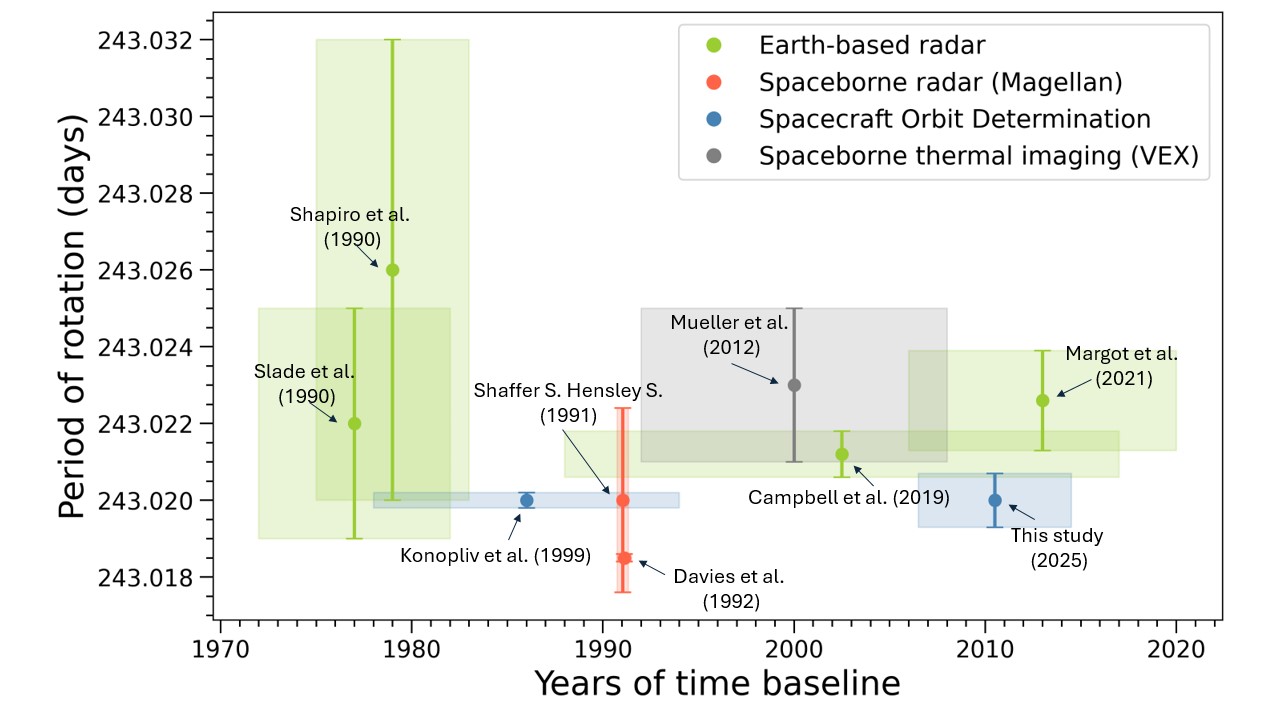
We determined a rotation period for Venus of 243.0202 ± 0.0008 days using these tracking data from Venus Express over the 8 years of the mission. As shown in Figure 1, this result aligns well with previous estimates obtained through different methods and datasets. However, the associated uncertainty is relatively large compared to earlier measurements using Magellan and Pioneer Venus Orbiter (PVO) tracking data [3]. This uncertainty reflects the influence of the atmospheric model employed in our POD computations (such as Hedin, Venus-GRAM, or Venus Climate Database) and the difficulty in accurately resolving velocity anomalies introduced by the spacecraft’s daily desaturation maneuvers.


Figure 1: Estimates of Venus' rotation period, along with their measurement time baseline and corresponding error-bars at 1-sigma (Lévesque et al. (2025), under review)​.

In Figure 1, the different estimates of Venus’s rotation period are generally averaged over one year or more. To investigate potential shorter variations in our results, we computed a separate estimate of the rotation period every 12 arcs, corresponding to approximately three months of data (shown in black in Figure 2). Values in red represents the measurements of instantaneous periods obtained by Margot et al. (2021) [4] relative to the operating period of VEX. A comparison of the median values shows that these two independent methods yield consistent results over the same time span. In both studies the dispersion is too large to see a variation in the Length of Day or a clear periodic signal. Therefore, more precise measurements are needed in order to see possible variations in the LOD.


Figure 2: Time series of Venus's rotation period, with one value reported for every 12 arcs. The results of our study are shown in black, while the findings from Margot et al. (2021) covering the period from mid-2006 to 2014 are displayed in red. In grey, the 3 minutes amplitude predicted by the theory (Lévesque et al. (2025), under review).​

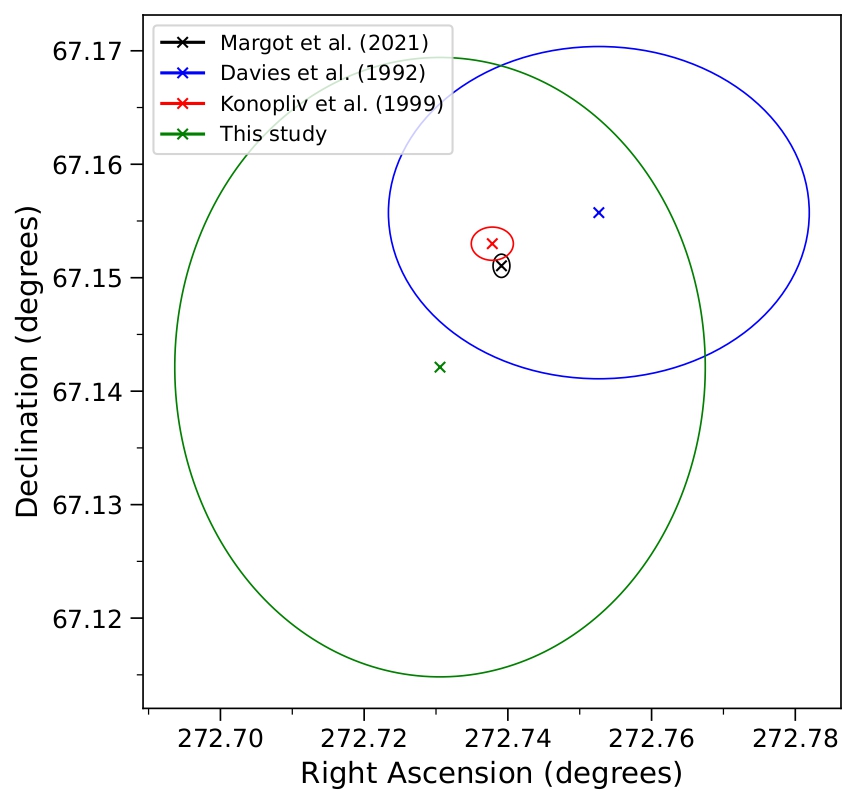
The rotation period estimate from our study was determined simultaneously with the orientation of Venus’s rotation axis, defined by its right ascension and declination. Figure 3, adapted from Margot et al. (2021) [4], presents results from various studies along with their 1-sigma uncertainties. In our case, the uncertainties are relatively large, preventing us from  determining the precession rate.


Figure 3: Spin axis orientation of Venus with 1 sigma uncertainties, i.e. 2D confidence intervals at 68.3 % levels. Modified from Margot et al. (2021) (Lévesque et al. (2025), under review)

Our ability to accurately estimate Venus’s geophysical parameters using Venus Express tracking data remains limited. Upcoming missions like NASA’s VERITAS and ESA’s EnVision are expected to provide crucial new data to improve this estimation. Scheduled for launch in 2031, EnVision will study Venus from its deep interior to the upper atmosphere. Thanks to its near-polar, low-eccentricity orbit, the mission will provide greater sensitivity to the planet's gravity field and rotational state. We carried out simulations to predict EnVision’s performances [5]. The predicted 3-sigma uncertainty in the rotation period is 1,3 seconds, compared to the uncertainty of more than 1 minute obtained with VEX. For the precession rate, the 3-sigma uncertainty is 1.2%, compared to 7% obtained with ground-based radar data [4].


[1] Cottereau, L. et al.: The various contributions in Venus rotation rate and LOD, Astron.Astrophys. 531, A45, 2011

[2] Konopliv A. S. et al.: Venus Gravity: 180th Degree and Order Model. Icarus 139, 3–18, 1999

[3] Margot, J. L. et al.: Spin state and moment of inertia of Venus, Nat Astron 5:676–683, 2021

[4] Rosenblatt, P. et al.: EnVision gravity experiment: Joint inversion of Doppler tracking data and tie-points monitoring from SAR images. Vol. 17, EPSC2024-410, 2024

How to cite: Lévesque, M., Rosenblatt, P., Marty, J.-C., and Dumoulin, C.: Measurement of the spin of Venus using radio tracking data from Venus Express and expected outcomes from EnVision, EPSC-DPS Joint Meeting 2025, Helsinki, Finland, 7–13 Sep 2025, EPSC-DPS2025-718, https://doi.org/10.5194/epsc-dps2025-718, 2025.

EPSC-DPS2025-1241 | ECP | Posters | TP4 | OPC: evaluations required

Thermal anomaly on Venus’s mesosphere 

Ting-Juan Liao, Dave Crisp, and Yuk Yung
Mon, 08 Sep, 18:00–19:30 (EEST)   Finlandia Hall foyer | F22

The Venus mesosphere (~60 - 100 km) is bounded below by the massive, cloudy, super-rotating troposphere and above by the thermosphere/cryosphere. Despite the fact that Venus has negligible obliquity (< 4K) and that the mesosphere is subjected to intense solar radiative forcing, most of this atmospheric layer has an anomalous, reversed pole-to-equator thermal structure with polar temperatures up to 10 K warmer than those over the equator [1]. This thermal structure implies net (solar – thermal) radiative heating in the Venus mesosphere. Here, we employ the Spectral Mapping Radiative Transfer (SMART) model to estimate the net heating rates. We used updated constraints on the atmospheric thermal structure and composition from ground-based observations and results from the Venus Express mission. The net heating is thought to be maintained by a thermally-indirect meridional circulation driven by interactions between the zonal super-rotation and atmospheric thermal tides [2]. Also, we updated Sulfur dioxide concentration to reach global heat balanced. The meridional circulation could play a critical role in the transport of trace gases and the production of sulfuric acid aerosols at levels throughout the Venus mesosphere. This circulation may imply the lofting of sulfuric acid aerosols containing enriched HDO, thereby explaining the dramatic enhancement of the D/H ratio[3] in the upper atmosphere of Venus > 100 km.


[1] Limaye, S.S., Grassi, D., Mahieux, A. et al.Venus Atmospheric Thermal Structure and Radiative Balance. Space Sci Rev 214, 102 (2018).

[2] Crisp, D. (1986). Radiative forcing of the Venus mesosphere: I. solar fluxes and heating rates. Icarus, 67(3), 484-514.

[3] Mahieux, Arnaud, Sébastien Viscardy, Roger Vincent Yelle, Hiroki Karyu, Sarah Chamberlain, Séverine Robert, Arianna Piccialli et al. "Unexpected increase of the deuterium to hydrogen ratio in the Venus mesosphere." Proceedings of the National Academy of Sciences 121, no. 34 (2024): e2401638121.

How to cite: Liao, T.-J., Crisp, D., and Yung, Y.: Thermal anomaly on Venus’s mesosphere, EPSC-DPS Joint Meeting 2025, Helsinki, Finland, 7–13 Sep 2025, EPSC-DPS2025-1241, https://doi.org/10.5194/epsc-dps2025-1241, 2025.

EPSC-DPS2025-1518 | ECP | Posters | TP4

Tesserae extension estimation and comparison with crustal plateau thickness, Venus 

Julia Álvarez-Lozano, Ignacio Romeo, Javier Ruiz, Hodei Uzkeda, and Alberto Jiménez-Díaz
Mon, 08 Sep, 18:00–19:30 (EEST)   Finlandia Hall foyer | F41

Most of the Venus surface is geologically young1, while the locally oldest materials are tessera terrains covering around 8% of the surface2. Most tesserae feature a penetrative extensional fabric characterized by long narrow graben so called ribbons. Ribbon-bearing tesserae are typically found on Venusian crustal plateaus, elevated, quasi-circular regions with steep edges and flat tops. They show small gravity anomalies, low gravity to topography ratios and shallow apparent compensation depths (ADC), all of which suggest a thickened crust3.

The tectonic patterns of crustal plateaus are highly complex, featuring both extensional and compressional structures across a wide range of wavelengths and spacings. While radial extension is widely accepted as the final evolutionary phase, earlier stages are debated. The plume and lava pond hypotheses suggests a strong brittle layer thickening during cooling causing an increase of the structures wavelength (or spacing) with time4,5,6. Other works provide evidence of initial compression followed by extension7,8,9. Moreover, different wavelengths of structures can simultaneously be caused by the tectonic deformation of a layered crust [10]. Recently, dyke swarm emplacement has been linked to ribbon formation11, which provides an elegant explanation to the persistent spacing.

Despite all crustal plateaus feature thick crusts associated to negative gravity anomalies, a wide range of crustal thicknesses, topographic elevations, and Bouguer anomalies is observed12. At one end, Ovda Regio exhibits a significantly thickened crust, high topography, and a large Bouguer anomaly, while the opposite is true for Alpha Regio. In this study, we conduct a structural analysis of tessera terrain and calculate the total extension produced, with the aim of identifying possible relations between the main geophysical features and ribbon formation.

Geologic mapping and structural analysis of Ovda Regio and Alpha Regio were made using high-resolution SAR images (~75m resolution) and altimetry (10 to 20 km horizontal resolution and 50 to 100 m vertical resolution) from NASA Magellan mission. Data visualization was performed using QGIS. The digitization of regularly-spaced, long narrow graben allowed us to identify and evaluate the presence of different extensional families, as well as their orientations and spatial continuity.

Once regularly-spaced long narrow graben (ribbons) were identified in Ovda Regio and Alpha Regio, the study areas were subdivided into a 200 x 200 km grid. For subsequent analysis, we selected the zones within each grid cell exhibiting the maximum density of normal faults (to evaluate the maximum registered extension). Assuming a pure dip slip kinematics for the normal faults, the maximum observed extension was calculated along lines perpendicular to each fault set. Average fault heave was obtained assuming a fault dip of 60º (typical of normal faults) and a fault throw inferred from partially lava filled grabens at fold limbs. In areas where two graben sets coexist, the resultant extension was obtained by adding the deformation of each set. The estimated maximum extension was obtained by summing the heave of all the normal faults present. A stretching value was calculated for each grid cell, and was subsequently represented by deformation ellipses. Finally, we compared the stretching values with the crustal thickness12,13in the same 200 x 200 km areas for both regions Ovda and Alpha.

Previous estimates of stretching generated by ribbon within Fortuna Tessera have ranged from 58% to 84%5. However, our analysis of Ovda Regio and Alpha Regio revealed maximum stretch values of 12%. We found a general trend where maximum stretch values generated by ribbons are higher in areas of lower crustal thickness, suggesting that ribbon play a role during gravitational collapse rather than being involved in plateau construction.

References

[1] Schaber, G. G. et al. (1992). JGR: Planets, 97(E8), 13257-13301.

[2] Ivanov, M. A., & Head, J. W. (2011). PSS, 59(13), 1559-1600.

[3] Grimm, R. E. (1994). JGR: Planets, 99(E11), 23163-23171.

[4] Hansen, V. L., & J. J. Willis (1996). Icarus 123, 296-312.

[5] Hansen, V. L., & Willis, J. J. (1998). Icarus, 132(2), 321-343.

[6] Hansen, V. L. (2006). JGR: Planets, 111(E11).

[7] Gilmore, M. S. el al. (1998). JGR: Planets, 103(E7), 16813-16840.

[8] Gilmore, M. S. et al. (1997). JGR: Planets, 102(E6), 13357-13368.

[9] Romeo, I., Capote, R., & Anguita, F. (2005). Icarus, 175(2), 320-334.

[10] Romeo, I., & Capote, R. (2011). PSS, 59(13), 1428-1445.

[11] Hanmer, S. (2020). Earth-Science Reviews, 201, 103077.

[12] Jiménez-Díaz, A. et al. (2015). Icarus, 260, 215-231.

[13] Maia, J. S., & Wieczorek, M. A. (2022). JGR: Planets, 127, e2021JE007004.

Acknowledgements

This work was supported by the Spanish Agencia Estatal de Investigación through the research project PID2022-140686NB-I00 (MARVEN), the associated predoctoral grant CT21/24 and grant PR3/23-30839 (GEOMAVE), funded by the Universidad Complutense de Madrid.

How to cite: Álvarez-Lozano, J., Romeo, I., Ruiz, J., Uzkeda, H., and Jiménez-Díaz, A.: Tesserae extension estimation and comparison with crustal plateau thickness, Venus, EPSC-DPS Joint Meeting 2025, Helsinki, Finland, 7–13 Sep 2025, EPSC-DPS2025-1518, https://doi.org/10.5194/epsc-dps2025-1518, 2025.

EPSC-DPS2025-1946 | ECP | Posters | TP4 | OPC: evaluations required

Inferring Venus interior structure based on present geophysical constraints 

Anna Maria Gargiulo, Antonio Genova, Martina Ciambellini, Tommaso Torrini, Gabriel Tobie, Pascal Rosenblatt, and Caroline Dumoulin
Mon, 08 Sep, 18:00–19:30 (EEST)   Finlandia Hall foyer | F48
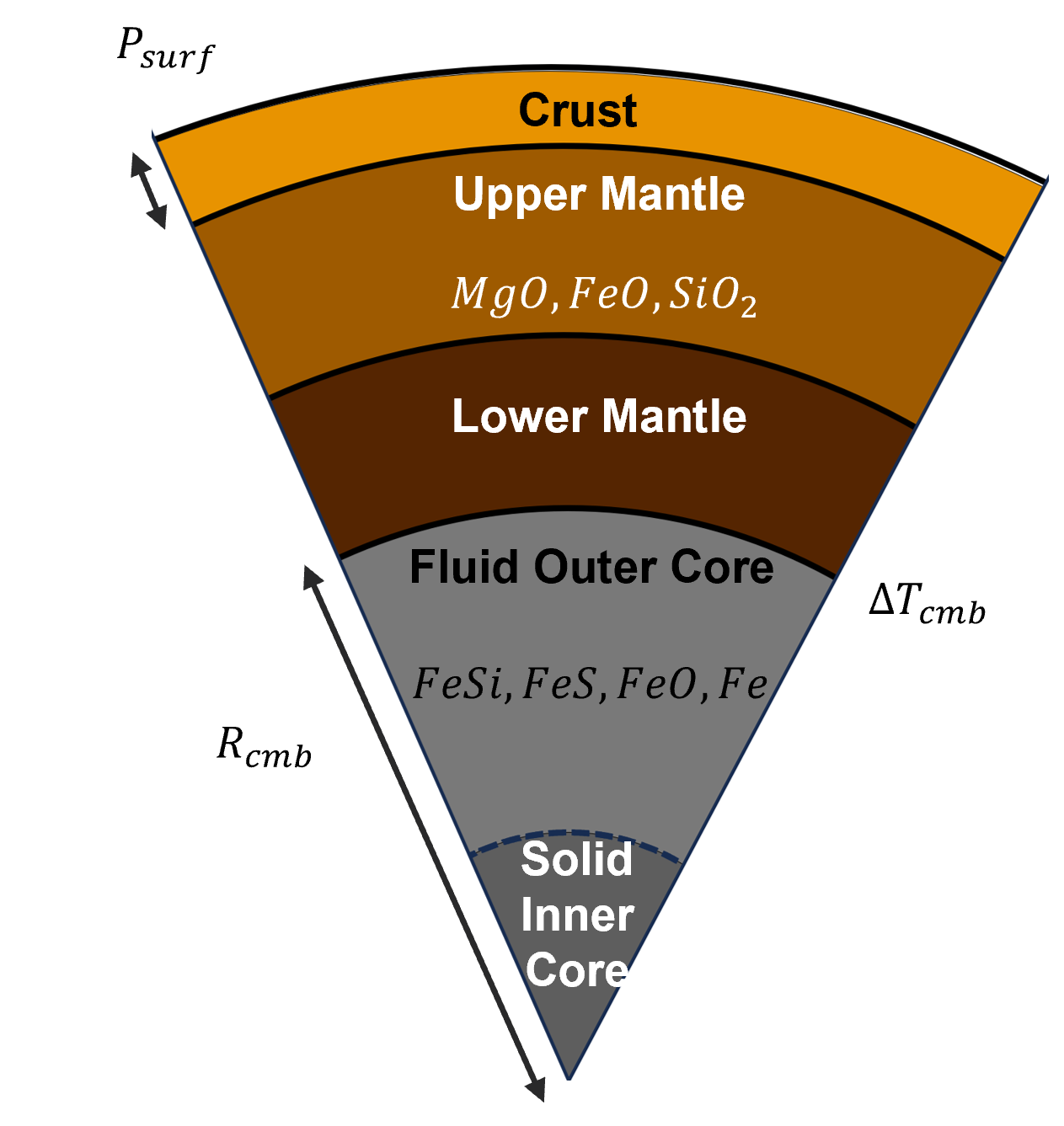
Introduction

The upcoming decade of Venus exploration, supported by unprecedented measurement accuracies, is expected to yield tight constraints on the planet’s interior structure. Key geophysical properties that enable inference of Venus’ interior include the Moment of Inertia (MoI), mass, and tidal Love number k2. Although current estimates and their associated uncertainties limit a detailed characterization of the deep interior, the combination of these parameters is essential for deriving consistent interior structure models. By using present observational accuracies, we investigate Venus’ interior through a Bayesian inference approach based on the Markov Chain Monte Carlo (MCMC) method [1]. In our study we account for an accurate modeling of the possible composition of the core and the mantle and retrieve pressure, temperature and density profiles that are consistent with the probability distributions of the observations.

Geophysical Constraints

Venus’ high surface temperature and pressure of about 730 K and 92 bar [2], resulting from its dense atmosphere, along with its lack of plate tectonics [3] and magnetic field, suggest significant differences in internal dynamics compared to Earth. If an Earth-like dynamo [4] were active on Venus, it would have implied convection mechanisms in an outer fluid core surrounding a solid inner core. The absence of a global magnetic field, instead, could be explained by an insufficient cooling of Venus’ core [5], or by limited convection in the mantle, insufficient to start the dynamo process [6]. While the existence of a solid inner core, thus, cannot be excluded, the lack of seismic data prevents better constraints on the mantle-core boundary. Venus’ slow rotation and consequent small oblateness hinder the determination of its MoI based solely on gravity data. Margot et al., 2021 [7] determined Venus’ MoI of 0.337± 0.024 (1-σ) through Earth-based radar observations of Venus’ spin vector. The tidal Love number k2 = 0.295±0.033 (1-σ) [8] is the only direct constraint on Venus’ interior structure, although the current uncertainty doesn’t allow definitive conclusions regarding the state of the core [9].

Interior Model Inversion

A multi-layered configuration is assumed for the internal structure of Venus, including a crust, upper and lower mantle and an iron-rich core (Figure 1) [10]. The model accounts for both fully molten and partially solidified core scenarios, including a fluid outer core and a solid inner core. To obtain an accurate modeling of the structure of Venus, variations in mantle and core compositions are included in this study.

The first step of the proposed approach is to identify a set of free parameters that can be explored to generate internal structure models. The crust is assumed to have uniform density. The upper mantle, whose constituents are assumed to be MgO, FeO and SiO2, extends to 25 GPa, which is the phase transition pressure of the Olivine to Perovskite. The lower mantle is assumed to have a homogeneous chemical composition with respect to the upper mantle. The model also considers a fluid core composed of FeSi, FeS, and FeO mixed with pure iron, as well as the potential presence of a solid core of pure iron, provided the required pressure and temperature conditions for solidification are satisfied.

Further assumptions governing the generation of interior structure models include a single-stage core segregation at a certain segregation pressure, with mantle composition derived via a metal-silicate partitioning model [11]. The temperature at the crust-mantle interface is sampled within a range compatible with basaltic magma generation. A temperature drop at the core-mantle interface is also accounted for. Our MCMC method explores the parameter space using the Metropolis Hastings algorithm, and convergence is checked through the Gelman-Rubin criterion. The posterior distribution of the properties of Venus’ interior provides models that match the observed values of mass, MoI and k2. The planet’s tidal response is computed using PyALMA [12], assuming Andrade rheological model and constant viscosities.

Our preliminary results based on current geophysical measurements show a distribution of models with a core radius between 3250 and 3650 km (1-σ) (Figure 2), consistent with previous estimates [7,9]. A subset of models highlighted in orange (~6%) supports the existence of a solid inner core, while those highlighted in green indicate a Perovskite to post-Perovskite phase transition in the lower mantle. The method's convergence is validated by the 2D histograms of the target values for mass, MoI, and k2 (Figure 3), which align with the observed constraints.

It should be noted that the adopted compositional assumptions, combined with the observed uncertainty in k2, impose tighter constraints on the MoI than current geophysical estimates, ensuring consistency with the measured mass.

Summary

We present here a robust Bayesian inference approach to evaluate the likely interior structure of Venus based on multidisciplinary geophysical constraints. Current estimates of the tidal Love number k2 are key to inferring Venus’ interior providing more stringent constraints than the moment of inertia. The proposed methodology offers a flexible framework that can be extended to incorporate more precise data from upcoming missions enabling deeper insights into Venus’s core and mantle.

References:
[1] Genova A. et al (2019) GRL 46(7), 3625–3633
[2] Lebonnois S. et al., (2010) JGR, 115(E6).
[3] Kaula, W. M. (1994). Philos.Trans.R.Soc. A, 349 (1690).
[4] Elsasser W. M. (1956) Rev.Mod.Phys 28(2), 135–163.
[5] Stevenson, D. J (1983) Icarus, 54(3), 466–489
[6] Nimmo, F. (2002) Geology, 30(11), 987.
[7] Margot J.L. et al (2021) Nat.Astron. 5(7), 676–683.
[8] Yoder C. F. and Ahrens, T. (1995) AGU, 1.
[9] Dumoulin C. et al. (2017) JGR 22(6), 1338–1352.
[10] Shah O. et al (2022) ApJ, 926, 2.
[11] Fischer R.A. et al (2015). Geochim.Cosmochim.Acta., 167, 177–194.
[12] Petricca F. et al. (2024) Icarus, 417, 116120.

Figure 1. Schematic representation of Venus' interior.

Figure 2. Histograms of the posterior core radius distribution from MCMC models (blue), models with solid core (orange), and models showing Perovskite to post-Perovskite transition (green).

Figure 3. MCMC convergence: 2D histograms of mass, k2, and MoI from the inversion models. Red shows mean values and 3-sigma uncertainty ellipses; white indicates measured values.

How to cite: Gargiulo, A. M., Genova, A., Ciambellini, M., Torrini, T., Tobie, G., Rosenblatt, P., and Dumoulin, C.: Inferring Venus interior structure based on present geophysical constraints, EPSC-DPS Joint Meeting 2025, Helsinki, Finland, 7–13 Sep 2025, EPSC-DPS2025-1946, https://doi.org/10.5194/epsc-dps2025-1946, 2025.

TP5 | Planetary volcanism, tectonics, and seismicity

EPSC-DPS2025-474 | ECP | Posters | TP5

Hectometric-scale mounds on Mars: insights from Bernard Crater and surrounding terrains in Terra Sirenum, Mars 

Elettra Mariani, Pascal Allemand, and Goro Komastu
Tue, 09 Sep, 18:00–19:30 (EEST)   Finlandia Hall foyer | F39

Hectometric-scale mound-like features in Terra Sirenum, Mars, have been hypothesized to result from either sedimentary volcanism or small-scale igneous volcanic activity. Discriminating between these processes is essential for understanding the subsurface dynamics, tectonic evolution, and hydrological history of the region. This study provides a comprehensive structural, morphological, and preliminary mineralogical analysis of more than 700 mounds distributed across Terra Sirenum, focusing particularly on the Bernard Crater area, a Noachian-aged impact structure modified by subsequent tectono-magmatic processes. Our work integrates high-resolution orbital datasets (CTX, HiRISE, MOLA, CRISM) into a GIS-based analytical framework, allowing detailed mapping, morphometric analysis, crater size-frequency dating, and mineralogical assessments. The objectives are to characterize the emplacement context of the mounds, identify possible formation mechanisms, and explore the relationship between mound distribution and regional tectonics. The analysis reveals that mound features across Terra Sirenum exhibit significant morphological variability. Morphologies include pitted cones, flat-topped mounds, clustered forms, and aligned mounds along structural trends. In Bernard Crater, mounds frequently occur in association with concentric and radial fracture systems, and their spatial clustering suggests a strong structural control on emplacement. Notably, several features within Bernard Crater display morphologies consistent with collapsed volcanic conduits and dike-fed structures, offering crucial evidence supporting an igneous origin. Crater size-frequency distribution analysis dates the surfaces hosting the mounds to the Noachian epoch (~3.7–4.1 Ga), while some areas within the Terra Sirenum basin suggest resurfacing events during the Hesperian-Amazonian. These results indicate that mound emplacement spanned significant geological timescales, potentially linked to episodic tectonic and magmatic activity associated with the evolution of the Tharsis region. Structural mapping highlights a clear correlation between mound alignments and the regional fault and graben network, particularly those associated with the Sirenum Fossae extensional system. Mounds tend to align parallel to the major graben trends or cluster along secondary fractures, suggesting that tectonic structures acted as preferential pathways for subsurface material ascent. This spatial organization is consistent with mound emplacement mechanisms involving dike intrusions or fault-assisted fluid migration. Preliminary mineralogical analysis using CRISM targeted hydrated and mafic mineral phases indicative of fluid-related processes or igneous activity. Localized detections of alteration minerals, although not definitive, point toward the interaction between subsurface fluids and the surrounding rock matrix during or after mound formation. Comparative analysis with terrestrial analogues strengthens the interpretations. While certain morphological characteristics of the Martian mounds resemble mud volcanoes observed in tectonically active regions such as Azerbaijan and NE China, key differences are apparent and small features from igneous volcanism in Arizona and Iceland. The association of many mounds with fracture corridors, the presence of summit pits suggestive of vent structures, and the absence of widespread mudflows or brecciation argue against a purely sedimentary volcanic origin. Instead, similarities with small igneous cones and dike-induced structures in rift settings, such as those in Iceland, appear more compelling. A central scientific question addressed by this study is whether the observed mound features primarily result from sedimentary extrusion processes (e.g., mud volcanism) or from magmatic activity associated with shallow dike emplacement and small-scale volcanic eruptions. The structural control, morphometric characteristics, and comparative terrestrial analogues collectively favour an interpretation where igneous processes played a major role, particularly within the Bernard Crater area. Nonetheless, given the morphological equifinality between sedimentary and igneous features and the limitations of orbital datasets, a contribution from sedimentary processes cannot be entirely ruled out. Localized episodes of fluid-assisted extrusion, possibly involving groundwater or volatile-rich materials, may have contributed to mound formation in some areas, especially in topographic lows where clustering is observed. In conclusion, the integrated structural, morphological, and preliminary mineralogical evidence suggests that the small mound features in Terra Sirenum, and particularly within Bernard Crater, are more consistent with an igneous volcanic origin than with sedimentary processes. Mound formation appears to have been structurally controlled by extensional tectonics, with subsurface dike propagation likely facilitating localized surface expressions. These findings have significant implications for understanding the tectono-magmatic evolution of Terra Sirenum and the broader highland-lowland transitional region on Mars. 

How to cite: Mariani, E., Allemand, P., and Komastu, G.: Hectometric-scale mounds on Mars: insights from Bernard Crater and surrounding terrains in Terra Sirenum, Mars, EPSC-DPS Joint Meeting 2025, Helsinki, Finland, 7–13 Sep 2025, EPSC-DPS2025-474, https://doi.org/10.5194/epsc-dps2025-474, 2025.

EPSC-DPS2025-1726 | ECP | Posters | TP5

Reconstructing Displacement Histories at Fault–Crater Intersections on Mercury. 

Antonio Sepe, Luigi Ferranti, Valentina Galluzzi, Gene Walter Schmidt, Salvatore Buoninfante, and Pasquale Palumbo
Tue, 09 Sep, 18:00–19:30 (EEST)   Finlandia Hall foyer | F42

Introduction

Mercury is a contracting planet that has undergone a global contraction of about 7 km [1]. This contraction has produced ubiquitous compressional landforms—including lobate scarps, high-relief ridges, and wrinkle ridges—that have been active since the Early Calorian period [2] and possibly into the present day [3].

Mercurian faults, like their terrestrial counterparts, likely initiate as small segments that later coalesce into longer, more continuous structures [e.g., 4]. Terrestrial faults typically exhibit bell-shaped displacement profiles, with peak displacement at the center and tapering toward the tips [e.g., 5]. However, observations on Mercury reveal anomalies in this trend, especially near intersections with impact craters, where displacement first drops at the crater rim and then slightly peaks at the crater floor. These deviations suggest syn-tectonic crater formation.

This study investigates such anomalies in three key fault systems—segments of the Victoria System, Discovery Rupes, and Enterprise System—to reconstruct their original displacement profiles and constrain the relative chronology of fault evolution and crater formation.

Data and Methods

Our analysis integrates the MESSENGER/MDIS BDR global basemap (166 m/px), the global DEM [6], and the global structural map [7]. We focus on four fault–crater intersections: the Victoria System at Geddes and Donne craters, the Enterprise System at Karsh crater, and Discovery Rupes at Rameau crater.

Displacement profiles were extracted along multiple cross-fault transects both within and outside the craters. Scarp heights measured along these profiles were plotted against fault length, derived from cumulative transect spacing. Peaks in these plots indicate discrete fault segments. To reconstruct the original (pre-crater) displacement profiles, we linearly interpolated the segment flanks and used their intersection points to estimate the expected maximum displacement. The average y-values of these intersections provided a rough displacement estimation.

By combining the reconstructed profiles with published chronologies [8–11], we derived average slip rates and estimated crater ages based on the modelled displacement accumulation.

Results and Interpretation

Victoria System (Geddes crater): The fault segment cutting Geddes crater displays slight asymmetry between its two major segments. Despite some erosion likely caused by the impact, both segments suggest comparable original displacement. Tectonic activity spanned 3.8–2.4 Ga [8], with 2.43 km of total displacement, yielding a slip rate of ~170 cm/Myr. The observed 1.15 km of displacement within the crater accumulated over ~0.68 Gyr, suggesting a crater age of ~3.1 Ga (Mid Calorian).

Victoria System (Donne crater): The Donne segment features a nearly symmetrical profile adjacent to the crater, indicating undisturbed fault growth. With 1.09 km of total displacement and a slip rate of 78 cm/Myr, the central 0.9 km peak implies 1.15 Gyr of growth. This places Donne Crater’s formation at ~3.55 Ga (Early Calorian), during the fault’s early activity.

Enterprise System (Karsh crater): The Enterprise System is one of the longest fault systems on Mercury, extending over 900 km. With tectonic activity spanning 3.8–0.95 Ga [8] and a maximum displacement of 3.7 km, it yields an average slip rate of 130 cm/Myr. The 0.9 km displacement within Karsh Crater likely developed ~710 Myr before the end of the fault’s tectonic activity, suggesting a crater age of ~1.66 Ga (Late Calorian).

Discovery Rupes (Rameau crater): Absolute dating for Discovery Rupes is unavailable, but it is estimated to have remained active into the Mansurian period (1.7–0.3 Ga) [9]. Assuming faulting began in the Early Calorian (3.85 Ga) [2], the total 1.34 km displacement implies a slip rate of 38 cm/Myr. The 0.6 km displacement within Rameau likely accrued over 1.58 Gyr, suggesting a crater age of ~1.88 Ga (Late Calorian).

Conclusions and Future Work

Our results highlight the diagnostic potential of displacement profiles in reconstructing fault evolution and offer insights into the timing and dynamics of tectonic activity when faults intersect syn-tectonic craters.

Our age estimates for Geddes, Donne, and Karsh craters are consistent with published morphological dating [10], supporting the robustness of our modelling. While the approach is promising, uncertainties remain—especially where long tectonic histories blur temporal resolution (as in the case of Discovery Rupes and Rameau Crater). Ongoing work will systematically date all fault–crater intersections on Mercury, enabling a more comprehensive reconstruction of the planet’s global contraction history.

References: [1] Byrne et al. (2014). Nature Geoscience, 7, 301–307. [2] Crane & Klimczak (2017). Geophysical Research Letters, 44(7), 3082-3089. [3] Tosi et al. (2013). JGR: Planets, 118(12), 2474-2487. [4] Klimczak et al. (2013). JGR: Planets, 118, 2030-2044. [5] Kim & Sanderson (2005). Earth-Sci. Rev., 68(3-4), 317-334. [6] Becker et al. (2016). LPSC Contrib., 1903. [7] Man et al. (2023). Nature Geoscience, 16, 856–862. [8] Galluzzi et al. (2019). JGR: Planets, 124, 2543-2562. [9] Giacomini et al. (2020). Geoscience Frontiers, 18, 15187. [10] Clark et al. (2024). LPSC Contrib. No. 3040. [11] Kinczyk et al. (2020). Icarus, 341, 113637.

Acknowledgements: We gratefully acknowledge funding from the Italian Space Agency (ASI) under ASI-INAF agreement 2024-18-HH.0.
This research is also supported by INAF through RSN3 Mini-Grant “Investigation of Mercury’s Tectonics (iMeT)

How to cite: Sepe, A., Ferranti, L., Galluzzi, V., Schmidt, G. W., Buoninfante, S., and Palumbo, P.: Reconstructing Displacement Histories at Fault–Crater Intersections on Mercury., EPSC-DPS Joint Meeting 2025, Helsinki, Finland, 7–13 Sep 2025, EPSC-DPS2025-1726, https://doi.org/10.5194/epsc-dps2025-1726, 2025.

TP6 | Past, present and future landed missions on Mars and its satellites

EPSC-DPS2025-613 | ECP | Posters | TP6 | OPC: evaluations required

Gas mixing at Martian atmospheric conditions through a Smoothed Particle Hydrodynamics approach 

Luca Maggioni, Matteo Teodori, Gianfranco Magni, Michelangelo Formisano, Maria Cristina De Sanctis, and Francesca Altieri
Thu, 11 Sep, 18:00–19:30 (EEST)   Finlandia Hall foyer | F31

Introduction

Many fluid dynamics problems in planetary science involve multiple phases and require advanced numerical methods. While Eulerian approaches are difficult to adapt to complex multi-phase systems, Lagrangian methods like Smoothed Particle Hydrodynamics (SPH) [1] offer greater flexibility, making them well-suited for multi-component flows. In SPH, the fluid is represented by particles, and each particle’s properties are determined by neighboring particles within the range of an interpolation function. Although SPH has been widely used for gas-dust systems [2,3], relatively little work has been done on binary gas mixtures. While [2] suggests that gas-dust models can be extended to gas-gas mixtures, an added challenge arises: molecular collision timescales are much shorter than hydrodynamic timescales, complicating diffusion modeling, especially in multi-phase systems with solid components like dust and ice.

In this work, we present an SPH model for binary gas mixtures using a multi-fluid approach, where each species follows its own set of equations. To handle the short diffusion timescales efficiently, a splitting scheme is implemented, allowing hydrodynamic and diffusive processes to be treated separately, significantly reducing the computational cost. The method applies to any binary mixture of monatomic gases and is designed for future extension to more realistic scenarios, such as the interaction between water vapor and the CO₂-dominated Martian atmosphere, where contributions from rotational and vibrational modes must be included.

Gas mixing models are relevant in a wide range of astrophysical applications, including planetary missions like ExoMars and, in particular, the ESA Rosalind Franklin rover. Scheduled for launch in 2028, the rover will drill up to 2 meters below the surface at Oxia Planum [4]. In an ongoing study [5], we are exploring how drilling operations may influence the presence and stability of possible subsurface volatiles, such as water ice. The gas mixing framework developed here provides a key foundation for incorporating atmospheric effects into such models.

Model 

In this two-fluid model formulation, the density, momentum, and energy of each gas are treated separately. The standard Euler equations for an inviscid, ideal gas with zero thermal conductivity are modified to include collisional terms that account for momentum and energy exchange between the species. These terms are derived from a kinetic relaxation model based on the Boltzmann equation [6,7]. A first-order operator splitting [8] separates the hydrodynamic evolution from the collisional terms. Hydrodynamics are advanced using a two-step Euler scheme, while collisional terms are applied as a corrective step within each timestep. Standard hydrodynamic terms, such as pressure gradients in the momentum and energy equations, follow the usual SPH formulation [1]. The exponentially relaxing collisional system is then solved, and the original hydrodynamic velocities and energies are updated with the new collisional terms before advancing to the next integration timestep. 

Results 

The proposed approach is validated through numerical tests, starting with a comparison of Trotter splitting against the standard SPH method. Additionally, tests on Xe-Ne mixture in a controlled environment verify that the simulations align with expected hydrodynamic and thermodynamic behavior. The tests consider two monatomic gases in a closed cylindrical domain, initially set at Martian atmospheric pressure. The heavier gas occupies the upper half, and the lighter gas the lower half. Finally, no external forces are considered. Fig.1 illustrates the initial setup for the SPH simulation.

Fig.1: Illustration of the initial system setup. 

Firstly, we fix the temperature at 300 K and compare results from the formal SPH formulation, using the smaller collisional timestep, with those from Trotter splitting. Fig.2 shows that both approaches yield consistent results, with a maximum discrepancy of 6%. Using 50000 particles on an 18-core workstation, the formal SPH simulation took 6 hours, while the Trotter splitting method finished in about 40 minutes.

Fig.2: Time evolution of mean densities for neon (top) and xenon (bottom). Solid lines show results with the smaller collisional timestep, while dotted lines represent the Trotter splitting approach.

In a second test, xenon is set to an initial temperature of 500 K, and neon is set to 300 K. The simulation shows that the collisional energy exchange causes the gases' temperatures to relax around 366 K  (Fig.3), close to the expected equilibrium temperature of 375 K. Fig.4, instead, demonstrates that both gases reach an equilibrium density slightly below half their initial values. Although the final mean density is underestimated by about 8–9%, the simulation correctly reflects the expected behavior. Indeed, since mass is conserved and the volume occupied by each gas doubles during mixing, the final equilibrium densities are expected to be half of their initial values. The small underestimation is primarily attributed to the influence of boundary conditions in the SPH framework.

Fig.3: Time evolution of the mean temperatures of neon (blue) and xenon (red).

Fig.4: Time evolution of the mean densities of neon (blue) and xenon (red).

Conclusions

We developed a novel SPH model for simulating binary gas mixing, with explicit treatment of interspecies collisional momentum and energy exchange based on a kinetic relaxation model. Our results show that even a first-order scheme can yield physically consistent outcomes, capturing realistic thermal equilibration, density relaxation, and energy conservation across various test cases. The proposed framework is well-suited for multi-component systems, as it allows each gas to be modeled with its own set of Euler equations and interspecies interaction terms. This structure provides a natural pathway for extending the model to include additional physical processes, such as drag interactions with ice and dust [3]. Therefore, it offers a robust foundation for modeling gas dynamics in complex planetary science scenarios.

Acknowledgments 

Work supported by the ASI-INAF grant "Attività scientifica di preparazione all'esplorazione marziana 2023-3-HH.0".

References

[1] Monaghan (2005), Rep. Prog. Phys. 68, 1703.

[2] Monaghan & Kocharyan (1995), Comput. Phys. Commun., 87, 225.

[3] Laibe & Price (2012a), MNRAS, 420, 2345

[4] Vago et al. (2017), Astrobiology, 17, 471.

[5] Maggioni et al., in preparation

[6] Gross & Krook (1956), Phys. Rev., 102, 593

[7] Vega Reyes et al. (2007), Phys. Rev.

[8] Trotter, H. F. (1959), Proc. Am. Math. Soc., 10, 545

How to cite: Maggioni, L., Teodori, M., Magni, G., Formisano, M., De Sanctis, M. C., and Altieri, F.: Gas mixing at Martian atmospheric conditions through a Smoothed Particle Hydrodynamics approach, EPSC-DPS Joint Meeting 2025, Helsinki, Finland, 7–13 Sep 2025, EPSC-DPS2025-613, https://doi.org/10.5194/epsc-dps2025-613, 2025.

EPSC-DPS2025-1752 | ECP | Posters | TP6 | OPC: evaluations required

From Imagery to Insight: Machine Learning for Grain-Scale Sediment Analysis on Mars 

Shreya Gandhi, Ayden Hayes, Mansa Krishna, Emma Rogers, and Ari Koeppel
Thu, 11 Sep, 18:00–19:30 (EEST)   Finlandia Hall foyer | F38
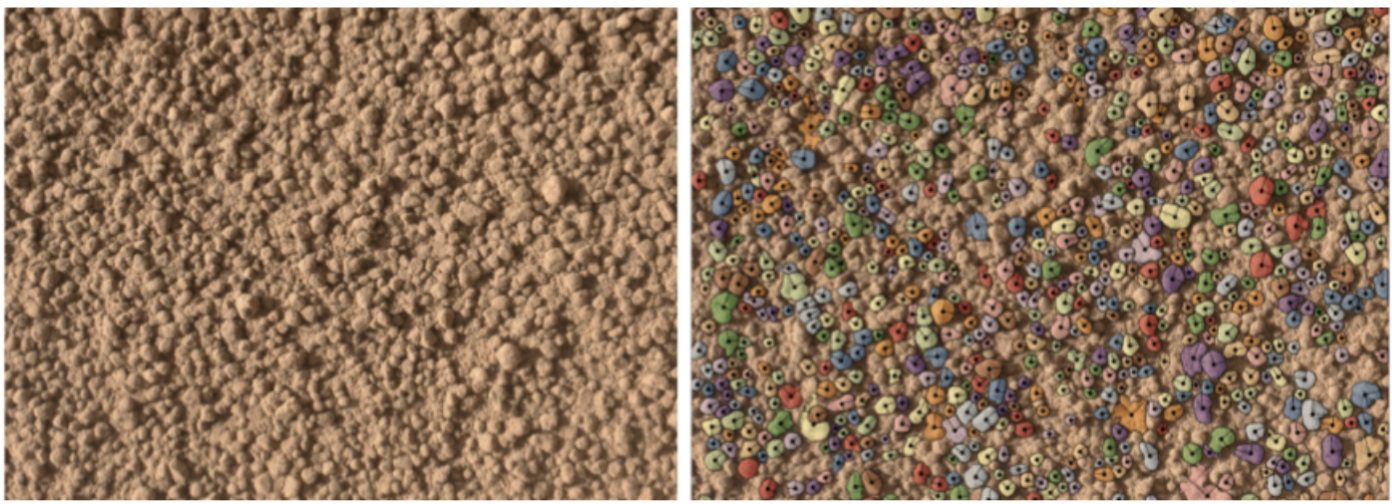
Introduction:

Rovers have traversed over 100 kilometers of the Martian surface, assembling an expansive archive of over one million high-quality imagery of sedimentary features in diverse geologic settings.1 These images record fine sediment grains (0.5-2 mm in diameter) shaped by their billions of years of surface processes. Studying grain morphology offers insight into sediments’ origins and deposition, crucial to reconstruct regional climatic histories.2

Grain size and form indicate transport history and paleo-depositional environments, making them fundamental expressions of Mars’ climatic and hydrological evolution.3,4 While previous studies classify individual rock outcrops along the rovers’ traverses, broader questions about sedimentary grain variability across the Martian surface remain unanswered. This project addresses that gap by applying deep learning to quantify grain morphometry across rover imagery, enabling us to extrapolate a novel large-scale sedimentary analysis.

Data & Methods:

We assess imagery from NASA’s Spirit, Opportunity, Curiosity, and Perseverance rovers which are each equipped with optical cameras meant for geologic investigation. The rovers have collectively returned across more than 13,000 sols that capture a wide range of morphological features including volcanic, aeolian, lacustrine, deltaic, and fluvial systems.3,4 We classified grains using five widely-accepted metrics in Martian sedimentology: grain size distribution (D50, D84), axial ratio (Ra), circularity (IR), convexity (C), and roundness (P).4,5,6,7 These characteristics allow us to infer transport histories, and determine environments—alluvial fan/fluvial, deltaic, lacustrine, aeolian, and crater floor/wall deposits.

To automate grain form identification, we use a deep learning image segmentation model and high-quality unobstructed images from NASA’s Planetary Data Sciences Imaging node.8 Our work builds on the precedent of other domain-adapted deep learning models on Mars9 but shifts the focus to finer geologic units. We adapted the Segment Anything Model (SAM2), a vision transformer by Meta AI  Research that uses global self-attention to contextualize local features and perform general-purpose segmentation.10 Unlike conventional convolutional neural networks, SAM2 is adept in complex, cluttered scenes, ideal for Martian surface imagery, and pixel-level segmentation is possible without retraining the model extensively. This circumvents the need for densely labeled training data, the likes of which do not exist for Martian sediments, and helps enable flexible, semi-supervised or even unsupervised workflows that can still produce geologically meaningful outputs. This significantly lowers the barrier to entry for planetary-scale sediment analysis and allows us to scale insights without exhaustive manual input.

We further adapted SAM2 using a transfer learning strategy, drawing upon Segment Every Grain, an open-source Earth-based framework that applies SAM2 to cobble-sized sediment segmentation.11 We retrain the model on a subset of annotated rover imagery, enabling us to specialize the model according to the Martian surface. Reliably detected grains’ morphometric features can then be recorded, and linked to metadata about rover location and image characteristics to populate datasets for spatial and temporal analyses. 

Results & Discussion:

By automating grain-scale segmentation, we anticipate a large-volume dataset that allows us to compare sediment characteristics across diverse Martian terrains and enables large-scale sediment provenance and transport studies that are otherwise infeasible via manual analysis. Our preliminary results suggest that SAM2 is effective in the identification of grains: the figure below demonstrates an image of Martian sediment and the identification of grains within the image that are then classified according to morphometric qualities. 

Figure 1: Left demonstrates the image before segmentation, showing a dense cluster of pebble-sized clasts. The right panel demonstrates several correctly-identified grains from which morphometric quantities were extracted using SAM2.

Anticipated results include a novel geospatial distribution of styles of grain processing and their correlations to inferred depositional systems. This opens new frontiers for regional climatic reconstructions in a new light. Beyond Mars, this work contributes broadly to planetary science, sedimentology, and machine vision. Such automated grain-scale analysis could be extended to other planetary bodies. Likewise, the methodology could help advance Earth-based geoscience, including fluvial transport modeling, coastal erosion studies, and landslide prediction.3 All code, models, and processed datasets from this project will be made open-source to support future research and maximize scientific return from planetary imagery, encouraging community-driven development. 

References: 

[1] Rice, M. S., et al. (2017), Geologic overview of the Mars Science Laboratory rover mission at the Kimberley, Gale crater, Mars, J. Geophys. Res. Planets, 122, 2–20.

[2] Wadell, H. (1932). Volume, Shape, and Roundness of Rock Particles. The Journal of Geology, 40(5), 443–451. 

[3] Attal, M., and J. Lavé (2009), Pebble abrasion during fluvial transport: Experimental results and implications for the evolution of the sediment load along rivers, J. Geophys. Res., 114, F04023.

[4] Szabó, T., Domokos, G., Grotzinger, J., et al (2015), Reconstructing the transport history of pebbles on Mars. Nat Commun 6, 8366.

[5] Yingst, R. A., et al. (2013), Characteristics of pebble- and cobble-sized clasts along the Curiosity rover traverse from Bradbury Landing to Rocknest, J. Geophys. Res. Planets, 118, 2361–2380.

[6] Palucis, M. C., W. E. Dietrich, A. G. Hayes, R. M. E. Williams, S. Gupta, N. Mangold, H. Newsom, C. Hardgrove, F. Calef III, and D. Y. Sumner (2014), The origin and evolution of the Peace Vallis fan system that drains to the Curiosity landing area, Gale Crater, Mars, J. Geophys. Res. Planets, 119, 705–728.

[7] Gupta, S., & Farley, K. (2021). Mars 2020 Mission: Geology of Jezero crater and Outside Jezero and Sampling on a notional Mission Traverse Mars 2020 Mission Objectives, 1–30.

[8] NASA JPL and USGS. (2025). Rover Data Archives. PDS Cartography and Imaging Sciences Node.

[9] Panambur, T., and M. Parente (2025). Enhancing Martian Terrain Recognition with Deep Constrained Clustering, arXiv e-prints, 2503.17633. 

[10] Meta AI. (2023). SegmentAnything Model (SAM) 2 [Computer software]. 

[11] Sylvester, Z. (2024). segmenteverygrain (Version 0.2.1) [Computer software]. 

How to cite: Gandhi, S., Hayes, A., Krishna, M., Rogers, E., and Koeppel, A.: From Imagery to Insight: Machine Learning for Grain-Scale Sediment Analysis on Mars, EPSC-DPS Joint Meeting 2025, Helsinki, Finland, 7–13 Sep 2025, EPSC-DPS2025-1752, https://doi.org/10.5194/epsc-dps2025-1752, 2025.

EPSC-DPS2025-1775 | ECP | Posters | TP6 | OPC: evaluations required

Preliminary Feasibility Assessment of the Tumbleweed Rover Platform and Mission using the AU Planetary Environment Facility 

James Kingsnorth, Mário de Pinto Balsemão, Abhimanyu Shanbhag, Luka Pikulić, Jonathan Merrison, Jens Iversen, Cristina Moisuc, Morgan Peterson, and Julian Rothenbuchner
Thu, 11 Sep, 18:00–19:30 (EEST)   Finlandia Hall foyer | F45
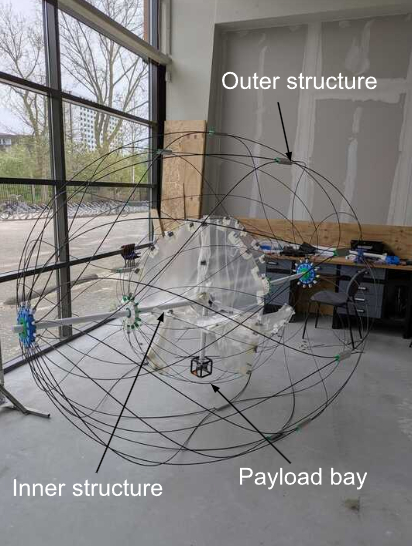
The Tumbleweed mission is novel, and its scientific value has been validated through years of research identifying knowledge gaps that can be addressed by the mission’s broad in-situ exploration capabilities on Mars [1]. The swarm-based mission of 5-meter-diameter spheroidal wind-driven tumbling rovers enables the collection of large spatio-temporal datasets covering large swaths of the planet, finally providing a terminal network of distributed sensors in the stationary phase of the mission [2]. This mission will bridge the gap between low-resolution orbiters and physically constrained wheeled rovers with a cost-efficient alternative.

The needs of planetary scientists, and the initial mission concept, have been verified over the last few years, with science and instrument requirements clearly stated for all relevant science cases ranging from mapping subsurface water ice with a miniaturised neutron spectrometer (currently in development) to prospecting surface geology with our suite of multispectral cameras [3]. 

At this juncture, the technical feasibility of the Tumbleweed rover needs to be proven, through demonstration of scientific data collection in static and dynamic configurations. Testing is essential to characterise the behaviour of the Tumbleweed rover in different terrain and conditions. This constitutes Phase A feasibility studies, wherein testing is intended to raise the Technology Readiness Level (TRL) from 3-4 to 5-6.

The Science Testbed -  a platform for research

To address this requirement, we constructed the Science Testbed: a scaled-down prototype of the Tumbleweed rover [4]. This development enables us to characterise the dynamic environments and noise that affect payloads on board a tumbling platform. The first iteration of the testbed is shown in Figure 1 and was tested in April 2025 in the ENCI Maastricht quarry, with a suite of simple Commercial off-the-shelf (COTS) sensors. Notably, the design of this half-scale terrestrial prototype enables decoupling the rolling outer structure from the stabilised inner structure for effective data collection.  

Figure 1: First iteration of the Science Testbed during development in the Delft (Netherlands) workshop.

Aarhus Planetary Environment Facility 

In July 2025, the second iteration of the Science Testbed was tested in the AU Planetary Environment Facility in Aarhus (Denmark), wherein the ‘dirty’ wind tunnel can replicate Martian surface conditions. The scaled-down spheroidal Tumbleweed rover was tested with a variety of controlled experiments studying rover mobility, aerodynamic behavior, dust transport and accumulation, locomotion efficiency and payload stability. Thus informing additional constraints for an internally developed physics-based simulation tool. This tool will enable advanced assessment of various mission design options with respect to scientific return, payload performance, locomotion and navigation risk, as well as operational feasibility. 

The tests in the Planetary Environment Facility were conducted according to the overarching objective of extracting meaningful information about the behavior and performance of the rover under Martian conditions. This can be decomposed into the following sub-objectives:

  • Analyse the fluid-structure interactions of the rover during Force-Balance tests varying wind speed and orientations of the rover
  • Analyse the impact of tumbling motion and varying environmental conditions on payload performance and instrument operations
  • Examine the impact of varying regolith roughness on rover movement and payload performance 
    • Determine the threshold wind velocity that initiates rolling of the rover
  • Understand dust mobilisation around the rover
    • Understand dust accumulation and electric field signatures during a traverse.
  • Understand the uncertainty in down-scaling the rover with respect to payload stability, rover dynamics and locomotion efficiency

The experiments were conducted in two parts - static and dynamic tests.

Static Tests

Force-Balance tests were performed to measure lift, drag, moment, and torque acting on the rover. Two variables were changed independently: the initial orientation of the rover and wind speed. The other tests were performed on our payload. COTS sensors were placed on the cryogenic cooling plate, reaching some of the coldest temperatures experienced on Mars (around -143 degrees Celsius), confirming the robustness of our atmospheric instrumentation such as pressure, temperature, soil permittivity and humidity sensors.

Dynamic Tests

The rover was propelled in a controlled manner from an initial stationary position to then traverse a predetermined distance along the chamber. The dynamic tests had miniaturised sensors onboard, notably a microphone, a camera, and a wind sensor to test their performance in varying terrain and atmospheric conditions.

Locomotion-based testing involved varying the underlying regolith to different surface roughnesses in order to understand the impact of regolith on the mode of transportation the rover takes (saltation or traction). Moreover, by varying the wind speed, the threshold wind speeds for rolling were determined for different surfaces. This was done by changing plates with glued sand grains of specific sizes. Larger morphological features such as sand ripples or dunes were also simulated.

Accelerated testing of the dust environment on Mars was done by injecting a high concentration of Martian simulant dust through the wind tunnel. The size of the dust particles varied from 1-10 micrometers and the gas density was kept constant. The accumulation of dust was measured by sticky traps being weighed after a traverse. These sticky traps were placed at various spots on the rover, including the payload bay. Possible extensions could include measurements of  triboelectrically charged dust at high wind speeds, using onboard electric field sensors. Measurement of electric fields in dust devils and dust storms is crucial for understanding dust adhesion in future surface-based missions. 

These findings advance the development of passively propelled and low‑cost robotic systems for distributed sensing in remote environments, while also providing critical insights into the dynamics of tumbling, wind‑driven platforms and the operational conditions their payloads encounter.

Future testing

Further field campaigns are planned, including a test in the Atacama Desert in November 2025 and a follow-up in Svalbard in early 2026 to validate Earth-based use-cases, particularly in atmospheric and radiation sciences.

Acknowledgements

We gratefully acknowledge the Europlanet Transnational Access (TA) scheme and the funding it provided, which made these tests possible. Our sincere thanks to the AU Planetary Environment Facility for their support.

References

[1] https://doi.org/10.5194/egusphere-egu24-20149, 2024. 

[2] Renoldner et al, IAC 2023.

[3] https://doi.org/10.5194/epsc2024-1103, 2024. 

[4] https://doi.org/10.5194/egusphere-egu25-18773, 2025.

How to cite: Kingsnorth, J., de Pinto Balsemão, M., Shanbhag, A., Pikulić, L., Merrison, J., Iversen, J., Moisuc, C., Peterson, M., and Rothenbuchner, J.: Preliminary Feasibility Assessment of the Tumbleweed Rover Platform and Mission using the AU Planetary Environment Facility, EPSC-DPS Joint Meeting 2025, Helsinki, Finland, 7–13 Sep 2025, EPSC-DPS2025-1775, https://doi.org/10.5194/epsc-dps2025-1775, 2025.

TP7 | Ionospheres of unmagnetized or weakly magnetized bodies

EPSC-DPS2025-214 | ECP | Posters | TP7

Statistical Study on the Solar Wind Turbulence Spectra upstream of Mars 

Zhuxuan Zou, Yuming Wang, and Zhenpeng Su
Mon, 08 Sep, 18:00–19:30 (EEST)   Finlandia Hall foyer | F62

We statistically analyze the power spectral density (PSD) of magnetic field turbulence in the upstream solar wind of the Martian bow shock by investigating the data from Tianwen-1 and MAVEN during November 13 and December 31, 2021. The spectral indices and break frequencies of these PSDs are automatically identified. According to the profiles of the PSDs, we find that they could be classified into three types: A, B and C. Only less than a quarter of the events exhibit characteristics similar to the 1 AU PSDs (Type A). We observe the energy injection in more than one-third of the events (Type B), and the injected energy usually results in the steeper spectral indices of the dissipation ranges. We find the absence of the dissipation range in over one third of the PSDs (Type C), which is likely due to the dissipation occurring at higher frequencies rather than proton cyclotron resonant frequencies. We also find that the two spacecraft observed different types of PSDs in more than half of the investigated episodes, indicating significant variability upstream of the Martian bow shock. For example, the Type-B PSDs are more often seen by Tianwen-1, which was near the flank of the bow shock, than by MAVEN near the nose. This statistical study demonstrates the complicated turbulent environment of the solar wind upstream of the Martian bow shock.

How to cite: Zou, Z., Wang, Y., and Su, Z.: Statistical Study on the Solar Wind Turbulence Spectra upstream of Mars, EPSC-DPS Joint Meeting 2025, Helsinki, Finland, 7–13 Sep 2025, EPSC-DPS2025-214, https://doi.org/10.5194/epsc-dps2025-214, 2025.

EPSC-DPS2025-572 | ECP | Posters | TP7 | OPC: evaluations required

Modeling the Martian Crustal Magnetic Field Using Data from MGS, MAVEN, and Tianwen-1 

Feng Wanqiu, Cheng Long, and Wang Yuming
Mon, 08 Sep, 18:00–19:30 (EEST)   Finlandia Hall foyer | F55
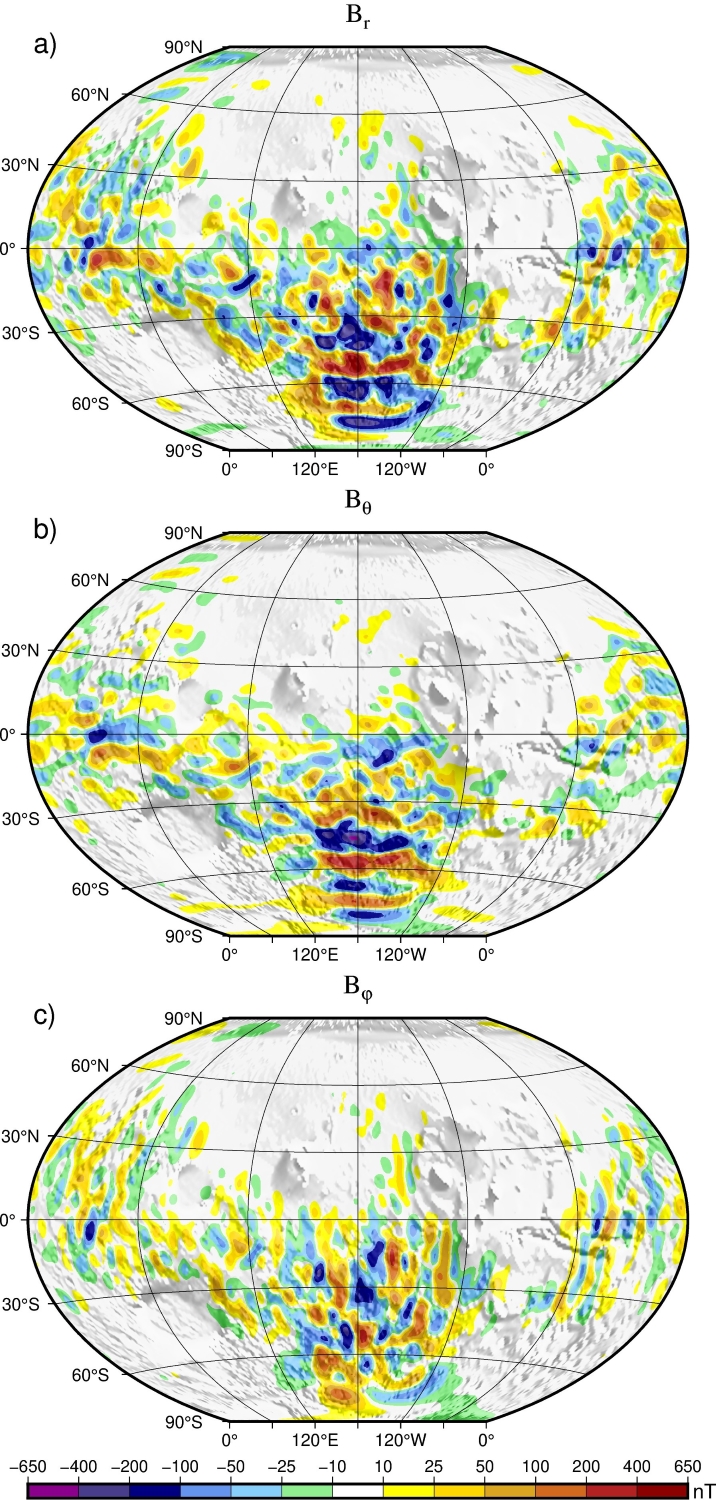
Introduction

Mars does not have a global dipole magnetic field as is the case for Earth, but it possesses localized remanent magnetic fields originating in the Martian lithosphere, which are universally accepted to have been generated by an ancient core dynamo. Satellite measurements over the past few decades have provided the necessary data for modeling these crustal fields. The most widely used crustal magnetic field models include the Equivalent Source Dipole (ESD) model and the Spherical Harmonic (SH) model.

Data Sets and Data Selection

Mars Global Surveyor (MGS) operated in Martian orbit from 1997 to 2006, providing magnetic field measurements during two distinct mission phases: the aerobraking and science phase orbit (AB/SPO, 1997-1999) with elliptical orbits, and the mapping phase orbit (MPO, 1999-2006) with near-circular orbits at approximately 400 km altitude. MAVEN (2014–present) and Tianwen-1 (2021–present) continue to operate in elliptical orbits, conducting magnetic field measurements at lower altitudes.

A key challenge in crustal field modeling is minimizing external field interference associated with solar wind interactions with Mars. Langlais et al. (2019) selected MPO datasets with minimal deviation from the mean to construct a preliminary model, and excluded MAVEN datasets with correlation coefficients below 0.4 when compared to the extrapolated field of the preliminary model. Gao et al. (2021) selected MAVEN datasets based on upstream solar wind conditions, retaining orbits when the mean interplanetary magnetic field (IMF) magnitude is below 2.6 nT. Since mean-based criteria for near-circular orbits are physically less reliable than upstream solar wind criteria for elliptical orbits, we decided to use only elliptical orbit data, refine the quiet-period identification method, and incorporate updated MAVEN and Tianwen-1 observations to develop a new crustal field model.

We utilized datasets from MGS during AB/SPO phase (1997-1999), MAVEN (2014-2024), and Tianwen-1 (2021-2023), with the following selection criteria applied to constrain the datasets:

  • The bow shock crossings of MAVEN from 2014 to 2022 were identified using the dataset provided by Wedlund et al. (2022), while those for other orbits were manually determined by examining magnetometer measurements. Quiet orbits were selected based on specific criteria: solar wind duration exceeding 0.5 hours, IMF strength below 3 nT, IMF fluctuation rate under 0.3 nT/s, electron density below 0.3 cm⁻³, and solar wind dynamic pressure below 6 nPa. For MGS and Tianwen-1, which lack electron density and dynamic pressure measurements, only the IMF criteria were applied. Only periapsis data from these quiet orbits were retained. Since the operational periods of MAVEN and Tianwen-1 overlap, if one spacecraft detected quiet solar wind conditions within a two-hour window, the periapsis data from the other spacecraft were also retained.
  • Due to greater solar wind interference on the dayside, we exclusively utilized data acquired below 350 km altitude on the dayside and below 500 km on the nightside.
  • A 60-second moving average was applied to suppress high-frequency noise.
  • Following the method described in Langlais et al. (2019) Appendix B, we performed data selection along orbits with increased sampling density in regions exhibiting strong magnetic field gradients or at lower altitudes.

Finally we obtained 0.38 million data points of the field vector, 10% for model assessment and 90% for model construction.

Model Results

In this study, we employ the ESD modeling approach, which imposes less stringent requirements on the spatial uniformity of datasets. Then we used the ESD-derived spatially uniform magnetic field data to construct an SH model, enabling extrapolation to the surface. The calculated field distributions are shown in Figure 1.

Figure 1. Maps of the Martian magnetic field calculated by our SH model at an altitude of 200 km. (a) Br, (b) Bθ , (c) Bφ .

The model performance was evaluated using residuals between the assessment dataset and model predictions. As shown in Figure 2, our model demonstrates superior fitting performance compared to previous studies, indicating that the methodological improvements have enhanced model quality.

Figure 2. Residual distribution of the Langlais et al. (2019) model, the Gao et al. (2021) model, and this model for the assessment datasets.(a) Br, (b) Bθ , (c) Bφ .

Subsequent research will further refine the solar wind selection parameters to enhance model performance, and will consider incorporating relevant studies on the Martian ionospheric current system to optimize the quiet data selection method.

How to cite: Wanqiu, F., Long, C., and Yuming, W.: Modeling the Martian Crustal Magnetic Field Using Data from MGS, MAVEN, and Tianwen-1, EPSC-DPS Joint Meeting 2025, Helsinki, Finland, 7–13 Sep 2025, EPSC-DPS2025-572, https://doi.org/10.5194/epsc-dps2025-572, 2025.

EPSC-DPS2025-832 | ECP | Posters | TP7 | OPC: evaluations required

Photoionization and photodissociation rates across a solar cycle  

Russell Mapaye and Luke Moore
Mon, 08 Sep, 18:00–19:30 (EEST)   Finlandia Hall foyer | F66

We calculate unattenuated photoionization and photodissociation rate coefficients using solar spectral irradiance (SSI) measurements from the TIMED/SEE mission (Woods et al., 2005) over a full solar cycle (2004–2014). These coefficients are parameterized by the solar activity index F₁₀.₇P, defined as F₁₀.₇P = ½(F₁₀.₇ + F₁₀.₇A), where F₁₀.₇ (10.7 cm solar radio flux) acts as a proxy for solar extreme ultraviolet (EUV) variability, and F₁₀.₇A represents its 81-day running average. Combining high-resolution (1 nm) SSI data with cross-sections from the PHIDRATES database (Huebner & Mukherjee 2015; http://phidrates.space.swri.edu/), we derive power-law relationships (j = A0[F₁₀.₇P]A1) for 48 reactions involving 12 species critical to Solar System atmospheres and cometary comae: H, H₂, OH, H₂O, O, O₂, C, CO, CO₂, N₂, N, and CH₄. 

Whereas prior estimates are limited to a subset of solar conditions (e.g., solar minimum or maximum), the photo rate coefficients derived here are broadly consistent with those results while extending them to span the full range of solar activity. This work establishes an efficient, observational approach to estimate photoionization rates requiring access to SSI or cross-section data. By utilizing F₁₀.₇P, a widely available and historical solar proxy, the power laws allow for easier modeling of atmospheric and cometary chemistry under diverse solar conditions. Applications include simulating tenuous exospheres (e.g., Mercury, Moon) and analyzing in situ data from outer planets and comets. The method is anchored in publicly accessible PHIDRATES cross-sections and TIMED/SEE SSI records (http://lasp.colorado.edu/home/see/data/daily-averages/level-3), ensuring utility for a variety of studies. Future work will address uncertainties for resolution-sensitive reactions and expand the species/reaction inventory, advancing our capacity to model solar-driven photochemistry throughout the Solar System.


How to cite: Mapaye, R. and Moore, L.: Photoionization and photodissociation rates across a solar cycle , EPSC-DPS Joint Meeting 2025, Helsinki, Finland, 7–13 Sep 2025, EPSC-DPS2025-832, https://doi.org/10.5194/epsc-dps2025-832, 2025.

TP8 | The Multi-Scale Physics of Surface-Bounded Exosphere and Surface Interactions

EPSC-DPS2025-748 | Posters | TP8 | OPC: evaluations required

Atomic Scale Modelling of Icy Surfaces: A Best Practice for Validating Interatomic Potentials and Ice Substrates in Extreme Environments 

Vikentiy Pashuk, Liam Morrissey, Ivan Saika-Voivod, and Rocky Taylor
Mon, 08 Sep, 18:00–19:30 (EEST)   Finlandia Hall foyer | F74

Introduction: Several current and upcoming missions will be focusing on understanding the evolution of icy surfaces and their interaction with the exosphere. For example, Europa Clipper and JUICE aim to study the icy Moons of Jupiter [1], and ongoing work on the Moon and Mercury has identified the icy permanently shadowed regions as being of scientific and operational importance. However, while significant computational and laboratory research has been conducted on volatile interactions with silicate surfaces, there is comparatively less work on icy surfaces. Understanding the interaction of icy surfaces with the space environment on these bodies is necessary for interpreting much of the upcoming observation data. For example, binding energies and diffusion characteristics of volatiles on icy surfaces can be incorporated into exospheric models to better understand the exosphere formation. While experiments are costly and time-consuming, molecular dynamics (MD) offers a theoretical alternative by simulating the behavior of atoms in extreme environments. It has proven valuable in understanding surface diffusion and surface binding energies of key volatiles on silicate surfaces [2,3]. These approaches commonly use reactive interatomic potentials (ReaxFF) that are capable of modelling dynamic bond breaking and reformation found during chemical reactions. However, while ReaxFF potentials have been well studied and validated for silicates they remain relatively untested for the conditions and compositions relevant to icy bodies. A validation of available interatomic potentials (IPs) for ice is needed before we can apply these MD-methods to exosphere modelling.

Here, we aim to validate ReaxFF for icy surfaces by comparing the mechanical properties of ice to a standard, and well validated, water-based potential called TIP4P/Ice (that cannot model chemical reactions) and available experimental results to help build a computational and methodological framework for future surface studies. We perform MD simulations of crystalline and amorphous water-ice and focus on validating against diffusion, Youngs Modulus (EY), isothermal compressibility (kT), and density (ρ).

Methodology: We have studied crystalline and amorphous ice at 25 K, 100 K, and 264 K, the first two temperatures due to the relevance in shadowed craters on the Moon and Mercury and the latter for comparison against experiment. Crystalline proton disordered, non-polar, 1h ice was first created using GenIce. Amorphous ice was then made by melting the crystalline structure at 360 K and then equilibrating at 264 K while for lower temperatures for the amorphous ice was equilibrated at 245 K before quenching to 25 K and 100 K with rates ranging from 80 ns to 80 ps. Following the work by Baran et al. [4], we calculated the diffusion of Oxygen in amorphous ice as a function of temperature for 40 ns in a constant volume and temperature ensemble. For the EY the crystalline and amorphous substrates we produced stress-strain curves using a minimum strain rate [5]. Finally, the isothermal compressibility was computed from volume variations.

Results: First, we demonstrate a notable methodological advancement by validating the ability to convert equilibrated ice structures from TIP4P/Ice to ReaxFF formats. This allows researchers to leverage the faster TIP4P/Ice for equilibration of the surface and then switch to the more computationally intensive ReaxFF potential for the chemically reactive simulations that will be found during volatile interactions.

Due to limited experimental data, the EY of the two IPs was only compared to experimental data at 264 K [6]. For both IPs there was strong agreement when compared to experiment, a 5.2% and 5.6% difference for TIP4P/Ice and ReaxFF potentials respectively. As temperature increases from 25 K to 264 K, we found that the difference in EY between the two potentials decreased from 23% to 0.3%, suggesting that at temperatures below melting ReaxFF is well optimized. When comparing amorphous to crystalline ice, we found that the EY is lower by ~50% for ReaxFF for both 25 K and 100 K cases whereas for TIP4P/Ice the EY decreases by 28% and 42% for 25 and 100 K respectively. As expected at 264 K the sample is melted and has a Young Modulus of zero. The EY values for amorphous ice were found to increase with increasing the quenching time. The third ReaxFF potential showed similar trends but was more diffusive translating to a higher melting point and lower EY.

The calculated diffusion values for both tested IPs compared well to previous simulations that used TIP4P/Ice [4]. Isothermal compressibility for both potentials is consistent with each other but is underestimated compared to previous studies [7]. Density falls within expected ranges for both crystalline, 0.88 < ρ < 0.94, and amorphous ice, 1.05 < ρ < 1.16.

Conclusion: We tested ReaxFF potentials for key properties of icy surfaces and suggest a new validation methodological approach for future simulations. Hence, we provided a clear framework that can be reliably applied by other researchers to assess new and emerging potentials relevant to space applications. This advancement not only ensures accurate simulation of mechanical behavior of ice but also opens pathways for further exploration into icy surface chemistry. This study lays the groundwork for accelerating our understand of surface exosphere connections on icy bodies.

[1] Magnanini et al. (2024) Astronomy & Astrophysics 687 A132. [2] Morrissey, et al. (2022) Icarus, vol. 379, article no. 114979. [3] Morrissey, et al. (2022) The Astrophysical Jounral Letters 925. [4] Baran et al (2023) J. Chem. Phys. 158 (6): 064503. [5] Santos-Flórez, et al. (2018) The Journal of Chemical Physics 149.16. [6] Schulson. (1999) Jom 51 21-27. [7] Neumeier. (2018) J. Phys. Chem. 47 (3).

How to cite: Pashuk, V., Morrissey, L., Saika-Voivod, I., and Taylor, R.: Atomic Scale Modelling of Icy Surfaces: A Best Practice for Validating Interatomic Potentials and Ice Substrates in Extreme Environments, EPSC-DPS Joint Meeting 2025, Helsinki, Finland, 7–13 Sep 2025, EPSC-DPS2025-748, https://doi.org/10.5194/epsc-dps2025-748, 2025.

EPSC-DPS2025-1193 | ECP | Posters | TP8 | OPC: evaluations required

Solar Wind-Induced Sputtering: Investigating Anisotropy in the Angular Distribution of Ejecta using SDTrimSP 

Ben Clouter-Gergen, Liam Morrissey, Caxia Bu, Andreas Mutzke, Sébastien Verkercke, and Daniel Savin
Mon, 08 Sep, 18:00–19:30 (EEST)   Finlandia Hall foyer | F75
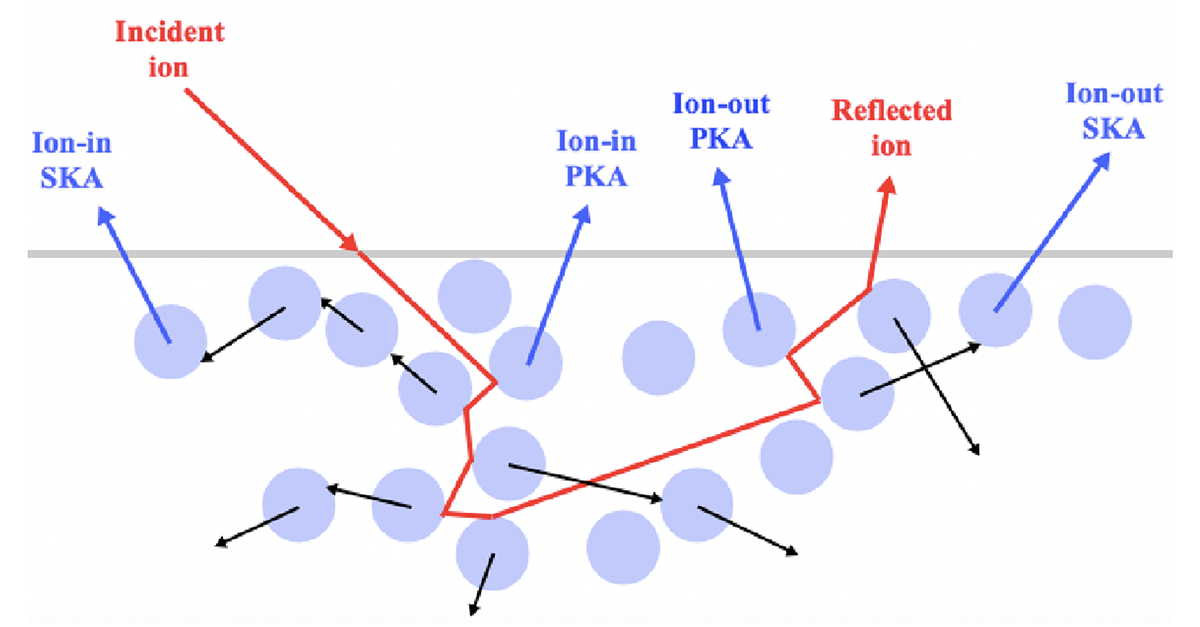
Introduction

Sputtering in planetary science occurs as the solar-wind (SW)—a stream of energetic ions emitted from the Sun—impacts an airless body, ejecting atoms from its surface [1,2]. This process alongside micrometeorite impacts, photo-stimulated desorption, and thermal desorption contribute to the formation of planets’ exospheres [3–5]. While various spacecraft can detect exospheric species such as MESSENGER, BepiColombo, LADEE, and CHACE-2, they cannot discern the respective contributions of the mentioned processes and thus a strong theoretical understanding of sputtering is needed to quantify its influence on the exosphere [6–9].

The sputtering yield is well-studied. In contrast, the angular distribution of ejecta has been given significantly less attention, its treatment being particularly sparse in cases relevant to planetary science. As such, sputtering models that consider the angular distribution of ejecta often assume isotropy. Here, we present a theoretical study quantifying anisotropy in the angular distribution of ejecta for SW-induced sputtering cases, helping advance the understanding of sputtering’s contribution to exosphere formation. Further, we compare the results to a common experimental case since experiments often employ heavier, higher energy ions to leverage the enhanced mass detection consequent of a greater sputter yield. These experimental results must then be scaled to inform SW-induced sputtering and, as such, unique behaviors occurring for lower mass impactor cases may be overlooked. Finally, following quantification, we consider the relative contributions from four ejecta-types demonstrated in Fig. 1, an approach enabling us to understand the underlying behavior leading to anisotropy differences between the different cases considered.


Fig. 1: An incident ion (red) impacts a target, collides with atoms within, and exits as a reflected ion, triggering four ejecta-types in the process (blue), from left to right: ion-in SKAs, ion-in PKAs, ion-out PKAs, and ion-out SKAs.

Methodology

To simulate sputtering, we utilized the software SDTrimSP which follows the binary collision approximation (BCA) model where sputtering occurs through a sequence of independent collisions within a material prior to the ejection of an atom [1,2]. While both electronic and collisional effects occur in the sputtering process, the latter dominate at energies below 100keV amu-1 and thus we consider collisional sputtering exclusively [2].

We selected 1 keV ionized Hydrogen (H+) and 4 keV ionized Helium (He++) to emulate the SW, while 20 keV ionized Krypton (Kr+) was employed given its prevalence in experimental studies. For the target surface, silica (SiO2) was selected given its prominence in both the lunar and Mercurian surfaces and recurrent usage in experiments [10–12]. We simulated ion incidence angles between 0° and 85° (measured from the surface normal) while ejecta were interpreted as a function of polar and azimuthal angles, ranging from 0° to 90° and 0° to 180°, respectively. The scenario is illustrated in Fig. 2.


Fig. 2: An incident ion impacts a target substrate at an incidence angle, θi, sputtering an atom as a function of polar (θs) and azimuthal (φs) angles within the depicted quarter-sphere.

Results

Forward-backward anisotropy exists when a greater percentage of atoms are sputtered at azimuthal angles between 0° and 90° than 90° and 180°. While the azimuthal distribution of ejecta is isotropic at normal incidence, anisotropy emerges as the ion incidence angle is varied. Noticeable differences in anisotropies between ion cases arise as the ion’s incidence angle is made increasingly oblique, forward-backward anisotropy becoming most pronounced in the H+ case while developing more modestly in the He++ and Kr+ cases. Alternatively, to assess anisotropy in the polar distribution of ejecta we consider anisotropy occurring as a greater percentage of atoms are sputtered between 0° and 45° (“low” angles) than 45° and 90° (“high” angles). At normal incidence, low-angle anisotropy is prominent in all cases. With increasing incidence angle, the polar distribution of ejecta becomes more isotropic in the H+ case, slightly more anisotropic in the He++ case, while remaining relatively steady in the Kr+ case.

The divergence in the anisotropies witnessed in the H+ case from those occurring in the other two impactor cases considered can be explained by an interplay between the percentage contribution of specific ejecta-types and the extent to which they are forward and low-angle pronounced. On the one hand, the ejecta-types most readily sputtered forward and at high-angles are generally most prominent in the H+ case and on the other, individual ejecta-types in the H+ case typically have higher forward and lower low-angle sputtering percentages than those in the He++ and Kr+ cases.

Concluding Statement

The findings demonstrate that sputtering anisotropy varies significantly depending on the ion-target case considered. While anisotropies in the He++ and Kr+ cases are similar, there are clear differences in the case of H+ bombarding SiO2. Experimental cases using increased energies and masses are, therefore, likely underestimating the degree to which forward-backward anisotropy is present in SW-induced sputtering cases, while overestimating the extent of anisotropy in the polar distribution of ejecta. Accounting for these effects is essential when scaling experimental results to inform planetary sputtering.

How to cite: Clouter-Gergen, B., Morrissey, L., Bu, C., Mutzke, A., Verkercke, S., and Savin, D.: Solar Wind-Induced Sputtering: Investigating Anisotropy in the Angular Distribution of Ejecta using SDTrimSP, EPSC-DPS Joint Meeting 2025, Helsinki, Finland, 7–13 Sep 2025, EPSC-DPS2025-1193, https://doi.org/10.5194/epsc-dps2025-1193, 2025.

EPSC-DPS2025-1690 | ECP | Posters | TP8

Understanding the energy spectra of scattered solar wind ions using low energy ion scattering 

Johannes Brötzner, Matthias Kogler, Lukas Kalchgruber, Paul Stefan Szabo, Andreas Nenning, Andreas Mutzke, Hans Hofsäss, Markus Valtiner, and Richard Arthur Wilhelm
Mon, 08 Sep, 18:00–19:30 (EEST)   Finlandia Hall foyer | F71

The solar wind, a stream of charged particles from the Sun, interacts with planetary bodies in a variety of ways. One such interaction is the reflection of solar wind ions from regolith surfaces where particles may be scattered as ions or undergo neutralisation processes, leading to the formation of energetic neutral atoms (ENAs). In either case, the scattered particles can in turn be observed by space missions providing valuable insight on the space weathering of rocky bodies and the interaction of their surfaces with the solar wind. Such information is available for, e.g., the reflection of protons at the Moon [1] or Phobos [2,3].

Similarly, the scattering of light ions off sample surfaces, referred to as low energy ion scattering (LEIS), is a commonly used ion beam analysis technique. In LEIS, the energies of ions scattered into a certain detector geometry are recorded. In these energy spectra, the positions and heights of peaks are indicative of the chemical surface composition. Consequently, LEIS is usually employed to monitor composition changes during processes like material deposition, erosion or chemical reactions [4]. Conventional LEIS setups commonly use electrostatic analysers, and thus the neutralised fraction of projectiles is not accessible. Quantifying the neutralisation probability is therefore tedious and also not available in binary collision approximation (BCA) simulations like SDTrimSP [5]. Because however the physics behind the ion scattering processes is the same as in the space environment, LEIS experiments are an ideal tool to study the reflection of solar wind ions in a simplified, controlled laboratory setting.

In this study, we present measurements using He projectiles of energies ranging between 1 keV and 5 keV on samples prepared from the pyroxenoid wollastonite (CaSiO3). The samples were prepared as flat thin films on Si substrates such that in a first step, surface roughness or regolith-like porosity would not obfuscate our understanding of the underlying physical processes. While He is significantly less abundant in the solar wind than H, it is chemically inert and thus simplifies interpretation of the results. The Ca in the sample facilitates a greater relative mass difference to the projectile and therefore a better separation from the low-energy background compared to using silicates containing lighter elements, like Na or Mg. The experiments were carried out using a commercial LEIS setup (ionTOF Qtac) with an electrostatic analyser. Additionally, we performed BCA simulations with the codes SDTrimSP and IMINTDYN [6]. Using the former, we can model the surface composition changes during sputter cleaning of the sample, while the latter is capable of calculating the resulting LEIS spectra under consideration of the actual experimental geometry, ignoring however the charge state of the scattered ions. A key feature of IMINTDYN is further that it can separate the spectra into contributions from ions that scattered once, twice or multiple times, as well as by the sample species at which the scattering event took place.

Using this combined experimental and numerical approach, we find that the multiple scattering contribution from deeper sample layers is suppressed by roughly an order of magnitude compared to single and double scattering events. Furthermore, since the simulations consider all scattered particles as neutral, while the analyzer detects only ions, comparison of the two allows for estimation of the charge fraction of scattered projectiles. This capability to assess the ion-to-neutral ratio is highly relevant for ENA studies and goes beyond what is accessible with conventional BCA simulations alone.

[1] C. Lue et al., J. Geophys. Res. Space Phys. 123 (2018) 5289–5299.
[2] Y. Futaana et al., J. Geophys. Res. Space Phys. 115 (2010), A10213.
[3] Y. Futaana et al., J. Geophys. Res. Planets 126 (2021) e2021JE006969.
[4] H.H. Brongersma et al., Surf. Sci. Rep. 62 (2007) 63–109.
[5] A. Mutzke et al., IPP Report (2019).
[6] H. Hofsäss, A. Stegmaier, Nucl. Instrum. Methods Phys. Res. B 517 (2022) 49–62.


How to cite: Brötzner, J., Kogler, M., Kalchgruber, L., Szabo, P. S., Nenning, A., Mutzke, A., Hofsäss, H., Valtiner, M., and Wilhelm, R. A.: Understanding the energy spectra of scattered solar wind ions using low energy ion scattering, EPSC-DPS Joint Meeting 2025, Helsinki, Finland, 7–13 Sep 2025, EPSC-DPS2025-1690, https://doi.org/10.5194/epsc-dps2025-1690, 2025.

TP9 | On the Quest to Solve Mercury's Secrets

EPSC-DPS2025-256 | ECP | Posters | TP9

Deep learning map of fresh crater ejecta on Mercury: a resource for space weathering studies 

Michele Lissoni, Alain Doressoundiram, and Sebastien Besse
Thu, 11 Sep, 18:00–19:30 (EEST)   Finlandia Hall foyer | F60

Space weathering (SpWe), the physical and chemical alteration of planetary surfaces due to exposure to the space environment, and namely to micrometeorite impacts and solar wind particles, is the primary process that continues nowadays to modify the surface of Mercury. The effects of SpWe include the amorphization of regolith grains, the chemical reduction of the surface leading namely to the transformation of ferrous oxide (FeO) into nanophase particles of elemental iron, and the darkening and reddening of the surface’s visible and near-infrared reflectance spectrum (Domingue et al. 2014).

These effects have however been ascertained primarily through the study of lunar samples and it is unclear to what degree they can be generalized to Mercury. The planet’s proximity to the Sun suggests that SpWe should be more intense, an assumption borne out by the absence of the FeO 1 µm absorption band, which implies that most FeO has already been converted to nanophase iron (Izenberg et al. 2014). If that were so, however, SpWe should have reached saturation across the planet (Leon-Dasi et al. 2025). This is clearly not the case, as demonstrated by the prominent presence of high-albedo terrains with a low degree of weathering, mostly associated with recent impact craters and their ejecta. Furthermore, intense SpWe is supposed to deplete volatile elements in the planetary surface, but these have been observed to persist on Mercury (Weider et al. 2012). Mercury’s magnetic field, finally, might influence SpWe by regulating the solar wind particle flux to the surface (Lavorenti et al. 2023). However, no correspondence has so far been found between the expected particle fluxes and the surface’s spectral properties.

In order to investigate these questions, we have focused on the ejecta of recent impact craters. Distinguished by their higher albedo, these are the most widespread surfaces where SpWe can be confidently said not to have reached saturation. A comparison between their spectra and those of more weathered terrains could thus provide information on the effect of SpWe and make it possible to develop a reliable quantitative SpWe spectral indicator. Furthermore, comparing ejecta spectra from the same crater, which have the same age, but in different locations could reveal SpWe spatial patterns across Mercury. Finally, comparing ejecta spectra from different craters could provide information on the age of said craters.

Unfortunately, crater ejecta on Mercury have not so far been systematically mapped. Mercury quadrangle maps (Galluzzi et al. 2016) contain a partial map, but they are not yet complete and crater ejecta have been mapped unevenly across them. We have thus created a more complete map through deep learning. We trained a convolutional neural network model for semantic segmentation on multi-band images of Mercury’s surface produced by the MDIS/WAC instrument of the MESSENGER mission, having classified the crater ejecta in these images either manually or by using the quadrangle maps. We then used this neural network to produce a planet-wide map of crater ejecta. We then built a second deep learning tool that assigned the ejecta to their progenitor crater, on the basis of the ejecta shape and orientation.

We present the resulting ejecta map, a valuable resource for SpWe studies. It will now be possible to systematically retrieve the spectra of ejecta measured by the MESSENGER MASCS/VIRS hyperspectral instrument. The ejecta map could also prove useful to reconstruct the dynamics of the progenitor impacts and perhaps even the characteristics of the impactors. The deep learning tools we have developed could furthermore help map crater ejecta on the Moon or on other bodies.


References

Domingue et al., 2014, Space Science Reviews, 181, 121-214.

Izenberg et al., 2014, Icarus, 228, 364-374.

Galluzzi et al. 2016, Journal of Maps, 12(sup1), 227-238.

Lavorenti et al., 2023, PSJ, 4(9), 163.

Leon-Dasi et al., 2025, Icarus, 429, 116421.

Weider et al., 2012, JGR: Planets, 117(E12).

How to cite: Lissoni, M., Doressoundiram, A., and Besse, S.: Deep learning map of fresh crater ejecta on Mercury: a resource for space weathering studies, EPSC-DPS Joint Meeting 2025, Helsinki, Finland, 7–13 Sep 2025, EPSC-DPS2025-256, https://doi.org/10.5194/epsc-dps2025-256, 2025.

EPSC-DPS2025-687 | ECP | Posters | TP9

Status Update on Strofio: Recovery and Performance Advancements Post-Launch Anomaly 

Jared Schroeder, Stefano Livi, and Frederic Allegrini
Thu, 11 Sep, 18:00–19:30 (EEST)   Finlandia Hall foyer | F62

The Strofio neutral mass spectrometer, part of the SERENA suite aboard BepiColombo, experienced a launch anomaly that left one of its electrodes (D5) permanently shorted to ground (0 V). Following an extensive diagnostic and testing campaign, we report major progress in recovering and even enhancing Strofio's operational capabilities despite this hardware limitation. In particular, molecular beam testing conducted in February 2025 led to the discovery of a new operational configuration that restores full mass range coverage (3–64 amu) with excellent mass resolution (m/Δm > 100 at mass 40). This configuration overcomes the constraints imposed by the D5 anomaly but requires alternating between two distinct modes to resolve the H and H₂ peaks (masses 1 and 2), mitigating spectral overlap effects inherent to Strofio’s rotating field time-of-flight technique. We present the updated operational parameters, validate the instrument’s performance under this new mode, and discuss the planned cross-calibration with other instruments in the SERENA suite to ensure data consistency. These advancements represent a significant restoration of Strofio's scientific capabilities and position the instrument to deliver high-quality compositional data during BepiColombo’s orbital mission at Mercury.

How to cite: Schroeder, J., Livi, S., and Allegrini, F.: Status Update on Strofio: Recovery and Performance Advancements Post-Launch Anomaly, EPSC-DPS Joint Meeting 2025, Helsinki, Finland, 7–13 Sep 2025, EPSC-DPS2025-687, https://doi.org/10.5194/epsc-dps2025-687, 2025.

EPSC-DPS2025-712 | ECP | Posters | TP9

Assessment of Cosmic-Ray-Induced Space Weathering on Mercury’s Surface Using Geant4 Simulations 

Gaku Kinoshita
Thu, 11 Sep, 18:00–19:30 (EEST)   Finlandia Hall foyer | F61
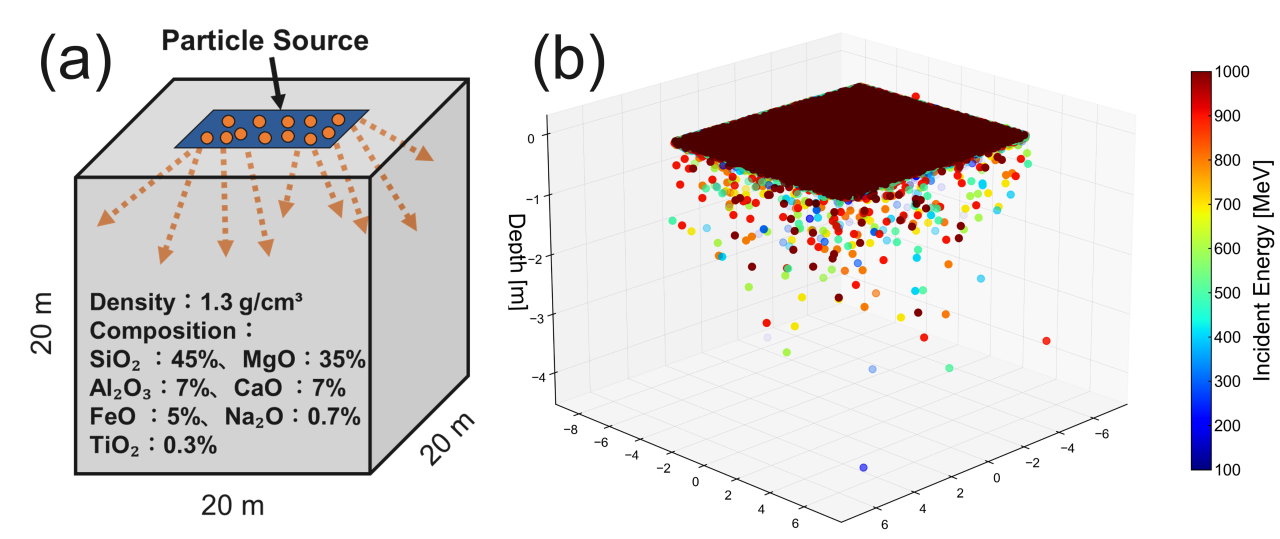
Understanding Mercury's evolution requires disentangling the effects of space weathering from remote sensing observations of the planetary surface. Space weathering processes fall into two broad categories: (i) stochastic micrometeoroid impacts and (ii) radiation effects from the solar wind and galactic cosmic rays (GCRs) (Mesick et al., 2018). This study focuses on the latter and aims to quantitatively evaluate GCR-induced space weathering using Geant4 radiation transport simulations (Allison et al., 2016).

GCRs consist mainly of protons with energies ranging from several hundred MeV to several GeV, originating from outside the solar system and accelerated by supernova explosions (Simpson, 1983). Previous work by Gurtner et al. (2004) explored GCR interactions with Mercury’s surface using Geant4, but relied heavily on assumptions due to limited observational data from Mariner 10. With the advancements brought by MESSENGER and BepiColombo, a reassessment based on updated environmental and surface composition data is now necessary.

This study addresses two main objectives: (1) characterization of the near-Mercury GCR environment based on models and observations, and (2) simulation-based estimation of energy deposition by cosmic-ray protons into Mercury’s surface. For (1), we assessed the effect of Mercury’s magnetosphere on GCR penetration using the KT17 magnetic field model (Korth et al., 2017). We calculated Larmor radii and particle rigidity to estimate the shielding effect. We also analyzed high-energy particle data from the “SPM” radiation housekeeping monitor (Kinoshita et al., 2025) onboard BepiColombo/MMO (Murakami et al., 2020). The SPM continuously observes galactic cosmic rays (GCRs) during BepiColombo’s cruise phase; in this study, we focus on measurements obtained during the Mercury swing-by.

For (2), we constructed a model of Mercury-analog material in Geant4 and simulated incident proton trajectories (see Fig. 1). We recorded parameters such as incident energy, deposited energy, angle of incidence, and maximum penetration depth to examine their interdependencies. These results provide key insights for interpreting upcoming observations of Mercury’s surface by X-ray, gamma-ray, and neutron spectrometers following BepiColombo’s orbital insertion at the end of 2026.

Figure 1. (a) Mercury surface simulant constructed in the Geant4 model environment. (b) Relationship between the incident energy of protons and their penetration depth into the simulated surface. (This is a preliminary result; future work will further refine simulation settings.)

References

[1] Allison, J., Amako, K., Apostolakis, J., Arce, P., Asai, M., Aso, T., et al. (2016). Recent developments in Geant4. Nuclear Instruments and Methods in Physics Research Section A: Accelerators, Spectrometers, Detectors and Associated Equipment, 835, 186–225. https://doi.org/10.1016/j.nima.2016.06.125

[2] Gurtner, M., Desorgher, L., Flückiger, E. O., & Moser, M. R. (2006). A Geant4 application to simulate the interaction of space radiation with the Mercurian environment. Advances in Space Research, 37(9), 1759–1763.

[3] Kinoshita, G., Ueno, H., Murakami, G., Pinto, M., Yoshioka, K., & Miyoshi, Y. (2025). Simulation for the calibration of radiation housekeeping monitor onboard BepiColombo/MMO and application to the inner heliosphere exploration. Journal of Geophysical Research: Space Physics, 130, e2024JA033147. https://doi.org/10.1029/2024JA033147

[4] Korth, H., Johnson, C. L., Philpott, L., Tsyganenko, N. A., & Anderson, B. J. (2017). A dynamic model of Mercury’s magnetospheric magnetic field. Geophysical Research Letters, 44, 10,147–10,154. https://doi.org/10.1002/2017GL074699

[5] Mesick, K. E., Feldman, W. C., Coupland, D. D. S., & Stonehill, L. C. (2018). Benchmarking Geant4 for simulating galactic cosmic ray interactions within planetary bodies. Earth and Space Science, 5, 324–338. https://doi.org/10.1029/2018EA000400

[6] Murakami, G., Hiroyuki, O., Shoya, M., Taeko, S., Yasumasa, K., Yoshifumi, S., et al. (2020). Mio—First comprehensive exploration of Mercury’s space environment: Mission overview. Space Science Reviews, 216(7), 113. https://doi.org/10.1007/s11214‐020‐00733‐3

[7] Pieters, C. M., & Noble, S. K. (2016). Space weathering on airless bodies. Journal of Geophysical Research: Planets, 121, 1865–1884. https://doi.org/10.1002/2016JE005128

How to cite: Kinoshita, G.: Assessment of Cosmic-Ray-Induced Space Weathering on Mercury’s Surface Using Geant4 Simulations, EPSC-DPS Joint Meeting 2025, Helsinki, Finland, 7–13 Sep 2025, EPSC-DPS2025-712, https://doi.org/10.5194/epsc-dps2025-712, 2025.

EPSC-DPS2025-1361 | Posters | TP9

Mercury surface UV-Vis-NIR spectral reflectance: Role of Graphite 

Giorgia Incaminato, Mikko Vuori, Antti Penttilä, Cristian Carli, Alessandro Maturilli, Anna Galiano, Laeticia Petit, Nirajan Ojha, Khaldoon Nasser, Markku Vainio, and Karri Muinonen
Thu, 11 Sep, 18:00–19:30 (EEST)   Finlandia Hall foyer | F51
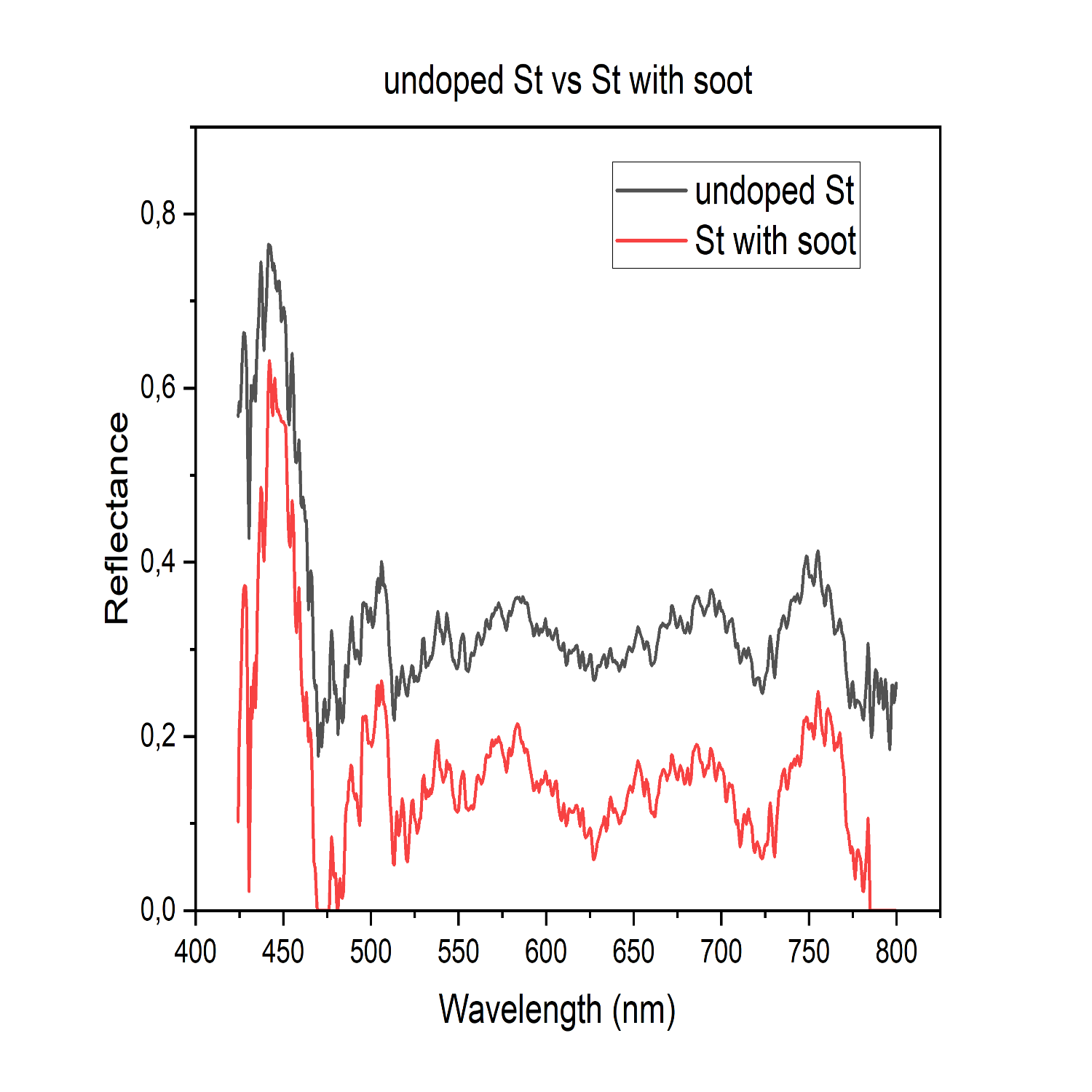
It is of crucial importance to gain a more profound comprehension of the evolution and formation of Mercury, one of the terrestrial planets in the Solar System. The absence of a significant atmosphere, temperature oscillations, and the continuous exposition to solar wind, result in Mercury surface being a mixture of crystalline and glassy materials (Wurz et al., 2025).

The particularity about the Mercury surface is that it has a remarkably low reflectance, but NASA’s MESSENGER mission did not detect the absorption band of iron in the NIR, implying the iron content on Mercury surface would be low compared to other dark planetary bodies (Syal et al. 2015). However, observations and modelling suggest that a darkening agent is needed to explain the low reflectance in the Vis-NIR spectra of Mercury surface. The agent is thought to be carbon, particularly in the form of graphite (Lark et al. 2023).

We proposed to test if introducing carbon would darken the Mercury surface analogue materials to the desired level. To investigate this, the material UV-Vis-NIR spectral reflectances were analysed. We prepared three types of samples: “St” glass externally mixed with soot (Figure 1), 90NaPO3-10NaF (mol%) glass (Figure 2), and komatiite (volcanic glass 12%, olivine 35%, clinopyroxene 15%, plagioclase 21%, spinel 9%, opaques 4%, and serpentine 3%) to which different amounts of graphite up to 7.5-wt% were added into the glass batch prior to the melting. Komatiite is recognized as a good analogue for the Mercury surface (Caminiti et al. 2024; Wieder et al. 2012). The phosphate glass was melted at 750°C, whereas komatiite was melted at 1600°C.

Analysis of the UV-Vis-NIR reflectance spectra of the komatiite glass revealed that graphite did not survive the melting process. The undoped komatiite showed the lowest reflectance and increasing the initial graphite content resulted in a brighter, rather than darker glass (Figure 3). High temperature and the presence of atmospheric oxygen in the furnace probably led to its oxidation, releasing it as CO or CO2.

To qualitatively evaluate the surface properties of the grains and determine with precision the cause of what is suggested by the reflectance spectra of the komatiite intimately mixed with graphite, Scanning Electron Microscopy (SEM) was performed. The SEM analysis showed a progressive change in size, shape, and roughness of the grains with the increase of graphite initially added, with a direct correlation between their morphological irregularity and the graphite content used in the melting process of komatiite, which directly affect the optical properties of the material, leading to a higher reflectance for the komatiite powder with an initially higher -wt% of graphite. To evaluate the effect of graphite also on the komatiite, graphite was added externally in the same -wt% as previously. The reflectance spectra show that, when graphite is externally added, its effect is in line with the expectations for decreasing reflectance with increasing concentration (Figure 4).

Our study confirms that graphite is an effective darkening agent and could plausibly contribute to the low reflectance of the Mercury surface. The main challenge has been the melting of the glass in an oxygenated environment, so future work will focus on replicating the melting process in an oxygen-free atmosphere.

Figure 1: Spectral reflectance of the St glass powders. In black the reflectance spectrum of the undoped St glass powder; in red the reflectance spectrum of the St glass powder externally doped with 0.05 wt% of soot.


Figure 2:  Spectral reflectance of the 90NaPO3-10NaF (mol%) glasses with various wt% of graphite, designated as C, intimately added. As the amount of graphite added increases, reflectance decreases.


Figure 3: Spectral reflectance of the komatiite glasses with various wt% of graphite, designated as C, intimately added. The spectra reveal that, as the amount of graphite initially added to the glass composition prior to the melting increases, the reflectance increases. 


Figure 4: Spectral reflectance of the komatiite glasses with various wt% of graphite, designated as C, externally added. The spectra reveal that as the amount of graphite externally added to the glass increases, the reflectance decreases.


Caminiti, E., et al. (2024). Icarus, 420, 116191.

Lark, L. H., et al. (2023). Earth and Planetary Science Letters, 613, 118192.

Syal, M. B., et al. (2015). Nature Geoscience, 8(5), 352–356.

Weider, S. Z., et al. (2012). J. Geophys. Res., 117, E00L05.

Wurz, P., et al. (2025). The Planetary Science Journal, 6(1), 24.


How to cite: Incaminato, G., Vuori, M., Penttilä, A., Carli, C., Maturilli, A., Galiano, A., Petit, L., Ojha, N., Nasser, K., Vainio, M., and Muinonen, K.: Mercury surface UV-Vis-NIR spectral reflectance: Role of Graphite, EPSC-DPS Joint Meeting 2025, Helsinki, Finland, 7–13 Sep 2025, EPSC-DPS2025-1361, https://doi.org/10.5194/epsc-dps2025-1361, 2025.

EPSC-DPS2025-1516 | ECP | Posters | TP9

Spectral fingerprints of pure and mixed minerals: Laboratory characterization and ML Integration 

Nimisha Verma, Jörn Helbert, Mario D'Amore, Alessandro Maturilli, Oceane Barraud, Aurelie Van den Neucker, Giulia Alemanno, Akin Domac, and Solmaz Adeli
Thu, 11 Sep, 18:00–19:30 (EEST)   Finlandia Hall foyer | F50

1. Introduction:

Studies based on MESSENGER mission data have shown that the elemental composition of Mercury differs significantly from that of other rocky planets in the Solar System  [1]. MESSENGER have revealed that Mercury’s surface has a low abundance of iron (Fe), which is typically found in higher concentrations on other rocky bodies [1, 2]. However, Mercury shows a higher concentration of magnesium, often mixed with different elements depending on the surface type [1, 2, 3]. Over the years, different studies have been conducted to understand the surface mineralogy of Mercury based on these initial understandings from the MESSENGER data. While we do have a good idea about the elemental abundances observed on Mercury, the exact mineralogical composition and its distribution remain poorly constrained.

Although planned before MESSENGER entered orbit, the joint ESA-JAXA mission BepiColombo, launched in 2018, is equipped to address many of the new scientific questions raised by MESSENGER's findings. One of the instruments onboard BepiColombo is MERTIS (MErcury Radiometer and Thermal infrared Spectrometer) as part of the Mercury Planetary Orbiter (MPO) payload. MERTIS aims to investigate the mineral composition of Mercury and understand the planet’s thermal behavior [6]. It consists of an infrared spectrometer (TIS) with a spectral range of 7-14 μm with a resolution of 90 nm, and a radiometer (TIR) with a radiometric range of 7-40 μm, split into two bands - 8-14 μm and 7-40 μm [6].

In order to study the surface using MERTIS and bridge the gap towards understanding the mineral distribution, we are developing a spectral identification framework at the Planetary Spectroscopy Laboratories (PSL), DLR, Berlin, based on laboratory measurements of various Mercury analogs such as FeO-free enstatite, forsterite, albite etc. These measurements will serve as the foundation for a machine learning (ML) based identification algorithm, which will classify individual and mixed minerals [7] using distinctive spectral fingerprints identified from these spectra.

2. Dataset and Methodology:

The dataset for the spectral identification framework will consist of the emissivity spectra measured at PSL using Mercury analogs such as magnesium-rich and FeO-poor minerals like enstatite, forsterite, olivine, labradorite, microcline, anorthoclase etc. [7]. In addition, several mixes of pure minerals with varying grain sizes (<25 µm, 25-63 µm and >125 µm) are being prepared to understand the influence of mixture and grain size on emissivity measurements at Mercury day-side temperature. PSL is equipped to measure emissivity spectra in vacuum (0.7 mbar) in the spectral range of MERTIS with temperatures from 100° to above 400° for a large suite of Mercury surface analogs. Out of the three spectrometers, one is equipped with an external chamber to measure the emissivity of solid samples (powder or slab). A shutter allows separating the spectrometer from the external chamber, that can be evacuated to the same pressure as the spectrometer [7].

To expand our library of emissivity spectra, we also aim to create synthetic spectra using various ratios of above-mentioned minerals using linear and non-linear mixing algorithms. These synthetic spectra will be cross-referenced with the laboratory measured spectra to calculate accuracy. The main goal for these different steps is to create a library of emissivity spectra dedicated to the MERTIS range and to automate and ease the process of identifying the mineral distribution on the surface of Mercury.

3. Preliminary results and future work:

Emissivity measurements are currently being conducted at the Planetary Spectroscopy Laboratories, DLR, Berlin [7] on a broad range of Mercury analog minerals.  In parallel, we are also developing an algorithm to extract and classify distinct spectral features from the measured spectra. We aim to use an unsupervised machine learning approach—specifically, using autoencoders—to detect key spectral features. This method will facilitate the identification of unique spectral features for minerals with different grain sizes and mixtures using both laboratory and synthetically generated emissivity spectra. To evaluate the algorithm’s performance, we will test it on unknown mixtures, prepared and measured in the lab, and assess its ability to correctly identify their mineralogical components.

References


[1]

L. R. Nittler et. al., "The Major-Element Composition of Mercury’s Surface from MESSENGER X-ray Spectrometry," Science, pp. 1847-1850, 2011.

[2]

L. G. Evans et.al., "Major‐element abundances on the surface of Mercury: Results from the MESSENGER Gamma‐Ray Spectrometer," Journal of Geophysical Research: Planets, vol. 117, no. E12, 2012.

[3]

N. R. Izenberg et. al., "The low-iron, reduced surface of Mercury as seen in spectral reflectance by MESSENGER," Icarus, vol. 228, pp. 364-374, 2014.

[4]

O. Barraud et.al., "Low sulfide concentration in Mercury’s smooth plains inhibits hollows," Science Advances, vol. 9, 2023.

[5]

M. S. Robinson et. al., "Reflectance and Color Variations on Mercury: Regolith Processes and Compositional Heterogeneity," Science, vol. 321, no. 5885, pp. 66-69, 2008.

[6]

H. Hiesinger and J. Helbert, "The Mercury Radiometer and Thermal Infrared Spectrometer (MERTIS) for the BepiColombo mission," Planetary and Space Science, vol. 58, no. 1-2, pp. 144-165, 2010.

[7]

A. Maturilli et. al., "Emissivity spectra of analogue materials at Mercury T-P conditions," in LPSC, 2017.

[8]

H. Hiesinger et. al., "Studying the Composition and Mineralogy of the Hermean Surface with the Mercury Radiometer and Thermal Infrared Spectrometer (MERTIS) for the BepiColombo Mission: An Update," Space Science Reviews, p. 110, 2020.


How to cite: Verma, N., Helbert, J., D'Amore, M., Maturilli, A., Barraud, O., Van den Neucker, A., Alemanno, G., Domac, A., and Adeli, S.: Spectral fingerprints of pure and mixed minerals: Laboratory characterization and ML Integration, EPSC-DPS Joint Meeting 2025, Helsinki, Finland, 7–13 Sep 2025, EPSC-DPS2025-1516, https://doi.org/10.5194/epsc-dps2025-1516, 2025.

TP10 | Planetary Cryospheres: Ices in the Solar System

EPSC-DPS2025-301 | ECP | Posters | TP10

Low-temperature hyper-spectral acquisitions of slabs with water ice and Martian simulant MGS-1. 

Nicole Costa, Alessandro Bonetto, Patrizia Ferretti, Bruno Casarotto, Matteo Massironi, Beatrice Baschetti, Pascal Bohleber, and Francesca Altieri
Tue, 09 Sep, 18:00–19:30 (EEST)   Finlandia Hall foyer | F45

Introduction:

Several space missions have confirmed the presence of ice in our Solar System, including on the surface and subsurface of Mars. The North Polar Cap on Mars shows stratified scarps made of water ice with a minor content of inclusions. These stratified sequences constitute the North Polar Layered Deposits (NPLD). Inclusions vary in terms of compositions - such as lithic materials and dry ice - and in terms of quantity because of climate changes due to astronomical parameters variations [1]. Variations among polar layers are so evident that they can be detected from orbital instruments, such as the Compact Reconnaissance Imaging Spectrometer for Mars (CRISM) onboard the NASA Mars Reconnaissance Orbiter (MRO). This space spectrometer operates in the VNIR-SWIR range (400-4000 nm), with a spectral sampling of 6.55 nm/channel and a spatial resolution of 18.4 m/px, enabling the detection of the surface composition on Mars [2].

Our project aims to produce synthetic icy analogs with similar spectral characteristics to the uppermost part of the North Polar Cap of Mars. Spectra of these analogs will be comparable to the North Polar Layered Deposits (NPLD) spectra collected by CRISM to better understand the composition of the dust inclusions into the polar layers.

Methodology:

 Martian Simulants

After a complete characterization of three commercially available Martian simulants (Figure 1) [3], which are Mars Global High-Fidelity Martian Dirt Simulant (MGS-1) [4], Mojave Mars Simulant (MMS-1) and Enhanced Mars Simulant (MMS-2) [5], we selected the most suitable simulant for our project. Indeed, the MGS-1 simulant, in particular its finest component (0-32 µm), fit pretty well the spectrum of the atmospheric dust, that could be entrapped in the North Polar Layered Deposits [6]. Moreover, the 0-32 µm grainsize reflects the grainsize that the Martian wind could raise and maintain in atmosphere [7].  

Figure 1. Three Martian commercially available simulants analyzed in this work.

Laboratory set-up:

We used the Headwall Photonics Nano Hyperspec VNIR imaging camera and the Micro Hyperspec SWIR imaging camera and their accommodation stage. The accommodations stage was modified to allow spectral acquisition of icy sample at low temperatures: cooling system for the sample-holder, thermocouple, glove-box filled with nitrogen to prevent the water condensation over the samples (Figure 2).

Figure 2. Hyperspectral camera and its modified stage to acquire spectra of icy slabs.

Icy slabs

Mixtures containing different quantities of the finest grains of MGS-1 and deionized water were frozen in narrow slabs to prevent the separation of the two components. The freezing was performed using the followed two methods:

  • at -80°C simulating the summer temperature at the Martian North Pole [8] to achieve a heterogeneous distribution of the dust into the ice (slow-cooling slab);
  • instantaneously in liquid nitrogen for a homogeneous distribution (fast-cooling slab).

We acquired hyperspectral data using the set-up previously described, varying not only the dust content into the icy slabs but also the sample temperature during the acquisitions (Figure 3).

Figure 3. Example of a slab slowly cooled at 193K with 25% dust.

Preliminary results:

Variations in dust amount.

Both slow-cooling and fast-cooling slabs display absorption bands at 500 nm due to the iron charge transfer and at 1500 and 2000 nm associated with water ice. Increasing the inclusion percentage in the mixtures resulted in a deepening of the 500 nm band and a weakening of 1500 and 2000 nm bands.

Figure 4. VNIR and SWIR spectra of fast-cooling slabs varying the dust content.

Variations in temperature.

Considering that surface temperatures on the North Polar Cap varies from 148 K to 203 K, in winter and in summer respectively [8], we performed experiments within this range.

The major spectral features keep their positions unchanged in both typologies of slabs. We recorded a general upward shift of the whole reflectance and the weakening of the absorption band at 1650  nm, with the increasing of the sample temperature. 

Figure 5. SWIR spectra of slow-cooling slab with 25% dust, varying the sample temperature.

Variations due to different cooling methods.

The spectra of the fast-cooling slabs have more marked spectral features in the whole wavelength range than the slow-cooling slabs spectra. This is probably due to the different procedures of sample preparation and cooling, that cause different crystal grainsize.

Figure 6. SWIR spectra of fast-cooling and slow-cooling slabs with 15% dust at -90°C.

Conclusions:

The laboratory set-up presented in this work enables the imaging hyper-spectral acquisition of icy slabs at low temperatures. Moreover, icy slabs are probably more representative than granular ice of the exposed compact ice along the walls of the Martian North Polar Layered Deposits, as well as of the icy crust of small bodies in the outer Solar System. Additionally, the icy slabs allow us to incorporate up to 35% dust into the ice whereas granular ice preparation can not exceed 5% of dust content.

Finally, we are now improving the laboratory set-up with the building of a cryo-genic cell, which allows us to reach even lower temperature and have a better control of the temperature and atmospheric environment during the experiments.

References:

[1] Byrne S. (2009) Annu. Rev. Earth. Planet. Sci., 37(1), 535-560, https://www.annualreviews.org/doi/pdf/10.1146/annurev.earth.031208.100101.

[2] Viviano-Beck C. E. et al. (2014) J. Geophys. Res., 119(6), 1403-1431, https://doi.org/10.1002/2014JE004627.

[3] Costa et al. (2024) Data in Brief, 57, https://doi.org/10.1016/j.dib.2024.111099.

[4] Cannon K. M. et al. (2019) Icarus., 317, 470–478,  https://doi.org/10.1016/j.icarus.2018.08.019.  

[5] Peters et al. (2008) Icarus, 197, 470–479, https://doi.org/10.1016/j.icarus.2008.05.004.

[6] Poulet, F. et al. (2009) Icarus 201(1), 69-83, https://doi.org/10.1016/j.icarus.2008.12.025.

[7] Nunes, D. C. et Phillips, R. J. (2006) J. Geophys. Res. Planets 111(E6), https://doi.org/10.1029/2005JE002609.

[8] Larsen J. and Dahl-Jensen D. (2000)  Icarus, 144, 2, 456-462, https://doi.org/10.1006/icar.1999.6296.

How to cite: Costa, N., Bonetto, A., Ferretti, P., Casarotto, B., Massironi, M., Baschetti, B., Bohleber, P., and Altieri, F.: Low-temperature hyper-spectral acquisitions of slabs with water ice and Martian simulant MGS-1., EPSC-DPS Joint Meeting 2025, Helsinki, Finland, 7–13 Sep 2025, EPSC-DPS2025-301, https://doi.org/10.5194/epsc-dps2025-301, 2025.

TP11 | Lunar Space Environment

EPSC-DPS2025-1060 | ECP | Posters | TP11 | OPC: evaluations required

Refining a Thermophysical Model of the Lunar Surface using Eclipses 

Luis Langermann, Johanna Bürger, Paul O. Hayne, Marco Delbo, and Jürgen Blum
Thu, 11 Sep, 18:00–19:30 (EEST)   Finlandia Hall foyer | F79
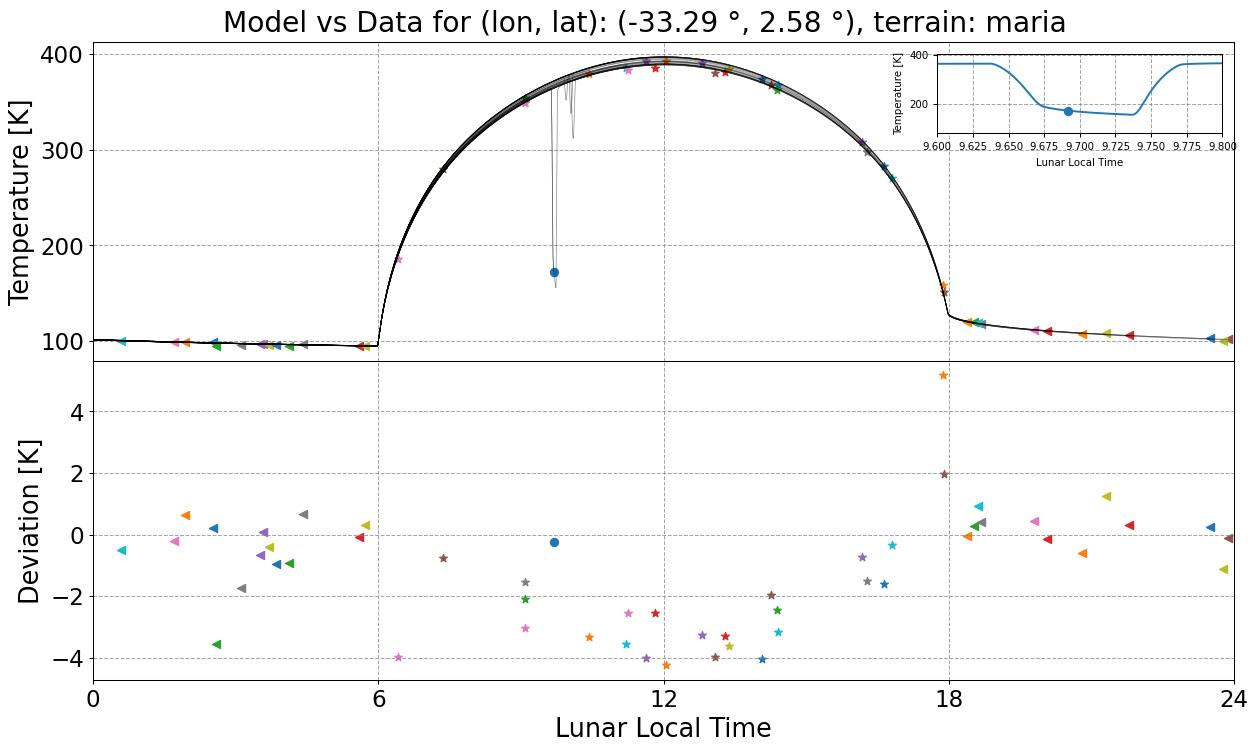
The Moon’s surface thermal environment is extreme compared to other planetary bodies in the solar system, with temperatures ranging between 400 K at the subsolar point and lower than 40 K in permanently shadowed regions around the poles (Paige et al. 2010). The surface temperature of the Moon also represents a fundamental boundary condition that governs the thermal state of the Moon’s regolith, the interior, and the behaviour of near-surface volatiles. The regolith is the layer of unconsolidated material covering the lunar surface, created by impacts and space weathering. The lunar environment is known to be characterized by interactions between the space plasma and the dusty surface, leading to a complex exosphere. Knowing more about the current state of the lunar regolith can give us insight into the geological history of the moon.

In contrast to in-situ measurements or returned samples, remote sensing measurements can be used to constrain surface properties on a global scale. NASA’s Lunar Reconnaissance Orbiter (LRO) was the first spacecraft to create a global 3D map of the lunar surface. During the 15+ years of operation of LRO, the Diviner Lunar Radiometer Experiment (Diviner) has measured the brightness temperature of the lunar surface in 9 wavelength channels ranging from 0.35 µm to 400 µm (Paige et al. 2010) with a spatial resolution of approximately 250 meters per pixel. With the help of thermal models, the Diviner measurements were used to derive global properties of the lunar regolith (Hayne et al. 2017). Based on the latter work, Bürger et al. (2024) developed a thermal model of the lunar regolith using microphysical parameters, such as the regolith grain size and stratification. However, their best-fit results to Diviner nighttime measurements were non-unique.

On the contrary to the diurnal cycle which spans roughly 29.5 Earth days, lunar eclipses (solar eclipses as seen from the lunar surface) provide cooling curves of the regolith on a much smaller timescale of roughly 4 Earth hours. As a consequence, eclipse cooling occurs only within a thin layer corresponding to the much shallower thermal skin depth < 1 cm (compared to ~10 cm for the diurnal cycle). Lunar eclipse events lead to a significant cooling of the lunar surface by ΔT ≈ 200 K, due to the lack of a lunar atmosphere. Therefore, eclipse events offer a unique opportunity to constrain the physical properties of the uppermost regolith layer, the interaction zone between the lunar space environment and the lunar surface.

We present a refinement of the thermal model of Bürger et al. (2024) by combining Diviner daytime, nighttime, and eclipse measurements to resolve the degeneracy of the solution space and give best-fit estimates for microphysical properties of the lunar regolith such as regolith grain size and stratification on a global scale. To capture the precise timing and geometry of each lunar eclipse we improve the upper boundary condition of the thermal model by using the SPICE toolkit. We filter for locations with a low rock abundance below the average of 0.4% (Bandfield et al. 2011) and small local slopes below 5 degrees, describing default regolith properties and avoiding offsets of the lunar local time. We analyse lunar maria and highlands independently and investigate a latitudinal trend of the derived regolith properties. A comparison with in-situ measurements conducted by the Apollo mission is made to confirm the results.

Figure 1: Comparison of the thermal model with the Diviner data for a location in the maria near the equator. The top panel shows the available Diviner measurements for this location between 2009-12-01 and 2024-06-01 on top of their respective simulated diurnal curves. Nighttime data are marked with triangles, daytime data with asterisks. The eclipse event on the morning side is marked with a circle and shown in the cutout in the top right corner. The temperature drops by ~200 K for a short duration and then rises quickly to continue the ascending curve of the morning side. A drop in temperature without a measurement means that the location was not in the field of view of Diviner during the eclipse, instead it is part of the diurnal curve of another data point. The bottom panel shows the difference between model and data with χ2 = 1.6 K.


References:

Paige et al. (2010), Space Sci. Rev., 150(1-4).

Bandfield et al. (2011), JGR, 116(12).

Hayne et al. (2017), JGR, 122(12).

Bürger et al. (2024), JGR, 129(3).

How to cite: Langermann, L., Bürger, J., Hayne, P. O., Delbo, M., and Blum, J.: Refining a Thermophysical Model of the Lunar Surface using Eclipses, EPSC-DPS Joint Meeting 2025, Helsinki, Finland, 7–13 Sep 2025, EPSC-DPS2025-1060, https://doi.org/10.5194/epsc-dps2025-1060, 2025.

TP13 | Planetary Dynamics: Shape, Gravity, Orbit, Tides, and Rotation from Observations and Models

EPSC-DPS2025-1502 | ECP | Posters | TP13

High-resolution Shape Modeling of Ryugu from an Improved Neural Implicit Method 

Hao Chen, Philipp Gläser, Wladimir Neumann, and Jürgen Oberst
Tue, 09 Sep, 18:00–19:30 (EEST)   Finlandia Hall foyer | F64

The Hayabusa-2 mission, conducted by JAXA, orbited and returned samples from asteroid (162173) Ryugu in 2018 (Watanabe et al., 2017). The Optical Navigation Camera Telescope (ONC-T) was designed to capture high-resolution images for modeling the shape of Ryugu (Watanabe et al., 2017). Currently, the publicly available shape models of Ryugu have been generated from two approaches: structure-from-motion combined with multi-view stereo (SfM-MVS; Watanabe et al., 2019), and a neural implicit method (NIM) based on neural radiance fields (NeRF; Chen et al., 2024). While these methods effectively reconstruct the asteroid’s overall geometry, they fail to accurately resolve fine surface details, highlighting the need for enhanced modeling techniques. Fortunately, the NIM shows significant promise in achieving high-fidelity 3D scene representation, even with limited image input.

In this study, we used an improved NIM to perform detailed shape modeling of Ryugu and accurately reconstruct its surface morphology (Chen et al., 2025). To capture fine-scale surface features, including boulders of varying sizes and shapes, our approach introduces a multi-scale deformable grid representation that flexibly incorporates neighborhood information with different receptive fields. In addition, the 3D points generated by the SfM-MVS method are used to provide explicit geometric supervision during training, enhancing the accuracy of surface reconstruction.

To evaluate the reconstruction performance, we used 61 ONC-T images acquired during the 'Box-C' operations, with a spatial resolution of approximately 0.6 to 0.7 meters. We demonstrate that our proposed NIM is capable of reliably reconstructing Ryugu’s shape from a limited number of images, yielding volume and surface area estimates that are more consistent with the SfM-MVS reference than those produced by the NIM model of Chen et al. (2024). Compared to the SfM-MVS model and the NIM model proposed by Chen et al. (2024), our method more effectively reconstructs both small-scale and large, irregularly shaped boulders, as evidenced by comparisons between real and synthetic images from 3D models. In addition, it successfully recovers terrain features in the polar regions, despite the limited coverage of the ONC-T imagery. Owing to its reduced dependency on dense image inputs, our approach also presents the potential to simplify mission planning for global shape modeling by relaxing image acquisition requirements.

References:

Chen et al., 2024. Neural implicit shape modeling for small planetary bodies from multi-view images using a mask-based classification sampling strategy. ISPRS Journal of Photogrammetry and Remote Sensing, 212, pp.122-145.

Chen et al., 2025. Modeling the global shape and surface morphology of the Ryugu asteroid using an improved neural implicit method. Astronomy & Astrophysics, 696, p.A212.

Watanabe et al., 2017. Hayabusa2 mission overview. Space Science Reviews, 208, pp.3-16.

Watanabe et al., 2019. Hayabusa2 arrives at the carbonaceous asteroid 162173 Ryugu—A spinning top–shaped rubble pile. Science, 364(6437), pp.268-272.

How to cite: Chen, H., Gläser, P., Neumann, W., and Oberst, J.: High-resolution Shape Modeling of Ryugu from an Improved Neural Implicit Method, EPSC-DPS Joint Meeting 2025, Helsinki, Finland, 7–13 Sep 2025, EPSC-DPS2025-1502, https://doi.org/10.5194/epsc-dps2025-1502, 2025.

OPS1 | Unveiling the Jovian Moons: Juno’s view of Io, Europa, and Ganymede

EPSC-DPS2025-996 | ECP | Posters | OPS1 | OPC: evaluations required

Evaluating Multi-Spacecraft Stereo Imaging for DEM Generation on Ganymede 

Gianluca Chiarolanza and Giuseppe Mitri
Tue, 09 Sep, 18:00–19:30 (EEST)   Lämpiö foyer | L2
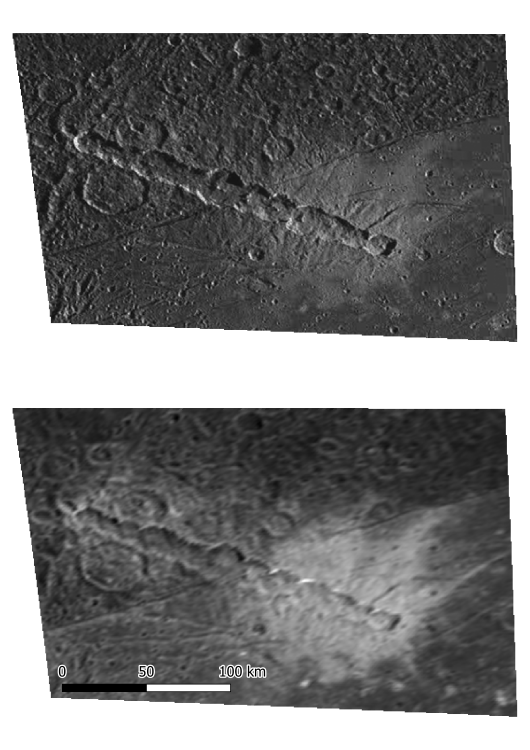
INTRODUCTION
The upcoming ESA JUICE and NASA Europa Clipper missions will provide topographic data for Jupiter's icy moons, Ganymede and Europa, respectively. Both spacecraft will acquire stereo images using their onboard cameras: JANUS on JUICE [1], and EIS on Europa Clipper [2]. In addition, their radar sounders RIME [3] and REASON [4], primarily designed for subsurface sounding, will contribute to surface elevation measurements. JUICE is also equipped with the GALA laser altimeter [5], which will deliver precise elevation profiles along its ground tracks.
Beyond  its primary science phase around Ganymede, JUICE will perform a series of targeted flybys of Europa and Callisto during its Jupiter tour [6]. These encounters offer an opportunity to image portions of their surfaces. However, due to mission design, topographic coverage will be limited by the number of planned observations, orbital geometry, and illumination conditions. As a consequence, some areas imaged during these flybys may lack a complementary observation necessary to: (1) form a stereopair suitable for standard stereophotogrammetric processing, or (2) support multi-view datasets for Shape-from-Shading (SfS) techniques [7].
One possible way to overcome this limitation is by searching for existing image data from previous missions that can be paired with newly acquired images to complete a stereopair [e.g., 8]. Even when the geometry does not support stereo processing, a second image may still be useful in multi-view SfS analyses. This study explores the feasibility and potential of this strategy, referred to here as the "multi-spacecraft" approach. This method is compared to the conventional "single-spacecraft" approach, where both images in a stereopair are taken by the same instrument, either through planned stereo imaging or serendipitous overlap.
To test this approach, we focus on Ganymede, which was imaged by NASA’s Juno spacecraft during a close flyby on 7 June 2021. JunoCam acquired four RGB images that enabled the generation of Digital Elevation Models (DEMs) for surface regions previously lacking detailed topographic coverage [9]. The first DEMs produced for these terrains were generated using standard stereo photogrammetry from JunoCam pairs, with supplemental photoclinometry applied where possible [9 - 10]. In a subsequent, independent study, higher-resolution DEMs over two selected regions were generated adopting a stereo vectorisation approach [11]. This method is based on an iterative process that involves measuring control points and vectors manually using stereo glasses and photogrammetric software. Importantly, stereo vectorisation was successfully applied not only to JunoCam stereopairs but also to multi-spacecraft stereopairs combining Juno and Galileo data.


PROPOSED WORKFLOW
In this study, we aim to identify one or more surface regions on Ganymede that have been imaged by multiple spacecraft at sufficient resolution to support stereo processing. Once such regions are identified, we will search for potential stereopairs in both the single-spacecraft and multi-spacecraft datasets. Each candidate pair will be assessed using established criteria for stereo suitability, including stereo angle, illumination compatibility, and ground sampling distance (GSD) [12].
For each selected area, two DEMs will be produced: one from a single-spacecraft stereopair and one from a multi-spacecraft stereopair. Both DEMs will be generated using the same photogrammetric software and workflow, specifically the Ames Stereo Pipeline [13], to ensure consistent processing. Quality assessments will follow established methodologies [14], allowing direct comparisons of elevation values and providing estimates on resolution and precision.


EXPECTED OUTCOMES AND TEST AREAS
The primary goal is to evaluate how closely the DEM generated from the multi-spacecraft pair matches the one produced from the single-spacecraft pair. The DEM from the single-spacecraft configuration will serve as a reference, while the multi-spacecraft DEM will be treated as the test case. Through this comparison, we aim to assess whether DEMs generated from multi-spacecraft image combinations are comparable in quality to those derived from single-spacecraft stereopairs, focusing on resolution and precision as indicators of quality.
One promising candidate for this analysis is the Enki Catena region (Figure 1), which has already been studied in previous works. DEMs for this area have been generated using both single-spacecraft (Juno-Juno) and multi-spacecraft (Galileo-Juno) stereopairs [10 - 11]. However, those studies used different processing techniques (standard stereogrammetry versus manual stereo vectorisation) making it difficult to isolate the impact of the data sources themselves. In our approach, both DEMs will be created using the same methodology and software, ensuring that any discrepancies observed can be attributed primarily to the nature of the input images, rather than differences in processing strategy.
This analysis will also help assess the practical advantages and limitations of the multi-spacecraft approach, such as expanded coverage, improved stereo angles, or increased complexity in image alignment and co-registration. Ultimately, the results could provide valuable guidance for future multi-mission data fusion efforts in support of JUICE, Europa Clipper, and beyond.


ACKNOWLEDGMENTS
G.C. and G.M. acknowledge support from the Italian Space Agency (2023-6-HH.0).


REFERENCES
[1] P. Palumbo et al., Space Sci. Rev., 2025.
[2] E. P. Turtle et al., Space Sci. Rev., 2024.
[3] L. Bruzzone et al., IEEE IGARSS, 2013.
[4] D. D. Blankenship et al., Space Sci. Rev., 2024.
[5] K. Enya et al., Adv. Space Res., 2022.
[6] ESA, JUICE Red Book, ESA/SRE(2014)1, 2014.
[7] O. Alexandrov and R. A. Beyer, Earth Space Sci., 2018.
[8] M. J. S. Belton et al., Science, 1996.
[9] M. A. Ravine et al., Geophys. Res. Lett., 2022.
[10] P. Schenk et al., LPSC, 2022.
[11] I. E. Nadezhdina et al., Planet. Space Sci., 2024.
[12] K. J. Becker et al., LPSC, 2015.
[13] R. A. Beyer et al., Earth Space Sci., 2018.
[14] R. L. Kirk et al., Remote Sens., 2021.


Figure 1 Enki Catena region on Ganymede, as seen in a multi-spacecraft stereopair formed by a Galileo SSI frame (top) and a JunoCam frame (bottom), both map-projected to Simple Cylindrical.

How to cite: Chiarolanza, G. and Mitri, G.: Evaluating Multi-Spacecraft Stereo Imaging for DEM Generation on Ganymede, EPSC-DPS Joint Meeting 2025, Helsinki, Finland, 7–13 Sep 2025, EPSC-DPS2025-996, https://doi.org/10.5194/epsc-dps2025-996, 2025.

EPSC-DPS2025-999 | ECP | Posters | OPS1 | OPC: evaluations required

Europa's Variable Alkali Exosphere After the Juno 2022 Flyby 

Emma Lovett and Carl Schmidt
Tue, 09 Sep, 18:00–19:30 (EEST)   Lämpiö foyer | L3

     A thin atmosphere of sodium and potassium traces the behaviors of Europa’s neutral gases. Brown & Hill (1996) first discovered Europa’s sodium exosphere with the assumption that it was entirely sourced exogenically: ionized Na from Io corotates with the plasma torus and implants in Europa’s ice surface where subsequent sputtering could then liberate it in neutral form. However, different ratios of sodium to potassium at Io and Europa offered the first evidence that Europa contributes to its own alkali exosphere (Brown 2001). Surface spectroscopy with HST revealed concentrations of irradiated sodium chloride around regions of known chaos terrain, suggesting that subsurface ocean water may upwell through the ice shell and become available to sputtering from incoming plasma bombardment at the surface (Trumbo et al. 2019). Together, these prompt the question: how much does Io contribute to Europa’s alkali exosphere versus what is endogenically sourced? To answer this, we must better understand the roles of Europa’s centrifugal latitude and orbital longitude around Jupiter, and whether it reacts to Io’s stochastic volcanism.

     Observations from Brown (2001), 3D Monte Carlo simulations from Leblanc et al. (2002), and laboratory measurements from Johnson et al. (2002) work in tandem to support a scenario where Europa’s alkali gases are sputtered from compounds that derive from its saltwater ocean. This sputtering process varies with the Jovian radiation environment. The ~10° offset of Jupiter’s magnetic axis from its rotational axis and the corotation of the plasma torus leads to the sinusoidal relationship of the Galilean moons’ centrifugal latitude. This geometry modulates plasma precipitation and north-south asymmetries can be seen in Europa’s oxygen aurorae, which alternate with an 11.1-hour period (Roth et al. 2016). Leblanc et al. (2005) accounted for this variation and compared their model to existing observations to show the effects of centrifugal latitude, as well as photon stimulated desorption at various orbital longitudes and contributions from Io.

Figure 1. Map of Europa’s sodium (left) and potassium (right) atmospheric column densities on 2022 Sept 29 during Juno’s close flyby. The 28″-long slit was used with a sodium filter and blocking filter for Na and K, respectively. Alkali emission within 3RE is overwhelmed by reflected sunlight.

     Europa’s sodium and potassium exospheres were mapped with Keck/HIRES during the 2022 Sept 29 Juno flyby (Lovett et al. submitted). The 28″-long slit was used to collect maximal spatial information around Europa’s disk and was offset 10 and 20 Europa radii (RE) in all directions, as well as along the Juno flyby trajectory for the Na data. At the time of observations, Europa was within 1″ of western elongation from Jupiter and was centered in the plasma sheet. Io was transiting Jupiter and in Europa’s wake, resulting in minimal contamination. Measurements close to Europa’s disk are overwhelmed by reflected sunlight, rendering altitudes within 3RE unusable. The resultant maps in Figure 1 suggest an oval-shaped sodium cloud elongated east-west with remarkable east-west and north-south symmetry. When fit to a power law, the radial profile of Na falls off close to R-1, indicative of purely escaping gas. Much of the potassium data was discarded due to high noise and imperfect pointing of the north-south slit positions, and the resulting map falls off as R-0.66. Potassium outweighs lighter sodium, so the more extended K exosphere comes as a surprise.

     The Na map in Figure 1 during Juno’s flyby was obtained just after a plasma sheet crossing and during a unique time where Io’s sodium escape was enhanced several-fold (Morgenthaler et al. 2024). To help place these data in context, several additional measurements were made with the associated orbital and magnetic coordinates seen in Figure 2. These data could illuminate the neutral cloud’s dependence on Europa’s geometry, and in principle permit detection of highly debated transient plume eruptions (Roth et al. 2014; Jia et al. 2018; Paganini et al. 2020).

Figure 2. Observation geometries of Europa when observed by Keck/HIRES from 2022-2024. Panel a: Europa’s orbital longitude, with eclipse measurements at 0° and western elongation at 270°. Panel b: Europa’s magnetic longitude in System III coordinates, where the magnetic and orbital equators align at 291° and 111°. The solid line at 5.9RE represents Io’s orbit and dotted line at 9.4RE represents Europa’s orbit. Panel c: Europa’s centrifugal latitude as calculated from Phipps & Bagenal (2021) and magnetic longitude at the time of each observation.

     Europa’s orbital geometry during Juno’s flyby was nearly replicated on 5 Feb 2024, providing a valuable comparison in Figure 3. Despite Europa’s opposite magnetic latitude, and influx from Io that is plausibly significantly lesser, a very similar distribution is seen between the two measurements. These results support the interpretation that Europa is a net source of Na, and that this source rate significantly dominates influx from Io. Further analysis of this dataset will characterize how orbital and magnetic geometry modulate Europa’s alkali exosphere, and if further differences between sodium and potassium are evident.

Figure 3. Map of Europa’s sodium atmospheric column density on 5 Feb 2024. Europa’s angular diameter was ~0.86″ and the Io and Europa orbital geometry is nearly identical to Fig. 1.

How to cite: Lovett, E. and Schmidt, C.: Europa's Variable Alkali Exosphere After the Juno 2022 Flyby, EPSC-DPS Joint Meeting 2025, Helsinki, Finland, 7–13 Sep 2025, EPSC-DPS2025-999, https://doi.org/10.5194/epsc-dps2025-999, 2025.

OPS2 | Icy Moons and Ocean Worlds in the Era of Juice and Europa Clipper

EPSC-DPS2025-90 | ECP | Posters | OPS2 | OPC: evaluations required

Ray Tracing for Titan’s Ionospheric Occultation of Saturn Radio Emissions: Implications for JUICE Mission 

Rikuto Yasuda, Hiroaki Misawa, Baptiste Cecconi, Tomoki Kimura, Corentin Louis, Lucas Grosset, Yasumasa Kasaba, Fuminori Tsuchiya, Thomas Gautier, Takeru Kato, and Shotaro Sakai
Mon, 08 Sep, 18:00–19:30 (EEST)   Lämpiö foyer | L28

Titan has an ionosphere with complex variations caused by both solar radiation and its interaction with Saturn's magnetospheric plasma. Previous studies have examined Titan’s electron density using methods such as radio occultation and in situ measurements. However, additional observations are needed to better capture the spatial variability of the electron density—including its dependence on local time, latitude, and magnetic conditions—and to improve our understanding of the overall structure of Titan’s ionosphere.

In Yasuda et al. (2024), we developed a new method to estimate ionospheric electron densities using planetary auroral radio emissions. This technique was first applied to Galileo PWS data to study the ionospheres of Ganymede and Callisto, two Jovian moons with thin neutral atmospheres.

To extend this method using radio emissions from other planets or to adapt it for moons with dense atmospheres, we applied it to Cassini RPWS data to derive Titan's ionospheric electron density. We focused on the Titan 15 flyby and applied our method to obtain the electron density profile of Titan’s ionosphere. As a result, we confirmed that the method remains effective in this new configuration and successfully derived electron density profiles at several locations around Titan.

In addition, we used the polarization data from RPWS to identify the direction of the radio source. The polarization sense (right- or left-handed circular) clearly indicates whether the source was in the northern or southern hemisphere of Saturn. This allowed us to narrow down the possible radio source locations during the occultation. Our results demonstrate that polarization measurements are useful not only for identifying the origin of radio emissions but also for improving the accuracy of ionospheric measurements.

This approach has direct relevance to upcoming radio observations by the JUICE mission and is expected to support the characterization of the ionospheres of Jupiter’s icy moons in the 2030s. Cassini RPWS observations provide the closest available analog to JUICE RPWI data. Like RPWS, JUICE RPWI is equipped with three orthogonal electric antennas for detailed polarization measurements. This similarity makes RPWS data valuable for developing and validating analysis methods for JUICE. Our study suggests that applying this method to future JUICE data can yield new insights into the ionospheres of moons like Ganymede and Callisto, especially when combined with polarization measurements. We will present our analysis of the Titan 15 flyby and discuss how this approach can support future JUICE observations.

How to cite: Yasuda, R., Misawa, H., Cecconi, B., Kimura, T., Louis, C., Grosset, L., Kasaba, Y., Tsuchiya, F., Gautier, T., Kato, T., and Sakai, S.: Ray Tracing for Titan’s Ionospheric Occultation of Saturn Radio Emissions: Implications for JUICE Mission, EPSC-DPS Joint Meeting 2025, Helsinki, Finland, 7–13 Sep 2025, EPSC-DPS2025-90, https://doi.org/10.5194/epsc-dps2025-90, 2025.

EPSC-DPS2025-94 | ECP | Posters | OPS2

Role of carbon in the interior structure of Jupiter’s moons Europa and Io 

Valentin André, Gabriel Tobie, Marie Běhounková, Mathilde Kervazo, Bruno Reynard, and Christophe Sotin
Mon, 08 Sep, 18:00–19:30 (EEST)   Lämpiö foyer | L1

The Galilean moons of Jupiter have been of great interest over the past years and are the targets of the JUICE and Europa Clipper missions. Europa is an ocean world that may potentially be suitable for hosting life, while Io is the most volcanically active world of the solar system. Despite their apparent differences, Europa and Io are believed to have accreted in a similar environment in the circumjovian disk [1]. In addition, their thermo-chemical evolutions are modulated by the nature of the accreted materials [2], and tidal heating forces induced by Jupiter and the Laplace resonance. Thus, determining the interior structure, chemical composition and thermal evolution of Europa and Io is crucial to understanding the origin and the history of the Jovian system as a whole. Previous studies attempted to conciliate the internal structure of Io and Europa with their chemical composition in order to constrain the origin of the accreted materials. The relatively low density of their rocky interior suggested that Europa and Io may be depleted in iron relative to the solar compositions and that iron-poor ordinary chondrites may be the most suitable accretionary materials [3], [4], [5]. More recent studies however preferred volatile-poor carbonaceous chondrites for Europa [6], which highlights the lack of consensus. However, these studies do not simultaneously consider Io and Europa while the comparison between the two bodies is necessary to better assess their chemical composition and origin. Organic matter has been proposed to be incorporated in large amounts in the interior of large icy moons like Ganymede and Titan [7], [8]. Organic matter may also constitute a significant amount of Europa’s interior [9]. 

In this study, the internal structure and chemical composition of Europa and Io are constrained through a joint analysis. The method relies on a Monte-Carlo Markov Chains inversion scheme fitting the mass and moment of inertia of the two bodies [10], [11]. Using state-of-the-art equations of states for the densities of the metallic core, silicate mantle, and integration of the internal structure, elemental ratios Fe/Si & Mg/Si are computed and compared to that of chondrites. Two endmembers are used for the numerical modelling, with a carbon-free interior and another with a mantle incorporating a mass fraction of graphite. Different temperature profiles are also tested to take into account uncertainties on the present thermal-state of the two bodies. In the carbon-free scenario, the results show that only the elemental ratios of iron-poor L/LL chondrites are reached for both Europa and Io, which is consistent with the conclusions of the aforementioned studies. These chondrites are, however, almost water-free and thus cannot explain the hydrosphere of Europa on their own. With the addition of several weight% of graphite in the silicate mantle, elemental ratios of iron- volatile-rich carbonaceous chondrites, whose compositions are close to the solar photosphere, are reached. In the case of Io, the amount of graphite is systematically higher than the bulk carbon content of carbonaceous chondrites for any temperature profile. For Europa, while the water content is systematically lower, the amount of graphite is strongly anti-correlated to the thickness of the hydrosphere. This suggests that Europa and Io have accreted from materials enriched in refractory organic compounds and reduced in water relative to carbonaceous chondrites. This favors an accretion scenario where ice and organic rich pebbles are delivered from the outer solar system and are progressively ablated the more they move towards Jupiter, explaining the volatile gradient observed in the Galilean satellites [1], [12]. The results further support the idea that carbon under the form of organic matter is a major component in the bulk composition of outer solar system objects and may have strongly affected the chemistry of Europa’s ocean. 


References

[1] Estrada, P.R. et al. Formation of Jupiter and conditions for accretion of the Galilean satellites. In: Pappalardo, R.T., McKinnon, W.B., Khurana, K. (eds.) Europa, pp. 27–58. University of Arizona Press, Tucson, AZ (2009)

[2] Hussmann, H. and Spohn, T. (2004). Thermal-orbital evolution of io and Europa. Icarus, 171(2):391–410.

[3] Sohl et al. (2002). Implications from Galileo observations on the interior structure and chemistry of the Galilean satellites. Icarus, 157:104-119.

[4] Kuskov, O. L. and Kronrod, V. A. (2001). Core sizes and internal structure of Earth’s and Jupiter's satellites. Icarus, 151(2):204–227.

[5] Kuskov, O. and Kronrod, V. (2005). Internal structure of Europa and Callisto. Icarus, 177(2):550–569.

[6] Petricca, F. et al. (2025). Partial differentiation of Europa and implications for the origin of materials in the Jupiter system. Nature Astronomy, pages 1–11. doi:  https://doi.org/10.1038/s41550-024-02469-4

[7] Néri, A. et al. (2020). A carbonaceous chondrite and cometary origin for icy moons of Jupiter and Saturn. Earth and Planetary Science Letters, 530:115920. doi: https://doi.org/10.1016/j.epsl.2019.115920

[8] Reynard, B. and Sotin, C. (2023). Carbon-rich icy moons and dwarf planets. Earth and Planetary Science Letters, 612:118172. doi: https://doi.org/10.1016/j.epsl.2023.118172

[9] Becker, T. et al. (2024). Exploring the composition of Europa with the upcoming Europa Clipper mission. Space Science Reviews, 220(5):49. doi: https://doi.org/10.1007/s11214-024-01069-y

[10] Anderson, J. et al.  (1998). Europa’s differentiated internal structure: Inferences from four Galileo encounters. Science, 281(5385):2019–2022.

[11] Casajus, L. et al. (2021). Updated europa gravity field and interior structure from a reanalysis of Galileo tracking data. Icarus, 358:114187. doi: https://doi.org/10.1016/j.icarus.2020.114187

[12] Mousis, O. et al. (2023). Early stages of Galilean moon formation in a water-depleted environment. The Astrophysical journal letters, 944(2):L37. doi:  https://doi.org/10.3847/2041-8213/acb5a4


Acknowledgments 

This study has been co-funded by the European Union (ERC, PROMISES, project #101054470). Views and opinions expressed are however those of the author(s) only and do not necessarily reflect those of the European Union or the European Research Council. Neither the European Union nor the granting authority can be held responsible for them.

How to cite: André, V., Tobie, G., Běhounková, M., Kervazo, M., Reynard, B., and Sotin, C.: Role of carbon in the interior structure of Jupiter’s moons Europa and Io, EPSC-DPS Joint Meeting 2025, Helsinki, Finland, 7–13 Sep 2025, EPSC-DPS2025-94, https://doi.org/10.5194/epsc-dps2025-94, 2025.

EPSC-DPS2025-601 | ECP | Posters | OPS2 | OPC: evaluations required

Thermal Surface Measurements of Europa using Galileo PPR: Searching for Temperature Anomalies 

Sarah Howes and Carly Howett
Mon, 08 Sep, 18:00–19:30 (EEST)   Lämpiö foyer | L11

1. Introduction

Perhaps one of the most fascinating ice-covered moons in our solar system is the Galilean satellite Europa. The successful launch of Europa Clipper has motivated the re-evaluation of our current knowledge of the Jovian moon -- specifically thermal measurements of the moon's surface, which may contain information about recent geologic activity. After the discovery of active plumes on Enceladus [1], similar phenomena were searched for on Europa [2]. While evidence of surface alteration -- such as troughs, ridges, chaos terrain, and the lack of prevalent craters -- indicate ongoing activity and a relatively young surface [3], the presence of plumes is still being debated. 

While no endogenic thermal anomalies have yet been observed on Europa's surface [4], we re-assess the thermal IR data from Galileo Orbiter's photopolarimeter-radiometer instrument (PPR) [5]. We perform a thermal analysis of the surface properties of Europa, including mapping the thermal inertia and albedo similar to what was done by Rathbun et al. [4], with a goal of extending thermal surface mapping beyond the previous 20% surface coverage. We also perform a sensitivity study of PPR in hotspot detection by determining the minimum detectable hotspot temperature across the surface of the moon and compare our results to previous work.


2. Data Analysis

We use 29 PPR radiometry datasets taken during various orbits ranging from November 1996 to November 1999. Both narrow band and open filters were used, with a total wavelength range of 0.3-110 μm. We divide the surface into 3°x3° longitude/latitude grid cells and determine each cell's temperature at a given local time to produce diurnal temperature curves. To determine the thermal inertia and albedo, we fit a thermophysical model to each cell's diurnal curve using the Thermophysical Body Model Simulation Script (TEMPEST) [6] as our modelling tool. The best-fit diurnal curve is chosen by minimizing the reduced chi-squared of the model fit, while all data with χred2 <1 is considered an adequate fit.

We choose three synthetic hotspot areas -- 50, 100, 200 km2 -- to represent the possible size range of hotspots based on average sizes of lenticulae [7]. We increase the hotspot temperature by 1 K until the integrated radiance across the PPR filter of the synthetic blackbody exceeds 2σ of the original observation's radiance. The result provides a map of the minimum temperature a hotspot of a given size would need in order to be detected by PPR.


3. Results

3.1 Albedo & Thermal Inertia

We calculate the bolometric albedo and thermal inertia for 38% of the surface of Europa (Fig. 1). Our fitting criteria requires at least three data points forming a diurnal curve, with at least one point 45 degrees from noon. These are more relaxed constraints when compared to Rathbun et al. [4], which, alongside the use of more PPR datasets, allows for the increase in surface coverage. This however leads to higher margins of error in our results, which must be taken in account: nearly half of our fits for thermal inertia do not have a constrained upper bound. Nevertheless, these results provide a broad estimate in the possible thermophysical properties of previously unmapped regions. 

We notice lower albedo and thermal inertia in darker regions near the equator, which coincides well with chaos terrain when compared to geological maps [8]. This may provide a physical explanation for variations in albedo and thermal inertia, as opposed to those caused by endogenic emission. Because of this, no thermal anomalies can be verified as of yet based solely on thermal PPR data, which agrees with previous studies [4], [9]. We aim to perform a more detailed comparison between thermophysical properties and geological regions in future work.

Figure 1. Albedo and thermal inertia maps. Base map from Becker et al. [10].


3.2 Minimum Hotspot Temperature

Minimum detectable hotspot temperatures for 50 and 200 km2 hotspots are displayed in Fig. 2, alongside their respective probability density histograms. The mean for a 200 km2 hotspot is 185.89±44.84 K, and 290.86±116.59 K for a 50 km2 hotspot. To illustrate agreement in analysis methods, we compare our results to similar work by Rathbun et al. [4] in Fig. 3 for a 100 km2 hotspot, plotting only the 15 datasets used in their work. For a 100 km2 hotspot, the minimum hotspot temperature detectable by PPR has a mean and standard deviation of 228.98±69.53 K. 

These results provide a visualization of the extent of surface coverage of PPR. Regions in Figs. 2 & 3 with lower hotspot detection thresholds indicate higher resolution nighttime observations, while regions with only daytime or low resolution observations require higher hotspot temperatures to be detected. This highlights areas that would benefit from priority observations from future missions due to their lack of sufficient coverage. 

Figure 2. Minimum detectable hotspot temperature for 50 km2 (top) and 200 km2 (bottom) hotspots. Histograms for each are plotted to the right.


Figure 3. Minimum detectable hotspot temperature for a 100 km2 hotspot compared to Rathbun et al. (2010) [4] (lower).


References

[1] Porco, C. C. et al. Science 311, 1393–1401 (2006). 
[2] Roth, L. et al. Science 343. Publisher: American Association for the Advancement of Science, 171–174 (Jan. 2014). 
[3] Pappalardo, R. T. et al. JGR 104, 24015–24056 (Oct. 1999). 
[4] Rathbun, J. A. et al. en. Icarus 210, 763–769 (Dec. 2010). 
[5] Russell, E. E. et al. en. Space Sci Rev 60, 531–563 (May 1992). 
[6] Lyster, D. et al. Europlanet Science Congress 2024, Berlin, Germany, 8–13 Sep 2024, EPSC2024-1121.
[7] Greeley, R. et al. JGR: Planets 105, 22559–22578 (2000). 
[8] Leonard, E. J. et al. Global geologic map of Europa English. Report 3513 (Reston, VA, 2024), 18. 
[9] Spencer, J. R. et al. en. Science 284, 1514–1516 (May 1999). 
[10] Becker, T. et al. Europa Voyager-Galileo SSI Global Mosaic 500m, USGS Astrogeology Science Center (Jan. 2010).

How to cite: Howes, S. and Howett, C.: Thermal Surface Measurements of Europa using Galileo PPR: Searching for Temperature Anomalies, EPSC-DPS Joint Meeting 2025, Helsinki, Finland, 7–13 Sep 2025, EPSC-DPS2025-601, https://doi.org/10.5194/epsc-dps2025-601, 2025.

EPSC-DPS2025-646 | ECP | Posters | OPS2 | OPC: evaluations required

Carbon-rich interiors of Ganymede and Titan: application of a kinetic model of carbonaceous organic matter transformation 

Camille Delarue, Bruno Reynard, Christophe Sotin, Fellah Clémentine, Cardon Hervé, Montagnac Gilles, Confortini Giorgia, and Rafael Ferreiro Mählmann
Mon, 08 Sep, 18:00–19:30 (EEST)   Lämpiö foyer | L10

Compostion models of icy bodies require the incorporation of important volume of carbonaceous organic matter (COM) in their rocky cores to account for their density and moment of inertia[1], as measured by the Cassini and Galileo missions. In these models, the effects of temperature and pressure on COM were either simplified or neglected due to the lack of experimental data. To address this, we conducted experiments to constrain the evolution of COM composition and density at elevated temperatures and pressures within the range of icy moons core conditions (up to ~7 GPa and 1300 K in Ganymede’s core). Type III kerogens were used as analogs for COM to quantify this transformation.

The ambient-temperature compressibility of kerogens was measured using diamond anvil cell experiments while the evolution of COM chemistry and density with temperature and time was described by adapting a kinetic model previously developed for coals[2]. Kinetic model parameters[3] were adjusted to account for the chemical composition and physical properties (density, vitrinite reflectance) of experimental samples heated between 473 and 723 K for durations ranging from seconds to hundreds of days under various pressures (0.2–2.5 GPa). The density of COM as a function of time, temperature, and pressure was determined by combining compressibility data with the kinetic model.

The kinetic model adjusted to experimental data on coals provides a good fit to experimentally determined chemical variations of IOM and IOM analogs (Miller). This suggests that type III kerogens are indeed valid analogs to describe the density and composition of meteoritic IOM submitted to metamorphism in icy bodies. The kinetic model was implemented in thermo-chemical evolution models to describe the composition and density evolution of COM in the refractory cores of icy bodies.

At astronomical timescales (>100 Myrs), COM density undergoes a rapid variation from ~1350 kg/m³ 300 K to values close to that of graphite (~2250 kg/m³) at 600 K according to the present kinetic model. Additionally, the kinetic model predicts the nature and proportions of released volatiles (H₂O, CO₂, and CH₄). Reactions between core material and volatiles produced during COM transformation have been investigated, and are taken into account in the thermal evolution model. Applications to Titan and Ganymede suggest that the amount of COM required to match gravitational constraints is higher than previously estimated, potentially reaching 40 wt% for Titan and 25% for Ganymede, based on the newly determined density values. Future gravity measurements by the JUICE and Europa Clipper missions will allow testing and refining the present reference composition models.

Acknowledgements: This work was supported by Institut National des Sciences de l'Univers through Programme National de Planétologie, by the Agence Nationale de la Recherche (ANR, project OSSO BUCO, ANR-23-CE49-0003) and by the European Union (ERC, PROMISES, project #101054470). Views and opinions expressed are, however, those of the authors only and do not necessarily reflect those of the European Union or the European Research Council. Neither the European Union nor the granting authority can be held responsible for them.

[1] Reynard, B., & Sotin, C. (2023). Carbon-rich icy moons and dwarf planets. Earth and Planetary Science Letters, 612, 118172.

[2] Burnham, A. K. Kinetic models of vitrinite, kerogen, and bitumen reflectance. Organic Geochemistry 131, 50-59 (2019). https://doi.org/https://doi.org/10.1016/j.orggeochem.2019.03.007

[3] Braun, R. L., & Burnham, A. K. (1987). Analysis of chemical reaction kinetics using a distribution of activation energies and simpler models. Energy & Fuels, 1(2), 153-161.

How to cite: Delarue, C., Reynard, B., Sotin, C., Clémentine, F., Hervé, C., Gilles, M., Giorgia, C., and Ferreiro Mählmann, R.: Carbon-rich interiors of Ganymede and Titan: application of a kinetic model of carbonaceous organic matter transformation, EPSC-DPS Joint Meeting 2025, Helsinki, Finland, 7–13 Sep 2025, EPSC-DPS2025-646, https://doi.org/10.5194/epsc-dps2025-646, 2025.

EPSC-DPS2025-656 | ECP | Posters | OPS2 | OPC: evaluations required

Interior structure models and tidal Love numbers of Ganymede, Callisto and Titan: A prospective study for JUICE and Dragonfly 

Dargilan Oliveira Amorim, Gabriel Tobie, Gael Choblet, and Livia Bove
Mon, 08 Sep, 18:00–19:30 (EEST)   Lämpiö foyer | L14

Despite being comparable in size and mass, the largest moons in the Solar System—Jupiter’s moons Ganymede and Callisto, and Saturn’s moon Titan—exhibit contrasting surface characteristics and varying degrees of internal differentiation, suggesting distinct geological evolution paths. Characterizing their interior structure and thermal state is crucial for understanding the origin, evolution, and potential habitability of their subsurface oceans. Future geophysical measurements, including tidal monitoring and magnetic induction from the upcoming JUICE and Dragonfly missions (Van Hoolst et al., 2024; Charnay et al., 2022), will be essential for determining the structure of their hydrospheres and constraining their thermal state and degree of differentiation.


The hydrosphere structure is modeled using the SeaFreeze Python library (Journaux et al., 2020), which provides thermodynamic and elastic properties of water and various ice polymorphs over a wide range of temperatures and pressures. The library also includes similar properties for aqueous NaCl solutions. When integrating the mass, pressure, and temperature equations throughout the hydrosphere, we obtain the necessary properties at each depth using data from this Python package.


In our models, the outer ice shell consists primarily of pure ice I and includes an upper crust with different thermodynamic properties (reduced strength and low conductivity). Depending on its thickness and the assumed viscosity values, the shell may be either fully conductive or partially convective.  To determine the appropriate temperature profile and the relative proportions of conductive and convective layers, we apply scaling laws from Dumoulin et al. (1999), Deschamps and Sotin (2000), and Tobie et al. (2003). The main parameters in our ice shell models are the  total shell thickness, the crust thickness and the reference viscosity at the melting point. The adopted surface temperature, thermal conductivity, and ocean composition also influence the ice shell thermal structure.


The ocean is modeled as an aqueous NaCl solution with varying concentrations, and its thermodynamic properties at each pressure and temperature are determined using the SeaFreeze package. The NaCl concentration influences the ice–water phase transition, as well as the ocean’s density and electrical conductivity. The ocean is assumed to follow an adiabatic temperature profile, while the underlying high-pressure ice layer is modeled using various thermal structure scenarios. The possibility of using implementing ocean induction constraints such as Jia et al. (2025) in our hydrosphere models is also discussed.


The interiors of the moons are modeled with either two or three distinct layers. For Ganymede, the interior consists of a silicate mantle and a liquid iron core, with or without a solid inner core. For Titan and Callisto, we assume an outer hydrated silicate mantle (characterized by low density) and a denser inner rocky core. The presence of a significant fraction of carbon in the form of graphite is also considered. For each hydrosphere model, we explore all combinations of radii and densities for the interior layers that produce moments of inertia consistent with observational constraints. Density within each layer increases with depth according to the Adams–Williamson equation. For each adopted model, we also vary the elastic moduli and viscosity of the interior layers.


When computing tidal deformation, it is crucial to properly account for anelasticity. In this work, we adopt Andrade rheology, following the approach described by Amorim and Gudkova (2025). The tidal Love numbers for each model are computed using an algorithm similar to that of Amorim and Gudkova (2024), but with some improvements regarding the governing equations and boundary conditions.


For each moon, we generate tens of thousands of interior structure models by varying all relevant parameters that describe their hydrosphere and deep interior. We compute the tidal Love numbers k2 and h2, which characterize the gravitational potential perturbation and surface displacement caused by tidal forces, respectively, along with their associated phase lags. In particular, we investigate the influence of the ice shell thickness, ocean properties, and the thermal state of both the ice I and high-pressure ice layers on the amplitude and phase lag of the Love numbers. We also assess how these quantities may be constrained by future observations from the JUICE and Dragonfly missions.

How to cite: Oliveira Amorim, D., Tobie, G., Choblet, G., and Bove, L.: Interior structure models and tidal Love numbers of Ganymede, Callisto and Titan: A prospective study for JUICE and Dragonfly, EPSC-DPS Joint Meeting 2025, Helsinki, Finland, 7–13 Sep 2025, EPSC-DPS2025-656, https://doi.org/10.5194/epsc-dps2025-656, 2025.

EPSC-DPS2025-777 | ECP | Posters | OPS2

Formation Conditions Leading to an Unmelted Callisto and a Differentiated Ganymede  

Yannis Bennacer, Olivier Mousis, Marc Monnereau, Vincent Hue, and Antoine Schneeberger
Mon, 08 Sep, 18:00–19:30 (EEST)   Lämpiö foyer | L15
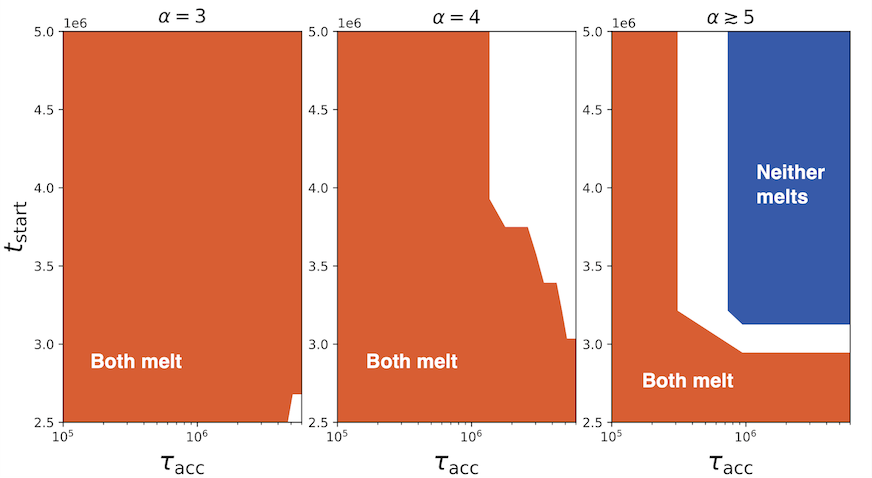
Gravity data from the Galileo mission suggest that Callisto has a partially differentiated interior, in contrast to the globally molten state of Ganymede. This dichotomy poses unique challenges to theories of the formation and evolution of the Galilean moons. During their formation, both moons were exposed to multiple heating mechanisms, including tidal dissipation, radiogenic heating from short-lived isotopes, impact-driven accretional heating, and thermal input from the circumplanetary disk.

In this study, we investigate the range of accretion conditions that could produce Callisto's incomplete differentiation while allowing Ganymede to undergo global melting. Our analysis focuses on key parameters such as the timing of accretion onset, its duration, and the impactor size distribution.

We find that the divergent internal structures of Ganymede and Callisto can arise under similar formation conditions, assuming an identical impactor size distribution and composition in the Jovian circumplanetary disk. Our results indicate that both satellites accreted gradually over periods longer than 2 million years, with accretion stopping at least 5.5 million years after the formation of calcium-aluminum-rich inclusions in the protosolar nebula. Our model also shows that Callisto can remain undifferentiated despite the accretion of a substantial influx of kilometer-sized impactors, while still allowing for the full differentiation of Ganymede.


Figure 1. Final states of Callisto and Ganymede as functions of accretion parameters tstart, τacc, and α which are respectively the timing of accretion onset, the duration of accretion, and the impactor size distribution. The white region indicates where Ganymede undergoes melting, while Callisto remains undifferentiated. From left to right, the panels display increasing values of α, ranging from 3 to 5, with a total of 100 simulations per panel.

How to cite: Bennacer, Y., Mousis, O., Monnereau, M., Hue, V., and Schneeberger, A.: Formation Conditions Leading to an Unmelted Callisto and a Differentiated Ganymede , EPSC-DPS Joint Meeting 2025, Helsinki, Finland, 7–13 Sep 2025, EPSC-DPS2025-777, https://doi.org/10.5194/epsc-dps2025-777, 2025.

EPSC-DPS2025-899 | ECP | Posters | OPS2

DSMC Modelling of Gaseous Plumes in Europa’s Icy Vents 

Tim Mosimann, Audrey Vorburger, and Leander Schlarmann
Mon, 08 Sep, 18:00–19:30 (EEST)   Lämpiö foyer | L17
In this study, we present preliminary results of Direct Simulation Monte Carlo (DSMC) [1] modelling of plumes through icy vents on Europa.
Jupiter's icy moon Europa is of great interest because of its potentially habitable subsurface oceans. Both ESA's JUpiter Icy Moons Explorer (JUICE) [2] and NASA's Europa Clipper [3] missions will, among a multitude of other measurements, perform mass spectrometry on samples from Europa's atmosphere and potential plumes. For the exciting prospect of determining Europa's habitability, estimating the chemical composition of the subsurface liquid water reservoirs is indispensable.
To infer the abundances of different chemical species in such a reservoir from their abundances far above the surface, it is crucial to understand the change in chemical composition of the gaseous plume content from the subsurface liquid water reservoir to the above-surface plume. To this end, we are simulating the evolution of water plumes erupting from a subsurface reservoir, be that an ocean or a water inclusion, from initial triple-point conditions, through the icy crust and into space. Our group benefits from expertise in simulating plumes from Europa's surface [4]. 
Our chosen method is Direct Simulation Monte Carlo (DSMC), modelling individual gas (macro-)particles and their intereactions to simulate the behaviour of a vastly larger number of (micro-)particles. The DSMC method is more computationally expensive than numerical simulations of macroscopic quantities in a crevasse [5], but naturally allows the incorporation of collisional phenomena and chemical reactions between particles and the icy walls, and is applicable to a wide range of pressures and temperatures. Almost a decade ago, DSMC already proved to be an effective tool for simulating Europa plumes from the surface upward [6]. 
We developed our own new DSMC code to familiarize ourselves with this method. We also made use of the state-of-the-art open-source Stochastic PArallel Rarefied-gas Time-accurate Analyzer (SPARTA) code [7]. Our simulations aim to improve the understanding of how chemical compositions change as gaseous material is transported from Europa’s interior into space, and ultimately to support the scientific analysis of data collected by the mass spectrometers NIM on JUICE and MASPEX on Europa Clipper. We will expand on and compare different models by running them under consistent geometrical and physical initial conditions and by comparing their predictions. The ultimate goal is to subject the modelled plumes to a reversal algorithms, to be able to retrieve predictions about subsurface reservoirs from above-surface measurements.
 
Acknowledgement:
The authors acknowledge the financial support of the SNSF under SNSF starting grant 218336.
 
References:
[1] G. A. Bird (1994). Molecular gas dynamics and the direct simulation of gas flows.
[2] O. Grasset, et al. (2013). Planetary and Space Science, 78, 1-21. https://doi.org/10.1016/j.pss.2012.12.002
[3] C. B. Phillips, and R. T. Pappalardo (2014). Eos, Transactions AGU, 95(20), 165-167. https://doi.org/10.1002/2014EO200002
[4] Vorburger, A., and Wurz, P. (2021). J. Geophys. Res. Space Phys., 126(9).  https://doi.org/10.1029/2021JA029690
[5] N. J. van der Hijden et al. (2024). Icarus 417, 116114. https://doi.org/10.1016/j.icarus.2024.116114
[6] J. J. Berg, et al. (2016). Icarus 277, 370–380. https://doi.org/10.1016/j.icarus.2016.05.030
[7] S. J. Plimpton, et al. (2019). Physics of Fluids 31, 086101. https://doi.org/10.1063/1.5108534

How to cite: Mosimann, T., Vorburger, A., and Schlarmann, L.: DSMC Modelling of Gaseous Plumes in Europa’s Icy Vents, EPSC-DPS Joint Meeting 2025, Helsinki, Finland, 7–13 Sep 2025, EPSC-DPS2025-899, https://doi.org/10.5194/epsc-dps2025-899, 2025.

EPSC-DPS2025-1360 | ECP | Posters | OPS2 | OPC: evaluations required

New Mathematical Tool For Icy Moon Exploration: Spherical Iterative Filtering For Gravimetric Data And The Study Case Of Ganymede  

Edoardo Santero Mormile and Giuseppe Mitri
Mon, 08 Sep, 18:00–19:30 (EEST)   Lämpiö foyer | L18

The gravitational field of a planetary body is a direct manifestation of its internal mass distribution, and the ability to decompose this signal into contributions from individual internal layers is crucial for accurate interior characterization. This is particularly relevant for icy moons, where the internal structure is thought to consist of a dense, rocky core overlain by a hydrosphere composed of a subsurface ocean and icy shells. Due to this layered configuration, large-scale gravitational anomalies are typically attributed to the deeper rocky components, while finer-scale features are often linked to the upper hydrosphere and ice shell. Through the expansion of the gravitational potential into spherical harmonics [1], the field can be interpreted as a combination of spatial frequencies, making it analysable to signal processing techniques. In this framework, the gravitational field can be viewed as a two-dimensional oscillatory signal distributed over the spherical surface of the planetary body. However, traditional signal decomposition tools, such as Fourier or wavelet transforms, are often inadequate for non-stationary, non-linear signals on spherical domains, which is where our proposed approach comes into play.

In this work, we present a novel mathematical tool called Spherical Iterative Filtering (SIF), designed specifically for the decomposition of non-stationary signals defined on spherical surfaces. The method extends the well-established Iterative Filtering (IF) algorithm, originally developed for one-dimensional time series [2], into the spherical domain. IF works by iteratively removing local averages to isolate intrinsic mode functions (IMFs), each representing a dominant oscillatory mode in the signal. Its value has been demonstrated across various disciplines [3], and its performance has been significantly enhanced via the Fast Iterative Filtering (FIF) approach, which can be guaranteed a priori convergent and whose acceleration is obtained via the so called Fast Fourier Transform [4]. SIF generalizes this decomposition strategy to spherical data, yielding what we term Intrinsic Mode Surfaces (IMSs). Unlike other techniques, SIF does not require any a priori assumptions or predefined basis functions, allowing it to adaptively separate components while preserving the inherent non-stationary characteristics of the data. This algorithm has also addressed the convergence properties of the method on the sphere in discrete settings, by leveraging the Generalized Locally Toeplitz (GLT) matrix theory, laying a solid theoretical foundation for its application in planetary sciences [5].

As a case study, we apply SIF to simulated gravimetric data of Ganymede, Jupiter’s largest moon and a prime target of ESA’s upcoming JUICE mission. This mission is expected to return high-resolution gravitational data that will be critical for probing Ganymede’s internal structure. Using an interior model of Ganymede based on current knowledge [6], we apply SIF to decompose the moon’s synthetic gravitational field and demonstrate its ability to separate contributions from the rocky core and the overlying hydrosphere. Remarkably, this decomposition is achieved in a blind fashion without any external constraints or prior information about the internal layers. Although the results presented here are based on simulated data and are subject to uncertainty, they provide a strong proof of concept. The outputs from SIF can serve as a first-order tool to constrain parameter spaces for more computationally intensive inverse methods, offering a valuable pre-processing step in planetary gravity inversion pipelines.

In summary, Spherical Iterative Filtering emerges as a powerful and flexible tool for the analysis of gravitational signals on planetary bodies, particularly those with complex, layered interiors like Ganymede. Its ability to decompose spherical, non-stationary signals in a fully data-driven way, with minimal assumptions, makes it a strong candidate for future geophysical applications in icy moon exploration and beyond.


Acknowledgements:
E.S.M. and G.M. acknowledge support from the Italian Space Agency (project 2023-6-HH.0). This research has been conducted within the framework of the Italian national inter-university PhD programme in Space Science and Technology.


References:

[1] M. A. Wieczorek, ‘Gravity and Topography of the Terrestrial Planets’, in Treatise on Geophysics, Elsevier, 2015.

[2] L. Lin, Y. Wang, and H. Zhou. Iterative filtering as an alternative algorithm for empirical mode decomposition. Adv. in Adap. Data An., 2009, 1.04, 543-560.

[3] G. Barbarino, A. Cicone. Conjectures on spectral properties of ALIF algorithm. Linear Algebra and its Applications, 2022, 647, 127-152.

[4] A. Cicone, H. Zhou. Numerical Analysis for Iterative Filtering with New Efficient Implementations Based on FFT. Num. Math., 2021, 147 (1),1-28.

[5] G. Barbarino, R. Cavassi, A. Cicone. Extension and convergence analysis of Iterative Filtering to spherical data. Lin. Alg. and its Applications, 2024.

[6] D. M. Fabrizio et al., ‘Observability of Ganymede’s gravity anomalies related to surface features by the 3GM experiment onboard ESA’s JUpiter ICy moons Explorer (JUICE) mission’, Icarus, 2021.

How to cite: Santero Mormile, E. and Mitri, G.: New Mathematical Tool For Icy Moon Exploration: Spherical Iterative Filtering For Gravimetric Data And The Study Case Of Ganymede , EPSC-DPS Joint Meeting 2025, Helsinki, Finland, 7–13 Sep 2025, EPSC-DPS2025-1360, https://doi.org/10.5194/epsc-dps2025-1360, 2025.

EPSC-DPS2025-1570 | ECP | Posters | OPS2 | OPC: evaluations required

Modeling the interactions between Callisto’s neutral and ionized environments and the Jovian magnetosphere 

Thomas Le Liboux, Ronan Modolo, Nicolas André, and François Leblanc
Mon, 08 Sep, 18:00–19:30 (EEST)   Lämpiö foyer | L31

Callisto is the most distant of the four Galilean moons, orbiting at around 26.3 Jovian radii from its planet. Composed of equal parts rock and ice, the moon has a tenuous atmosphere composed mainly of O2 [Cunningham et al., 2015] and CO2 [Carlson, 1999], as well as an ionosphere characterized by densities of up to 104 cm−3 [Kliore et al., 2002]. The moon’s environment interacts with the Jovian magnetosphere (surface erosion, Alfvén wings, etc.), whose physical characteristics vary greatly during its orbit, with a wide excursion in magnetic latitude. Due to a time-varying magnetic environment, electromagnetic induction occurs at Callisto in its ionosphere [Hartkorn & Saur, 2017], but also in a potential subsurface liquid ocean, as it was observed by NASA’s Galileo mission during flybys of the moon [Zimmer et al., 2000; Cochrane et al., 2025].

While the JUICE mission plans to carry out several flybys of Callisto, the interaction between the moon and Jupiter’s magnetosphere remains poorly understood. Simulations describing the neutral and ionized environments of the Jovian satellite must therefore be set up. The Larmor radii of freshly generated pick-up ions of O2+ and CO2+ being larger than the moon radius, a kinetic approach for the ion dynamic is more appropriate than a fluid model and is enable to capture asymmetries in Callisto’s plasma interaction. Therefore, these simulations use the LatHyS hybrid multi-species parallel 3D model [Modolo et al., 2016; 2018] developed to describe planetary plasma environments. This model has already been used to simulate the interaction between Galilean moons and the Jovian magnetosphere : Ganymede [Leclercq, 2015] and Europa [Baskevitch et al., 2025].

We will present our latest simulation results and compare them with Galileo in-situ observations, in particular with the C23 flyby (closest approach at 1052 km) which was the closest one to the center of the Jovian current sheet.

How to cite: Le Liboux, T., Modolo, R., André, N., and Leblanc, F.: Modeling the interactions between Callisto’s neutral and ionized environments and the Jovian magnetosphere, EPSC-DPS Joint Meeting 2025, Helsinki, Finland, 7–13 Sep 2025, EPSC-DPS2025-1570, https://doi.org/10.5194/epsc-dps2025-1570, 2025.

OPS3 | Jupiter’s Magnetosphere in the Juno Era and beyond: Insights from In-Situ and remote sensing Exploration

EPSC-DPS2025-525 | ECP | Posters | OPS3 | OPC: evaluations required

Stochastic Modelling of Jupiter's Magnetosphere  

Marco Loncar and Andrew Jackson
Thu, 11 Sep, 18:00–19:30 (EEST)   Lämpiö foyer | L4

With the Juno spacecraft in orbit about Jupiter, an extensive data set of magnetic field measurements now exists for the Jovian field. This has improved the coverage of the planet both in space and time by reaching greater latitudes as well as providing a continuous timeseries over a nine year period (2016-present). Such improved sampling of Jupiter has allowed for far more in-depth studies of its magnetic field, producing more complex field models to those found from earlier missions and the first claims of secular variation at a body other than Earth [1,2].

Although these models have revealed interesting new features of the Jovian magnetic field, they all suffer from large misfits in comparison with intrinsic satellite uncertainties: typical rms misfits of 500-1000 nT give weighted rms misfits of the order of ~10 (when published error budgets are adopted) [3]. Statistically, this underfitting strongly suggests that there are currently unmodelled processes that need to be considered.

Given the size of the Jovian magnetosphere, we believe this external field is responsible for the observed mismatch. The majority of field models take this external field as a low order l ~ 1, 2 spherical harmonic expansion, corresponding physically to Jupiter’s magnetodisc (a ring current, tilted with respect to the equatorial plane). This (near-)dipolar magnetosphere describes a simplified system in which small scale effects are neglected. A deterministic, higher order spherical harmonic expansion would provide a more accurate representation of the external field. However, there is still insufficient data to carry out this process to the desired level of accuracy.

The remaining approach to consider is a stochastic description of the system [4,5]. To do so, we model a distribution of randomly oriented currents around a planet, in a simplified spherical geometry. We find that measurements made within this region have non-zero, large scale correlations. This indicates that the presence of stochastic currents in the magnetosphere acts to relate measurements that would otherwise be considered independent.

We apply this method to the Juno data set for the case of a spherical magnetosphere geometry as described above. By taking into account these newfound correlations, we “pre-whiten” the Juno measurements (removing the effects of these stochastic currents in the magnetosphere). The resulting dataset is composed of entries that are more independent than the raw data itself. Through regularised inversion of this “pre-whitened” data, we find new models of Jupiter’s internally sourced magnetic field. For appropriately chosen current variance, these models fit the data well and account for the misfit seen in previous cases.

This is an encouraging result that shows the importance of a more full description of Jupiter’s magnetosphere. There is, however, more to consider in regards to further magnetosphere geometries and the interplay between these more complex magnetospheres and other contemporary models of Jupiter’s magentic field.


Acknowledgments:

The Planetary Data System (PDS) has proved invaluable in carrying out this work, to source data from both Juno and the earlier missions mentioned used throughout.


References:

[1] K. Moore et al. (2019) Nature, 561, 76-78

[2] J. Bloxham et al. (2022) JGR: Planets, 127

[3] S. Sharan et al. (2022) Geophysical Research Letters , 49

[4] R. Parker (1988) JGR: Solid Earth, 93, 3105

[5] A. Jackson (1990) GJI, 103, 657

How to cite: Loncar, M. and Jackson, A.: Stochastic Modelling of Jupiter's Magnetosphere , EPSC-DPS Joint Meeting 2025, Helsinki, Finland, 7–13 Sep 2025, EPSC-DPS2025-525, https://doi.org/10.5194/epsc-dps2025-525, 2025.

EPSC-DPS2025-713 | ECP | Posters | OPS3 | OPC: evaluations required

Radio occultation experiments of the Io plasma torus: from Juno to JUICE 

Irene Doria, Daniele Durante, Paolo Cappuccio, Mauro Di Benedetto, and Luciano Iess
Thu, 11 Sep, 18:00–19:30 (EEST)   Lämpiö foyer | L5

The volcanic activity of Io, the innermost of the Jupiter’s Galilean moons, is the main source of plasma in the Jupiter’s magnetosphere: the neutral particles ejected by Io’s volcanos are indeed ionized via electron collision and charge exchange processes (Thomas, N., et al., 2004). The produced ions are then affected by the electromagnetic force and by the gravitational and centrifugal forces, becoming confined in a torus around Io’s orbit called the Io plasma torus (IPT).

The IPT affects any radio signal travelling across this region, causing an additional frequency shift and a delay in, respectively, Doppler and range measurements between a deep space probe and the Earth. This effect can be exploited to analyze the IPT, in particular radio science data allow to study electron density models.

Radio occultation experiments have been performed with the Juno mission (Phipps, P.H., et al., 2021). The radio-tracking system enables a two-link configuration in X and Ka band but only Doppler measurements are performed, in two-way coherent mode. The two possible dual-link configurations are X/X + Ka/Ka and X/X + X/Ka and they allow isolating either the uplink or the downlink plasma contribution, which can be related to the total electron content and so to the electron density Ne. The Doppler plasma contribution can be integrated to derive the path delay which can be expressed in terms of the total electron content.

In this way it is possible to study electron density models for the IPT; in particular, we consider the empirical model proposed by (Phipps, P. H., and Withers, P., 2017): it divides the IPT into three main regions, the cold torus, the ribbon and the warm torus, plus the extended torus;  in each region Ne is modeled with a Gaussian-like distribution, and it is expressed as a function of the radial distance r from Jupiter in the centrifugal plane and the distance z away from the plane of the centrifugal equator. This is an axisymmetric model but there may be dependences of the density with the longitude or with time (due to Io’s volcanic activity). These dependences may be expressed with a Fourier expansion for the terms Ni and Hi, the central density and the scale height, respectively, for each region (Moirano, A., et al., 2021).

Juno performed many perijoves with occultation of the IPT allowing us to estimate the model parameters using a Markov Chain Monte Carlo (MCMC) algorithm; however, the model could be potentially further improved with future measurements from the JUICE mission (Grasset, O., et al., 2013).

The JUICE spacecraft is equipped with a radio-tracking system similar to BepiColombo (Iess, L., et al., 2021; Cappuccio, P., et al., 2025): a Deep Space Transponder can establish simultaneously X/X and X/Ka two-way coherent links, while a Ka-Transponder ensures an additional Ka/Ka one. In this way three links are simultaneously established, and the multi-frequency calibration scheme allows isolating the plasma contribution on both the uplink and downlink legs. Differently from Juno, JUICE can collect both Doppler and range data (in a coherent two-way mode) which give access to the absolute value of the total electron content. JUICE also hosts an Ultra Stable Oscillator (USO) (Shapira, A., et al., 2016) which can be used to perform dual frequency X-Ka IPT observations in non-coherent one-way downlink mode.

We report on an analysis performed to find the future optimal opportunities for the occultation of the IPT with the JUICE spacecraft. The occultation opportunities are identified using the SPICE kernels of the mission, then the path delay and the path delay rate are simulated.

The IPT morphology is not yet well understood, and the rich dataset collected by Juno together with the future torus occultations of JUICE gives the opportunity to study in more detail this plasma region and in particular to perform analyses on the electron plasma density.

How to cite: Doria, I., Durante, D., Cappuccio, P., Di Benedetto, M., and Iess, L.: Radio occultation experiments of the Io plasma torus: from Juno to JUICE, EPSC-DPS Joint Meeting 2025, Helsinki, Finland, 7–13 Sep 2025, EPSC-DPS2025-713, https://doi.org/10.5194/epsc-dps2025-713, 2025.

EPSC-DPS2025-1140 | ECP | Posters | OPS3 | OPC: evaluations required

Constraining the Spatial Profile of Oxygen in Io’s Neutral Cloud with HST’s Cosmic Origins Spectrograph. 

Simon Mendenhall and the Co-authors
Thu, 11 Sep, 18:00–19:30 (EEST)   Lämpiö foyer | L10
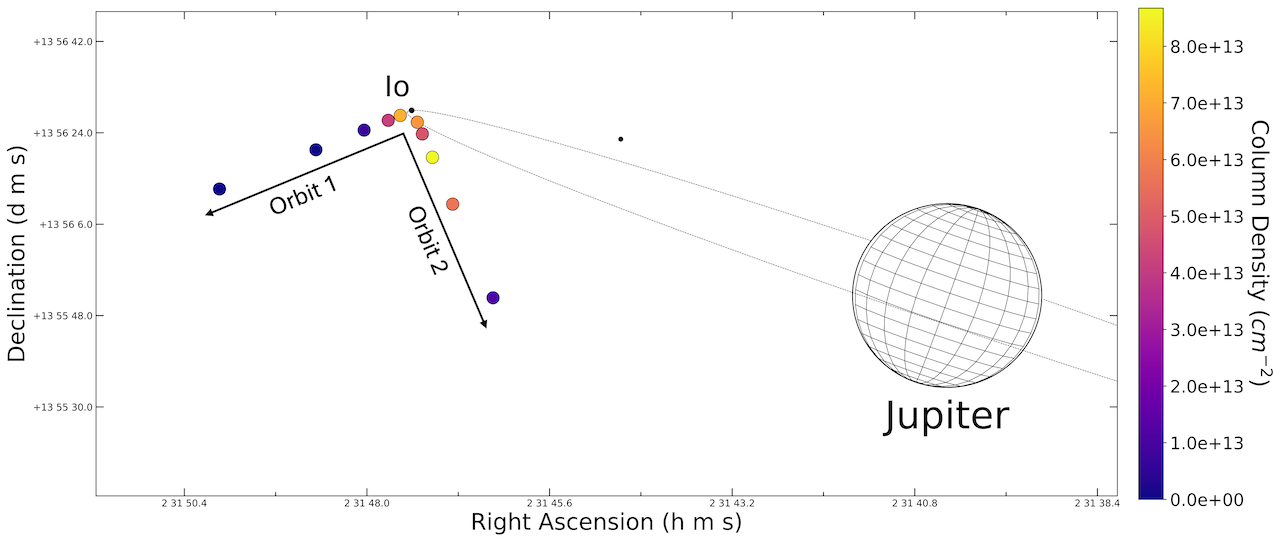
Introduction: Oxygen in Io’s extended neutral cloud is difficult to observe due to its reliance on collisionally excited emission by electrons in the plasma torus. Previous studies have shown temporal and spatial asymmetries in OI emission brightness, possibly due to contributions from volcanic activity as well as seasonal variability (Koga et al., JGR: Space Phys., 2019; Bagenal & Dols, JGR: Space Phys., 2020). The observed brightness of the FUV emission from the OI] 135.6 nm multiplet results from a combination of multiple parameters like the electron density, electron temperature, neutral oxygen density, and integration of the emission along the line of sight. Our work offers additional observation points to constrain the spatial profile of Io’s neutral oxygen cloud.

Methodology: The Hubble Space Telescope’s (HST) Cosmic Origins Spectrograph (COS) performed an orthogonal step-scan of Io’s extended neutral cloud over two HST orbits, totaling 12 exposures. From the OI] 135.6 nm emission multiplet brightness of off-disk exposures, we estimated the column density of neutral oxygen, assuming a constant electron density and temperature along COS’s line of sight.

Results: We present our estimates of neutral oxygen column density for 10 off-disk exposures using COS, ranging in distance from 5 to 86 RIo from Io. We detect significant OI emissions up to 85 RIo from Io, extending ~1.6 RJ below the orbital plane. Our analysis suggests that oxygen is mostly confined inside Io’s orbit, in agreement with measurements from Hisaki (Koga et al., JGR: Space Phys., 2018). Our estimated peak column density of (8.67  1.48) × 1013 cm–2 measured near Io is as expected larger than the typical neutral cloud densities of 2-9 × 1012 cm–2 estimated by Smith et al. (JGR: Space Phys., 2022). Our future work will constrain the source of oxygen emissions as atomic O or SO2 in the context of neutral cloud and torus modeling by coauthors Smith et al. and Bagenal et al.


Figure 1. Step-scan geometry of Io’s neutral cloud at the east orbital ansa on Feb 24, 2024. Column densities for 10 exposures of the neutral cloud are shown to scale as shaded circles inside the 2.5” diameter COS aperture.

How to cite: Mendenhall, S. and the Co-authors: Constraining the Spatial Profile of Oxygen in Io’s Neutral Cloud with HST’s Cosmic Origins Spectrograph., EPSC-DPS Joint Meeting 2025, Helsinki, Finland, 7–13 Sep 2025, EPSC-DPS2025-1140, https://doi.org/10.5194/epsc-dps2025-1140, 2025.

EPSC-DPS2025-1463 | Posters | OPS3 | OPC: evaluations required

Analysis of Io’s far-ultraviolet emission morphology using HST STIS spectral imaging data from 1997 to present 

Anatol Große-Schware, Lorenz Roth, Nickolay Ivchenko, Kurt Retherford, and Simon Mendenhall
Thu, 11 Sep, 18:00–19:30 (EEST)   Lämpiö foyer | L11

The volcanism on Jupiter’s moon Io – generated by huge tidal forces exerted by the gas giant – is the most active in the whole solar system. It feeds a thin and short-lived atmosphere, consisting of mostly SO2, S2, O, SO and S. This sublimation-driven atmosphere loses around 1000 kg s-1 to the Jovian magnetosphere. The processes that drive this atmospheric escape of neutrals and the formation of neutral clouds within the plasma torus are not fully understood yet. The observation of far ultraviolet (FUV) emissions of Io’s atmosphere and its environment provide an opportunity to study the atmospheric escape. In this study, spectral data from the Space Telescope Imaging Spectrograph (STIS) instrument of the Hubble Space Telescope (HST) are analyzed. STIS observed Io for the first time in 1997, and until today a total amount of 122 datasets with exposure time > 500s is available. This large number of datasets and the ongoing HST campaign allow long-term studies of the FUV emissions. In these observations, STIS is used with a 52 times 2 arcseconds large slit capturing the complete ~1 arcsecond wide disk of the moon. The captured photons pass a grating, such that the 25 times 25 arcseconds large detector image contains both, spatial and spectral information and consists of one dispersion and one cross-dispersion axis. Figure 1 shows such a raw dataset of an observation carried out in October 2024. The corresponding observation geometry is displayed in Figure 2, including the Jovian magnetic field, the plasma torus and incoming solar radiation. The most prominent features are the HI-1216Å-line and the OI-1304Å-line, although the photons captured here do not originate from Io. These are foreground geocoronal emissions, i.e., scattered light from H and O atoms within Earths exosphere that need to be removed from the raw data. To analyze Io’s atmosphere, reflected sunlight from the Io disk needs to be removed as well. To do so, a synthetic model of reflected sunlight is generated, using a daily solar spectral model and the point-spread-function (PSF) of STIS. To obtain the albedo, the synthetic reflected sunlight is compared to the data between 1520Å and 1640Å, where no Io-genic emissions are expected. The wavelength-dependency of the albedo is neglected. The observed emissions – in all relevant wavelengths – consists of three main features: Bright equatorial spots that vary their position with the orientation of the Jovian background field, the limb glow and emissions from Io’s extended exosphere. The analysis’ focus lies on the long-term brightness variability in neutral and sulfur ion auroral ultraviolet emissions from Io's equatorial spots and the limb glow. Furthermore, emissions from Io's extended exosphere are evaluated to figure out spatial brightness variations along the instrument's slit. Since these extended exosphere emissions are proportional to the line-of-sight (LOS) column density, a simple analytical density model of Io’s escaping atmosphere proportional to r-2 is applied and compared to the extended emission profiles. The results are investigated regarding to correlations of neutral aurora, neutral extended emissions and ion emissions and compared to plasma torus density models and aurora models.

Figure 1: Detector raw image of an observation on 2024-10-22. Several O and S emission lines are displayed to indicate wavelengths where to expect Io-genic emissions.


Figure 2: Local geometry of STIS observing Io within the Jovian system (in scale) in LOS coordinates (y from HST towards Io, z towards Io North projected in the LOS plane). Top: 3D-image, bottom: slices along xy-, xz- (LOS), and yz-plane. STIS’ field of view is displayed in grey, the Jovian background magnetic field lines including the dipole axis and the magnetic equator in orange, the Io plasma torus in red and incoming solar radiation in yellow.

How to cite: Große-Schware, A., Roth, L., Ivchenko, N., Retherford, K., and Mendenhall, S.: Analysis of Io’s far-ultraviolet emission morphology using HST STIS spectral imaging data from 1997 to present, EPSC-DPS Joint Meeting 2025, Helsinki, Finland, 7–13 Sep 2025, EPSC-DPS2025-1463, https://doi.org/10.5194/epsc-dps2025-1463, 2025.

EPSC-DPS2025-1569 | ECP | Posters | OPS3 | OPC: evaluations required

Electron distribution in the Jovian inner magnetosphere derived from multiple observations 

Saniya Sanada, Kazuo Yoshioka, Fuminori Tsuchiya, Natsuko Matsushita, Fran Bagenal, and Kurt Retherford
Thu, 11 Sep, 18:00–19:30 (EEST)   Lämpiö foyer | L12

Jupiter forms the largest magnetosphere in the solar system, covering an area nearly 100 times the radius of Jupiter. Jupiter's magnetosphere has been observed by various instruments, including the HISAKI satellite and the Juno spacecraft. The HISAKI satellite observes Jupiter and its surrounding region out to ~8 R_J with a fixed field of view while orbiting the Earth. The Juno spacecraft, on the other hand, directly observes a wide area of the magnetosphere while orbiting Jupiter. It has been suggested that energy supplied by the solar wind and Jupiter's interior is stored in the outer magnetosphere and rapidly released by reconnection, causing plasma to flow toward Jupiter (Tao et al., 2018). In addition, previous studies have shown that volcanic activity on Jupiter's moon Io plays an important role in supplying the material that accumulates within Jupiter's magnetosphere, and data from the HISAKI satellite reinforces this understanding (Yoshioka et al., 2017). Continuous observations of Io's activity and the distant magnetosphere would clarify the impact of Io on Jupiter's magnetosphere and lead to a better understanding of the energy transport process in the magnetosphere. Therefore, in this study, we compare observation data from the HISAKI and Juno spacecraft to describe the average distribution of energy and density of Io-derived plasma particles as a function of distance from Jupiter (i.e., M-shell) in the vast magnetosphere. The electron temperature, electron density, and ion density were derived by fitting spectra obtained from remote sensing by the HISAKI satellite with a model using the atomic database CHIANTI. The orbital electron distribution was also obtained from particle measurement data obtained by in-situ observation of Juno, as being published by Sarkango et al. 2025. We focus our comparison on the plasma parameter distributions obtained from the HISAKI observation data and the Juno JADE instrument in the period when the observation areas of the two spacecrafts nearly overlap.

How to cite: Sanada, S., Yoshioka, K., Tsuchiya, F., Matsushita, N., Bagenal, F., and Retherford, K.: Electron distribution in the Jovian inner magnetosphere derived from multiple observations, EPSC-DPS Joint Meeting 2025, Helsinki, Finland, 7–13 Sep 2025, EPSC-DPS2025-1569, https://doi.org/10.5194/epsc-dps2025-1569, 2025.

OPS4 | Exploring the Saturn system

EPSC-DPS2025-544 | Posters | OPS4 | OPC: evaluations required

Towards understanding mass spectra from icy moons using quantum chemistry: A case study for aromatic compounds. 

Thomas R. O'Sullivan, Partha P. Bera, Nozair Khawaja, Maryse Napoleoni, and Frank Postberg
Tue, 09 Sep, 18:00–19:30 (EEST)   Lämpiö foyer | L16

Ice grains emitted by the geologically active Saturnian moon Enceladus were sampled by Cassini’s Cosmic Dust Analyzer (CDA) – an impact ionisation mass spectrometer [1, 2] – allowing their compositional analysis. CDA exploited the kinetic energy from hypervelocity impacts of ice grains onto its metal target to ionise and fragment molecular compounds embedded in a water ice environment. Cassini’s observations at Enceladus have revealed the presence of a diverse chemical inventory, with CDA detecting a wide range of organic and inorganic compounds incorporated into ice grains ejected through the south polar plume [3-8]. The observed species imply a rich (geo)chemistry in its subsurface liquid water ocean and ongoing hydrothermal activity at its rocky, warm seafloor [9, 10]. The combination of liquid water, rich and active chemistry, and a source of energy – which together hint at habitable conditions - have cemented Enceladus’ place as a prime target in the search for life beyond Earth.

Across the entire mass range of detected organic species, which include nitrogen- and oxygen-bearing compounds and span a wide range of chemical properties, aromatic compounds are common in ice grains sampled from both the fresh plume and Saturn's E ring [3, 6, 11]. The assignment of mass spectral features to specific aromatic parent molecules has hitherto been challenging, as single-ringed aromatics generally fragment via similar pathways during impact ionisation. Organic compounds in ice grains sampled at hypervelocity by CDA generally undergo a degree of fragmentation closely correlated with the impact speed and molecular structure [12]. Unlike other mass spectral techniques, little empirical data is available as a reference for spaceborne impact ionisation mass spectrometry, due to the technical difficulties of accelerating ice grains in the laboratory. Analogue techniques such as laser-induced liquid beam ion desorption (LILBID) mass spectrometry, can successfully recreate impact ionisation mass spectra and thus represent a critical mode of data analysis for past and future space missions [12, 13]. There remains, however, a need for a deeper theoretical understanding of the physics and chemistry behind impact ionisation mass spectrometry, enabling both the prediction of mass spectral appearances for a large variety of organic compounds and – vice versa – the reconstruction of parent molecules from a given mass spectrum.

As a first case study, we employ quantum chemical calculations using the ORCA theoretical chemistry package [14] to investigate the relative energies of various pathways for the dissociation of aromatic compounds in water matrices, representative of the (semi-)polar aromatics detected in ice grains by CDA. These dissociation channels are compared to LILBID mass spectra simulating those obtained from impacts of aromatic-containing ice grains onto a spacecraft detector. We discuss the general applicability of quantum chemistry to impact ionisation and its efficacy in explaining the observed fragment ions of LILBID. We investigate phenol in particular, which is a compound representative of the (semi-)polar aromatics detected by CDA in Enceladean ice grains. We also discuss the influence of the water ice matrix on fragmentation using an explicit solvation model. In general, we find that fragment ions in LILBID match those predicted by some low-energy dissociation channels, but find inconsistencies related to peak intensities. Our work here not only guides the interpretation of existing data from Cassini’s CDA, but will also assist in planning for the SUrface Dust Analyzer (SUDA) instrument, which is based on CDA heritage, onboard the recently launched Europa Clipper [15].

1. Postberg, F., et al., Icarus, 2008. 193: p. 438-454.

2. Srama, R., et al., Space Science Reviews, 2004. 114(1-4): p. 465-518.

3. Khawaja, N., et al., Monthly Notices of the Royal Astronomical Society, 2019. 489(4): p. 5231-5243.

4. Postberg, F., et al. Plume and Surface Composition of Enceladus. 2018.

5. Postberg, F., et al. Nature, 2009. 459(7250): p. 1098-1101.

6. Postberg, F., et al. Nature, 2018. 558(7711): p. 564-568.

7. Postberg, F., et al. Nature, 2011. 474: p. 620-622.

8. Postberg, F., et al. Nature, 2023. 618: p. 489-493.

9. Hsu, H.-W., et al. Nature, 2015. 519(7542): p. 207-210.

10. Sekine, Y., et al. Nature Communications, 2015. 6(1): p. 8604.

11. Khawaja, N. et al. Cassini's New Look at Organic Material in Enceladus' Plume Ice Grains with CDA: Implication for the Habitability of Ocean Worlds. in Europlanet Science Congress 2024. Berlin, Germany.

12. Klenner, F., et al. Rapid Communications in Mass Spectrometry, 2019. 33(22): p. 1751-1760.

13. Klenner, F., et al. Earth and Space Science, 2022. 9(9): p. e2022EA002313.

14. Neese, F., WIREs Computational Molecular Science, 2025. 15(2).

15. Kempf, S., et al. Space Science Reviews, 2025. 221(1): p. 10.

How to cite: O'Sullivan, T. R., Bera, P. P., Khawaja, N., Napoleoni, M., and Postberg, F.: Towards understanding mass spectra from icy moons using quantum chemistry: A case study for aromatic compounds., EPSC-DPS Joint Meeting 2025, Helsinki, Finland, 7–13 Sep 2025, EPSC-DPS2025-544, https://doi.org/10.5194/epsc-dps2025-544, 2025.

EPSC-DPS2025-1574 | Posters | OPS4

Ozone in Planetary Ices: Solid-State Detection under Enceladus-like conditions 

Tara-Marie Bründl, Stephanie Cazaux, Ko-Ju Chuang, Jeroen Terwisscha van Scheltinga, and Harold Linnartz
Tue, 09 Sep, 18:00–19:30 (EEST)   Lämpiö foyer | L17

Introduction:

Once considered enigmatic, Enceladus has attracted steadily growing scientific interest over the past 20 years since the first visual detection of cryovolcanic plumes venting from the tiger stripes in 2005 [1]. A combination of magnetospheric and gravity data revealed that under a kilometer's thick icy crust, Enceladus harbours a warm subsurface ocean maintained by tidal dissipation and hydrothermal vents on the oceanic floor [2, 3, 4]. This ocean escapes the icy crust through plumes that expel a mixture of vapour and icy grains composed mainly of water, salts and traces of organic material [5]. Material from these plumes feeds the E-ring or falls back to the surface depending on the particle’s velocity. While the surface of Enceladus is mostly rich in water, patches of CO2 ice have been observed in-between the tiger stripes, possibly due to gas exsolution from the ocean and diffusion through small fissures in the icy crust [6]. Despite the wealth of these new discoveries, many of the moon’s endogenic and surface processes remain unresolved to date. For instance, how material is exchanged between the ocean and the surface, or how surface ice is affected by the external environment are key questions of interest. In this work, we studied the UV-photolysis of H2O and CO2-rich ices under Enceladus environmental conditions to determine the products of photo-induced reactions as well as the lifetime of these ices [7, under review]. 


Methods:
 

To this end, we use a cryogenic ultra-high vacuum (UHV) setup housed at Leiden University’s Laboratory for Astrophysics that is employed to investigate the formation of complex organic molecules through energetic processing of simulated Enceladus ices. Thin CO2-rich ice films are grown at a base pressure of 10-11 mbar on a substrate that is cryogenically cooled and thermally controlled.  These ices are photo-irradiated using a specialized microwave discharge hydrogen-flow lamp, producing vacuum ultraviolet (VUV) light with an SED including Ly-α and H2-emissions. The UHV system is equipped with two diagnostic tools for the spectroscopic analysis of thin ices across a range of compositions and temperatures, allowing for detailed investigation of the physico-chemical processes within the ice. Changes in the solid phase are tracked via Fourier-transform infrared (FTIR) spectroscopy, while a quadrupole mass spectrometer provides complementary detection of gas-phase species that desorb during linear warming of the substrate from 70 to 200 K.   


Results and Discussion: 


By systematically probing VUV-photolysed pure (H2O, CO2, and NH3) and mixed ices (H2O:CO2:NH3), the detection of photo-induced ozone in an Enceladus-like ice at 70 K is verified spectroscopically, besides other O and N-bearing chemical products forming in the ice. We found that ozone entrapment in CO2-rich ice occurs at temperatures as high as 88 K. Most likely, ozone is produced from the photodissociation of segregated CO2into CO + O, followed by consecutive O-atom addition reactions that form molecular oxygen (O2) and, finally, ozone (O3). Further, the survival of the VUV-irradiated parent molecules, CO2 and NH3, is quantified based on the fitted UV photodestruction cross-sections and half-lives, assuming first-order kinetics. The molecular half-lives are found to range from a few to several weeks on Enceladus. Our experimental work highlights that such short geological timescales possibly suggest an ongoing replenishing process that supplies surface CO2 as a key precursor for the formation of ozone. Future in-situ or remote-sensing detections of this molecule may serve as an indicator of geological activity involving surface renewal processes. We showed that ozone remains trapped in the solid-state in CO2-rich ices at temperatures up to 88 K and may therefore be found on Enceladus - or other sufficiently cold Solar System bodies that are exposed to comparable or higher levels of UV-radiation.  

References:
[1] Porco, C. C., et al.: Cassini observes the active South Pole of Enceladus, Science, Vol. 311, pp. 1393-1401, 2006.
[2] Dougherty, M., et al.: Identification of a dynamic atmosphere at Enceladus with the Cassini magnetometer, Science, Vol. 311, pp. 1406-1409, 2006.
[3] Iess, L., et al.: The gravity field and interior structure of Enceladus, Science, Vol. 344, pp. 78-80, 2014.
[4] Waite, J. H., et al.: Cassini finds molecular hydrogen in the Enceladus plume: Evidence for hydrothermal processes, Science, Vol. 356, pp. 155-159, 2017.
[5] Postberg, F., et al.: A salt-water reservoir as the source of a compositionally stratified plume on Enceladus, Nature, Vol. 474, pp. 620-622, 2011.
[6] Combe, J.-P., et al.: Nature, distribution and origin of CO2 on Enceladus, Icarus, Vol. 317, pp. 491-508, 2019.
[7] Bründl, T.-M., et al.: The photochemistry of Enceladus ice analogues – Implications for the formation of ozone and carbon trioxide, Icarus – under review (2025). 

How to cite: Bründl, T.-M., Cazaux, S., Chuang, K.-J., Terwisscha van Scheltinga, J., and Linnartz, H.: Ozone in Planetary Ices: Solid-State Detection under Enceladus-like conditions, EPSC-DPS Joint Meeting 2025, Helsinki, Finland, 7–13 Sep 2025, EPSC-DPS2025-1574, https://doi.org/10.5194/epsc-dps2025-1574, 2025.

EPSC-DPS2025-1769 | ECP | Posters | OPS4 | OPC: evaluations required

Evolution of Viscous Overstability in Saturn’s Rings:Insights from Large-Scale N-Body Simulations
(withdrawn after no-show)

Annabella Mondino Llermanos and Heikki Salo
Tue, 09 Sep, 18:00–19:30 (EEST)   Lämpiö foyer | L27

EPSC-DPS2025-1889 | ECP | Posters | OPS4 | OPC: evaluations required

Constraining Enceladus' interior structure by using libration measurement in a Bayesian framework 

Martina Ciambellini, Antonio Genova, Anna Maria Gargiulo, and Gabriele Boccacci
Tue, 09 Sep, 18:00–19:30 (EEST)   Lämpiö foyer | L20
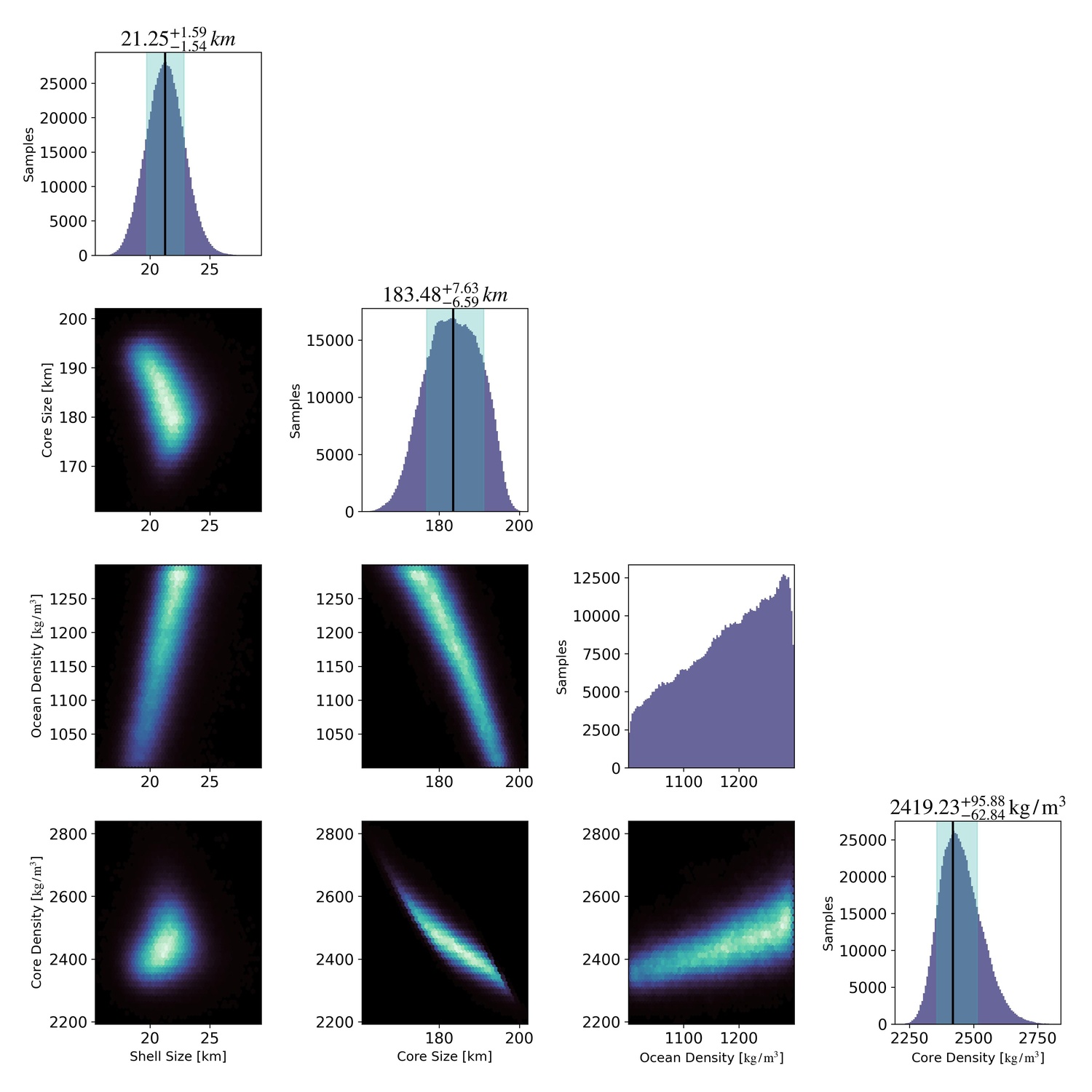
Introduction: One of the most compelling discoveries in planetary science is the potential existence of habitable subsurface oceans within icy moons. Among these, Saturn's moon Enceladus stands out due to its remarkable geological activity, characterized by the continuous venting of water vapor, ice particles, and organic compounds from its south polar region [1]. Cassini's comprehensive suite of measurements, including gravity data, confirmed the existence of a global subsurface ocean [2]. Accurately modeling the internal structure of Enceladus is crucial for assessing its habitability. Geophysical parameters, such as total mass and moment of inertia (MoI), are effective at constraining the total thickness of the hydrosphere, but they provide limited information on the separate contributions of the ice shell and the underlying liquid ocean. In contrast, measurements of physical librations in longitude are particularly sensitive to the internal structure of the hydrosphere, as they are influenced by the degree of mechanical decoupling provided by the liquid layer and the rigidity of the overlying ice shell. By combining mass and the moment of inertia measurements with libration amplitude estimate, a Bayesian inference approach enables tighter constraints on the deep interior and hydrosphere properties. This study presents an internal structure framework based on the Markov Chain Monte Carlo (MCMC) method that is well-suited for the estimation of Enceladus’ interior properties with rigorously quantified uncertainties by exploring the parameter space.

Methods: The mass, MoI and libration amplitude provide constraints that are integrated into a Bayesian inference framework, which is used to infer the internal properties of the investigated body. In particular, we implemented a MCMC algorithm to invert interior models by varying the free parameters associated with the structure of an icy moon. In accordance with the methodologies employed and tested in previous studies [3-4], our approach considers the body to be a multi-layered structure with free parameters of layer size, density, and rheology. These parameters are iteratively refined within the MCMC framework using the Metropolis–Hastings algorithm, which generates a diverse set of interior models. To ensure robust mapping of the parameter space, 20 independent chains are employed, each generating approximately 50,000 accepted models. Following the convergence of all chains, probability distributions for each parameter are derived, yielding constraints on the likely internal structure that are consistent with the observed geophysical data.

Enceladus Interior Model Inversion: The internal structure of Enceladus is constrained using a combination of geophysical parameters derived from Cassini mission data. The mass of Enceladus, determined from radio science data, is 1.08022 ± 0.00108 × 10²⁰ kg [5], while the normalized MoI is estimated at 0.335 ± 0.002 [6]. These parameters place fundamental constraints on the total thickness of the hydrosphere, while remaining insensitive to the separate contributions of the ice shell and the subsurface ocean [6]. Physical librations, however, offer a crucial complementary constraint, as it is highly sensitive to the thickness and mechanical properties of the ice shell. The libration amplitude of Enceladus was determined from optical tracking of surface features by the Cassini spacecraft, revealing a physical libration of 0.120 ± 0.007°, which corresponds to an equatorial displacement of approximately 530 ± 30 m [7].

In this work, we implement the elastic libration model [8], which accounts for the gravitational torques acting on both the periodic and static tidal bulges and includes the complex gravitational interactions between the individual layers of the icy moon arising from their mutual misalignment and the pressure forces exerted by the liquid ocean on the surrounding solid layers. The model captures the contributions from both the direct external gravitational torque and the internal gravitational coupling between layers, as well as the pressure feedback from the ocean.

The moon is modeled with a three-layer structure comprising a rocky core, a subsurface ocean, and an ice shell. The thicknesses of the core and ice shell were treated as free parameters, while the ocean thickness was determined based on Enceladus’ known radius. The free parameters included the densities of the core and ocean, while the ice shell density was fixed at 917 kg m-3. The viscosities and shear moduli of the shell and core were included as free parameters. Within the MCMC framework, each proposed interior model starts from a simplified spherical approximation, characterized by an average radius and the densities of each layer. The hydrostatic shapes of the internal interfaces are then computed assuming hydrostatic equilibrium, calculating the polar and equatorial eccentricities of each layer using a fourth-order formulation [9].

The results suggest that incorporating libration amplitude can significantly improve the characterization of the internal differentiation withing Enceladus' hydrosphere, providing an estimate of the ice shell thickness with an uncertainty of approximately 1.5 km around a mean value of 21 km, consistent with previous studies.

Summary: The application of MCMC inversion with libration constraint offers a powerful approach to precisely determine the ice shell thickness of Enceladus, achieving a constraint accuracy of approximately 1.5 km. This framework can be readily adapted to other icy moons, providing a valuable tool for probing the internal structures of ocean worlds throughout the solar system.


References:

[1] Glein et al. (2015) GeCoA, 162, 202. [2] Iess et al. (2014), Sci, 344, 78. [3] Genova A. et al (2019) GRL 46(7), 3625–3633. [4] Petricca et al. (2023) GRL, 50, e2023GL104016. [5] Hemingway et al. (2018) in Enceladus and the Icy Moons of Saturn, Univ. Ariz. Press, 57. [6] Genova et al. (2024) PSJ, 5(2), 40. [7] Thomas et al. (2016) Icarus, 264: 37-47. [8] Van Hoolst et al. (2013) Icarus, 2013, 226.1: 299-315. [9] Tricarico (2014) ApJ, 782(2), 99.

How to cite: Ciambellini, M., Genova, A., Gargiulo, A. M., and Boccacci, G.: Constraining Enceladus' interior structure by using libration measurement in a Bayesian framework, EPSC-DPS Joint Meeting 2025, Helsinki, Finland, 7–13 Sep 2025, EPSC-DPS2025-1889, https://doi.org/10.5194/epsc-dps2025-1889, 2025.

OPS5 | Exploration of Titan

EPSC-DPS2025-85 | ECP | Posters | OPS5 | OPC: evaluations required

Modeling Atmospheric Alteration on Titan: Hydrodynamics and Shock-Induced Chemistry of Meteoroid Entry 

Ryushi Miyayama, Laura Schaefer, Hiroshi Kobayashi, and Andrea Zorzi
Mon, 08 Sep, 18:00–19:30 (EEST)   Lämpiö foyer | L46

Meteoroid entry into planetary atmospheres generates bow shocks, resulting in high-temperature gas conditions. In shocked gas, high temperatures accelerate chemical reactions, leading to significant compositional changes. However, as the gas expands and cools, the reaction rate decreases (cf. Arrhenius's law) and eventually becomes slower than the cooling timescale, causing chemical reactions to freeze out. Thus, the final chemical composition is governed by two key fliud dynamical processes: shock heating and subsequent cooling. 

However, many previous studies have estimated the final chemical products under the assumption of equilibrium neglecting fluid dynamics. In this paper, we perform three-dimensional hydrodynamic simulations of meteoroid entry using the Athena++ code, coupled with chemical kinetics calculations via Cantera to model the non-equilibrium chemistry triggered by atmospheric entry. Our aerodynamical simulations reveal the formation of complex shock structures, including secondary shock waves, which influence the thermodynamic evolution of the gas medium. By tracking thermodynamic parameters along streamlines, we analyze the effects of shock heating and subsequent expansion cooling on chemical reaction pathways.

Our results demonstrate that chemical quenching occurs when the cooling timescale surpasses reaction rates, leading to the formation of distinct chemical products that deviate from equilibrium predictions. We show that the efficiency of molecular synthesis depends on the object’s size and velocity, influencing the composition of the post-entry gas mixture. Applying our model to Titan, we demonstrate that organic matter can be synthesized in the present environment of Titan. Also, we find that nitrogen, the dominant atmospheric component, remains stable, while water vapor is efficiently removed, a result inconsistent with equilibrium chemistry assumptions. Moreover, we compare our simulation results with laser experiments and find good agreement in chemical yields. Subsequent impact on the ground surface generates vaporized gas, which can also contribute to atmospheric alteration. Finally, we assess the relative contributions of atmospheric entry heating and impact-induced vaporization in driving atmospheric evolution.

How to cite: Miyayama, R., Schaefer, L., Kobayashi, H., and Zorzi, A.: Modeling Atmospheric Alteration on Titan: Hydrodynamics and Shock-Induced Chemistry of Meteoroid Entry, EPSC-DPS Joint Meeting 2025, Helsinki, Finland, 7–13 Sep 2025, EPSC-DPS2025-85, https://doi.org/10.5194/epsc-dps2025-85, 2025.

EPSC-DPS2025-108 | ECP | Posters | OPS5

Cloud formation and composition on Titan with a Planetary Climate Model 

Lucie Rosset, Audrey Chatain, Yassin Jaziri, Nathalie Carrasco, Bruno de Batz de Trenquelléon, Clément Petetin, and Enora Moisan
Mon, 08 Sep, 18:00–19:30 (EEST)   Lämpiö foyer | L39

1. Introduction

The thick atmosphere of Titan is home to complex, tightly coupled dynamics, photochemistry and microphysics. Methane is abundent, and the conditions of pressure and temperature allow for the development of a methane cycle similar to that of water on Earth, with convective methane clouds forming in the troposphere [1]. In addition to the methane cycle, stratiform hydrocarbon clouds at the poles, or HCN clouds at high altitude have also been observed [2]. Knowledge of Titan’s clouds mostly comes from the data collected during the Cassini-Huygens mission (2014-2017). In this context, climate models are invaluable tools for understanding the mechanisms at work and deepening our interpretation of these observations. The characteristics and conditions of formation of Titan’s clouds depends on many parameters and mechanisms, among which the atmospheric conditions, but also the properties of the photochemical aerosols that serve as privileged cloud condensation nuclei. The aim of this presentation is to assess the impact of these different factors on cloud formation and composition, and their repercussions on Titan's climate.

2. Methods

The Titan Planetary Climate Model (Titan PCM [3]), first developed at the Pierre-Simon Laplace Institute (IPSL), is a 3D model that can simulate Titan’s Climate at a global scale. By integrating couplings between dynamics, radiative transfer, chemistry and microphysics, it enables to study the interaction between these various processes and their influence on each other. In particular, it now includes a microphysical model in moments for haze and clouds [4]. Nevertheless, discrepancies with observations persist, and in its current state, the model only takes into account the condensation of a limited number of species (CH4, C2H2, C2H6, HCN) in the form of ice only, and independently of each other. Certain parameters, such as wettability or density of the aerosols, also remain poorly constrained. We want to further develop the microphysical model in order to improve the description of clouds on Titan and better understand the mechanisms of cloud formation and the methane cycle.

3. Results and objectives

Previous studies have hypothesized the existence of different cloud layers in the troposphere, with solid mehane cloud forming around 25 km of altitude, and liquid methane-nitrogen clouds closer to the surface, around 10 km [5,6]. While the model reproduces cloud formation at these two altitudes at a latitude and period coherent with observations, it does not consistently discriminate two distinct layers between 10 and 30 km (see Fig. 1). Therefore, forthcoming studies will focus on the implementation of the various phases of the droplets (solid and liquid), which would enable the impact of mixtures and interactions between species to be taken into account at a later stage. First, we will investigate the formation of liquid-phase clouds in the troposphere. In particular, the role of ethane and nitrogen in the condensation and stabilization of liquid methane will be studied. Model results will be compared with observations. These developments will first be tested in a 1D study before being incorporated into the 3D model.

Fig. 1 : Comparison between the modeled cloud extinction profile at 0.7 μm (in red) and the modeled temperature profile (in black dashed line) at low latitudes (30°N) during the middle of northern summer (Ls=135°). The extinction peak between 30-80 km corresponds to a mist layer of minor species condensates, while the extinction below is associated with methane clouds. The altitude scale on the right axis is approximate.


References

[1] Turtle, E. P., J. E. Perry, J. M. Barbara, A. D. Del Genio, S. Rodriguez, S. Le Mouélic, C. Sotin, et al. « Titan’s Meteorology Over the Cassini Mission: Evidence for Extensive Subsurface Methane Reservoirs ». Geophysical Research Letters 45, no 11 (2018): 5320‑28. https://doi.org/10.1029/2018GL078170.

[2] West, R. A., Del Genio, A. D., Barbara, J. M., Toledo, D., Lavvas, P., Rannou, P., . . . Perry, J. (2016). « Cassini Imaging Science Subsystem observations of Titan’s south polar cloud ». Icarus, 270 , 399-408. doi:10.1016/j.icarus.2014.11.038

[3] De Batz De Trenquelléon, Bruno, Lucie Rosset, Jan Vatant d’Ollone, Sébastien Lebonnois, Pascal Rannou, Jérémie Burgalat, et Sandrine Vinatier. « The New Titan Planetary Climate Model. I. Seasonal Variations of the Thermal Structure and Circulation in the Stratosphere ». The Planetary Science Journal 6, no 4 (1 avril 2025): 78. https://doi.org/10.3847/PSJ/adbbe7.

[4] De Batz De Trenquelléon, Bruno, Pascal Rannou, Jérémie Burgalat, Sébastien Lebonnois, et Jan Vatant d’Ollone. « The New Titan Planetary Climate Model. II. Titan’s Haze and Cloud Cycles ». The Planetary Science Journal 6, no 4 (1 avril 2025): 79. https://doi.org/10.3847/PSJ/adbb6c.

[5] Wang, Chia C., Sushil K. Atreya, et Ruth Signorell. « Evidence for Layered Methane Clouds in Titan’s Troposphere ». Icarus 206, no 2 (avril 2010): 787‑90. https://doi.org/10.1016/j.icarus.2009.11.022.

[6] Curtis, Daniel B., Courtney D. Hatch, Christa A. Hasenkopf, Owen B. Toon, Margaret A. Tolbert, Christopher P. McKay, et Bishun N. Khare. « Laboratory Studies of Methane and Ethane Adsorption and Nucleation onto Organic Particles: Application to Titan’s Clouds ». Icarus 195, no 2 (juin 2008): 792‑801. https://doi.org/10.1016/j.icarus.2008.02.003.

How to cite: Rosset, L., Chatain, A., Jaziri, Y., Carrasco, N., de Batz de Trenquelléon, B., Petetin, C., and Moisan, E.: Cloud formation and composition on Titan with a Planetary Climate Model, EPSC-DPS Joint Meeting 2025, Helsinki, Finland, 7–13 Sep 2025, EPSC-DPS2025-108, https://doi.org/10.5194/epsc-dps2025-108, 2025.

OPS6 | Ice Giant Systems: Science and Exploration

EPSC-DPS2025-693 | Posters | OPS6 | OPC: evaluations required

First Observations of Uranus’ H3+ Vertical Profiles with JWST 

Paola Tiranti, Henrik Melin, Luke Moore, Emma Thomas, Katie Knowles, Tom Stallard, James O'Donoghue, Kate Roberts, and Khalid Mohamed
Thu, 11 Sep, 18:00–19:30 (EEST)   Lämpiö foyer | L26

Uranus’ tumbling magnetic field, which switches polarities every half rotation (8.6 h), generates a dynamic and complex plasma environment which is still poorly understood. JWST Programme #5073 observed Uranus continuously for a full rotation (17.24 h) to investigate ionospheric dynamics and temporal variations. We use JWST/NIRSpec (which covers the wavelength range between 3-5μm) to extract H₃⁺ emission lines and use this ion to probe physical and chemical properties of Uranus’ ionosphere. Here, we present the first-ever H₃⁺ temperature and ion density vertical profiles up to 8,000 km above Uranus’ planetary limb across different longitudes. We find global median temperatures of 430 ± 5.0 K with peaks between 3,000 – 4,000 km across all ULS longitudes.  We observe localised temperature enhancements at lower altitudes (800 - 1,500 km) between 50 – 100° ULS and 250° ULS longitudes, corresponding to Uranus' northern and southern auroral regions. Ion densities peak (~10⁸ m⁻³) at 1,500 – 1,700 km, decreasing sharply above 3,000 km. The total H₃⁺ emission intensity distinctly peaks within the identified auroral longitude bands. This work provides crucial constraints for magnetosphere-ionosphere coupling models and offers new insights in the mechanisms driving Uranus’ aurora. Additionally, these parameters will help quantify the role of auroral heating in shaping the overall planetary budget in the upper atmosphere as well as establish essential context for future missions, including the proposed Uranus Orbiter and Probe (UOP).

How to cite: Tiranti, P., Melin, H., Moore, L., Thomas, E., Knowles, K., Stallard, T., O'Donoghue, J., Roberts, K., and Mohamed, K.: First Observations of Uranus’ H3+ Vertical Profiles with JWST, EPSC-DPS Joint Meeting 2025, Helsinki, Finland, 7–13 Sep 2025, EPSC-DPS2025-693, https://doi.org/10.5194/epsc-dps2025-693, 2025.

EPSC-DPS2025-1554 | ECP | Posters | OPS6 | OPC: evaluations required

Surface investigation of Ariel’s structural features 

Susanna Tonoian, Alice Lucchetti, Matteo Massironi, Chloe B. Beddingfield, Luca Penasa, Maurizio Pajola, and Costanza Rossi
Thu, 11 Sep, 18:00–19:30 (EEST)   Lämpiö foyer | L24
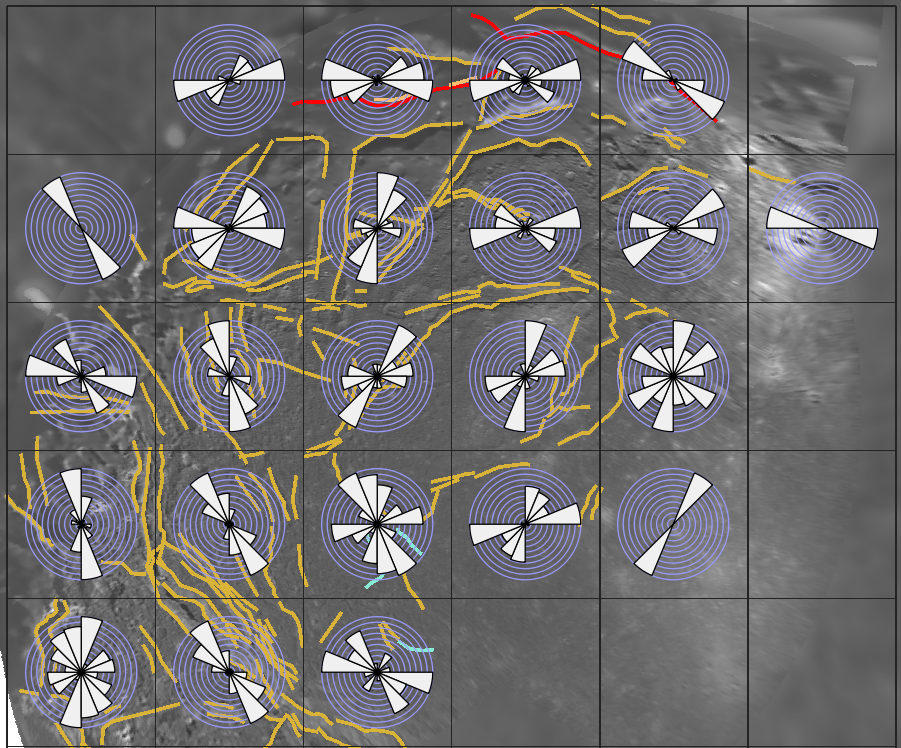
Introduction

Ariel, one of  Uranus’ icy satellites, has been known since the 19th century, with most of our current knowledge about its surface coming from the Voyager 2 flyby. Despite the limited number of images acquired during the mission, they remain the primary source of information onUranus’s icy moons. When combined with data from  more recent observations, such as those from the James Webb Space Telescope (JWST), they contribute to our understanding of the evolution of icy bodies by shedding light on both surface and subsurface processes.

Ariel's surface exhibits extensive resurfacing [1] and it is primarily composed of CO₂ and CO ices, and possibly NH-bearing species [2]. It is also considered as a candidate ocean world, potentially harboring a subsurface ocean [3]. The portion of Ariel’s terrain recorded by Voyager 2 has been mapped and classified into geological units based on both absolute and relative stratigraphic ages. Specifically, the Crater Plains unit is the oldest one with an estimated absolute age of approximately 1.3 – 0.6/+2.0 Ga [4] with a more tectonized region being 0.8 -0.5/+1.8 Ga, while three younger units have been identified through  relative dating with no absolute modeled age.

Given the diversity of surface features,such as medial grooves, fault scarps, grabens, deep troughs, and ridges [5],  conducted a detailed structural analysis is essential.This work aims to investigate the structural relationships among these features and explore their potential connection to Ariel’s subsurface. 

Data and Methods

For this study we used processed mosaics from Voyager 2 ISS images along with a digital elevation model (DEM) [1], both with a spatial resolution of 1 km. Building on previous mapping efforts [5] we are conducting additional mapping of structural features using QGIS software to perform the structural analysis. From this mapping, we derive statistical properties, such as feature orientation and lengths. To identify orientation patterns, we generate rose diagrams for different feature groups using the Line Direction Histogram plugin [6].

In addition, we analysed the DEM using VRGS software to investigate dip and dip direction trends via the Tensor Analysis inbuilt tool [7].

 Discussion and future work

The preliminary resulting orientation distribution of structural features, as shown in Figure 1, will provide insights into the stress field behavior of Ariel’s surface.  In the future, we will finalize the mapping deriving all the statistical properties of the analyzed surface features. Such investigation will help in reconstructing the influence of global processes such as tidal stress and contraction, as well as local processes associated with cryovolcanism and diapiric upwelling [8], [9]. Additionally, it will offer indirect evidence about Ariel’s interior, including possible subsurface ocean presence and internal layers differentiation. 

Figure 1. An example of the Rose diagrams with an applied grid of 300 km.

Indeed, to further investigate the icy crust, we will also apply fractal clustering methods to determine the possible thickness of icy fractured medium [10]. 

Acknowledgements: This activity has been developed under the ASI/UniBo-CIRI agreement n. 2024-5-HH.0.

References: [1] Schenk & Moore (2020) R. Soc. A 378. [2] Cartwright et al. (2024) ApJ Lett, 970, L29. [3] Castillo-Rogez et al. (2023) JGR Planets, 128, 1. [4] Kirchoff et al. (2022) Planet. Sci. J., 3, 2. [5] Beddingfield et al. (2025) Planet. Sci. J., 6, 2. [6] Tveite (2025) QGIS, Line direction histogram. [7] VRGeoscience Limited (2003) VRGS. [8] Barr & Hammond (2015) Phys. Earth Planet. Inter., 249, 18–27. [9] Beddingfield & Cartwright (2021) Icarus, 367, 114583. [10] Lucchetti et al. (2021) Planet. Space Sci., 195, 10514.

How to cite: Tonoian, S., Lucchetti, A., Massironi, M., Beddingfield, C. B., Penasa, L., Pajola, M., and Rossi, C.: Surface investigation of Ariel’s structural features, EPSC-DPS Joint Meeting 2025, Helsinki, Finland, 7–13 Sep 2025, EPSC-DPS2025-1554, https://doi.org/10.5194/epsc-dps2025-1554, 2025.

OPS7 | Aerosols and clouds in planetary atmospheres

EPSC-DPS2025-204 | ECP | Posters | OPS7 | OPC: evaluations required

Bridging Chemistry and Technology: The Dual Role of PAHs in Exoplanetary Atmospheres 
(withdrawn after no-show)

Dwaipayan Dubey, Karan Molaverdikhani, and Barbara Ercolano
Tue, 09 Sep, 18:00–19:30 (EEST)   Lämpiö foyer | L38

EPSC-DPS2025-420 | ECP | Posters | OPS7 | OPC: evaluations required

Revealing patchy clouds on WASP-43b and WASP-121b through coupled microphysical and hydrodynamical models 

Emeline Fromont, Thaddeus Komacek, Peter Gao, Hayley Beltz, Arjun Savel, Isaac Malsky, Diana Powell, Eliza Kempton, and Xianyu Tan
Tue, 09 Sep, 18:00–19:30 (EEST)   Lämpiö foyer | L41

Hot and ultra-hot Jupiters are currently the best observational targets to study the effects of clouds on exoplanet atmospheres. Observations have reported westward optical phase curve offsets, weak spectral features, and nightside temperatures remaining constant with increasing stellar flux, which may together be explained by the presence of exoplanetary clouds. Although there are many models that simulate the 3D structure and circulation of hot/ultra-hot Jupiters and many microphysical models describing the formation of clouds, very few models exist that couple these two approaches. This gap, along with recent JWST observations unmatched by models, suggests a need for more accurate models to track the formation of clouds as well as their radiative feedback on atmospheric circulation and dynamics. In this work, we couple two models to better understand how atmospheric dynamics and cloud microphysics in hot Jupiter atmospheres affect each other and the observable properties of such planets in the context of JWST data. We run cloudless 3D general circulation model (GCM) simulations using the SPARC/MITgcm for WASP-43b and WASP-121b, two hot/ultra-hot Jupiters that already have high-quality data from HST and recent JWST observations. We then feed the temperature-pressure profile outputs from the GCM simulations into 1D CARMA, which models the microphysics of mineral clouds in hot and ultra-hot Jupiter atmospheres. Finally, we use our coupled circulation and cloud formation results to calculate synthetic spectra with a ray-striking radiative transfer code and compare our results to emission and transmission observations of WASP-43b and WASP-121b. We find that various cloud species, including corundum, forsterite, and iron, form everywhere on WASP-43b and on the nightside and west limb of WASP-121b, perhaps explaining the most recent phase curve observations of these planets. We discuss implications for the interpretation of JWST/MIRI and JWST/NIRSpec observations of WASP-43b and WASP-121b respectively, with implications for the broader planetary population.

How to cite: Fromont, E., Komacek, T., Gao, P., Beltz, H., Savel, A., Malsky, I., Powell, D., Kempton, E., and Tan, X.: Revealing patchy clouds on WASP-43b and WASP-121b through coupled microphysical and hydrodynamical models, EPSC-DPS Joint Meeting 2025, Helsinki, Finland, 7–13 Sep 2025, EPSC-DPS2025-420, https://doi.org/10.5194/epsc-dps2025-420, 2025.

EPSC-DPS2025-453 | ECP | Posters | OPS7

Reactive uptake of SO2 in H2SO4 droplets under Venus-analogous conditions: Laboratory study using a single particle levitation method 

Soma Ubukata, Hiroki Karyu, Hiromu Nakagawa, Shungo Koyama, Rikuto Minamikawa, Takeshi Kuroda, Naoki Terada, and Masao Gen
Tue, 09 Sep, 18:00–19:30 (EEST)   Lämpiö foyer | L29

Heterogeneous reactions involving cloud particles are known to influence the chemical balance of planetary atmospheres. Understanding these interactions is especially important for Venus, where cloud particle chemistry likely plays a significant role in shaping the observed vertical distribution of sulfur dioxide (SO2). Observations show that the concentration of SO2 decreases by three orders of magnitude from the bottom to the top of the cloud layers. However, this SO2 depletion cannot be explained by gas-phase chemistry alone, suggesting a missing SO2 sink within the cloud layers. A potential mechanism for SO2 depletion is the reactive uptake of SO2 by cloud droplets, which is a well-documented process in Earth’s atmosphere, particularly in the presence of oxidants. However, it is highly uncertain whether the reactive uptake mechanism can contribute significantly to SO2 depletion in the cloud layers of Venus because the solubility of SO2 in sulfuric acid (H2SO4) is extremely low. This unaccounted-for pathway necessitates experimental validation under Venus-analogous conditions.

Here, we performed laboratory experiments to examine the uptake of SO2 by a single H2SO4 droplet of ~10 µm in the presence of nitrogen dioxide (NO2) as an oxidant for SO2 oxidation. A single sulfuric acid droplet was levitated using an electrodynamic balance (EDB), a device that uses electric fields to levitate a charged particle in mid-air. The droplet was levitated at ambient temperature (~298 K) and pressure (1 atm), conditions approximately corresponding to an altitude of 50-55 km on Venus. The radius of the droplet was determined by analyzing the Mie scattering spectrum of white light scattered by the droplet, allowing precise quantification of size growth due to reactive uptake.

We find that the size growth of the H2SO4 droplet occurs only when both SO2 and NO2 are present, indicating SO2 oxidation by NO2 within the droplet. The growth rate increases with NO2 concentration, and the reactive uptake coefficient of SO2, γ, is parameterized by the number density of NO2 (cm-3), nNO2, as log10 γ = 0.572 × log10 nNO2 - 15.03 . Numerical simulations suggest that γ = 10-7 is required to reproduce the observed SO2 concentration at the top of the cloud layer. Our results underscore that the reactive uptake of SO2 by droplets may play an important role in SO2 depletion in the Venusian cloud layers, warranting future observations of oxidants in the Venusian atmosphere.

How to cite: Ubukata, S., Karyu, H., Nakagawa, H., Koyama, S., Minamikawa, R., Kuroda, T., Terada, N., and Gen, M.: Reactive uptake of SO2 in H2SO4 droplets under Venus-analogous conditions: Laboratory study using a single particle levitation method, EPSC-DPS Joint Meeting 2025, Helsinki, Finland, 7–13 Sep 2025, EPSC-DPS2025-453, https://doi.org/10.5194/epsc-dps2025-453, 2025.

EPSC-DPS2025-1094 | ECP | Posters | OPS7 | OPC: evaluations required

Clearing the Air: Solar System Bodies as Windows into the Impact of Aerosols on Exoplanet Atmospheric Retrievals 

Lily Robinthal, Tyler D. Robinson, Tommi Koskinen, Franck Montemessin, and Guillaume Petzold
Tue, 09 Sep, 18:00–19:30 (EEST)   Lämpiö foyer | L39

Introduction: As we enter the next chapter in our characterization of exoplanet atmospheres with state-of-the-art telescopes such as the James Webb Space Telescope, the efficacy of our atmospheric retrieval pipelines is more important than ever. At present, these models share a major challenge: the parameterizations of aerosols such as clouds, dusts, and hazes. Aerosols are ubiquitous in the atmospheres of both Solar System bodies and exoplanets, but, by necessity, must be heavily simplified in exoplanet inference models. Understanding the impact of these aerosols on atmospheric spectra is key to deriving accurate compositional information from exoplanet atmospheric retrievals. Fortunately, we have the opportunity to use pre-existing Solar System observations to validate and improve exoplanet-focused approaches to representing aerosol structures. We derive aerosol profiles from occultation data of Solar System worlds with known atmospheric composition, such as Mars and Titan. These profiles provide an opportunity for ground-truth verification of exoplanet atmospheric characterization tools and allow us to improve our retrieval pipelines. 

We will be presenting aerosol profiles derived from occultation observations of Mars and Titan, as well as comparisons of these with parameterizations of aerosols in various exoplanet atmospheric retrieval models. We aim to understand if simplified model representations produce results that resemble real clouds and hazes and, if not, where we can improve, as well as determine what impact these simplifications have on retrievals.

Methods: This work involves two major stages. The first is to use the large collection of pre-existing Solar System occultation observations to create an empirically-driven database of aerosol structures. In the second stage, we  will use this ground truth to explore parameterizations of aerosols in exoplanet atmospheres and validate approaches to representing clouds/hazes in models.

For the first stage, our highest priorities are Mars and Titan, and we began with Mars. The Mars Atmosphere and Volatile Evolution (MAVEN) mission's Imaging Ultraviolet Spectrograph (IUVS) has taken 1719 occultation observations of Mars. The data are readily available in the Planetary Data System (PDS) in a derived format, which provides the aerosol optical depths at 1000 nm. There have been 48 occultation campaigns since the beginning of the mission, with campaigns occurring approximately every two months and each campaign consisting of order 10-100 individual occultation observations.

Concurrent with our analysis of the MAVEN IUVS data, we have also begun to explore occultation observations of Titan from Cassini’s UVIS instrument. Additionally, we are compiling exoplanet cloud parameterizations from different atmospheric retrieval pipelines which we will compare to our aerosol profiles.

World

Mission

Instrument

Band m)

Resolution

Date Range

No.

Venus

Venus Exp.

SPICAV-SOIR

2.3 – 4.2

0.2 cm−1

2007 – 2013

337

Earth

SCISAT -1

ACE-FTS

2 – 100

0.0025 cm−1

2004 –

10k+

Mars

MAVEN

IUVS

0.18 – 0.34

400 (λ/∆λ)

2015–

1719

Mars

TGO

NOMAD

0.2 – 4.3

> 0.15 cm−1

2018 –

10k+

Saturn

Cassini

VIMS-IR

0.85 – 5.1

16.6 nm

2005 – 2017

172

Saturn

Cassini

UVIS

0.11 – 0.19

0.28 nm

2006 – 2016

101

Titan

Cassini

VIMS-IR

0.85 – 5.1

16.6 nm

2004 – 2016

38

Titan

Cassini

UVIS

0.11 – 0.19

0.28 nm

2006 – 2016

15

Pluto

New Hor.

Alice

0.052 – 0.19

0.3–0.6 nm

2015

2

Table 1: A selection of the mission data being considered in this work.

Results: We have derived slant aerosol profiles for 45 Maven IUVS occultation campaigns, two of which are shown below.

Figure 1: Aerosol profiles from MAVEN’s campaign 24, taken from 9/12/2018-9/13/2018 (left) and 30, taken from 11/11/2019-11/12/2019 (right).

These plots extend to an altitude of 90 km, corresponding to the MUV range of the IUVS instrument. Aerosol extinction above this altitude, corresponding to the FUV range of the instrument, is unable to be confidently distinguished from the CO2 signal, so we have not included this range. The data become noisy around 60 km due to the transition from the MUV channel to the FUV channel. These profiles show a consistent structure of  higher optical depths at low altitudes, in accordance with opacity due to dust at low altitudes on Mars.

Future Work: Our next step will be to construct aerosol profiles for Titan with Cassini’s UVIS occultation observations. We will investigate aerosol parameterizations in a variety of exoplanet models and retrieval pipelines to compare to the Martian aerosol profiles as well as those we derive for Titan. We will then continue compiling aerosol profiles using occultation data of Venus, Earth, Saturn and Pluto to expand our catalog of ground-truth calibrations. We will subsequently compare these to the exoplanet parameterizations, with the ultimate goal of improving the efficacy of retrieval pipelines and deriving more accurate atmospheric composition information from transit observations of exoplanet atmospheres.

How to cite: Robinthal, L., Robinson, T. D., Koskinen, T., Montemessin, F., and Petzold, G.: Clearing the Air: Solar System Bodies as Windows into the Impact of Aerosols on Exoplanet Atmospheric Retrievals, EPSC-DPS Joint Meeting 2025, Helsinki, Finland, 7–13 Sep 2025, EPSC-DPS2025-1094, https://doi.org/10.5194/epsc-dps2025-1094, 2025.

OPS8 | Jupiter's and Saturn's Atmospheres

EPSC-DPS2025-143 | Posters | OPS8 | OPC: evaluations required

Jovian Zonal Winds Revealed from Cassini/VIMS Observations 

shenghan ma, Yuming Wang, Tao Li, Quanhao Zhang, Jiajia Liu, and Ruobing Zheng
Thu, 11 Sep, 18:00–19:30 (EEST)   Lämpiö foyer | L36

Understanding Jupiter's zonal winds is crucial for unraveling the dynamics of Jupiter’s atmosphere. Multiple facilities were used to derive zonal winds using various methods. Here, we develop a correlation-based method for the near-infrared data from the Cassini spacecraft to investigate zonal winds at different altitudes. The new method establishes the capability to process the Cassini/VIMS-IR spectral data with a low spatial/temporal resolution and a non-uniform cadence. By applying this method to the episode during 2001, January 15, 9:42 UT – January 16, 3:22 UT, we reveal the zonal winds at three different wavebands and latitudes as well as the wind vertical structure at the equator, showing significant vertical wind shear in the troposphere. The vertical wind shear we derived is weaker than reported in previous studies, highlighting the intricate interactions among multiple dynamical processes in Jupiter's atmosphere and reflecting the complexity of its atmospheric circulation. More observations in the future are essential to explore the underlying mechanisms in Jupiter's atmosphere.

How to cite: ma, S., Wang, Y., Li, T., Zhang, Q., Liu, J., and Zheng, R.: Jovian Zonal Winds Revealed from Cassini/VIMS Observations, EPSC-DPS Joint Meeting 2025, Helsinki, Finland, 7–13 Sep 2025, EPSC-DPS2025-143, https://doi.org/10.5194/epsc-dps2025-143, 2025.

EPSC-DPS2025-643 | ECP | Posters | OPS8 | OPC: evaluations required

Experimental study of the interference dips observed on the collision-induced absorption fundamental band of H2: their relevance to planetary atmosphere characterization 

Francesca Vitali, Stefania Stefani, Giuseppe Piccioni, Marcel Snels, Davide Grassi, David Biondi, and Angelo Boccaccini
Thu, 11 Sep, 18:00–19:30 (EEST)   Lämpiö foyer | L46

Introduction: The atmospheres of the gaseous and icy giant planets represent a high-density environment whose composition is generally dominated by H2 and He.

Consequently, the H2 Collision-Induced Absorption (CIA) represents one of the main opacity sources in the near-infrared spectral range between 1 and 5 μm. This is a spectral range widely investigated for Jupiter not only by ground-based instruments, but also from space, presently through the eyes of JIRAM on board JUNO, JWST, and in future also of MAJIS on board JUICE.

Jupiter, in fact, represents an archetype for the giants’ gaseous planets, and the understanding of its magnetosphere, composition, and opacity of its dense and complex atmosphere are all important elements for the most comprehensive view about how the Jupiter system(s) works.

In this work, we performed an experimental study of the H2 CIA in the [3600, 5500] cm-1 spectral range at high resolution, to investigate not only the overall opacity due to the CIA, but also to study the narrow features called interference dips, not taken into account by the existing models.

Experimental setup: The experimental setup employed here is called PASSxS (Planetary Atmosphere Simulation System x Spectroscopy) [1]. It consists of a simulation chamber that contains a Multi-Pass cell coupled with an IR Fourier spectrometer (FTIR) and aligned to reach an optical path of 3.28 m. The chamber can be heated up to 550 K, cooled down to 100 K, and sustain pressures up to 70 bar. The FTIR has a maximum spectral resolution of 0.002 cm-1.

A picture of the setup can be visualized in Figure 1.

Figure 1: Experimental setup, consisting of a Fourier Spectrometer coupled with a simulation chamber (in grey behind the FTIR)

Results and discussion: Binary absorption coefficients due to both the H2-H2 and H2-He collisions in the [3600, 5500] cm-1  spectral range for temperatures going from 120 to 500 K has been recently published in [2]. Superimposed on the CIA absorption, some narrow features have been observed at all the temperatures. These interference dips correspond with a smaller absorption at specific frequencies with respect to the overall CIA band contour.

They have been previously observed in other experimental works [3-7] at temperatures up to 300 K. To study the behavior of those features with density and temperature, we performed measurements of the H2 CIA fundamental band at a resolution of 0.05 cm-1, temperatures from 305 to 499 K, and different pressures.

Figure 2 shows the measured absorption coefficients for three pressures at 399 K.

Figure 2: Experimental absorption coefficients measured at 399 K for three different pressures

The interference dips are well visible on the left side of the main peak of the band.

Furthermore, they are also present around 4161 cm-1, 4500 cm-1, 4700 cm-1, and 4900 cm-1, but the latter three are superimposed on several sharp absorption lines due to the H2 quadrupolar transitions, located approximately in the centre of the dips.  

The phenomenon generating those dips has been previously investigated by Van Kranendonk [8]. They are caused by the interference of induced dipole moments in consecutive collisions and are not reproduced by the existing CIA model simulations.

Van Kranendonk calculated a symmetric theoretical profile to describe their shape as a function of the intracollisional halfwidth δ and the frequency of the dip’s peak νc.

He also predicted a linear behavior of the intracollisional halfwidth with density.

However, Kelley and Bragg [5] observed an asymmetry of the main peak of the dips. Consequently, they used a modified version of Van Kranendonk’s profile by adding a phase α to fit the asymmetric line profiles as shown Equation 1.

Equation 1: Asymmetric profile [5]

We used their profile to fit the Q(1) dip near 4155 cm-1 for all the pressures considered at the investigated temperatures and retrieve the δ parameter.

Figure 3 shows the fit performed over the Q(1) dip measured at 12.7 bar and 399 K.

Figure 3: Q(1) interference dip (black solid line) measured at 399 K and 12.7 bar. The light blue dotted line represents the fit made with the asymmetric profile [4].

The intracollisional halfwidth has been then plotted against the density, finding a linear behavior for all three temperatures considered, 305 K, 399 K, and 499 K, as can be seen in Figure 4, as expected by Van Kranendonk's theory.

Figure 4: Behavior of the intracollisional halfwidth (δ) with density for the three temperatures considered

CIA of H2 plays an important role in investigating Jupiter’s atmosphere, and accurate laboratory measurements along with models are of primary importance to study the chemistry and physical properties of a gas giant atmosphere.

Laboratory data can also potentially provide additional elements, such as the dependence of the interference dips on density, that can extend the retrieval of atmospheric parameters otherwise difficult to access.

References:

[1] M. Snels et al. (2021), AMT 14, 7187–7197,

https://doi.org/10.5194/amt-14-7187-2021.

[2] Vitali F. et al. (2025), JQSRT, Vol. 330, doi: https://doi.org/10.1016/j.jqsrt.2024.109255

[3] J. D. Poll et al (1975), Can. J. Phys., 53, 954

[4] A. R. McKellar et al. (1975), Can. J. Phys., 53, 2060

[5] J. D. Kelley et al. (1984), Phys. Rev. A, 29, 1168

[6] J. P. Bouanich et al. (1990), JQSRT, 44, 4

[7] J. Westberg et al. (2025), Optics Express, 33, 5

[8] Van Kranendonk J. (1968), Canadian Journal of Physics, Vol. 46 N.10,

doi: https://doi.org/10.1139/p68-150

Acknowledgments:  This work has been developed under the ASI-INAF agreement n. 2023-6-HH.0. The upgrade (in progress) of this experimental setup is partially funded by the EMM (Earth Moon Mars) project of PNRR (task 1500-13).


How to cite: Vitali, F., Stefani, S., Piccioni, G., Snels, M., Grassi, D., Biondi, D., and Boccaccini, A.: Experimental study of the interference dips observed on the collision-induced absorption fundamental band of H2: their relevance to planetary atmosphere characterization, EPSC-DPS Joint Meeting 2025, Helsinki, Finland, 7–13 Sep 2025, EPSC-DPS2025-643, https://doi.org/10.5194/epsc-dps2025-643, 2025.

EPSC-DPS2025-1624 | ECP | Posters | OPS8 | OPC: evaluations required

The Role of Bottom Thermal Forcing on Modulating Baroclinic Instability in a Jupiter GCM 

Xinmiao Hu, Peter Read, Roland Young, and Greg Colyer
Thu, 11 Sep, 18:00–19:30 (EEST)   Lämpiö foyer | L45
The atmospheric circulation of Jupiter is shaped by a complex interplay between deep internal processes and cloud-level dynamics. Numerical simulations and observational analyses have suggested that Jupiter’s mid-latitude jets are strongly influenced by baroclinic instability [1], which is governed by the planet’s atmospheric thermal structure. Jupiter emits a substantial intrinsic heat flux originating from its interior. Past modelling efforts [2, 3] have demonstrated that this internal energy plays a key role in shaping large-scale atmospheric dynamics.

Our previous work [4] showed that latitudinal variations in interior heat flux can significantly impact the structure and behaviour of Jupiter’s mid-latitude jets in a General Circulation Model (GCM).  Such an impact is best illustrated by the relative vorticity snapshots from two simulations with the lowest and highest latitudinal flux gradient (see Figure 1). In this study, we present a more detailed analysis linking these jet modifications to changes in the atmospheric thermal structure and, consequently, to the strength and distribution of baroclinic eddy activity. In particular, we use the Lorenz energy cycle framework to diagnose how variations in deep thermal forcing influence baroclinic energy conversion and eddy-mean flow interactions. We further examine the implications for meridional transport and the water cycle within Jupiter’s weather layer.

Additionally, we present a control simulation in which the potential temperature at the model’s lower boundary is forced toward a fixed value (a deep adiabat setup). We compute the equivalent upward heat flux associated with this forcing to place it in the context of previous models that impose constant or latitudinally varying interior heat flux. This allows a direct comparison of how different representations of deep thermal forcing affect upper-atmospheric dynamics.

Finally, we discuss the broader implications of these findings for future weather-layer models of Jupiter and other gas giant planets, especially on the effect of bottom boundary conditions in representing the coupling between deep and observable atmospheric dynamics.


Figure 1: Mollweide projection of the relative vorticity at 1 bar at the end of two simulations.


Reference:
[1] Read, P. L. (2023). The dynamics of Jupiter’s and Saturn’s weather layers: a synthesis after Cassini and Juno. Annual Review of Fluid Mechanics, 56(1), 271–293. https://doi.org/10.1146/annurev-fluid-121021-040058
[2] Liu, J., & Schneider, T. (2011). Convective Generation of Equatorial Superrotation in Planetary Atmospheres. Journal of the Atmospheric Sciences, 68(11), 2742-2756. https://doi.org/10.1175/JAS-D-10-05013.1
[3] Young, R. M. B., Read, P. L., & Wang, Y. (2018). Simulating Jupiter’s weather layer. Part I: Jet spin-up in a dry atmosphere. Icarus, 326, 225–252. https://doi.org/10.1016/j.icarus.2018.12.005
[‌4] Hu, X. and Read, P.: Latitudinal Variation in Internal Heat Flux in Jupiter's Atmosphere: Effect on Weather Layer Dynamics, Europlanet Science Congress 2024, EPSC2024-669, https://doi.org/10.5194/epsc2024-669, 2024.

How to cite: Hu, X., Read, P., Young, R., and Colyer, G.: The Role of Bottom Thermal Forcing on Modulating Baroclinic Instability in a Jupiter GCM, EPSC-DPS Joint Meeting 2025, Helsinki, Finland, 7–13 Sep 2025, EPSC-DPS2025-1624, https://doi.org/10.5194/epsc-dps2025-1624, 2025.

OPS9 | Giant Planet Interiors, Atmospheres, and Evolution

EPSC-DPS2025-155 | ECP | Posters | OPS9 | OPC: evaluations required

Giant Planet Formation in the Solar System 

Anuja Raorane, Ramon Brasser, Soko Matsumura, Tommy Lau, Man Hoi Lee, and Audrey Bouvier
Thu, 11 Sep, 18:00–19:30 (EEST)   Lämpiö foyer | L51

The formation of gas giants has greatly influenced the structure of our solar system while their evolution has played a crucial role in shaping its history. Consequently, the growth of Jupiter has been studied quite extensively. However, little attention has been paid to Saturn and the other giants in the outer solar system.

Here we explore, through 𝑁-body simulations, the implications of the simplest disc and pebble accretion model on the formation of the giant planets in the solar system. A steady-state accretion scenario with an assumed ring structure in the disc at 5 AU was adopted for the simulations. A 10-parameter space was explored, including disk parameters related to gas — such as the gas diffusion rate and the strength of disk turbulence — as well as parameters concerning planetesimals, including their number, mass, and spatial distribution.

In this framework, giant planet formation is most sensitive to the accretion sticking efficiency in addition to all the gas disk parameters. The probability distribution of the final location of the giant planets is approximately constant in log r, suggesting there is a slight preference for formation closer to the Sun, but no preference for more massive planets to form closer. We compute the average formation time for proto-Jupiter to reach 10 Earth masses to be 1.1 ± 0.3 Myr and for proto-Saturn 3.3 ± 0.4 Myr, while for the ice giants this increases to ~5 Myr.

The formation timescales of the cores of the gas giants are distinct, suggesting that they formed sequentially. Accordingly, ice giants formed at the very end of the gas disc’s lifetime resulting in their low gas mass. A larger parameter space and extended simulation times are required to capture the full range of possible outcomes, with particular emphasis on producing all three types of giant planets within a single simulation.

How to cite: Raorane, A., Brasser, R., Matsumura, S., Lau, T., Lee, M. H., and Bouvier, A.: Giant Planet Formation in the Solar System, EPSC-DPS Joint Meeting 2025, Helsinki, Finland, 7–13 Sep 2025, EPSC-DPS2025-155, https://doi.org/10.5194/epsc-dps2025-155, 2025.

EPSC-DPS2025-413 | ECP | Posters | OPS9

Toward a Comprehensive Global Climate Model of Uranus: Radiative-Convective and Dynamical Simulations 

Caleb Keaveney and Juan Lora
Thu, 11 Sep, 18:00–19:30 (EEST)   Lämpiö foyer | L50

Uranus is a unique world in the solar system, with its extreme obliquity and low apparent internal heat flux raising compelling atmospheric and climate dynamics questions. Observations reveal an altogether different circulation regime from the gas giants, with a single mid-latitude prograde jet in each hemisphere and a weak subrotating equatorial jet. Indications of a warm equator and poles with cool mid-latitudes, as well as density gradients associated with nonuniform abundance of methane and hydrogen sulfide, can be linked to vertical motion in the upper atmosphere and vertical structure in the jets (Fletcher et al., 2021). Multiple haze and aerosol layers are likely present as well, which are a major component of the atmosphere’s radiation budget (Irwin et al., 2022). All these observations suggest a complex climate system and global circulation, but they do not provide an especially clear or self-consistent model. This motivates greater observational efforts which are ongoing, particularly with the development of the Uranus Orbiter and Probe mission. However, such efforts will take a long time to get off the ground, and long-term variability in the Uranus climate system cannot be studied directly with observations due to the long orbital period and radiative timescales. Thus, global climate modeling is necessary to fully understand the dynamics of the Uranian climate.

Here we present progress on the development of a comprehensive general circulation model (GCM) for Uranus to investigate climatic processes. The GCM is built on the GFDL Finite-Volume Cubed-Sphere (FV3) dynamical core, which solves the nonhydrostatic Euler equations for a shallow atmosphere on a highly parallelizable finite-volume grid (Harris et al., 2021). We have made modifications to incorporate Uranus’s planetary constants, extend the model bottom to higher pressures, and introduce parameterizations of unresolved physical processes relevant for Uranus. These include several options, of varying complexity, to parameterize radiative heating and cooling: Newtonian cooling; a two-stream gray radiation scheme based on Liu & Schneider (2010); and a correlated-k radiative transfer scheme modified from Lora et al. (2015), including full opacity contributions from molecular and collision-induced absorption, Rayleigh scattering, and scattering and absorption by aerosol layers as described by Irwin et al. (2022).

Our work focuses on understanding jet formation and overturning circulations driven by baroclinic eddies and momentum transport in Uranus's atmosphere. The connection between this global circulation and chemical tracer gradients—particularly methane and hydrogen sulfide—is another area of interest, as is the influence of Uranus’s extreme seasonal forcing, which remains poorly understood. The hierarchy of simulation complexity enabled by our various model configurations will enable us to diagnose the dominant mechanisms controlling Uranus's climate. The temperature and wind structures simulated with a simple Newtonian cooling case, which show the development of mid-latitude prograde jets and an equatorial retrograde jet, are consistent with observations (Figure 1). The prograde jets are eddy-driven as indicated by the distribution of eddy angular momentum flux divergence, which reveals deposition of prograde angular momentum into the mid-latitudes by baroclinic Rossby waves. Prograde angular momentum is fluxed out of low latitudes in the process, resulting in a weak subrotating jet centered on the equator. Associated with these jets are three meridional overturning cells. Separately, the correlated-k radiative transfer scheme, including all opacity contributions, an enthalpy-conservative dry convective adjustment scheme, and a thermosphere heat conduction scheme (Milcareck et al., 2024) produces a Uranus-like vertical temperature profile (Figure 2) between 10 bar and the lower stratosphere, with a too-cold upper stratosphere, consistent with previous modeling challenges. We will show progress in integrating this correlated-k radiative transfer scheme with the GCM dynamics, with simulations including full seasonally varying radiation, a weak intrinsic heat flux, and a parameterization of interior drag.

Figure 1: Zonal and time mean temperature (top) and zonal wind (bottom) for Newtonian cooling simulation over one Uranus year.

Figure 2: Radiative-convective equilibrium temperature profiles from correlated-k radiative transfer scheme. Blue curve shows global mean simulation, green shows equatorial profile, red shows Orton et al. (2014) observations. 

References

Fletcher, L. N., de Pater, I., Orton, G. S., Hofstadter, M. D., Irwin, P. G. J., Roman, M. T., & Toledo, D. (2020). Ice Giant Circulation Patterns: Implications for Atmospheric Probes. Space Science Reviews, 216(2), 21. https://doi.org/10.1007/s11214-020-00646-1

Irwin, P. G. J., Teanby, N. A., Fletcher, L. N., Toledo, D., Orton, G. S., Wong, M. H., Roman, M. T., Pérez-Hoyos, S., James, A., & Dobinson, J. (2022). Hazy Blue Worlds: A Holistic Aerosol Model for Uranus and Neptune, Including Dark Spots. Journal of Geophysical Research: Planets, 127(6), e2022JE007189. https://doi.org/10.1029/2022JE007189

Harris, L., Chen, X., Putman, W., Zhou, L., & Chen, J.-H. (2021). A Scientific Description of the GFDL Finite-Volume Cubed-Sphere Dynamical Core. Geophysical Fluid Dynamics Laboratory. https://repository.library.noaa.gov/view/noaa/30725

Liu, J., & Schneider, T. (2010). Mechanisms of jet formation on the giant planets. Journal of the Atmospheric Sciences, 67(11), 3652–3672. https://doi.org/10.1175/2010JAS3492.1

Lora, J. M., Lunine, J. I., & Russell, J. L. (2015). GCM simulations of Titan’s middle and lower atmosphere and comparison to observations. Icarus, 250, 516–528. https://doi.org/10.1016/j.icarus.2014.12.030

Milcareck, G., Guerlet, S., Montmessin, F., Spiga, A., Leconte, J., Millour, E., Clément, N., Fletcher, L. N., Roman, M. T., Lellouch, E., Moreno, R., Cavalié, T., & Carrión-González, Ó. (2024). Radiative-convective models of the atmospheres of Uranus and Neptune: Heating sources and seasonal effects. Astronomy & Astrophysics. http://arxiv.org/abs/2403.13399

Orton, G. S., Moses, J. I., Fletcher, L. N., Mainzer, A. K., Hines, D., Hammel, H. B., Martin-Torres, J., Burgdorf, M., Merlet, C., & Line, M. R. (2014). Mid-infrared spectroscopy of Uranus from the Spitzer infrared spectrometer: 2. Determination of the mean composition of the upper troposphere and stratosphere. Icarus, 243, 471–493. https://doi.org/10.1016/j.icarus.2014.07.012

How to cite: Keaveney, C. and Lora, J.: Toward a Comprehensive Global Climate Model of Uranus: Radiative-Convective and Dynamical Simulations, EPSC-DPS Joint Meeting 2025, Helsinki, Finland, 7–13 Sep 2025, EPSC-DPS2025-413, https://doi.org/10.5194/epsc-dps2025-413, 2025.

EPSC-DPS2025-730 | ECP | Posters | OPS9 | OPC: evaluations required

Conditions for stable layers in Jupiter and Saturn over time 

Louis Siebenaler and Yamila Miguel
Thu, 11 Sep, 18:00–19:30 (EEST)   Lämpiö foyer | L53

Interior models of giant planets in the Solar System traditionally assume convection as the dominant heat transport mechanism in the molecular hydrogen envelope. However, several observations of Jupiter are challenging to explain under this assumption, including the measured abundances of CO and water in the atmosphere, as well as the depth of the zonal winds. A stable layer located around the kilobar level has been proposed to reconcile these observations, an idea that has gained more support with recent Juno measurements of alkali metals, which suggest a depletion in the deep atmosphere. While the presence of a stable layer around the kilobar level appears promising, the degree of alkali depletion required to sustain it remains unclear.

In this work, we compute new opacity tables to determine the specific atmospheric compositions that can give rise to stable stratification in the outer envelopes of Jupiter and Saturn. Using evolution models, we investigate the long-term conditions that allow stable layers to persist, and how their depth changes over time. In addition, we investigate how stable layers influence key observables, such as the effective temperature and the atmospheric helium abundance.

How to cite: Siebenaler, L. and Miguel, Y.: Conditions for stable layers in Jupiter and Saturn over time, EPSC-DPS Joint Meeting 2025, Helsinki, Finland, 7–13 Sep 2025, EPSC-DPS2025-730, https://doi.org/10.5194/epsc-dps2025-730, 2025.

EPSC-DPS2025-1293 | ECP | Posters | OPS9 | OPC: evaluations required

From Jupiter to Saturn: Characterizing Interior Structures with Machine Learning 

Maayan Ziv, Eli Galanti, and Yohai Kaspi
Thu, 11 Sep, 18:00–19:30 (EEST)   Lämpiö foyer | L49

Understanding the interiors of both Jupiter and Saturn is essential for building a consistent picture of giant planet formation and evolution. While the two planets share many similarities, each provides unique observational windows into its internal structure: Jupiter through atmospheric abundances measured by the Galileo entry probe and the Juno mission, and Saturn through oscillation modes detected via ring seismology. In both cases, high-precision gravity measurements, by Juno for Jupiter and Cassini for Saturn, offer strong constraints on interior models. However, despite their accuracy, these measurements cannot uniquely determine the internal structure, given the complexity and variability of possible structural configurations.

To address this, we develop a unified modeling framework that combines NeuralCMS, a deep neural network trained on interior models computed with the concentric Maclaurin spheroid (CMS) method, with a self-consistent wind model. This approach enables efficient exploration of a wide parameter space of Jupiter interior models without relying on prior assumptions. Using clustering analysis on the multidimensional model space, we identify four key classes of interior structures, characterized by differences in core configuration and envelope properties. We also show that Jupiter’s structure can be effectively described using only two key parameters, significantly reducing the complexity of the problem.

We then extend this approach to model Saturn’s interior, enabling a systematic and meaningful comparison between the two planets within a shared framework. The comparative analysis provides a broader perspective on the diversity of giant planet interiors and the processes that shape them. This work demonstrates the value of unified, data-driven modeling approaches in advancing our understanding of giant planet interiors across the Solar System.

How to cite: Ziv, M., Galanti, E., and Kaspi, Y.: From Jupiter to Saturn: Characterizing Interior Structures with Machine Learning, EPSC-DPS Joint Meeting 2025, Helsinki, Finland, 7–13 Sep 2025, EPSC-DPS2025-1293, https://doi.org/10.5194/epsc-dps2025-1293, 2025.

MITM2 | Planetary Missions, Instrumentations, and mission concepts: new opportunities for planetary exploration

EPSC-DPS2025-65 | ECP | Posters | MITM2 | OPC: evaluations required

Modelling the Radiative Environment of the Lunar South Pole Aitken basin.  

Monty Rix, William Shields, and Richard Ghail
Tue, 09 Sep, 18:00–19:30 (EEST)   Finlandia Hall foyer | F66

A unique virtual model of the interactions between galactic cosmic rays (GCRs) and the regolith in the Von Kármán crater in the South Pole Aitken basin (SPA basin) has been constructed using the BDSIM particle simulation environment, built on the Geant4 physics code. This project is the first use of BDSIM to model an extraterrestrial environment.

The model consists of a new synthetic composition for the regolith surrounding the Chang’e-4 probe, a series of GCR spectra and a simulation architecture. This measures the neutron flux, proton albedo and cosmogenic samarium and gadolinium populations within a 2-metre depth homogenous tranche of simulated lunar material. It was configured partly to produce secondary neutron production rates to be used as inputs to the LUCRES regolith gardening simulator.

Fig 1: Flowchart of the project, with references to internal sections.

The input composition is a synthesis of Kaguya orbiter, Yutu-2 and Chang’e-6 sample return data taken synthesised from various sources into an approximation of the elemental weight percent of the regolith in the Von Kármán crater, with major, minor and trace elements modelled. These data were analysed to give a mineral distribution of olivine, clinopyroxene, orthopyroxene and feldspar and then processes with numerical tools from Bütner and Putirka to produce elemental weight percentages for major element components. The minor element, Titanium, was sourced from Yutu-2 observations and converted into elemental weight percent using the previously described methods. The trace element distributions were taken from Chang’e-6 data and selected for this purpose by matching the bulk composition of Chang’e-6 regolith samples to that of the synthetic Von Kármán samples described previously.

The simulation input GCR spectrum that was fired at the lunar material was a recreation of the spectrum described by Li et al. While some of the authors for LUCRES provided a detailed GCR spectrum (mainly protons and alpha particles), their data and physics lists were difficult to integrate into BDSIM. Therefore, the project used the GCR model from Li et al. (2017), which was already compatible with Geant4. Though LUCRES collaborators noted that different solar modulation factors (a parametrisation of the sun’s effect on interstellar galactic cosmic rays) affect neutron flux, this study found that higher-energy GCRs (which are less affected by modulation) are primarily responsible for neutron production. In contrast, lower-energy GCRs (more affected by modulation) significantly influence proton albedo, although this was less apparent in the results of this project. As a result, different modulation factors were tested in simulations to assess their impact on albedo. The GCR spectrum was modelled in BDSIM as an external source of particles and generated a Monte-Carlo sampled particle distributions according to the chosen modulation factors.

Proton albedo was measured within the simulation with a scoring mesh at the surface that recorded retrograde movement of protons. Two different solar modulation factors (ϕ) were tested and showed that there is limited difference between the albedo distributions for different values of ϕ at this significance level. The outputs of this simulation are shown in fig 2 with proton albedo data from the Chang’e-4 rover (LND) and the Lunar Reconnaissance Orbiter (CRaTER). These data fall directly onto the curve of the proton albedo produced in this simulation, and the REDMoon simulation used by Xu et al (2022) falls within the bounds of the BDSIM simulation. The left side of the REDMoon simulation (between 60 and 10 MeV) diverges from the BDSIM simulation as the REDMoon simulation uses a different GCR input (CREME96) that has a solar particle contamination at the lower energies, as shown in the blue band in the figure. This contamination is not present in the BDSIM input and has been removed from the current version of the CRÈME GCR simulation.

Fig 2: Proton albedo from BDSIM shown with that of Xu et al (using REDMoon).

Neutron flux was simulated as a function of depth within the regolith column. Total neutron populations were measured, but the thermal neutron flux that causes cosmogenic Sm and Gd production was too low to be statistically significant. While cosmogenic Sm and Gd were produced in this simulation, future runs will require larger numbers of incident particles to produce significant thermal neutron induced Sm and Gd populations, which can be used in the gardening simulation LUCRES. Analysis of the meteorite NWA 2995 in conjunction with the BDSIM total neutron flux distribution at depth shows that the thermal neutron flux peak may be deeper into the regolith than the total neutron flux peak.

Fig 3: Neutron flux in regolith tranche with sample NWA 2995 shown at predicted depth and the point on curve (pink triangle). This demonstrates the difference in depth of peak all neutron and thermal neutron flux.

This project suggests an inquiry to settle the dispute between the BDSIM and REDMoon proton albedo predictions at the lower energy ranges may be of value to make sure use of different GCR models are appropriate in future predictions. The architecture of BDSIM can be used to produce static profiles of future drill cores that can be collected in the planned future exploration of the SPA basin, primarily by the Chinese space program. No drill cores have been collected from the Moon in the last half a century, and simulations like this (and the challenges with their configuration) show how crucial this kind of sample can be to the understanding of space weathering processes like gardening and GCR interactions. The SPA basin is extremely understudied compared to other lunar terranes, and the authors strongly suggest this region as an ideal candidate for human exploration, especially in the context of drill core return, as such samples have only ever been collected by humans.

This project therefore recommends the deployment of a segmented silicon solid state proton dosimetry device at the surface of the Moon to measure albedo within the 10-60 MeV range and the return of a regolith drill core for the analysis for cosmogenic samarium and gadolinium populations with comparative analysis with other material thought to be from the SPA region.

How to cite: Rix, M., Shields, W., and Ghail, R.: Modelling the Radiative Environment of the Lunar South Pole Aitken basin. , EPSC-DPS Joint Meeting 2025, Helsinki, Finland, 7–13 Sep 2025, EPSC-DPS2025-65, https://doi.org/10.5194/epsc-dps2025-65, 2025.

EPSC-DPS2025-71 | ECP | Posters | MITM2 | OPC: evaluations required

Flux Gate Magentometer and Boom for Cubesat Mission Beyond Low Earth Orbit 

Marius Anger, Roman Shalamov, Raphael Steinhoefler, David Fischer, and Jaan Praks
Tue, 09 Sep, 18:00–19:30 (EEST)   Finlandia Hall foyer | F65

The Foresail-2 and Foresail-3 satellites form part of the COnstellation of Radiation BElt Survey (CORBES), a mission led by COSPAR to study the dynamics of Earth's radiation belts [Wu et al., 2024]. 
Designed to advance our understanding of space weather, the mission requires highly precise magnetospheric measurements to capture proxies of geomagnetic activity and radiation belt behaviour [Anger et al., 2023]. 
To this end, each satellite in the constellation is outfitted with a state-of-the-art fluxgate magnetometer.

The Fluxgate Magnetometer Aboard the ForeSail cubesaT (MAST) was developed by the Space Research Institute of the Austrian Academy of Sciences (IWF). 
MAST is a miniaturized, CubeSat-optimized adaptation of the technology employed in the FIELDS instrument suite aboard NASA's Magnetospheric Multiscale (MMS) mission [Torbert et al., 2016]. 
Central to this innovation is the Magnetometer Frontend Application-Specific Integrated Circuit (MFA), which has been comprehensively redesigned and miniaturized to meet the strict size, mass, and power constraints of nanosatellite platforms.

To ensure accurate magnetic measurements for this mission, the sensor must be mounted at least 50 centimetres from the spacecraft bus to mitigate magnetic contamination from onboard electronics. 
It communicates with the Instrument Control Unit (ICU)—located within the satellite—via UV-protected twisted pair cables, which help suppress electrical interference. Despite its advanced capabilities, the ICU is remarkably compact, occupying a volume of just 14.6 by 8.4 by 3 cm³.

System-level testing has confirmed robust communication between the magnetometer and the satellite’s command and data handling system using a redundant RS485 interface. 
To further validate the full sensor system, a preliminary boom deployment test was conducted using a 3D-printed prototype of the magnetometer boom. 
This early-stage test confirmed the mechanical design and deployment mechanics under controlled conditions. 
Following the successful prototype trial, a metallic flight-like version of the boom has been manufactured and is currently undergoing rigorous functional and environmental testing. 
These tests aim to verify the boom's deployment reliability, structural integrity, and tolerance to launch and space conditions, ensuring its suitability for both the CORBES mission and potential adaptation in future deep space applications.

While initially designed for near-Earth space weather monitoring, the MAST architecture is scalable and holds significant potential for use in interplanetary and planetary missions. Accurate magnetic field measurements are fundamental not only for radiation belt studies, but also for understanding the solar wind interaction with planetary magnetospheres, crustal magnetic anomalies, and plasma environments throughout the solar system.

Future adaptations of the MAST system could support deep space missions to bodies such as Mars, Jupiter’s moons, or asteroids, where magnetic field characterization contributes to objectives ranging from habitability assessment to planetary formation studies. 
The low mass and power footprint of the MAST system makes it particularly attractive for resource-constrained platforms, such as small satellite constellations, ride-along payloads, or even instrument packages on landers and rovers.

By building on the technical developments from the CORBES initiative and the heritage of the MMS mission the MAST system provides a solution for magnetic field investigations across a wide spectrum of space science missions—from low Earth orbit to the outer solar system.

[Wu et al. 2024] Wu J., Deng L., Praks J. et al. ”CORBES: radiation belt survey with international small satellite constellation”, Advances in Space Research, 2024, https://doi.org/10.1016/j.asr.2024.04.051
[Anger et al. 2023] Anger M., Niemel¨a P., Cheremetiev K. et al. ”Foresail-2: Space Physics Mission in a Challenging Environment”, Space Sci Rev 219, 66, 2023, doi: 10.1007/s11214-023-01012-7
[Torbert et al. 2016] Torbert RB., Russell CT., Magnes W. et al., ”The fields instrument suite on MMS: scientific objectives, measurements, and data products”, Space Sci Rev, 2016, 199:105–135, doi: 10.1007/s11214-014-0109-8

How to cite: Anger, M., Shalamov, R., Steinhoefler, R., Fischer, D., and Praks, J.: Flux Gate Magentometer and Boom for Cubesat Mission Beyond Low Earth Orbit, EPSC-DPS Joint Meeting 2025, Helsinki, Finland, 7–13 Sep 2025, EPSC-DPS2025-71, https://doi.org/10.5194/epsc-dps2025-71, 2025.

EPSC-DPS2025-156 | ECP | Posters | MITM2

Neptune Orbital Survey and TRiton Orbiter MissiOn (NOSTROMO): A Mission Concept to Explore the Neptune-Triton System.  

Aurelie Van den Neucker, Laura Pirker, Georgia Moutsiana, Anike Ohm, Quentin Rommel, Alexander Bühler, Declan McCloskey, Thomas Formánek, Veronica Saz Ulibarrena, Elise Knutsen, and Günther Kargl
Tue, 09 Sep, 18:00–19:30 (EEST)   Finlandia Hall foyer | F74

Introduction

The Neptune Orbital Survey and TRitOn MissiOn (NOSTROMO) is a mission concept aimed to explore the ice giant Neptune and its icy moon Triton, with the goal to advance our understanding of ice giant systems and their role in planetary formation both within and beyond our Solar System. Aligned with ESA’s Voyage 2050 plan, NOSTROMO aims to reveal the processes that formed the outer Solar System, provide insights for interpreting the mini-Neptunes exoplanets and enhance our understanding on potential habitable zones beyond Earth.


Science Objectives

The main goal of the NOSTROMO mission is to conduct an exploration of Neptune and its moon Triton, aimed to enhance our understanding on the planetary system formation and evolution of ice giants and their moons. This is done by studying Neptune’s atmospheric dynamics, magnetic field, and interior structure, as well as Triton’s surface composition, interior dynamics and possibility of possessing a subsurface ocean. NOSTROMO plans to also investigate the moon’s potential for habitability. In general, the mission aims to enhance our understanding of the outer Solar System and provide insights into interpreting mini-Neptune-like exoplanets.

The three primary scientific questions that NOSTROMO will address are the following:

SQ-1: How did Neptune and other ice giants form and evolve, and what can they reveal about planetary system formation, including exoplanets?

SQ-2: What is Triton’s origin and geological evolution, and how does it inform us about captured KBOs and early Solar System history?

SQ-3: Could Triton support habitability, and what do its plumes and subsurface features suggest about habitable zones beyond Earth?

Payload

The NOSTROMO spacecraft (Fig.1) is equipped with a suite of seven scientific instruments to explore Neptune and its icy moon Triton. Each instrument has been carefully selected and adapted from proven heritage systems to operate in the extreme environments of the outer Solar System, addressing key scientific questions about planetary formation, atmospheric dynamics, magnetospheric interactions, composition, and potential habitability.

The payload includes a Magnetometer in a dual fluxgate and scalar sensor configuration, derived from JUICE J-MAG, to investigate Neptune’s unique magnetic field and probe Triton’s internal conductivity for signs of subsurface oceans. A Particle Suite, adapted partially from JUICE PEP, features a mass spectrometer, ion and electron detectors, and an Energetic Neutral Atom (ENA) camera to study plasma environments and particle composition around Neptune and Triton in high resolution.

For visual observations, a set of Optical Cameras; a Narrow Angle Camera (NAC) and Wide-Angle Camera (WAC), based on Rosetta heritage, will image Triton’s surface and Neptune’s dynamic atmosphere. A Radio Science instrument will use Doppler tracking to map the gravity fields and internal structures of both bodies.

An UltraViolet imaging Spectrometer (UVS), with heritage from Europa Clipper and Cassini, will enable studies of aurorae, lightning, and plume activity, while also conducting stellar and solar occultations for atmospheric analysis. A VIS-NIR Spectrometer derived from OSIRIS-REx will perform chemical mapping of Neptune’s atmosphere and Triton’s surface and plume deposits, with different observation modes and high spectral resolution.

Finally, a Thermal Infrared Imaging Spectrometer, inspired by BepiColombo’s MERTIS, will deliver global thermal and emissivity maps of Triton, enabling the identification of thermal anomalies, surface activity, composition and potential cryovolcanic features.


Mission and spacecraft overview

The interplanetary mission follows an EEJN (Earth-Earth-Jupiter-Neptune) transfer sequence, with the primary launch window targeted for March 2041 and a backup opportunity in April 2042. After launch, the spacecraft will perform a deep space maneuver, followed by an Earth swing-by in 2043 and a Jupiter gravity assist in 2045. Arrival at Neptune is scheduled for September 2061, following a 20.5 year journey.

Upon arrival, the spacecraft will enter a highly elliptical retrograde orbit around Neptune with an eccentricity of 0.98 and a periapsis of 1000 km above the 1 bar reference of Neptune’s atmosphere. Subsequently, the apoapsis is lowered to achieve an eccentricity of 0.88 enabling global observations of Neptune’s surface, atmosphere, and magnetic field close to periapsis. This science phase will image 20% of Neptune’s surface, covering up to 20° of latitude north and south of the equator, and enhanced coverage in select areas.

Following the Neptune science phase, the spacecraft transfers into a Triton orbit using Tisserand leveraging maneuvers. The spacecraft will settle into a near-circular, 200 km altitude orbit with an 87° inclination. This configuration will allow a 3.16 year science campaign to achieve 90% surface coverage of Triton, including detailed observations of its smaller and possibly active surface features such as cryoplumes.

At the end of its operational life, the spacecraft will transfer to a 700 km graveyard orbit using an additional 120 m/s of Δv. Alternatively, a more stable Neptune-centered disposal orbit may be considered, at the cost of 625 m/s of Δv. The total mission Δv budget is estimated at 3957 m/s.

Operating in the remote environment of Neptune imposes several constraints that drive the spacecraft design. These include significant travel time, extremely low solar irradiance, and limited communication capabilities. Most significantly, the low solar flux at the Neptune system makes using solar power impractical. Therefore, americium-241 radioisotope thermoelectric generators (RTGs) were selected as nuclear power sources. Due to the low development stage of these RTGs in particular, and the high cost of RTGs in general, mission cost reduction was another design driver. The significant travel distance necessitates a very large fuel load, resulting in a mass of 8.1 t when the spacecraft is fully fueled and a mass of 2.3 t without fuel. Given the long development timeline and the estimated mission cost, including risk margin, of 1.42 billion euros, this mission concept falls into the ESA Large-class. This further aligns with the ESA Voyage 2050 senior committee final recommendations, where a Large-class mission is recommended to address the “Moons of the Giant Planets” theme.

Figure 1: NOSTROMO spacecraft design with annotated instrumentation: NOSTROMO spacecraft upright (left) and as it would appear in orbit (right), with the planet-facing side directed downward and the MAG boom deployed. Height: 4.5 m, Diameter incl. RTGs: 2.9 m.

How to cite: Van den Neucker, A., Pirker, L., Moutsiana, G., Ohm, A., Rommel, Q., Bühler, A., McCloskey, D., Formánek, T., Saz Ulibarrena, V., Knutsen, E., and Kargl, G.: Neptune Orbital Survey and TRiton Orbiter MissiOn (NOSTROMO): A Mission Concept to Explore the Neptune-Triton System. , EPSC-DPS Joint Meeting 2025, Helsinki, Finland, 7–13 Sep 2025, EPSC-DPS2025-156, https://doi.org/10.5194/epsc-dps2025-156, 2025.

EPSC-DPS2025-298 | ECP | Posters | MITM2 | OPC: evaluations required

Long-Term Planning Framework and Key Scientific Inputs for the M-MATISSE mission 

Julia Marín-Yaseli de la Parra, Beatriz Sánchez-Cano, Olivier Witasse, David Sánchez-Cabezudo, Francois Leblanc, Alfredo Escalante Lopez, David Andrews, Yuki Nakamura, Silvia Tellmann, Francisco González Galindo, Mika Holmberg, Krzysztof Barczynski, Ivana Kolmašová, and Lucie Riu and the M-Matisse team
Tue, 09 Sep, 18:00–19:30 (EEST)   Finlandia Hall foyer | F71

The Mars Magnetosphere ATmosphere Ionosphere and Space-weather SciencE (M-MATISSE) mission is an ESA Medium-class (M7) Phase A candidate. Its twin orbiters—Henri and Marguerite—operate in complementary eccentric trajectories to sample Mars’s magnetosphere–ionosphere–thermosphere (MIT) system under varying solar-wind conditions. Science objectives include (1) mapping MIT coupling, (2) characterizing the radiation environment, and (3) probing ionosphere–surface interactions.

The Science Ground Segment (SGS) at ESAC brings over two decades of mission-operations heritage—supporting Mars Express, ExoMars, BepiColombo, and JUICE, between others—providing end-to-end planning, health monitoring, and quick-look analysis using tools such as MAPPS/EPS-AGM and SPICE. The Mars Science Centre (MSC) adds specialist scientific oversight: defining observation strategies, refining event triggers, and ensuring agile responses to space-weather alerts and transient phenomena.

Long-Term Planning (LTP), conducted at least six months before science operations, converts high-level objectives into:

  • Observation Definitions (ObsDefs): generic templates for instrument modes (continuous, burst, event-driven), pointing and calibration requirements, and inter-instrument coordination.

  • Resource Envelopes: power, data-rate, and thermal budgets for each ObsDef, generated via MAPPS/EPS-AGM to guarantee feasibility under worst-case margins.

  • Preliminary Event Files: time-tagged orbital and geometric triggers—e.g., altitude crossings, solar-longitude markers, alignment windows—that drive ObsDef activation and feed into Medium-Term (MTP) and Short-Term Planning (STP).

By front-loading these products, SGS and MSC ensure that all six instruments (COMPASS, M-EPI, M-MSA, M-SoSpIM, MaCro, M-AC) can seamlessly transition between routine monitoring and rapid-response campaigns, maximizing scientific return within spacecraft constraints.

The LTP poster translates these products into a clear visual planning aid, highlighting representative mission-critical windows and sample plots rather than an exhaustive list. Key elements include:

  • Annotated Eclipse & Occultation Intervals: shadow passages and Earth–line-of-sight losses, showing when instruments switch to safe or calibration modes.

  • Flyby & Alignment Opportunities: selected Phobos/Deimos close approaches and inter-spacecraft proximity events, illustrating windows for radio-science occultations and coordinated measurements.

  • Orbit-Regime Passages: representative sheath, magnetotail, and induced-magnetosphere boundary intervals, derived from SPICE-based analyses, indicating when to switch ObsDefs.

  • Data-Rate Forecasts: sample bitrate-vs.-time curves annotated with solar-longitude markers, guiding allocation of high-data-volume burst modes.

  • Trigger-Timeline Charts: simplified periapsis altitude and geometry plots labeled with example windows (e.g., terminator-ionosphere, dayside vs. nightside passes).

Each figure is annotated with relevant parameters—solar longitude (Ls), solar-zenith-angle ranges, and spacecraft altitudes—to guide science and operations teams in correlating orbital geometry with ObsDef activation. By presenting a curated set of examples, the poster serves as an actionable blueprint, ensuring transparent communication of planning constraints and opportunities, and preparing M-MATISSE to capture both steady-state and transient Martian space-weather phenomena.

How to cite: Marín-Yaseli de la Parra, J., Sánchez-Cano, B., Witasse, O., Sánchez-Cabezudo, D., Leblanc, F., Escalante Lopez, A., Andrews, D., Nakamura, Y., Tellmann, S., González Galindo, F., Holmberg, M., Barczynski, K., Kolmašová, I., and Riu, L. and the M-Matisse team: Long-Term Planning Framework and Key Scientific Inputs for the M-MATISSE mission, EPSC-DPS Joint Meeting 2025, Helsinki, Finland, 7–13 Sep 2025, EPSC-DPS2025-298, https://doi.org/10.5194/epsc-dps2025-298, 2025.

EPSC-DPS2025-874 | ECP | Posters | MITM2

SEAFARER: Navigating Unknown Seas An L4-class space mission concept for the exploration of the Saturnian System developed during the ESA 2024 Summer School Alpbach  

Fabian Weichbold, Diogo Quirino, Agathe Bouis, Samuele Vaghi, David Placke, Anike Ohm, Julia Wiltenburg, Eléna González, Vincent Affatato, Johanna Buerger, Brent Quanten, Christos Ntinos, Boris Baudel, Emil Juul, and Colm Daly
Tue, 09 Sep, 18:00–19:30 (EEST)   Finlandia Hall foyer | F82

The Saturnian System hosts a wide diversity of planetary environments, from an active ocean world to the only moon in our Solar System with a dense atmosphere and complex chemistry. These worlds are natural laboratories to test planetary evolution and the geophysical and chemical processes that shape Habitability. We present an L4-class space mission concept developed by a team of European students during the European Space Agency (ESA) Summer School Alpbach 2024 with the objective of exploring the range of possible Habitability scenarios on a single system of moons. The proposed space mission concept, SEAFARER - Surveying Environments Across the Saturnian System For hAbitability REseaRch, will have dedicated mission phases to Enceladus and Titan, allowing the exploration of different rich geochemical settings within the same space mission.  

The SEAFARER space mission consists of three specialised segments: an orbiter, a Saturn atmospheric entry probe and a planetary lander to be deployed on Kraken Mare, Titan’s largest hydrocarbon sea. The orbiter will survey the Saturnian System using a remote sensing suite, performing multiple flybys of Saturn and its moons, with close flybys of Mimas and Enceladus. During its trajectory, SEAFARER will analyse the dust environment, while monitoring the long term weather on Saturn and ring dynamics. The orbiter will investigate Mimas for the presence of a possible young subsurface ocean through a series of flybys. Following this phase, SEAFARER will raise its periapsis, conducting a series of targeted flybys of Enceladus. During these, it will sample and analyse material from the Enceladus’s south polar plume, searching for organic chemistry and test the possibility of hydrothermal activity and evidence for a biosphere. The mission will reach the final phase entering a high-inclination orbit around Titan. The orbiter will monitor the dense atmosphere of Titan including its dynamics (polar vortex, superrotation), hazes (formation, chemistry), tracking its seasonal evolution from polar to equatorial latitudes. Titan’s  surface will be mapped via radar, enabling for tracking the hydrological cycle and surface processes, such as cryovolcanism. 

The atmospheric probe will be deployed as SEAFARER entry the Saturn System. It will perform in situ studies of composition and dynamics on the Saturn’s upper atmosphere, providing insight into Saturn formation and orbital evolution, constraining planetary migration scenarios that resulted in the present-day Solar System architecture. 

The Titan lander will be deployed from a high-inclination orbit on Kraken Mare, providing the first oceanographic mission outside the Earth. The lander will act as a drifter, measuring sea currents, physical parameters such as surface temperature and sea-atmosphere energy fluxes, while providing weather information on variables such as precipitation. This mission’s segment will provide a unique insight into the hydrocarbon sea as a reservoir for the methane-based hydrological cycle. 

SEAFARER is expected to address the Saturnian System planetary science questions stemming from the legacy of the NASA/ESA/Cassini-Huygens mission. SEAFARER instrument suite will provide remote sensing and in situ measurements of a diversity of Ocean Worlds, from the possible young Mimas to the active Enceladus where complex organic chemistry can be studied. SEAFARER will determine whether Enceladus hosts a biosphere. The mission will explore the complexity of a methane-rich atmosphere and its hazes with implications for radiative transfer studies and global climate models. SEAFARER Titan lander will provide the first in situ exploration of a sea outside the Earth, rendering it a true oceanographic mission in the outer Solar System.

How to cite: Weichbold, F., Quirino, D., Bouis, A., Vaghi, S., Placke, D., Ohm, A., Wiltenburg, J., González, E., Affatato, V., Buerger, J., Quanten, B., Ntinos, C., Baudel, B., Juul, E., and Daly, C.: SEAFARER: Navigating Unknown Seas An L4-class space mission concept for the exploration of the Saturnian System developed during the ESA 2024 Summer School Alpbach , EPSC-DPS Joint Meeting 2025, Helsinki, Finland, 7–13 Sep 2025, EPSC-DPS2025-874, https://doi.org/10.5194/epsc-dps2025-874, 2025.

MITM5 | Artificial Intelligence and Machine Learning in Planetary Science

EPSC-DPS2025-149 | ECP | Posters | MITM5 | OPC: evaluations required

Exploring the potential of neural networks in early detection of potentially hazardous Near-Earth Objects 

Vanessa Vichi and Giacomo Tommei
Thu, 11 Sep, 18:00–19:30 (EEST)   Finlandia Hall foyer | F83

The solar system is home to a diverse population of small celestial objects, including asteroids, comets, and meteoroids. Most small bodies in the solar system are found in two distinct regions, known as the Main Belt and the Kuiper Belt. However, certain small bodies, such as Near-Earth Objects (NEOs), have orbits that bring them into close proximity with the Earth and in some cases even collide with our planet. The goal of Impact Monitoring (IM)
is to assess the risk of collision of a small body with Earth. Understanding the potential risk posed by an asteroid and monitoring objects with a higher risk of collision is crucial for developing strategies for planetary defense. Since in the following years, vast amounts of data from astronomical surveys will become available, it is essential to implement a preliminary filter to determine which objects should be prioritized for follow-up using traditional IM methods.

We present a novel method for estimating the Minimum Orbit Intersection Distance (MOID) of a NEO based on artificial Neural Networks (NNs). The MOID is defined as the minimum distance between the two osculating Keplerian orbits of the Earth and the NEO as curves in the three-dimensional space; it is usually used as an indicator of the possibilities of a collision between the asteroid and the Earth, at least for the period during which the Keplerian orbit of the asteroid provides a reliable approximation of the actual orbit. Since Machine Learning (ML) has gained enormous popularity in the last few years and has been applied also to some Celestial Mechanics problems, we decided to try to estimate the MOID with a multilayer feedforward NN, which takes as input the coordinates of the asteroid at a specified epoch. After being trained on an artificial dataset of about 800,000 NEOs generated with NEOPOP, the NN has been tested on the currently known population of Near-Earth Asteroids. The network exhibits near-instantaneous predictions of the MOID and achieves a mean absolute error of approximately 10−3 on the test set. Fig. 1 shows the histogram of the actual and predicted values. The overestimation of the number of asteroids with a MOID value of 0 is due to the activation function used in the final layer of the NN, namely ReLU, which, by definition, outputs 0 for any negative input. By selecting a threshold value of 0.05, we transformed the regression problem into a classification problem. In particular, we consider the positive class the one formed by all asteroids with a predicted MOID exceeding the threshold. The resulting accuracy and false positive rate (FPR) are approximately 96.61% and 2.56%, respectively. To reduce false positives, we propose to prioritize testing with classical IM methods every object with a predicted MOID of 0.10 or less. In fact, we believe that ML should serve as an initial screening tool, enabling us to prioritize follow-up assessments using traditional IM methods when managing large volumes of data.

Figure 1: Histogram of the actual and predicted values

As a follow-up, we are testing the possibility of developing a NN capable of predicting the MOID starting from computable quantities derived directly from the observations. This would eliminate the need to calculate a preliminary orbit and apply the differential corrections procedure.
Specifically, we intend to use as input vector for the NN an attributable (α, δ, ˙ α, ˙δ ), together with the second derivatives of right ascension and declination. In fact, given m ≥ 3 optical observations (αi, δi) at times ti, it is easy to compute, with a quadratic fit of both angular variables separately, the quantities α, ˙ α, ¨α and δ, ˙δ, ¨δ. Although this task is more difficult, both in terms of data acquisition and NN training, the preliminary findings are promising.

In conclusion, this research represents a step forward in addressing the urgent need for effective IM techniques, partially answering the question of whether ML can serve as a preliminary filter for some orbit determination problems.


[1] Vichi, V., Tommei, G. Exploring the potential of neural networks in early detection of
potentially hazardous near-earth objects, Celest Mech Dyn Astron 137, 17 (2025).


How to cite: Vichi, V. and Tommei, G.: Exploring the potential of neural networks in early detection of potentially hazardous Near-Earth Objects, EPSC-DPS Joint Meeting 2025, Helsinki, Finland, 7–13 Sep 2025, EPSC-DPS2025-149, https://doi.org/10.5194/epsc-dps2025-149, 2025.

EPSC-DPS2025-272 | ECP | Posters | MITM5 | OPC: evaluations required

Implementing a Neural Network on Forward Models:A Case study for Exoplanet Atmospheres 

Sofia Paraskevaidou
Thu, 11 Sep, 18:00–19:30 (EEST)   Finlandia Hall foyer | F92

Simulating exoplanetary atmospheres is essential for describing them, estimating their composition, investigating the presence of haze and clouds, and identifying their relationship with observational signatures. With the emergence of JWST (James Webb Space Telescope) and the upcoming ARIEL (Atmospheric Remotesensing Infrared Exoplanet Large-survey) mission (Tinetti et al. 2018; Pascale, Bezawada, and al. 2018), the need for a fast implementation of the classical forward models is more important than ever. Machine learning (ML) can offer a revolutionary solution to this challenge by providing efficient surrogate models or emulators that approximate the behavior of specific components or the whole system, significantly accelerating the
simulation pipeline.
In our research in general, we are using a 1D self-consistent model including haze/cloud microphysics, disequilibrium chemistry, and radiative transfer interactions to simulate the atmospheric structure of temperate exoplanets from the deep (103 bar) to the upper thermosphere ( 10−10 bar). This forward model was used in exoplanet studies, like in Arfaux and Lavvas (2022) and many other studies (Lavvas et al. 2019; Arfaux and Lavvas 2023; Lavvas, Paraskevaidou, and Arfaux 2023), offering a more detailed correspondence of the atmospheric composition with the transit observations. In this work we will try to develop a supervised neural network-based surrogate model, with inspiration from Hendrix, Louca, and Miguel (2023), trained on the outputs of the forward model, enabling fast approximation of atmospheric responses for a range of exoplanetary parameters (like planet mass, stellar radius, temperature-pressure profile, stellar flux, metallicity, etc.) without repeated execution of the full model.
We are currently replacing the microphysics of the forward model, which simulates the photochemical haze particle size distribution over a grid of particles radii, with a neural network trained on a given temperature (isothermal), pressure profile, viscosity (which correlates with metallicity), eddy mixing, and gravity. Our goal is to replace the entire forward model (or at least the most time-consuming parts) and improve atmospheric characterization speed and accuracy. This work has the potential to greatly benefit the research community by making comparative studies across planetary systems more accessible to a wider range of groups. It can also be used in hybrid frameworks in which ML handles expensive subcomponents (e.g., radiative transfer) and traditional models handle dynamics, preserving physical interpretability while increasing efficiency.

References
Arfaux, Anthony and Panayotis Lavvas (June 2022). “A large range of haziness conditions in hot-Jupiter atmospheres”. In: Monthly Notices of the Royal Astronomical Society 515.4, pp. 4753–4779. issn: 0035-8711. doi: 10.1093 /mnras /stac1772. eprint: https : / / academic.oup .com /mnras /article - pdf/515/4/4753/45475436/stac1772.pdf. url: https://doi.org/10.1093/mnras/stac1772.
Arfaux, Anthony and Panayotis Lavvas (Apr. 2023). “A physically derived eddy parametrization for giant planet atmospheres with application on hot-Jupiters”. In: Monthly Notices of the Royal Astronomical Society 522.2, pp. 2525–2542. issn: 0035-8711. doi: 10 . 1093 / mnras / stad1135. eprint: https : / /
academic . oup . com / mnras / article - pdf / 522 / 2 / 2525 / 50113176 / stad1135. pdf. url: https ://doi.org/10.1093/mnras/stad1135.
Hendrix, Julius L A M, Amy J Louca, and Yamila Miguel (June 2023). “Using a neural network approach to accelerate disequilibrium chemistry calculations in exoplanet atmospheres”. In: Monthly Notices of the Royal Astronomical Society 524.1, pp. 643–655. issn: 0035-8711. doi: 10 . 1093 / mnras / stad1763.eprint: https://academic.oup.com/mnras/article-pdf/524/1/643/54758485/stad1763.pdf. url: https://doi.org/10.1093/mnras/stad1763.
Lavvas, Panayotis, Sofia Paraskevaidou, and Anthony Arfaux (Oct. 2023). “Photochemical hazes clouds in the atmosphere of GJ 1214 b in view of recent JWST observations”. In: 55th Annual Meeting of the Division for Planetary Sciences, id. 223.08. Bulletin of the American Astronomical Society e-id 2023n8i223p08 55.8. url: https://ui.adsabs.harvard.edu/abs/2023DPS....5522308L/abstract.
Lavvas, Panayotis et al. (June 2019). “Photochemical Hazes in Sub-Neptunian Atmospheres with a Focus on GJ 1214b”. In: 878.2, 118, p. 118. doi: 10.3847/1538-4357/ab204e. arXiv: 1905.02976 [astro-ph.EP].
Pascale, Enzo, Naidu Bezawada, and et al. (July 2018). “The ARIEL space mission”. In: Space Telescopes and Instrumentation 2018: Optical, Infrared, and Millimeter Wave. Ed. by Makenzie Lystrup et al. Vol. 10698. Society of Photo-Optical Instrumentation Engineers (SPIE) Conference Series, 106980H, 106980H. doi: 10.1117/12.2311838.
Tinetti, Giovanna et al. (Nov. 2018). “A chemical survey of exoplanets with ARIEL”. In: Experimental Astronomy 46.1, pp. 135–209. doi: 10.1007/s10686-018-9598-x.

How to cite: Paraskevaidou, S.: Implementing a Neural Network on Forward Models:A Case study for Exoplanet Atmospheres, EPSC-DPS Joint Meeting 2025, Helsinki, Finland, 7–13 Sep 2025, EPSC-DPS2025-272, https://doi.org/10.5194/epsc-dps2025-272, 2025.

EPSC-DPS2025-691 | Posters | MITM5 | OPC: evaluations required

Enforcing multiple constraints on the interior structure of Ganymede: a machine learning approach 

Giulio Macrì and Stefano Casotto
Thu, 11 Sep, 18:00–19:30 (EEST)   Finlandia Hall foyer | F91
Introduction:  Determining the internal mass distribution of planetary bodies, such as Ganymede, remains a challenging problem due to observational degeneracies. In the 2030s the JUICE mission with its several instruments will orbit Ganymede and provide information on parameters that depend on the interior structure of the moon, including estimates of the polar moment of inertia, the radial and gravitational Love numbers and associated phase-lags, the longitudinal libration amplitudes, as well as the phase and amplitude of the induced magnetic field due to the presence of a subsurface ocean. In order to impose the constraints on the interior structure in the most effective way a joint inversion of all available parameters is ideally  necessary. In this work, we use a machine learning approach  to predict the thicknesses and densities of Ganymede's internal layers and ocean conductivity using these parameters. To achieve this,  a synthetic dataset of  plausible internal structure models of Ganymede is generated via Monte Carlo sampling. For each of these internal structures we compute the corresponding observable parameters (Love numbers, libration amplitude, polar moment of inertia, etc.) using existing  models. We then train a Neural Network on the synthetic dataset to learn the intricate relationships between these parameters and the internal structure model. 

Our model is able to retrieve the internal structure parameters with varying levels of accuracy across different layers, with promising  performance in the prediction the icy shell and ocean thickness and density, ocean conductivity and  thickness of the high-pressure ice layer. The Monte Carlo dropout method is utilized to estimate the uncertainties in the predicted parameters. These results highlight the potential of machine learning as a preliminary and fast tool to detect families of interior structures compatible with the observed parameters. 


Interior Structure Model: The interior of the icy satellites is modeled as several spherically symmetric, uniform shells and is completely specified by the values of radius Ri, density ρi, rigidity µi, and viscosity ηi of each layer. The five layers are: an icy shell, a liquid subsurface ocean, an High-Pressure-ice (HP-ice) layer, a silicate mantle and a solid inner core.  For the solid layers we adopt an Andrade rheology, while the ocean and liquid core are treated are treated as inviscid fluids. 

Figure 1: schematic representation of the an internal structure model for Ganymede with five layers.

Dataset and training:  we trained the Neural Network on a synthetic dataset consisting of 107 interior structures, that we generated by performing a Monte-Carlo sampling of the internal structure parameters y, namely: thicknesses and densities of each layer,   icy shell viscosity and ocean conductivity, subject to the total radius and mass constraints. For each interior structure we then computed a set of observables x, including the polar moment of inertia, the radial and gravitational Love numbers h2 and k2 using the ALMA3 code [1], the libration amplitude Ls at the orbital period [2], as well as the amplitude A and phase φA of the induced magnetic field at the orbital period [3]. 

Neural Network architecture. A schematic representation of the Neural Network is shown in Fig. 2.  The minimization of the loss function is performed using Adam optimizer [5]. In order to prevent any issues with model overfitting we adopt early stopping [6]. We train the neural network with 80% of the data set and use the remaining 20% for validation.

Figure 2: schematic representation of the neural network

Montecarlo dropout. In order to capture the uncertainty in the predicted parameters it would be desirable to have a posterior distribution of the interior structure parameters, rather than deterministic values. To do this we use the Montecarlo dropout approach [7], which allows to obtain an approximate Bayesian inference through dropout training. 

Results and Conclusions:  Our model demonstrates significant predictive accuracy in estimating the thickness and density distributions of Ganymede like icy satellites across its five-layer interior. In Fig. 3, we show a comparison between the actual values of the interior parameters y and those predicted by our trained neural network for the validation dataset y. A perfect prediction would fall on the green dashed line. From the validation dataset, the neural network effectively captured the characteristics of the icy shell and ocean, with excellent agreement between predicted and actual values. The HP-ice layer’s thickness was predicted with moderate accuracy, while its density estimates showed higher variability. The model performs poorly in the task of inferring the thickness and density of the core and mantle, suggesting limited sensitivity of the selected observables to these parameters. However, this had to be expected, and is in line with previous results present in the literature. 

 In Fig. 4 we show the posterior distributions obtained with the Montecarlo dropout method corresponding to the set of parameters x* drawn from the synthetic dataset. We observe that the true values of the internal structure parameters y*, shown as dashed vertical lines, fall within the posterior distributions, close to the mean values in the case of the icy shell, the ocean, and HP-ice layer. However, the methodology presented here come short in the task of assessing the uncertainty in the deeper interior, as the intrinsic degeneracy in the inverse problem allows for a broader range of deep interior structures than those predicted by the neural network.


Figure 3.  

Figure 4.  

References:  [1] Melini D., et al., 2022, Geophysical Journal International, 231, 1502 [2] Baland R.-M., Van Hoolst T., 2010, Icarus, 209, 651 [3] Vance S. D., et al., 2021, Journal of Geophysical Research: Planets, 126, [4] Srivastava N., et al., 2014, Journal of Machine Learning Research, 15, 1929  [5] Kingma D. P., Ba J., 2014, CoRR, abs/1412.6980 [6] Prechelt L., 1998, Neural Networks, 11, 761 [7] Gal Y., Ghahramani Z., 2016, in Balcan M. F., Weinberger K. Q., eds, Proceedings of Machine Learning Research Vol. 48.

How to cite: Macrì, G. and Casotto, S.: Enforcing multiple constraints on the interior structure of Ganymede: a machine learning approach, EPSC-DPS Joint Meeting 2025, Helsinki, Finland, 7–13 Sep 2025, EPSC-DPS2025-691, https://doi.org/10.5194/epsc-dps2025-691, 2025.

EPSC-DPS2025-709 | ECP | Posters | MITM5 | OPC: evaluations required

ThermoONet -- Deep Learning-based Small Body Thermophysical Network 

Shunjing Zhao, Xian Shi, and Hanlun Lei
Thu, 11 Sep, 18:00–19:30 (EEST)   Finlandia Hall foyer | F84

Understanding the surface and subsurface temperature distributions of small bodies in the Solar System is fundamental to thermophysical studies, which provide insight into their composition, evolution, and dynamical behavior [1,2]. Thermophysical models are essential tools for this purpose, but conventional numerical treatments are often computationally expensive. This limitation presents significant challenges, particularly for studies requiring high-resolution simulations or large-scale, repeated calculations across parameter spaces.

To overcome these computational bottlenecks, we developed ThermoONet -- a deep learning-based neural network designed to efficiently and accurately predict temperature distributions for small Solar System bodies [3,4]. ThermoONet is trained on results from traditional thermophysical simulations and is capable of replicating their accuracy with dramatically reduced computational cost. We apply ThermoONet to two representative cases: modeling the surface temperature of asteroids and the subsurface temperature of comets. Evaluation against numerical benchmarks shows that ThermoONet achieves mean relative errors of approximately 1% for asteroids and 2% for comets, while reducing computation time by over five orders of magnitude.

We test the ability of ThermoONet with two scientifically compelling yet computationally heavy tasks. We model the long-term orbit evolution of asteroids (3200) Phaethon and (89433) 2001 WM41 using N-body simulations augmented by instantaneous Yarkovsky accelerations derived from ThermoONet-driven thermophysical modelling [3]. Results show that by applying ThermoONet, it is possible to employ actual shapes of asteroids for high-fidelity modelling of the Yarkovsky effect. Furthermore, we employ ThermoONet to simulate water ice activity of comets [4]. By fitting the water production rate curves of comets 67P/Churyumov-Gerasimenko and 21P/Giacobini-Zinner, we show that ThermoONet could be of use for the inversion of physical properties of comets that are difficult to achieve with traditional methods.

[1] Delbo, M., Mueller, M., Emery, J.P., Rozitis, B. and Capria, M.T., 2015. Asteroid thermophysical modeling. Asteroids iv1, pp.107-128.

[2] Prialnik, D., Benkhoff, J. and Podolak, M., 2004. Modeling the structure and activity of comet nuclei. Comets II, 1, pp.359-387.

[3] Zhao, S., Lei, H. and Shi, X., 2024. Deep operator neural network applied to efficient computation of asteroid surface temperature and the Yarkovsky effect. Astronomy & Astrophysics, 691, p.A224.

[4] Zhao, S., Shi, X. and Lei, H., 2025. ThermoONet: Deep learning-based small-body thermophysical network: Applications to modeling the water activity of comets. Astronomy & Astrophysics, in press.

How to cite: Zhao, S., Shi, X., and Lei, H.: ThermoONet -- Deep Learning-based Small Body Thermophysical Network, EPSC-DPS Joint Meeting 2025, Helsinki, Finland, 7–13 Sep 2025, EPSC-DPS2025-709, https://doi.org/10.5194/epsc-dps2025-709, 2025.

EPSC-DPS2025-1703 | ECP | Posters | MITM5

A Novel Machine Learning Approach for Objective Fluvial Network Classification: Earth & Beyond 

Mariarca D'Aniello, Claudio Velotti, Gennaro Esposito Mocerino, and Carlo Donadio
Thu, 11 Sep, 18:00–19:30 (EEST)   Finlandia Hall foyer | F87
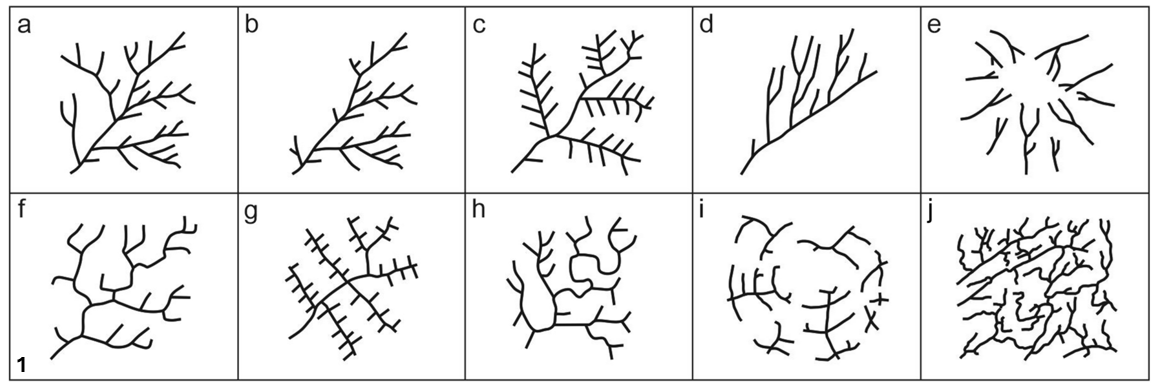
Introduction

Fluvial networks provide key insights into surface processes, underlying lithology, and the tectonic and climatic history of planetary bodies. On Earth, these drainage systems have been studied extensively, but classification still relies heavily on visual interpretation. Such manual methods are not scalable, especially when applied to large datasets or remote planetary terrains where direct observation is limited. This study presents a fully automated, unsupervised machine learning framework designed to classify fluvial patterns objectively, initially tested on terrestrial rivers but developed with a clear orientation toward planetary applications.


Methods

The classification pipeline begins with HydroRIVERS v1.0, a global hydrographic dataset, from which river segments are extracted. For each segment, a suite of morphometric descriptors is calculated, encompassing parameters related to geometry, orientation, curvature, and network topology. These features are used as inputs for unsupervised clustering. Three clustering techniques were evaluated: K-Means, Gaussian Mixture Models (GMM), and CLARANS. Among them, K-Means consistently delivered the highest internal validation scores across silhouette, Davies-Bouldin, and Dunn indices. CLARANS, while computationally more intensive, offered greater interpretability by selecting real river segments as cluster centers, which is especially valuable in a geomorphological context. Classification at the river-system level was then achieved by exploring multiple strategies, including majority voting among segments, and aggregation of morphometric features by their mean or median; they all produced reliable and coherent drainage typologies.

Results

The optimal solution identified six distinct morphometric clusters. These clusters were subsequently interpreted and labeled based on canonical fluvial patterns, such as dendritic, sub-dendritic, radial, trellis, and rectangular. This interpretation followed geomorphological typologies standardized by Donadio et al. (2021) (Figure 1), enabling the translation of purely numerical groupings into geological meaning.


Figure 1. Different classes of drainage patterns following the scheme proposed by Donadio et al. 2021: a) dendritic; b) sub-dendritic; c) pinnate; d) parallel; e) radial; f) rectangular; g) trellis; h) angular; i) annular; j) contorted.


Validation against a reference dataset containing thousands of manually classified segments showed strong agreement. The K-Means algorithm achieved high consistency with expert labels, while CLARANS proved useful in highlighting key reference cases. To visualize the effectiveness of clustering, a principal component analysis (PCA) was performed, projecting the high-dimensional feature space into three dimensions (Figure 2).


Figure 2. Images of the resulting distribution, where the six clusters form distinct, compact groupings: 2a shows the clustering results with k-means algorithm; 2b shows the clustering results with CLARANS algorithm.


Planetary Application and Discussion

The versatility of the proposed framework makes it well suited for planetary science. Many bodies in the Solar System, such as Mars and Titan, show evidence of ancient or current fluvial activity. These features, visible in high-resolution orbital imagery, share morphometric properties with terrestrial rivers. The automated and objective nature of our method is ideal for application to planetary surfaces, where field validation is not possible and manual classification is impractical. On Mars, dendritic valley networks such as Warrego Valles (Figure 3) could be objectively identified and differentiated from structurally controlled systems like those near Valles Marineris. On Titan, channel networks via Cassini RADAR data present complex patterns possibly influenced by tectonics or cryovolcanism. The ability to distinguish between morphometric types without supervision may support hypotheses on climate evolution and crustal processes in these environments.

Figure 3. A visual comparison between a dendritic river system on Earth and a Martian network: 3A shows the original image of Po River (Italy) before pre-processing; 3B shows the manually extracted image of Po River. 3B shows the original image of Warrego Valles (Mars) before pre-processing; 3B shows the manually extracted image of Warrego Valles (Mars).

In the future, this approach may also be extended to Venus, where missions like ESA’s EnVision could reveal previously hidden fluvial features through synthetic aperture radar. Additionally, expanding the feature set to include elevation data and terrain roughness could further enhance classification capability and geological interpretation.


Conclusions

This study introduces a robust, unsupervised framework for the classification of fluvial networks that moves beyond the limitations of subjective interpretation. While trained and tested on terrestrial data, the method is explicitly designed with planetary applications in mind. It demonstrates strong potential for analyzing fluvial systems on Mars, Titan, and other planetary bodies, offering new perspectives on landscape evolution and hydrologic history. Future work will focus on applying the pipeline to specific planetary case studies, enhancing feature sets, and integrating data from multiple remote sensing platforms.

How to cite: D'Aniello, M., Velotti, C., Esposito Mocerino, G., and Donadio, C.: A Novel Machine Learning Approach for Objective Fluvial Network Classification: Earth & Beyond, EPSC-DPS Joint Meeting 2025, Helsinki, Finland, 7–13 Sep 2025, EPSC-DPS2025-1703, https://doi.org/10.5194/epsc-dps2025-1703, 2025.

MITM8 | Imagery, photometry, and spectroscopy of small bodies and planetary surfaces

EPSC-DPS2025-812 | ECP | Posters | MITM8 | OPC: evaluations required

A Spectral Comparison of Small Main Belt and Near-Earth V-types in the Near-Infrared 

Chansey Champagne, Cristina Thomas, and Joshua Emery
Tue, 09 Sep, 18:00–19:30 (EEST)   Finlandia Hall foyer | F101

Introduction

V-type asteroids are not as common as those found in the C- and S- complexes in both near-Earth space and the main belt. In near-Earth space, V-types make up ~5% of the distribution (by number) [1], and the same is true for the main belt [2]. The vast majority of V-type asteroids in the main belt consist of the (4) Vesta dynamical asteroid family [3]. One study of interest is near-Earth V-types’ connection to the (4) Vesta family, which primarily consists of V-types. Its members are referred to as Vestoids. These two groups have been connected through orbital dynamics, due to Vestoids’ location in the inner main belt close to the ν6 resonance [4]. Near-Earth V-types and Vestoids have also been connected due to their similar compositions to each other and to howardite, eucrite, and diogenite (HED) meteorites [5,6]. The dynamical and compositional connections between these two groups gives us the opportunity to compare their spectra and make inferences on how the location of these asteroids affects their surface properties.

Spectra of V-type asteroids are quantified by computing band parameters of the 0.9-μm (Band I) and 1.9-μm (Band II) pyroxene absorptions. Previous work has found that near-Earth V-type spectra and main belt V-types have differences in their band parameters [7]. There are differences between the absorption band centers, with near-Earth V-types having band centers at longer wavelengths (average Band I center  = 0.935  ± 0.01 μm; average Band II center = 1.968  ± 0.032 μm) compared to main belt V-types (average Band I center  = 0.926  ± 0.01 μm; average Band II center = 1.946  ± 0.038 μm) [7]. The greatest difference is the Band I slope, which is the slope of the continuum line across the Band I absorption feature.  The Band I slope of main belt V-types has an average value of 0.66 ± 0.2 μm-1, while near-Earth V-types have a much lower average Band I slope of 0.23 ± 0.13 μm-1 [7]. The band parameters of the near-Earth V-types are much closer to those of eucrites (BI slope = 0.28 ± 0.09 μm-1), which are thought to have Vestoids as their parent bodies [8]. Both eucrites and near-Earth V-types have Band I slopes that are not as red as main belt V-types, which could be due to multiple factors, including space weathering [9] and regolith grain size [10]. 

Due to continuous collisions over time, smaller asteroids tend to have younger surfaces [11]. Near-Earth V-types are typically an order of magnitude smaller than most observed main belt V-types [1,12]. Therefore, we hypothesize that the cause of the band parameter discrepancy is the observational bias towards larger, older main belt V-types. If true, we would expect small main belt V-types to be spectrally similar to NEA V-types. 


Methods

Several main belt Vestoids in the size range of 1-3 km were observed during the Fall 2024 and Spring 2025 semesters using the SpeX spectrograph on NASA’s Infrared Telescope Facility (IRTF), which is a 3-m infrared telescope to measure their near-infrared spectra (prism, 0.7-2.5 um) [13]. Before each observation, the slit was rotated to match the parallactic angle of the target. All observations were aimed to be taken at an air mass less than  1.5 and spectra of local solar standard stars were taken to correct the asteroid spectra of telluric features. These solar standards were also used to remove the spectral slope caused by the Sun. The extraction and reduction of the data were done using the IDL SpeXtool package [14]. A Python program was written to perform the band parameter analysis, and the method used is described in [15]. For each asteroid, the Band I and II centers, the Band I slope, and the separation between the two bands were determined. We performed the same analysis on previously published data of both near-Earth and main belt V-type asteroids [1, 15, 16]. This analysis was done not only to validate the algorithm, but to be able to compare the near-Earth V-types to both large and small main belt V-types to look for any correlations with asteroid size. Main belt Vestoids in the size range of 4-6 km were also observed in the same manner, to identify any trends between Band I slope and asteroid size for V-types.


Results

The results show that there is potential correlation between Band I slope and asteroid size, rather than the asteroid’s dynamical class. This potential correlation is especially apparent for the smaller main belt V-types, which have Band I slopes that seem to overlap with those of near-Earth V-types of similar sizes. Our next steps for this project include obtaining spectra for main belt Vestoids <2 km in diameter. 


We will present the results of comparing the spectral parameters of near-Earth V-types to those of main belt Vestoids as a function of asteroid diameter and the implications of the results. 


References

[1] Binzel et al. 2019, Icarus, 324, 41-47.

[2] Carvano et al., 2010. A&A 510, A43.

[3] DeMeo & Carry, 2013. Icarus, 226, 1, 723-741.

[4] Marzari et al. 1996, Astronomy and Astrophysics, 316, 248-262.

[5] Burbine et al. 2010. Meteoritics & Planetary Science, 44, 9, 1331-1341.

[6] McSween Jr., et al. 2013. Meteoritics & Planetary Science, 48, 11, 2090-2104.

[7] Fulvio et al. 2018, Planetary and Space Science, 164, 37-43.

[8] De Sanctis et al. 2012. Science, 336, 697-700.

[9] Fulvio et al. 2012, Astronomy and Astrophysics, 537, L11.

[10] Bowen et al. 2023. Planet. Sci. J., 4, 52.

[11] Price. 2004, Advances in Space Research, 33, 9, 1548-1557. 

[12] Oszkiewicz et al. 2020, Astronomy and Astrophysics, 643, A117.

[13] Rayner et al. 2003. PASP, 115, 362.

[14] Cushing et al. 2004. PASP, 116, 818.

[15] Moskovitz et al. 2010. Icarus, 208, 2, 773-788.

[16] Marsset et al. 2022. The Astronomical Journal, 163, 4.


How to cite: Champagne, C., Thomas, C., and Emery, J.: A Spectral Comparison of Small Main Belt and Near-Earth V-types in the Near-Infrared, EPSC-DPS Joint Meeting 2025, Helsinki, Finland, 7–13 Sep 2025, EPSC-DPS2025-812, https://doi.org/10.5194/epsc-dps2025-812, 2025.

EPSC-DPS2025-945 | ECP | Posters | MITM8 | OPC: evaluations required

Hyperspectral Mineral Mapping for Sustainable Lunar Exploration: Targeting ISRU Resources in Key Lunar Regions  

Clara Guth, Francesca Mancini, Pascal Allemand, Gian Gabriele Ori, and Francesco Salese
Tue, 09 Sep, 18:00–19:30 (EEST)   Finlandia Hall foyer | F102

Introduction and Objectives

For ISRU and sustainable lunar habitats, characterizing the mineralogical heterogeneity of candidate landing sites is critical for identifying regions of high resource potential. This study investigates four geologically diverse lunar regions—Aristarchus, Malapert, Mare Tranquillitatis, and Leibnitz Crater—using data from the Moon Mineralogy Mapper (M³) onboard Chandrayaan-1. The objective is to map mineralogical compositions relevant to resource extraction, supporting future lunar exploration strategies.

Site Selection Criteria

The four regions were selected based on their geological diversity and potential ISRU value. Key mineralogical targets include ilmenite (for oxygen production), anorthosite and plagioclase (for construction materials), and regions enriched in FeO, TiO₂, or Helium-3. Polar regions like Malapert may contain water ice in shadowed areas and offer thermal stability.
Site accessibility and terrain complexity were also considered. Although precise landing constraints are mission-specific and still under active assessment, general factors such as surface roughness and illumination conditions can influence the operational feasibility of exploration. The near side supports direct Earth communication, while far side sites like Leibnitz offer long-term strategic value.

Availability of high-quality M³ imagery was also essential for ensuring robust mineralogical mapping.

M3 Instrument Overview

Moon Mineralogy Mapper (M³) is a high-resolution imaging spectrometer that measured reflectance in the 430-3000 nm range with 10 nm spectral resolution on 85 adjacent bands. Here, calibrated Level 2 products (NASA PDS) have been used that have gone through radiometric, photometric, and thermal corrections (Martinot et al., 2018; Mustard et al., 2011; Staid et al., 2011). Most M³ scenes were captured in global mode, with ~140 m/pixel resolution, adequate for regional-scale mineralogical analysis.

Data Preprocessing and Subsetting

To ensure optimal signal quality, two destriping procedures were used: a standard destriping routine and the THOR method to remove striping vertically. Spectral and spatial subsetting was then performed to remove noise bands, black edge effects, and non-relevant pixels. Preprocessing was critical in polar regions like Malapert, where signal degradation dominates. Final datasets typically retained 83 of the initial 85 spectral bands.

Hyperspectral Analysis Workflow

The analysis process used the Spectral Hourglass methodology to derive endmembers and mineral abundance map.

  • Dimensionality Reduction: Minimum Noise Fraction (MNF) transformation was used to reduce data dimensionality without loss of variance. Most scenes had >90% of spectral variance in the first 3–6 MNF components.
  • Endmember Extraction: Pixel Purity Index (PPI) found spectrally pure pixels spectrally, then plotted in the N-Dimensional Visualizer. PPI iterations and thresholds were tuned for each image (~10,000 iterations, threshold ~2.5) to identify stable endmember candidates.
  • Spectral Classification: Linear Spectral Unmixing (LSU) and Spectral Angle Mapper (SAM) were applied. LSU provides sub-pixel abundance maps, and SAM offers angular similarity-based classification, illumination-variation resistance—critical for lunar landscapes.
  • Spectral Library Comparison: Spectra were compared with laboratory reflectance standards of the RELAB database (NASA PDS, 2020) between 540–2990 nm. Target minerals: plagioclase, Ca-pyroxenes, ilmenite, and spinel

Mineral Identification Criteria

Diagnostic absorption features were identified by depth, asymmetry, and center wavelength. Continuum subtraction was used to detect key features, especially in space-weathered materials. After Suarez-Valencia et al. (2024), rigorous model selection was employed to minimize false positives.

  • Pyroxenes show characteristic absorptions at 1000 and 2000 nm.
  • Olivine exhibited a broad, asymmetric feature at 1000 nm.
  • Spinel displays a prominent ~2000 nm band.
  • Anorthosite and plagioclase exhibited low absorption near 1250 nm with high total reflectance.
  • Troilite was characterized by flat, low-reflectance spectra with small features in the visible.

Results and Interpretation

The analysis confirms the geochemical diversity and ISRU interest in each of the four regions:

Aristarchus: Dominated by anorthositic highlands and central peak materials. Steep 1250 nm features in high-albedo spectra confirm plagioclase presence. Pyroxene-rich mare basalts (LCP and HCP) are present. Due to spectral overlap, the identification of spinel units remains inconclusive in this area. Detection of troilite attests to sulfur-bearing mafic lithologies.

Malapert: Near the South Lunar Pole, displays pairings of highland and mafic materials. High-Ca pyroxenes and pigeonite are present. A strong 2000 nm band confirms Mg-spinel. This region shows promise for oxygen extraction and construction resource use.

Mare Tranquillitatis: Includes high-Ti basalt and ilmenite-bearing units, close to the Dionysius crater. Spectral patterns suggest pyroclastic origins. Feldspathic breccias point to regolith mixing.

Leibnitz Crater (Far Side): Exposes diverse terrain including high-Ti basalts, pigeonite-bearing regolith, and highland  anorthosites. The diversity is consistent with crustal excavation and impact mixing.  

Conclusions and Outlook

This study demonstrates the capability of M3 hyperspectral data, laboratory spectra, and advanced spectral algorithms to detect and map key lunar minerals of potential interest for ISRU. Combining quantitative (LSU) and qualitative (SAM) methods enables robust mapping of mineralogical heterogeneity.The results confirm and augment the outcomes of previous missions (e.g., KAGUYA) and provide an extension of the investigation to less characterized and compositionally complex areas such as Leibnitz. Significant ISRU-related substances such as high-Ti basalts (for oxygen extraction), anorthosites (suitable for construction material), and sulfur-bearing mafic units (e.g., troilite) are found at multiple locations.

These findings provide a foundation for site selection for future crewed missions and infrastructure development on the Moon, supporting decision-making through validated remote sensing workflows and operational criteria.


REFERENCES
Martinot, M., Besse, S., Flahaut, J., Quantin-Nataf, C., Lozac’h, L., & van Westrenen, W. (2018). Mineralogical diversity and geology of Humboldt crater derived using Moon Mineralogy Mapper data. Journal of Geophysical Research: Planets, 123, 612–629. https://doi.org/10.1002/2017JE005435.

Mustard, J. F., et al. (2011), Compositional diversity and geologic insights of the Aristarchus crater from Moon Mineralogy Mapper data, J. Geophys. Res., 116, E00G12, doi:10.1029/2010JE003726.

NASA PDS (2020) – RELAB Spectral Library Bundle. NASA Planetary Data System, https://doi.org/10.17189/1519032.

Pieters C.M. et al. (2009) – The Moon Mineralogy Mapper (M³) on Chandrayaan-1. Curr. Sci., 96(4), 500–505.

Staid, M. I., et al. (2011), The mineralogy of late stage lunar volcanism as observed by the Moon Mineralogy Mapper on Chandrayaan‐1, J. Geophys. Res., 116, E00G10, doi:10.1029/2010JE003735.

Suárez‐Valencia, J. E., Rossi, A. P., Zambon, F., Carli, C., & Nodjoumi, G. (2024). MoonIndex, an open‐source tool to generate spectral indexes for the Moon from M3 data. Earth and Space Science, 11, e2023EA003464. https://doi.org/10. 1029/2023EA003464.

How to cite: Guth, C., Mancini, F., Allemand, P., Ori, G. G., and Salese, F.: Hyperspectral Mineral Mapping for Sustainable Lunar Exploration: Targeting ISRU Resources in Key Lunar Regions , EPSC-DPS Joint Meeting 2025, Helsinki, Finland, 7–13 Sep 2025, EPSC-DPS2025-945, https://doi.org/10.5194/epsc-dps2025-945, 2025.

EPSC-DPS2025-997 | ECP | Posters | MITM8 | OPC: evaluations required

A Pilot Rapid-Response Project to Characterize Small Near Earth Objectswith LCO’s MuSCAT Instruments. 

Remington Cantelas, David Trilling, Joey Chatelain, Nicolas Erasmus, Tim Lister, Andy López-Oquendo, Nick Moskovitz, and Cristina Thomas
Tue, 09 Sep, 18:00–19:30 (EEST)   Finlandia Hall foyer | F103
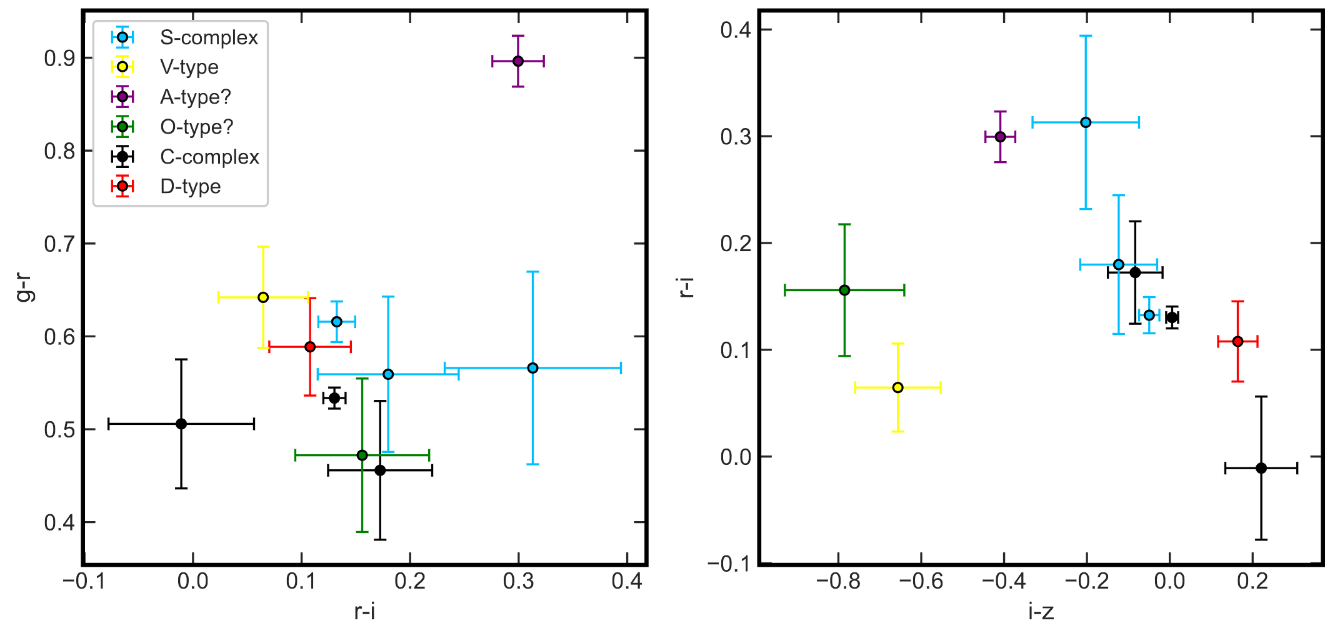
1. Summary
Close to 80% of meteorites are ordinary chondrites, commonly associated with S-type asteroids [1]. However, among Near-Earth Objects (NEOs), silicate-rich S-types are no more abundant than abundant as primitive (C-, D-, and X-) types [2]. The most likely parent bodies for meteorites are small NEOs, the composition of which are not well understood. The taxonomic make-up of small NEOs is further complicated by recent meteorite recoveries corresponding to rare taxonomic types, such as the Almahata Sitta ureilite [3] and an aubrite meteorite that was formerly 2024 BX1 [4].
 
Here we present the results of a pilot-project in preperation for a longer program to determine the rough taxonomies of at least ∼1000 very small (absolute magnitude >25, or diameters <30 meters) NEOs over a three year period using the MuSCAT3/4 simultaneous four-channel imagers on the Las Cumbres Observatory (LCO) 2-meter telescopes.
 
2. Observations and Data Reduction
The smallest NEOs are best observed during their closest approach to Earth shortly after discovery and are typically only visible for a few weeks. MuSCAT3/4’s ability to perform simultaneous g, r, i, and zs observations make it possible to observe our targets accurately and efficiently, and LCOs queue-scheduled robotic observing system means targets can be observed within minutes of their submission and well within their window of visibility.
 
We observed 10 NEOs between Nov 9 2024 and Feb 22 2025 using MuSCAT3 installed on the 2-meter Faulkes North Telescope in Haleakala. Each target was observed for ∼7 minutes, with seven tracked 60-second exposures in each filter sandwiched between two 10-second exposures that were used for photometric calibration. Targets were selected from newly discovered asteroids, and chosen based on several constraints. The object must have been discovered in the 5-weeks prior to observation and have an official designation. This group was further filtered to objects with an apparent magnitude (V) < 21, the limiting magnitude required to achieve an SNR of 10 within a 7-minute exposure, and an absolute magnitude (H) > 25. The rate of the object was also taken into consideration and limited to 1000 ”/hour to avoid trailing in calibration frames. These targets were then submitted to the LCO observing queue. Data from successful observations were reduced and calibrated using LCO’s in-house BANZAI reduction software [5]. Photometry was carried out with a simple procedure that utilizes the Python Photutils package.
 
As part of the goals for this pilot project, we developed a pipeline to automate observations and analysis. Each step — from selecting targets from the Minor Planet Center database, submitting targets to the LCO queue, acquiring reduced, calibrated data and photometry — was carried out using this pipeline. Future work will incorporate a machine learning-based tool to assign objects to a probabilistic taxonomic classification.
 
3. Results
Preliminary results, shown in Figure 1, indicate that 6 out of the 10 sampled objects exhibit colors consistent with S- and C-type classifications, evenly divided between the two. Unexpectedly, 4 objects resembled taxonomic types that are not commonly found amongst NEOs; the most surprising of these were the colors of 2025 AF and 2024 VC.
 
2025 AF (H = 25.10, D ≈ 28 m) shows a best match to O-type asterods. O-types are exceptionally rare, with only seven confirmed to date [6] — primarily among NEOs — with the notable exceptions of main-belt asteroid 3628 Božněmcová and potentially 7472 Kumakiri [7]. 2024 VC (H = 27.41, D ≈ 9.8 m) on the other hand did not match exactly to any known taxonomies, but fit best to A or R type asteroids. Both A- and R- types are also notably rare with 17 known A-types (mostly Inner Main Belt asteroids and Mars-crossers) and 5 R-types (4 main-belt and 1 Amor NEO) [6].
 
Spectrophotometric measurements such as those presented here are far more efficient than spectroscopy, but have much lower fidelity. Therefore, these colors are suggestive, but not conclusive. The relatively high fraction of uncommon taxonomic classes observed in our target sample may suggest greater diversity within the small NEO population; however, additional observations are required to substantiate this. Generally, these findings demonstrate that the MuSCAT3 and 4 instruments, along with our analysis tools, are sufficient to derive coarse taxonomies for small NEOs. Our full survey will begin on May 1, 2025. We will observe 1000 NEOs with the MuSCAT cameras through the end of 2027B. We will measure the implied compositional distribution of very
small NEOs.
 
Figure 1: Color-color diagram showing the colors of 10 pilot project NEOs presented here, grouped by
taxonomic class.
 
4. Acknowledgments
This work makes use of observations from the Las Cumbres Observatory global telescope network. This paper is based on observations made with the MuSCAT3 instrument, developed by Astrobiology Center and under financial supports by JSPS KAKENHI (JP18H05439) and JST PRESTO (JPMJPR1775), at Faulkes Telescope North on Maui, HI, operated by the Las Cumbres
Observatory. This project is supported by the Arizona Board of Regents Technology and Research Initiative Fund and by NASA YORPD award 80NSSC25K7438.
 
References
[1] Nakamura, T., Noguchi, T., Tanaka, M., et al. 2011, Itokawa Dust Particles: A Direct Link Between S-Type Asteroids and Ordinary Chondrites, Science, 333, 1113
[2] Mommert, M., Trilling, D. E., Borth, D., et al. 2016, First Results from the Rapid-response Spectrophotometric Characterization of Near-Earth Objects using UKIRT, AJ, 151, 98
[3] Jenniskens, P., Shaddad, M. H., Numan, D., et al. 2009, The impact and recovery of asteroid 2008 TC3, Nature, 458, 485
[4] Cantillo, D. C., Ridenhour, K. I., Battle, A., et al. 2024, Laboratory Spectral Characterization of Ribbeck Aubrite: Meteorite Sample of Earth-impacting Near-Earth Asteroid 2024 BX1, , 5, 138
[5] McCully, C., Turner, M., Volgenau, N., et al. 2018, LCOGT/banzai: Initial Release, 0.9.4, Zenodo
[6] Bus, S. J., Binzel, R. P., & . 2002, Phase II of the Small Main-Belt Asteroid Spectroscopic Survey. A Feature-Based Taxonomy, Icarus, 158, 146
[7] Burbine, T. H., Duffard, R., Buchanan, P. C., Cloutis, E. A., & Binzel, R. P. 2011, in 42nd Annual Lunar and Planetary Science Conference, Lunar and Planetary Science Conference, 2483

How to cite: Cantelas, R., Trilling, D., Chatelain, J., Erasmus, N., Lister, T., López-Oquendo, A., Moskovitz, N., and Thomas, C.: A Pilot Rapid-Response Project to Characterize Small Near Earth Objectswith LCO’s MuSCAT Instruments., EPSC-DPS Joint Meeting 2025, Helsinki, Finland, 7–13 Sep 2025, EPSC-DPS2025-997, https://doi.org/10.5194/epsc-dps2025-997, 2025.

EPSC-DPS2025-1190 | ECP | Posters | MITM8 | OPC: evaluations required

Fluorescence Modelling and Spectroscopic Analysis of the NH2 Radical inCometary Environments  

Alessandra Mura, Fiorangela La Forgia, Gabriele Cremonese, Luca Bizzocchi, Monica Lazzarin, Hideyo Kawakita, Pamela Cambianica, Hitomi Kobayashi, Mattia Melosso, Giovanni Munaretto, Cristina Puzzarini, Yoshiharu Shinnaka, and Ko Tsujimoto
Tue, 09 Sep, 18:00–19:30 (EEST)   Finlandia Hall foyer | F105

Introduction
The amidogen (NH2) radical is a widely found species in the coma of comets. It is believed to be primarily produced through the photodissociation of ammonia (NH3) as parent species by the solar ultraviolet radiation. The presence of ammonia in comets serves as a crucial indicator of the first molecules formed in the protosolar nebula, reflecting the primordial conditions of the early Solar System. NH3, together with H2O, CH4, CO and CO2, is believed to be one of the first ices formed on the surface of dust grains in the presolar nebula (Watanabe & Kouchi 2008).

Detecting ammonia (NH3) in comets remains challenging. In the radio domain, its inversion transitions near 24 GHz have been firmly detected only in a few cases, such as comets C/1996 B2 (Hyakutake) and C/1995 O1 (Hale-Bopp) (Palmer et al. 1996; Bird et al. 1997), due to beam dilution and sensitivity limits. In the infrared, rovibrational transitions around 3 µm offer a favourable window, though atmospheric absorption and line blending with other species often interfere with clear identification. In contrast, NH2,
the primary photodissociation product of NH3, emits strongly in the optical range (4000–8000 Å), and is commonly used as a proxy for ammonia in cometary comae, assuming it originates solely from NH3 photolysis (Tegler & Wyckoff 1989). After formation, NH2 radicals are excited by solar radiation and
decay via fluorescence. Fluorescence models generally assume equilibrium conditions in an optically thin coma, where collisional effects near the nucleus are negligible (Tegler & Wyckoff 1989; Kawakita et al. 2001; Kawakita & Watanabe 2002). Under these assumptions, NH2 emission can be reliably used to
infer ammonia abundance.

Aim
In the current literature, there are relatively few studies on NH2 fluorescence models, and these are confined to specific spectral regions at a time (Kawakita & Watanabe 2002; Kawakita & Mumma 2011), leaving gaps in the overall understanding of NH2 fluorescence behaviour across broader ranges.
The starting point of this study is to develop a comprehensive and improved fluorescence model for NH2, aiming to provide a unified framework for the calculation of fluorescence efficiencies (g-factors) for multiple bands, offering a more complete and consistent approach to NH2 fluorescence analysis. 

One of the drivers behind revising the current understanding of the spectroscopic behaviour of NH2 is the presence of numerous unidentified features in high-resolution cometary spectra (Brown et al. 1996; Cremonese et al. 2007; Cambianica et al. 2021). In particular, high-resolution spectra of comet
NEOWISE (Cambianica et al. 2021) revealed a considerable number of unidentified lines. These lines are typically confined to specific regions of the spectrum, suggesting that they may originate from the same species. Since other known radicals, such as CN and C2, already have well-established models for line positions and fluorescence efficiency (Rousselot et al. 2000; Tanabashi et al. 2007; Schleicher 2010; Brooke et al. 2014), it is unlikely that these unidentified features belong to them. As a result, NH2 remains a promising candidate for resolving some uncertain line assignments. A detailed re-analysis of
existing NH2 spectroscopic data, along with a revision of the current fluorescence models, is necessary to explore this possibility.


Methods
The treatment of fluorescence equilibrium equations is based on the methodology implemented in the Python code FlorPy (Bromley et al. 2024). FlorPy is a valuable tool for solving these equations, and allows the computation of fluorescence efficiencies (g-factors) for individual transitions, if the line positions and Einstein coefficients are known.

This activity has prompted the authors to improve the spectroscopic study of the NH2 radical by re-analising the vast but rather sparse data collection present in the literature (Hadj Bachir et al. 1999; Huet et al. 1996; Dressler & Ramsay 1959; Ross et al. 1988).
For this purpose, we will use the PGOPHER program (Western 2017), a tool widely employed for spectral fitting of many molecular species. Such comprehensive treatment of the NH2 radical will culminate in a complete set of g-factors for cometary abundance retrieval. This approach would make a significant contribution in terms of the accuracy of the g-factors calculation, though it also introduces several complications.


As a matter of fact, NH2 is a triatomic radical with an open-shell electronic configuration (Dressler & Ramsay 1957). In its electronic ground state (X2B1), it is bent and behaves as a regular semi-rigid asymmetric top. The first excited state exhibits a quasi-linear configuration and it features a strong vibronic coupling between the electronic angular momentum and vibrational angular momentum produced by the linear (doubly degenerate) bending motion. This coupling is labelled as Renner-Teller effect and breaks down the Born-Oppenheimer approximation, making the usual formalism for the computation of ro-vibrational energies no longer applicable (Renner 1934).

The PGOPHER tool operates within the frame of the Born-Oppenheimer approximation, i.e. by postulating a clear separation between electronic and ro-vibrational energies. Still, it can be used for problematic cases, as of NH2, by adopting the approach of effective fits, i.e. by separating the overall spectrum in independent subbands, for which specialised Hamiltonians are able to "effectively" reproduce the observed line positions within experimental accuracy. If properly adopted, this approach can provide a set of spectroscopic parameters which, if difficult to interpret in the usual manner, do have good spectral predictive capability within the range of energies actually sampled by the analysis.


Conclusions
This work presents a new approach to the analysis of the NH2 radical, currently under development. It focuses on its fluorescence mechanisms and the computation of g-factors for individual transitions. The development of a self-consistent model for NHwould significantly enhance the accuracy of abundance calculations in cometary environments and contribute to a deeper understanding of molecular spectroscopy in comets. However, this approach also presents challenges, particularly concerning the Renner-Teller effect, which will require further refinement of existing models. Despite these complications, the work is expected to improve the current understanding of NH2 radical fluorescence mechanism in cometary comae.

How to cite: Mura, A., La Forgia, F., Cremonese, G., Bizzocchi, L., Lazzarin, M., Kawakita, H., Cambianica, P., Kobayashi, H., Melosso, M., Munaretto, G., Puzzarini, C., Shinnaka, Y., and Tsujimoto, K.: Fluorescence Modelling and Spectroscopic Analysis of the NH2 Radical inCometary Environments , EPSC-DPS Joint Meeting 2025, Helsinki, Finland, 7–13 Sep 2025, EPSC-DPS2025-1190, https://doi.org/10.5194/epsc-dps2025-1190, 2025.

EPSC-DPS2025-1272 | ECP | Posters | MITM8 | OPC: evaluations required

Investigation of near-ultraviolet-visible range in spectra of primitive asteroids 

Sofiia Mykhailova, Tomasz Kwiatkowski, Julia de Leon, Eri Tatsumi, Nicolas Erasmus, and Wojciech Dimitrow
Tue, 09 Sep, 18:00–19:30 (EEST)   Finlandia Hall foyer | F113
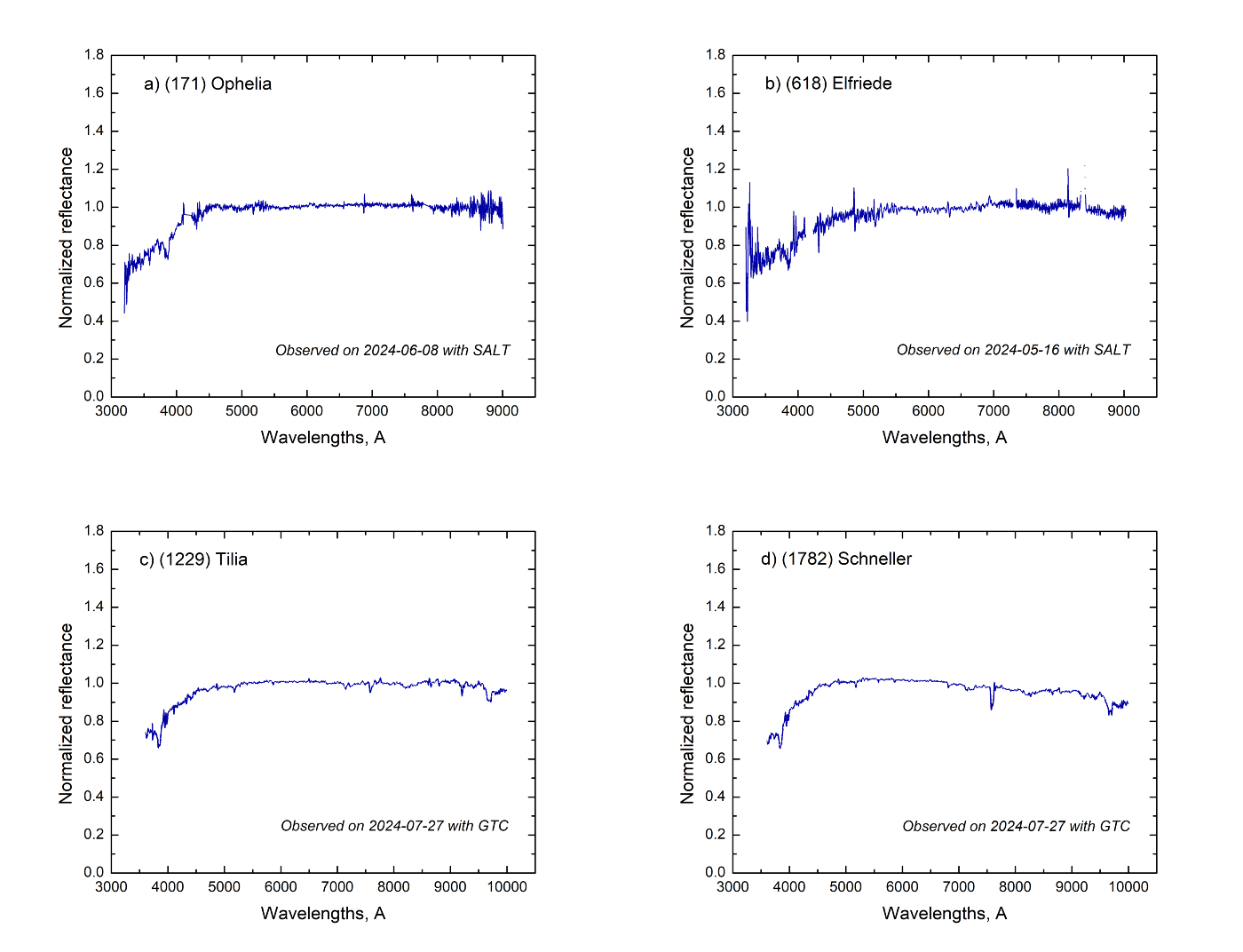
Primitive asteroids belonging to the C-complex groups are considered to be among the most ancient and least thermally altered bodies in the Solar System. They are thought to preserve a record of early Solar System conditions, including the primordial distribution of volatiles and organic compounds that may have played a role in the emergence of life on Earth. Understanding their composition, alteration history, and surface evolution is essential for reconstructing early planetary processes.

One of the most widely used techniques for investigating these bodies is low-resolution reflectance spectroscopy, which covers a broad spectral range: from ultraviolet (UV) to near-infrared (NIR) wavelengths. This method allows for the identification of broad absorption features and spectral slopes indicative of surface mineralogy and alteration processes.

However, due to the limited quantum efficiency of CCDs in the near-UV (NUV) and atmospheric scattering, most spectroscopic surveys - such as the Small Main Belt Asteroid Spectroscopic Survey (SMASS) I and II [1, 6], and the Small Solar System Objects Spectroscopic Survey (S3OS2) [4]- are constrained to wavelengths above 0.45 μm, leaving NUV absorption largely unexplored. In this work, we aim to explore the presence of hydrated minerals based on spectral key features of primitive asteroids in the NUV-visible range. We investigate properties in the spectra of C-complex asteroids, such as the NUV absorption feature and the 0.7 µm band, to refine our understanding of asteroid surface composition, space weathering effects [3], and aqueous alteration processes [2]. These features serve as crucial indicators of the presence of phyllosilicates and other hydrated minerals.

Since November 2023, we have been conducting observations using the 10-meter Southern African Large Telescope (SALT), located in Sutherland, South Africa. SALT is equipped with the Robert Stobie Spectrograph (RSS), which we used to obtain asteroid spectra at a resolution of R = 800. A distinctive advantage of SALT is its  enhanced throughput at short wavelengths, reaching down to 0.32 μm in the near-ultraviolet, thanks to the NaCl correction lens.

For some observations, we also used the 10.4-meter Gran Telescopio Canarias (GTC), located in La Palma, Spain. It allowed us to observe asteroids that were not accessible from SALT. By observing selected targets with both telescopes, we were also able to check our spectra for instrumental biases.

At the conference, we will present the results from our first observing pool, which includes spectra of 25 asteroids and their analysis; outline our ongoing long-term observational program and future plans. We will also discuss our observational strategy, particularly the identification and use of solar analogue stars in the NUV range in the Southern Hemisphere for accurate spectral calibration.

Figure 1:  Examples of reflectance spectra of several C-type asteroids observed: a-b) with SALT in the range 0.32-0.9 μm; c-d) with GTC in the range 0.35-1.0 μm. Asteroid spectra have been divided by spectra of the solar analogue star SA112-1333, obtained on the same night as the asteroids. All spectra have been normalized to 1 at a wavelength of 0.55 μm..

Acknowledgments: Part of observations reported in this abstract were obtained with the Southern African Large Telescope (SALT). This work has been done under the SALT programs 2023-2-SCI-025, 2024-1-SCI-012 and 2024-2-SCI-005 (PI: T.  Kwiatkowski). Polish participation in SALT is funded by grant No. MEiN nr 2021/WK/01. This work has been done under the GTC program GTC37-24A (PI: J. de León). JdL acknowledges support from the Agencia Estatal de Investigación del Ministerio de Ciencia e Innovación (AEI-MCINN) under grant "Hydrated Minerals and Organic Compounds in Primitive Asteroids" with reference PID2020-120464GB-100.

References: [1] Bus, Binzel (2002) Icarus, 158, 1; [2] Fornasier et al. (2014) Icarus, 223; [3] Hendrix & Vilas (2019) Geophys. Res. Lett., 46, 24;  [4] Lazzaro et al. (2004) Icarus, 172, 1; [5] Vilas (1994) Icarus, 111, 2; [6] Xu et al. (1995) Icarus, 115, 1 

How to cite: Mykhailova, S., Kwiatkowski, T., de Leon, J., Tatsumi, E., Erasmus, N., and Dimitrow, W.: Investigation of near-ultraviolet-visible range in spectra of primitive asteroids, EPSC-DPS Joint Meeting 2025, Helsinki, Finland, 7–13 Sep 2025, EPSC-DPS2025-1272, https://doi.org/10.5194/epsc-dps2025-1272, 2025.

EPSC-DPS2025-1613 | ECP | Posters | MITM8 | OPC: evaluations required

Alignment and fusion of digital terrain models : case study of planetary surfaces 

Loïs Brun, Adeline Paiement, Sylvain Doute, and Jerenimo Bernard Salas
Tue, 09 Sep, 18:00–19:30 (EEST)   Finlandia Hall foyer | F109

Data alignment and fusion are crucial steps in exploiting complementary data from different satellites. In planetary science, and particularly in remote sensing, the majority of data are not correctly aligned due to inaccuracies in sensor location. This makes merging and joint analysis imprecise and time-consuming, as planetary scientist have to correct these alignments manually. Existing alignment algorithms are designed for feature-rich data and pairwise alignment. The present study considers the case of Digital Terrain Models (DTMs), which are 3D data formats where elevation information is derived from a pair of 2D photogrammetric observations. This 3D information provides additional information useful for alignment. However, existing 3D alignment algorithms still suffer from the above-mentioned limitations with this data. The aim of this study is to develop a method to automatically align rigidly an arbitrary number of DTMs while producing a topographic model that fuses their information. We introduce a self-adaptive envelope, coupled to DTMs, whose role is both to produce a high resolution topographic model and to direct the alignment of the DTMs to a common reference.

How to cite: Brun, L., Paiement, A., Doute, S., and Bernard Salas, J.: Alignment and fusion of digital terrain models : case study of planetary surfaces, EPSC-DPS Joint Meeting 2025, Helsinki, Finland, 7–13 Sep 2025, EPSC-DPS2025-1613, https://doi.org/10.5194/epsc-dps2025-1613, 2025.

MITM9 | Planetary in-situ measurements

EPSC-DPS2025-114 | ECP | Posters | MITM9 | OPC: evaluations required

Boulder shape analysis: is a 2D projection reliable for capturing the 3D geometry? 

Alexia Duchêne, Naomi Murdoch, Colas Robin, T. Dylan Mikesell, Olivier S. Barnouin, Ronald L. Ballouz, and Alex X. Jerves
Tue, 09 Sep, 18:00–19:30 (EEST)   Finlandia Hall foyer | F115

The boulder shape at the surface of small bodies enables the investigation of the geological processes the surface boulders have undergone, and the estimation of certain mechanical properties (e.g. [1]). Studies conducted on surface boulders observed on extraterrestrial planetary bodies are usually performed using 2D images of the projected surface [1, 2, 3, 4]. 2D projections of irregular particle are known to differ from their 3D geometry [5, 6, 7], therefore, careful precautions are required when comparing different surfaces and, in particular, different representations (2D or 3D).

To investigate how representative 2D images of boulders are for estimating bulk 3D morphological parameters, three different granular samples (LHS-1 Lunar Highland Simulant, Øysand soil, and glass grit) were scanned by XCT (X-ray Computed Tomography) to reconstruct the 3D geometry of each particle.  The shapes of more than 2500 particles have been analyzed using both the 3D geometry and different 2D projections from the 3D reconstruction. The 2D shape analysis pipeline used in this study was previously applied in Robin et al. (2024) [1] and Kohout et al. (2024) [8]. A 3D shape analysis has been extended using the same methodology as the 2D analysis.

The shape can be expressed using three independent descriptors based on the observation scale [9, 10]: the form (large scale), roundness (intermediate scale), and surface texture (small scale). The morphological parameters measured in this study include axes ratios and sphericity (large-scale measurements), and roundness. In addition to the shape analysis, the size of particles is also computed (fig. 1).

Figure 1: Definitions of size and shape descriptors measured for 2D (left) and 3D (right) representations.


Using the 2D and 3D morphological analysis of the XCT scan dataset, correlation formulas with confidence intervals have been established between both representations to estimate 3D morphological parameters from 2D measurements.

Our methodology to estimate 3D parameters from 2D measurements is being tested with boulders observed on asteroid Bennu by the NASA OSIRIS-REx mission (fig. 2). Boulders on Bennu have been observed by different instruments; in 2D by OCAMS (OSIRIS-REx Camera Suite) [11], and in 3D by OLA (OSIRIS-REx Laser Altimeter) [12]. The results of the comparison between the estimated 3D parameters obtained with the 2D images and the 3D analysis from the same boulders observed with OLA will be presented during the conference in addition to the analysis of XCT scan data.

Figure 2: An example of boulders observed on asteroid Bennu by different instruments during the NASA OSIRIS-REx mission. OLA measurements (left) provide the surface topography (3D), and the same surface has also been observed in 2D with OCAMS (right). (Credit: NASA/Goddard/University Of Arizona)


References

[1] Robin, et al. (2024). Mechanical properties of rubble pile asteroids (Dimorphos, Itokawa, Ryugu, and Bennu) through surface boulder morphological analysis. Nature communications, 15: 6203.

[2] Yingst, et al. (2007). Quantitative morphology of rocks at the Mars Pathfinder landing site. Journal of Geophysical Research: Planets, 112.

[3] Cambianica, et al. (2019). Quantitative analysis of isolated boulder fields on comet 67P/ Churyumov-Gerasimenko. Astronomy & Astrophysics, 630:15.

[4] Jawin, et al. (2023). Boulder Diversity in the Nightingale Region of Asteroid (101955) Bennu and Predictions for Physical Properties of the OSIRIS-REx Sample. Journal of Geophysical Research: Planets, 128:12.

[5] Jia et al. (2023). Sphericity and roundness for three-dimensional high explosive particles by computational geometry. Computational Particle Mechanics, 10:817-836.

[6] Beemer, et al. (2022). Comparison of 2D Optical Imaging and 3D Microtomography Shape Measurements of a Coastal Bioclastic Calcareous Sand. Journal of Imaging, 8:72.

[7] Zheng, et al. (2021). Three-dimensional Wadell roundness for particle angularity characterization of granular soils. Acta Geotechnica, 16:133-149.

[8] Kohout, et al. (2024). Impact Disruption of Bjurböle Porous Chondritic Projectile. The Planetary Science Journal, 5:128.

[9] Barrett (1980). The shape of rock particles, a critical review. Sedimentology, 27:3.

[10] Cho, et al. (2006). Particle Shape Effects on Packing Density, Stiffness, and Strength: Natural and Crushed Sands. Journal of Geotechnical and Geoenvironmental Engineering, 132:5.

[11] Rizk, et al. (2018). OCAMS: The OSIRIS-REx Camera Suite. Space Science Reviews, 214:26.

[12] Daly, et al. (2017). The OSIRIS-REx Laser Altimeter (OLA) Investigation and Instrument. Space Science Reviews, 212:899-924.


Acknowledgements

This project has received funding from the European Union’s Horizon 2020 research and innovation program under grant agreement N°870377 (project NEO-MAPP), and CNES in the framework of the Hera mission and the MMX rover/wheelcams. A.D. acknowledges PhD funding from Université de Toulouse III. C.R. acknowledges PhD funding from CNES and ISAE SUPAERO. O. S. Barnouin’s and R. L. Ballouz’s efforts were funded by the NASA New Frontier Data Analysis Program under grand number 80NSSC22K1035 P00004.


How to cite: Duchêne, A., Murdoch, N., Robin, C., Mikesell, T. D., Barnouin, O. S., Ballouz, R. L., and Jerves, A. X.: Boulder shape analysis: is a 2D projection reliable for capturing the 3D geometry?, EPSC-DPS Joint Meeting 2025, Helsinki, Finland, 7–13 Sep 2025, EPSC-DPS2025-114, https://doi.org/10.5194/epsc-dps2025-114, 2025.

EPSC-DPS2025-1741 | ECP | Posters | MITM9 | OPC: evaluations required

Spacecraft charging during the 2024 Juice Earth gravity assist 

Maryam Zeroual and Mika Holmberg
Tue, 09 Sep, 18:00–19:30 (EEST)   Finlandia Hall foyer | F122

We use the Spacecraft Plasma Interaction Software (SPIS) to simulate the interaction between the Juice Spacecraft and its environment during the Earth gravity assist performed on the 20th August 2024. A world first was achieved by the Juice spacecraft with its execution of a double gravity assist with the Moon and Earth. Following the lunar gravity assist, Juice approached from the magnetotail and entered the plasmasphere. An unexpected sharp density drop was observed around the closest approach, leading to a drop in spacecraft potential also being seen. Around five hours after first entering the plasmasphere, Juice crossed the magnetopause into the magnetosheath.

In this work, we study how the interaction between the Juice spacecraft and the plasmasphere and magnetosheath environments impacts the surface charging on the spacecraft and the effect on the local particle environment. This understanding is essential as it will affect the Juice particle and field measurements and is crucial for the data analysis.

Here we present surface potentials and local electron, photoelectron, secondary electron and ion populations for four different plasma regimes in the plasmasphere and magnetosheath. We discuss the impact on the Juice RPWI and PEP particle and field measurements.  Large differential charging was observed due to the dielectric material covering the radiators on the spacecraft. We also examine the impact on the surface charging of the spacecraft due to the sudden drop in the plasma density near closest approach.

How to cite: Zeroual, M. and Holmberg, M.: Spacecraft charging during the 2024 Juice Earth gravity assist, EPSC-DPS Joint Meeting 2025, Helsinki, Finland, 7–13 Sep 2025, EPSC-DPS2025-1741, https://doi.org/10.5194/epsc-dps2025-1741, 2025.

MITM10 | Laboratory experiments in support of ground observations and space missions (sample return, analogs, analytical workflow etc.)

EPSC-DPS2025-1534 | Posters | MITM10 | OPC: evaluations required

Spectral analysis of silicate glasses analog of Mercury’s geochemical terrains and comparison with MESSENGER and BepiColombo data 

Baptiste Gaudart, Océane Barraud, Bernard Charlier, Olivier Namur, Greta Lamers, Alessandro Maturilli, and Solmaz Adeli
Tue, 09 Sep, 18:00–19:30 (EEST)   Finlandia Hall foyer | F129

Introduction

Mercury, the closest planet to the Sun, has been studied by two NASA missions: Mariner 10 and MESSENGER (Mercury Surface, Space Environment, Geochemistry, and Ranging). They provided much information about the surface of the planet including the unique surface composition—characterized by a strong depletion in iron for example—and the identification of distinct regions with varying chemical compositions. However, one remaining question about Mercury is the mineralogical composition of its surface. Visible to near-infrared observations from the Mercury Atmospheric and Surface Composition Spectrometer (MASCS) aboard MESSENGER lack absorption features of mafic minerals. One hypothesis for the absence of spectral signatures typically associated with mafic minerals is the low abundance of FeO [1]. Furthermore, Mercury's complex geological history, involving extensive volcanic activity, impact melting, and intense space weathering, likely resulted in the production of substantial amounts of glass at the surface, which may significantly influence the planet's spectral properties [2]. The ESA’s BepiColombo mission, launched in 2018, will soon be in its polar orbit around Mercury. Two key instruments will help characterize the surface mineralogy of the planet: MERTIS (Mercury radiometer and thermal infrared spectrometer), a radiometer and thermal infrared spectrometer operating between 7 and 14 µm and SIMBIO-SYS (Spectrometers and Imagers for MPO BepiColombo Integrated Observatory System), a high-resolution camera, a stereo camera and a near infrared hyperspectral imager operating between 0.4 and 2 µm. The aim of this study is to spectrally characterize glassy synthetic analogs with compositions similar to the five main geochemical regions of Mercury. This work is done at the Planetary Spectroscopy Laboratory (PSL) of the German Aerospace Center (DLR), Berlin. The spectral measurements will be compared to MASCS data and used for the interpretation of SIMBIO-SYS and MERTIS data. Thus, it will be possible to identify the effect of volcanic glass and their specific compositions characterized by a range of MgO content and low FeO.

Samples

The samples used in this study have been synthesized at the University of Liège by mixing high purity oxides and melting them in a Platinum crucible at 1500°C for 1 hour. The silicate melts were quenched in water to produce glass beads, similar to the volcanic glass expected on Mercury. The compositions are analogs to five hermean regions [3]: the Low-Mg Northern Volcanic Plains (Low-Mg-NVP), the High-Mg Northern Volcanic Plains (High-Mg NVP), the Smooth Plains, High-Mg Province and the Intermediate Terrains (ICP-HCT). The geochemical compositions of the samples are given in Table 1. In order to investigate the effect of glass particle size, each sample has been crushed in two different grain sizes: <125 µm  and 125-250 µm, thus a total of 10 samples have been measured.

Table 1: Selected chemical compositions of glassy analogues (in wt%) [3].

Region

SiO2

Al2O3

MgO

CaO

Na2O

Total

Low-Mg NVP

63.36

14.40

10.21

5.78

6.25

100.00

Smooth Plains

59.90

16.03

11.40

7.35

5.32

100.00

High-Mg NVP

60.43

12.31

16.89

6.44

3.92

99.99

ICT HCT

55.76

12.70

21.73

5.70

4.11

100.00

High-Mg Province

55.82

7.05

26.80

7.14

3.19

100.00


Experimental procedure

Firstly, the bidirectional reflectance of the samples has been measured in a range of ultraviolet (UV) to the mid-infrared (MIR) to cover the wavelength domains of MESSENGER’s (0.3 to 1.45 µm) and BepiColombo’s instruments (0.4 to 2 µm and 7 to 14 µm). Several illumination conditions and viewing geometries have been used to obtain bidirectional reflectance spectra in the same conditions of MASCS and SIMBIO-SYS observations. The reflectance measurements were supplemented with hemispherical reflectance data acquired in the MIR domain. Then, the samples have been heated up at temperatures from 250°C to 450°C to simulate the surface temperature of Mercury, and measure the emissivity every 50°C in the MIR - spectral range of the MERTIS instrument. After heating the samples, reflectance measurements in the UV to MIR were acquired again, to investigate the effect of the heating at Mercury’s day-side temperature. All the measurements have been performed under vacuum to simulate Mercury’s surface conditions. 

Preliminary results

After calibrating and merging the different wavelengths for the bidirectional reflectance, we obtained the spectra shown in Figure 1. A decrease of reflectance is visible when the phase angle increases before and after heating. After heating, the sample ICP-HCT shows an increase of the reflectance in the visible to NIR and a decrease of the hemispherical reflectance in the MIR spectral domain. In the MIR, the sample exhibits a strong Christiansen Feature (CF) - reflectance minimum - at around 8.25 µm. Calibration and processing of the emissivity measurement data are currently in progress.

Figure 1 : (a) Bidirectional reflectance of ICP-HCT (125-250 µm) before heating (solid line) and after heating (dashed line) at 3 different geometries in the UV, visible and near-infrared. (b) Hemispherical reflectance of the same sample before and after heating in the MIR spectral domain. 

Conclusion

In this study we measured unique samples simulating volcanic glass of different geochemical regions of Mercury. We obtained the reflectance of the samples before and after heating at Mercury’s day-side temperature, through different illumination and viewing geometries, in a wavelength range covering the range of both MESSENGER’s and BepiColombo’s instruments. Emissivity spectra were also completed while heating the samples to simulate the temperature of Mercury’s surface.The measurements will be compared to MASCS/MESSENGER observations and will be used for the interpretation of SIMBIO-SYS and MERTIS observations by the BepiColombo spacecraft.

References

1. Murchie, S. L., et al. (2015). Icarus, 254, 287-305.

2. Pisello, A., et al. (2022). Icarus, 388, 115222.

3. Namur, O. & Charlier, B. Nat. Geosci. 10, 9–13 (2017). 

How to cite: Gaudart, B., Barraud, O., Charlier, B., Namur, O., Lamers, G., Maturilli, A., and Adeli, S.: Spectral analysis of silicate glasses analog of Mercury’s geochemical terrains and comparison with MESSENGER and BepiColombo data, EPSC-DPS Joint Meeting 2025, Helsinki, Finland, 7–13 Sep 2025, EPSC-DPS2025-1534, https://doi.org/10.5194/epsc-dps2025-1534, 2025.

MITM14 | Exploiting Gaia to study minor bodies of the Solar System: results, challenges, and perspectives

EPSC-DPS2025-42 | ECP | Posters | MITM14

Using Gaia to reduce atmospheric turbulence displacements in LSST minor planet astrometry 

Daniel C. H. Gomes and Gary M. Bernstein
Thu, 11 Sep, 18:00–19:30 (EEST)   Finlandia Hall foyer | F99
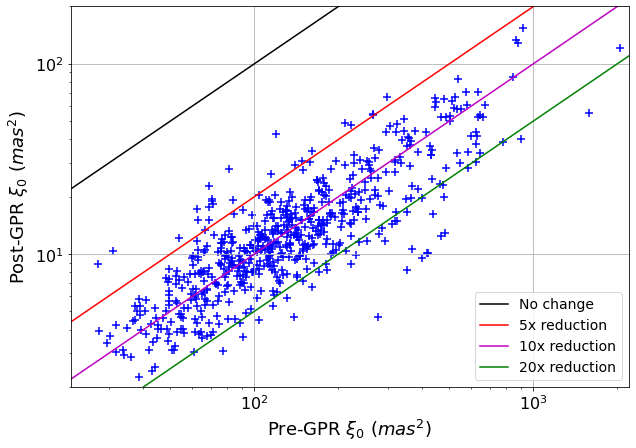
The imminent start of LSST will trigger an unprecedented advance in the discovery and precise tracking of small solar system bodies. The survey is expected to yield order-of-magnitude increases in known population sizes, and to produce hundreds of observations of each target during its 10-year duration. The nominal astrometry requirement is 10 mas RMS errors per visit, a level where unmodeled displacements are dominated by atmospheric turbulence. We present a new code that interpolates, with Gaussian process regression (GPR), the turbulence displacement field on any ground-based telescope exposure that includes enough stars from Gaia DR3, using the computed displacement at the position of these stars. This idea was initially laid forth by Fortino et al. (2021), who tested a preliminary method on a few Dark Energy Survey (DES) exposures. Their code required optimization of the Gaussian process kernel, and therefore was too computationally expensive to be scalable for future surveys such as LSST. We approach the problem by generating empirical kernels: the correlation function of the turbulence field is measured directly with TreeCorr (Jarvis 2015) and smoothed to avoid numerical issues.


Our code roughly follows these steps: (1) Find stars on the exposure that have close matches to Gaia solutions; (2) compute the displacements in both directions for each reference star—these directions are treated as independent fields; (3) perform a polynomial fit to model large-scale correlations, remove outliers from the reference star set; (4) measure the correlation function of polynomial-subtracted displacements with TreeCorr; (5) reduce noise and apodize the measured correlation function to generate the GPR kernel; (6) divide exposure in patches and perform a GPR on each patch to get a modeled turbulence displacement value on the target positions (that is, the position of every star on the exposure that does not have a match in the Gaia catalog). An initial run may be done to detect additional outliers from the reference set, have them removed, before a second and final GPR run. 


For cross-validation purposes, we divide the reference star set into five subsets, and perform five GPR runs, each with one of these sets reserved as targets. We then use the model-subtracted residuals at these targets to estimate the remaining unmodeled turbulence. We test our code both on real DES exposures and on simulated LSST data (where turbulence is generated by the atmospheric model from Hebert (2024)). Using the average correlation function for separations < 1’ (ξ0) as a metric for the variance of turbulence distortions, we compare its raw value with the model-subtracted one and we find that it is reduced by an average factor of 12.2 on the DES exposures. The pre-GPR and post-GPR values for the tested exposures are shown in Figure 1. For the LSST simulations (where the “true” displacements are accessible to us), we compute the true variance of the displacement fields before and after the GPR, and the reduction factor is 13.8. The square root of these values (3.5 and 3.7 respectively) provide us the expected improvement on the RMS of turbulence displacement errors.

Figure 1. Post-GPR (model subtracted) average correlation function for separations < 1’ versus the corresponding Pre-GPR value. Each blue point denotes one DES exposure where the turbulence reduction code was tested.


We then look at the potential use of our code to improve LSST minor planet astrometry. We consider a set of ~1000 main belt asteroid orbits and predict all their detections on a baseline LSST simulated survey. For each detection, we compute the estimated astrometric errors with and without turbulence reduction. The total error is a combination of the photon-noise error and a fixed astrometric floor that accounts for turbulence and remaining calibration errors. This astrometric floor is set at the pre-GPR nominal value of 10mas for the uncorrected scenario, and at the post-GPR value of 2.5mas, the typical value achieved on simulated LSST fields, for the corrected scenario. We find that the total positional information on MBA orbits (defined as ∑ 1/(σi)2 for i observations) improves by a factor of 13.3 (for asteroids with H < 16) and by a factor of 5.4 for H > 16.  Figure 2 shows the positional information for each object after the 10-year survey, in both scenarios (corrected and uncorrected). Fainter asteroids have a larger contribution of photon-noise error and therefore are less affected by the turbulence reduction.

Figure 2. Total positional information expected after 10 years of LSST, for a sample of ~1000 Main Belt Asteroids. Blue points represent the scenario where no turbulence correction is applied (10mas errors added in quadrature to the photon noise error). Red points reduce the astrometric errors according to the performance of our turbulence reduction code (the astrometric floor is moved from 10mas to 2.5mas).

The information gain from Gaia-referenced turbulence reduction will translate into more precise orbital constraints for a given number of measurements, improving sensitivity to signals such as non-gravitational forces, small deflections from mutual encounters, and gravitational perturbations from unmodeled mass in the Solar System.


References


Fortino, Willow. F., Bernstein, Gary M., Bernardinelli, Pedro H., et. al. 2021. "Reducing Ground-based Astrometric Errors with Gaia and Gaussian Processes." The Astronomical Journal 162 (3): 106. https://doi.org/10.3847/1538-3881/ac0722.

Hébert, Claire-Alice, Meyers, Joshua E., Do, My H., et. al. 2024. "Generation of Realistic Input Parameters for Simulating Atmospheric Point-Spread Functions at Astronomical Observatories." The Open Journal of Astrophysics 7 (April): 22. https://doi.org/10.33232/001c.115727.

Jarvis, Mike. 2015. TreeCorr: Two-point Correlation Functions. Astrophysics Source Code Library, record ascl:1508.007. https://ui.adsabs.harvard.edu/abs/2015ascl.soft08007J.

How to cite: Gomes, D. C. H. and Bernstein, G. M.: Using Gaia to reduce atmospheric turbulence displacements in LSST minor planet astrometry, EPSC-DPS Joint Meeting 2025, Helsinki, Finland, 7–13 Sep 2025, EPSC-DPS2025-42, https://doi.org/10.5194/epsc-dps2025-42, 2025.

EPSC-DPS2025-296 | ECP | Posters | MITM14 | OPC: evaluations required

Spectral classification of Gaia DR3 Solar System small bodies and application to the search for A-type olivine-rich asteroids 

Marjorie Galinier, Marco Delbo, and Laurent Galluccio
Thu, 11 Sep, 18:00–19:30 (EEST)   Finlandia Hall foyer | F103

The Data Release 3 (DR3) of ESA's Gaia mission contains 60 518 mean reflectance spectra of Solar System small bodies, spanning the visible wavelength range in 16 bands [1]. Such large and homogeneous dataset is a powerful tool to study the Main Belt as a whole.

We developed a classification method for the DR3 dataset, focusing on the search for new potential olivine-rich A-type asteroids in the Main Belt. Indeed, there is an observed scarcity of purely olivine-rich asteroids in the Main Belt known as the "missing-mantle problem" [2,3]. DeMeo et al. (2019) [4] derived from NIR spectroscopic observations that A-type asteroids account for less than 0.16\% of the Main Belt, for asteroids with a diameter above 2 km. We tested this assertion by exploiting the Gaia DR3 dataset, as this low quantity of olivine-rich bodies contrasts with differentiation theories [5].

We developed a classification method for the DR3 dataset based on a curve matching algorithm that gives the best two spectral classes associated with an asteroid spectrum [6] after a comparison with spectral classes template spectra. To take into account inherent differences existing between DR3 and ground-based spectra, we defined Gaia DR3 template spectra based on the Bus taxonomic scheme [7] to perform the classification.

We filtered the Gaia DR3 dataset to test and apply the classification algorithm on the best-quality spectra only. We considered only spectra with an average signal-to-noise ratio above 30 and without flagged bands from 462 to 946 nm, which left us with 18 739 DR3 spectra. This sample will be refered to as the "filtered DR3 dataset" in the following. We then designed the classification using a sample of objects characterized from NIR or VISNIR spectroscopy in the literature and having a spectrum in the filtered DR3 dataset. Using a trial-and-error approach, we improved the classification of these objects by eliminating certain sub-classes from the Gaia templates and grouping others into larger complexes. The confusion matrix corresponding to this classification is displayed in the figure below. It is quite diagonal, indicating satisfactory results.

To improve the classification of A-type asteroids specifically, we defined a secondary classification step based on the blue part of DR3 spectra only, from 462 to 594 nm. We exploited the fact that this wavelength range does not appear affected by the reddening phenomenon impacting some DR3 spectra compared to ground-based spectra, which allowed us to distinguish between real A-type asteroids and false positives. This secondary step allowed us to classify correctly most A-type asteroids, while keeping the contamination of the A-class low.

We applied this two-steps classification to the 18 739 asteroids of the filtered DR3 dataset, and we obtained a total of 98 potential A-types. Of these objects, 77 had never been characterized with spectroscopy before the Gaia DR3. Considering only objects with a diameter above 2 km, we found a proportion of 0.51% of A-types in the Main Belt, which is more than three times the 0.16% found by DeMeo et al. (2019) [4].

Finally, the two steps classification method we developed gives satisfactory results for the classification of DR3 spectra and allowed to detect new potential A-type asteroids in the Main Belt. It appears that the amount of purely olivine-rich asteroids in the Main belt could be more than three times what previously thought, but this result has to be confirmed by NIR spectroscopy.

Acknowledgements:

This work has made use of data from the European Space Agency (ESA) mission Gaia (https://www.cosmos.esa.int/gaia), processed by the Gaia Data Processing and Analysis Consortium (DPAC). Funding for the DPAC has been provided by national institutions, in particular the institutions participating in the Gaia Multilateral Agreement. The authors acknowledge financial support from CNES, the Observatoire de la Côte d'Azur and the ANR ORIGINS (ANR-18-CE31-0014). 

References:

[1] Gaia Collaboration, Galluccio, L. et al. (2023) "Gaia Data Release 3. Reflectance spectra of Solar System small bodies." In: Astronomy & Astrophysics 674, A35. doi: 10.1051/0004-6361/202243791.
[2] Chapman, C. R. (1986). In: Proceedings of the NASA and CNR, International Workshop on Catastrophic Disruption of Asteroids and Satellites, 103–114.
[3] Burbine, T.H., Meibom, A., Binzel, R.P., 1996. "Mantle material in the main belt: Battered to bits?" Meteoritics and Planetary Science 31, 607–620. doi: 10.1111/j.1945-5100.1996.tb02033.x.
[4] DeMeo, Francesca E., David Polishook, Benoît Carry, Brian J. Burt, Henry H. Hsieh, Richard P. Binzel, Nicholas A. Moskovitz, and Thomas H. Burbine (Apr. 2019). "Olivine-dominated A-type asteroids in the main belt: Distribution, abundance and relation to families." In: Icarus 322, pp. 13–30. doi: 10.1016/j.icarus.2018.12.016.
[5] Neumann,W., D. Breuer, and T. Spohn (July 2012). "Differentiation and core formation in accreting planetesimals." In: Astronomy & Astrophysics 543, A141. doi: 10.1051/0004-6361/201219157.
[6] Popescu, M., M. Birlan, and D. A. Nedelcu (Aug. 2012). "Modeling of asteroid spectra - M4AST." In: Astronomy & Astrophysics 544, A130. doi: 10.1051/0004-6361/201219584.
[7] Bus, Schelte J. and Richard P. Binzel (July 2002a). “Phase II of the Small Main-Belt Asteroid Spectroscopic Survey. A Feature-Based Taxonomy.” In: Icarus 158.1, pp. 146–177. doi: 10.1006/icar.2002.6856.

How to cite: Galinier, M., Delbo, M., and Galluccio, L.: Spectral classification of Gaia DR3 Solar System small bodies and application to the search for A-type olivine-rich asteroids, EPSC-DPS Joint Meeting 2025, Helsinki, Finland, 7–13 Sep 2025, EPSC-DPS2025-296, https://doi.org/10.5194/epsc-dps2025-296, 2025.

MITM15 | Solar System Science from JWST

EPSC-DPS2025-359 | ECP | Posters | MITM15 | OPC: evaluations required

Composition of asteroid 84 Klio with NIRSpec/JWST 

Tania Le Pivert-Jolivet, Julia de León, Javier Licandro, Bryan Holler, Noemí Pinilla-Alonso, Mário De Prá, Joshua Emery, Brittany Harvison, Joseph Masiero, Lucas McClure, and Driss Takir
Thu, 11 Sep, 18:00–19:30 (EEST)   Finlandia Hall foyer | F118

Primitive C-complex asteroids, primarily located in the main asteroid belt, are commonly associated with carbonaceous chondrites (CCs) due to their low geometric albedo (typically pv<10%) and similar spectral shape [e.g. 1]. The presence of hydrated minerals and organics in CCs attests to the accretion of volatiles by their parent body in the early solar system. These volatiles subsequently evolved through secondary processes, such as aqueous alteration. Thus, primitive asteroids are key witnesses for tracing the distribution and evolution of volatiles since solar system formation, as well as the role of primitive asteroids in Earth's water budget. Low-albedo collisional families of asteroids located in the inner main asteroid belt, between the ν6 secular resonance at 2.1 au and the 3:1 mean motion resonance with Jupiter at 2.5 au, are likely the sources of primitive near Earth asteroids (NEAs) and CCs [e.g. 2]. Recently, two space missions, Hayabusa2 (JAXA) and OSIRIS-REx (NASA), collected and returned to Earth samples from two primitive NEAs, Ryugu and Bennu. Laboratory analysis of the samples and their contextualization in relation to primitive asteroids will be key to understanding the evolution of the solar system.


The aim of James Webb Space Telescope (JWST) SAMBA3 (Spectral Analysis of Main Belt Asteroids in the 3-µm region) program (General Observer program #6384, Cycle 3) led by Driss Takir, is to observe and analyze spectra of nine asteroids from the seven low-albedo and low-inclination (i < 15°) inner main belt families (New Polana, Eulalia, Erigone, Sulamitis, Clarissa, Chaldaea and Klio) with the NIRSpec instrument (0.97 – 5.10 µm). Primitive asteroids typically present featureless spectra in the 0.5-2.5 µm, with the exception of a shallow absorption at 0.7 µm attributed to Fe-rich phyllosilicates in some asteroids [3]. On the contrary, several diagnostic spectral features can be observed at wavelengths > 2.5 µm in spectra of primitive bodies, such as bands associated also with phyllosilicates at 2.7-2.8 µm, water ice around 3.1 µm, organics around 3.4 µm and carbonates around 3.4 and 3.9 µm [e.g. 4, 5, 6]. The inaccessibility of certain wavelengths in the infrared from ground-based observations, due to the atmospheric opacity, makes JWST essential for constraining the composition of primitive asteroids. Here, we aim at analyzing the reflectance spectra of the primitive asteroid (84) Klio, the largest member of the Klio family, with NIRSpec.


The observation of Klio was conducted on July 6, 2024. The data were calibrated using the JWST pipeline. The solar analog P330E (JWST program #1538, led by Karl Gordon) was used to separate the reflected and emitted components of the spectrum. The thermal emission was fitted using the Near-Earth Asteroid Thermal Model (NEATM, [7]), allowing us to estimate Klio’s diameter to 78.1 km. We then analyzed the reflectance spectrum in the 2.8, 3.4 and 3.9 µm regions. Different Gaussian fits were used to estimate the peak position and the amplitude of the features. Those spectral parameters give valuable information on the composition, in particular when compared with primitive samples analyzed in the laboratory. We thus compared Klio with reflectance spectra of samples of carbonaceous chondrites from Takir et al. [6,8], Ryugu samples from Pilorget et al. [9] and Bennu samples from Lauretta et al. [10]. We will present the result of this analysis, as well as the interpretation of Klio’s composition and the evolution processes undergone by its parent body. In particular, this study revealed significant spectral differences between Klio and the Bennu/Ryugu samples, reinforcing the hypothesis that Klio is an unlikely parent body for the Hayabusa2 and OSIRIS-REx targets.


Acknowledgements: We’d like to acknowledge the support of the Space Telescope Science Institute (JWST-GO-06384.001-A). TPJ, JdL, and JL acknowledge support from the Agencia Estatal de Investigacion del Ministerio de Ciencia e Innovación (AEI-MCINN) under grant "Hydrated Minerals and Organic Compounds in Primitive Asteroids" with reference PID2020-120464GB-100.


References:

[1] Campins, H., et al. 2018, in Primitive Meteorites and Asteroids, ed. N. Abreu (Elsevier), 345–369, [2] Broz, M., et al. 2024, A&A 689, [3] Vilas, F. & Gaffey, M. J. 1989, Science, 246, 790, [4] Campins, H., et al. 2010, Nature, 464, 1320, [5] Takir, D. & Emery, J. P. 2012, Icarus, 219, 641, [6] Takir, D. et al. 2013, Meteor. Planet. Sci., 48, 1618, [7] Harris, A. W., 1998, Icarus, 131, 291, [8] Takir, D., et al. 2019, Icarus, 333, 243, [9] Pilorget, C. et al. 2021, Nature Astronomy, 6, 221, [10] Lauretta, D. S., et al. 2024, Meteor. Planet. Sci., 59, 2453

How to cite: Le Pivert-Jolivet, T., de León, J., Licandro, J., Holler, B., Pinilla-Alonso, N., De Prá, M., Emery, J., Harvison, B., Masiero, J., McClure, L., and Takir, D.: Composition of asteroid 84 Klio with NIRSpec/JWST, EPSC-DPS Joint Meeting 2025, Helsinki, Finland, 7–13 Sep 2025, EPSC-DPS2025-359, https://doi.org/10.5194/epsc-dps2025-359, 2025.

EPSC-DPS2025-622 | Posters | MITM15 | OPC: evaluations required

Thermodynamic modeling of metamorphic fluids supports internal source of carbon-bearing molecules at the surface of TNOs 

Giorgia Confortini, Camille Delarue, Bruno Reynard, and Christophe Sotin
Thu, 11 Sep, 18:00–19:30 (EEST)   Finlandia Hall foyer | F108

JWST observations of TNOs up to 800 km in diameter show surface ices that include carbon-bearing species such as CO₂, CO, CH₃OH, and complex organic molecules (Pinilla-Alonso et al., 2024). Although surface compositions vary, no systematic trend with object size suggests these variations are dominated by surface processes. The surface compositions of larger TNOs display strong methane bands in addition to H₂O ice and CO₂ (Brown, 2012), and recent hydrogen and carbon isotopic measurements of CH₄ on Eris and Makemake by JWST suggest an internal origin for these species (Grundy et al., 2024). The bulk densities of icy moons and dwarf planets support the idea that their refractory cores contain a mixture of CI chondrite and carbonaceous material, reinforcing the idea that carbon-bearing molecules at their surfaces may originate from internal activity. Oxygen fugacity (fO₂) plays a crucial role in controlling the stability of carbonates, graphite, and associated mineral phases, governing carbon speciation and fluid composition in planetary interiors.

We studied the impact of carbon on the mineralogy of trans-Neptunian object (TNO) interiors. We model phase relations in the MgO–SiO₂–Fe–C–H₂ and MgO–SiO₂–CaO–Fe–C–H₂ systems across the P–T range of TNOs (300–1300 K, 1–7000 bar), using thermodynamic modeling with Perple_X (Connolly, 2005) and assuming CI elemental composition. The results reveal that at high fO₂, carbonates (magnesite, dolomite), water, and CO₂ are stable, whereas at lower fO₂, carbon is progressively reduced to graphite, with methane and hydrogen as the dominant volatiles. The stability fields of major species (CO2, H2O, CH4) in COH fluids are bounded by different oxygen fugacity buffers defined by the stability of various carbon-bearing mineral assemblages. Conversely, if fluid composition is fixed, for example by degradation reactions of carbonaceous matter, it will determine the mineral assemblages. Pressure does not significantly influence these transitions, whereas changes in oxygen fugacity and temperature strongly affect the gas species released from the mineral assemblage into metamorphic fluids. Specifically, at high temperatures, reduced phases such as methane are stable, while at lower temperatures, oxidized species and CO₂ are favored. Thus, temperature and oxygen fugacity play a crucial role in controlling the nature of carbon-bearing phases in solids and in fluids that can reach the surface of TNOs.

The predicted metamorphic evolution of mineral assemblages shows that the internal composition is directly reflected in fluid composition, which may eventually reach the surface and atmosphere of TNOs. Small TNOs (typically <800 km in diameter) have cold cores and therefore high oxygen fugacity, supporting the idea of oxidized interiors where carbonates and CO₂ are stable. In contrast, large TNOs such as Eris, Makemake, and Pluto, with higher core temperatures and/or lower oxygen fugacity, likely host more reducing phases, leading to the release of reduced fluid species such as methane. Overall, these findings suggest that redox-driven transformations have significantly shaped the interiors and volatile emissions of icy, carbon-rich bodies in the outer solar system, influencing their potential habitability. These results are consistent with JWST and earlier spectroscopic observations suggesting that volatiles of internal origin contribute to present-day surface compositions. It is predicted that CH₄ should become increasingly dominant as TNO size increases, a hypothesis that will be tested further by upcoming JWST spectroscopic investigations of TNOs.

Acknowledgement

This work was supported by Institut National des Sciences de l'Univers through Programme National de Planétologie, by the Agence Nationale de la Recherche (ANR, project OSSO BUCO, ANR-23-CE49-0003) and by the European Union (ERC, PROMISES, project #101054470). Views and opinions expressed are, however, those of the authors only and do not necessarily reflect those of the European Union or the European Research Council. Neither the European Union nor the granting authority can be held responsible for them.

References:

Brown, M. E. (2012). The Compositions of Kuiper Belt Objects. Annual Review of Earth and Planetary Sciences, 40 (Volume 40, 2012), 467–494. https://doi.org/https://doi.org/10.1146/annurev-earth-042711-105352

Connolly, J. A. D. (2005). Computation of phase equilibria by linear programming: A tool for geodynamic modeling and its application to subduction zone decarbonation. Earth and Planetary Science Letters, 236(1–2), 524–541. https://doi.org/10.1016/j.epsl.2005.04.033

Grundy, W. M., Wong, I., Glein, C. R., Protopapa, S., Holler, B. J., Cook, J. C., Stansberry, J. A., Lunine, J. I., Parker, A. H., Hammel, H. B., Milam, S. N., Brunetto, R., Pinilla-Alonso, N., de Souza Feliciano, A. C., Emery, J. P., & Licandro, J. (2024). Measurement of D/H and 13C/12C ratios in methane ice on Eris and Makemake: Evidence for internal activity. Icarus, 411. https://doi.org/10.1016/j.icarus.2023.115923

Pinilla-Alonso, N., Brunetto, R., De Prá, M. N., Holler, B. J., Hénault, E., Feliciano, A. C. de S., Lorenzi, V., Pendleton, Y. J., Cruikshank, D. P., Müller, T. G., Stansberry, J. A., Emery, J. P., Schambeau, C. A., Licandro, J., Harvison, B., McClure, L., Guilbert-Lepoutre, A., Peixinho, N., Bannister, M. T., & Wong, I. (2024). A JWST/DiSCo-TNOs portrait of the primordial Solar System through its trans-Neptunian objects. Nature Astronomy. https://doi.org/10.1038/s41550-024-02433-2

How to cite: Confortini, G., Delarue, C., Reynard, B., and Sotin, C.: Thermodynamic modeling of metamorphic fluids supports internal source of carbon-bearing molecules at the surface of TNOs, EPSC-DPS Joint Meeting 2025, Helsinki, Finland, 7–13 Sep 2025, EPSC-DPS2025-622, https://doi.org/10.5194/epsc-dps2025-622, 2025.

EPSC-DPS2025-805 | ECP | Posters | MITM15 | OPC: evaluations required

A Scorched Story: JWST Reveals Phaethon's Dehydrated Surface Composition and Thermal History 

Aidan O. Madden-Watson, Cristina A. Thomas, Christopher W. Haberle, Andrew S. Rivkin, Heidi B. Hammel, and Stefanie N. Milam
Thu, 11 Sep, 18:00–19:30 (EEST)   Finlandia Hall foyer | F110

Asteroid (3200) Phaethon is a unique near-Earth asteroid with a perihelion of 0.14 AU. It experiences extreme temperatures exceeding 1000 °C during its close solar approaches. The asteroid follows a highly eccentric orbit (e ~ 0.89) and is notable as the parent body of the Geminid meteor shower (a rare case where its origins come from an asteroid rather than a comet [1]). Observations from the Solar Terrestrial Relations Observatory (STEREO) have shown sodium emissions from Phaethon at perihelion [2]. These emissions suggest that the asteroid’s surface undergoes active and potentially transformative processes under intense solar heating. Spectroscopic data from the NASA Infrared Telescope Facility (IRTF) and the James Webb Space Telescope (JWST) show no detectable 3-µm absorption feature, indicating that Phaethon’s surface is dehydrated [3][4]. Additionally, JWST GTO Program 1245 observed Phaethon with the Mid-Infrared Instrument (MIRI), providing insights into compositional properties in this wavelength region. This presentation will discuss in-depth research on Phaethon’s thermal history and surface evolution.

To model Spitzer IRS observations of (3200) Phaethon, Maclennan & Granvik (2024)[5] looked for meteorite analogs and corresponding minerals for the asteroid from the RELAB database[6]. Their work’s analysis suggests that CY carbonaceous chondrites are good meteorite analogs, with olivine samples of varying forsterite percentages as good mineral analogs. Starting materials for their linear mixing model were selected to represent primitive, aqueously altered compositions (carbonaceous chondrites) and minerals that are products of Phaethon’s thermal evolution (secondary olivine, enstatite). We build on this study with our higher resolution and signal-to-noise JWST MIRI data [4], starting with similar carbonaceous chondrites and olivine samples in our analysis.

The meteorite analog and olivine (fo40 to fo80) mid-infrared data from RELAB were compared to the collected asteroid spectrum to begin constraining the mineralogical signatures observed in the JWST MIRI data. Both qualitative and quantitative spectral matching techniques were applied, and the results indicate that CY carbonaceous chondrite Y-86720 [4] appears to be the best match to Phaethon’s mid-infrared spectrum (Fig. 1). In addition, fo68 was the best-fit match to the olivine present on the surface, which differs from the previously best-fit forsterite percentage found in the previously published work [5]. This is likely due to the SNR of our data allowing for viewing of specific features like those in the 17 micron region.

With these constraints, we used a linear mixing model to combine mineral spectra and compare to the MIRI spectrum. We use mineral spectra from the RELAB database, including minerals relevant to olivine hydration and thermal alteration pathways. Troilite (FeS) was included in the mixing model to account for potential sulfide phases, though its use was minimized in the fits as troilite is expected to become unstable and devolatilize at the temperatures that Phaethon reaches near perihelion [7]. A mean absolute error (MAE) calculation was performed across the wavelength range, providing a quantitative assessment of how effectively the model reproduced the mid-infrared spectra. This modeling approach was compared to previous efforts [5] that utilized the Spitzer spectrum. A diagnostic feature at 17.5 µm, corresponding to the Christensen feature associated with phyllosilicate vibrations, is notably flat in the JWST MIRI data. This behavior suggests a high degree of dehydration, as this diagnostic feature disappears with thermal alteration of the phyllosilicates. The updated JWST-based modeling (Fig. 2) provides a more refined view of Phaethon’s surface composition, indicating dehydration and thermal processing from experiencing the high temperatures with close passes to the Sun that was not fully captured by the Spitzer observations. The model analysis suggests that Phaethon’s surface likely includes enstatite and secondary olivine that would have formed alongside the enstatite during thermal processing.

We are also interested in how solar heating alters the asteroid’s surface and subsurface, as remote observations only give us surface-level data. To explore this, we employed a thermal conduction model (KRC) to simulate the diurnal and annual heating cycles. This allowed for examination of how deeply high temperatures penetrated into the asteroid’s subsurface. The takeaway from this work is that primitive and aqueously altered rock is likely not found too deep under the surface because such materials are less affected by the intense heat of perihelion. Our thermal models show a dropoff of temperature as two or three skin depths are passed.

We will present our in-depth research into Phaethon’s mid-infrared spectrum, linear mixing model, and thermal model. Our work, which uses new JWST data and expands on previous studies, will yield a better understanding of the composition of Phaethon and its thermal history. 


References:
[1] https://blogs.nasa.gov/parkersolarprobe/2023/06/14/scientists-shed-light-on-the-unusual-origin-of-a-familiar-meteor-shower/

[2] Qicheng Zhang et al 2023 Planet. Sci. J. 4 70

[3] Takir, D., Kareta, T., Emery, J.P. et al. Near-infrared observations of active asteroid (3200) Phaethon reveal no evidence for hydration. Nat Commun 11, 2050 (2020). https://doi.org/10.1038/s41467-020-15637-7

[4] https://doi.org/10.48550/arXiv.2505.00692

[5] MacLennan, E., Granvik, M. Thermal decomposition as the activity driver of near-Earth asteroid (3200) Phaethon. Nat Astron 8, 60–68 (2024). https://doi.org/10.1038/s41550-023-02091-w

[6] This research utilizes spectra acquired from Ralph E. Milliken, Tim Glotch, Don Lindsay, and others with the NASA RELAB facility at Brown University

[7] https://www.hou.usra.edu/meetings/metsoc2024/pdf/6409.pdf

How to cite: Madden-Watson, A. O., Thomas, C. A., Haberle, C. W., Rivkin, A. S., Hammel, H. B., and Milam, S. N.: A Scorched Story: JWST Reveals Phaethon's Dehydrated Surface Composition and Thermal History, EPSC-DPS Joint Meeting 2025, Helsinki, Finland, 7–13 Sep 2025, EPSC-DPS2025-805, https://doi.org/10.5194/epsc-dps2025-805, 2025.

EPSC-DPS2025-820 | ECP | Posters | MITM15 | OPC: evaluations required

JWST/NIRSpec IFU Observations of Jupiter’s South Pole: Vertical and Latitudinal Structure of Aerosols in the Near-Infrared 

Simon Toogood, Leigh Fletcher, Oliver King, Jake Harkett, Michael Roman, Imke de Pater, Francesco Biagiotti, Henrik Melin, Thierry Fouchet, Mike Wong, and Pablo Rodriguez-Ovalle
Thu, 11 Sep, 18:00–19:30 (EEST)   Finlandia Hall foyer | F111

We present observations of Jupiter’s south polar region using the JWST/NIRSpec IFU spectrometer, providing high resolution spectral imaging across the near-infrared that probes the vertical and latitudinal distribution of aerosols and gaseous species.  Near-infrared spectroscopic mapping is a powerful diagnostic for studying giant planet atmospheres, enabling constraints on cloud structure in the weather-forming lower troposphere, and haze in the radiatively-controlled lower stratosphere.  The 1.7-5.3 µm range sampled here provides access to reflected sunlight both inside and outside of strong methane absorption bands; ionospheric emission from CH4 and H3+; and deep thermal emission from the 5 µm window where gaseous absorption is relatively low; sensing the 1 – 10 bar region. Locating and constraining the aerosol layers of Jupiter’s atmosphere is of great importance for photochemical models, as these hazes are produced in high-altitude photochemistry [1], and affect the efficiency of radiative heating and cooling of the upper troposphere and stratosphere [2]. The highest latitudinal zonal jets entrain a cold polar vortex, with clear transitions in aerosol properties (and potentially gaseous abundances) across the polar vortex boundary. Reflective aerosols may also be created by auroral particle precipitation [3] which allows magnetospheric phenomena to be traced onto the Jovian clouds [4]. We will invert the JWST NIRSpec observations to explore how aerosol and gaseous properties differ between the south polar vortex and the mid-latitudes.

JWST/NIRSpec observed the south pole of Jupiter on 24 December 2022 as part of ERS-1373 (Co-PIs: de Pater & Fouchet), using the high-resolution, long-wavelength filter/grating combination F290LP/G395H (2.8 – 5.3 µm). This provides exceptional spectral resolution (R~2700, =0.7nm) over the latitude range 42 – 85oS at spatial resolutions between 74km at 42oS and 1100km at 85oS. Six tiles were taken using this grating, giving 100o of longitudinal coverage, and three tiles were taken with F170LP/G235H (1.7 – 3.2 µm) extending the wavelength range down to 1.7µm. This covers the full near-IR range, from short-wavelength reflected sunlight to long-wavelength thermal emission. Hubble and Juno also observed the region at a similar time (2022/11/12 and 2022/12/15) allowing comparison of features in visible light and tracking over time in the same wavelength range.
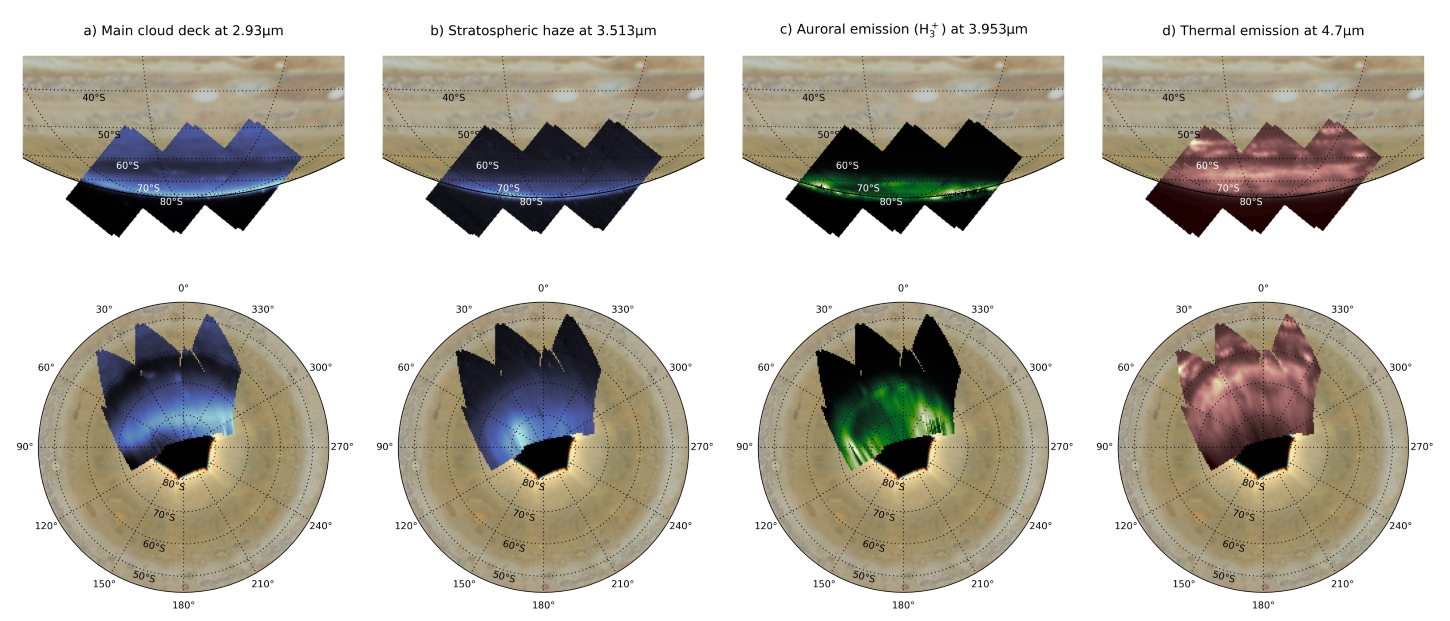
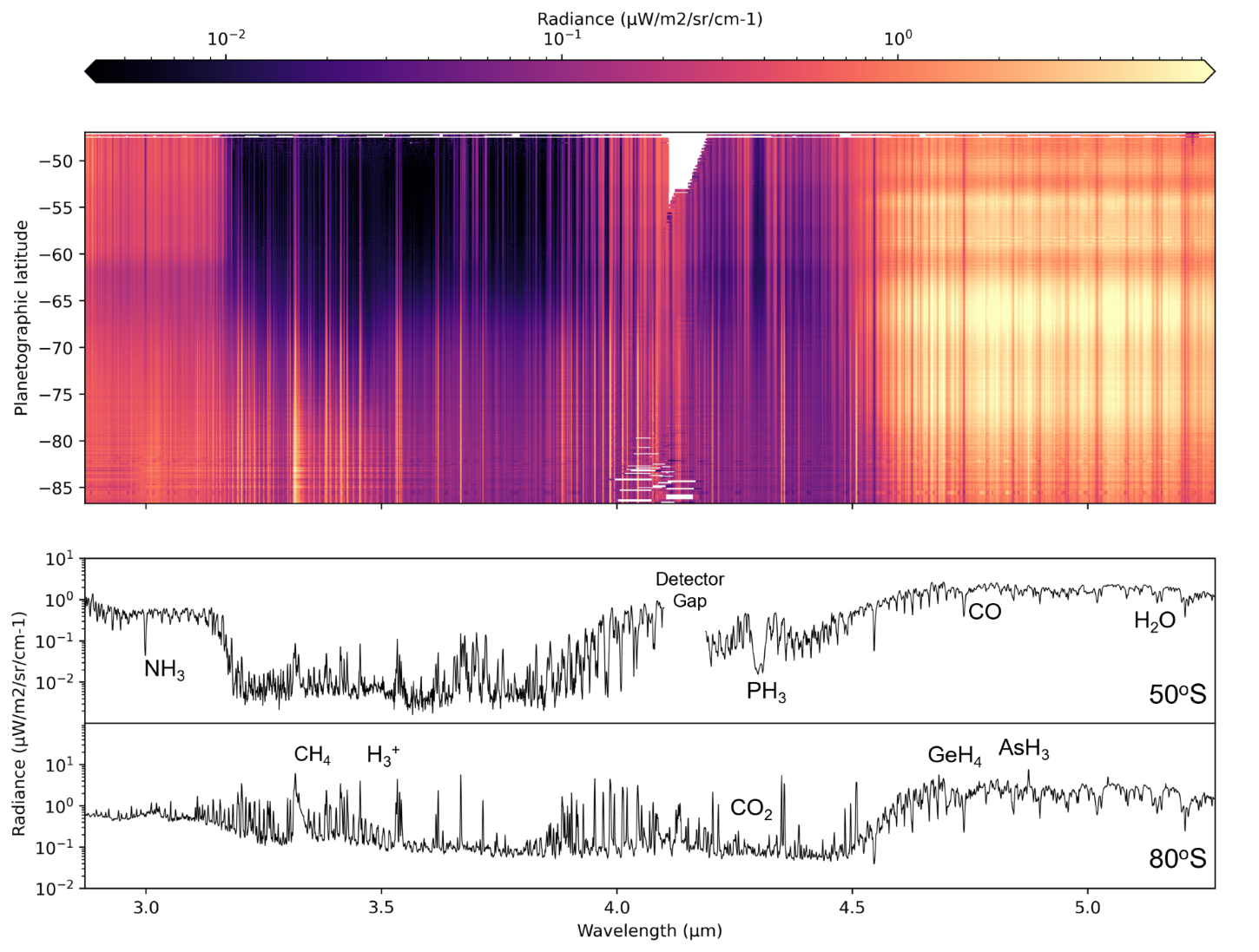
The vertical structure of aerosols and gases will be determined using spectral modelling and inversion package NEMESIS [5]. A key challenge is modelling and removing the ionospheric emissions from methane fluorescence and H3+, which is done outside NEMESIS, before performing the multiple-scattering retrievals to constrain aerosol properties. We vary the vertical profile of several gases including PH3 and NH3 and compare hazes in the upper troposphere and stratosphere atop a single extended cloud deck in the troposphere. We found that a stratospheric haze is required to replicate the broad shape of the region between 3.2 µm and 3.6 µm, where an upper tropospheric haze alone is not sufficiently reflective. Once these gas profiles and aerosols are tuned to provide a physical best-fit, model will be applied to zonally-averaged spectra across the full latitude range of the observations in order to study the changes in chemistry and aerosol properties that occur over the polar vortex boundary.

Figures:

Figure 1 The South Polar region observed by JWST/NIRSpec using G395H at 4 selected wavelengths. Top: Mosaic in the RA/Dec frame, rotated such that North is up. Bottom: reprojected onto an equidistant polar projection. 2.93µm (a) shows sunlight reflecting off the main cloud deck, 3.513µm (b) shows the highly reflective stratospheric haze layer, 3.953µm (c) is dominated by auroral emission from excited H3+ ions, and 4.7µm (d) shows thermal emission from deep within Jupiter (1 – 10bar). Context images are Hubble OPAL visible light images from Nov 2022.

Figure 2 Top: Observed radiance with JWST as a function of latitude and wavelength. Bottom: Two zonally averaged spectra at 50oS and 80oS, with some gas absorption/emission features labelled. The difference between the mid-latitude and high-latitude spectra are evident, with broadband methane and phosphine absorption disappearing at high latitude, and auroral emission from H3+ and CH4 becoming more dominant.

References:

[1]  Wong, A.-S., Y. L. Yung, and A. J. Friedson (2003), Benzene and Haze Formation in the Polar Atmosphere of Jupiter, Geophys. Res. Lett.

[2] Zhang X., West R. A., Banfield D., and Y.L. Yung (2013), Stratospheric aerosols on Jupiter from Cassini observations, Icarus

[3]: Sinclair J.A., Moses J.I., Hue V., Greathouse T.K., Orton G.S., Fletcher L.N., Irwin P.J.G (2019), Jupiter's auroral-related stratospheric heating and chemistry III: Abundances of C2H4, CH3C2H, C4H2 and C6H6 from Voyager-IRIS and Cassini-CIRS, Icarus

[4]: Tsubota, T.K., Wong, M.H., Stallard, T., Zhang X., Simon, A. (2025), UV-dark polar ovals on Jupiter as tracers of magnetosphere–atmosphere connections, Nature Astronomy

[5]: Irwin P.G.J., Teanby N.A., de Kok R., Fletcher L.N., Howett C.J.A., Tsang C.C.C., Wilson C.F., Calcutt S.B., Nixon C.A., Parrish P.D. (2008), The NEMESIS planetary atmosphere radiative transfer and retrieval tool, Journal of Quantitative Spectroscopy and Radiative Transfer

How to cite: Toogood, S., Fletcher, L., King, O., Harkett, J., Roman, M., de Pater, I., Biagiotti, F., Melin, H., Fouchet, T., Wong, M., and Rodriguez-Ovalle, P.: JWST/NIRSpec IFU Observations of Jupiter’s South Pole: Vertical and Latitudinal Structure of Aerosols in the Near-Infrared, EPSC-DPS Joint Meeting 2025, Helsinki, Finland, 7–13 Sep 2025, EPSC-DPS2025-820, https://doi.org/10.5194/epsc-dps2025-820, 2025.

EPSC-DPS2025-1004 | ECP | Posters | MITM15

(163) Erigone, (302) Clarissa, and (752) Sulamitis as seen with JWST’s NIRSpec 

Brittany Harvison, Mario De Prá, Noemí Pinilla-Alonso, Driss Takir, Tania Le Pivert-Jolivet, Javier Licandro, Julia de Leon, Bryan Holler, Joshua Emery, Lucas McClure, and Joseph Masiero
Thu, 11 Sep, 18:00–19:30 (EEST)   Finlandia Hall foyer | F122

Primitive asteroids in the Main Belt possess one of the most pristine inventories of materials in the Solar System. Main Belt primitive asteroids are particularly interesting due to clear evidence of phyllosilicates, i.e., silicates that have encountered liquid water and undergone chemical alteration. Since asteroids are thought to be likely contributors to Earth's water content [1-3], mapping hydration across the primitive asteroid population is essential for understanding the compositional structure of the early Solar System and the introduction of water on Earth. Low-albedo (pv < 10%) and low-inclination (i < 10°) primitive asteroid families in the inner Main Belt are dynamically linked to the primitive NEAs Ryugu and Bennu [4,5], further supporting the importance of investigating their composition and the dynamics responsible for their delivery to near-Earth space. The Cycle 3 Program, “Low-Albedo and Inclination Asteroid Families as Tracers for Water and Organics in the Inner Solar System,” is currently conducting observations using the James Webb Space Telescope (JWST) to investigate this category of primitive bodies directly. Utilizing JWST’s NIRSpec Integral Field Unit (IFU), the program is acquiring near-infrared spectra (0.6 – 5.2 µm) from the largest bodies in the Clarissa, Erigone, and Sulamitis asteroid families. 

Initial investigations into the visible spectra of the Erigone, Sulamitis, and Clarissa families identified a specific trend regarding Fe-rich phyllosilicates: the Erigone and Sulamitis families exhibited similar, high percentages of members showing the 0.7 μm band, indicative of this mineral (60%). In contrast, an extremely low percentage of members expressed the feature in the Clarissa and Polana families [6]. While the absence of a 0.7 μm feature may initially suggest no hydration, it does not provide sufficient grounds to conclude that the body is not hydrated, as Mg-rich phyllosilicates do not show this feature. Studies have shown that although some asteroids lack the 0.7 μm feature, they may still exhibit the 3.0 μm region, whereas all asteroids with a 0.7 μm feature display the 3.0 μm band [7]. This region has been notoriously hard to observe from ground-based observatories due to the Earth’s water-rich atmosphere. JWST observations are required to adequately constrain these bodies' thermal and compositional histories. We will present the compiled preliminary investigations of JWST NIRSpec spectra of (163) Erigone, (302) Clarissa, and (752) Sulamitis. We will search for diagnostic features of hydrated minerals, complex organics, and carbonates. Each spectral feature will be characterized by band center, depth, and area, and compared to features identified in the spectra of carbonaceous chondrite meteorite analogs to investigate possible relationships. Finally, we will explore the compositional diversity of inner belt primitive families and how this connects to their formation and evolutionary history.

References: [1] Marty, B. (2012). Earth and Planetary Science Letters. [2] Piani, L. et al. (2020). Science. [3] Mezger, K. et al. (2021). Icarus. [4] Campins, H. et al. (2010). The Astrophysical Journal. [5] Campins, H. et al. (2013). The Astronomical Journal. [6] Morate, D. et al. (2018). Astronomy and Astrophysics. [7] Rivkin, A. et al. (2015). The Astronomical Journal.

How to cite: Harvison, B., De Prá, M., Pinilla-Alonso, N., Takir, D., Le Pivert-Jolivet, T., Licandro, J., de Leon, J., Holler, B., Emery, J., McClure, L., and Masiero, J.: (163) Erigone, (302) Clarissa, and (752) Sulamitis as seen with JWST’s NIRSpec, EPSC-DPS Joint Meeting 2025, Helsinki, Finland, 7–13 Sep 2025, EPSC-DPS2025-1004, https://doi.org/10.5194/epsc-dps2025-1004, 2025.

MITM18 | Planetary Defense: space missions, observations, modeling and experiments

EPSC-DPS2025-1400 | ECP | Posters | MITM18 | OPC: evaluations required

In-flight observations during the cruise phase of HyperScout-H instrument of ESA/Hera mission 

George Pantelimon Prodan, Marcel Popescu, Julia de León, Gábor Kovács, Balázs Nagy, Björn Grieger, Michael Küppers, Tomáš Kohout, and Javier Licandro
Mon, 08 Sep, 18:00–19:30 (EEST)   Finlandia Hall foyer | F109
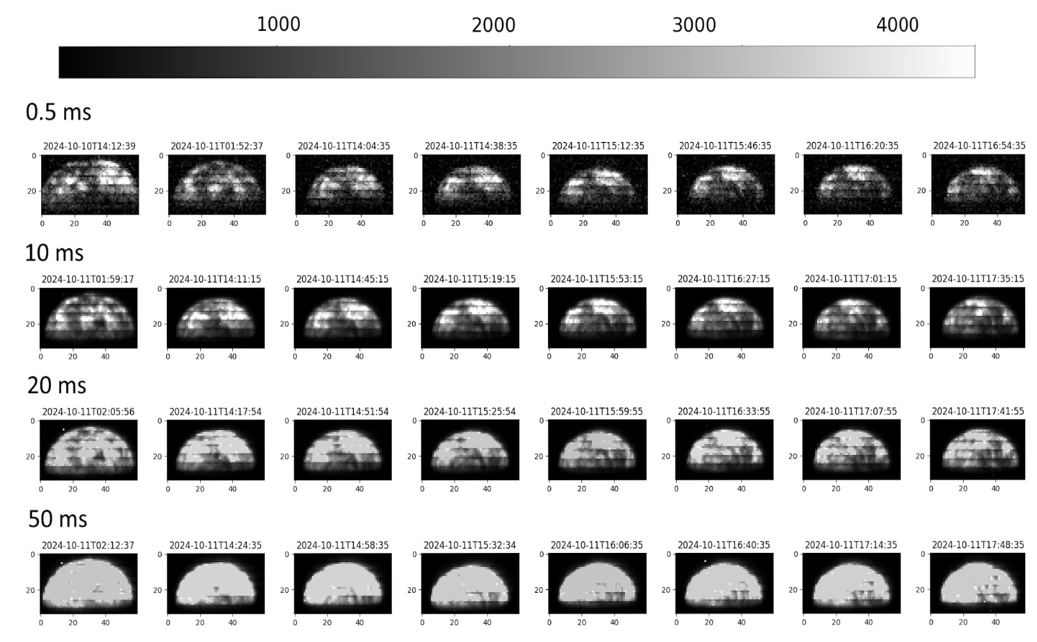
The HyperScout-H hyperspectral imager (HS-H) is one of the payloads aboard ESA’s Hera spacecraft, launched in October 7, 2024. It is produced by cosine* and its primary objective is to provide a detailed characterization of the near-Earth binary asteroid system (65803) Didymos-Dimorphos, following the impact of NASA’s DART mission [1, 2]. HS-H is a versatile, dual-purpose payload, functioning as a hyperspectral imager that captures both images and spectral data within the 0.65 – 0.95 μm wavelength range covered by 25 filters that are distributed along the detector on 5 by 5 macropixels. This work is focused on the in-flight observations of HS-H during the cruise phase. These were performed between October 2024 and March 2025, during the commissioning, early cruise phases of the mission, and the Mars swing-by.

The commissioning activities included imaging the Earth-Moon system, acquiring bias and dark images, and observing several star fields, including various observations of Vega and Aldebaran stars. The goal of these observations was to validate the instrument's functionality and cross-check the calibration performed in the laboratory [3].

The sequence of Earth – Moon images demonstrates that the full photometric range of the instrument was tested using varying exposure times as presented in Figure 1, where we can see Earth’s images at different exposure times. The star exposures of Vega and Aldebaran confirm the expected behavior of the Point Spread Function and validate the detector’s linear response regime. Three images of Aldebaran (a K5III star) at different exposure times are shown in Figure 2. Radiometric calibration was verified within a 10% margin, consistent with the accuracy limitations of the method.

Figure 1. Earth images obtained by HS-H are displayed with the number of pixels on each axis indicated. The images are organized based on their exposure time and the moment they were captured. The dark/white levels are set according to the instrument's dynamic range (grayscale color bar at the top), i.e. from 0 to 4095 Digital Numbers (DNs).

Figure 2: Linearity test images for Aldebaran at different wavelengths of the central pixel and exposure times as shown in the plots. The images correspond to three different frames, showing the increase in detected signal with exposure time. The grayscale color bar on the right indicates the pixel intensity in DNs.


To further validate the instrument’s radiometric accuracy, we perform a cross-calibration using hyperspectral observations of Mars. By targeting well-characterized surface features (e.g. Huygens crater) and comparing the extracted spectra with established datasets (e.g. CRISM@MRO), we asses both spectral and radiometric consistency. The reflectance spectrum shown in Figure 3 is extracted from a region of interest inside the Huygens crater of Mars.  

The in-flight observations successfully validated the instrument’s functionality and helped improve the radiometric and spectral calibrations, ensuring readiness for scientific operations. These early results are a solid foundation for its upcoming observations of the Didymos-Dimorphos system.

Figure 3. HS-H image of Huygens crater on Mars with an annotated Region of Interest (ROI), indicated by the white square, used for spectral extraction. The inset plot displays the normalized reflectance spectrum (dots) and a third degree polynomial fit (continuos line). The blue color of Mars observed in near-infrared resulted from a coloring algorithm that uses shifted colors with blue channel at 650 – 750 nm and red channel at 850 – 950 nm.

[1] P. Michel et al. The ESA Hera Mission: Detailed Characterization of the DART Impact Outcome and of the Binary Asteroid (65803) Didymos. , 3(7):160, July 2022.

[2] Andrew S. Rivkin et al.. The double asteroid redirection test (dart): Planetary defense investigations and requirements. The Planetary Science Journal, 2(5):173, aug 2021.

[3] Popescu, M., de León, J., Goldberg, H., Kovács, G., Krämer Ruggiu, L., Nagy, B., Prodan, G. P., Grieger, B., Kohout, T., Licandro, J., Karatekin, Ö., Esposito, M., and Küppers, M.: Hyperspectral imaging of meteorites using the HyperScout-H instrument, Europlanet Science Congress 2024, Berlin, Germany, 8–13 Sep 2024, EPSC2024-586, https://doi.org/10.5194/epsc2024-586, 2024.

* https://www.cosine.nl/

How to cite: Prodan, G. P., Popescu, M., de León, J., Kovács, G., Nagy, B., Grieger, B., Küppers, M., Kohout, T., and Licandro, J.: In-flight observations during the cruise phase of HyperScout-H instrument of ESA/Hera mission, EPSC-DPS Joint Meeting 2025, Helsinki, Finland, 7–13 Sep 2025, EPSC-DPS2025-1400, https://doi.org/10.5194/epsc-dps2025-1400, 2025.

SB0 | Small Body Dynamics

EPSC-DPS2025-946 | Posters | SB0

The properties of the (617) Patroclus binary system derived from the mutualevents of 2017–2018 and 2024–2025 

Joaquin Fernandez, Marcel Popescu, Noemí Pinilla-Alonso, Miquel Serra-Ricart Serra-Ricart, Javier Licandro, Miguel R. Alarcón, Lucía Matamoros Pava, and Estela Fernández Valenzuela
Thu, 11 Sep, 18:00–19:30 (EEST)   Finlandia Hall foyer | F137
The (617) Patroclus is a binary asteroid system located in the trailing Trojan group (L5) of
Jupiter. The two components, Patroclus and Menoetius (the satellite), orbit a common center of
mass and are nearly equal in size. Studies suggest that Jupiter’s Trojan asteroids, including
Patroclus and Menoetius, may have originated from the outer solar system and were later captured
into their current orbits during the migration of the giant planets (e.g., Morbidelli et al., 2005). The
binary nature of this system adds another layer of importance, as such systems are thought to form
under specific conditions. Their mutual orbit provides valuable insights into the distribution of
mass, size, and material in the early solar system (e.g., Merline et al., 2001). The Lucy spacecraft is
expected to fly by this system in 2033, marking the final encounter of its 12-year journey.
 
A particularly useful technique for studying binary asteroids involves observing mutual
events—eclipses or occultations—that occur when the orbital plane of the system aligns with both
the Sun and the observer. This alignment allows for the accurate determination of key orbital
parameters and the physical characteristics of the system, including mutual orbital elements and the
shape of the bodies. As a result, we initiated an observing campaign that ran during both the 2017–
2018 season and the 2024–2025 season.
 
We observed a total of 7 events using various telescopes across the Earth during 2017-2018.
During 2024-2025 we took advantage of the cutting edge instruments provide by Light Bridges, the
Twin Two Mtere telescopes and we were able to capture 15 complex events (occultations and
eclipses). These telescopes are locate at at the Teide Observatory of the Instituto de Astrofisica de
Canarias (IAC), that Light Bridges operates in the island of Tenerife, Canary Islands (Spain). The
observations made with TTT were performed using the Luminance filter. The log of all these
observations is shown in Table 1.
 
We retrieved the right ascension and declination of (617) Patroclus from the Minor Planet
Center. We modeled the two components, Patroclus and Menoetius, as ellipsoids and ran a two-
body problem code for various orbital parameters. To determine the best orbital solution, we
implemented a grid search algorithm. The light curves were computed by considering three
elements in the plane of sight: the projections of Patroclus, Menoetius, and the shadow cast by the
body in front. We then calculated the flux contribution from the foreground body and the portion of
its shadow covering the background body at each timestamp using the following formula:
 
 
Thanks to the new model implemented in this study, we obtained a refined orbital solution
by trying to match all the 22 events. The best match between (Figure 1) the model and the
observations was achieved using the following orbital parameters: a (semi-major axis) = 692.4 ± 5
km, e (eccentricity) = 0.018 ± 0.018, i (inclination) = 164.8° ± 0.2, L (mean longitude) = 114.13° ±
5, Ω (longitude of the ascending node) = 270.04° ± 2.3, T (orbital period) = 4.272797 ± 0.00003
days. The estimated dimensions are 118.76 × 107.3 × 104.78 km for Patroclus, and 110.7 × 96.88 ×
94.24 km for Menoetius.
Observation log: N.images refers to the number of frames acquired for each event; UT start and UT
end indicate the start and end times of each observation in UTC; details on the telescope,
instrument, filter, and exposure time (Texp) used for each observation night are also included.
 
As noted by Pinilla-Alonso et al. (2022), there is a discrepancy in the superior events when
attempting to match the model to the upper occultation data. This difference is attributed to a crater
located at the south pole of Menoetius, as proposed in that study. Our new observations are
consistent with this interpretation (e.g. Figure 2).
 
Figure 1: Example of an observed (blue) and simulated (black) light curve for an inferior mutual
event in the Patroclus–Menoetius system. The simulated lightcurve was obtained using the best
solution we found
 
Figure 2: Example of an observed (blue) and simulated (black) light curve for an superior mutual
event in the Patroclus–Menoetius system.The simulated lightcurve was obtained using the best
solution we found

How to cite: Fernandez, J., Popescu, M., Pinilla-Alonso, N., Serra-Ricart, M. S.-R., Licandro, J., R. Alarcón, M., Matamoros Pava, L., and Fernández Valenzuela, E.: The properties of the (617) Patroclus binary system derived from the mutualevents of 2017–2018 and 2024–2025, EPSC-DPS Joint Meeting 2025, Helsinki, Finland, 7–13 Sep 2025, EPSC-DPS2025-946, https://doi.org/10.5194/epsc-dps2025-946, 2025.

EPSC-DPS2025-1110 | ECP | Posters | SB0 | OPC: evaluations required

On the forced planes of the Hilda asteroids and other resonant groups 

Ian Matheson and Renu Malhotra
Thu, 11 Sep, 18:00–19:30 (EEST)   Finlandia Hall foyer | F132

Laplace-Lagrange linear secular theory describes the mean orbit plane forced by the massive planets for small body populations outside mean motion resonances. The mean planes of several non-resonant populations inside the asteroid belt and Kuiper belt have been shown to match the Laplace plane to within the statistical limits imposed by the observed populations and the methods used in calculating the mean plane. Although linear secular theory is considered inapplicable within mean motion resonances, we show that it describes the forced planes of the Hilda asteroids in Jupiter’s interior 3:2 mean motion resonance and of the Hilda and Schubart collisional families therein, to the level of statistical precision with which those can be computed from the orbital data. We use the Hilda asteroids as a test population because they are observationally complete up to absolute magnitude H ≈ 15.7, and up-to-date catalogs are available to identify collisional families therein. This gives a statistically useful sample of thousands (n ~ 2100) of resonant objects that can be studied on a population level while limiting the statistical uncertainties to those inherent in parameter estimation without the need to account for the observational biases of various sky surveys. At the present time and for at least 2 Myr into the future, the mean orbit planes of the Hilda collisional family and the Schubart collisional family are statistically indistinguishable from each other and from the local instantaneous Laplace plane as predicted by Laplace-Lagrange linear secular theory based on the known planets. However, they are also statistically indistinguishable from the orbit plane of Jupiter. We estimate that a sample population ~100 times larger is necessary to statistically distinguish between the Laplace plane and Jupiter plane as hypothetical “true” forced planes for the Hilda asteroids. In the coming decade, the Rubin observatory may be able to push the completeness limit to dimmer magnitudes and enable a more sensitive test of Laplace theory within the Hilda region. For more tests of Laplace theory for resonant populations, we consider the mean plane of the Hilda asteroids in a solar system with a fictitious more massive, highly inclined Saturn, and we study the mean planes of the Plutino and Twotino groups in the Kuiper belt. As of the time we write this abstract, we do not have results for these last-mentioned studies, but we hope to have preliminary findings to share by the time of the conference. IM gratefully acknowledges funding by NASA FINESST grant #80NSSC23K1362.

How to cite: Matheson, I. and Malhotra, R.: On the forced planes of the Hilda asteroids and other resonant groups, EPSC-DPS Joint Meeting 2025, Helsinki, Finland, 7–13 Sep 2025, EPSC-DPS2025-1110, https://doi.org/10.5194/epsc-dps2025-1110, 2025.

EPSC-DPS2025-1589 | ECP | Posters | SB0

Charging and Dynamics of Interstellar Dust throughout the Heliosphere 

Tim Arnet and Veerle J. Sterken
Thu, 11 Sep, 18:00–19:30 (EEST)   Finlandia Hall foyer | F139

The heliosphere is a “bubble” of plasma that forms around the Sun through a pressure balance between the outflowing solar wind and the interstellar medium. The Sun is currently traversing the local interstellar medium at a relative velocity of approximately 26 km s−1. Due to the Sun’s motion, interstellar dust grains present in the interstellar medium are transported through the heliosphere’s boundary, from the upwind direction.

Dust grains in a space environment are subject to a variety of charging mechanisms, which result in an overall equilibrium charge on their surface. In the interstellar medium and in the solar wind, the primary charging mechanisms are plasma collection, secondary electron emission, and photoelectric emission. The charge acquired by a dust grain depends on several factors, including the size, composition, and structure of the dust grain itself, as well as on the characteristics of the surrounding environment.

The trajectories of charged dust grains are influenced by the magnetic field in the environment they are moving through due to the emerging Lorentz force. When approaching the heliosphere, the interstellar magnetic field starts to get disturbed by the solar wind (heliospheric) magnetic field. The amount of trajectory deflection an inflowing interstellar dust grain experiences depends on its charge-to-mass ratio. Consequently, not all interstellar dust grains enter the solar system.

We discuss the dust charging with a particular focus on the influence of the space environment conditions that are expected at different locations throughout the heliosphere, including the boundary regions and including short-term and long-term variations of the environmental conditions due to the solar activity. Using these results, we show the influence of heliospheric properties on the dust grain trajectories at the heliospheric interface in specific. The results will help to understand the physical processes occurring at the boundary of the heliosphere.

How to cite: Arnet, T. and Sterken, V. J.: Charging and Dynamics of Interstellar Dust throughout the Heliosphere, EPSC-DPS Joint Meeting 2025, Helsinki, Finland, 7–13 Sep 2025, EPSC-DPS2025-1589, https://doi.org/10.5194/epsc-dps2025-1589, 2025.

EPSC-DPS2025-2091 | ECP | Posters | SB0 | OPC: evaluations required

Dynamical Evolution of Refractory Elements in an alpha-Protoplanetary Disk 

Patrick Franco and Sebastien Charnoz
Thu, 11 Sep, 18:00–19:30 (EEST)   Finlandia Hall foyer | F135

Introduction: Planets form within protoplanetary disks surrounding protostars. Both the star and the disk originate from the collapse of a dense molecular cloud. The condensation of the earliest solids, Calcium Aluminium-rich Inclusions (CAIs), marks the time zero of the solar system (ss). These refractory minerals are increasingly thought to form contemporaneously with the assembly of the protoplanetary disk, as their existence requires extremely high temperatures and widespread distribution across the disk [1-2].
In contrast to carbonaceous meteorites (non-CI) and Earth, which are enriched in refractory elements as CAIs, non-carbonaceous chondrites (NCC), which should have formed closer to the Sun, exhibit a sub-solar abundance trend of refractory elements such as Al and Mg, both relative to Si. This could be due to the loss of a refractory-rich component from a disc with the original solar composition [3-4].
[5] has proposed an astrophysical scenario for the sequestration of refractory elements from the NCC source region, which suggests that massive olivine condensation increased the dust concentration in the disk as it cooled down, suppressing magneto-rotational instability and prompting the rapid formation of the first planetesimals. This process isolated the condensed solids, preventing their further interaction with gas-solid equilibrium chemistry. Later, as temperatures dropped further, new “residual condensates” could form from the residual gas. Then, NCCs likely formed from a mixture of these residual condensates and solar-composition materials, including local grains non-accreted into the first planetesimals and possibly grains migrating from outer regions to the residual region, without element fractionation.

Whereas there is a general agreement that CAIs may have condensed in high temperature conditions, a major conundrum is how to make Enstatite and Ordinary chondrites with non-solar composition (with lower Al/Si and Mg/Si ratios compared to solar) [5]. So, here, we individually track the different refractory components (Al, Mg, and Si) and investigate their radial distribution along the disk.
Methods: We simulate a 1D protoplanetary disk using a Python-based code DustPy, to evolve systems with gas and dust [7]. We initially distribute the gas surface density radially following [8]. We have also modeled the early infall into the disk by implementing an external source term, Sext, with a flux of mass of 0.5e-5MSun/year falling within 0.2au (Fig. 1).
Our planar disk extends from 0.1 to 100 au with 40 grid cells, from which 16 refined cells around 2 au. To accurately study dust growth evolution, each radial point contains 78 logarithmically spaced mass bins every mass decade, and the growth and fragmentation of dust is calculated using Smoluchowski's equation. We set the standard dust/gas ratio value to 0.01. The newly formed star has radius RStar = 0.1au, mass MStar = 0.3MSun. Dust grain sizes start with minimum radii of 0.5 microns and bulk densities of around 1.25 g cm-3.

Results: Figure 3 showcases the evolution of surface density of refractory elements (Al, Mg, and Si) when we apply the  phase equilibrium codeFASTCHEMCOND [10-11] in the post-simulation. The pressure maxima in surface density occurs now near 1au after hundreds of years due to evolution of pressure profile. As the infall material reaches the midplane, it accumulates in the inner disk region, increasing the pressure in it. This material moves outwards due to the viscous spreading, reaching the condensation zone (gray dotted line), when some gas starts to condensate. Figure 4 presents
the average radial velocity of gas and dust. Small dust grains are the most abundant in the first thousand years and they are strongly coupled to the gas flow. Fractionation of the element abundances are observed during all evolution of the disk, especially in the condensation fronts.
Our results show that the dynamical evolution of a viscously evolving protoplanetary disk, when coupled with realistic dust growth and condensation models, naturally leads to the fractionation of refractory elements such as Al, Mg, and Si. The emergence of a pressure bump near the MRI front, as a result of the viscosity transition, prevents the immediate inward drift of solids and promotes a local accumulation of their surface density. This process leads to variations in condensation of the gas, which results in element fractionation over time. These findings support the idea that the observed depletion of refractory elements in non-carbonaceous chondrites is caused by early disc processes.
Our next steps will investigate the relationship between radial mixing and chemical evolution as both the disk becomes accretionary and the global temperature of the disk cools.
References: [1] Drążkowska, J. & Dullemond, C. P. (2018) AAP, 614, A62 [2] Pignatale F. C. et al. (2018) AJL, 867, L23 [3] Larimer J. W. (1979) Icarus, 40, 446-454. [4] Alexander, C.M.O’D. (2019). Geochim. Cosmochim., 254, 246 [5] Morbidelli A. (2020) Earth and Planet. Sci. Letters 538,116220 [7] Charnoz S. et al. (2019), A&A 627, A50 [8] Lynden-Bell & Pringle (1974) MNRAS 168, 603-637 [9] Birnstiel T. et al. (2012) A&A 539, A148 [10] Zhu, Z. et al. (2010) ApJ, 713, 1134 [11] Kitzmann D. et al. (2024) MNRAS 527, 7263–7283 [12] Stock J. W. et al. (2018) MNRAS, 479, 865.


FIGURE 1: Surface density evolution (y-left) of gas (blue line) and 100 x dust (orange line). Dust-to-gas ratio (gray solid line, y-right) as a function of distance r over time. Dotted gray line stands for condensation temperature, Tcond, before which dust is evaporated.


FIGURE 2: The graph shows the temperature (blue line, y-left) and pressure (black line, y-right) profiles evolution as a function of distance r over time. It is possible to note the pressure bump rising around 2au.


FIGURE 3: Surface density profiles of aluminium (Al, orange), magnesium (Mg, red), and silicon (Si, cyan) in both dust and gas phases (solid and dashed lines, respectively). Dotted and dashed black lines stand for condensation and MRI temperatures, respectively.


FIGURE 4. Mean radial velocities of dust (orange line) and gas (blue line). Dotted and dashed gray lines stand for condensation and MRI temperatures, respectively.

How to cite: Franco, P. and Charnoz, S.: Dynamical Evolution of Refractory Elements in an alpha-Protoplanetary Disk, EPSC-DPS Joint Meeting 2025, Helsinki, Finland, 7–13 Sep 2025, EPSC-DPS2025-2091, https://doi.org/10.5194/epsc-dps2025-2091, 2025.

SB3 | Observational investigations of comets

EPSC-DPS2025-869 | ECP | Posters | SB3 | OPC: evaluations required

JFC Reflectivity Reassessed: Preliminary Albedos and Statistical Trends 

Rhiannon Hicks, Yanga Fernandez, Stephen Lowry, Carey Lisse, and Harold Weaver
Thu, 11 Sep, 18:00–19:30 (EEST)   Finlandia Hall foyer | F148

Comets are widely viewed as preserving some of the compositional and structural properties of the planetesimals in the solar system during its formation. Studying their current physical properties is essential for understanding their surface evolution over time. Albedo is an intrinsic physical property influenced by an object’s material composition, porosity, regolith, and surface roughness, and is important for context when studying e.g. shape, color, and surface heterogeneity. Cometary nuclei generally do have very low albedo values, alluding to their primitive surfaces. However, the actual geometric albedo distribution of comets is not well-constrained, as literature provides this quantity for only 29 comets, with 19 of those being Jupiter Family Comets (JFCs) [1]. The lack of albedo values is due to multiple observational limitations. First, comae tend to obscure the comet nuclei when they are best observable, and second, each target’s radius must be obtained independently. We present here preliminary results from our work to measure the JFC albedo distribution in a statistically significant subset of the population by avoiding both of these problems. We have obtained R-band imaging photometry of about 100 JFC nuclei with known, independent radii from the SEPPCoN survey using the Spitzer telescope [2] and other sources [1]. We have generally made use of 3-8 meter telescopes (e.g. ARC at Apache Point, VLT, PAL200) to observe these comets at multiple epochs when they are ~3-5 au from the Sun, i.e. when the nuclei, while faint, have minimal or no activity. A montage of our Apache Point data can be seen in the figure below. To avoid too much extrapolation, we reference our results to a 10 degree phase angle, and assume a typical linear phase coefficient of 0.04 mag/deg. We will present our albedo analysis thus far, including an assessment of the mean albedo and of any possible anomalous albedos, and a comparison of JFC albedos with those of related populations such as Centaurs, Trojans, and Trans-Neptunian Objects (TNOs). The results of this work have the potential to provide much needed insight into the current distribution of albedo values for JFCs, and will help constrain their placement in the broader population of small bodies albedos. We hope to in the future make use of publicly available infrared (e.g. SPHEREx, NEO-Surveyor) and visible (e.g. Vera Rubin Observatory) data to augment the sample size of albedos. Acknowledgements: We acknowledge support from NASA’s SSERVI program via award 80NSSC19M0214 for the Center for Lunar and Asteroid Surface Science. [1] M. M. Knight, et al. Physical and Surface Properties of Comet Nuclei from Remote Observations, in Comets III (K. J. Meech et al., Eds.), U. Arizona Press, Tucson, 2024, pp. 361-404.  [2] Y. R. Fernández, et al. Icarus, 226, 1138, 2013. 

How to cite: Hicks, R., Fernandez, Y., Lowry, S., Lisse, C., and Weaver, H.: JFC Reflectivity Reassessed: Preliminary Albedos and Statistical Trends, EPSC-DPS Joint Meeting 2025, Helsinki, Finland, 7–13 Sep 2025, EPSC-DPS2025-869, https://doi.org/10.5194/epsc-dps2025-869, 2025.

EPSC-DPS2025-1175 | ECP | Posters | SB3

Unveiling Comet Nuclei Surface Spectra: Validating a Coma Subtraction Technique for IFU Comet Observations 

Aren Beck, Charles Schambeau, and Yan Fernandez
Thu, 11 Sep, 18:00–19:30 (EEST)   Finlandia Hall foyer | F151

Cometary nuclei preserve clues to our early solar system and spectroscopic studies of both their surfaces and surrounding comae—clouds of gas and dust that activate during solar approach—offer critical insight into their composition and evolution. Specifically, cometary surface spectra reveal the materials present on the object’s outermost layers, which record evidence of past and ongoing surface processing. Characterization of these surfaces also enables comparisons—and potential connections—to other small body populations (e.g., asteroids, centaurs, and trans-Neptunian objects) providing perspective into the myriads of gravitational rearrangements experienced by these objects since our solar system’s formation. However, obtaining spectroscopic data for a large number of cometary nuclei remains challenging. Their small, dark surfaces often make them difficult to observe during inactive periods, which typically occur at larger heliocentric distances. Conversely, during observations at smaller heliocentric distances, their proximity to the Sun increases the likelihood of activity, where the enshrouding presence of comae leads to an entanglement of the signals received and complicates efforts to isolate nucleus-only information.

To address this observational challenge, we investigate whether an established coma modeling and removal technique, originally developed for broadband imaging [e.g., 1, 2, 3], can be adapted to spectroscopic integral field unit (IFU) observations of comets. IFU systems capture both spatial and spectral information, where each spectral wavelength element corresponds to a reconstructed 2D image of the instrument’s field of view (FOV), such as that produced by JWST’s NIRSpec IFU (see Figure 1). This data structure presents a potential opportunity to isolate high-resolution, nucleus-only spectra by modeling and removing the coma’s contribution from each of the spectrum’s wavelength resolution elements. A successful coma subtraction requires sufficient details of the coma’s 2D surface-brightness distribution to generate an accurate coma model, a task enabled by imaging’s larger FOVs. However, IFU instruments typically have smaller FOVs, raising uncertainties about their ability to provide enough coma information for accurate modeling. Our work aims to evaluate the efficacy and limits of the nucleus extraction technique’s application to IFU data.

Rather than relying on real comet data for the method’s validation, where coma and nucleus flux contributions are inherently uncertain a priori, our approach utilizes synthetic comet “observations” created to mimic real data, but with known input signals for each component. These simulated datasets create a controlled environment that enables rigorous validation of coma modeling accuracy and the potential for recovering clean nucleus spectra under realistic observing circumstances. Here, we present our progress towards this goal and preliminary simulation results focused on comet data acquired with the JWST NIRSpec IFU in Prism mode.

Figure 1. A JWST NIRSpec spectrum of the active comet/centaur 29P/Schwassmann-Wachmann 1 [4] is shown where individual datacube wavelength slices are identified. The coma’s surface brightness is clearly visible in the wavelength slices. Our project seeks to identify if the coma modeling and removal procedure proven successful in broadband imaging studies can be applied to smaller FOV IFU data. For reference, the JWST NIRSpec IFU FOV is 3” x 3”.

References:

[1] P. Lamy and I. Toth, "Direct detection of a cometary nucleus with the Hubble Space Telescope," Astronomy and Astrophysics, vol. 293, pp. L43-L45, 1995.

[2] C. M. Lisse, "The Nucleus of Comet Hyakutake (C/1996 B2)," Icarus, vol. 140, no. 1, pp. 189-204, 1999.

[3] Y. R. Fernandez, "Physical properties of cometary nuclei," PhDT, 1999.

[4] Faggi, S., “Heterogeneous outgassing regions identified on active centaur 29P/Schwassmann–Wachmann 1”, Nature Astronomy, vol. 8, no. 10, pp. 1237–1245, 2024.

How to cite: Beck, A., Schambeau, C., and Fernandez, Y.: Unveiling Comet Nuclei Surface Spectra: Validating a Coma Subtraction Technique for IFU Comet Observations, EPSC-DPS Joint Meeting 2025, Helsinki, Finland, 7–13 Sep 2025, EPSC-DPS2025-1175, https://doi.org/10.5194/epsc-dps2025-1175, 2025.

EPSC-DPS2025-1182 | ECP | Posters | SB3

Spatial intensity profiles of forbidden atomic oxygen emission lines in C/2023 A3 (Tsuchinshan-ATLAS) 

Ko Tsujimoto, Hideyo Kawakita, Yoshiharu Shinnaka, and Hitomi Kobayashi
Thu, 11 Sep, 18:00–19:30 (EEST)   Finlandia Hall foyer | F163

  Comets, icy small bodies formed approximately 4.6 billion years ago during the formation of the solar system and which have remained in distant regions for most of their lifetimes, are thought to preserve pristine information about the early solar system. Therefore, studying comets is essential for understanding the processes and materials (ice and dust) involved in the formation of the solar system.

  The primary constituents of cometary ices are H₂O, CO₂, and CO. Once these molecules sublimate from the nucleus surface, they are photo-dissociated into fragments by the solar UV radiation, producing atomic oxygen through several reaction channels. Not only are oxygen atoms in the electronic ground state 3P produced, but also excited states ¹D and 1S. These excited states are meta-stable, with lifetimes of ~110 seconds for the 1D state and ~1 seconds for the 1S state. Oxygen atoms in the 1D state emit forbidden lines at 6300 Å and 6364 Å (red lines), while those in the 1S state emit the forbidden line at 5577 Å (green line). Measuring the intensity ratio between the green and red lines I₅₅₇₇ / (I₆₃₀₀ + I₆₃₆₄), known as the green-to-red (G/R) ratio, allows for estimating the relative abundance of CO₂ with respect to H₂O (CO₂/H₂O) in the coma (Cochran & Cochran 2001; Furusho et al. 2006; Huffman et al. 2024 and references therein).

  However, this method has is based on the assumption that all excited oxygen atoms emit the photons as forbidden emission. In the inner coma, where the gas density is sufficiently high, the oxygen atoms in the 1D and 1S state can collide with water molecules and are de-excited to the ground state without emitting photons. This collisional quenching is especially significant for oxygen O(¹D) due to its longer radiative lifetime. As a result, quenched oxygen atoms do not contribute to the observed emission spectrum, potentially leading to an overestimation of the CO₂ abundance derived from the G/R ratio (Decock et al. 2015). Therefore, it is necessary to correct for this effect in the G/R ratio in order to accurately determine the CO₂/H₂O ratio.

  To address this issue, it is necessary to investigate the spatial distribution of the forbidden emission of atomic oxygen (i.e., the G/R ratio as a function of the distance from the nucleus). Decock et al. (2015) demonstrated that the G/R ratio varies significantly with nucleocentric distance, increasing markedly within 1000 km due to the quenching effects.

  In this study, we aim to more accurately estimate the CO₂/H₂O ratio by analyzing the spatial distribution of forbidden atomic oxygen lines. We conducted high-dispersion optical spectroscopic observations of comet C/2023 A3 (Tsuchinshan-ATLAS) on October 31 and November 1, 2024 (at heliocentric distance of 0.9 au), using the High Dispersion Spectrograph (HDS) mounted on the Subaru Telescope at the summit of Maunakea, Hawaii. Based on the obtained data, we discuss the spatial distribution of forbidden emission lines and compare the observed profiles with model results.

How to cite: Tsujimoto, K., Kawakita, H., Shinnaka, Y., and Kobayashi, H.: Spatial intensity profiles of forbidden atomic oxygen emission lines in C/2023 A3 (Tsuchinshan-ATLAS), EPSC-DPS Joint Meeting 2025, Helsinki, Finland, 7–13 Sep 2025, EPSC-DPS2025-1182, https://doi.org/10.5194/epsc-dps2025-1182, 2025.

EPSC-DPS2025-1523 | ECP | Posters | SB3

NH fluorescence models for measuring cometary D/H isotopic ratios 

Elsa Blond Hanten, Philippe Rousselot, Emmanuël Jehin, Pierre Hardy, Damien Hutsemékers, and Jean Manfroid
Thu, 11 Sep, 18:00–19:30 (EEST)   Finlandia Hall foyer | F155
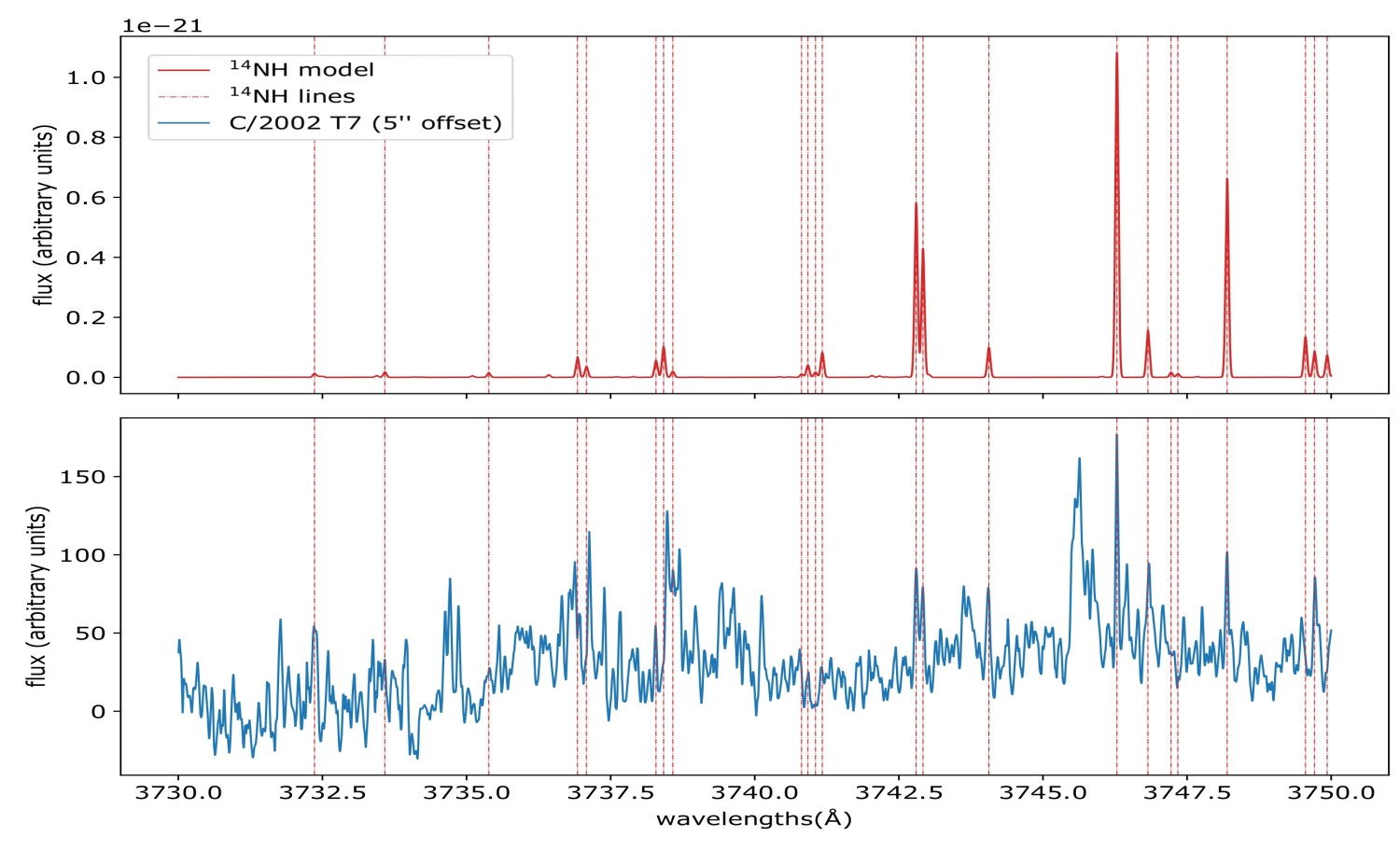
This study presents an updated fluorescence model for the NH radical and its isotopologues (14NH, 14ND, and 15NH) in cometary spectra, offering new insights into the isotopic composition of nitrogen-bearing molecules and, in particular, the deuterium-to-hydrogen (D/H) ratio in comets. NH is a photodissociation product of ammonia (NH₃), commonly detected in the visible spectral range of comets.

Scientific Context and Motivation

Comets are considered among the most primitive celestial bodies in the Solar System, preserving information from its early formation phases. Spectroscopic observations of comets allow researchers to probe their chemical compositions. The NH radical has been detected in cometary spectra as early as the beginning of the 20th century and originates from the breakdown of ammonia. Initial models of NH fluorescence spectra, such as those by Litvak & Kuiper (1982) and refined by Kim et al. (1989), enabled initial analysis of this molecule, but suffered from limited accuracy due to outdated atomic and molecular data and incomplete observational coverage.

In light of new Einstein coefficients made available by the ExoMol project (Perri & McKemmish 2024) and the availability of high-resolution cometary spectra from UVES at ESO's Very Large Telescope, this study aims to reconstruct and enhance the fluorescence models of NH and its isotopologues. Specifically, it investigates comets C/2002 T7 (LINEAR), C/2012 F6 (Lemmon), and 73P/Schwassmann–Wachmann, to both improve the NH model and derive isotopic ratios, including D/H, for nitrogen-bearing molecules in cometary comae.

Methods and Modeling Approach

The core methodology centers on building and applying detailed fluorescence models for the 14NH, 14ND, and 15NH radicals. These models incorporate new laboratory-derived Einstein coefficients and simulate the population distribution among molecular energy levels. The population distributions are calculated by solving a system of radiative transfer equations using a matrix-based method inspired by Zucconi & Festou (1985), which reduces computational complexity while ensuring accuracy.

The modeling included electronic transitions within the A³Πᵢ − X³Σ⁻ system, pure rotational and vibrational transitions within the ground electronic state. Intensity simulations for multiple rovibrational bands were performed, including (0-0), (0-1), and (1-1), under varying heliocentric distances and velocities to match specific observational conditions of the selected comets.

High signal-to-noise, high-resolution UVES spectra from the VLT were used to validate the modeled emission lines. Coaddition was employed to enhance signal detection of weak lines in the observational data. This approach was crucial for extracting isotopic signals from comets with low concentrations of 14ND and 15NH.

Results and Line Identification

The revised model accurately reproduced observed spectral lines of 14NH and identified the previously undetected (0-1) band around 3750 Å (Figure 1).

Comparison with observational spectra at different heliocentric distances (0.68 au for T7 and 1.175 au for F6) showed strong agreement, confirming the model's robustness (Figure 2 & 3). Fluorescence efficiencies (g-factors) derived from the models were found to be about 20% higher than in previous studies.


The study also successfully detected the presence of 14ND in Comet 73P, enabling for the first time the measurement of the D/H ratio in the NH radical (Figure 4). The derived isotopic ratio 14ND/14NH was 2.7 × 10⁻³ ± 1.8 × 10⁻³. In comets T7 and F6, the signal from ND was too weak to allow for a reliable measurement. No detection of 15NH was achieved due to the minimal wavelength shift (as little as 0.008 Å from 14NH) (Figure 5).

Discussion and Implications

The successful identification of 14ND in 73P represents a significant milestone, as this is the first direct D/H ratio measurement in NH, a nitrogen-bearing species in cometary comae. The result aligns well with the upper limit of (D/H)NH ≤ 0.006 previously derived in Comet Hyakutake and the D/H ratio in ammonia (1.1 × 10⁻³) measured in Comet 67P by the Rosetta spacecraft. These findings reinforce the observation that D/H ratios in nitrogen-bearing molecules tend to be an order of magnitude higher than those in water.

This discrepancy in isotopic ratios among cometary species has important implications for understanding the origin and processing of volatiles in the early Solar System. It suggests either differing formation environments for water and ammonia or subsequent fractionation processes affecting these molecules differently. Additionally, the improved g-factors for NH and its isotopologues will enable more accurate future measurements of nitrogen isotopic ratios in comets, once spectral resolutions improve to a level that can distinguish 15NH lines.

Conclusions

This study provides an enhanced fluorescence model for 14NH, 14ND, and 15NH, validated by high-resolution spectroscopic observations of three comets. The new model allows the identification of previously undetected spectral features and the computation of updated fluorescence efficiencies. Importantly, it enabled the first D/H measurement in NH, revealing isotopic fractionation trends that match prior findings for other nitrogen-bearing species and diverge from water-based measurements.

This work contributes to the advancement of isotopic studies of cometary volatiles and emphasizes the importance of continued high-resolution spectroscopic observations. In particular, future instruments with improved spectral resolution may make it possible to distinguish closely spaced spectral lines, such as those of 14NH and 15NH.

How to cite: Blond Hanten, E., Rousselot, P., Jehin, E., Hardy, P., Hutsemékers, D., and Manfroid, J.: NH fluorescence models for measuring cometary D/H isotopic ratios, EPSC-DPS Joint Meeting 2025, Helsinki, Finland, 7–13 Sep 2025, EPSC-DPS2025-1523, https://doi.org/10.5194/epsc-dps2025-1523, 2025.

EPSC-DPS2025-1635 | ECP | Posters | SB3

Tracing Asymmetries in the 67P’s Dust Coma Brightness Distribution Using Rosetta’s OSIRIS Observations 

Daniella Glezina, Raphael Marschall, and Cecilia Tubiana
Thu, 11 Sep, 18:00–19:30 (EEST)   Finlandia Hall foyer | F145

Comet 67P/Churyumov–Gerasimenko provides a rare opportunity to explore the interplay between illumination geometry, seasonal activity, and dust coma structure, thanks to ESA’s Rosetta mission. In this study, we examine directional asymmetries in the inner coma brightness using OSIRIS Wide-Angle Camera (WAC) images. We focus on azimuthal profiles at a fixed radial distance from the nucleus, allowing us to quantify day-night brightness ratios and assess whether peak intensities align with the projected subsolar direction.

A Python-based processing pipeline was developed to enable the automatic selection, calibration, and analysis of OSIRIS WAC images. This tool supports large-scale, reproducible analysis of the dust coma by systematically extracting azimuthal intensity distributions along circular profiles at a fixed impact parameter (typically 10–12 km from the nucleus center). This radius is commonly used in cometary coma studies as it approximates the force-free radial flow regime, where column densities scale as 1/r, enabling a robust comparison of brightness profiles across time and observational geometry (Gerig et al. 2018, Zakharov et al. 2018).

First stages of our research included reproducing the work of Gerig et al. (2021), who tracked the dayside-to-nightside (DS:NS) brightness ratio over the mission timeline. Indeed, the ratio grows from 2.5 to 4 as the comet moves from 1.88 AU to perihelium at 1.25 AU (perihelium). One might expect a much greater contrast in brightness under the assumption that solar illumination is the primary driver of gas and dust emission, particularly considering that the nightside outgassing was estimated to contribute only around 2-10% of the total production (Bieler et al. 2015). 

The key observation from this work is that the primary direction of the dust emission  almost never lies precisely in the subsolar direction, and the minimum is not strictly antipodal as would be expected in a purely illumination-driven model for a spherical nucleus. 

This misalignment suggests that the comet's rotation, orientation, and shape, as well as possibly thermal inertia effects, significantly influence the spatial distribution of dust emission. By quantifying the angular offset between the peak brightness and the subsolar direction over time, we aim to better understand the role of topographically shaded regions, thermal lag, and non-uniform subsurface volatile distribution in shaping the dust coma.

The underlying cause of such asymmetries is likely linked to 67P’s seasonal illumination cycle, driven by its extreme axial tilt (52°). This results in a variation of the sub-solar latitude between +52° and -52° over its 6.45-year orbit. The obliquity causes prolonged northern summer near aphelion, with the southern hemisphere (e.g., Anhur region) in darkness. Around perihelion (1.24 AU), the subsolar point shifts rapidly southward, causing intense but brief southern summer activity. These cycles together with the non-spherical shape create strong asymmetries in outgassing, which in turn shape the spatial dust distribution.

Figure 1 shows how the peak of the intensity distribution shifts relatively to the subsolar direction (0°) during the comet's inbound journey. Positive values indicate that peak lies towards the afternoon, while negative values correspond to shifts towards the morning. In Figure 2 we see the comparison of two images: one (25.07.2015) with a calibrated morning peak associated with the neck region, other (27.06.2015) with multiple peaks.

In future work, these results could be compared with existing models or used to guide targeted simulations of localized activity. While further analysis is needed to fully interpret the observed offsets, our method offers a reproducible way to characterize asymmetries in the dust coma and supports a deeper understanding of cometary dust dynamics.

Figure 1: Angular difference between sub-solar direction and direction of the maximum intensity changing with heliocentric distance.

Figure 2: Circular histograms of azimuthal brightness extracted at 12 km impact parameter from 2 OSIRIS/WAC images (27.06.2015 on the left, 25.07.2015 on the right). Green bars indicate normalized brightness as a function of angle. The yellow arrow marks the solar direction. The brightness maximum is offset from the subsolar point, demonstrating non-radial symmetry in coma structure.


How to cite: Glezina, D., Marschall, R., and Tubiana, C.: Tracing Asymmetries in the 67P’s Dust Coma Brightness Distribution Using Rosetta’s OSIRIS Observations, EPSC-DPS Joint Meeting 2025, Helsinki, Finland, 7–13 Sep 2025, EPSC-DPS2025-1635, https://doi.org/10.5194/epsc-dps2025-1635, 2025.

SB4 | Sample Return: in-progress analyses and perspectives

EPSC-DPS2025-548 | ECP | Posters | SB4

Spectral Variability and Compositional Insights from Asteroid (101955) Bennu’s Sampling Sites Using OTES Data  

Emma Belhadfa, Katherine Shirley, and Neil Bowles
Mon, 08 Sep, 18:00–19:30 (EEST)   Finlandia Hall foyer | F138

Introduction: During the Reconnaissance phase of NASA’s OSIRIS-REx mission, the Thermal Emission Spectrometer (OTES) acquired high–spatial resolution emissivity spectra over Bennu’s four prospective sampling sites [1, 2]. We analyse the calibrated OTES dataset archived in the Planetary Data System [3] to quantify compositional and mineralogical diversity across the original four candidate sample sites (Nightingale, Kingfisher, Osprey, and Sandpiper) and to explore possible drivers of Bennu’s surface heterogeneity, including implications for Bennu’s mineralogy and space-weathering history. 

Figure 1: Site-Averaged Emissivity Spectra with Annotated Band Parameters

Methods: Calibrated emissivity spectra (5.7-100 µm) were linked to corresponding OCAMS imagery [5] to place the thermal infrared measurements in geological context, by cross-referencing observation times. For every spectrum we derived four diagnostic band parameters: Christiansen Feature (CF), silicate stretching band, silicate bending band and spectral slope, following the methods outlined in [6]. Each site contains thousands of spectral observations (site-averaged for visualization in Figure 1). The corresponding band parameters were compared using three statistical models: Principal Component Analysis (PCA) [5], k-Nearest Neighbors (KNN) [7], and Analysis of Variance (ANOVA) [8]. The three methods compare the mean and variance of each individual observation per site, considering how the in-group variance (i.e. the spread within all observations of a single site) compares to the out-group variance (i.e. the spread from other sites). 

Results: Significant differences in emissivity spectra emerged among the four sites. PCA indicated that the first three components explain 85.5% of spectral variance, distinguishing Kingfisher as notably unique, with Sandpiper and Osprey exhibiting the greatest similarity. The KNN analysis corroborated PCA findings, reaching optimal classification accuracy (47%) at k = 21. ANOVA highlighted significant variability among the sites, especially in the spectral slope parameter (F = 762.8), suggesting differences in particle size distribution and space weathering could be driving factors in the detected heterogeneity [9]. Band ratio analyses provided additional insight into site-specific mineralogical distinctions, notably the relationship between silicate features and aqueous alteration indicators [10]. 

Figure 2: Distributions of Band Parameters by Site

Discussion: Variability in spectral parameters aligns with documented particle size frequency distributions and known space weathering spectral types across Bennu’s surface [9]. Nightingale, the mission’s selected sample site, captures representative global characteristics, contrasting with Kingfisher’s distinct compositional and physical attributes, potentially related to differences in Fe/Mg content and degree of aqueous alteration [10]. 

Conclusion: Integrative use of multiple statistical approaches confirms the compositional and physical diversity of Bennu's surface, as seen through the four prospective sites. These analyses provide a framework for interpreting returned sample data and offer insights into the connections between mineralogy, particle size, and space weathering processes on small airless body surfaces. 

References: [1] Lauretta D. S. et al (2021) Sample Return Missions. [2] Hamilton V. et al. (2021) A&A (Vol. 650). [3] Christensen, P. R. et al. (2019) NASA Planetary Data System [4] Christensen P. R. et al. (2018) Space Science Reviews (Vol. 214, Issue 5). [5] Rizk B. et al (2018) Space Science Reviews (Vol. 214, Issue 1). [6] Xie B. et al (2022) Minerals (Vol. 508, Issue 12). [7] Kramer O. (2013) Intelligent Systems Reference Library (13-23). [8] Sawyer S. (2009) Journal of Manual & Manipulative Therapy. [9] Clark B. E. et al (2023) Icarus (Vol. 400). [10] Bates H. et al (2020) MaPS (Vol. 55, Issue 1). 

How to cite: Belhadfa, E., Shirley, K., and Bowles, N.: Spectral Variability and Compositional Insights from Asteroid (101955) Bennu’s Sampling Sites Using OTES Data , EPSC-DPS Joint Meeting 2025, Helsinki, Finland, 7–13 Sep 2025, EPSC-DPS2025-548, https://doi.org/10.5194/epsc-dps2025-548, 2025.

EPSC-DPS2025-1487 | ECP | Posters | SB4

3D Detection and Analysis of Lithologies in Ryugu: Insights into its Complex Geological Formation 

Léna Jossé, Zélia Dionnet, Alice Aléon-Toppani, Rosario Brunetto, Andrew King, Emmanuel Gardés, and Eva Héripré
Mon, 08 Sep, 18:00–19:30 (EEST)   Finlandia Hall foyer | F141

INTRODUCTION & CONTEXT
Ryugu is a C-type asteroid, rich in carbon and organic compounds, and is considered to have evolved relatively little since its formation. It therefore represents a major scientific target for understanding the origins and early formation of Solar System bodies. As a relatively accessible near-Earth asteroid, it was selected by the Japanese Space Agency (JAXA) to be sampled as part of the Hayabusa2 mission. In December 2020, approximately 5 grams of material were successfully returned to Earth, enabling the development of various scenarios regarding Ryugu’s formation and evolution.

Ryugu is thought to originate from a larger parent body, estimated to have had a diameter ranging from several tens to several hundreds of kilometers [1, 2]. This body likely formed between 1.8 and 2.9 million years after the first solid components of the Solar System, beyond 3–4 AU, in a cold region where water (H2O) and carbon dioxide (CO2) could exist in the form of ice [2]. The parent body, mostly composed of ice, amorphous silicates (GEMS-like material), some minerals (metals, sulfides, and anhydrous silicates) and organics [3, 4, 5], would have experienced internal heating due to the radioactive decay of aluminum-26 leading to the melting of ices and the onset of mineralogical aqueous alteration depending on the location within the body [6]. These processes created local heterogeneities enriched in secondary minerals. Major impact events also contributed to the brecciation of the surface and the possible formation of second-generation asteroids, such as rubble piles, of which Ryugu is believed to be one [7].

The breccias that resulted from these catastrophic events are composed of fragments (or clasts) of various mineralogical assemblages cemented within a fine-grained matrix [8]. The lithological diversity observed in these breccias reflects the complex geological evolution of planetary surfaces and bodies in the Solar System, making their study essential for better understanding the processes that shaped these objects.

In this context, and to overcome the limitations of traditional 2D analyses, we developed a semi-automated method called Local Histogram (LH) segmentation ([9], publication in prep.), applied to a millimetric grain from Ryugu using Synchrotron-Radiation X-Ray Micro-Computed Tomography (SR-μXCT) dataset. This approach enables the 3D identification and visualization of mineralogical heterogeneities while minimizing manual intervention.


RESULTS & PERSPECTIVES
The analysis of a single grain revealed a composite of five distinct lithologies. Three of them (Lith I, II, and III) are matrix-dominated but differ in their contents of carbonates, magnetite, calcium phosphates, and sulfides. The widespread presence of hydrated phyllosilicates attests to an aqueous alteration process that led to the formation of these lithologies. Their current juxtaposition could be the result of a brecciation event that brought together materials from different depths within the parent body, consistent with rubble-pile formation simulations [10].

The 3D segmentation, combined with fracture analysis, revealed a clear fracture separating Lith I and Lith II, strengthening the hypothesis of a brecciation event. However, the contiguous (Lith I, II, then III) and sometimes concentric distribution in 3D also suggests a progressive, potentially radial alteration process, affecting each lithology differently (from the less altered Lith I to the carbonate-rich Lith III). Among the other detected lithologies are (i) a millimetric carbonate vein [11] (Lith IV), which appears to crosscut Lith II and III, suggesting that the aqueous event responsible for its formation occurred after the event(s) that juxtaposed or differentially altered these lithologies, and (ii) aggregates of large opaque minerals (mainly magnetite), associated with matrix and/or carbonates (Lith V), found within both Lith II and III, whose relative origin remains to be determined through further analysis. The 3D analysis enabled the formulation of several hypotheses concerning lithology formation; however, additional studies are required to converge on a consistent and coherent scenario. Thanks to 3D segmentation, specific zones of interest were precisely targeted for further investigation.

Two sections were prepared using Xe-pFIB and subsequently analyzed by scanning electron microscopy (SEM) and infrared spectroscopy. Preliminary results suggest a possible genetic link between the fracture network and the crystallization of the carbonate vein, providing new insights into fragmentation processes.In conclusion, this work highlights the complex thermal, aqueous, and mechanical histories that lead to the formation of meteoritic breccias. It underscores the crucial contribution of 3D analysis in reconstructing the geological evolution of small Solar System bodies.

ACKNOWLEDGEMENT
We thank JAXA for providing the Ryugu A0159 sample during the first Hayabusa2 AO. We acknowledge K. Hatakeda, M. Matsumoto, S. Pont, F. Borondics, C. Sandt, C. Le Guillou, F. Brisset, C. Boukary, D. Baklouti, Z. Djouadi, C. Lantz, and O. Mivumbi for their contributions. This work involved collaboration between IAS, CNRS, Université Paris-Saclay, and JAXA, with funding from CNES, ANR (LARCAS project, ANR-22-CE49-0009-01), Region Ile-de-France (DIM-ACAV), and SOLEIL.

REFERENCES
[1] K. A. McCain et al., Nature Astronomy, vol. 7, no. 3, pp. 309–317, 2023.
[2] E. Nakamura et al., Proceedings of the Japan Academy, Series B, vol. 98, no. 6, pp. 227–282, 2022.
[3] A. Tsuchiyama et al., Geochimica et Cosmochimica Acta, 2024.
[4] H. Yabuta et al., Science, vol. 379, no. 6634, p. eabn9057, 2023.
[5] T. Nakamura et al., Science, vol. 379, no. 6634, p. eabn8671, 2023.
[6] A. Yamaguchi et al., Nature Astronomy, vol. 7, pp. 1–8, 03 2023.
[7] W. Herbst et al., The Planetary Science Journal, vol. 2, no. 3, p. 110, 2021.
[8] A. Bischoff et al., Meteorites and the early solar system II, pp. 679–712, 2006.
[9] L. Jossé et al., LPI Contributions, vol. 3036, p. 6017, 2024.
[10] P. Michel et al., Science, vol. 294, no. 5547, pp. 1696–1700, 2001.
[11] L. Jossé et al., abstract, METSOC 2024

How to cite: Jossé, L., Dionnet, Z., Aléon-Toppani, A., Brunetto, R., King, A., Gardés, E., and Héripré, E.: 3D Detection and Analysis of Lithologies in Ryugu: Insights into its Complex Geological Formation, EPSC-DPS Joint Meeting 2025, Helsinki, Finland, 7–13 Sep 2025, EPSC-DPS2025-1487, https://doi.org/10.5194/epsc-dps2025-1487, 2025.

SB5 | Physical properties and composition of TNOs and Centaurs

EPSC-DPS2025-227 | ECP | Posters | SB5

The Colibri Telescope Array for TNO Detection through Serendipitous Stellar Occultations: Simulation of Scientific Performance 

Anthony Girmenia, Stanimir Metchev, Toni Almeida, Connor Martz, and Michael Mazur
Tue, 09 Sep, 18:00–19:30 (EEST)   Finlandia Hall foyer | F142

The size distribution of small Transneptunian objects (TNOs) approximately follows a power law n(D)∝D-q with logarithmic slope q that can adopt several values at different diameter ranges. The value of q for small TNOs is largely unconstrained due to the difficulty of imaging them directly. Observing serendipitous stellar occultations (SSOs) of stars by TNOs is currently the most promising method for measuring the size distribution of smaller kilometre-sized TNOs. Because of the rarity of SSO events occurring, millions of star-hours worth of observations are required to produce enough detections to form reasonable constraints on the values of q. Dedicated SSO surveys are therefore the ideal method for measuring the small size distribution. 

Western University’s Colibri Telescope Array [1] is a fast photometry wide-field observatory dedicated to detecting small kilometre-sized TNOs via SSOs. Colibri consists of three identical 0.5-meter prime-focus telescopes produced by Hercules Telescopes (Montréal, Canada), each equipped with a Kepler KL4040 sCMOS camera from Finger Lakes Instruments capable of acquiring 2×2 pixel-binned images at rates of up to 40 frames per second. This rate is matched to the Nyquist rate for observing the anticipated Fresnel diffraction pattern produced by kilometre-sized SSOs at opposition [2]. The system provides a field of view of 1.43×1.43 at 2.52′′ per binned pixel. The three telescopes monitor the same stellar fields for SSOs simultaneously, so that candidate events can be separated from false positives by coincidence checking. The Colibri Telescope Array is located at Elginfield Observatory (4311′33′′ N, 8118′57′′ W), north of London, Ontario, Canada. The observatory is operating semi-regularly with full robotic operations under development. Images of the facility and one of the telescopes are shown in Figures 1 and 2, respectively.

Figure 1: Elginfield Observatory. The arrows indicate the three domes of the Colibri Telescope Array. The no-arrow dome is for the no longer used 1.2 m Ritchey–Chrétien telescope. The observatory is 25 km north of London, Ontario, Canada.

Figure 2: One of the three Colibri telescopes: a Hercules 50 cm f/3 telescope with a Wynne corrector in prime focus, set on an Astro-Physics AP1600 GTO mount.

We present a trade study of imaging frequency vs. sensitivity to SSOs tailored to the Colibri Telescope Array. Observing at imaging rates below the Nyquist rate will increase the photometric sensitivity of the system at the cost of decreased temporal resolution. This has the effect of potentially under-sampling individual occultation events, while increasing the likelihood of detecting an occultation within the FOV because of increased sensitivity to fainter stars. To explore the optimal compromise between temporal resolution and photometric sensitivity, we have conducted comprehensive simulations of Colibri's observing program while operating at imaging cadences between 5 Hz and 40 Hz. 

The simulations realistically model important aspects of the observing program. Data-driven models of atmospheric extinction, the instrument's sensitivity, and weather losses at Elginfield are incorporated. We perform dynamic scheduling of target fields chosen from a pre-selected set of high stellar density fields that span the sky in RA to facilitate year-round observing. Our scheduling algorithm chooses the optimal field to observe at a given time based on predictions of the SSO detection rate of each field. Each simulation run consists of 10 years' worth of Colibri observations. 

Simulations were performed assuming an unbroken power law for the size distribution of TNOs that corresponds to upper limits from the TAOS I survey [3], sampling objects with 1 km < D < 90 km. The results are shown in Figure 3. The change in the total number of detections with imaging cadence shows complex behaviour without any clear trends. Concrete explanations for this behaviour are currently being investigated. We find that rapid imaging rates (≥ 30 Hz) seem to be required to optimize the number of small (D < 2 km) detections. Sensitivity to D < 2 km objects appears to decrease with decreasing imaging rate, as may be expected from sub-Nyquist sampling of the Fresnel diffraction pattern. Slower rates (e.g., 10 Hz) may be optimal for maximizing the total number of detections at the expense of sensitivity to small objects.

Figure 3: Results from 10 years of simulations of Colibri observations by framerate. Error bars correspond to √(NTotal). (Left) The total number of simulated SSO events that occur within Colibri’s FOV during observation. The total number of occultations increases with decreasing imaging cadence as sensitivity to fainter stars increases. (Right) The total number of simulated SSOs detected by framerate. The total number of detections is highest at 10 Hz, possibly suggesting that imaging at rates moderately below the Nyquist rate may be an optimal compromise between sensitivity and temporal resolution for maximizing the overall number of detections. Imaging cadences < 30 Hz show decreased sensitivity to small (D < 2 km) objects. Rapid imaging is required to maintain sensitivity to small TNOs at the possible expense of the total number of detections.

Our results suggest that Colibri can detect a significant number of kilometre-sized TNOs when fully operational, and that SSO surveys in general will be able to further constrain the values of q for small TNOs.

References:

[1] Michael J. Mazur, Stanimir Metchev, Rachel A. Brown, Ridhee Gupta, Richard Bloch, Tristan Mills, and Emily Pass. The colibri telescope array for kbo detection through serendipitous stellar occultations: A technical description. Frontiers in Astronomy and Space Sciences, 9, 2022.

[2] S. J. Bickerton, D. L. Welch, and J. J. Kavelaars. Kuiper Belt Object Occultations: Expected Rates, False Positives, and Survey Design. , 137(5):4270–4281, May 2009.

[3] Z. W. Zhang, M. J. Lehner, J. H. Wang, C. Y. Wen, S. Y. Wang, S. K. King, ´A. P. Granados, C. Alcock, T. Axelrod, F. B. Bianco, Y. I. Byun, W. P. Chen, N. K. Coehlo, K. H. Cook, I. de Pater, D. W. Kim, T. Lee, J. J. Lissauer, S. L. Marshall, P. Protopapas, J. A. Rice, and M. E. Schwamb. The TAOS Project: Results from Seven Years of Survey Data. , 146(1):14, July 2013.

How to cite: Girmenia, A., Metchev, S., Almeida, T., Martz, C., and Mazur, M.: The Colibri Telescope Array for TNO Detection through Serendipitous Stellar Occultations: Simulation of Scientific Performance, EPSC-DPS Joint Meeting 2025, Helsinki, Finland, 7–13 Sep 2025, EPSC-DPS2025-227, https://doi.org/10.5194/epsc-dps2025-227, 2025.

EPSC-DPS2025-422 | Posters | SB5

Looking for slow objects in the outer solar system 

Jose David Balseca Cisneros, Adriano Campo Bagatin, Paula Gabriela Benavidez Lozano, and Toni Santana-Ros
Tue, 09 Sep, 18:00–19:30 (EEST)   Finlandia Hall foyer | F148

We present a study focused on the detection of large, distant objects in the Solar System, specifically those of planetary size located beyond 100 AU. This search is motivated by models of the primordial planetesimal disk, which suggest that the early Solar System may have hosted hundreds to thousands of Pluto-sized bodies, and potentially a few Mars-sized or larger objects. These predictions, consistent with both dynamical simulations and accretion models, raise the possibility that some of these distant bodies may still exist but remain undetected.

To explore this, we analyze deep-sky images collected over the past four years by the 0.68-m Schmidt telescope at Mt. Bigelow and the 1.5-m Cass telescope at Mt. Lemmon, both part of the Catalina Sky Survey. Our approach involves co-adding wide-field unfiltered images from different nights to increase the sensitivity and reveal faint, slowly moving sources. Image alignment is performed using the Tycho Tracker software, and source detection is carried out via Python codes based on the Astropy library and a matched-filter technique. This stacking method allows us to reach a limiting magnitude of V ≈ 21.5, sufficient to detect distant objects in the trans-Neptunian region. We then compare source positions across different epochs to identify candidate moving objects. For those showing consistent motion, we determine preliminary orbits using the software Find Orb, which enables orbital fitting even with sparse and low-cadence data sets. This step is essential for distinguishing real distant Solar System bodies from false positives or artifacts.

The methodology described here offers a robust and scalable framework that can be applied to other panoramic multi-epoch surveys, improving our ability to uncover faint and distant members of the Solar System population.

.Keywords: Surveys, co-added images, match filter.

How to cite: Balseca Cisneros, J. D., Campo Bagatin, A., Benavidez Lozano, P. G., and Santana-Ros, T.: Looking for slow objects in the outer solar system, EPSC-DPS Joint Meeting 2025, Helsinki, Finland, 7–13 Sep 2025, EPSC-DPS2025-422, https://doi.org/10.5194/epsc-dps2025-422, 2025.

SB6 | Surface and interiors of small bodies, meteorite parent bodies, and icy moons: thermal properties, evolution, and structure

EPSC-DPS2025-134 | ECP | Posters | SB6

Thermal State and Physical Properties of Water Ice in Ceres' Oxo Crater: Implications for Surface geomorphology and Evolution 

Bianca Ranieri, Andrea Raponi, Maria Cristina De Sanctis, and Monica Pondrelli
Tue, 09 Sep, 18:00–19:30 (EEST)   Finlandia Hall foyer | F153

Introduction

Ceres provides key insights into volatile-rich body evolution. Dawn showed Ceres' impact-modified surface involves subsurface volatiles. Recent craters reveal the shallow subsurface and ongoing geological activity. Oxo crater, a small (~9 km diameter) and geologically young feature (~1-10 Myr old; Combe et al., 2016; Nathues et al., 2017) located in Ceres' northern hemisphere (42.20°N, 359.75°E), is notable for its prominent exposures of water ice on its southern crater wall.

We integrate spectral/geological analyses to characterize ice properties (thermal state, grain size, abundance, distribution) and constrain its origin and role in recent surface evolution.

Data and Methods

  • Spectral Analysis: We used Dawn VIR data (1.0–4.2 µm; De Sanctis et al., 2011), covering diagnostic water ice and carbonate absorption features. Pixels in/around Oxo crater were classified into four compositional types based on 2.0 µm ice and 4.0 µm carbonate absorption strengths: 1A (water ice and carbonates present), 1B (water ice present, carbonates weak), 1C (carbonates present, water ice absent), and 1D (Ceres’ average surface composition).

  • Radiative Transfer Modeling: To quantify ice unit (1A, 1B) properties, we modeled spectra via Hapke theory (Hapke, 2012) using ice optical constants (Mastrapa et al., 2009) from 50-150 K. Areal mixing models (using 1C/1D and ice endmembers) yielded ice T, granulometry, and abundance. A linear correction addressed residual continuum slopes.
  • Geological Mapping: Geomorphological mapping used Dawn FC images in QGIS, aided by a high-resolution DEM produced via ISIS stereo. This involved identifying and delineating structural (fractures), surface textures and features such as crater walls, taluses slump blocks, flow-like features, and the distribution of high-albedo materials potentially associated with ice deposits.

Results

  • Spectral Modeling: Our analysis indicates that areal mixing models provide better fits for VIR spectra of ice-bearing units compared to intimate mixing models in accordance with previous studies (Combe et al., 2016, 2019; Raponi et al., 2016;). The best-fit parameters for the two ice-bearing classes under areal mixing are:
    • Class 1A: effective ice temperature of T ≈ 110 K,  grain size of ~125 µm, and ice abundance of ~1.4%.
    • Class 1B: also T ≈ 110 K, but a distinct grain size of ~105 µm and ice abundance of ~2.0%.
  • Geological Analysis: Preliminary mapping reveals complex wall structures with evidence of slumping and terracing, particularly on the pole-facing slopes where ice exposures are concentrated. The spatial distribution of the spectrally classified units (1A, 1B, 1C, 1D) is being actively correlated with these mapped geomorphic features.

Discussion

The derived effective temperature of ~110 K for water ice in both dominant spectral classes (1A and 1B) is noteworthy. This temperature is significantly lower than Ceres' average daytime surface temperature (Combe et al., 2016; Formisano et al., 2019) but may reflect diurnal temperatures in pixel-scale micro-shadowed regions. The distinction between Class 1A and 1B, primarily in grain size, suggests potential differences in formation mechanism, exposure age, or subsequent surface processing (preferential sublimation, regolith mixing).

The slightly higher abundance and smaller grain size of Class 1B might indicate relatively fresher or purer ice exposures compared to Class 1A, where ice and carbonates appear more co-located. Additionally the presence and distribution of Class 1C pixels are also significant. This observation could represent several scenarios: areas where water ice, perhaps initially associated with carbonates as in Class 1A, has subsequently sublimated away, leaving a carbonate-enriched lag deposit; locations where carbonates were emplaced via a distinct process (impact-related, endogenic activity) not directly linked to the currently observed primary ice exposures; or surfaces where ice might persist below VIR's detection limits. Understanding the origin of these carbonate-rich, ice-poor areas, together with ice rich areas, is key to interpreting the evolution of volatile exposures and the driving mechanism for geology within Oxo.

The geological mapping aims to determine if these different spectral units (1A, 1B, and 1C) correlate spatially with morphological features. Are slumps predominantly associated with a particular ice type (1A vs 1B), suggesting a causal link between ice properties (abundance, perhaps influencing mechanical strength) and mass wasting? Furthermore, analyzing the spatial relationship between the ice-bearing units (1A, 1B) and the carbonate-dominant units (1C) can provide constraints on transport mechanisms, relative emplacement timing, and the longevity of exposed ice. Integrating spectral data with geomorphology constrains Oxo's evolution and how near-surface materials modify Ceres' craters, informing volatile-rich small body surface dynamics.

Conclusions

Our integrated analysis of VIR spectroscopy and geological mapping reveals distinct compositional units, including populations of water ice, within the young Oxo crater on Ceres. Characterized by an effective temperature of ~110 K but differing grain sizes, abundances, and significant variations in association with carbonates, these surface materials likely reflect complex emplacement and modification histories. Ongoing work correlating these spectral units with detailed geomorphological mapping will further understanding about the role of water ice and associated non-ice components in controlling surface evolution and mass wasting processes on Ceres. This study highlights the synergy between spectral modeling and geological investigation in deciphering the activity and evolution of volatile-rich small bodies.

Bibliography

  • Combe J.-P. et al. (2016), Science, 353, aaf3010.

  • Combe J.-P. et al. (2019), Icarus, 318, 22.

  • De Sanctis M. C. et al. (2011), Space Sci. Rev., 163, 329.

  • Formisano M. et al. (2019), J. Geophys. Res. Planets, 124, 2.

  • Hapke B. (2012), Cambridge Univ. Press.

  • Mastrapa R. M. et al. (2009), Astrophys. J., 701, 1347.

  • Nathues A. et al. (2017), Astron. J., 154, 84.

  • Raponi A. et al. (2016), AAS/DPS Meet. Abstr., 48, #48.

How to cite: Ranieri, B., Raponi, A., De Sanctis, M. C., and Pondrelli, M.: Thermal State and Physical Properties of Water Ice in Ceres' Oxo Crater: Implications for Surface geomorphology and Evolution, EPSC-DPS Joint Meeting 2025, Helsinki, Finland, 7–13 Sep 2025, EPSC-DPS2025-134, https://doi.org/10.5194/epsc-dps2025-134, 2025.

EPSC-DPS2025-312 | Posters | SB6 | OPC: evaluations required

On the cohesion of the TNO Arrokoth across different density ranges 

Rai Machado, Othon Winter, Rafael Sfair, André Amarante, and Fernando Azevedo
Tue, 09 Sep, 18:00–19:30 (EEST)   Finlandia Hall foyer | F155
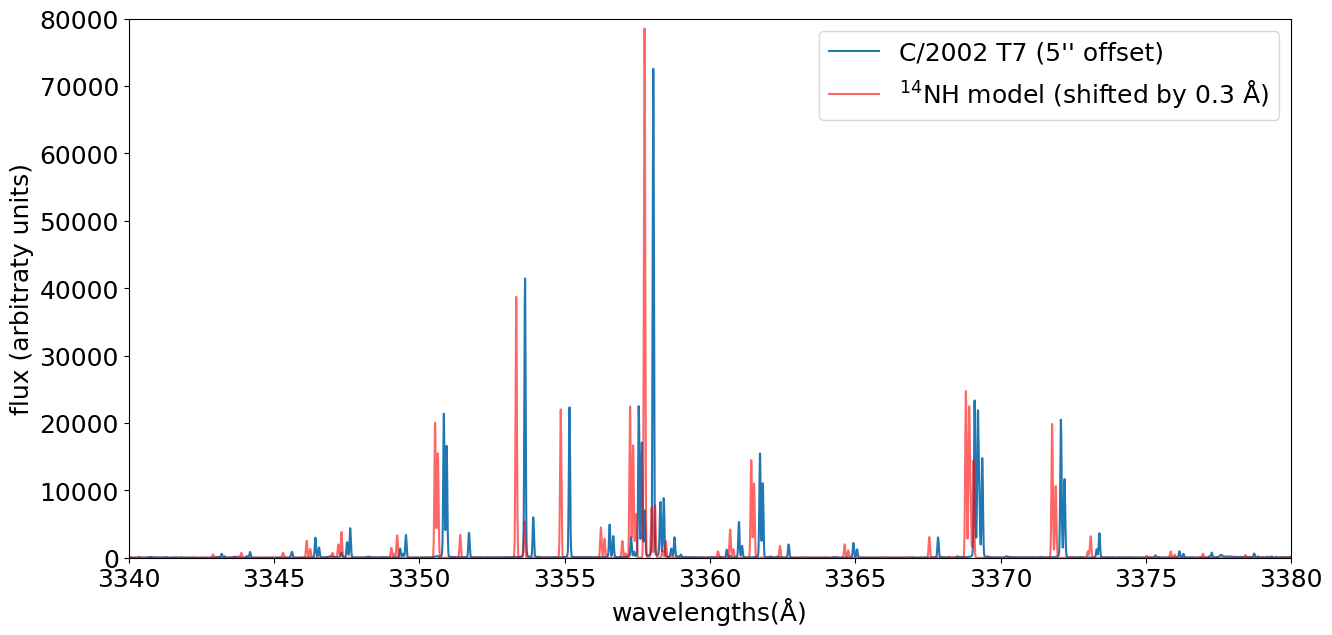
The New Horizons probe approached (486958) Arrokoth in January 2019, producing remarkable information about a trans-Neptunian object. The first images revealed a "snowman" shape with notable pits and craters on the surface, composed of a small lobe and a large lobe attached by a narrow neck. Thus, the elongated bilobate shape was classified as a contact binary (Fig. 1). 

Fig. 1. (486958) Arrokoth surface. The red dashed line encompasses the Small Lobe (SL), and the yellow one, the Large Lobe (LL). The pink dashed line indicates the Sky crater on the SL. The green dashed line is noticed at the neck (also called Akasa). Adapted from: NASA/Johns Hopkins University Applied Physics Laboratory/Southwest Research Institute/ESA.

Several studies have been conducted to analyze Arrokoth’s near environment and surface characteristics. However, its internal structure remains an open question, with aspects yet to be explored. Meyer and Scheeres (2024) studied the cohesive strength of Arrokoth and other contact binaries, fitting two ellipsoids to represent the bodies. Kim et al. (2024) investigated the cohesive strength regime of Arrokoth under the assumption that the Sky crater-forming event occurred after the formation of its bilobate shape. Geomorphological analysis from the mission images revealed structural feature differences between the two lobes, indicating the possibility that each lobe has distinct physical properties. Thus, this study aims to analyze its internal structure by considering a range of density values in each lobe and a constant spin period, assuming that all pits and craters were formed before the contact-binary attachment. Keane et al. (2022), considering a possible density range of 155–600 g/cm3, determined an optimal homogeneous bulk density of 235 g/cm3 for Arrokoth. In this work, we use the Finite Element Method to investigate static stress propagation in an elastic-plastic body under self-gravitational and centrifugal forces. The self-gravitational forces at each lobe were computed considering the density range proposed by Keane et al. (2022) (Fig. 2).

Fig. 2. Schematic representation of the densities in Arrokoth’s lobes under the xy plane view. We split the two lobes simply considering a division in x = -3900, y = z = 0. When it was assumed heterogeneous bulk density d1 ≠ d2, whilst on the homogeneous bulk density d1 = d2.

Our analysis was performed using the irregular shape of the object, creating a mesh with 34,575 elements and 51,674 nodes. Hooke’s law behavior was assumed to compute the stress-strain relationship in the elastic state. In the plastic state, we employed the Drucker–Prager criterion. In both elastic and plastic states, we assume icy parameters (i.e., Young’s modulus, Poisson’s ratio, and friction angle) to represent the object’s material properties. From the analysis, the minimum cohesion required to maintain the object’s structural integrity was defined. The results showed a tendency for failure propagation around the neck of the object, caused in most cases by compressive stress. We also identified the lowest cohesion when each lobe had different density values. Finally, we generated a global cohesion map for each assumed density (Fig. 3) and identified potential failure regions on the Arrokoth shape structure.

Fig. 3. Arrokoth cohesion map. The x-axis represents the density of the small lobe, while the y-axis represents the density of the large lobe. The color bar indicates the minimum cohesion required for the object.

Acknowledgements
This study was financed by CAPES, International Cooperation Project number 3266, FAPESP - Proc. 2022/01678-0 and CNPq - Proc. 316991/2023-6.

References
KEANE, James T. et al. The geophysical environment of (486958) Arrokoth—A small Kuiper belt object explored by New Horizons. Journal of Geophysical Research: Planets, v. 127, n. 6, p. e2021JE007068, 2022.
KIM, Yaeji; HIRABAYASHI, Masatoshi; BAUER, James. Numerical Investigation of the Cohesive Strength Regime of the Bilobated Arrokoth after the Sky-crater-forming Impact Event. The Planetary Science Journal, v. 5, n. 11, p. 241, 2024.
MEYER, Alex J.; SCHEERES, Daniel J. The strength and shapes of contact binary objects. The Astrophysical Journal Letters, v. 963, n. 1, p. L14, 2024.

How to cite: Machado, R., Winter, O., Sfair, R., Amarante, A., and Azevedo, F.: On the cohesion of the TNO Arrokoth across different density ranges, EPSC-DPS Joint Meeting 2025, Helsinki, Finland, 7–13 Sep 2025, EPSC-DPS2025-312, https://doi.org/10.5194/epsc-dps2025-312, 2025.

EPSC-DPS2025-750 | ECP | Posters | SB6

Analysis of thermalcentre-barycentre offsets and application to ALMA observations 

Ziyu Liu, Shunjing Zhao, Xian Shi, Daniel Hestroffer, and Man-To Hui
Tue, 09 Sep, 18:00–19:30 (EEST)   Finlandia Hall foyer | F157

Photocentre displacement is a well-known effect in optical observations of extended celestial bodies such as asteroids. It shows a shift in the observed position with respect to the actual centre of mass. This shift is linked to the physical properties of asteroids, such as surface composition, shape and size [1][2].

Similarly, in millimeter/sub-millimeter observations, the derived position of the target is usually the thermal centre, i.e.position of the peak flux density  which may differ from the barycentre (the center of mass) due to the high resolution of the instrument. These differences can be of the order of a few milli-arcseconds. In a recent study on Kalliope-Linus, a main-belt binary asteroid system, a discrepancy was found between the separation of Kalliope and Linus obtained from ALMA data and that predicted by the ephemeris [3]. In this study, we aim to investigate this difference by considering the offset between the thermal centre and the centre of mass.

For each ALMA observation, we simulate the temperature distribution of Kalliope at different depths with a one-dimensional numerical thermophysical model [4]. By translating subsurface temperatures to thermal flux density, we could estimate the thermal center of Kalliope in each observation as well as its offset to barycenter. The estimates are then used to calibrate the observations for comparison with the ephemeris. In addition, it is possible to update the mutual orbit of the Kalliope system using this revised data.

[1] L. Lindegren, “Meridian observations of planets with a photoelectric multislit micrometer.,”, vol. 57, no. 1-2, pp. 55–72, May 1977

[2] D. Hestroffer, “Photocentre displacement of minor planets: analysis of HIPPARCOS astrometry,”, vol. 336, pp. 776–781, Aug. 1998.

[3] Katherine de Kleer et al 2024, Surface properties of the Kalliope-Linus system from ALMA and VLA data

[4] Shunjing Zhao et al 2024, Deep operator neural network applied to efficient computation of asteroid surface temperature and the Yarkovsky effect

How to cite: Liu, Z., Zhao, S., Shi, X., Hestroffer, D., and Hui, M.-T.: Analysis of thermalcentre-barycentre offsets and application to ALMA observations, EPSC-DPS Joint Meeting 2025, Helsinki, Finland, 7–13 Sep 2025, EPSC-DPS2025-750, https://doi.org/10.5194/epsc-dps2025-750, 2025.

EPSC-DPS2025-1161 | ECP | Posters | SB6

Boulder Mobility on Comets: Insights from Rosetta Observations and Numerical Modelling 

Xiang Tang, Xian Shi, Bin Cheng, Xiaoran Yan, Jianchun Shi, and Man-To Hui
Tue, 09 Sep, 18:00–19:30 (EEST)   Finlandia Hall foyer | F159

Boulder displacement on comets, including the migration of rocks up to tens of meters and relocation of decimeter- to meter-scale debris, are critical processes in reshaping the nucleus as well as redistributing volatile materials. During its over-two-year rendezvous with comet 67P/Churyumov–Gerasimenko (hereafter 67P), European Space Agency’s Rosetta spacecraft revealed a wide range of boulder activities. Decimeter- to meter-scale chunks were detected in the near-nucleus coma, with many ultimately falling back onto the comet's surface [1,2,3]. Boulder migration was also observed directly on the nucleus, like falling and bouncing of chunks from cliffs [4,5]. Different scenarios have been proposed for the destabilization of cometary boulders, such as occurrence of an outburst underneath the boulder, seismic vibrations from nearby active sources [6,7], acceleration by the surrounding asymmetric gas field [3], and 'rocket force' caused by volatile activity within the boulder [8].

The most striking boulder displacement event occurred in the Khonsu region of 67P's southern hemisphere, where a ~30 m boulder was found to have moved ~140 m during the perihelion passage [6]. Recently, via a systematic search through imaging data obtained by Rosetta's OSIRIS camera system, we successfully narrowed the time of this event to within 14 hours on October 3, 2015 [8]. Observations also show numerous changes in the boulder's surrounding area, as well as localized night-time dust activities coinciding with the displacement [8]. These new observational constraints enable synthetic analysis on the boulder's triggeringmechanism in the context of its thermal history and dynamical environment.

In this work, we present latest findings in investigating the unique event of Khonsu boulder. Leveraging the Discrete Element Method (DEM), we investigate the destabilization of the boulder under various conditions. Drawing from methodologies previously applied to asteroid surface evolution [e.g.,9, 10], we model 67P's nucleus surface as a granular medium, with physical properties constrained by Rosetta's in-situ observation data including those derived from Philae's landing dynamics [11,12,13]. Our simulations incorporate realistic topography, mechanical and thermal properties to assess the susceptibility of boulders of different scales to destabilizing forces. Preliminary results suggest the critical role of the comet's seismic efficiency in governing the mobility of large surface blocks, comparable to the impact-induced seismic shaking dynamics on asteroids [14,15]. These findings provide new insights into the physical conditions required to trigger major boulder displacements on comets, with direct implications for understanding surface evolution and volatile redistribution across small Solar System bodies.


References

1. Agarwal, J. et al. Evidence of sub-surface energy storage in comet 67P from the outburst of 2016 July 03. Monthly Notices of the Royal Astronomical Society 469, s606–s625 (2017).

2. Pfeifer, M., Agarwal, J. & Schröter, M. On the trail of a comet’s tail: A particle tracking algorithm for comet 67P/Churyumov-Gerasimenko. A&A 659, A171 (2022).

3. Shi, X. et al. Diurnal Ejection of Boulder Clusters on Comet 67P Lasting beyond 3 au. ApJL 961, L16 (2024).

4. Pajola, M. et al. The pebbles/boulders size distributions on Sais: Rosetta’s final landing site on comet 67P/Churyumov–Gerasimenko. Monthly Notices of the Royal Astronomical Society 469, S636–S645 (2017).

5. Vincent, J.-B. et al. Bouncing boulders on comet 67P. in vol. 13 EPSC-DPS2019-502 (2019).

6. El-Maarry, M. R. et al. Surface changes on comet 67P/Churyumov-Gerasimenko suggest a more active past. Science 355, 1392–1395 (2017).

7. Hasselmann, P. H. et al. Pronounced morphological changes in a southern active zone on comet 67P/Churyumov-Gerasimenko. A&A 630, A8 (2019).

8. Tang, X., Shi, X. & El-Maarry, M. R. Boulder Migration in the Khonsu Region of Comet 67P/Churyumov–Gerasimenko. ApJ 979, 91 (2025).

9. Richardson, D. C., Walsh, K. J., Murdoch, N. & Michel, P. Numerical simulations of granular dynamics: I. Hard-sphere discrete element method and tests. Icarus 212, 427–437 (2011).

10. Cheng, B. et al. Reconstructing the formation history of top-shaped asteroids from the surface boulder distribution. Nat Astron 5, 134–138 (2020).

1 Biele, J. et al. The landing(s) of Philae and inferences about comet surface mechanical properties. Science (2015).

12. Wu, X., Küppers, M., Grieger, B. & Shang, H. Characterization of the Agilkia region through discrete-element simulation of Philae’s rebound. A&A 630, A14 (2019).

13. O’Rourke, L. et al. The Philae lander reveals low-strength primitive ice inside cometary boulders. Nature 586, 697–701 (2020).

14. Miyamoto, H. et al. Regolith Migration and Sorting on Asteroid Itokawa. Science 316, 1011–1014 (2007).

15. Richardson, J. E., Steckloff, J. K. & Minton, D. A. Impact-produced seismic shaking and regolith growth on asteroids 433 Eros, 2867 Šteins, and 25143 Itokawa. Icarus 347, 113811 (2020).

How to cite: Tang, X., Shi, X., Cheng, B., Yan, X., Shi, J., and Hui, M.-T.: Boulder Mobility on Comets: Insights from Rosetta Observations and Numerical Modelling, EPSC-DPS Joint Meeting 2025, Helsinki, Finland, 7–13 Sep 2025, EPSC-DPS2025-1161, https://doi.org/10.5194/epsc-dps2025-1161, 2025.

EPSC-DPS2025-1200 | Posters | SB6

 Mechanical Properties of Insoluble Organic Matter and Implications for Its Evolution and Influence on Planetary Processes.  

Eric Austin, Xinting Yu, Adis Husić, Dionysis Foustoukos, Kelly Miller, Conel Alexander, Alan Whittington, Julie Castillo-Rogez, Ricardo Vega, Chris Glein, and Ngoc Truong
Tue, 09 Sep, 18:00–19:30 (EEST)   Finlandia Hall foyer | F169
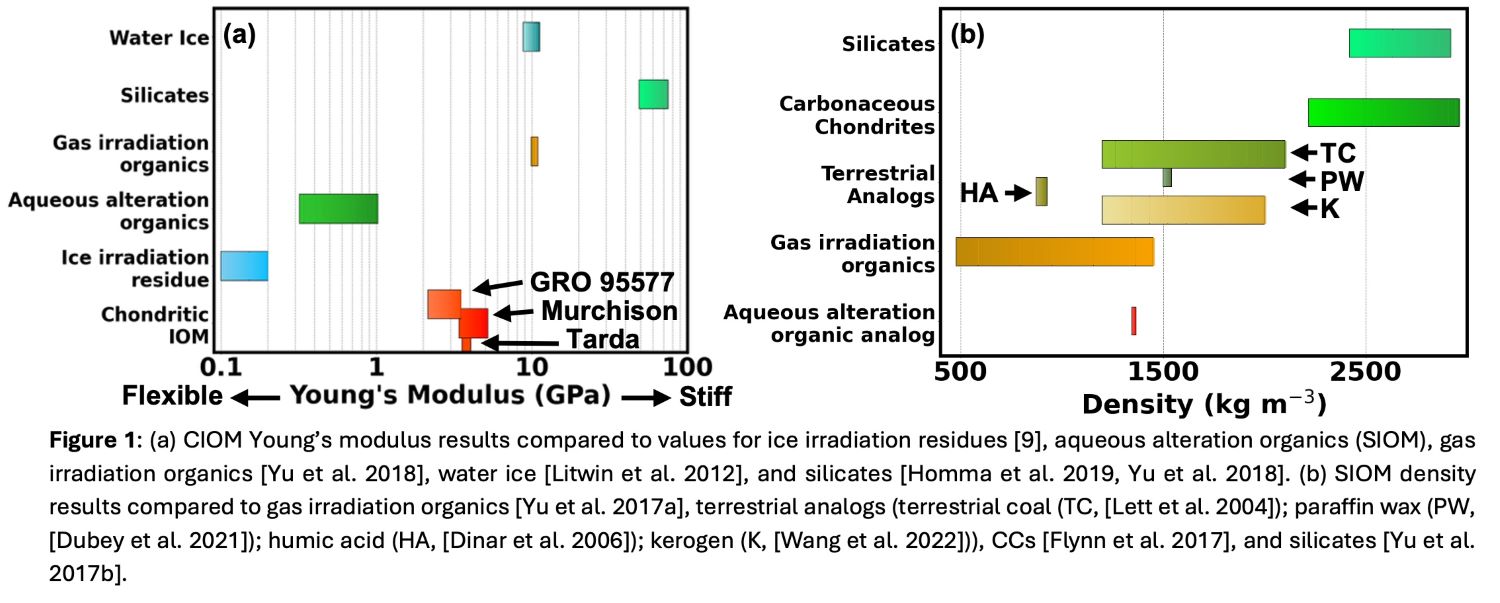
Introduction: Organic molecules are ubiquitous as primitive Solar System building blocks and are also central to astrobiology, yet their origins and evolution remain debated. These organics likely play crucial, yet poorly constrained, roles in fundamental planetary processes during the formation and evolution of planetary systems. Models of planet formation struggle to explain the rapid aggregation of dust into planetesimals, facing collisional barriers where silicate grains tend to fragment rather than stick [Birnstiel (2024)]. The presence of organic matter in chondrites and comets has fostered the hypothesis that organic matter may coat these grains, enhancing their sticking efficiency [Homma et al. (2019)]. However, current attempts to quantify this effect remain theoretical, relying on values for analogs such as terrestrial coal to represent parameters for organics present within the interstellar medium (ISM) or protosolar nebula (PSN) [Homma et al. (2019)]. Meanwhile, understanding the thermal evolution and potential habitability of icy moons and dwarf planets hinges on modeling their internal structure and heat sources, primarily tidal dissipation [Bagheri et al. (2022)]. Observations suggest that these bodies contain significant amounts of low-density refractory material, likely primitive organic matter, mixed with rock and ice [Reynard and Sotin (2023)]. The amount and the mechanical/viscoelastic properties of this organic fraction would critically influence tidal heating efficiency and internal dynamics. Accurately modeling planetesimal aggregation and icy world evolution thus requires direct measurements of the physical properties of relevant Solar System organics. Insoluble Organic Matter (IOM), the dominant organic component in chondrites, represents a key material whose origin (interstellar, nebular, parent-body) is complex [Alexander et al. (2017)]. This study utilizes nanoindentation and helium pycnometry to characterize two fundamental physical properties (Young's modulus, Y​; grain density, 𝜌) of chondritic IOM (CIOM) and synthetic analogs, aiming to provide crucial data for planet formation and icy body models while simultaneously shedding new light on the complex origins and processing history of IOM. 

Methods: We measured Young's modulus using dynamic nanoindentation [Oliver and Pharr (2004)] (KLA iMicro) on CIOM extracted from three carbonaceous chondrites (CCs): Murchison (CM2), Tarda (C2), and Grosvenor Mountains (GRO) 95577 (CR1) [Cody et al. (2002)]. These represent materials with varying degrees of parent body aqueous alteration. Using nanoindentation and helium pycnometry (Anton Paar Ultrapyc 3000), we also measured the Young's modulus and density of synthetic IOM (SIOM) synthesized hydrothermally via dextrose carbonization [Foustoukos et al. (2021)]. Young’s modulus measurements were compared to synthetic organic analogs representing key formation/processing pathways: (1) Ice irradiation residues [Piani et al. (2017)]; (2) Aqueous alteration organics (SIOM); and (3) Gas irradiation organics (Titan tholin analogs, [Yu et al. (2018)]). Density measurements were compared to terrestrial organic analogs typically used in planetary modelling. CIOM (and SIOM following density measurements) samples were embedded in epoxy, polished (Pace Technologies NANO-2000S), and indented under N2Y​ was determined by the instrument’s software from load-displacement curves, averaging data from depths > 500 nm. 

Results: Significant differences in mechanical stiffness were observed (Figure 1a). Synthetic analogs showed distinct moduli linked to formation pathways: stiffness increased in the order Ice Irradiation Residues < Aqueous Alteration Organics < Gas Irradiation Organics. CIOM from Murchison, Tarda, and GRO 95577 exhibited intermediate stiffness (Y ~ 2-6 GPa), about an order of magnitude stiffer than ice irradiation residues (Y ~ 0.1 GPa). Their moduli fell between those of aqueous alteration analogs (SIOM measured at 0.69 ± 0.4 GPa) and gas irradiation analogs (~ 10 GPa). Notably, CIOM from GRO 95577, the most primitive sample [Alexander et al. (2010)], was mechanically softer than Murchison and Tarda IOM, suggesting that the aqueous alteration of the parent body may stiffen the structure of IOM. Moreover, measurements for both CIOM and SIOM indicate the material is more flexible (lower Y) than water ice (~ 10 GPa) and silicates (> 50 GPa). Density measurements of SIOM (Figure 1b) align with values for terrestrial coal and kerogen currently used in planetary modeling.

Discussion: The intermediate stiffness of CIOM, significantly different from highly flexible ice residues but generally softer than stiff gas irradiation products, points towards a complex, multi-stage history. Based on our data, we favor a model involving the formation of precursors, likely in cold environments (consistent with isotopes), followed by subsequent processing (e.g., aqueous alteration, gas-phase reactions/irradiation), gradually creating stiffer macromolecules. Further experimentation investigating the effects of aqueously altering ice and gas irradiation organics, as well as measuring the Young’s modulus of other CC petrological types aside from those analyzed thus far (CM2, C2-ung, CR1), is necessary to confidently substantiate whether aqueous alteration affects the stiffnes of the material.

Our Young’s modulus measurements confirm that IOM is significantly more flexible than silicates. This increased elasticity, along with the density measurements, results in an enhanced sticking efficiency during dust collisions, likely promoting aggregation and assisting in overcoming fragmentation barriers, thereby potentially accelerating planetesimal growth compared to silicate-only models.

Our finding that IOM has a significantly lower Young's modulus than rock implies higher shear compliance. Therefore, an organic-rich component within an icy moon's interior (consistent with low bulk densities) would deform more readily under tidal forces, potentially leading to significantly enhanced tidal dissipation and internal heating than purely rock-ice models. This impacts internal structure, thermal history, and habitability potential of many astrobiological targets in the outer solar system.

Conclusions: Mechanical properties provide a novel diagnostic tool for deciphering IOM's complex history. Our nanoindentation results on CIOM and analogs support a multi-stage origin involving the processing of precursors in cold environments via ice irradiation, followed by gradual stiffening through processes involving aqueous alteration and/or gas irradiation. Moreover, the mechanical characteristics of SIOM and CIOM have intriguing implications, suggesting organics play key roles in facilitating planetesimal formation through enhanced aggregation and influencing the thermal evolution and habitability of icy worlds via enhanced tidal dissipation.

How to cite: Austin, E., Yu, X., Husić, A., Foustoukos, D., Miller, K., Alexander, C., Whittington, A., Castillo-Rogez, J., Vega, R., Glein, C., and Truong, N.:  Mechanical Properties of Insoluble Organic Matter and Implications for Its Evolution and Influence on Planetary Processes. , EPSC-DPS Joint Meeting 2025, Helsinki, Finland, 7–13 Sep 2025, EPSC-DPS2025-1200, https://doi.org/10.5194/epsc-dps2025-1200, 2025.

EPSC-DPS2025-1591 | ECP | Posters | SB6

Internal Structure and Dynamical Evolution of Ceres 

Delaram Darivasi, Jürgen Oberst, and Neumann Wladimir
Tue, 09 Sep, 18:00–19:30 (EEST)   Finlandia Hall foyer | F164
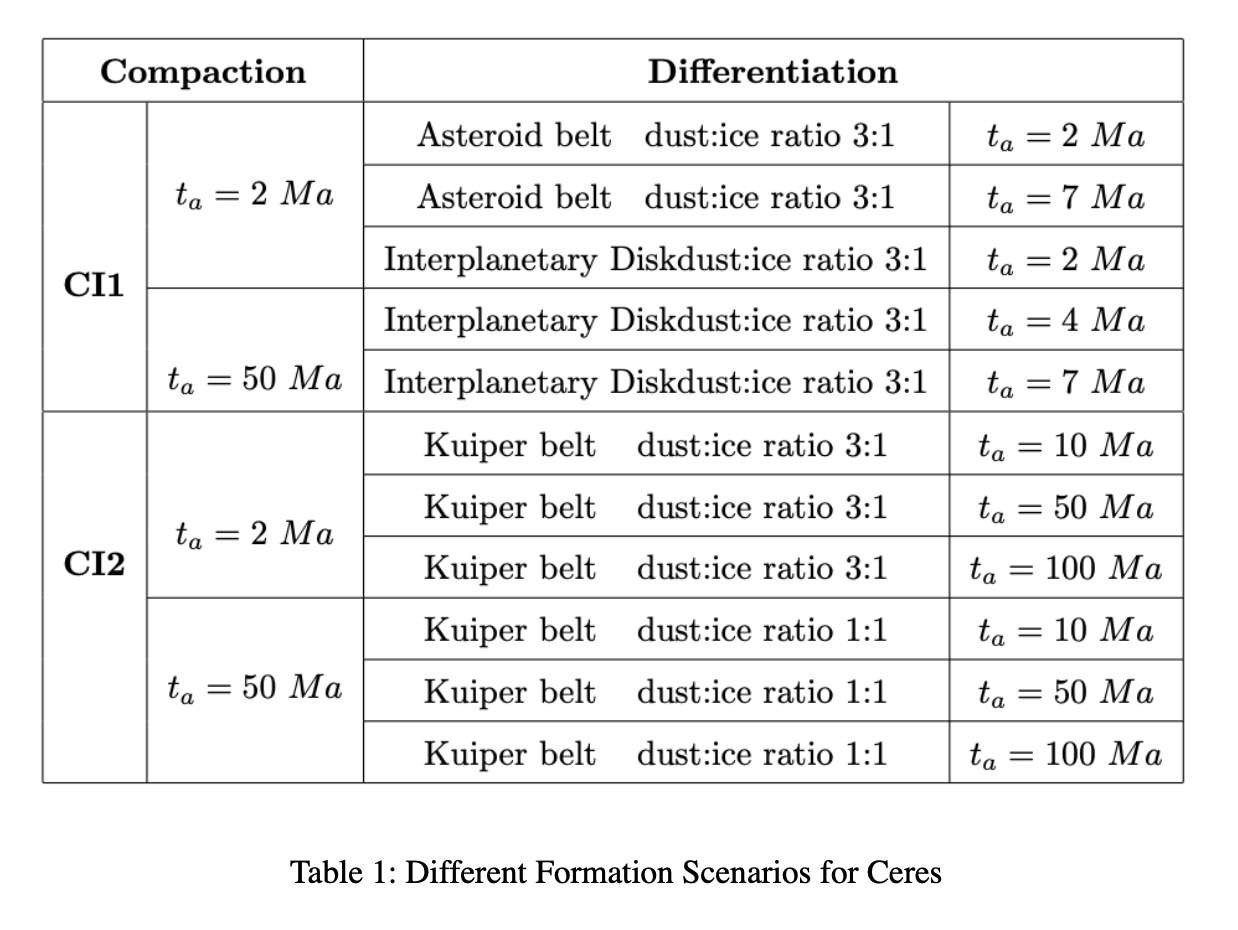
Introduction:

Ceres, the largest body in the asteroid belt, became the first dwarf planet orbited by a spacecraft when NASA’s Dawn mission arrived in 2015. Located at 2.767 AU from the Sun and rotating every ~9.07 hours [1], recent gravity data suggest Ceres retains a fossil equatorial bulge, hinting at a faster past rotation, possibly despun by 6.5%, potentially resulting from the loss of a satellite or a major impact event [2,3,4]. 


Methodology:

We build on internal structure models from [5], exploring various formation and accretion scenarios (Table 1) to examine how Ceres’ interior evolution influences its angular velocity and energy state. Our primary focus is a scenario where Ceres accreted over 10 Ma in the Kuiper Belt with a 3:1 dust-to-ice ratio, then migrated to the asteroid belt ~600 Ma after CAI formation, completing the migration within 1 Ma. We analyze how this formation pathway affects the evolution of its MOI, angular velocity, kinetic energy, and potential energy, including an analytical approximation of the latter. The resulting normalized MOI is compared with the spacecraft-derived range of 0.345–0.375 [4] to assess the plausibility of this scenario.


Results:

MOI

Figure 1 illustrates how Ceres’s thermal and internal evolution influenced its MOI. In the 3:1 rock-to-ice composition scenario, early radiogenic heating was dominated by the rock component, primarily driven by short-lived isotopes. However, due to the prolonged accretion timescale of 10 Ma, most of the short-lived isotopes had decayed by the end of accretion. Consequently, internal heating was sustained mainly by long-lived isotopes. Formation in the cold Kuiper Belt further suppressed internal temperatures, limiting early differentiation. As a result, Ceres likely developed only a partially dehydrated silicate core, with substantial amounts of ice and porosity preserved in its interior. Despite this subdued internal evolution, the degree of differentiation and compaction was sufficient to reduce the MOI to ~0.369, which falls well within the observed range of 0.345–0.375. These results support are in line with the Kuiper Belt origin for Ceres, consistent with current geophysical constraints.


Angular Velocity

Figure 2 illustrates that the most significant angular velocity increase occurs in the Kuiper Belt formation scenario. As Ceres migrates from ~40–50 AU to ~2.7 AU, possibly associated with theLate Heavy Bombardment or the Nice Model, rising environmental temperatures cause internal restructuring, including ice sublimation and porosity collapse. Two spikes in angular velocity are evident in Figure 2: the first likely due to a differentiation in the cold Kuiper Belt (~50 K), drivenprimarily by radioactive isotopes, and the second resulting from restructuring in the warmer asteroid belt (~170 K), which caused mass redistribution, lowering the MOI and increasing angular velocity by ~45% to conserve angular momentum—significantly higher than the ~6% despin previously proposed by [4], who assumed a static internal structure.


Kinetic Energy

Figure 3 shows corresponding increases in kinetic energy during phases of angular velocity change. The sharp rises in KE coincide with internal differentiation events, highlighting the linkbetween structural evolution and rotational dynamics. These findings emphasize that rising temperatures during migration triggered the mechanical collapse of porous ice-rock mixtures and differentiation, releasing energy as Ceres adjusted to a new equilibrium state.


Gravitational Potential Energy

As shown in Figure 4, Ceres’ gravitational potential energy increases during accretion as mass accumulates and self-gravity strengthens. After accretion, fluctuations in potential energy reflect mass redistribution resulting from porosity reduction and internal differentiation. Earlyheating was significantly driven by the decay of short-lived nuclides, though this effect diminished rapidly, with long-lived isotopes sustaining a slower thermal evolution thereafter. Distinct steps in the potential energy curve correspond to major structural changes, particularly during the transition from Kuiper Belt to asteroid belt conditions.


Conclusion:

This study investigates how internal structure, thermal evolution, and migration history influence the rotational dynamics and energy budget of Ceres. Focusing on a Kuiper Belt formation scenario followed by inward migration, we find that the computed MOI values are consistent withcurrent gravity and shape data [4], supporting the plausibility of this origin. Notably, we show that Ceres’ angular velocity could have increased by ~45% due to internal restructuring driven by thermal changes and subsequent evolution, significantly higher than previous estimates [4].These findings highlight internal evolution and environmental transitions as key drivers of planetary spin states and energy distributions.

[1] M.A. Chamberlain et al., Icarus 188, 451 (2007).

[2] X. Mao and W.B. McKinnon, LPSC 47, 1637 (2016).

[3] X. Mao and W.B. McKinnon, LPSC 48, 2744 (2017).

[4] X. Mao and W.B. McKinnon, Icarus 299, 430 (2018).

[5] W. Neumann et al., A&A 633, A117 (2020).

How to cite: Darivasi, D., Oberst, J., and Wladimir, N.: Internal Structure and Dynamical Evolution of Ceres, EPSC-DPS Joint Meeting 2025, Helsinki, Finland, 7–13 Sep 2025, EPSC-DPS2025-1591, https://doi.org/10.5194/epsc-dps2025-1591, 2025.

EPSC-DPS2025-1966 | ECP | Posters | SB6 | OPC: evaluations required

Search for Stable Orbits around Saturn’s Moon Enceladus using Numerical Modeling 

Sonasha Auer Wilkins, Jürgen Oberst, Alexander Stark, Hauke Hussmann, Andreas Benedikter, and Wladimir Neumann
Tue, 09 Sep, 18:00–19:30 (EEST)   Finlandia Hall foyer | F167

Enceladus, a small icy moon orbiting Saturn, has become a key focus in the search for extraterrestrial life within our Solar System. Composed primarily of water ice, rock and other icy volatiles, Enceladus is part of a class of icy moons believed to harbor global oceans of liquid water underneath their crusts. With the presence of liquid water, the detection of life essential elements such as carbon, hydrogen, nitrogen, oxygen, phosphor and sulfur [1] (CHNOPS elements), and evidence of ongoing geothermal activity between the ocean and the rocky core of Enceladus [2], the moon meets the basic requirements for the existence of life and has therefore become a prime candidate for astrobiological research. To this end, the German Space Agency at DLR has launched the Enceladus Explorer (EnEx) initiative, a collaborative research project with the goal of studying Enceladus’ geophysical characteristics and searching for biosignatures by sampling the moon’s liquid subsurface water. As part of this initiative, the EnEx-RaTNOS (Radar Transponder based Navigation and Orbit Determination by Satellite) project aims to achieve precise orbit determination using radar transponders placed on Enceladus’ surface [3].

The determination of stable orbits is a fundamental prerequisite for precise orbit determination and is also of high importance for topographic mapping and measuring surface deformationhrough synthetic aperture radar (SAR) imaging, as proposed in above mentioned EnEx [4] [5]. A satellite orbiting Enceladus should have a low altitude, low eccentricity and a high inclination to provide global coverage with a focus on the south polar region. However, orbits with such properties around planetary satellites are notoriously unstable, with the planet’s gravitational perturbations causing the orbiting vehicle to impact the moon within short time periods [6]. The acquisition of SAR measurements imposes additional constraints on a satellite orbit [7]. For repeat-pass SAR, the SAR image acquisition is performed over two or more time instances by a single receiver, requiring a periodic orbit in which the ground track between an initial and a repeating orbit is parallel and repeats in a body-fixed reference frame. The distance between two consecutive ground tracks is constrained by the critical baseline B, which is in the range of several hundred meters for ka-band (26-40 GHz) and several kilometers for P-band (around 300 MHz) frequencies [8]. Short repeat periods are preferable due to the risk of decorrelation caused by surface changes occurring in the time interval between two image acquisitions.

This study focuses on determining stable and periodic orbits around Enceladus which fulfill the previously outlined requirements and includes a comparative evaluation of the orbit integration tools provided by the TU Delft Astrodynamics Toolbox (Tudat) and the DLR’s Particle Integrator (pInt), in order to verify the similarity of propagation results produced by both integration tools. Building on prior research by Benedikter et al. (2022) [8], a grid-search method is implemented with the goal of identifying combinations of initial values within a defined parameter space for semi-major axis, inclination and eccentricity which lead to stable and long-term repeating orbits around Enceladus. In contrast to Benedikter et al. (2022), the orbit integration is achieved using the integration method of Tudat rather than pInt and uses the more recent non-spherical gravity terms of Enceladus published by Park et al. (2024) [9]. In addition to the higher gravity terms of Enceladus, Saturn’s higher gravity terms are included as perturbing factors acting on the orbiting satellite.

In order to determine likely candidates for periodic orbits, the grid-search method looks for orbits that minimize the angle between the initial orbital state vector and the state vectors within a time window after an estimated repeat period. Results of the grid-search method show range of possible solutions for periodic orbits around Enceladus which are further analyzed for long-term stability and optimized towards higher inclinations. Three example orbits, K1′, K2′ and K3′, with short repeat periods of 1.2, 2.5 and 3.8 days and mean inclinations of 56.4, 52.5 and 57.8 degrees respectively are discussed in detail and compared to the orbits with similar repeat periods identified by Benedikter et al. (2022). The K3′ orbit shows the best long-term periodicity, with no visible differences between the orbit after 80 days and the orbit after 200 days. The identified orbits are promising candidates for stable and repeating satellite trajectories as required for the EnEx mission concept and can be used as a foundation for further analysis. Results from this study will be demonstrated and discussed at the conference.

References
[1] Weiming Xu et al. Enough sulfur and iron for potential life make enceladus’s ocean fully habitable. The Astrophysical Journal Letters, 980(1):L10, February 2025.
[2] Ligia F. Coelho and Zita Martins. The geochemistry of icy moons, pages 207–216. Elsevier, 2021.
[3] J. Oberst and M. Vossiek. Gesamtvorhabensbeschreibung EnEx-RaTNOS Radartransponder basierte Navigation und Orbitbestimmung von Satelliten. Technical report, 6 2023.
[4] Mark Simons et al. Crustal deformation derived from repeat-pass Interferometric SAR at Enceladus – why and how? In AAS/Division for Planetary Sciences Meeting Abstracts #55, volume 55 of AAS/Division for Planetary Sciences Meeting Abstracts, page 210.07, October 2023.
[5] Andreas Benedikter et al. Performance analysis of a repeat-pass insar mission for deformation and topography mapping of Saturn’s moon Enceladus. In IGARSS 2023 - 2023 IEEE International Geoscience and Remote Sensing Symposium, pages 4177–4180. IEEE, July 2023.
[6] Ryan P. Russell and Martin Lara. On the design of an enceladus science orbit. Acta Astronautica, 65(1–2):27–39, July 2009.
[7] Paul A. Rosen et al. Repeat pass insar at enceladus- a geophysics mission concept to understand dynamics and habitability. In EUSAR 2024; 15th European Conference on Synthetic Aperture Radar, pages 1318–1323, 2024.
[8] Andreas Benedikter et al. Periodic orbits for interferometric and tomographic radar imaging of Saturn’s moon Enceladus. Acta Astronautica, 191:326–345, February 2022.
[9] R. S. Park et al. The global shape, gravity field, and libration of Enceladus. Journal of Geophysical Research: Planets, 129(1), January 2024.

How to cite: Auer Wilkins, S., Oberst, J., Stark, A., Hussmann, H., Benedikter, A., and Neumann, W.: Search for Stable Orbits around Saturn’s Moon Enceladus using Numerical Modeling, EPSC-DPS Joint Meeting 2025, Helsinki, Finland, 7–13 Sep 2025, EPSC-DPS2025-1966, https://doi.org/10.5194/epsc-dps2025-1966, 2025.

SB7 | Advances in Photopolarimetry and Spectropolarimetry of Solar System Small Bodies

EPSC-DPS2025-1126 | ECP | Posters | SB7

Calibration of Danuri/Wide-Angle Polarimetric Camera (PolCam): Preliminary Results 

Kilho Baek, Sungsoo S. Kim, and Minsup Jeong
Mon, 08 Sep, 18:00–19:30 (EEST)   Finlandia Hall foyer | F152

The wide-angle polarimetric camera (PolCam) aboard Danuri, South Korea’s first lunar orbiter, represents the first instrument to perform global polarimetric observations of the lunar surface. Since April 2023, PolCam has been conducting polarimetric observations at visible wavelengths of 430 and 750 nm for nearly two years. The mission aims to acquire at least three observation sets across a range of phase angles for latitudes between –70° and +70°. Polarimetric measurements provide critical insight into regolith grain size, a fundamental physical property of the lunar surface, thus PolCam dataset will play a crucial role in advancing our understanding of lunar surface characteristics. Because the degree of polarization on the Moon reaches its maximum near a 100° phase angle, acquiring data at high phase angles is essential; accordingly, PolCam was designed with a 45° off‑nadir tilt, facilitating observations at phase angles up to 135°. Off-nadir observations experience substantially greater geometric distortion compared to nadir measurements, rendering precise geometric calibration and inter-channel alignment imperative for accurate polarization degree estimations. Furthermore, unexpected smear artifacts were identified in all PolCam images, and addressing these effects was both essential and technically challenging to ensure reliable polarization data. In this presentation, we describe the geometric and radiometric calibration procedures necessary to derive polarimetric data and present the first-ever polarimetric measurements in lunar orbit.

For geometric calibration, we employed feature detection and matching techniques to obtain matched point pairs between PolCam and Kaguya MI images and built control networks of over 30,000 matched point pairs. Through bundle adjustment, we derived the extrinsic parameters (mounting angles on the spacecraft body) and the intrinsic parameters of each channel (focal length, principal point, and optical distortion coefficients). Incorporating these parameters into the geometric correction pipeline effectively mitigates distortions induced by complex lunar topography. Figure 1 compares the Copernicus crater before and after geometric correction: Panel (a) displays raw data from five orbital tracks, whereas Panel (b) depicts the mosaic after correction and simple cylindrical projection. The boundaries between orbital tracks are seamlessly aligned, even in highly curved regions near the crater rim, with an alignment accuracy of about 2–3 pixels.


Figure 1. Geometric correction of Copernicus crater. (a) Raw PolCam data from five contiguous orbital tracks. (b) Mosaic after geometric correction and simple cylindrical projection, showing seamless registration across track boundaries.


Radiometric calibration of PolCam includes dark current removal, flat-fielding, and smear correction. In particular, smear artifacts induced by the characteristics of the frame-transfer CCD critically impacts the accuracy of polarization measurements. Figure 2 compares a heavily smeared crater before and after smear correction: Panel (a) applies dark removal and flat-fielding only, whereas Panel (b) incorporates smear correction. Residual artifacts that caused vertical elongation of the crater have been effectively removed. Figure 3 illustrates the 430 nm intensity and degree of polarization of the Reiner Gamma swirl to demonstrate the impact of smear on polarization measurements. Panel (a) presents the results without smear correction, where the “eye-shape” structure of the swirl is not clearly resolved in the polarization image. In contrast, Panel (b) displays the results after smear correction, with enhanced contrast between bright and dark regions in the intensity image, and a pronounced depiction of the swirl’s eye-shape in the polarization image.

Figure 2. Smear correction in a heavily smeared lunar crater. (a) Images following dark-current removal and flat-fielding only, in which vertical streak artifacts produce a stretched appearance. (b) Images after additional frame-transfer smear correction, with streak artifacts effectively removed and true crater morphology restored.


Figure 3. Impact of smear on 430 nm intensity and degree of polarization of the Reiner Gamma swirl. (a) Without smear correction: intensity (left) and polarization (right) images, in which the characteristic “eye‑shape” of the swirl is obscured. (b) With smear correction: intensity (left) exhibits enhanced contrast between bright and dark regions, and the “eye‑shape” structure appears clearly in the polarization (right) image.


Over the past two years, we have operated PolCam in lunar orbit, successfully covering most lunar regions across a broad range of phase angles. Throughout this period, we continuously solved unexpected problems and encountered various trial-and-error in the calibration processes to produce reliable polarization data. In particular, substantial effort was devoted to accurately estimating the intrinsic parameters of the optical system from the observational data and to recovering polarization signals obscured by smear artifacts. Following extensive testing and refinement, we successfully generated the high-resolution polarization datasets. These data are expected to provide new insights for a wide range of studies aimed at understanding the evolution of the lunar surface.


How to cite: Baek, K., Kim, S. S., and Jeong, M.: Calibration of Danuri/Wide-Angle Polarimetric Camera (PolCam): Preliminary Results, EPSC-DPS Joint Meeting 2025, Helsinki, Finland, 7–13 Sep 2025, EPSC-DPS2025-1126, https://doi.org/10.5194/epsc-dps2025-1126, 2025.

SB8 | Active small bodies: dynamics, activity, and genetic links

EPSC-DPS2025-858 | ECP | Posters | SB8 | OPC: evaluations required

RESTing Comets: Studying Dormant Comets via a Remnant Emission Survey Tool 

Daejhanae Smith, Yanga Fernandez, and Charles Schambeau
Tue, 09 Sep, 18:00–19:30 (EEST)   Finlandia Hall foyer | F192

Past studies have explored the ambiguous boundary between asteroids and dormant comets, emphasizing the subtle differences that make it difficult to distinguish them [1-3]. Within asteroid populations, for example, some bodies have exhibited signs of transient activity, which challenges the common definition of asteroids being inactive bodies, and suggests that at least some may be of cometary origin. Dormant comets contain volatile materials that have been mostly sealed off due to past cometary activity, i.e. due to significant loss of near-surface ices and the accumulation of a fallback dust blanket that form an insulating layer. Consequently, there are dormant comets and asteroids that share physical characteristics, e.g. reflectance, albedo, and polarization [4-6], making it challenging to determine whether a given asteroid is a dormant comet. However, one direct way of testing this is by searching for low levels of activity. A recent analysis of 75 dynamically-selected dormant comet candidates and six near-Sun asteroids applied machine learning techniques to search for activity by comparing predicted and measured V-band brightnesses. From this, only the near-Earth object (NEO) (3552) Don Quixote displayed signs of activity [7]. Further analysis of Spitzer molecular band emission observations confirmed Don Quixote as a weakly active comet [8].

Here we address the complexities of delineating these bodies in a related way by performing a comprehensive search for weak levels of extended emission in archival imaging of dormant comet candidates. We first selected ~ 3700 comet candidates by looking at asteroids in ‘classic’ Jupiter-family comet (JFC)-type orbits that have appropriate Jupiter-MOID values, and that have Tisserand parameters, TJ, < 3. We are currently developing software – the Remnant Emission Survey Tool (REST) – that will be able to automatically search through data archives, retrieve images of dormant comet candidates, and analyze their radial profiles to identify objects with possible extended emission. We will present preliminary results from the initial application of REST to several objects in our candidate list. For now, we are analyzing archival images taken by the Dark Energy Camera (DECam) instrument on the Cerro Tololo Inter-American (CTIO) Blanco 4-meter telescope in Chile [9]. Our study will ultimately be conducted for all the selected candidates, and will be expanded to include additional data archives. We are particularly interested in imaging that samples the gas coma – e.g. V- and g-band imaging at visible wavelengths,  and NEOWISE Channel 2 (4.5 µm) imaging [10]. Here, we will outline the developmental stages of REST, and present further initial findings from its early applications.

Acknowledgements: We extend our acknowledgements to the CTIO Blanco DECam Data Release 1 archive for providing the data utilized in this preliminary study. We also acknowledge support from NASA’s SSERVI program via award 80NSSC19M0214. References: [1] Jewitt, D. & Hsieh, H. H. (2024) in Comets III, 767 [2] Jewitt, D. et al. (2015) in Asteroids IV, 221 [3] Binzel, R. P. et al. (2015) in Asteroids IV, 243  [4] Chamberlin, A. B. et al. (1996) Icarus 119, 173 [5] Fernández, Y. R. et al. (2005) AJ 130, 308 [6] Geem, J. et al. (2022) A&A 658, A158.  [7] Mommert, M. et al. (2020) PSJ 1, 10. [8] Mommert, M. et al. (2020) PSJ 1, 12. [9] Dark Energy Survey Collaboration et al. (2016) MNRAS 460, 1270 [10] Mainzer, A. et al. (2011) ApJ 731, 53.

How to cite: Smith, D., Fernandez, Y., and Schambeau, C.: RESTing Comets: Studying Dormant Comets via a Remnant Emission Survey Tool, EPSC-DPS Joint Meeting 2025, Helsinki, Finland, 7–13 Sep 2025, EPSC-DPS2025-858, https://doi.org/10.5194/epsc-dps2025-858, 2025.

EPSC-DPS2025-975 | ECP | Posters | SB8

JWST Observations of the Active Centaur 423P/Lemmon: Gas and Dust Comae Characterizations 

Megan Firgard, Charles Schambeau, Yanga Fernandez, Adam McKay, Michael S. P. Kelley, Olga Harrington Pinto, Sara Faggi, Maria Womack, Geronimo Villanueva, Dominique Bockelee-Morvan, Lori Feaga, Michael DiSanti, James Bauer, and Kacper Wierzchos
Tue, 09 Sep, 18:00–19:30 (EEST)   Finlandia Hall foyer | F193

Centaurs are small bodies that, compared to age of the Solar System, are located on dynamically unstable, giant planet-crossing orbits between Jupiter and Neptune. Their orbits place them between the icy, distant trans-Neptunian objects (TNOs) and the rapidly sublimating Jupiter-family comets (JFCs), and it is thought that centaurs are one step in the evolution of the former to the latter (e.g., [1, 2, 3]). With this in mind, cometary activity in centaurs is of particular interest for a number of reasons. Perturbed out of the cold storage of the TNO region, these closer, warmer orbits could mean that this is the first time these objects are undergoing phase transitions of key volatile species (e.g., CO, CH4, CO2, amorphous water ice) in their interiors since their formations [4]. While centaurs are generally understood to have an abundance of volatile inventories, the observed diversity of centaur activity behaviors beyond the water ice sublimation line is not well understood. One possible mechanism for this distant activity is the sublimation of other volatile ices, such as CO and CO2 [5]; another one is the crystallization of porous amorphous water ice, which could have stored various amounts of non-water volatiles that are released upon crystallization [6]. Whatever the mechanism at work, one of the keys to understanding the gas-driven mass loss of these objects—the gas itself—has been difficult to observe in many centaurs directly until recently. With its sensitivity, the James Webb Space Telescope (JWST) has made it possible to observe volatile gas species in more centaurs, many of which for the first time [5, 7]. Through these new observations it is possible to analyze both components—the gas and the dust—of the comae around these objects directly through multi-wavelength observing campaigns.   

We present JWST near-infrared (NIR) spectral and Gemini North Telescope visible imaging data of the active centaur 423P/Lemmon (hereafter, 423P). The UT 2022 November 28 JWST spectrum was collected with Near Infrared Spectrograph (NIRSpec) in integral field unit (IFU) mode with the low-resolution PRISM/CLEAR disperser-filter combination [8]. The target and dedicated background observations were collected with the 4-point dither pattern. The data span the entire 0.6 - 5.3μm wavelength range of the NIRSpec instrument, which includes regions where CO, CO2, and H2O (common gas comae species) are known for fluorescence. The Gemini data were collected between 2019 - 2024 using the Gemini Multi-Object Spectrographs (GMOS) in imaging mode to monitor the dust coma’s secular lightcurve behavior. The combination of long baseline dust activity monitoring with snapshot gas comae measurements has been limited for active centaurs, especially for a relatively small one such as 423P (radius ~ 1.5 km) [9]. A multi-wavelength characterization of 423P such as this, in combination with similar studies of more active centaurs in general utilizing JWST observations (see, e.g., [5]), opens the door for future detailed thermophysical modeling investigations targeted at understanding the nature of the interiors of these objects.  

Our results focus on analysis of the gas species in the JWST data, with the Gemini data providing us with a long-term baseline understanding of the dust characteristics and behavior. We present an extracted NIR reflectance spectrum of 423P and provide estimates of the gas production rates (or their upper limits, in the case of non-detections) of common gas species.  Preliminary analysis shows that CO2 emission is present in the spectrum, with CO and H2O emission being more ambiguous. The format of the JWST datacubes allow us the unique opportunity to see the spatial distribution of gas and dust around the centaur through the examination of individual datacube slices at specific wavelengths that those particles are known to contribute at. We present preliminary analysis of gas and dust coma morphologies, the latter in the context of the Gemini data. We discuss how these morphologies could relate to activity mechanisms occurring on the nucleus. We also place this study of 423P in context with previous observations as well as compare it to other centaurs, TNOs, and JFCs.  

References: [1] Levison, H. F., & Duncan, M. J., 1997, Icarus, 127, 13. [2] Fraser, W. C., et al., 2024, Comets III, ed. K. J. Meech, M. R. Combi, D. Bockelee-Morvan, S. N. Raymond, & M. E. Zolensky, 121–152. [3] Guilbert-Lepoutre, A., et al., 2023, ApJ, 942, 92. [4] Jewitt, D., 2009, AJ, 137, 4296. [5] Harrington Pinto, O., et al., 2023, PSJ, 4, 208. [6] Meech, K. J., & Svoren, J., 2004, Comets II, ed. M. C. Festou, H. U. Keller, & H. A. Weaver, 317. [7] Pinilla-Alonso, N., et al., 2024, A&A, 692, L11. [8] McKay, A., et al., JWST Proposal Cycle 1, ID. #2416. [9] Schambeau et al., 2021, IAU CBET #4992.

How to cite: Firgard, M., Schambeau, C., Fernandez, Y., McKay, A., Kelley, M. S. P., Harrington Pinto, O., Faggi, S., Womack, M., Villanueva, G., Bockelee-Morvan, D., Feaga, L., DiSanti, M., Bauer, J., and Wierzchos, K.: JWST Observations of the Active Centaur 423P/Lemmon: Gas and Dust Comae Characterizations, EPSC-DPS Joint Meeting 2025, Helsinki, Finland, 7–13 Sep 2025, EPSC-DPS2025-975, https://doi.org/10.5194/epsc-dps2025-975, 2025.

EPSC-DPS2025-1784 | ECP | Posters | SB8 | OPC: evaluations required

N-Body Simulations of two Dynamically New Comets with different compositional characteristics 

Goldy Ahuja, Shashikiran Ganesh, Agnes Fienga, Aravind Krishnakumar, and Zach Murray
Tue, 09 Sep, 18:00–19:30 (EEST)   Finlandia Hall foyer | F195

Comets are primitive small bodies that are mainly distributed in two big reservoirs, i.e., the Kuiper Belt and the Oort Cloud. The Oort Cloud is the source of the Long-Period Comets, hereafter LPCs, having isotropic inclinations. Dynamically New Comets, hereafter DNCs, are a subset of the LPCs having the semi-major axis greater than 10000 au [1]. These comets are called new because they have never been to the inner solar system before. Understanding these comets can give us insights into the evolution of the early solar system.  The origin of the DNCs, is still an open question.

In this work, we compare two DNCs, coming into the inner solar system for the very first time. Comet C/2020 V2 (ZTF), hereafter comet V2, had a perihelion distance of 2.28 au (8th-May-2023), while comet C/2023 A3 (Tsuchinshan-ATLAS), hereafter comet A3, had a perihelion distance of 0.39 au (27th-Sept-2024). On comparing the molecular band production rate ratios using spectroscopic and photometric techniques,  comet V2 is found to be typical in carbon composition (Ahuja et al., in preparation), while comet C/2023 A3 (Tsuchinshan-ATLAS), hereafter comet A3, is found to be depleted in carbon composition (Atel #16637, [2]). 

Both comets, V2 and A3, are in hyperbolic orbits as mentioned on the NASA JPL Horizons webpage.  Comet V2 has a heliocentric eccentricity of 1.000949 with an uncertainty of 0.0000027 or at almost 352σ level at the solution date of 28 Aug 2022, and comet A3, at the solution date of 01 Mar 2024, has a heliocentric eccentricity of 1.00012 with an uncertainty of 0.0000004 or at almost 300σ level. This shows that the comets are, presently (post-perihelion), in an unbound orbit. To understand these comets’ past and future, we have used the REBOUND simulation package [3] and run the simulation in the past and future for 1 million years. This is done to see whether the comets were bounded or unbounded prior to this perihelion passage.  To predict the nature of the orbit from this numerical simulation, we have used statistical methods and created 1000 clones by applying a multivariate distribution using the covariance matrix provided by the NASA JPL Small Body Database (SBDB) [4]. We have dynamically evolved these massless clones in the past and future, and then calculated the velocity parameter, which is the difference between the barycentric velocity calculated 1 million years ago and the escape velocity, which is calculated at the distance the clones reached at that time. The variation of the velocity parameter is used to calculate the probability of the comet being bound to the solar system or the comet being an interstellar interloper in the past.

Figure 1:  Distribution of radial distance (in au) vs time (in million years) for 200 massless clones of comet V2 integrated backwards to 1 million years. 


Figure 2: Distribution of radial distance (in au) vs time (in million years) for 200 massless clones of comet A3 integrated backwards to 1 million years. 


In Figure 1, we have plotted the radial distance vs time for the 200 massless clones of comet V2, integrated backwards for 1 million years. As shown in the figure, there is no interaction of comet V2 with the planets prior to the current apparition. We have also calculated the radial velocity of the comet V2  and used it to calculate the velocity parameter. The velocity parameter is the difference between the barycentric velocity and escape velocity in units of escape velocity. The distribution of the velocity parameter is between -0.48 to -0.41, which shows that the comet is bounded.

Similarly, Figure 2 shows the radial distance vs time for the 200 massless clones of comet A3 integrated backwards for 1 million years.  The velocity parameter is found to be -0.17 to -0.12, which also shows comet A3 to be bound to the solar system in the past.  

From our simulations, we conclude that the comets V2 and A3, now in hyperbolic orbits, were bound to the solar system in the past.


Acknowledgement:

We acknowledge the local staff at the Mount Abu InfraRed Observatory for their help. We thank the staff of Indian Astronomical Observatory, Hanle and Centre For Research & Education in Science & Technology, Hoskote that made these observations possible. The facilities at IAO and CREST are operated by the Indian Institute of Astrophysics, Bangalore. Work at Physical Research Laboratory is supported by the Department of Space, Govt. of India.

This work is a result of the bilateral Belgo-Indian projects on Precision Astronomical Spectroscopy for Stellar and Solar system bodies, BIPASS, funded by the Belgian Federal Science Policy Office (BELSPO, Government of Belgium; BL/33/IN22_BIPASS) and the International Division, Department of Science and Technology, (DST, Government of India; DST/INT/BELG/P-01/2021(G)).


References:

[1] Completing the Inventory of the Solar System, Levison H. F., 1996,  Astronomical Society of the Pacific Conference Proceedings, 107, 173.

[2] Molecular gas production rates of Comet C/2023 A3 (Tsuchinshan-ATLAS)., Ahuja, G., Aravind, K., Sahu, D., Jehin, E., Donckt, M.V., Hmiddouch, S., Ganesh, S., Sivarani, T., 2024. In: The Astronomer’s Telegram. p. 16637.

[3] REBOUND: an open-source multi-purpose N-body code for collisional dynamics, H.  Rein, S.-F.  Liu, A&A 537 A128 (2012), DOI: 10.1051/0004-6361/201118085

[4] Spectroscopic and dynamical properties of comet C/2018 F4, likely a true average former member of the Oort cloud, J.  Licandro, C.  de la Fuente Marcos, R.  de la Fuente Marcos, J.  de León, M.  Serra-Ricart, A.  Cabrera-Lavers, A&A 625 A133 (2019), DOI: 10.1051/0004-6361/201834902

How to cite: Ahuja, G., Ganesh, S., Fienga, A., Krishnakumar, A., and Murray, Z.: N-Body Simulations of two Dynamically New Comets with different compositional characteristics, EPSC-DPS Joint Meeting 2025, Helsinki, Finland, 7–13 Sep 2025, EPSC-DPS2025-1784, https://doi.org/10.5194/epsc-dps2025-1784, 2025.

SB10 | Observing and modelling meteors in planetary atmospheres

EPSC-DPS2025-976 | ECP | Posters | SB10 | OPC: evaluations required

Semi-Automated Fragmentation Modeling of Jovian Impacts 

Kathryn Davis, Csaba Palotai, and Ramanakumar Sankar
Mon, 08 Sep, 18:00–19:30 (EEST)   Finlandia Hall foyer | F161

Over the past 30 years, impact observations on Jupiter have provided unique opportunities to investigate the effects of mid- to large-sized collisions on atmospheres. In 1994, the Galileo spacecraft was in an advantageous position to observe the entry phase of Shoemaker-Levy 9's (SL9) fragments, while more recent impacts have been largely observed by amateur astronomers with Earth-based telescopes. Both Galileo and amateur astronomy return data in the form of light curves. However, these light curves make it difficult to discern certain dynamical properties associated with impacts. At the time of SL9, many of these properties were largely unconstrained. As a result, hydrodynamic models used necessary assumptions for initial conditions (Korycansky et al. 2006, Palotai et al. 2011). These assumptions lead to discrepancies between results. Following the impact of August 7, 2019, fragmentation modeling was used to match different properties to the observed light curve. This method gave the most probable velocity, entry angle, and density associated with the impact (Sankar et al. 2020). Fragmentation modeling can serve to provide those previously unknown parameters, which also include strength and terminal depth. By coupling fragmentation modeling with hydrodynamic modeling, it is possible to determine the entry and breakup of the impactor, as well as the atmospheric response to the impact. In this work, we implement the model fitting code Emcee, into the fragmentation model to iterate through different parameter combinations and generate the most likely scenario. We first test the expanded model with the  August 7, 2019 impact event, and further use it to study the November 15, 2023 impact. We find that the latter was likely of cometary origin with an entry angle of 24 degrees and an initial speed of 60 km/s. Furthermore, the final fit of the modeled light curve to the observed for this event agrees within 17% (see figure). The authors acknowledge support for this project by NASA's Solar System Workings Program (Grant No. 80NSSC22K1376). 

How to cite: Davis, K., Palotai, C., and Sankar, R.: Semi-Automated Fragmentation Modeling of Jovian Impacts, EPSC-DPS Joint Meeting 2025, Helsinki, Finland, 7–13 Sep 2025, EPSC-DPS2025-976, https://doi.org/10.5194/epsc-dps2025-976, 2025.

EPSC-DPS2025-1320 | ECP | Posters | SB10

Metal rich cosmic spherules from Calama (Atacama Desert) and Walnumfjellet (Antarctica): a textural, chemical and isotopic comparison  

Fien Marie Raf Jonckheere, Lisa Krämer Ruggiu, Jérôme Gattacceca, and Steven Goderis
Mon, 08 Sep, 18:00–19:30 (EEST)   Finlandia Hall foyer | F164
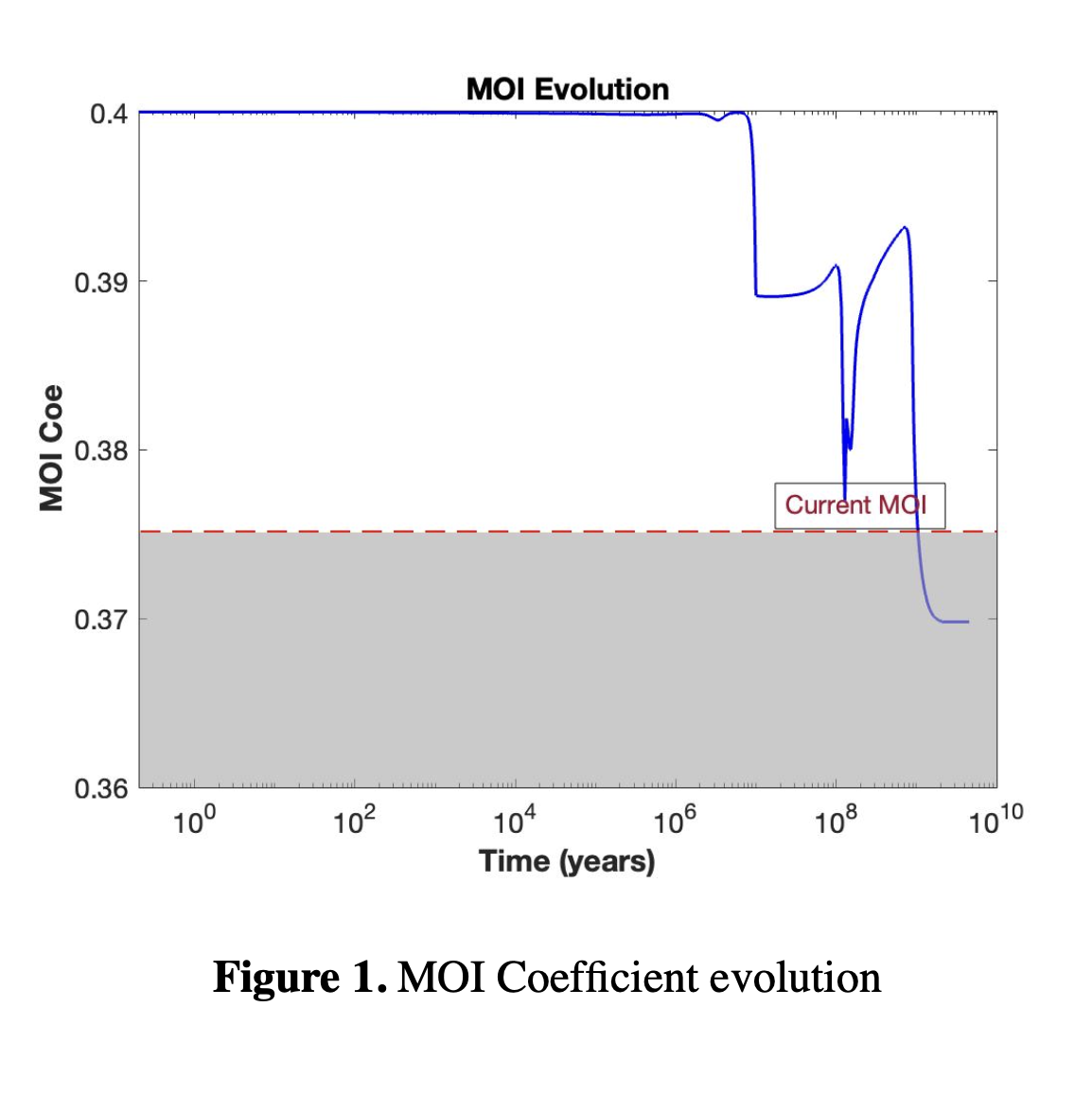
Introduction. Each year, approximately 40,000 ± 20,000 metric tons of extraterrestrial material reaches Earth, primarily in the form of micrometeorites [1]. Micrometeorites form by collisions between asteroids or as the result of evaporation of comets, and derive from a variety of parent bodies, including carbonaceous and ordinary chondrites [2]. Micrometeorites sample parent bodies distinct from those of meteorites, offering a unique perspective on the origin and evolution of the Solar System. They also provide valuable insights into potential dust-related hazards for space exploration. Melted micrometeorites, also termed cosmic spherules, are categorized into S-, I-, and G-types [3]. G-types, and to a lesser extent I-types, are rare in modern collections (1-2% are G-types) and their formation remains poorly understood, with no precise classification or parent body assignment [4]. This study focuses on I- and G-type particles recovered from both Antarctica and the Atacama Desert, to allow a direct comparison of relative particle abundance, state of preservation, and types of alteration in contrasting sedimentary environments. By comparing distinct I- and G-type collections, their classification can be improved, and their Solar System origins refined.

Methods. To assess the modern micrometeorite flux and distinct state of preservation, sediments are collected from two locations: near Calama in the Atacama Desert (Chile), and Walnumfjellet in the Sør Rondane Mountains (Antarctica). In the Atacama Desert, sediment is gathered from a 1 m² surface at 2 cm depth; Antarctic material is collected from sediment traps near Walnumfjellet mountain#5 in 2018. Around 500 g of sediment from each location is sieved into six size fractions between 2 mm and 32 µm. Magnetic separation is used to extract the magnetic micrometeorite-rich fraction from the bulk sediment. Candidate spherules are picked under a binocular microscope. Micro X-ray fluorescence (µXRF) analysis performed at AMGC (Vrije Universiteit Brussel) maps the major element composition of the selected spherules to obtain a preliminary identification. Internal textures and geochemical composition are analyzed using scanning electron microscope – energy dispersive spectrometry (SEM-EDS) at VUB. To determine parent body origin and atmospheric entry effects, in situ triple-oxygen isotopic compositions are measured using secondary ion mass spectrometry (SIMS) at CRPG in Nancy.

Results. Following SEM-EDS analysis, 5 I- and 11 G-type well-preserved cosmic spherules were identified in the Atacama sample (Fig. 1), with diameters ranging from 55 to 139 µm. Typical internal textures of I-type micrometeorites are observed, with or without metal beads. G-types consist of magnetite dendrites in a glassy mesostasis. Notably, the G-types exhibit different textures with variable thickness (0.2 µm to few micrometers wide) of magnetite dendrites and abundances of glassy mesostasis. This observed textural diversity highlights the need for a refined classification for G-types. Triple-oxygen data for four I-type and five G-type spherules indicate most G-types may derive from a similar source that aligns with CR or CV carbonaceous chondrites, while a single I-type can be linked to an ordinary chondrite source (Group 3) (Fig. 2). The remaining cosmic spherules plot near the terrestrial fractionation line (TFL, ~ δ17O = 0.52 x δ18O [5]), suggesting terrestrial atmospheric or diagenetic overprint.

The Antarctic sediment sample yields a larger number of micrometeorites than the Atacama sample, with 995 unclassified spherules that will be analyzed using µXRF and SEM in the upcoming months.  For now, the texture and composition of 13 well-preserved I-type spherules is observed using SEM-EDS (Fig. 1). SIMS data of triple-oxygen isotopes for 11 I-type cosmic spherules indicates strong oxidization during atmospheric entry, with ten spherules that may be linked to carbonaceous chondrites precursor. A single Antarctic I-type plots at a much lower δ18O value, possibly suggesting a link to an ordinary chondritic precursor. Despite the low number of particles analyzed and the measurement uncertainty, a difference in precursor material may explain the differences observed in isotopic compositions for the Atacama and Antarctic I-type spherules.

Conclusions. This study highlights the importance of comparing micrometeorite sampling sites and subpopulations directly, to assess variations in abundance and alteration of the micrometeorites. The Atacama location is promising for recovering rare G-types, which is crucial in refining the existing cosmic spherule classification schemes. Ongoing analysis of the Antarctic spherules will expand the dataset.

References. [1] Love and Brownlee (1993) Science 262:550-553. [2] Burns et al. (1979) Icarus 40:1-48. [3] Folco & Cordier (2015) EMU Notes in Mineralogy 15(9)253-297. [4] van Ginneken et al. (2024) Phil. Trans. R. Soc. A 382:20230195. [5] Clayton (1993) Annu. Rev. Earth. Planet. Sci. 21:115-149. [6] Thiemens and Brenninkmeijer (1995) Geophys. Res. Lett. 22(3)255-257. [7] Suavet et al. (2010) Earth Planet. Sci. Lett. 293:313-320.

Figure 1. SEM images of the internal textures of selected I- and G-type cosmic spherules from Calama (Atacama Desert) (A, E-I) and Walnumfjellet (Antarctica) (B-D). (A) I-type with metal bead (At-Cal-M1-26), (B) I-type with metal bead (WN18-M2-G5), (C) I-type (WN18-M2-F2), (D) I-type (WN18-M2-F2), (E) I-type (At-Cal-M2-41), (F) G-type (At-Cal-M3-63), (G) G-type (At-Cal-M2-44), (H) G-type (At-Cal-M2-06), (I) G-type (At-Cal-M2-35). Scalebar of 10 µm for image B, E-I, and 20 µm for A, C, D. 

Figure 2. (A) Triple-oxygen data of 9 micrometeorites from Calama (Atacama) and (B) 11 micrometeorites from Walnumfjellet (Antarctica) measured using SIMS. The results are plotted as Δ17O (‰) versus δ18O (‰). G- and I-type micrometeorites are plotted in relation to previously identified micrometeorite groups and meteorite parent body sources. The solid line represents the TFL (~ δ17O = 0.52 x δ18O; [5]), with associated analytical uncertainty as determined during SIMS sessions. The grey star represents the present average atmospheric isotopic composition of oxygen around the stratosphere-mesosphere transition (δ18O ~ 23.5‰ and δ17O ~ 11.8‰ [6]). The average uncertainty is 2SD. The plot is made after [7]. 

How to cite: Jonckheere, F. M. R., Krämer Ruggiu, L., Gattacceca, J., and Goderis, S.: Metal rich cosmic spherules from Calama (Atacama Desert) and Walnumfjellet (Antarctica): a textural, chemical and isotopic comparison , EPSC-DPS Joint Meeting 2025, Helsinki, Finland, 7–13 Sep 2025, EPSC-DPS2025-1320, https://doi.org/10.5194/epsc-dps2025-1320, 2025.

EPSC-DPS2025-1406 | ECP | Posters | SB10

Characterization of micrometerorites from Roysane and Nils Larsen, Sør Rondane Mountains (East Antarctica)  

Clara Zelinsky, Lisa Krämer Ruggiu, Samuele Boschi, Deepak Binu Beena, Vinciane Debaille, Maria Schönbächler, Maria Valdes, Philipp R. Heck, and Steven Goderis
Mon, 08 Sep, 18:00–19:30 (EEST)   Finlandia Hall foyer | F166

Characterization of micrometerorites from Roysane and Nils Larsen, Sør Rondane Mountains (East Antarctica)

Zelinsky1, C., Krämer Ruggiu1, L., Boschi1, S., Binu Beena1, D., Debaille2, V., Schönbächler3, M., Valdes4,5, M., Heck4, P. R., Goderis1, S.

1Archaeology, Environmental Changes, and Geo-Chemistry, Vrije Universiteit Brussel, Pleinlaan 2, B-1050 Brussels

2 Laboratoire G-Time, Université libre de Bruxelles, Avenue F.D. Roosevelt, 50 1050, Brussels  

3 Institut für Geochemie und Petrologie, ETH Zürich, Clausiusstrasse 25, 8092 Zürich

4 Robert A. Pritzker Center for Meteoritics and Polar Studies, The Field Museum of Natural History, Chicago, IL 60605, United States  

5 The School of the Art Institute of Chicago, Chicago, IL 60603, United States  

Each year ~5000 tons of extraterrestrial (ET) material accrete to Earth [1] with the majority consisting of small dust particles with size fractions of 2000 down to 10 µm, termed micrometeorites (MM). MMs are mainly thought to originate from evaporation tails of cometary bodies or to be produced during collision breakup events in the asteroid belt [2]. Despite their small size textural, chemical, and isotopic analysis of MMs has proven to be valuable in estimating Earth’s ET dust intake, reconstructing dust producing events in the Solar System, such as collision breakups of asteroids [3] and the convergence of new comets [4] and identifying potential parent body sources [5]. To provide a sturdy baseline for MM research and to mark MMs as a reliable tool in reconstructing the extraterrestrial influx over geological timescales, first, modern, well-preserved MMs need to be characterized in detail. Different sample locations in Antarctica have proven to be reliable sampling grounds as arid environments limit weathering effects and anthropogenic contamination is restricted [6]. Compared to melting snow and ice, sedimentary traps ensure an accumulation of sampling material over extended periods of time and relatively easy access.  One issue in MM research is inconsistent sample extraction and preparation rendering a direct comparison between different MM collections challenging. This project aims at comparing MMs from a wide range of sample locations across Antarctica to provide a more robust baseline of modern MMs. This study mainly focusses on the not yet studied sample sites of Roysane and Nils Larsen, both small moraines situated in the south-west of the Sør Rondane Mountains in East Antarctica and compares these to other Antarctic collections both in the Sør Rondane Mountains and beyond. Thorough petrographic characterization is first applied to identify different MM types, reconstruct the overall material flux to Earth, account for possible weathering effects and preservation of individual MMs. Major- and trace-element analysis via EPMA and LA-ICP-MS is used to compare weathering effects and constrain peak temperatures during atmospheric entry heating [7]. Triple-oxygen analysis via SIMS (Secondary Ion Mass Spectrometry) aids in refining atmospheric entry processes possible parent body source materials as oxygen isotope compositions vary significantly between distinct chondrite subclasses [7] and can therefore link individual MMs to various parent bodies. Although this study focuses on sample locations Nils Larsen and Roysane, other Antarctic collections such as Widerøefjellet and Walnumfjellet are processed in parallel to account for differences in physiochemical properties and sedimentary host deposits between sample locations [8, 9]. Ultimately, this combined effort will aid in providing a reliable and consistent baseline for MM studies and in obtaining a better understanding of the overall ET flux to Earth, potential parent bodies and interaction dynamics between Earth and the Solar System.    

References:

[1] Rojas et al., 2021, Earth Planet. Sci. Lett. 560, 116794.

[2] Suttle and Folco, 2020, J. Geophys. Res. Planets 125, 1–18.

[3] Farley et al., 2006, Nature, 439, 295–297.

[4] Genge, 2017, Geophys.Res. Lett., 44, 1679–1686.

[5] Suavet et al., 2010, Earth. Planet. Sci. Lett., 293, 313-320.

[6] Suavet et al., 2009, Polar Sci. 3, 100–109.

[7] Cordier et al., 2011, Geochim. Cosmochim. Acta 75 (2011) 5203–5218.

[8] Goderis et al., 2020, Geochim. Cosmochim. Acta 270 (2020) 112–143.

[9] Schmitz et al., 2019, Sci. Adv. 5, 1–11. 

How to cite: Zelinsky, C., Krämer Ruggiu, L., Boschi, S., Binu Beena, D., Debaille, V., Schönbächler, M., Valdes, M., Heck, P. R., and Goderis, S.: Characterization of micrometerorites from Roysane and Nils Larsen, Sør Rondane Mountains (East Antarctica) , EPSC-DPS Joint Meeting 2025, Helsinki, Finland, 7–13 Sep 2025, EPSC-DPS2025-1406, https://doi.org/10.5194/epsc-dps2025-1406, 2025.

EPSC-DPS2025-1425 | ECP | Posters | SB10

Micrometeorites from Rhodes Bluff, West Antarctica 

Deepak Binu Beena, Veronica Tollenaar, Lisa Krämer Ruggiu, Harry Zekollari, Raúl R. Cordero, Fernanda Cabello, Fernando Inostroza, Fien Jonckheere, Trygve Prestgard, and Steven Goderis
Mon, 08 Sep, 18:00–19:30 (EEST)   Finlandia Hall foyer | F167

Micrometeorites account for the largest influx of extraterrestrial particles into Earth and can be recovered from almost every corner of the planet. In the past few decades, pristine collections have been retrieved from high-altitude sediments from Antarctica. Here, we report a new collection of particles that have been recovered near Rhodes Bluff, West Antarctica, and describe the physicochemical properties of this new collection. First, the sediment is sieved into different size fractions, after which magnetic particles are separated using a neodymium magnet. Then, the particles are individually picked under an optical microscope, from which and more than 600 potential micrometeorite particles were recovered. MicroX-ray fluorescence (Bruker, Tornado M4) is used as the first tool to distinguish extraterrestrial particles from local background material using major and minor element compositions, which resulted in 270 possible micrometeorite candidates. Then, A first geochemical and textural classification is done using SEM-EDS. In total, 137 well-preserved micrometeorites have been recovered from a total of 1.5 kg of sediments. An unusual high abundance of  I-type cosmic spherules, as well as scoriaceous and unmelted, is observed. The I-type accounts for 12.4% by number (17 micrometeorites) of the 137 particles, while the combined scoriaceous and unmelted particles make up 11.6% (16 micrometeorites). This high abundance of I-type is quite rare in the Antarctica Collection and that of the scoriaceous together with unmelted particles is unique to this collection, an extensive study is required to produce the exact root cause.. From calculating the size of the particles, a size frequency distribution (Fig. 1) shows a size frequency peak distinct from other urban and Antarctic collections. A distinct accumulation or preservation mechanism may need to be invoked, or alternatively a distinct exposure history or source material may have influenced the Rhodes Bluff collection. Apart from this distinct peak on the size frequency plot, four particles with unusually high sulfur and iron content have also been found (Fig. 2). The preliminary results point towards a common extraterrestrial origin of these particles, and may trace the arrival of unique (micro)meteoritic material to Earth. Further studies with EPMA or SIMS will aid in understanding parent body source in the solar system, and weathering effects of the spherules.

References:

[1]. Genge et al., (2018), Meteoritics & Planetary Science 53, Nr 10, 2051–2066.

[2]. Suttle and Folco., (2020), Geophysical Research: Planets, 125, e2019JE006241.

[3]. Suttle et al., (2021),  Meteoritics & Planetary Science 56, Nr 8, 1531–1555

Fig.1 : Size distribution of various micrometeorite collections. Data from Rhodes Bluff, West Antarctica is compared with collections by Genge et al., 2018 (Larkman Nunatak), Suttle and Folco 2020 (Transantarctic Mountains, TAM65) and Suttle et al., 2021 (Urban). The urban and Larkman Nunatak collections show a comparable size frequency peak at 160 µm, while the TAM65 is dominated by a size frequency peak at 250 µm. In the case of the current study, a major peak occurs around ~90 µm, while a secondary peak is observed at ~180 µm.

Fig. 2: Examples of extracted extraterrestrial particles with a high sulfur and iron content, which shows a porphyritic to I-type texture. The particles have been analyzed using BSE-SEM-EDS. The SO2 content of the particles ranges from 5.2 – 29.4 wt% and the FeO content ranges from 48.7 – 70.8 wt%.


How to cite: Binu Beena, D., Tollenaar, V., Krämer Ruggiu, L., Zekollari, H., R. Cordero, R., Cabello, F., Inostroza, F., Jonckheere, F., Prestgard, T., and Goderis, S.: Micrometeorites from Rhodes Bluff, West Antarctica, EPSC-DPS Joint Meeting 2025, Helsinki, Finland, 7–13 Sep 2025, EPSC-DPS2025-1425, https://doi.org/10.5194/epsc-dps2025-1425, 2025.

EPSC-DPS2025-1452 | ECP | Posters | SB10

Micrometeorites from western Greenland: extending micrometeorite collections to sediment traps in the northern hemisphere. 

Julius Pesola, Lisa Krämer Ruggiu, Flore Van Maldeghem, William R. Hyde, Philippe Claeys, and Steven Goderis
Mon, 08 Sep, 18:00–19:30 (EEST)   Finlandia Hall foyer | F168

An estimated 4 (±2) x107 kg of cosmic dust reaches the Earth annually [1], three orders of magnitude greater than the corresponding flux of macroscopic meteorites [2]. Particles between 10 µm and 2 mm contribute the vast majority of cosmic dust ultimately accreting to Earth, known as micrometeorites (MMs) upon surviving atmospheric entry. MMs provide unique information on the composition and dynamics of small bodies in the Solar System. For example, geochemical evidence implies over 60% of MMs ≤1000 µm derive from carbonaceous chondritic parent bodies, while the corresponding number for meteorites is only c. 4% [3]. MMs have been collected from various environments, with hot and cold deserts in particular offering ideal dry environments for MM preservation owing to limited aqueous alteration and sedimentary reworking, and limited background sedimentation [4]. MM collections assembled by melting ice and snow are complemented by collections based on processing glacial sediment from ice-free high altitude sediment traps, for example in the Sør Rondane and Transantarctic Mountains, Antarctica [5, 6]. While MMs have been collected from residue in melt zones of glaciers in Greenland and Novaya Zemlya [7, 8], sediment traps in the Arctic have thus far not been targeted for MM extraction, and hence represent an untapped reservoir to better characterise the cosmic dust flux to Earth in the geologically recent past. Here we report MMs extracted from three sediment samples collected from sediment traps in western Greenland (two from the Nuussuaq peninsula, one from Disko Island) during a 2023 field campaign, adding to the five MMs extracted from 800 g of sediment previously reported [9].

Each 500 g sediment sample was washed and sieved wet into six size fractions <2 mm. A magnetic separation was applied to each size fraction, and MMs were picked from the magnetic portions based on their shape and surface appearance using an optical light Zeiss Stereoscope Discovery V.20 binocular microscope. Candidate MMs were mounted, polished to expose a representative cross-section, and subsequently imaged and analysed for their major and minor element compositions via SEM-EDS (JEOL JSMIT300). A representative portion of the non-magnetic residue was screened optically to ensure significant numbers of MMs were not missed. The first two samples, from sediment traps in two locations on the Nuussuaq peninsula, yielded 11 and 63 MMs. MM extraction from a third sample (from Disko Island) is underway. All recovered MMs are cosmic spherules, and comprise three S-types, two G-types, and six I-types in the first sample, and 48 S-types, five G-types, one mixed S/G-type, and nine I-types in the second sample. Preliminary comparison against Antarctic sediment trap collections reveals lower overall MM abundance, higher proportions of iron-rich (I- and G-type) to silicate-rich (S-type) cosmic spherules, and more prevalent weathered textures among Greenland sediment trap MMs. These features point to more advanced weathering in the Greenland sediment trap collection, likely due to differing environmental conditions, demonstrating the importance of comparative studies between MM collections from different polar environments. Further analytical campaigns are planned to measure detailed element compositions (EMPA) and triple oxygen isotopic compositions (SIMS) in order to constrain MM provenance and atmospheric entry effects.

MMs reported here greatly enlarge the current western Greenland sediment trap collection, and together with previously reported MMs represent the first sediment trap-derived MM collection from the northern hemisphere, allowing comparison of preservation between MMs extracted from sediment traps in Greenland and Antarctica. Ultimately, study of MMs collected from different environments across hemispheres will lead to a more comprehensive understanding of the spatial and temporal variabilities in the flux and delivery of extraterrestrial material to Earth. Arctic sediment trap MM collections also present an opportunity to gain new insight into sources of cosmic dust in the Solar System.

References: [1] S. G. Love & D. E. Brownlee (1993), Science, v. 262, p. 550–553. [2] G. W. Evatt et al., (2020), Geology, v. 48, p. 683–687. [3] L. Folco & C. Cordier, (2015), Planetary Mineralogy, Mineralogical Society of Great Britain and Ireland. [4] M. Van Ginneken et al., (2024), Philos. Trans. R. Soc. Math. Phys. Eng. Sci., v. 382, p. 20230195. [5] P. Rochette et al., (2008), Proc. Natl. Acad. Sci., v. 105, p. 18206–18211. [6] S. Goderis et al., (2020), Geochim. Cosmochim. Acta, v. 270, p. 112–143. [7] M. Maurette et al., (1987), Nature, v. 328, p. 699–702. [8] D. D. Badjukov & J. Raitala, (2003), Meteorit. Planet. Sci., v. 38, p. 329–340. [9] F. Van Maldeghem et al., (2023) NIPR Conference (abstract).

How to cite: Pesola, J., Krämer Ruggiu, L., Van Maldeghem, F., Hyde, W. R., Claeys, P., and Goderis, S.: Micrometeorites from western Greenland: extending micrometeorite collections to sediment traps in the northern hemisphere., EPSC-DPS Joint Meeting 2025, Helsinki, Finland, 7–13 Sep 2025, EPSC-DPS2025-1452, https://doi.org/10.5194/epsc-dps2025-1452, 2025.

EPSC-DPS2025-1734 | ECP | Posters | SB10 | OPC: evaluations required

Non destructive methodology to study GRO 95517  antarctic meteorite 

Giovanni Fanelli, Giovanna Agrosì, Daniela Mele, and Paola Manzari
Mon, 08 Sep, 18:00–19:30 (EEST)   Finlandia Hall foyer | F163

INTRODUCTION
Returning sample missions have gained
increasing attention in the last decades since
the only way to know the planetary surface's
composition and reconstruct the history
of geological processes is to analyse
samples using Earth-ground laboratorybased
techniques.
The employment of a non-or minimally destructive
protocol of analyses to carry out a
comprehensive characterisation is crucial
to preserving very precious extraterrestrial
samples.
On the other hand, non-destructive analyses
on samples of meteorites and micrometeorites
were yet successfully applied on Al-
Haggounia 001[1] and the micrometeorite
found on Mt. Gariglione, southern Italy[2].
With this aim, we are studying a fragment
of an antarctic meteorite named GRO
95517, a EH3 chondrite, found in 1995 in
Grosvenor Mountains (Antarctica – NZ).
The purpose of this investigation is the
study of mineralogical composition with
particular attention to the rare phases, mineral
distribution and association, texture and
microstructures in order to provide further
information on the origin and evolution of
this meteorite.
METHODS
The fragment was studied by Scanning
Electron Microscope (SEM) and microcomputed
tomography (μ-CT).
The correlation between SEM-EDS data,
chemical mapping and 3D reconstruction by
μ-CT allows to obtain us a volumetric reconstruction
of the fragment in nondestructive
way.
RESULTS
Optical analyses
GRO 95517 consists of chondrules
formed by pyroxene (enstatite) immersed in
a matrix composed by mesostases of plagioclase
in which nickel-iron alloys, sulfides
(daubréelite, oldhamite and troilite) and
phosphides (schreibersite) are disseminated.
The presence of oxidised phases such as
jarosite and oxides testify an heavily weathering.
The sample also exhibits several fractures.
Optical observations on thin section
show two families of enstatite chondrules
(EC): radial-pyroxene chondrules consisting
of fan-like arrays of enstatite and porphyritic
chondrules containing mainly enstatite.
Other mineralogical phases forming both
chondrules and mesostasis are mainly sulfides
and plagioclases.
In one enstatite chondrule we can appreciate
a “faulting” structure.
Sometimes, plagioclase and quartz aggregates
are observed.
SEM analysis
The S.E.M. analysis confirmed the presence
of pyroxene (enstatite), which is the
main constituent of chondrules. Furthermore, a significant distribution
of sulfides was detected, relatively
homogeneously dispersed throughout the
thin section. Through SEM analysis, these
sulfides are oldhamite, daubréelite, and
troilite.
Significant is also the presence of ironnickel
alloys (kamacite), which stand out
due to their bright white appearance in BSE
images.
Secondary mineralogical phases related
to terrestrial weathering alteration are limonite
(yellowish-brown in color) and jarosite.
Microcomputed Tomography (μ-CT)
This non-invasive technique was crucial
to obtain bulk information about the outer
and inner parts of the sample, thanks to the
ability to provide 3D reconstruction of meteoritic
fragments. GRO95517 is characterized
by a high presence of pores that, in
most cases, are filled by secondary phases. In the cross section minerals
with different attenuation coefficients
and chondrules can be observed.
CONCLUSION
The Antarctic meteorite GRO 95517 is
characterized by primary phases such as
enstatite, kamacite and troilite surrounded
by a glassy mesostasis. Few secondary
phases were recognized, that indicate a high
degree of weathering (limonite and jarosite).
The integration of SEM-EDS data,
chemical maps and 3D μ-CT reconstruction
allows to obtain a volumetric reconstruction
of the fragment, providing valuable information
on its internal structure without
compromising its integrity.

REFERENCES:
[1] Manzari, P., Mele, D., Tempesta, G. &
Agrosì, G. (2023) – New insights on the
porosity and grain features of Al Haggounia
001, an impact-melt meteorite, 1-10.
[2] Agrosì, G., Manzari, P., Mele, D., Tempesta,
G., Rizzo, F., Catelani, T., Cheng, G.,
Yao, N., Villenueve, J. & Bindi, L. (2025) –
Unique (Al, Cu)-alloys discovered in a micrometeorite
from Southern Italy. Communications
earth & environment, 1-10.

How to cite: Fanelli, G., Agrosì, G., Mele, D., and Manzari, P.: Non destructive methodology to study GRO 95517  antarctic meteorite, EPSC-DPS Joint Meeting 2025, Helsinki, Finland, 7–13 Sep 2025, EPSC-DPS2025-1734, https://doi.org/10.5194/epsc-dps2025-1734, 2025.

SB11 | The Rubin Observatory Census of the Solar System: Initial Commissioning Results and First Year Science Expectations for the Legacy Survey of Space and Time

EPSC-DPS2025-1056 | ECP | Posters | SB11 | OPC: evaluations required

Assessment of HelioLinC3D performance for near-Earth Asteroid discovery on LSST predictions 

Sam Cornwall, Siegfried Eggl, Ari Heinze, and Ben Engebreth
Tue, 09 Sep, 18:00–19:30 (EEST)   Finlandia Hall foyer | F198

The impending commencement of operations for the Vera C. Rubin Observatory’s Legacy Survey of Space and Time (LSST) is poised to initiate an order of magnitude increase in discoveries of Solar System Objects (Kurlander et al. 2025). Of particular interest to planetary defense efforts are near-Earth asteroids (NEAs) in the 0.1 to 1 km range. Due to the scale of the data set to be generated by LSST, delivering on these promises requires an efficient, scalable discovery algorithm. NEAs in particular require care, as their detections often occur on a dense background of Main Belt objects. 

HelioLinC3D (Eggl et al. 2020, Heinze et al. 2022), based on the HelioLinC algorithm (Holman et al. 2018) offers a new approach to linking asteroid detections. Using full scale datasets of simulated asteroid detections for the first year of LSST (Schwamb et. al.), we investigate the performance of HelioLinC3D for discovering NEAs from datasets containing both Main-Belt asteroids (MBAs) and false positives generated by image noise and differencing artifacts. In addition to the verification and testing of the performance of HelioLinC3D for NEAs, we provide discussion on the tuning and selection of various parameters in the algorithm for efficient identification of NEAs, through analysis of the ground truth provided through the simulated detections. 


References:

Eggl, S., Juric, M., Moeyens, J., & Jones, L. (2020), AAS/Division for Planetary Sciences Meeting Abstracts, 52, 211.01.

Heinze, A., Eggl, S., Juric, M., et al. (2022), in AAS/Division for Planetary Sciences Meeting Abstracts, Vol. 54, AAS/Division for Planetary Sciences Meeting Abstracts, 504.04 

Holman, M. J., Payne, M. J., Blankley, P., Janssen, R., & Kuindersma, S. (2018), AJ, 156, 135

Kurlander, J., Bernardinelli, P., Schwamb, M., Juric, M., Merritt, S., Murtagh, J., Oldag, D., West, M., Holman, M., Cornwall, S., Fedorets, G., Eggl, S., Kubica, J. "Predictions of the LSST Solar System Yield: Near-Earth Objects, Main Belt Asteroids, Jupiter Trojans, and Trans-Neptunian Objects", Planetary Science Journal, accepted.

Schwamb, M. et al. “Sorcha: A Solar System Survey Simulator for the Legacy Survey of Space and Time”, The Planetary Science Journal (in press)

How to cite: Cornwall, S., Eggl, S., Heinze, A., and Engebreth, B.: Assessment of HelioLinC3D performance for near-Earth Asteroid discovery on LSST predictions, EPSC-DPS Joint Meeting 2025, Helsinki, Finland, 7–13 Sep 2025, EPSC-DPS2025-1056, https://doi.org/10.5194/epsc-dps2025-1056, 2025.

SB12 | Exploring the Martian Moons: unraveling the origins of Phobos and Deimos

EPSC-DPS2025-623 | ECP | Posters | SB12

Experimental investigations of the photometric properties of Phobos simulant  

Nikhil Keshav, Stefan Schröder, Antoine Pommerol, and Axel Hagermann
Thu, 11 Sep, 18:00–19:30 (EEST)   Finlandia Hall foyer | F168

Deriving quantitative regolith properties from photometric remote sensing data remains a challenge. Many photometric models are empirical, where the parameters lack direct physical interpretation. Although Hapke models have parameters that correspond to physical properties of the regolith, they suffer from other issues such as parameter degeneracy (where different physical properties can explain the same behavior) or the fitting algorithm getting stuck in local minima. To reliably interpret remote sensing data, one can validate the findings by reproducing the observed photometric behavior in laboratory. One such study was recently performed by Wargnier et. al. (2024), where they found the single-scattering albedo (SSA) of Phobos simulants to be 3-6 times higher than the observation made by Fornasier et. al. (2024) and Simonelli et. al. (1998) based on Mars Express/HRSC and Viking clear filter images, respectively. However, a closer match with remote sensing observations may be achieved by using wider grain size distributions or higher porosity.

In preparation for the upcoming Martian Moons eXploration (MMX) mission to Phobos, multiple new Phobos regolith simulants have been developed for testing purposes [4,5]. A primary objective in preparing these simulants has been achieving spectroscopic similarity to the observations made during previous space missions. However, due to limited knowledge of some key physical properties like particle size distribution, packing density, and surface roughness, they are not tightly constrained in the simulants. Miyamoto et al. [4] prepared three different grain size models for the University of Tokyo Phobos Simulant (UTPS) - a) resembling lunar surface regolith, b) resembling possible regolith of the smooth area of Itokawa, and c) an intermediate distribution between models (a) and (b). While Wargnier et al. [1,4] used different grain size ranges for sample preparation and subsequent analysis, their focus was mainly on the detectability of hydrated minerals and organic bands. Despite these efforts, the effect of different grain size distributions, packing densities, and surface roughness on the photometric behavior of Phobos simulants has yet to be systematically investigated.

We conduct an extensive photometric analysis of the UTPS simulant using the PHIRE-2 (PHysikalisches Institut Radiometric Experiment - 2) radio-goniometer at the University of Bern. This instrument is particularly well suited for studying dark samples (like UTPS) and allows observations at phase angles as low as 0.5 degrees [6]. Our study compares the photometric behavior of samples with varying grain size distributions and packing densities against observations from the Mars Express/HRSC. We also plan to investigate wavelength dependency on the photometric properties to assess if the observed red/blue spectral dichotomy on Phobos can be attributed to differences in physical characteristics. These experiments will help us better interpret the observations from Mars Express/HRSC and should give us a more comprehensive understanding of the regolith properties of Phobos.


References: 
1. Wargnier, A. et al. (2024), "Spectro-photometry of Phobos simulants: I. Detectability of hydrated minerals and organic bands", Icarus v241, 116216, doi: 10.1016/j.icarus.2024.116216 

2. Fornasier, S. et al. (2024), "Phobos photometric properties from Mars Express HRSC observations", A&A, 686, A203, doi: 10.1051/0004-6361/202449220 

3. Simonelli, D. et al. (1998) "Photometric Properties of Phobos Surface Materials from Viking Images", Icarus 131(1), p. 52-77, doi:10.1006/icar.1997.5800 

4. Miyamoto, H. et. al. (2021), "Surface environment of Phobos and Phobos simulant UTPS", Earth Planets Space 73, 214, doi: 10.1186/s40623-021-01406-3 

5. Wargnier, A. et.al. (2023), "Development of a new Phobos spectral simulant: spectral properties from visible to the mid-infrared range", MNRAS v524-3, p3809–3820, doi: 10.1093/mnras/stad2132  

6. Jost et. Al. (2016), "Experimental characterization of the opposition surge in fine-grained water–ice and high albedo ice analogs", Icarus v264, 109-131, doi: 10.1016/j.icarus.2015.09.020 

How to cite: Keshav, N., Schröder, S., Pommerol, A., and Hagermann, A.: Experimental investigations of the photometric properties of Phobos simulant , EPSC-DPS Joint Meeting 2025, Helsinki, Finland, 7–13 Sep 2025, EPSC-DPS2025-623, https://doi.org/10.5194/epsc-dps2025-623, 2025.

SB15 | Computational and experimental astrophysics of small bodies and planets

EPSC-DPS2025-321 | Posters | SB15 | OPC: evaluations required

Unveiling Hidden Structures in the Main Belt: A Probabilistic Framework for Asteroid Families 

Maya Guy, Benoit Carry, and Vincent Vandewalle
Mon, 08 Sep, 18:00–19:30 (EEST)   Finlandia Hall foyer | F182

The identification of asteroid families is a key question in planetary sciences (Novaković et al. 2022), offering crucial insights into the collisional and dynamical history of the asteroid Main Belt (MB). These families, originating from the fragmentation of parent bodies due to catastrophic collisions, form dense clusters in orbital proper elements space. Over time, the non-gravitational Yarkovsky effect induces a semi-major axis drift, producing the characteristic V-shaped patterns in the (semi-major axis, absolute magnitude) plane.

Current techniques for family identification suffer from several limitations. The most widely used approach, the Hierarchical Clustering Method (HCM, Zappala et al. 1990), does not account for the presence of a background population, leading to overestimated family cores and the omission of their extended wings (often referred to as halos, Dermott et al. 2018). Furthermore, no families older than ∼2Gyr have been confidently identified using this method (Spoto et al. 2015). Additionally, HCM assumes that families are non-overlapping in the proper element space, an unrealistic assumption as young familiesmay overlap with older, more diffuse, families.

To overcome some of the HCM limitation, the V-shape method was developed (Bolin et al. 2017). Being based on the print of Yarkovsky-induced spreading, it successfully allowed to find very old families (Delbo et al. 2017; Delbo et al. 2019). While recent combined approaches have incorporated the background population into family detection frameworks (Ferrone et al. 2023), they still lack an intrinsic mechanism for handling overlapping families and do not yield probabilistic membership lists.

In this study, we propose a new probabilistic approach for identifying asteroid families in the MB, using model-based clustering. We model the observed population of the MB as a mixture of skewed-t distributions for eccentricity, inclination, and absolute magnitude, ST(xijμkjkjkjkj), j∈{1,2,3} coupled with a gaussian distribution for semi-major axis that explicitly depends on absolute magnitude N(xi4μk4+ck100.2xi3cosγs2k4) which captures the Yarkovsky-driven semi-major axis evolution. The parameters θkj, which define the shape and orientation of each cluster along each dimension (e, i, a, H), and mixture proportions αk of the model are estimated using the Expectation-Maximization (EM) algorithm. This model also includes a uniform background component for the primordial asteroid population.


This flexible approach accommodates anisotropic and overlapping family structures, and provides a probabilistic membership assignments, enabling a more nuanced and robust classification of asteroid families.
We will present the methodology and results from simulated datasets to demonstrate the performance and advantages of this approach.

References
Bolin, Bryce T., Marco Delbo, Alessandro Morbidelli, and Kevin J. Walsh (Jan. 2017). “Yarkovsky V-
shape identification of asteroid families”. In: Icarus 282, pp. 290–312. issn: 0019-1035.
Delbo, Marco, Chrysa Avdellidou, and Alessandro Morbidelli (2019). “Ancient and primordial collisional
families as the main sources of X-type asteroids of the inner main belt”. In: A&A 624, A69.
Delbo, Marco, Kevin Walsh, Bryce Bolin, Chrysa Avdellidou, and Alessandro Morbidelli (Sept. 2017).
“Identification of a primordial asteroid family constrains the original planetesimal population”. In:
Science 357.6355, pp. 1026–1029.
Dermott, Stanley F., Apostolos A. Christou, Dan Li, Thomas. J. J. Kehoe, and J. Malcolm Robinson (July
2018). “The common origin of family and non-family asteroids”. In: Nature Astronomy 2, pp. 549–554.
arXiv: 2010.13218 [astro-ph.EP].
Ferrone, S., Delbo, M., Avdellidou, C., Melikyan, R., Morbidelli, A., Walsh, K., and Deienno, R. (2023).
“Identification of a 4.3 billion year old asteroid family and planetesimal population in the Inner Main
Belt”. In: A&A 676, A5.
Novakovi´c, Bojan, David Vokrouhlick´y, Federica Spoto, and David Nesvorn´y (Aug. 2022). “Asteroid fam-
ilies: properties, recent advances, and future opportunities”. In: Celestial Mechanics and Dynamical
Astronomy 134.4, 34, p. 34. arXiv: 2205.06340 [astro-ph.EP].
Spoto, Federica, Andrea Milani, and Zoran Kneˇzevi´c (Sept. 2015). “Asteroid family ages”. In: Icarus 257,
pp. 275–289. arXiv: 1504.05461 [astro-ph.EP].
Zappala, Vincenzo, Alberto Cellino, Paolo Farinella, and Zoran Knezevic (Dec. 1990). “Asteroid Families.
I. Identification by Hierarchical Clustering and Reliability Assessment”. In: Astronomical Journal 100,
p. 2030.

How to cite: Guy, M., Carry, B., and Vandewalle, V.: Unveiling Hidden Structures in the Main Belt: A Probabilistic Framework for Asteroid Families, EPSC-DPS Joint Meeting 2025, Helsinki, Finland, 7–13 Sep 2025, EPSC-DPS2025-321, https://doi.org/10.5194/epsc-dps2025-321, 2025.

EPSC-DPS2025-332 | ECP | Posters | SB15

Hunting for Sub-Moons: A Map of Stability in the Jovian and Kronian Systems 

Ryan Dahoumane, Valéry Lainey, and Kévin Baillié
Mon, 08 Sep, 18:00–19:30 (EEST)   Finlandia Hall foyer | F171

The existence or inexistence of subsatellites (satellites of satellites) in the Solar System has never been demonstrated. Kollmeier and Raymond (2019) showed from an analytical approach exclusively based on tides that Jupiter and Saturn could both potentially host subsatellites. Later, Sucerquia, Mario et al. (2024) studied the stability of equatorial rings around main satellites of the gaseous planets, through N-body simulations. They concluded that such rings could be stable over long timescales, in contrast with the absence of direct observations. We extend this work by examining the stability of sub-moons around a large number of Jupiter’s and Saturn’s satellites—including the irregulars. Using N-body simulations that account for gravitational perturbations from the Sun and the neighbour planet, we evaluate the survival rates of subsatellites. We produce a map of the best candidates capable of hosting sub-satellites in the Jovian and Kronian systems.

How to cite: Dahoumane, R., Lainey, V., and Baillié, K.: Hunting for Sub-Moons: A Map of Stability in the Jovian and Kronian Systems, EPSC-DPS Joint Meeting 2025, Helsinki, Finland, 7–13 Sep 2025, EPSC-DPS2025-332, https://doi.org/10.5194/epsc-dps2025-332, 2025.

EPSC-DPS2025-726 | ECP | Posters | SB15 | OPC: evaluations required

Timescales for Hypervolatile Depletion from Small Kuiper Belt Objects 

Julia W. Miller, Orkan Umurhan, Christian Huber, and Samuel Birch
Mon, 08 Sep, 18:00–19:30 (EEST)   Finlandia Hall foyer | F180

Introduction: Small, ice-rich objects in and beyond the Kuiper Belt are likely to have undergone the least amount of processing in the billions of years since their formation, and can be used to form a more complete picture of the conditions and materials present in the early solar system. However, even these objects are unlikely to have remained entirely pristine. Since they would originally have contained substantial amounts of hypervolatile ice, even minor sources of heating may have resulted in significant thermal alteration.

To understand the extent to which the presence and quantity of volatile materials in a small body is indicative of when and where an object formed, we have developed a new thermophysical evolution model for small bodies, which includes all physical processes relevant to volatile loss at low temperatures.

Methods: We have developed a 1D spherically symmetric finite difference model for the thermophysical evolution of small porous bodies with volatile-rich interiors. We treat one species as a volatile material and track sublimation, deposition, and gas flow for this species. All other materials (predominantly silicates, complex organic materials, and amorphous water ice) make up the matrix, which is all treated as entirely refractory, consistent with the low range of temperatures we consider.

Our system is described by a set of coupled partial differential equations for the conservation of energy and mass through time. At each model time step, we solve the diffusion equation for volatile gas in the Knudsen flow regime, with phase change as a source term. This is done implicitly, assuming that the time step is long enough for the gas density to adjust to an equilibrium profile. We then update the temperature profile by solving an explicit form of the thermal diffusion equation, with the latent heat of phase change as an energy sink and the decay of long-lived radioisotopes as an energy source. We use a constant value for thermal conductivity but investigate the effect of varying this value, since the functional form generally has a strong dependence on both the porosity structure [1,2] and the distribution of solid components [3], neither of which are well constrained for small porous bodies.

For this study, the volatile of interest is carbon monoxide, and we use the updated vapor pressure curves from [4]. We use CI chondrite abundances of radioisotopes for the silicate portion of the body [16], and we assume a 1:1 ratio by mass of silicates to complex organic material [17]. We consider a range of temperatures between 30 K and 39 K, broadly consistent with equilibrium surface temperatures in the Kuiper Belt. We choose initial CO mass fractions between 0.05 and 0.15, generally consistent with estimates of protoplanetary disc composition at the location of the future Kuiper Belt [5]. We vary the pore size of the matrix material between 1 and 0.01 mm, and we test values of effective thermal conductivity between 1e-2 and 1e-4 W/m/K, both consistent with remote measurements of comets [6].

Results: We find that it is possible for a porous Kuiper Belt Object with a 5 km radius, such as Arrokoth, to retain CO over the lifetime of the solar system, although many plausible combinations of matrix porosity and thermal conductivity result in CO depletion even at a surface temperature of 30 K. Lower temperatures and porosities, and higher values for effective thermal conductivity result in slower rates of CO loss. Higher initial CO mass fractions also increase the volatile retention lifetime in a weakly nonlinear manner.

Discussion: It has been suggested [7,8] that the minimal amount of solar radiation received by objects in the Kuiper Belt and Oort Cloud may still have been enough to fully remove volatile ices, such as CO, on timescales much shorter than the age of the solar system. However, CO outgassing has been observed from comets sourced from these regions. This has led various workers to hypothesize that CO is trapped in less volatile materials such as amorphous water [9,10], clathrates [11], or CO2 ice [7,12]. If such mechanisms were responsible for the release of CO vapor, one would expect CO outgassing rates to be correlated with rates of H2O and CO2 vapor production, but this does not seem to be the case [12,13]. Furthermore, CO outgassing has been observed in recent years at large heliocentric distances where less volatile ices should be stable [15].

If CO can be preserved for billions of years within small bodies in the outer solar system, then additional mechanisms for volatile retention are not categorically required to explain observations, and the discrepancy outlined above is resolved. We suggest that this may be the case for some portion of comets which formed cold [18] and late [19], with small pores and thermally conductive interiors.


References: [1] Shoshany, Y., et al. (2002) Icarus 157, 219–227. [2] Krause, M., et al. (2011) Icarus 214.1, 286-296. [3] Wang, M., et al. (2007) J. Phys. D: Appl. Phys., 40, 260. [4] Grundy, W. M., et al. (2024) Icarus 410, 115767. [5] Estrada, P. R., Cuzzi, J. N. (2022) APJ 936 (1), 40. [6] Groussin, O., et al. (2019) Space Sci Rev, 215:29. [7] Lisse, C. M., et al. (2021) Icarus 356, 114072. [8] Bouziani, N., and Jewitt, D. (2022) APJ 924:37. [9] Jewitt, D. APJ 137, 4296–4312. [10] Prialnik, D., and Rosenberg, E. D. (2009) MNRAS 399, L79–L83. [11] Marboeuf, U., et al. (2010), APJ 708, 812. [12] Davidsson, B. J. R. (2021) MNRAS 505 (4), 5654–5685. [13] Kipfer, K. A., et al. (2024) A&A 686, A102. [14] De Prá, M. N., et al. (2024) Nat. Astro. 1-10. [15] Harrington Pinto, O., et al. (2022) PSJ 3:247. [16] Robuchon, G., and Nimmo, F. (2011) Icarus 216, 426-439. [17] Bardyn, A., et al. (2017) MNRAS 469, S712–S722. [18] Marschall, R., et al. (2025) PSS. [19] Davidsson, B. J. R. (2016) A&A 592, A63.

How to cite: Miller, J. W., Umurhan, O., Huber, C., and Birch, S.: Timescales for Hypervolatile Depletion from Small Kuiper Belt Objects, EPSC-DPS Joint Meeting 2025, Helsinki, Finland, 7–13 Sep 2025, EPSC-DPS2025-726, https://doi.org/10.5194/epsc-dps2025-726, 2025.

EPSC-DPS2025-958 | Posters | SB15

Ionizing atmospheres in collisions of grains  

Patrick Hock, Jens Teiser, and Gerhard Wurm
Mon, 08 Sep, 18:00–19:30 (EEST)   Finlandia Hall foyer | F174
The ionization of atmospheres is important for a number of physical and chemical processes from earth to other planets to protoplanetary disks. As many atmospheres are particle ladden at times with frequent collisions, we study the microphysics of particle collisions on ionization. It is well known that due to tribocharging particles carry charges after a collision. However, this charge transfer is not restricted to the grain surfaces. Somewhat less obvious, the gas phase also becomes ionized along.
 
In laboratory experiments, we quantify the amount of ions produced in a collision of glass beads with 2.8 mm diameter. We extract the ions by applying an external electrostatic field and measuring the generated current. The ions are detected at all the pressures studied, i.e. from 0.3 mbar to 100 mbar. However, the ionization rate peaks at about 1 mbar. Scaled to individual bouncing collisions, charge as high as 1 pC of each polarity was detected (Hock et al. 2025). This implies collisions of grains can be a significant source of ions in various atmospheres. In view of these results, this process might be a significant source of ionization in certain parts of atmospheres. 

How to cite: Hock, P., Teiser, J., and Wurm, G.: Ionizing atmospheres in collisions of grains , EPSC-DPS Joint Meeting 2025, Helsinki, Finland, 7–13 Sep 2025, EPSC-DPS2025-958, https://doi.org/10.5194/epsc-dps2025-958, 2025.

EPSC-DPS2025-1558 | ECP | Posters | SB15

Resonant Dynamics and Particle Trapping Around Non-Symmetric Asteroids 

Lucia Civati, Iosto Fodde, and Fabio Ferrari
Mon, 08 Sep, 18:00–19:30 (EEST)   Finlandia Hall foyer | F185

Asteroids exhibit intricate dynamical environments due to their irregular, nonspherical shapes, which give rise to complex gravitational fields capable of inducing chaotic motion in surrounding particles. Despite this apparent disorder, regions of periodic and resonant motion can emerge. These periodic and resonant structures, shaped by the gravitational asymmetry of the central body, are particularly evident in the body-fixed reference frame. In particular, resonant dynamics can provide valuable insight into the long-term evolution of ejecta, dust particles, and debris, as it can lead to their temporary or permanent trapping around small bodies. These mechanisms can drive the redistribution of material, with implications for regolith transport, debris retention, and the transition from transient to bound orbits [1]. In recent years, these dynamics have gained growing interest, especially for their relevance to early satellite formation, binary asteroid development, and the formation of rings or secondary bodies. Examples such as the rings observed around Chariklo and Haumea, suggesting  that these irregular bodies can host coherent structures maintained by resonant mechanisms [2].

Several studies have explored the influence of non-spherical gravitational potentials on resonant dynamics near small bodies [2][3], often relying on simplified representations such as ellipsoids, localized mass anomalies, or low-degree spherical harmonic models.

In this work, we model the deviation from spherical symmetry using a higher-order spherical harmonics expansion up to degree and order six, which proves sufficient to resolve resonant features close to the body. The approach is applied to the primary of the Didymos system, the binary asteroid targeted by ESA’s Hera mission, whose binary nature makes it an ideal case for investigating capture processes and the potential formation of secondary bodies.

An object is said to be in a p1 : p2 gravitational resonance when its orbital period and the rotational period of the central body satisfy the commensurability condition p1Ω = p2 n, where n denotes the mean motion of the particle (related to its orbital period in the inertial frame), and Ω is the rotational rate of the central body.

Near irregularly shaped bodies, it is more effective to adopt a body-fixed, co-rotating frame, in which the gravitational potential becomes time-invariant, and so problem autonomous, making it suitable for identifying resonance islands and stable regions through techniques such as Poincaré surface of section analysis. To provide a more intuitive and geometrically meaningful interpretation of resonances in the body-fixed frame, an alternative definition can be employed [6]. By defining the radial (epicyclic) frequency κ, which describes how frequently the particle returns to periapsis, and the synodic frequency, nΩ, which indicates how often the particle returns to the same spatial location in the co-rotating frame, the resonance condition can be reformulated as: κ = k( n−Ω), which corresponds to a k : (k − j) resonance: n/Ω∼k/(k-j).

Here, j represents the number of distinct types of sectors traced by the resonant orbit, while k indicates the number of identical sectors. Moreover, j also corresponds to the number of intersections on the Poincaré surface of section, offering a direct link between orbital resonances and visual structures in phase-space.

The phase-space structure around Didymos has been initially explored through Poincaré sections, revealing the emergence of resonant features and periodic orbit islands.  The resonances identified through these maps are then examined in using a Hamiltonian formalism. Through this approach, it becomes possible to construct portraits of the resonant phase-space, providing insights into the location of equilibrium points, the amplitude of libration and circulation zones, and the overall stability and dynamical features associated with a specific resonance.

This analysis is complemented through the use of a dynamical indicator: the Finite-Time Lyapunov Exponent (FTLE). This chaos indicator highlights the sensitivity of trajectories to initial conditions and is effective in capturing a broader picture of the system’s behavior. FTLE maps offer a useful benchmark for comparing results obtained via the classical Hamiltonian framework.

Fig. 1: Comparison between FTLE map (left) and phase-space portrait (right) for the 1:3 p1 : p2 resonance.

To investigate how resonances can facilitate the temporary or long-term trapping of particles, this study considers capture mechanisms influenced by perturbations relevant to natural ejecta, such as solar radiation pressure and energy-dissipating effects arising from particle collisions, extending the analysis beyond the typical resonance capture analysis applied to controlled spacecraft trajectories under low-thrust propulsion [5].  Inter-particle interactions are preliminarily modeled via a Stokes-like drag term, used as a simplified proxy for energy loss from mutual collisions.

A Monte Carlo approach is employed to statistically assess the probability of particles becoming trapped within previously identified resonant regions.

The examination of features such as the stabilization of the semi-major axis over time, energy variations near separatrices in the Hamiltonian phase-space, and the behavior of stability indicators, are used to distinguish transient from longer-lived trapping.

Fig. 2: Evolution of semi-major axis for particle captured in a Monte Carlo simulation with drag-like perturbation. 

Preliminary expectations indicate that collisional dissipation and low-thrust-like forces can facilitate trapping, while SRP, due to its varying direction, likely causes short-lived resonance locking. Further analysis will clarify the timescales and conditions for feasible capture. To complement the analysis, an N-body code designed for granular materials is used to simulate realistic particle collisions and investigate their role in resonant capture. While theoretical models offer insight into the dynamics around non-spherical bodies, collision simulations can provide a valuable counterpart by testing how these processes may lead to capture and possibly to binary system formation.

Acknowledgments

This work is funded by the European Union (ERC, TRACES, 101077758). Views and opinions expressed are however those of the authors only and do not necessarily reflect those of the European Union or the European Research Council. Neither the European Union nor the granting authority can be held responsible for them.

[1] D. Scheers et al. “The Fate of Asteroid Ejecta”.

[2] B. Sicardy et al. “The dynamics of rings around Centaurs and Trans-Neptunian Objects”.

[3] Nicolas Delsate. “Analytical and numerical study of the ground-track resonances of Dawn orbiting Vesta”.

[4] C. D. Murray et al. “Solar system dynamics”.

[5] W. Boumchita et al. “The capture probability of Dawn into ground-track resonances with Vesta”.


How to cite: Civati, L., Fodde, I., and Ferrari, F.: Resonant Dynamics and Particle Trapping Around Non-Symmetric Asteroids, EPSC-DPS Joint Meeting 2025, Helsinki, Finland, 7–13 Sep 2025, EPSC-DPS2025-1558, https://doi.org/10.5194/epsc-dps2025-1558, 2025.

SB22 | Understanding the internal structure of kilometric-size asteroids through measurements and modeling

EPSC-DPS2025-831 | ECP | Posters | SB22 | OPC: evaluations required

Comparative Evaluation of Inversion Methods for In-Situ RF Tomography of Kilometre-Scale Asteroids 

William Hickmott, Kai Hoettges, and Stefania Soldini
Tue, 09 Sep, 18:00–19:30 (EEST)   Finlandia Hall foyer | F209

Transforming dense, arbitrarily angled RF attenuation chords acquired by an in-situ swarm of surface-bound transceivers into faithful three-dimensional permittivity maps of kilometre-scale asteroids presents a critical yet inherently ill-posed inverse problem. Subsurface voids, boulders and compositional layers dictate an asteroid’s mechanical response to anchoring, sampling and deflection while preserving clues to its formation history. Radar experiments, such as the bistatic CONSERT experiment on Rosetta/Philae and the monostatic JuRa sounder aboard Hera’s Juventas CubeSat, have demonstrated subsurface sounding[1], [2], but their limited transmitter–receiver geometries sample only a small fraction of interior paths. By contrast, a distributed network of surface transceivers can acquire high-density, multi-angle chords, vastly improving volumetric coverage and reconstruction robustness.

To close this gap, we developed a three-dimensional simulation framework based on high-resolution meshes from the Small Body Mapping Tool[3] and a custom generator that assigns spatially varying permittivity fields to each polyhedral model. Voids are introduced via Perlin-noise masks whose amplitude and feature-size parameters control the granularity and homogeneity of dielectric contrasts, yielding analogues from nearly uniform interiors with fine, dispersed cavities to highly heterogeneous bodies with large, sharp voids. Figure 1 shows two extreme cases and a medium range for the field noise amplitudes versus a radially defined field. Measurement acquisition is simulated by placing approximately equidistant nodes on the surface and recording attenuation along each inter-node chord, which is discretised through the volume using a three-dimensional Bresenham algorithm. By varying the number of unique signal paths, from highly underdetermined cases to richly overdetermined ones, and preserving identical datasets for machine-learning training, we enable a direct comparison of inversion methods under matched inputs.

Figure 1 Bespoke asteroid generation tool outputs, with representative extreme ends and a middle value output.

Reconstruction of the attenuation field is performed using five established paradigms under matched inputs, with the addition of early results from a ML model. Simple back-projection (SBP) smears measurement residuals directly into the volume, offering a rapid yet low-fidelity baseline. Filtered back-projection (FBP) applies a band-limited filter in the frequency domain before back-projection, attenuating low-frequency blur at the cost of ringing artefacts around sharp interfaces. Algebraic Reconstruction Technique (ART) iteratively projects individual residuals along each ray in sequence, achieving fast initial updates but leaving streak artefacts that can obscure finer structures. Simultaneous Iterative Reconstruction Technique (SIRT) aggregates corrections from all rays at each cycle, smoothing these artefacts yet demanding more iterations to converge. Bayesian Maximum A Posteriori (B-MAP) estimation enhances the forward model with discrete 7-stencil Laplacian regularisation to penalise local curvature and enforce smoothness, thereby stabilising the inversion by minimising second-order differences between neighbouring voxels, improving noise resilience while preserving broad permittivity gradients.

Figure 2 Top, left to right: Generated true field followed by SBP, FBP, ART, SIRT, and B-MAP reconstructions. Bottom, left to right: voxelised errors for SBP, FBP, ART, SRT, and B-MAP reconstructions.

Figure 2 juxtaposes the ground-truth permittivity distribution with reconstructions obtained by SBP, FBP, ART, SIRT and B-MAP, alongside voxel-wise error maps quantifying local deviations. Back-projection methods prove ineffective for small-body tomography: FBP’s frequency-domain filtering removes desired permittivity contrasts, while SBP suffers from 1/r blurring and over-contrasting. ART accurately captures the broad outline of void regions and consistently delivers high-quality reconstructions, with only minor streak artefacts. SIRT reduces those artefacts at the expense of blending the field, thereby diminishing accuracy. Bayesian MAP delivers the sharpest delineation of interfaces and the most uniform error distribution under noisy conditions, but only once the number of nodes approaches roughly ten times the single-dimension voxel count. For instance, a  interior achieves high-quality reconstructions from an untuned B-MAP using 500 nodes. As path density increases, all methods converge towards the true field, yet their relative performance remains unchanged: analytical approaches plateau in accuracy, algebraic solvers differ in artefact profiles, and the Bayesian method maintains superior boundary clarity and noise resilience. Early ML algorithms demonstrate promise, provided sufficiently varied training datasets.

The outcomes of this study furnish mission planners with quantitative guidance for selecting inversion methods across diverse operational scenarios. For rapid, resource-constrained surveys, ART delivers the most favourable trade-off between speed, simplicity and reconstruction quality. When measurement density is high enough (on the order of ten times the one-dimensional voxel count), Bayesian MAP becomes the method of choice, offering superior boundary delineation and robustness to noise via its 7-stencil Laplacian regularisation. SIRT, which tends to blur true permittivity variations, is not recommended for detailed small-body mapping. Early ML reconstructions show promise in underdetermined regimes, but their quantitative performance awaits completion of network training on substantially larger, more varied datasets. Identical simulation datasets have been prepared for future ML development, and detailed ML results will be reported once training converges.

By integrating high-resolution asteroid meshes, Perlin-noise heterogeneity models, variable measurement-density simulations and a suite of analytical, algebraic and statistical inversion techniques, this work establishes a comprehensive framework for evaluating radio-frequency tomographic imaging methods on kilometre-scale bodies. Mapping performance envelopes across discretisation resolutions, measurement densities and interior contrasts provides precise algorithm-selection criteria for forthcoming small-body missions. As we explore hybrid schemes that combine Laplacian regularisation with data-driven models and refine our ML architectures, this framework will underpin autonomous, high-resolution subsurface imaging capable of revealing the hidden structure of kilometre-scale asteroids.

ACKNOWLEDGEMENTS

William Hickmott is supported by the Ashworth Electrical Engineering Studentship, University of Liverpool

Stefania Soldini was supported by the Medical Research Council UKRI-FLF grant number MR/W009498/1

REFERENCES

[1]        Y. Barbin et al., ‘The CONSERT instrument for the ROSETTA mission’, Advances in Space Research, vol. 24, no. 9, pp. 1115–1126, Jan. 1999, doi: 10.1016/S0273-1177(99)80205-1.

[2]        A. Herique, D. Plettemeier, and W. Kofman, ‘Radar Tomography of Asteroid Deep Interior - JuRa / HERA to Didymos and Ra proposed to APOPHIS’. Accessed: Apr. 03, 2025. [Online]. Available: https://meetingorganizer.copernicus.org/EPSC2024/EPSC2024-753.html

[3]        JHUAPL, ‘Small Body Mapping Tool’, Small Body Mapping Tool. Accessed: May 06, 2025. [Online]. Available: https://sbmt.jhuapl.edu/


How to cite: Hickmott, W., Hoettges, K., and Soldini, S.: Comparative Evaluation of Inversion Methods for In-Situ RF Tomography of Kilometre-Scale Asteroids, EPSC-DPS Joint Meeting 2025, Helsinki, Finland, 7–13 Sep 2025, EPSC-DPS2025-831, https://doi.org/10.5194/epsc-dps2025-831, 2025.

EPSC-DPS2025-871 | ECP | Posters | SB22 | OPC: evaluations required

A Preliminary Study of a Dynamical System Approach to Asteroid Gravity Inversion for Interior Estimation 

Amelia Samuel, Stefania Soldini, Monica D'Onofrio, and Dario Izzo
Tue, 09 Sep, 18:00–19:30 (EEST)   Finlandia Hall foyer | F211

Accurately modelling the internal density distribution of small bodies such as asteroids is essential for spacecraft navigation, scientific exploration, and planetary defence strategies. Reconstructing the density distribution from external measurements, known commonly as the “inverse gravity problem”, is a challenging problem due to its intrinsically ill-posed nature: different density distributions can yield functionally identical values for a given set of externally observable parameters, whether that is gravitational potential or Stokes coefficients from spacecraft induced accelerations, to name just a few. Furthermore, the solution is highly sensitive to the initial choice of density distribution, often causing the inversion to be dominated by biases from this starting estimate rather than tending towards the asteroid’s true internal structure.

Figure 1 shows this: for three separate initial distributions, the inverse gravity problem was carried out through an iterative least squares algorithm [1], adjusting the location of the mass concentrations (mascons) to minimise the residuals between the modelled Stokes coefficients and that of the “true” model. Despite the modelled Stokes coefficients for each test being the same within immensely small tolerances, the final distribution of each case is very different, thus displaying the issue of non-uniqueness in the gravity inversion problem, albeit for a very simple case. This is shown more clearly in Figure 2, wherein all the final distributions for the same three test cases are plotted on the same set of axes.


Addressing this issue of non-uniqueness typically involves imposing additional constraints to limit the number of feasible solutions. These constraints often come from observational data; for instance, ground-based observations such as photometry and radar measurements can refine the shape model and topography [2, 3]. Beyond surface characteristics, constraints on density distribution may also be introduced through estimations of the centre of mass [4], bulk density, and porosity. Although constraints based off this information certainly narrows down physically plausible solutions, it still leaves a range of possible distributions [5], highlighting the need to explore novel approaches for imposing further constraints. Restricting the solution based off these physical parameters has been widely explored; however, the incorporation of dynamical system theory principles has not been explored as extensively. The idea of using equipotential surface to inform the density distribution has been investigated [6], but, as of yet, utilising equilibrium points remains overlooked. Equilibrium points are locations wherein the gravitational and centrifugal forces of a body balance, potentially allowing debris and small particles to linger. In future, thanks to asteroid exploration missions, such points may be observationally detected, either through tracking debris or analysing spacecraft trajectories, thereby providing direct observational data to refine density distribution models.

This study presents a preliminary investigation into whether additional dynamical information- specifically, the location of equilibrium points- can effectively constrain the gravity inversion problem. The main hypothesis is that the locations and characteristics of equilibrium points are sensitive indicators of the underlying density distributions, offering novel dynamical constraints capable of reducing the range of feasible solutions. Initially, the sensitivity of equilibrium points to small variations in asteroid internal density distributions is explored, building upon prior foundational work [7] which indicated that equilibrium point locations shift in response to density changes, highlighting their potential to differentiate between competing density models.

Both forward and inverse methodologies are used to explore this hypothesis in a two-stage study, outlined schematically in Figure 3. Firstly, direct gravity modelling is performed using mascons to represent the internal structure of asteroids with varying density distributions. From these models, the corresponding equilibrium points are calculated. Secondly, the inverse problem is carried out, aiming to reconstruct the original density distributions, taken to be the “true” distribution, using the location of the equilibrium points as additional observational constraints. The results obtained from the unconstrained gravity inversion and the results derived from inversions constrained explicitly by equilibrium point data for the same initial density distribution are then evaluated. This allows a comparison of final distributions assumed by each algorithm, as well as how including equilibrium points affects the sensitivity of the final density distribution is to the initial conditions.

In summary, this work presents an analysis on the feasibility of using the location of equilibrium points around a small body to restrict the inverse gravity problem. By exploring how these locations respond to different mascon configurations and incorporating equilibrium point data alongside traditional gravitational measurements, it is investigated whether solution ambiguities could be reduced by these dynamical constraints.


Acknowledgments

Amelia Samuel was supported by ESA-OSIP Grant Number 4000142822/23/NL/MGu/nh

Dr Stefania Soldini was supported by the Medical Research Council UKRI-FLF grant number MR/W009498/1

Professor Monica D’Onofrio was partly funded by the European Union’s CHIST-ERA programme under grant agreement CHIST-ERA19-XAI-009 (MUCCA)

References

[1] B. A. Jones, “Efficient models for the evaluation and estimation of the gravity field,” Ph.D. dissertation, University of Colorado at Boulder, 2010.

[2] M. Kaasalainen, T. Kwiatkowski, M. Abe, et al., “CCD photometry and model of MUSES-C target (25143) 1998 SF36,” Astronomy & Astrophysics, vol. 405, no. 3, pp. L29–L32, 2003.

[3] S. J. Ostro, L. A. Benner, M. C. Nolan, et al., “Radar observations of asteroid 25143 Itokawa (1998 SF36),” Meteoritics & Planetary Science, vol. 39, no. 3, pp. 407–424, 2004.

[4] S. Lowry, P. Weissman, S. Duddy, et al., “The internal structure of asteroid (25143) Itokawa as revealed by detection of YORPspin-up,” Astronomy & Astrophysics, vol. 562, A48, 2014.

[5] D. Scheeres, A. French, P. Tricarico, et al., “Heterogeneous mass distribution of the rubble-pile asteroid (101955) Bennu,”Science advances, vol. 6, no. 41, eabc3350, 2020.

[6] M. Kanamaru, S. Sasaki, and M. Wieczorek, “Density distribution of asteroid 25143 Itokawa based on smooth terrain shape,” Planetary and Space Science, vol. 174, pp. 32–42, 2019.

[7] S. Soldini, T. Saiki, H. Ikeda, K. Wada, M. Arakawa, and Y. Tsuda, “The effect of “MASCONS” sphere packing onto the dynamical environment around rubble-pile asteroids: Application to Ryugu,” in Europlanet Science Congress 2020 (EPSC2020), Online, 21 September–9 October 2020, Paper EPSC2020-808, 2020. doi:10.5194/epsc2020-808. [Online]. Available: https://doi.org/10.5194/epsc2020-808.

How to cite: Samuel, A., Soldini, S., D'Onofrio, M., and Izzo, D.: A Preliminary Study of a Dynamical System Approach to Asteroid Gravity Inversion for Interior Estimation, EPSC-DPS Joint Meeting 2025, Helsinki, Finland, 7–13 Sep 2025, EPSC-DPS2025-871, https://doi.org/10.5194/epsc-dps2025-871, 2025.

EPSC-DPS2025-1359 | ECP | Posters | SB22

Asteroid internal structure determination from Hera mission 

Tzu-Heng Chang, Adriano Campo Bagatin, Po-Yen Liu, Manuel Pérez Molina, Stephen Schwartz, Przemyslaw Bartczak, and Paula Benavidez
Tue, 09 Sep, 18:00–19:30 (EEST)   Finlandia Hall foyer | F207

The Double Asteroid Redirection Test (DART, NASA) mission and the Hera space mission (ESA) are part of the Asteroid Impact and Deflection Assessment (AIDA) international collaboration supported by NASA and ESA. The target is the near-Earth binary asteroid, (65803) Didymos, which consists of a 800-m wide S-type asteroid (Didymos) and a 160-m wide asteroid (Dimorphos).

Our group had developed two different models  — INSIDE (INternal Structure realistIc moDElling) and AROUND (AsteROid accUrate calculatioN of gravitational fielD) — to generate the possible synthetic rubble-pile structures and to calculate the gravitational field of arbitrary mass distributions. We now plan to build a suitable pipeline to suit the model of internal structure of Didymos and Dimoprhos to the Hera mission data available at different mission phases, through the INSIDE and OUTSIDE models.

The interaction between the data flow and modeling tools will be implemented and tested before Hera reaches the Didymos system in late December 2026. Starting from January 2027, Hera mission will enter Early Characterization Phase (ECF), and estimate the mass and volume of Didymos. As entering Detailed Characterisation Phase (DCP), the space measurements, GRASS and JuRa, will operate and generate a more precise asteroid model with AROUND and INSIDE. After Close Observation Phase (COP), the monostatic radar measurement of JuRa will constrain the structure of Dimorphos. At the end, in the Experimental Phase (EP), the instrumentation will orbit at low altitude and provide accurate radar and gravity measurements, and optimize the Didymos binary interior model.
In the project, we aim to design a pipeline for inspecting asteroid interiors through combining the spacecraft data to optimize modeling of gravity and internal structure from Hera mission within measurement uncertainty limits. Such internal structure modelling will be applied to later missions, such as the RAMSES mission (ESA) to asteroid Apophis in 2029.

How to cite: Chang, T.-H., Campo Bagatin, A., Liu, P.-Y., Pérez Molina, M., Schwartz, S., Bartczak, P., and Benavidez, P.: Asteroid internal structure determination from Hera mission, EPSC-DPS Joint Meeting 2025, Helsinki, Finland, 7–13 Sep 2025, EPSC-DPS2025-1359, https://doi.org/10.5194/epsc-dps2025-1359, 2025.

EXOA0 | General Session of EXOA

EPSC-DPS2025-137 | ECP | Posters | EXOA0

Correcting for the impact of starspot-crossing events on the exoplanet transit depth with multiwavelength transit observations of CoRoT-2 b 

Andre O. Kovacs and Adriana Valio
Mon, 08 Sep, 18:00–19:30 (EEST)   Finlandia Hall foyer | F195

The photospheric manifestations of stellar magnetic activity, such as starspots, introduce contaminations in exoplanet transit observations. For instance, occulted starspots cause 'bumps' in the transit lightcurve that can change the shape of the ingress and egress phases, potentially mimicking transit timing variations (TTVs), or cause apparent transit depth variations, when closer to mid-transit. Conversely, unnoculted starspots can cause the so called "Transit Light Source Effect" (TLSE), impacting the estimated transit depth and, consequently, introducing contaminations in the transmission spectra. Differently from the usual single band observations, where the differentiation between stellar contamination and the transit signal is challenging, simultaneous multiwavelength transit observations offers the advantage of being able to take advantage from the chromaticity dependency of the stellar contamination to help disentangle it from the transit of the exoplanet. Our target, CoRoT-2 b, is a hot Jupiter exoplanet orbiting a young and moderately active G-type star CoRoT-2, known for displaying starspot-crossing events in its lightcurves during transit observations. In this work we evaluate possible mitigation scenarios for the impacts of occulted starspots on the transit depth, from simultaneous multiwavelength transit observations. We employ the transit mapping method to probe for starspot-crossing events in simultaneous multiwavelength observations of transits of the exoplanet CoRoT-2 b obtained from archival observations from the CoRoT space mission, using its three colors (blue, green, and red) from the exoplanet channel. For the transits identified as clearly containing starspot-crossing events, we compare the transit depths obtained from ignoring, masking, or fitting the spot contaminations on the lightcurves.

How to cite: O. Kovacs, A. and Valio, A.: Correcting for the impact of starspot-crossing events on the exoplanet transit depth with multiwavelength transit observations of CoRoT-2 b, EPSC-DPS Joint Meeting 2025, Helsinki, Finland, 7–13 Sep 2025, EPSC-DPS2025-137, https://doi.org/10.5194/epsc-dps2025-137, 2025.

EPSC-DPS2025-1541 | Posters | EXOA0

The Origin of Hot Jupiters Revealed Through Their Age Distribution 

Elin Stenmark, Luke Bouma, and Andrew Howard
Mon, 08 Sep, 18:00–19:30 (EEST)   Finlandia Hall foyer | F202

Exactly when and how hot Jupiters arrive on their close-in orbits has been a mystery since their first discovery in 1995. The hot Jupiter age distribution may provide valuable insight as the arrival timescale for hot Jupiters differs across migration models. We define a brightness-limited sample of 349 hot Jupiters previously discovered by a range of space and ground-based surveys, and examine the rotation period distribution of the hot Jupiter host stars. We then use these stellar rotation periods as age indicators, since the spin-down rate of Sun-like stars has been calibrated by other work. We compute ages for 58 hot Jupiter systems from the literature using this approach, under the assumption of minimal star-planet tidal interaction. The resulting rotational age distribution suggests a paucity of hot Jupiters younger than 0.8 ± 0.1 Gyr, relative to the abundance of hot Jupiters at older ages. While this result is consistent with a late arrival from high-eccentricity migration, additional work is needed to assess the potential impact of both the Milky Way’s star formation history and completeness of the rotation period catalog on the observed hot Jupiter age distribution.

How to cite: Stenmark, E., Bouma, L., and Howard, A.: The Origin of Hot Jupiters Revealed Through Their Age Distribution, EPSC-DPS Joint Meeting 2025, Helsinki, Finland, 7–13 Sep 2025, EPSC-DPS2025-1541, https://doi.org/10.5194/epsc-dps2025-1541, 2025.

EPSC-DPS2025-1693 | ECP | Posters | EXOA0

Reconstructing exoplanet surfaces from unresolved light curves 

Max Johann Dobat, Andrés Asensio Ramos, Jeffrey Richards Kuhn, and Nicolas Lodieu
Mon, 08 Sep, 18:00–19:30 (EEST)   Finlandia Hall foyer | F203

An important aspect of characterizing exoplanets is getting reliable information about structures on their surfaces. Resolving exoplanet surfaces might seem like an impossible challenge. Given that no resolved direct images of exoplanet surfaces exist, this skepticism is understandable. Terrestrial exoplanets are small, distant, and difficult to observe due to the stark contrast with their host stars.

The Small ExoLife Finder (SELF), a hybrid interferometric telescope currently under construction at Teide Observatory, Tenerife, is a dedicated instrument for direct imaging of exoplanets. It serves as a prototype for a much larger telescope, the ExoLife Finder (ELF). Both employ advanced optics and photonics, including lightweight mirrors and a novel approach to starlight suppression through destructive interference. With SELF, Jovian exoplanets will be observed, paving the way for ELF to target terrestrial ones.

Despite these promising prospects, obtaining resolved surface maps of exoplanets from the surveys of these telescopes remains non-trivial. Even the most sophisticated telescopes planned to date will not be able to directly resolve exoplanet surfaces. This task requires an alternative approach: reconstructing exoplanet surfaces from unresolved reflected light curves. Applying deep learning to this inverse problem and testing this spin-orbit tomography approach on Earth as an exoplanet shows the robustness of this method at recovering compact structures on exoplanets such as continents, even at moderate signal-to-noise (SNR) conditions.

Further characterizing, combining light curves across different wavelengths, even allows distinguishing between vegetated land, deserts, or ice. This would be an important contribution to the search for biosignatures. Going beyond natural features, this technique is also promising for discovering large-scale artificial structures, which is a highly interesting path to technosignature detection.

How to cite: Dobat, M. J., Asensio Ramos, A., Kuhn, J. R., and Lodieu, N.: Reconstructing exoplanet surfaces from unresolved light curves, EPSC-DPS Joint Meeting 2025, Helsinki, Finland, 7–13 Sep 2025, EPSC-DPS2025-1693, https://doi.org/10.5194/epsc-dps2025-1693, 2025.

EXOA7 | Astrobiology

EPSC-DPS2025-121 | ECP | Posters | EXOA7 | OPC: evaluations required

Bioenergetic Modeling of Methanogens in Europa's Subsurface Ocean Environment 

Maximos Goumas, Peter Higgins, and Manasvi Lingam
Tue, 09 Sep, 18:00–19:30 (EEST)   Finlandia Hall foyer | F213

The ultimate goal for many is to find life elsewhere in the universe, whether it be in our own Solar System or further, but current technological, physical, and/or other limitations prevent a definitive answer. Furthermore, the surface and subsurface oceans on the icy moons of our Solar System as well as on exoplanets, such as Hycean worlds, are manifestly of great astrobiological interest. Modeling these environments and the growth of putative organisms within them can aid in this grand endeavor of understanding and identifying other habitable and inhabited worlds. Simulating the interactions of these organisms with each other and with the available environmental nutrients and substrates, as well as the accessible energy sources and sinks, is crucial for not only determining the habitability potential of such environments but also developing a theoretical framework for later use during comparisons with direct observation and data collection. To elaborate on this theme further, ascertaining putative properties of ecosystems from a bioenergetic standpoint is valuable for the following two reasons: (1) interpretation and analysis of data from future missions, such as Europa Clipper and JUICE, and (2) theoretical predictions of what to expect in these ecosystems, thus potentially aiding in selecting the design and functionality of future missions and instruments. In this study, modeling is achieved through use of the python code package NutMEG (Nutrients, Maintenance, Energy and Growth),  in conjunction with The Geochemist's Workbench (referred to as GWB), with the chief objective to simulate hydrogenotrophic methanogens in the ocean environment of Europa, which may be more acidic relative to Earth (among other properties). The initial theoretical composition of Europa's ocean was formed through a literature search of various other models and laboratory experiments. This composition was then used as an input for GWB, where the activities of CO2 and H2O were determined for a range of pH values from 4 to 7, in half-pH increments, and a temperature range of 0 to 200 degrees Celsius, in 10 degree increments. These activities, along with the theoretical composition of Europa's ocean and the chosen temperature and pH ranges, were then used as inputs to NutMEG where the metabolic and environmental chemical reactions were simulated to determine bioenergetic habitability of Europa's subsurface ocean. High and low salinity scenarios were also tested to determine the power supply available and whether the power available would meet various habitability criteria, including exponential growth of methanogens. The results presented show that the theoretically available maintenance power and specific combinations of lower ocean pH (roughly from 4 to 5.5) and higher temperature meet the criteria for methanogens to survive in a relatively habitable environment. Lower pH and higher temperatures also allow for a lower salinity environment to meet the same habitability criteria. This work will also be expanded to Hycean worlds (which are thought to host global oceans under a thick Hydrogen, and sometimes Helium, atmosphere) and potentially to the early Earth as well, specifically the Hadean-Archean Earth. 

How to cite: Goumas, M., Higgins, P., and Lingam, M.: Bioenergetic Modeling of Methanogens in Europa's Subsurface Ocean Environment, EPSC-DPS Joint Meeting 2025, Helsinki, Finland, 7–13 Sep 2025, EPSC-DPS2025-121, https://doi.org/10.5194/epsc-dps2025-121, 2025.

EPSC-DPS2025-1237 | ECP | Posters | EXOA7

Biomolecule Remote Sensing Using Terahertz Spectroscopy 

Pauli Laine
Tue, 09 Sep, 18:00–19:30 (EEST)   Finlandia Hall foyer | F216

Terahertz (THz) radiation, located between traditional microwave and visible light, consists of electromagnetic waves within frequencies from 0.3 to 3 THz (1 THz = 1012 Hz). Recently, THz technology has made tremendous progress and many applications have been developed. One of these applications is remote detection of biomolecules in the THz region. Interestingly, many biological compounds exhibit distinct spectroscopic response in THz range. THz remote sensing is a promising method for biomolecule detection, as it is the only remote method that allows discriminating between common extraterrestrial organic matter from potential biomarkers. THz/F-IR spectroscopy is already used to investigate intermolecular interactions in the interstellar medium [1]. In this presentation, I will discuss about the possibilities and challenges of using THz remote sensing to detect possible biomarkers in Mars or in the icy worlds like Europa, Ganymede, and Enceladus. Remote sensing of biomarkers can be done from lander, orbital and flyby missions.

[1] K. Cowing, The Role of Terahertz and Far-IR Spectroscopy in Understanding the Formation and Evolution of Interstellar Prebiotic Molecules, Astro-PH.GA, August 11 (2021).

How to cite: Laine, P.: Biomolecule Remote Sensing Using Terahertz Spectroscopy, EPSC-DPS Joint Meeting 2025, Helsinki, Finland, 7–13 Sep 2025, EPSC-DPS2025-1237, https://doi.org/10.5194/epsc-dps2025-1237, 2025.

EXOA8 | Future and current instruments to detect and characterise extrasolar planets and their environment

EPSC-DPS2025-127 | ECP | Posters | EXOA8

Simulating Pixelated Focal-Plane Phase Masks for Coronagraphic High-Contrast Imaging 

Liurong Lin, Jonas Kühn, Axel Potier, Ruben Tandon, and Lucas Marquis
Thu, 11 Sep, 18:00–19:30 (EEST)   Finlandia Hall foyer | F191

Recent advancements in high-contrast exoplanet imaging have opened the door to adaptive coronagraphy, a new approach that leverages the use of active optical components to dynamically adapt to science goals or observing conditions, for example, to observe multiple star systems. Enabling technologies include liquid-crystal-on-silicon (LCoS) spatial light modulators (SLMs) as programmable focal-plane phase masks (FPMs), or digital micro-mirror devices (DMDs) as dynamic pupil apodizers.

However, these active devices introduce new challenges, such as limitations in spatial resolution, phase precision and accuracy, as well as extra weaknesses due to their pixelated and scalar nature. In this contribution, we present the detailed performance parameter space for pixelated FPM coronagraphs (see Figure 1). We are notably studying the impacts of key parameters such as spatial sampling, phase resolution and stability, and a few typical calibration errors. Using SLM-based systems as a case study, we evaluate several FPM coronagraphs: vortex masks, four-quadrant phase mask (FQPM), Roddier & Roddier and its dual-zone equivalent, and azimuthal cosine masks (ACM). Both monochromatic and broadband (20 percent bandwidth) conditions are considered. Scenarios with and without central telescope obstructions are also assessed, along with varying Lyot stop sizing parameters. Performance is quantified using metrics such as raw contrast (η*), throughput (ηp), and the throughput-to-contrast ratio ηp/√η* , which serves as a proxy for signal-to-noise on an off-axis point source.

Our findings shed light on the error budgets and fundamental trade-offs inherent to pixelated FPM coronagraphs. This is particularly timely with the upcoming first light of the Programmable Liquid-crystal Active Coronagraphic Imager for the 4-m DAG telescope (PLACID) instrument, which will be the first active high-contrast direct imaging instrument to field a LCOS SLM as a programmable digital FPM, operating in the H- to Ks-band. However, the lessons learned from this work may also provide valuable insights beyond the sole use of SLM panels, for instance to printed discretized FPMs or to other future photonic modulators that may exhibit sufficiently fine actuator pitch for focal-plane coronagraphy.

Figure 1, Illustration of the discretization for 8 commonly used coronagraphic FPMs, assuming 10 pixels per diffraction beamwidth: vortex with topographic charge 2, 4, 6 and 8, four-quadrant phase mask (FQPM), Roddier & Roddier, dual zone and azimuthal cosine mask (ACM) with charge 2.


Figure 2, SNR estimate for various coronagraphs in realistic conditions (20% broadband light, DAG telescope pupil with central obstruction, 10 SLM pixels per λ/D, 8-bits digitization). SNR of planetary companion is proportional to ~ ηp /√η* , where ηp is the throughput on an off-axis companion and η* is the transmission on the on-axis host star (null depth).

How to cite: Lin, L., Kühn, J., Potier, A., Tandon, R., and Marquis, L.: Simulating Pixelated Focal-Plane Phase Masks for Coronagraphic High-Contrast Imaging, EPSC-DPS Joint Meeting 2025, Helsinki, Finland, 7–13 Sep 2025, EPSC-DPS2025-127, https://doi.org/10.5194/epsc-dps2025-127, 2025.

EXOA11 | Exoplanet characterization of (super-)Earths and sub-Neptunes

EPSC-DPS2025-212 | ECP | Posters | EXOA11

A General Evolution Inference Framework for Close-In Small Planet Populations 

Adrian Ling Ho Lam and Michelle Kunimoto
Tue, 09 Sep, 18:00–19:30 (EEST)   Finlandia Hall foyer | F226

The Kepler mission has revealed a diverse array of exoplanet populations, particularly among Neptune-size and smaller planets, providing critical constraints for models of planet formation and evolution. While traditional comparisons between theoretical models and observations have been largely qualitative and limited in scope, recent advances allow for more rigorous statistical approaches. This poster outlines the development of a Bayesian inference framework that enables a quantitative comparison between observed planet populations and theoretical predictions. By applying this approach to various models explaining the radius valley - including photoevaporation, core-powered mass-loss, and gas-poor accretion - we will uncover the primordial properties of planetary systems, infer model parameters best explaining observed features, and make comparisons between competing theories. Upcoming improvements will include incorporating data from radial velocity surveys, facilitating broader exploration of planet population structures across both mass-period and radius-period space for the first time.

How to cite: Lam, A. L. H. and Kunimoto, M.: A General Evolution Inference Framework for Close-In Small Planet Populations, EPSC-DPS Joint Meeting 2025, Helsinki, Finland, 7–13 Sep 2025, EPSC-DPS2025-212, https://doi.org/10.5194/epsc-dps2025-212, 2025.

EPSC-DPS2025-998 | ECP | Posters | EXOA11

Assessing the Impact of Varying HSO and HNO Cross-Sections on Photochemical Models: Implications for Spectral Characterization of Terrestrial Exoplanets 

Alexandre Branco, Clara Sousa-Silva, Wynter Broussard, Sukrit Ranjan, Edward Schwieterman, and Pedro Machado
Tue, 09 Sep, 18:00–19:30 (EEST)   Finlandia Hall foyer | F227

The advent of the James Webb Space Telescope (JWST) is enabling initial forays into the characterization of rocky exoplanet atmospheres. By the end of this decade, the European Extremely Large Telescope (E-ELT) and ESA’s ARIEL space mission will see their first light, further advancing our ability to explore the chemical makeup of terrestrial worlds. Interpreting these observations requires a strong understanding of the underlying photochemical networks at play in distinct planetary settings.

However, a fundamental limitation of photochemical models comes from the quality of their input data [1,2,3]. Numerous molecular species remain unconstrained in terms of their absorption cross-sections. In the absence of data, the inclusion of such molecules into photochemical models is often done by proxy [4]. Consequently, the integrity of photochemical networks relying on such assumptions is uncertain, and may compromise both the planning and the interpretation of observations performed with modern spectroscopic facilities.

The long-term solution to this problem relies on the characterization of UV-Visible molecular absorption cross-sections via high accuracy experimental or ab initio studies, which are resource-intensive. It is therefore necessary to justify the importance of characterizing opacities for specific molecules before experimental and/or theoretical groups should be expected to be willing to expend the resources required to do so. This work tests the sensitivity of photochemical models on educated assumptions for HSO and HNO absorption cross-sections – two examples of such unconstrained species – to determine whether these should be prioritized as targets for detailed characterization efforts.

HSO is a radical which takes part in photochemical networks involving sulphur-bearing compounds (e.g., SO2, H2S) which can result in the formation of optically thick hazes in H2-, N2- and CO2-dominated, anoxic atmospheres [4]. The photolysis of HSO is often included in models assuming that its cross-sections can be approximated to those of HO2 [5,6], despite not being clear the implications of such an approach.

Additionally, photochemical models have demonstrated how an O2- and CO-rich atmosphere can emerge from an initially CO2-dominated composition on rocky exoplanets orbiting M-dwarf stars [7]. Importantly, nitrogenous photochemical networks have been suggested to significantly decrease the steady-state abundances of O2 and CO from those otherwise expected to accumulate in such planetary environments [8]. The importance of understanding the photochemical processes involving nitrogen-bearing species has been further underscored by studies of early Earth analogues. In particular, HNO chemistry has been identified as a potential source of fixed nitrogen through atmospheric production of nitrate (NO3) and nitrite (NO2) that rain out into prebiotic oceans – a potential key process for the emergence of life [9,10]. Nonetheless, HNO’s UV-Visible absorption cross-sections remain uncharacterized and are often approximated by those of HNO2 [6].

Here we identify the most suitable proxy molecules for HSO and HNO spectra by systematically comparing it to molecules with similar spectral properties (e.g., triatomics with the same point group symmetry, molecules with the same functional group). Using the photochemical component of Atmos, a one-dimensional coupled photochemical-climate model [11], we scale the cross-sections of these proxy molecules by a broad range (from a factor of 103 to 103). We evaluate whether the simulation results are sensitive to such dramatic variations in opacity, considering distinct types of planetary scenarios (e.g., different degrees of volcanic activity) and varying host star’s spectral types, and suggest new cross-section prescriptions for both atmospheric species.

References:

[1] Broussard, W.; et al. The Impact of Extended H2O Cross Sections on Temperate Anoxic Planet Atmospheres: Implications for Spectral Characterization of Habitable Worlds.  Astrophys. J. 2024, 967, 114

[2] Broussard, W.; et al. The Impact of Extended CO2 Cross Sections on Temperate Anoxic Planet Atmospheres.  Astrophys. J. 2025, 980, 198

[3] Ranjan, S.; et al. Photochemistry of Anoxic Abiotic Habitable Planet Atmospheres: Impact of New H2O Cross Sections. Astrophys. J. 2020, 896, 148

[4] Hu, R.; et al. Photochemistry in Terrestrial Exoplanet Atmospheres. II. H2S And SO2 Photochemistry in Anoxic Atmospheres. Astrophys. J. 2013, 769, 6

[5] Pavlov, A. & Kasting, J. Mass-Independent Fractionation of Sulfur Isotopes in Archean Sediments: Strong Evidence for an Anoxic Archean Atmosphere. Astrobiology 2002, 2, 1

[6] Hu, R.; et al. Photochemistry in Terrestrial Exoplanet Atmospheres. I. Photochemistry Model and Benchmark Cases. Astrophys. J. 2012, 761, 166

[7] Gao, P.; et al. Stability of CO2 Atmospheres on Desiccated M Dwarf Exoplanets. Astrophys. J. 2015, 806, 249

[8] Harman, C.; et al. Abiotic O2 Levels on Planets around F, G, K, and M Stars: Effects of Lightning-produced Catalysts in Eliminating Oxygen False Positives. Astrophys. J. 2018, 866, 56

[9] Wong, M.; et al. Nitrogen Oxides in Early Earth's Atmosphere as Electron Acceptors for Life's Emergence, Astrobiology 2017, 17, 10

[10] Ranjan, S.; et al. Nitrogen Oxide Concentrations in Natural Waters on Early Earth, Geochemistry, Geophysics, Geosystems 2019, 10, 4

[11] Arney, G.; et al. The Pale Orange Dot: The Spectrum and Habitability of Hazy Archean Earth, Astrobiology 2016, 16, 11

How to cite: Branco, A., Sousa-Silva, C., Broussard, W., Ranjan, S., Schwieterman, E., and Machado, P.: Assessing the Impact of Varying HSO and HNO Cross-Sections on Photochemical Models: Implications for Spectral Characterization of Terrestrial Exoplanets, EPSC-DPS Joint Meeting 2025, Helsinki, Finland, 7–13 Sep 2025, EPSC-DPS2025-998, https://doi.org/10.5194/epsc-dps2025-998, 2025.

EPSC-DPS2025-1521 | ECP | Posters | EXOA11

Exploring the Atmosphere of K2-18b through Retrievals and Forward Modelling 

Ruohan Liu, Panayotis Lavvas, and Giovanna Tinetti
Tue, 09 Sep, 18:00–19:30 (EEST)   Finlandia Hall foyer | F231

Sub-Neptunes (1.8R ≲ Rp ≲ 3.5R) are the most common class of exoplanets in our galaxy, yet their interior compositions remain elusive. Proposed interior structure models include gaseous ”mini-Neptunes” with thick H2-dominated envelopes, and ”Hycean” worlds with a thin H2 atmosphere overlying a deep liquid water layer (e.g. [1, 2, 3]).

The advent of the James Webb Space Telescope (JWST) has revolutionized exoplanet studies by providing high-precision near-infrared (NIR) spectroscopy, allowing us to characterise their atmospheres in unprecedented detail. Among these sub-Neptunes, K2-18b is one that has captured significant attention. Discovered in 2015 during the Kepler K2 mission [4, 5], it orbits within the habitable zone of an M dwarf, making it a prime target for studying the atmospheric composition, interior structure, and habitability of sub-Neptunes.

Previous studies using Hubble Space Telescope (HST) and Spitzer data identified an H2-rich atmosphere with significant H2O absorption features, suggesting the possibility of a liquid water ocean and habitable conditions, making K2-18b highly relevant for astrobiology studies [6, 7, 8]. However, similarities between CH4 and H2O absorption features in the HST bandpass (1.1–1.7 µm) led to competing interpretations of K2-18b’s atmospheric chemistry [9, 10].

JWST observations from the NIRISS SOSS and NIRSpec G395H instruments revealed strong absorption features between 0.9–5.2 µm. The original study [11] interpreted these as robust detections of CO2 (∼ 1% detected at 5σ) and CH4 (∼ 1% at 3σ) in an H2-rich atmosphere, alongside non-detections of H2O, CO, and NH3. Tentative (∼ 1σ) signs of dimethyl sulfide (DMS), a potential biosignature, were also reported. These abundances could point towards a Hycean-like scenario with a biogenic source of atmospheric CH4 [12]. Multiple studies have also argued in favour of a “mini-Neptune” scenario that is equally compatible with the JWST observations (e.g. [13, 14]). Moreover, recent independent reanalyses of the JWST data [15] reported no reliable evidence for CO2 or DMS, contradicting the original findings.

Recently, new JWST observations from the MIRI LRS instrument (∼6–12 µm) were released. The original analysis reported further evidence for DMS and dimethyl disulfide (DMDS) in the atmosphere – another gas proposed as a biosignature [16]. However, emerging evidence of an abiotic pathway to DMS in cometary matter has raised doubts over the reliability of these compounds as definitive biosignatures [17].

JWST’s observations have undoubtedly brought us closer to understanding the nature of K2-18b and sub-Neptunes more broadly. Nonetheless, no consensus yet exists on which model best explains K2-18b’s atmospheric composition. Although these studies have significantly expanded the realm of what we currently understand to be sub-Neptunes, the growing number of degenerate solutions highlights the need for more standardised methodologies across studies to ensure robust exoplanetary characterisation.

This study aims to refine our understanding of K2-18b by addressing key factors that influence atmospheric retrievals and characterization. First, we consider the effects of uncertainties in stellar mass and radius on derived planetary parameters in retrievals and models. To improve the treatment of K2-18’s UV spectrum, we incorporate previously unused HST STIS measurements in the UV, refining the input stellar flux used in atmospheric modelling. We employ the Iraclis data reduction pipeline [7, 18], which has not yet been applied to the JWST observations of K2-18b, offering an independent method to analyse the existing data and validate the reproducibility of previous studies (e.g. [11, 15]). Up until now, atmospheric retrieval studies of K2-18b have been limited to free chemistry, which assumes no physical or chemical processes in the atmosphere. Our retrieval framework includes both free chemistry retrievals and retrievals coupled with equilibrium chemistry models, allowing us to self-consistently solve for thermochemical equilibrium, fit key parameters such as metallicity and the C/O ratio, and predict the chemical species that could form and condense based on the retrieved elemental abundances and the pressure-temperature profile. Additionally, we perform supplementary forward modelling to account for haze/cloud microphysics, disequilibrium chemistry, and radiative feedbacks, providing a more physically motivated understanding of K2-18b’s atmosphere. Our studies leverage JWST observations from NIRISS, NIRSpec, and MIRI to inform our retrievals and chemical models of constraints to the transmission spectrum. Finally, we discuss new scenarios that could explain the JWST observations of K2-18b.

Our study highlights the broader implications of K2-18b as a natural laboratory for testing atmospheric retrieval methodologies and advancing our search for habitable environments beyond Earth.

How to cite: Liu, R., Lavvas, P., and Tinetti, G.: Exploring the Atmosphere of K2-18b through Retrievals and Forward Modelling, EPSC-DPS Joint Meeting 2025, Helsinki, Finland, 7–13 Sep 2025, EPSC-DPS2025-1521, https://doi.org/10.5194/epsc-dps2025-1521, 2025.

EXOA12 | Planet formation and evolution in solar system analogs

EPSC-DPS2025-636 | ECP | Posters | EXOA12

Planetesimal formation: On the evolution of super strong charge spots from colliding grains 

Jakob Penner, Jens Teiser, and Gerhard Wurm
Thu, 11 Sep, 18:00–19:30 (EEST)   Finlandia Hall foyer | F203

We conducted experiments with ensembles of colliding sub-millimeter basalt particles under prolonged microgravity conditions on a suborbital flight.  The collisions were induced by agitating the experiment chamber. During these collisions, the particles charge, as was measured by applying an electric field. In addition to the beads, the windows also charge ever stronger over time. Beads first start to stick to the windows weakly. Agitation of the experiment chamber removes them again. However, over time grain trajectories become more influenced by spots on the windows and more grains remain sticking at moderate agitation. Eventually, grains can no longer be removed even by the strongest agitation. By evaluating the different kinds of trajectories and motions from oscillating to perfect sticking, we estimate the growth of charge spots involved in this specific dynamic situation. We speculate that collisions of grains of different composition in protoplanetary disks should also create strong charge spots, which can act as strongly stabilizing element in preplanetary growth.

How to cite: Penner, J., Teiser, J., and Wurm, G.: Planetesimal formation: On the evolution of super strong charge spots from colliding grains, EPSC-DPS Joint Meeting 2025, Helsinki, Finland, 7–13 Sep 2025, EPSC-DPS2025-636, https://doi.org/10.5194/epsc-dps2025-636, 2025.

EPSC-DPS2025-1202 | ECP | Posters | EXOA12

Global N-body simulation of planetary formation:  The origins of Ice giants 

Tenri Jinno, Takayuki Saitoh, Yoko Funato, and Junichiro Makino
Thu, 11 Sep, 18:00–19:30 (EEST)   Finlandia Hall foyer | F205

We present the results of our first self-consistent N-body simulations of planet formation performed on the supercomputer “Fugaku”, modeling a large-scale planetesimal disk that extends from beyond the snow line to the ice-giant formation region. In our simulations, we include planet–gas disk interactions, planet–planetesimal interactions, gravitational interaction among all planetesimals (self-stirring), and physical collisions in a self-consistent manner. We discuss the effects of dynamic planetary migration—driven by Type-I migration and planetesimal-driven migration—on the planet-formation process.

Introduction:

In the standard theory of planet formation, planets form “in-situ” around their current orbits (Safronov 1972; Hayashi 1981). However, many problems have been pointed out for this in-situ formation model. For instance, it is difficult to explain the formation of Ice giants (Uranus & Neptune) within the solar system's lifetime (Levison & Stewart 2001). Moreover, recent observations of exoplanetary systems have revealed the existence of diverse planetary systems that cannot be explained without considering migration of planets (Borucki et al., 2010; Ricker et al., 2015). Both the formation timescale of Ice giants and the origins of diverse exoplanetary systems are not easy to explain with the standard theory. Promising mechanisms for such planetary migration include Type-I migration (Ward, 1986) and Planetesimal-Driven Migration (PDM; Fernandez & Ip, 1984). Type-I migration is driven by gravitational interactions between a planet and the gas disk, typically causing the planet to lose angular momentum and migrate inward toward the central star (Tanaka et al., 2002). In contrast, PDM is driven by gravitational scattering with planetesimals, whereby the planet can gain angular momentum from planetesimals and thus migrate not only inward but also outward. Planetary migration through PDM is expected to explain the outward migration of ice giants and the diversity of exoplanets (Malhotra 1993, 1995; Ida et al 2000; Levison & Morbidelli 2003; Nesvorný, 2018). The effects of PDM on planetary migration have been investigated in a number of studies (Kirsh et al., 2009; Capobianco et al., 2011; Minton & Levison, 2014; Kominami et al., 2016; Jinno et al., 2024). However, owing to computational resource limitations, these studies have only focused on characterizing planetary migration behavior itself—each assuming fully formed planets in their initial conditions. As a result, the effect of PDM on the planet formation process has not been explored. Here we perform the first self-consistent N-body simulations of planet formation from a large-scale planetesimal disk, in which planet-gas disk interactions, planet-planetesimal interactions, gravitational interaction among all planetesimals (self-stirring), and physical collisions between planetesimals are all taken into account.

Method:

We assume an axisymmetric protoplanetary disk around a solar‐type star, adopting the framework of the Minimum Mass Solar Nebula model (MMSN) (Hayashi et al., 1981). The snowline in our model is assumed to be at r= 2 AU, as it may have been closer to the Sun due to the viscous accretion of the gas disk and the Sun’s stellar evolution (Oka et al., 2011). For the planet-disk gas interactions, we adopt the gas drag model of Adachi et al. (1976) and employ the Type-I torque model proposed by Ida et al. (2020). The initial radial range of the planetesimal disk extends from 2 AU to 20 AU. We used a total of 354,350 particles (model 1) and 708,700 particles (model 2) to express the disk. The initial eccentricities and inclinations of planetesimals follow a Gaussian distribution with the dispersion <e2>1/2=2<i2>1/2=2rHill/rp, where rHill  is the Hill radius of the planetesimal (Ida & Makino 1992).

Results:

Figure 1 shows the time evolution of model 1 during planet formation within the planetesimal disk. In Fig. 1 (a) and (b), nineteen embryos with masses exceeding 0.1 formed by  0.3 Myr within the initially smoothed planetesimal disk. Two of these embryos migrated outward to 6 AU through outward PDM while scattering the surrounding planetesimals. By  0.6 Myr (Fig. 1 (c)), three embryos had reached the vicinity of 12 AU, followed by another three that migrated outward to around 8 AU. As shown in Fig. 1 (d), these six embryos continued their outward migration, eventually reaching semimajor axes of 12.2 AU, 14.0 AU, 14.8 AU, 17.1 AU, 18.5 AU, and 19.0 AU by  1.2 Myr. Overall, the system exhibits a bimodal distribution of embryos, separated by a wide gap of low‐eccentricity planetesimals between 7 AU and 12 AU, where no embryos are present.

There are two remarkable features in our simulation results:

  • Protoplanets formed in the inner disk undergo substantial outward migration through PDM while they grow.
  • Protoplanets formed in the inner disk, repel smaller protoplanets located further outward, leading to the outward migration of multiple protoplanets through PDM.

The results of our self-consistent N-body simulations of planet formation from a large-scale planetesimal disk suggest that planets dynamically migrate within the protoplanetary disk during their growth. Our findings may explain the origins of ice giants and also provide theoretical support for the planetary migration necessary to explain diverse exoplanetary systems.

Fig. 1 The time evolution of the system during planet formation within the planetesimal disk.


How to cite: Jinno, T., Saitoh, T., Funato, Y., and Makino, J.: Global N-body simulation of planetary formation:  The origins of Ice giants, EPSC-DPS Joint Meeting 2025, Helsinki, Finland, 7–13 Sep 2025, EPSC-DPS2025-1202, https://doi.org/10.5194/epsc-dps2025-1202, 2025.

EXOA15 | Recasting the Cosmic Shoreline in light of JWST: The Fate of Rocky Exoplanet Atmospheres

EPSC-DPS2025-1756 | ECP | Posters | EXOA15

Refining Exoplanet Escape Predictions with Molecular-Kinetic Simulations 

Richard Chatterjee, Shane Carberry Mogan, and Robert Johnson
Thu, 11 Sep, 18:00–19:30 (EEST)   Finlandia Hall foyer | F221

Following seminal studies such as Muñoz’s 2007 work on HD 209458b, which simulated heavy element escape beyond the Roche lobe, one-dimensional hydrocodes have flourished, routinely solving the Euler equations to model transonic outflows across an increasingly diverse population of exoplanets. However, the modelling frontier of escape is often shaped by the hand-off from continuum to rarefied flow (Kn ≳ 0.1) and non-equilibrium processes. Molecular-kinetic techniques, long the workhorse of Solar-System aeronomy, naturally bridge this gap, providing a self-consistent description of collisional, transitional and free-molecular regimes in a single framework. Here we make the case for a concerted push toward large-scale molecular-kinetic simulations of exoplanet outflows, highlighting two end-member scenarios along the escape spectrum where forthcoming observations may allow the theory to be tested and refined.

Cosmic Shoreline. Characterising the transition from Jeans (particle-by-particle) escape to subsonic and ultimately transonic bulk outflow remains an open problem in escape theory. The onset of rapid escape (~1 bar Myr⁻¹) as ionising irradiation increases is a key parameter defining the phase boundary between airless and airy rocky worlds—the “Cosmic Shoreline” (Zahnle & Catling 2017; Ji et al. 2025). Johnson et al. (2013) combined an analytic treatment with Direct Simulation Monte Carlo (DSMC; Bird 1994) to derive a critical heating rate for triggering transonic flow, working with the ansatz that the scaling of this transition extends smoothly from Pluto- to Earth-sized bodies. We will present new DSMC simulations that probe this transition for high-molecular-weight atmospheres on Earth-mass and super-Earth planets, refining the dynamics of rapid escape across this regime.

Helium triplet and fractionation. Fractionation may help explain some of the non-detections of the neutral-helium triplet (1083 nm) in giant-planet outflows (Schulik & Owen 2024). Multi-fluid hydrodynamics simulations have found that the neutral helium can actually be accelerated by gravity to accrete out of the flow at a downward velocity of ~1 km s⁻¹ (Xing et al. 2023; Schulik & Owen 2024). We note that the ratio of the slip velocity to the thermal speed of the outflow scales with the Knudsen number for collisionality, ΔU/ Vth~ KnHe . Thus, we will discuss how a significant slip velocity may require Kn ≳ 0.1, a regime in which the fractionation process may be better described with molecular-kinetics, possibly with implications for predictions of the transit depth of the helium triplet.

Moreover, the Direct Simulation Monte Carlo (DSMC) method offers some desirable properties over hydrocodes: it scales naturally to fully three-dimensional geometries, albeit at significant computational cost, and naturally treats non-equilibrium phenomena such as photoelectron heating and excited-state populations.

How to cite: Chatterjee, R., Carberry Mogan, S., and Johnson, R.: Refining Exoplanet Escape Predictions with Molecular-Kinetic Simulations, EPSC-DPS Joint Meeting 2025, Helsinki, Finland, 7–13 Sep 2025, EPSC-DPS2025-1756, https://doi.org/10.5194/epsc-dps2025-1756, 2025.

EXOA18 | Investigating Habitability and Biosignatures within Exoplanet Atmospheres

EPSC-DPS2025-98 | ECP | Posters | EXOA18

Habitability on exoplanets in eccentric orbits: the case of Gl 514 b and HD 20794 d 

Lorenzo Biasiotti, Paolo Simonetti, Stavro Ivanovski, Mario Damasso, Alessandro Sozzetti, Riccardo Spinelli, Lorenzo Calderone, Federico Dogo, Sergio Monai, and Giovanni Vladilo
Thu, 11 Sep, 18:00–19:30 (EEST)   Finlandia Hall foyer | F232

Introduction: High-eccentricity planets are not rare among confirmed exoplanets. Despite their dramatic seasonal changes in insolation between periastron and apoastron, several studies agree on assuming such worlds are habitable ([1,2,3,4,5,6]). However, they also agree that planets located near the outer regions of the habitable zone may enter a globally frozen ‘snowball’ state, posing a threat to their ability to support water-based life [2]. Therefore, detailed climate studies of highly eccentric planets are essential for testing these predictions. In this context, Gl 514b [7,8] and HD 20794d [9,10] offer the best chance for such investigations because, among the confirmed exoplanets orbiting around M-dwarfs and Sun-like stars, they have the highest eccentricity, e ∼ 0.45. In the present work, we used a seasonal-latitudinal energy balance model, EOS-ESTM [11], to explore the potential impact of both constrained and unconstrained planetary, orbital, and atmospheric parameters on their habitability, mapped in terms of surface temperature.

Results: To explore the surface habitability, we calculated a temperature-dependent habitability index, h, which represents the fraction of planetary surface with temperature within the liquid-water range. The climate simulations were constrained using measured quantities (e.g., insolation and planet mass) and parametrizing unknown planetary (e.g., geography, rotation period, axis obliquity), orbital (e.g., eccentricity, argument of periastron), and atmospheric (e.g., surface pressure, chemical composition) quantities. Since measurements of the radius are not available for the two planets, we assumed an internal composition similar to that of Earth.
Regarding the planetary atmosphere, in the case of Gl 514b, we tested three sets of CO2-dominated atmospheres, each with its own CH4 concentration (xCH4: 0, 0.1, and 1 percent), varying the total surface pressure in the range ptot ∈ (1, 13) bar. In contrast, for HD 20794d, we narrowed the ranges of surface pressures and CO2 fractions that enable potentially habitable conditions (Figure 1).
As a general trend, the higher the global coverage of oceans is, the more habitable the planet is (Figure 2). This behaviour is due to the combination of two factors (i) the land has a lower thermal capacity than the water and (ii) oceans are darker than bare soil.

When the obliquity increases, the planet experiences stronger seasonal excursions of surface temperature. This means a larger fraction of polar regions undergo periods of high daily-averaged insolation, reducing the ice caps and increasing habitability (Figure 3). However, the impact of higher obliquity tends to disappear as surface pressure increases due to the high efficiency of horizontal energy transport.

In the range of orbital eccentricity consistent with the observations (e=0.30-0.60), the impact of the eccentricity on habitability is important. The higher e, the wider the range of atmospheric pressure favourable to habitability becomes, down to a moderate pressure (ptot ∼1 bar). We find that the impact on habitability of eccentricity variations is higher than that induced by variations of other key planetary quantities, such as obliquity.
More in general, we underline that remarkable differences exist between the low- and high-concentration of CO2 and CH4, as well as between the low- and high-pressure regimes. These results are due to the higher greenhouse effect of the thick, CO2/CH4-rich atmospheres and to the higher efficiency of the hori-zontal transport at high atmospheric pressure.

Figure 1. Predicted values of the average surface temperature as a function of CO2 and ptot for an aquaplanet scenario. We adopt ε = 0◦, Prot = 1 day, e = 0.45 and ωperi = 0◦. The dashed areas indicate the parameter space in which atmospheric CO2 condensates (oblique bars) and H2O on the surface evaporates (horizontal bars). Yellow and red contour lines highlight the regions of the parameter space for which pure water can be maintained in liquid form and the biological limit, respectively. Dashed lines represent the average temperature along the orbit whilst solid lines represent the maximum temperature. Credits: [10].

Figure 2. Predicted values of h as a function of the ocean cover fraction and total surface pressure for an atmospheric composition with CO2+1 per cent CH4. We adopt ε=23.44◦, Prot=1 d and ωperi = 0◦. Credits: [8].

Figure 3. Seasonal and latitudinal maps of surface temperature obtained by extracting the results of case with 1% CH4 at constant values of axis obliquity (from ε = 20◦ to 60◦) and total pressure (from ptot = 4641 mbar to1668 mbar). The solid line indicate the limit within which water can be maintained in liquid form. Credits: [8].

Future perspectives: Future observations may help constrain the actual range of stellar, orbital, and planetary properties that affect the habitability of Gl 514b and HD 20794d. Asteroseismology obtained through extensive monitoring of nearby bright stars with PLATO may help measure stellar ages and internal structures. The large uncertainty in eccentricity can be reduced by a long-term sequence of radial velocity measurements.
Regarding Gl 514b, searches for transits might be performed with CHEOPS and PLATO. Moreover, high-contrast imaging is expected to become feasible with the ELT [7].
Concerning HD 20794d, high-contrast imaging with next-generation facilities (ELT) and dedicated missions like LIFE and HWO will enable direct atmospheric characterization in both the thermal and visible/near-infrared regimes. Given HD 20794’s proximity (6.04 pc) and its inclusion in target lists for PLATO and HWO, HD 20794d is poised to become a flagship object in our quest to understand the complex interplay between orbital dynamics, atmospheric processes, and habitability in super-Earths.

References:
[1] Williams D. and Pollard D. (2002) International Journal of Astrobiology, 1, 61-69.
[2] Dressing C. et al. (2010), ApJ, 721, L1295.
[3] Linsenmeier M. et al. (2015) Planet. Space Sci., 105, 43.
[4] Wang Y. et al. (2017) preprint (arXiv:1710.01405).
[5] Way M. and Georgakarakos N. (2017) ApJ, 835, L1.
[6] Kane S. et al. (2021) AJ, 161, 31.
[7] Damasso M. et al. (2022) A&A, 666, A187.
[8] Biasiotti L. et al. (2024) MNRAS, 530, 4300–4316.
[9] Nari N. et al. (2025) AAP, 693, A297.
[10] Biasiotti L. et al. (2025) (in prep.).
[11] Biasiotti L. et al. (2022) MNRAS, 514, 5105–5125.

How to cite: Biasiotti, L., Simonetti, P., Ivanovski, S., Damasso, M., Sozzetti, A., Spinelli, R., Calderone, L., Dogo, F., Monai, S., and Vladilo, G.: Habitability on exoplanets in eccentric orbits: the case of Gl 514 b and HD 20794 d, EPSC-DPS Joint Meeting 2025, Helsinki, Finland, 7–13 Sep 2025, EPSC-DPS2025-98, https://doi.org/10.5194/epsc-dps2025-98, 2025.

EXOA19 | AI for exoplanet and brown dwarf studies

EPSC-DPS2025-93 | Posters | EXOA19

Abstract: Can Gaia combined with AI help-us plant seeds in the Brown-Dwarf desert?    

Asier Abreu Aramburu, Jorge Lillo-Box, and Ana Maria Perez
Mon, 08 Sep, 18:00–19:30 (EEST)   Finlandia Hall foyer | F211
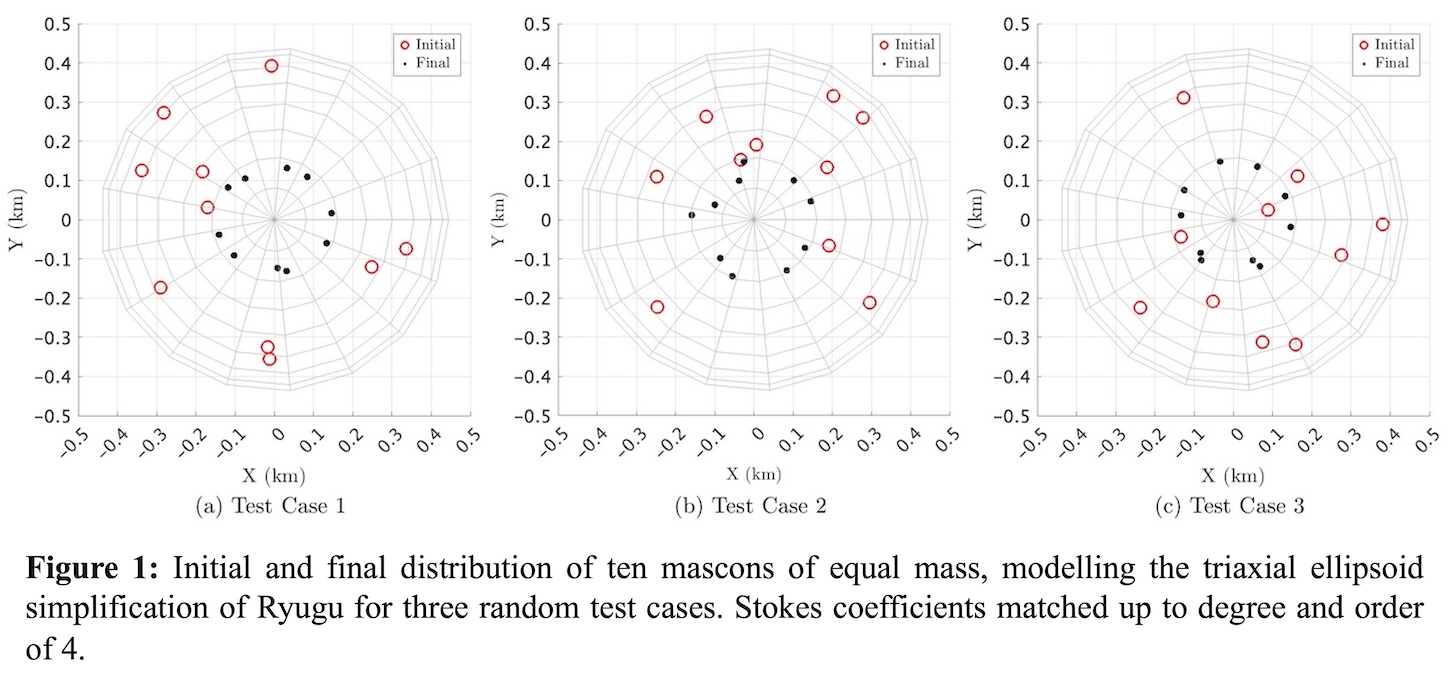
Gathering statistics on brown-dwarfs and better understanding their mass distribution  is critical to uncovering the underlying mechanisms for their formation. The current census of brown-dwarfs has revealed a scarcity of these sub-stellar objects on short period orbits (P<~100 days),  around solar-type stars, with minimum around 30–35 Mjup (Grether et al. 2004,Persson C. et al. 2019, Ma B. et al 2013, Stevenson J. et al. 2023).  This raises some interesting questions and several theories regarding the possible formation paths or post-formation migration for brown-dwarfs.  In this study, we take advantage of the rich dataset available in Gaia DR3 to try to shead some light into  this interesting question, by providing a mechanism for the systematic detection of these (and possibly other)  sub-stellar objects within Gaia DR3 data. To do so, we generate a deep learning model that takes advantage of the correlation existing  between quality of the astrometic fit performed by the Gaia data reduction system and the presence of an unseen companion.   To generate training data for our deep neural network , we use a probabilistic generative model, that simulates a stellar population composed of both single and binary systems  with primary masses ranging from 0.1 to 1.5 solar masses and secondary companion masses spanning 10 to 80 Jupiter masses  (a range intentionally selected to corver the "brown-dwarf desert"). We then generate astrometric epoch data for each system and also simulate the observations that Gaia would perform on each of our systems.  From these, we perform an astrometric fit similar to that one performed by Gaia data reduction system and obtain a set of quality-of-fit statistics  that, together with a known (single/binary) flag are fed into a deep neural network (DNN) to map the underlying correlation  between the presence of unseen companions and astrometric quality-of-fit.  We then apply our model to a sample of F,G,K,M stars from the Gaia DR3 and obtain the probablity of each of those stars to host  a sub-stellar companion. Using this model we identify ~8000 new candidate stars to host sub-stellar companions. Using suplementary data from existing ground RV surveys we can constrain the masses for the potential companions,  but only for a small subset of 20 of these candidates. The  estimated masses of these potential 20 sub-stellar companions are in the range  30-50M_Jup, and although statistics are scarce, this would locate them in the dry-est part of the brown-dwarf desert.

How to cite: Abreu Aramburu, A., Lillo-Box, J., and Perez, A. M.: Abstract: Can Gaia combined with AI help-us plant seeds in the Brown-Dwarf desert?   , EPSC-DPS Joint Meeting 2025, Helsinki, Finland, 7–13 Sep 2025, EPSC-DPS2025-93, https://doi.org/10.5194/epsc-dps2025-93, 2025.

EPSC-DPS2025-542 | ECP | Posters | EXOA19 | OPC: evaluations required

Multi-method extraction of quasi-periodic exoplanet signals from noisy data in transit surveys
(withdrawn after no-show)

Yannick Eyholzer, Adrien Leleu, and Slava Voloshynovskiy
Mon, 08 Sep, 18:00–19:30 (EEST)   Finlandia Hall foyer | F214